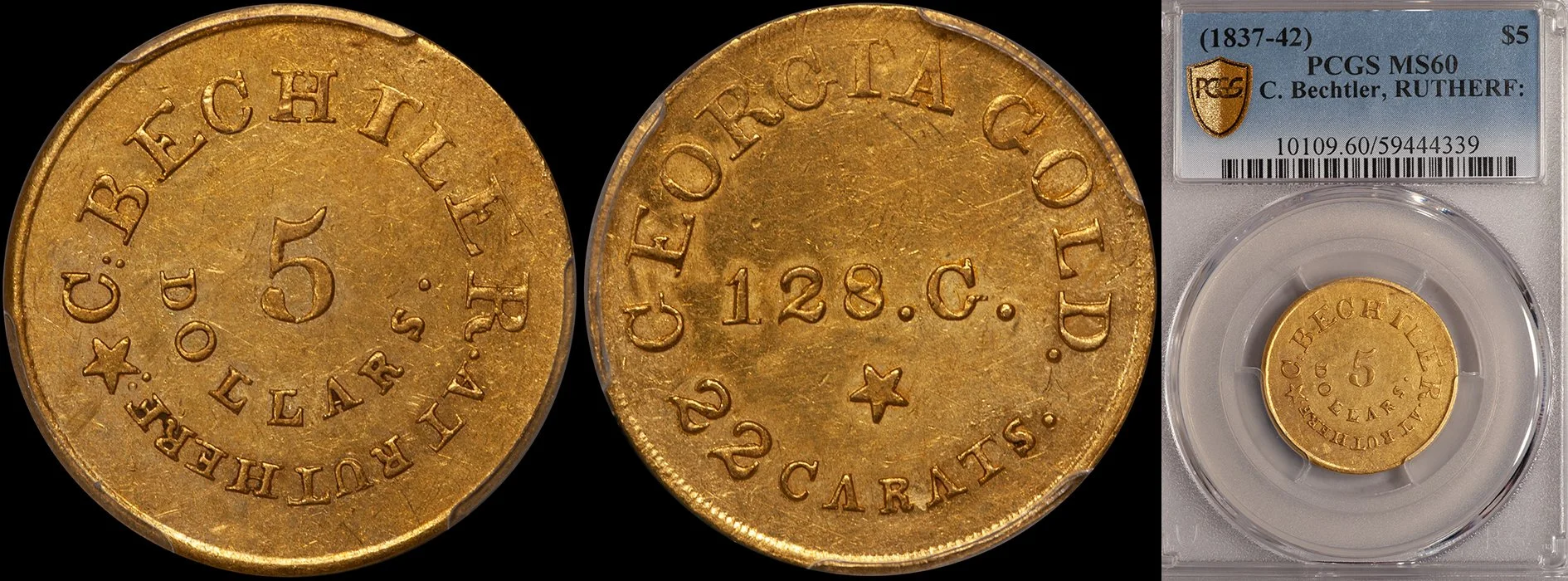
1842 Large Letters $5.00 NGC AU53

Large Letters variety. You can make a strong arguement that the 1842 Large Letters is the single rarest Philadelphia half eagle until the low production issues of 1863-1865. There are probably fewer than fifty known in all grades and most are in the EF40 to AU50 range. I know of exactly two in Uncirculated (an MS63 and an MS64, both graded by PCGS) and my best estimate is that issue is a Low R-7 in AU grades with fewer than a dozen known. In spite of this, the 1842 Large Letters is a readily affordable coin. This example, which is only the second I've offered for sale in over four years, has decent eye appeal with light to medium greenish-gold color accentuated by some reddish flashes in the protected areas. There are scattered ticks in the fields that limit the grade but good overall detail. If you are a collector who appreciates true rarity but you don't have an unlimited budget, you have to love a coin as scarce as this that is priced at under $4,000!

1867 $5.00 NGC EF45

After years and years of neglect, coins like this are finally starting to get their due. And for good reason. Let's take a quick peek at the 1867 half eagle. This Reconstruction Era issue has an original mintage figure of just 6,870. The combined PCGS/NGC population for the date is 88 coins which, of course, includes many resubmissions. The likely number known is fewer than 100 and it may be as low as 75. Yet despite this coin's obvious rarity, Trends is a paltry $1,750. Collectors are more into value and rarity than ever before and series like Liberty Head half eagles have numerous issues like the 1867. People may not buy this coin to start a date run but they know value when they see it. Not to mention the fact that this particular coin is really pleasing for the grade with natural light rose and green-gold color and some luster remaining on both sides. A few marks can be seen in the left obverse fields but overall this is a solid coin for the grade and an impressive value for less than $2,500.

1842-D Small Date $5.00 NGC EF40

Small Date variety. This is the more available of the two varieties of half eagle made at the Dahlonega mint in 1842; the 1842-D Large Date is rare in all grades. This piece has wonderful color with a crescent of electric blue and purple at the left; the reverse shows similar but less intense hues at the right border and outlining the eagle. This color is unquestionably real and it is likely the result of this piece having either been stored in a leather pouch or an old Wayte Raymond-style coin album. The surfaces are fairly abraded as is often seen on 1842-D Small Date half eagles but if you like colorfully toned southern branch mint gold coins I'm willing to bet that you'll overlook these abrasions due to the dramatic color. I'm asking around a 10-15% premium for the color and, for the right collector, this is a going to seem like a real bargain!

1840 $2.50 NGC MS60

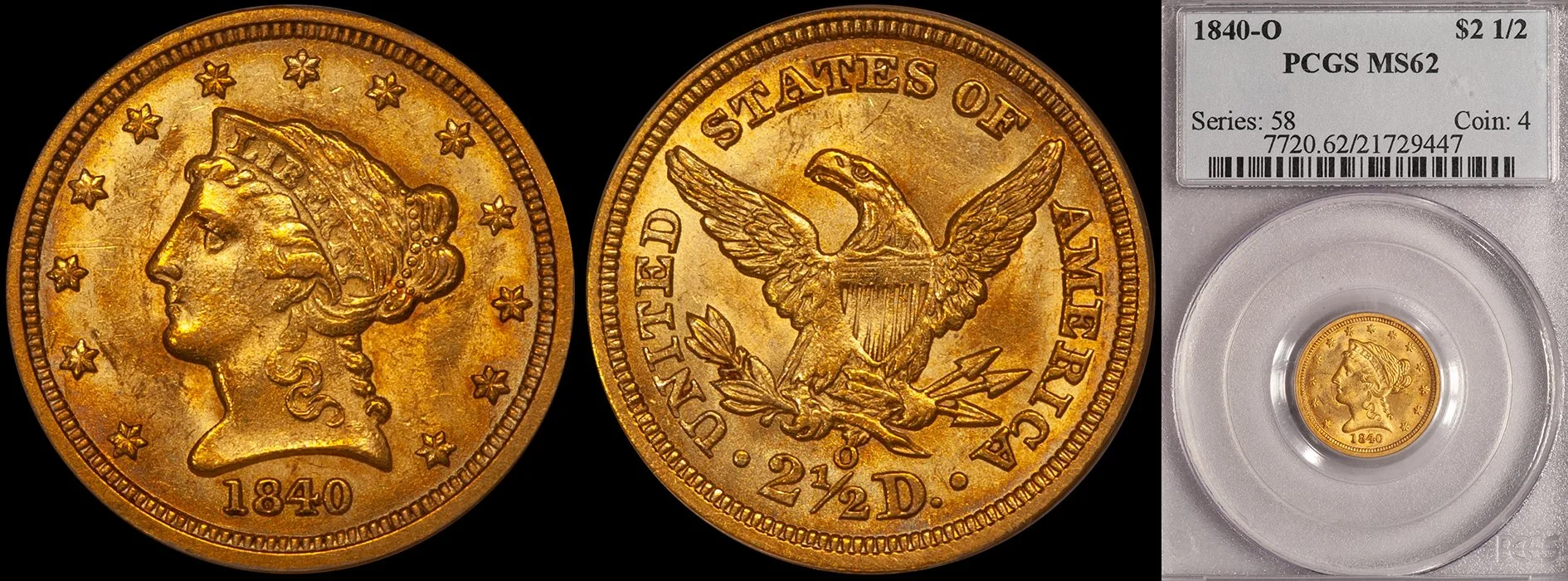
This numismatically significant issue represents the very first quarter eagle struck with the new Liberty Head design at the Philadelphia mint. The 1840 was not saved in any quantity and it is seldom seen above EF45 to AU50. In fact, until the discovery of a small group of MS63 to MS64 examples in the mid-1990's, the 1840 quarter eagle was essentially unavailable in Uncirculated (with the exception of the Bass-Garrett example which is now in a PCGS MS64 holder). The present example is fresh and would grade at least a point or two higher if it were not for some weakness of strike which is fairly pronounced at the centers. The surfaces are slightly scuffy but have warm, rich golden-orange and greenish color which are indicative of this piece never having been dipped or lightened. It would be an interesting to combine this coin with a high grade 1840 half eagle and eagle and assemble a three piece "first year of issue" Liberty Head gold trio.

Coins That I Never See With Good Eye Appeal, Part Three: Three Dollar Gold

In the third installment of this multi-part article, I'm going to delve into a series that has its share of issues that are not often seen with good eye appeal: three dollar gold. As a series, there are not many individual issues that are rare from an absolute sense. But I can think of a number of issues that are hard to find with a good overall appearance. I. 1854-O and 1854-D: These two issues are inexorably linked due to their status as the only three dollar gold pieces made at southern branch mints. The first is a common coin in nearly all circulated grades with a relatively high mintage figure of 24,000. The latter is regarded as among the rarest issues in the series with only 1,120 produced.

The 1854-O has a reputation among collectors as a condition rarity. There are hundreds and hundreds of pieces known in the VF-EF range and even a decent quantity in the lower AU grades. It becomes rare in properly graded AU55 to AU58 and it remains a very rare issue in Uncirculated with probably no more than five or six known.

But of the hundreds and hundreds of examples known, very few have good eye appeal. This is for a number of reasons. The first has to do with the fact that most 1854-O threes are struck from a late state of the dies that show lapping and re-polishing. This has removed some detail and made the reverse appear to be weakly struck, even on higher grade coins. In addition, the vast majority of 1854-O threes have been cleaned or dipped. It is possible to find a reasonably nice, original EF40 to EF45 example but choice, natural AU coins are quite scarce.

The 1854-D is another issue that is not well made. While this might add to the charm of the issue, it also makes it frustrating for collectors who seek well-detailed, "fresh" appearing coins. This is compounded by the fact that the vast majority of surviving 1854-D threes have been cleaned or dipped and many have been repaired or subtly altered as well. My best estimate is that out of the 125 or so examples that exist, less than 10% are "original" in the strict sense of the word. These coins should command a significant premium versus the typical quality for the issue. In my opinion, a choice, original 1854-D three dollar gold piece with good color and choice surfaces should command at least a 20% premium.

2. 1855-S and 1860-S:

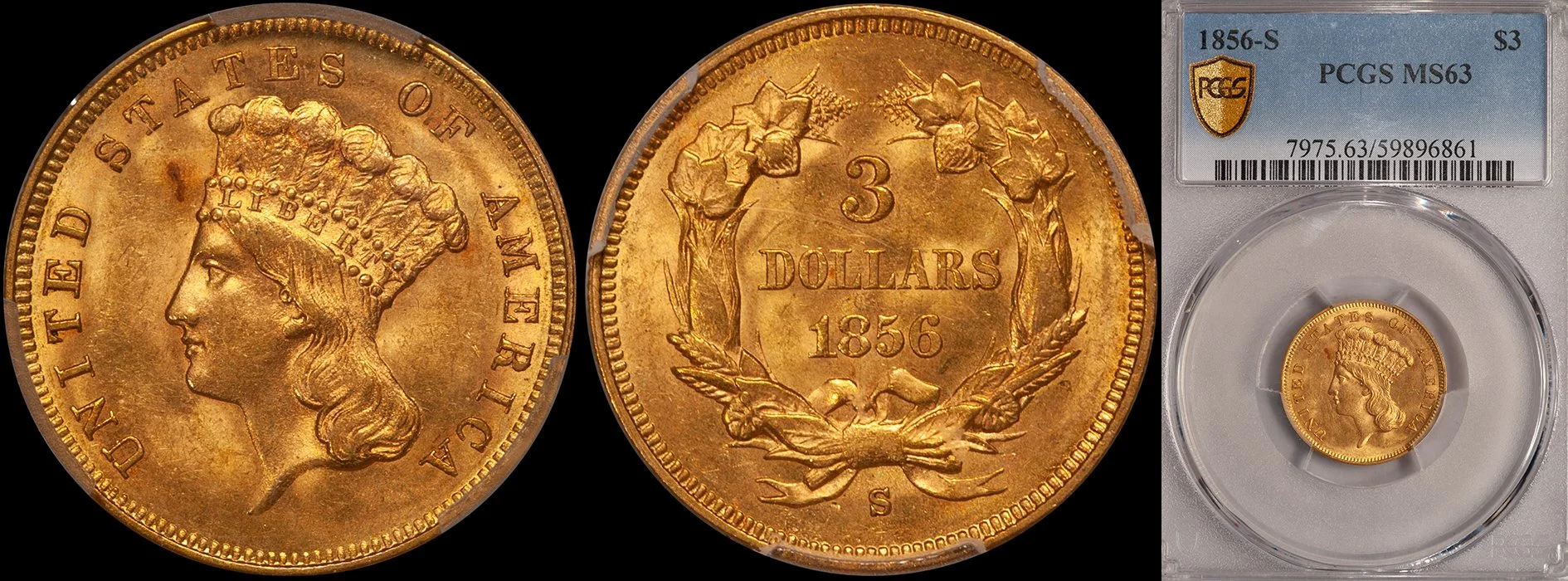
With the exception of the 1856-S, none of the San Francisco three dollar gold pieces are frequently encountered with good eye appeal. This is due to a number of factors. The first is that none of these issues had especially high original mintage figures and the survival rate is low. Secondly, these issues were used in commerce in Gold Rush era San Francisco and as a result were not handled with care. A lack of collector interest meant, of course, that there was no one around to save coins and even the usual "save a few for souvenirs" scenario doesn't apply to them.

The 1855-S is comparable to the 1854-D from the standpoint of overall rarity. It is extremely scarce in properly graded AU55 to AU58 and extremely rare in Uncirculated. I think that no more than three or four Uncirculated examples are known. The finest appears to be the PCGS MS62 in the Great Lakes collection; the second is the ex Pittman 2: 1889 coin, graded MS61, in the South Texas collection. Despite the rarity of this date with good eye appeal, it is surprisingly affordable. I have sold two nice EF examples this year for around $3,000.

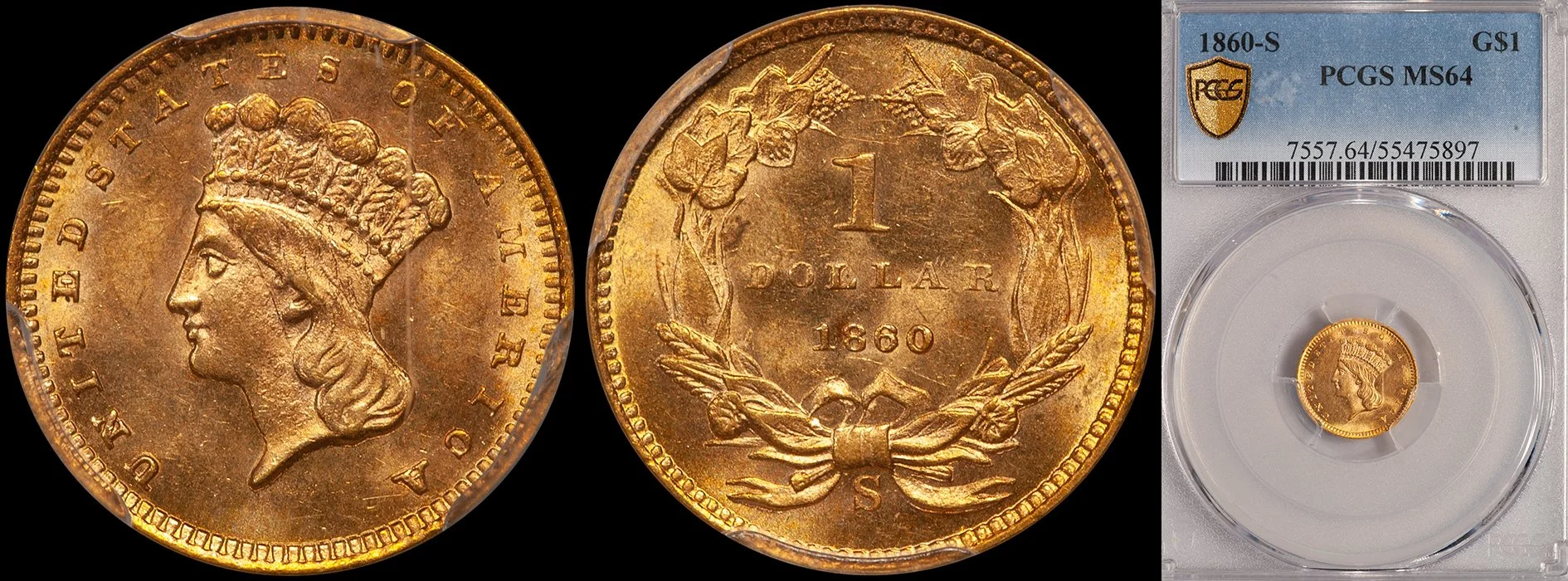
The 1860-S is an interesting issue for a number of reasons. It is the last obtainable three dollar gold pieces from this mint and it is rarer than the original mintage figure of 7,000 suggests; it is believed that as many as 2,592 were found to be underweight and later melted. I believe that only 100-125 are known today and examples with original color and surfaces are really hard to find.

The 1860-S is actually a tiny bit more available than the 1855-S in Uncirculated with as many as five or six known. The best of these include Eliasberg: 285, Bass II: 672 (graded MS62 by PCGS) and the Great Lakes coin which is in a PCGS MS61 holder. Most of the AU coins that I have seen are bright, heavily abraded and not appealing. The few Choice AU's that have sold in recent years have not realized significant premiums over typical examples and the savvy collector should consider this the next time he sees a pleasing 1860-S three dollar gold piece.

1865 and 1877:

One of the things about collecting this denomination is that the Philadelphia issues tend to be well made and they are generally available in relatively high grades. But there are clearly a few issues that are not only rare from the standpoint of total known but which are seldom seen with good eye appeal. In my experience, the two that stand out are the 1865 and the 1877.

The 1865 has a tiny mintage of 1,140 and it is likely that not more than 75-100 are known. This date tends to come two ways: really nice or really not nice. The finest known is a superb NGC MS67* from the Jewell Collection that sold for $57,500 in May 2005. Two PCGS MS66's exist as well. The five or six Gem 1865 three dollar gold pieces have great color, luster and eye appeal and are among the nicest Civil War era gold coins of any denomination. But these are locked away in tightly-held collections and the typical example is apt to grade EF45 to AU55 with very abraded semi-prooflike surfaces and clear signs of recent cleanings and/or processing.

The 1877 also has a small mintage; just 1,468 in this case. It is a bit more available than the 1865 in terms of overall rarity but it is harder to find in high grades. The finest known is a PCGS MS64 in the Great Lakes collection that is ex Heritage 6/11: 4602 at $80,500; it was earlier ex Bass II: 696 where it went reasonably in 1999 for $32,000. This is the only really choice 1877 three dollar gold piece known. There are an additional five or six coins in the MS60 to MS62 range This date is generally seen with prooflike surfaces that are very abraded and frequently show hairlines from mishandling.

There are other dates that I certainly could have added to this list. The 1858, 1867 and 1869 are three issues that are seldom found with good eye appeal. And the 1873 Closed 3 is an extremely hard date to find in any grade, let alone with natural color and surfaces.

For more information on three dollar gold pieces that are seldom seen with good eye appeal, please feel free to contact me at dwn@ont.com.

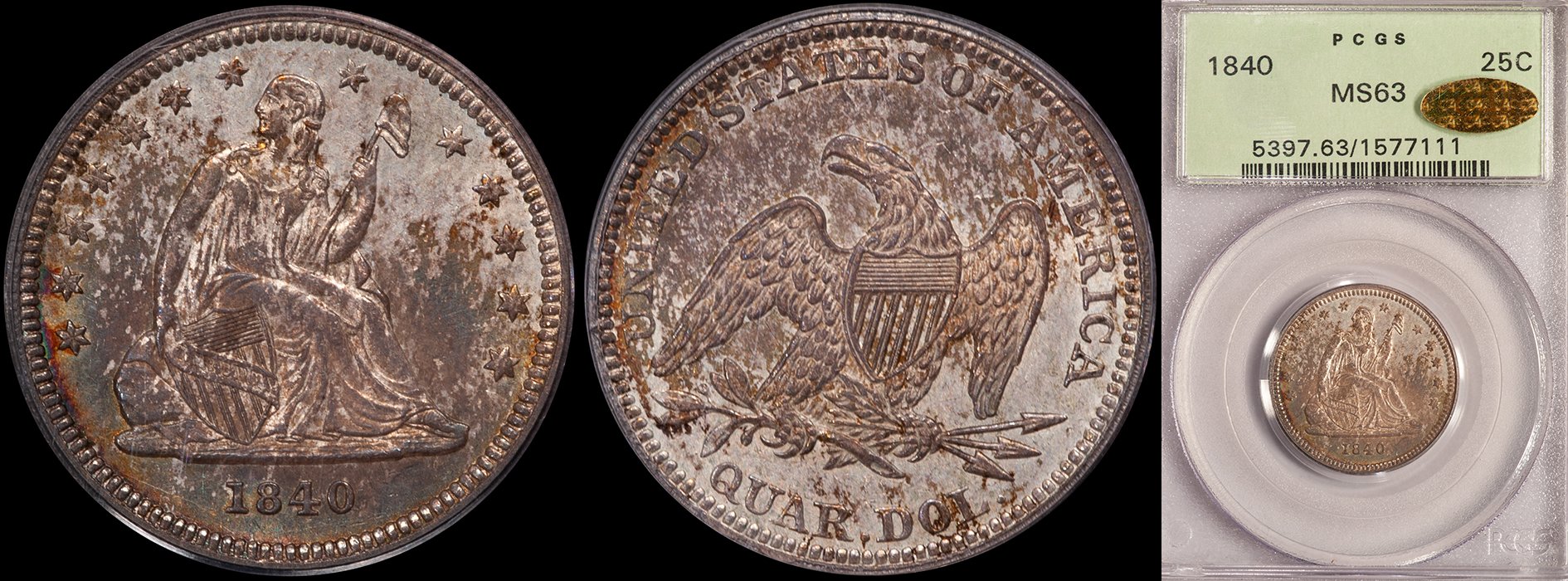
1856 $5.00 PCGS MS61 CAC

While very common in all circulated grades, the 1856 half eagle is not at all common in Uncirculated and nearly impossible above the MS62 to MS63 level. This lovely, fresh example has great eye appeal for the grade and looks more like a coin in an MS62 holder. The surfaces are very clean and show attractive golden-orange color. This piece has never been dipped or brightened and this can be established by the fact that there is a natural copper spot on the reverse at the first T in STATES. What appears to be a scratch on the cheek of Liberty is actually a mint-made raised die line that I have seen on a number of other examples of this date. Only three PCGS MS61's of this date have appeared at auction since May 2007. This is one of only two MS61 1856 half eagles approved by PCGS with one finer. A wonderful No Motto type coin.

1867 $5.00 NGC PR63 CAM

50 struck; around a dozen or so are known today. As with all proofs of this year the comparably "high" mintage of 50 is misleading as it is clear that a number went to the melting pot after going unsold. To date, NGC has graded just six Proof 1867 half egales while PCGS has graded eight; this figure, of course, includes regrades, crossovers, etc. This example is among the few affordable Proof half eagles of this era that is available. It has fully reflective surfaces that show no signs of cleaning but there are a few contact marks in the obverse fields; the reverse is clean and choice. There hasn't been a Proof of this date/denomination sold at auction since December 2009 and there are just eleven auction records since 2000. A Gem Proof example of this issue would cost at least three times the asking price of this piece if it were even available. An important piece of Proof gold for the savvy specialist.

1851-D $2.50 NGC EF40

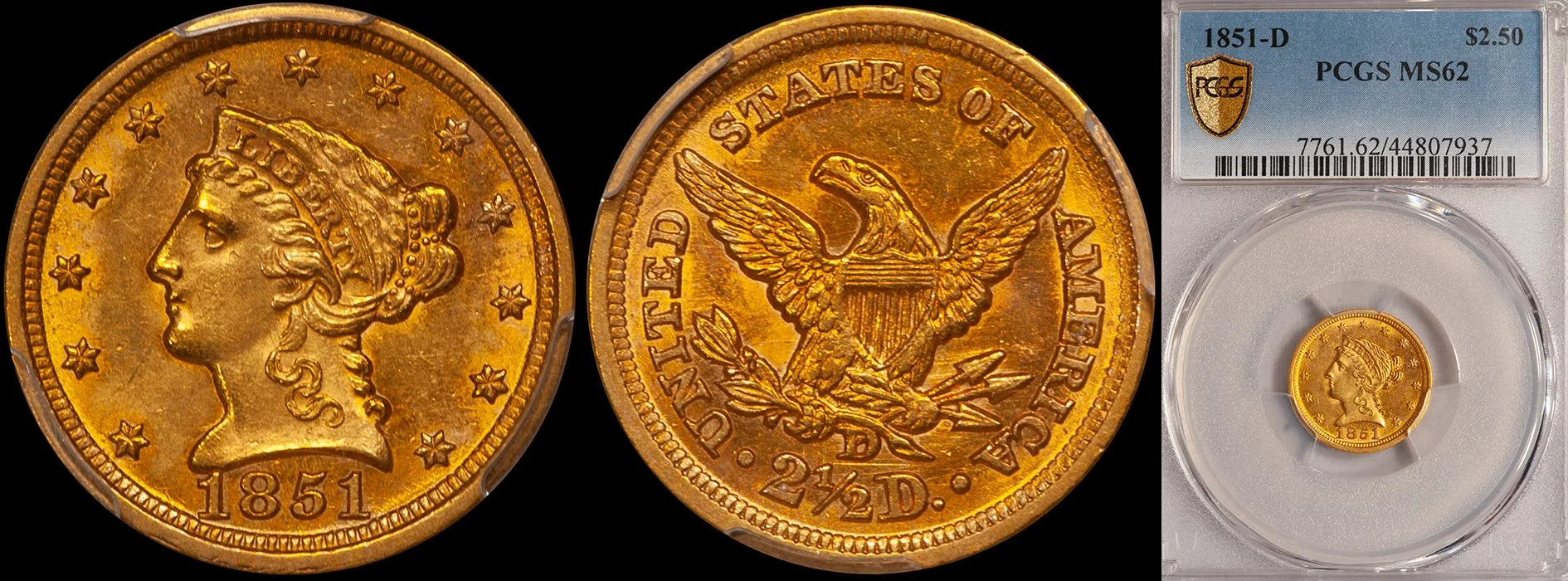
I've noticed a real surge in interest in nicely toned branch mint gold and this makes sense. In silver and copper coins, you can have a $100 coin that is worth an enormous premium because of its great color. Why isn't the same true with gold coins, especially when they are so hard to find? This attractive 1851-D quarter eagle is well detailed with splashes of rich orange-gold and coppery-rose hues on the obverse and reverse. There is a small, shallow mint-made plnachet defect on the obverse between stars two and three and a few contact marks seen on both sides but this piece has great eye appeal. As a date, the 1851-D is far scarcer than the 1843-50 Dahlonega issues and it is extremely hard to find with good color.

1810 Large Date $5.00 PCGS AU58 CAC

BD-4. R-2. Well struck in green-gold with pronounced clashmarks on the obverse and some roughness in the die as struck. This piece is as original an example as one could hope for with deep, even green-gold color on the obverse and the reverse. There are a few light vertical and horizontal adjustment marks on the obverse that are very hard to see without magnification and I feel that they are not detracting. This piece probably never entered circulation but it does show some very light rub on the high spots meriting the assigned grade. The 1810 Large Date, Large 5 is the most available of the four major varieties of half eagle produced during this year. Since it gets no date premium for its rarity, it is an ideal coin to use for type purposes. This coin isn't priced at a level much higher than a schlocky, processed Capped Bust Left half eagle in AU58 and, as such, it represents a very good value for the connoisseur.