1863-S $20.00 NGC MS62 CAC

Most high grade 1863-S double eagles are from shipwrecks (primarily the S.S. Brother Jonathan) but this remarkable coin appears to have natural non-seawater surfaces and is very rare as such. It shows great overall detail with some of the hair not fully struck (as usual) but with bold radial lines on the stars on both sides; the surfaces are nearly free of marks and very vibrant with rich natural color that deepens at the borders. I handled a PCGS MS62 example of this date earlier this year (also with a CAC sticker) and it is hard to say which of these is better; suffice to say that both are Condition Census examples. The only significantly better 1863-S double eagle that I have seen in some time is Heritage 1/12: 5041, graded MS64* by NGC, that went reasonably for $43,125. Only three of this date have been approved by CAC in MS62 and none finer. To say the least, a very important opportunity for someone to really add to their Type One or Civil War era double eagle set.
1850 $20.00 NGC AU53 CAC

This numismatically significant issue is the first collectable double eagle from the Philadelphia mint and it has an appearance that tends to be much different than the Type One issues that follow it. It is typically found better struck and there are some higher grade coins (in the MS62/63 range) that have superb color and detail. Circulated examples are relatively available but many are heavily abraded and most have been dipped or messwed with. This naturally toned example has pleasing mdeium to deep green-gold color atop very clean surfaces. A few marks rest in the left obverse field; the reverse is choice and very crusty with lots of dirt caked into the recesses. This is an issue you can afford to be pretty picky when you are looking for one but I think tis example will meet the requirements of even the fussiest collector.

1807 Bust Left $5.00 PCGS MS62

BD-8, R-2. The new Bust Left variety was introduced in 1807 and continued until it was replaced in 1813. None of the issues made during this era are really rare except in higher grades and nice MS62 examples are, in my opinion, amongst the best values of this type. Properly graded MS62's are free of wear and really new but not priced out of the range of many early gold collectors. This attractive, frosty example shows the rich green-gold color that is typical to the issue but which is not seen on coins that have been processed. It is well struck and free of planchet issues; a few minor ticks in the fields keep it firmly within the MS62 level but it is far nicer than usual for the grade. An MS63 example of this date will cost you close to $10,000 more than an MS62 and I'm not really certain that, in most cases, this premium is justified.

1854 Large Date $20.00 NGC AU55

Large Date variety. After years of neglect, the 1854 Large Date has been acknowledged as one of the rarest Philadelphia Type One double eagles. It is screamingly rare in Uncirculated and nice AU55 to AU58 examples are about as high up on the ladder as most collectors can hope for. This attractive example was recently found in Europe (where you can imagine it was sold as a "common" variety) and it is one of the cleanest 1854 Large Dates that I have seen with just a few light, unobtrusive marks scattered in the fields. The color is a pleasing light to medium green-gold and this is exactly the "right" hue for the issue. This issue cracked the $10,000 mark in AU55 about five years ago and while other coins of comparable scarcity (1854-S and 1859, to name two) have exploded in value, this hasn't risen to the degree it should.

All 1854 Large Date double eagles can be identified by the presence of an obverse die clash that looks like a "spray" at the third curl from the bottom. There is also a raised die dot towards the truncation that can be seen even on well-worn examples.

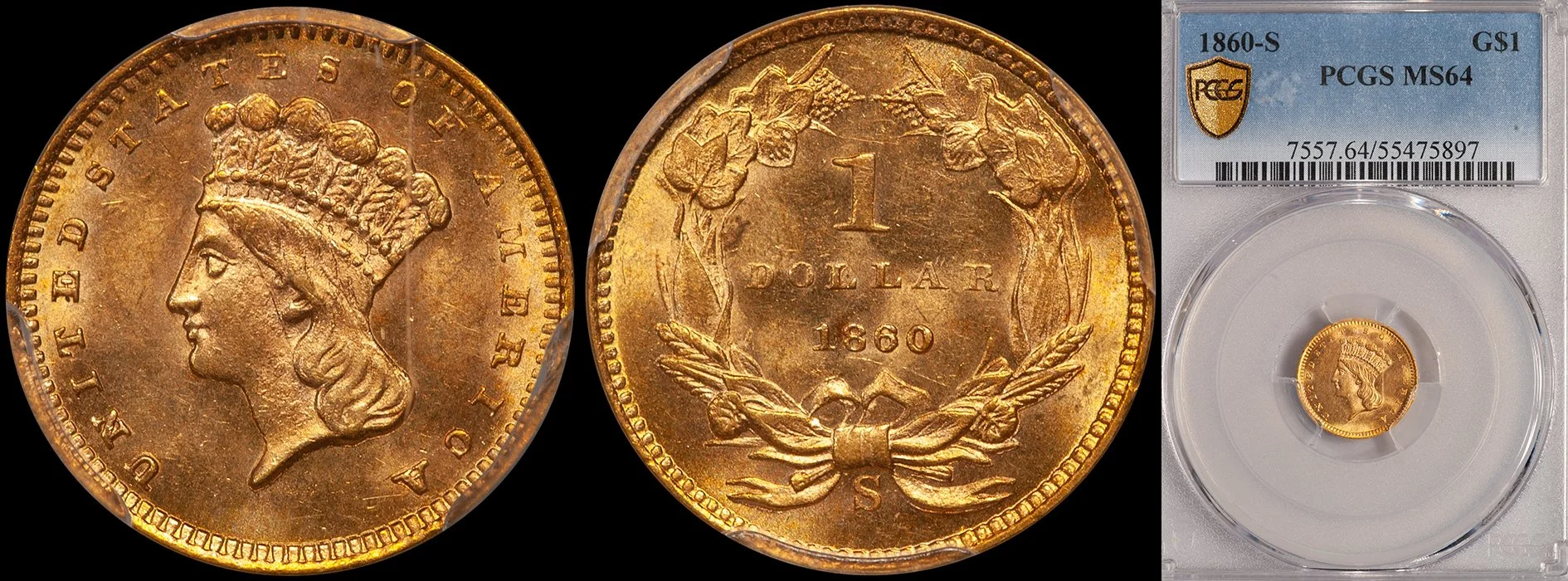
1858-S $1.00 PCGS AU58

I'm a big fan of the San Francisco gold dollar coinage. They are very inexpensive in circulated gradces but are scarce and very easy to assemble a set. The 1858-S has a mintage of just 10,000 coins and it is almost never seen in Uncirculated. This nice AU58 is well struck and shows splashes of orange-gold color on the surfaces. An old reverse scratch runs from the rim at around 7:00 to the bow.

1875-CC $20.00 NGC AU58 CAC

You don't often see Carson City double eagles that are nearly free of marks and this coin is just that: a piece that probably never saw circulation and somehow avoided the throw-it-in-a-bag fate that met so many of these coins when they were shipped. Both sides have thick, frosty luster with nice rose and green-gold color. A few small grease stains on the obverse are mint-made and do not detract.

1879 $20.00 PCGS MS62

After many years of not handling an example of this date in MS62, this is the second I have had in around a month. The last one, graded by PCGS and approved by CAC, sold quickly and received multiple orders. This example is comparable with nice surfaces, good luster and pleasing natural green-gold, rose and orange color. As a date, the 1879 is seldom seen above MS62 and there is a huge price jump to the next grade as an accurately graded PCGS MS63 is worth in the area of $17,500. If I were doing a date set of Type Three $20 Libs, I would stick with a nice MS62 and use the $10,000+ I saved towards more coins!

1882-CC $20.00 NGC MS60

This coin has a really outstanding "look" with naturally bright and very frosty surfaces that are splashed with golden-orange color which deepens towards the borders. The obverse has some marks in the fields while the reverse is choice and grades at least an MS61 to MS62 on its own. As a date, the 1882-CC is considerably scarcer in high grades than generally known. When seen in Uncirculated, it typically grades MS60 to MS61 and is riddled with marks; I haven't seen one better than MS62 in years. Only one MS60 has appeared at auction in the last three years (a PCGS coin) and this is the first I have handled in some time.