1847-O $5.00 NGC VF25 CAC

There are not many gold coins priced at less than $5,000 that can be described, without threat of contradiction, as "rarest date of the type from the New Orleans mint." The 1847-O is one of these and it is the single rarest Liberty Head half eagle from this mint. The present example is evenly worn and problem-free with nice light green-gold color and a complete lack of problems. The 1847-O is actually a rarer coin than issues like the 1861-C and 1861-D half eagle but it is still priced at a very affordable level. I recently listed a nice PCGS VF35 example of the 1847-O half eagle and it received multiple orders within hours of being posted on my website. If you missed that coin and are still in the market for a nice 1847-O, this may be the last shot you get for some time.

1872 $3.00 PCGS MS61

Only 2,000 business strike 1872 Three Dollar gold pieces were struck and, unlike some of the low mintage dates from the next decade, this date saw circulation and was not hoarded by speculators. There are fewer known in Uncirculated than the population figures at NGC and PCGS would suggest and this is compounded by the fact that some of the examples graded MS60 to MS62 are questionable as to their "newness." This piece, which is sem-prooflike and very appealing, is free of any rub or wear and it would grade at least a point higher were it not for a small old scrape below the left side of the first S in STATES. The surfaces show a nice light rose and orange-gold patina and the reverse is very choice with especially clean fields. I have always believed that this is one of the most undervalued dates in the entire Three Dollar series and it is not easy to find much nicer than the present example.

1861 $3.00 PCGS MS62

For many denominations, mintage figures in 1861 at the Philadelphia mint were quite high. But this is not the case with the 1861 Three Dollar as only 5,959 examples were produced. A few hundred examples exist in all grades with most in the EF45 to AU55 range. Nice Uncirculated examples are scarce and this date is rare in MS63 and above. This example is a pleasing light yellow gold with rich, satiny luster. The surfaces show the typical horizontal striations seen on all business strikes of this year but there are no marks of note and the strike is sharp. Last year there were only two MS62 examples of this date sold at auction. One, graded by NGC, brought $9,775 while the other, in a PCGS holder, sold for $9,488. Trends jumps to $16,500 in MS63 which makes this MS62 a good value for the Civil War collector seeking a special 1861 Three Dollar piece for his set.

1846 $2.50 NGC PR64 CAM CAC

Before the U.S. Mint began producing Proof gold coins in any sort of quantity in 1858, a limited number of proofs were struck in certain years. In 1846, it is belived that around four or five gold proof sets were made and today there are four 1846 quarter eagles known including two that are impounded in museums (Smithsonian and ANS). The other known example is the Trompeter/Eliasberg coin that appears to be graded PR65 by PCGS; it last sold in the 2/91 Superior sale for $52,800. The current coin, from the famous Pittman collection, has a pedigree going back well over a century and it is sourced from an original 1846 proof set that has been broken up. It has the look of a Gem with superb rich amber color over very reflective surfaces that are nearly free of hairlines. An old scratch on the obverse between stars nine and ten removes this from a higher grade and serves as immediate identification. With the exception of the 1841, Proof quarter eagles from the 1840's and early 1850's are virtually unknown and tend to be come available at major auctions. This is a remarkable opportunity for the collector or investor to own a truly monumental piece of American numismatics and it is a remarkable combination of rarity, beauty and provenance.

Ex Heritage 1/11: 5335 ($106,375), earlier part of an 1846 Proof set in the Pittman sale (lot 1712) that brought $522,500; obtained by Pittman from Numismatic Gallery in 1949 and before this part of an original 1846 gold proof set that was in Ed Frossard's November 1892 sale.

1857-S $3.00 PCGS AU58 CAC

The San Francisco Three Dollar gold pieces were made in limited quantity and these were not saved by collectors. Of the 14,000 examples struck in 1857 at this mint, a few hundred survive but most are well worn and this is an extremely rare issue in Uncirculated with no more than three or four known. In the lower AU grades, the 1857-S is slightly scarce but it is rare in properly graded AU55 to AU58. In fact, PCGS has a current population of just seven in AU58 with a single example better. This piece is very lustrous with nice light yellow-gold color. A small amount of wear is limited to the high spots of the obverse and the surfaces lack the abundant marks that characterize the issue. The last PCGS AU58 example to sell at auction was ANR 3/05: 618 (which brought $14,950) and before this, a PCGS AU58 sold in the October 1999 Bass II sale. This means that only two (count 'em, two...) examples in PCGS have sold at auction in the last thirteen years. CAC has approved just two 1857-S Three Dollar gold pieces in AU58 and none in grades higher than this. If Three Dollar gold pieces were just a bit more popular than they are currently are, I could see this being a $20,000 coin. As it is, a great value and an important pierce for the specialist.

Assembling a Date Set of Civil War Gold Coins: Part One, 1861-1862

1861 $1.00 NGC AU55

The combination of history and numismatic significance makes the United Sates gold coins struck during the Civil War era (1861 to 1865) a fascinating possible collecting area for the sophisticated numismatist. Let's take a look at each coin produced during this year and determine the most practical grade range for the collector.

1861 Gold Dollar. The 1861-P dollar is common in nearly all grades and can be found even in MS65. The finest known grade MS67 and there are as many as three to five known at that level. The best that I have personally seen is ex Heritage 2/10: 1420, graded MS67 by PCGS, that brought $19,550. This date typically comes with striated surfaces but it is well struck and well-produced with good luster and color. For most collectors, a nice MS64 to MS65 should be sufficient.

1861-D $1.00 PCGS AU55

1861-D Gold Dollar. This is the most popular singular coin in the entire Civil War gold set due to its status as the only issue that is positively attributable to the Confederacy. An estimated 1500-2500 were struck and there are probably fewer than a hundred known today. This issue is typically seen in AU50 to MS60 grades and it is less rare in Uncirculated than commonly believed due to hoarding. As many as a dozen+ are known in Uncirculated including a few in the MS63 to MS64 range. The finest available in the last decade was Duke's Creek: 1493, graded MS65 by NGC, that sold for $138,000. This issue is always found with weakness on the U in UNITED and it has a unique appearance. For an advanced collector, I would suggest a nice MS62 to MS63 if available.

1861 $2.50 PCGS MS64

1861 Quarter Eagle. Over a quarter of a million were struck and this is a common issue which is well made and easy to find with good eye appeal. It is common through MS63, slightly scarce in MS64 and only marginally rare in Gem. The best I have seen are a small group of MS66 examples and even these are priced well below $10,000. There are two varieties: the old reverse (scarce) and the new reverse (common). For most collections of Civil War gold, I would include a nice MS64 or MS65 example of this issue.

1861 $3.00 NGC MS62

1861 Three Dollars. Including Proofs, there a total of 6,072 examples produced. This is a scarce but not really rare date that is typically seen with lightly clashed dies and naturally striated planchets. The best I have seen is the Heritage 12/05: 30639 coin graded MS67 by Heritage which sold for $46,000. NGC has graded one coin an MS67 and it last sold for $47,000 in the Heritage 10/09 sale. The 1861 Three Dollar is typically seen in AU grades. It is slightly scarce in the lower Uncirculated grades, very scarce in MS63 and rare above this. For most collections of Civil War gold, I think a nice Uncirculated example would suffice. A Gem will be available with some patience at a cost of $20,000-30,000.

1861 $5.00 NGC MS64

1861 Half Eagle: This is another common issue and it is by far the most available of the four half eagles produced in 1861. It is a well made coin that can be found with good luster and color and an oustanding strike. The best I have seen is Stack's 1/08" 949, graded MS66 by NGC, that sold for a record $52,900. There are probably around a dozen or so Gems and maybe two or three pieces that grade MS66. The current value for a nice MS64 is $10,000-12,000 while a Gem is at least double. Given the many expensive coins it takes to complete this set, I'd suggest going with an MS64 and saving your money for a true rarity.

1861-C $5.00 NGC AU50

1861-C Half Eagle: With only 6,879 minted you'd expect this to be a scarce coin and it is. But the 1861-C half eagle wasn't a really in-demand coin until recently. That said, this is still an affordable coin in EF grades and the collector can find a decent example in the $5,000-10,000 range. Most 1861-C half eagles are abraded and show poor quality surfaces. There are three or four known in Uncirculated with the finest being, by a large margin, the NGC MS63 sold as Heritage 1/00: 7769 at $59,800. I love the history and think it is an integral part of a comprehensive Civil War gold collection.

1861-D $5.00 PCGS AU53

1861-D Half Eagle: I have discussed this issue comprehensively in other blogs and articles so I won't get too deeply into it here. I'd rather discuss, quickly, what the real value of this coin is right now in collector grades). Clearly, the price levels on the 1861-D (both the dollar and half eagle) have risen dramatically in recent years. I think a decent looking EF 1861-D half eagle is currently a $30,000+ coin and a nice AU is probably worth at least $50,000. Are these good values? That's hard to say and as someone who remembers buying nice AU's for $15,000 I may not be the best person to ask. But this is a critical coin in the Civil War set we are discussing here and the collector needs to be prepared to jump on the first good 1861-D half eagle he sees.

1861-S $5.00 NGC AU50

1861-S Half Eagle: This is a much scarcer issue than its mintage of 18,000 would suggest and it is actually rarer in high grades than the 1861-C or 1861-D. I am not aware of a single Uncirculated 1861-S half eagle and I have never seen one better than AU55 to AU58. The few nice ones I have seen seem to have been off the market since the 1990's (like the Milas coin) and today it is very hard to find one better than EF. Most 1861-S half eagles are weakly struck, well worn and have abraded surfaces. An AU50 or better with original color and surfaces would be a great addition to a Civil War gold set.

1861 $10.00 NGC MS61

1861 Eagle: This is a common issue in nearly all circulated grades and it is not hard to find a decent looking AU coin with good luster and scattered abrasions. In Uncirculated, there are probably fewer than fifteen to twenty known with most in the MS60 to MS61 range. I recently sold a nice NGC MS61 for less than $7,000 so this isn't an expensive coin in the lower Uncirculated grades. The finest known is an amazing PCGS MS66 from the Bass IV sale that brought $50,600; today this is easily a six-figure coin. I'd suggest an MS61 to MS62 for the Civil War collector.

1861-S $10.00 NGC AU58

1861-S Eagle: The 1861-S eagle is more available than its half eagle counterpart both in terms of overall and high grade rarity. A single Uncirculated coin is known (ex Heritage 1/12: 4977 where it brought $54,625; it is graded MS61 by NGC) as well as three to five properly graded AU55 to AU58 coins. This issue is most often seen in EF40 to AU50 grades and it is typically bright and baggy. Well struck, naturally toned examples are very scarce and it will prove very hard to locate an example in AU55 for this Civil War gold coin set.

1861 $20.00 NGC AU58 CAC

1861 Double Eagle: With nearly three million struck, the 1861 double eagle has the highest mintage of any coin in this set. It is readily available in circulated grades and not hard to find in the MS60 to MS62 range. It becomes scarce in properly graded MS63, rare in MS64 and very rare in MS65. The finest known is a mind-boggling PCGS MS67 that, as far as I know, has been off the market since the mid-1990's. There are maybe a dozen or so Gems known but for most collectors, the best value grade might be MS63 to MS64 with coins available, from time to time, in the $12,500-25,000 range depending on appearance and quality. This is a well produced issue that can be really spectacular in higher grades.

1861-O $20.00 NGC AU58

1861-O Double Eagle: This is another very historic issue and one that you read about in great depth in my book on New Orleans gold coinage. It is scarce in all grades but it is offered a few times per year at auction or through specialist dealers like myself in EF and low AU grades. I am aware of between four and six Uncirculated examples with the finest of these grading MS61 to MS62. This is a very, very hard coin to find with good eye appeal as most are not well struck and have been cleaned in the past few decades. Examples with natural color and choice surfaces are extremely scarce and command a strong premium over typical pieces. For a high quality Civil War set, I'd suggest an AU example and I would be hold put for as nice a piece as possible due to the importance of this issues. (NOTE: A second variety is known but it is not included in this article due to its extreme rarity. There are just two 1861 Paquet Reverse double eagles from Philadelphia currently known).

1861-S $20.00 NGC AU58
1861-S Paquet $20.00 NGC AU53

1861-S Double Eagle: There are two important varieties of San Francisco double eagle dated 1861. The more common of the two is the 1861-S with a normal reverse. This date is readily available in grades up to AU55 and scarce but obtainable in AU58. In Uncirculated, it is very scarce and it is very rare in MS62 or better. For most Civil War collectors, a nice MS60 to MS61 will suffice. The rarer variety is the 1861-S Paquet Reverse. There are a few hundred known, at most, and many have been found overseas since the 1970's. This issue is typically seen in EF40 to AU50 and properly graded AU55 examples with good color and surfaces are quite rare. I have seen one or twwo with claims to Uncirculated and the nicest to be sold in recent memory was Heritage 1/12: 5039, graded AU58 by NGC, that brought $184,000. This is a coin that I would stretch on if I were a Civil War collector due to its unique back story and appearance.

1861 Summary: This is a very interesting year in the annals of American gold coinage. You have coins struck this year that are very common (gold dollar, quarter eagle and double eagle), coins that are extremely rare (1861-P and 1861-S Paquet double eagles) and coins that are highly prized due to their historic connotations (1861-D dollar and half eagle, 1861-O double eagle).

1862 $1.00 PCGS MS65

1862 Gold Dollar: This issue has a huge mintage of 1.36 million and it is very common in grades up to MS64. It is only moderately scarce in MS65 and I have sold MS66 examples in the last year for between $3,500 and $4,000. The best I have seen are a small number of MS67 and these are only valued at $7,500 or so. This is an issue that comes well made with good luster and color. I suggest that the Civil War collector buy a nice MS65 or MS66.

1862 $2.50 PCGS AU58

1862 Quarter Eagle: For many years, the 1862-P quarter eagle was a "sleeper" and it was possible to buy a nice EF/AU coin for under $1,500. Prices shot up after an ill-advised promotion and now this issue is somewhat out-of-favor. It is relatively available in all circulated grades and there are around 15-20 known in Uncirculated. The best I have seen are a group of three or four in MS64; this includes two from the Bass collection. This date is found frosty or semi-prooflike and original coins can show very nice rich color. For most Civil War collections, a nice MS62 or MS63 will be a great addition but a properly graded MS64 at the right price (around $17,500-20,000) should merit strong consideration.

There is also an 1862/1 overdate known. I have always been a bit skeptical about this variety's status as a true overdate but it is recognized by both PCGS and NGC and always included in a date set of Liberty Head qurter eagles. It is scarce in all grades and very rare in Uncirculated. The best I have seen is a PCGS MS62 but I can't recall having ever handled an Uncirculated 1862/1 that I thought was choice. Nearly every example is bright from having been dipped and most are heavily abraded. It is possible to buy a nicer AU example in the $5,000 range and this is what I suggest for a Civil War set.

1862-S $2.50 PCGS AU58 CAC

1862-S Quarter Eagle: Only 8,000 were struck and this overlooked issue is scarce in all grades with probably fewer than 100 known. There are three or four known in Uncirculated and the finest by a clear margin is Goldberg 2/12: 1217, graded MS63+ by PCGS, that I recently purchased for $43,700. The typical 1862-S quarter eagle grades EF and original examples tend to show nice deep orange-gold or lighter rose shadings. Abrasions tend to be a problem for this issue and most are marked in the fields. A world-class Civil War collection would contain one of the few known examples in Uncirculated.

1862 $3.00 PCGS AU58 CAC

1862 Three Dollars: The 1862 three dollar is scarcer than the 1861. It is an issue that is generally found in AU grades and lower end Uncirculated pieces aren't really scarce. This date becomes rare in properly graded MS63 to MS64 and Gems are very rare with maybe four to six known. The best I have seen are a pair graded MS66; this includes ANR 3/05: 625, encapsulated by PCGS, that sold for $36,800. Collectors should look for pieces with shimmering satiny luster and light clashmarks and avoid examples that are bright or over-abraded. For most Civil War collectors, an MS63 to MS65 will suffice.

1862 $5.00 PCGS EF45

1862 Half Eagle: Until recently, this was a nearly-forgotten issue but the 1862-P half eagle has suddenly becomes popular (and seemingly more available as well). Of the estimated 75-85 known, most are very heavily abraded and range from VF35 to EF45. This is a tough coin in the lower AU grades but not a really rare one until you reach AU55. There are two known in Uncirculated: a PCGS MS62 that is ex Goldberg 5/07: 1610 and a PCGS MS61 that is ex Bass II: 1140. I would suggest waiting for at least an AU55 to an AU58 for your Civil War set and I would hold out for a coin with choice, original surfaces if possible.

1862-S $5.00 PCGS AU55

1862-S Half Eagle: While this is a very scarce coin, I think its rarity has been a bit overstated in the past few years. I think it is actually a bit more available than the 1862-P and, for some reason, it seems more available in AU grades than one might expect. That said, it is still a rare coin (probably just a dozen or so exist in AU) and most are low end coins with dipped, abraded surfaces. I know of two Uncirculated 1862-S half eagles: a PCGS MS62 (ex ANR 8/06: 1454, as PCGS MS61) and an NGC MS61 that was last sold as Heritage 11/07: 2047. A high quality Civil War set should aim for at least an AU55 to AU58.

1862 $10.00 NGC AU53 CAC

1862 Eagle: As with its half eagle counterpart, this is a rare, undervalued date whose interest level has soared in the past two or three years. While 10,960 were produced, many were melted survivors tend to be in the EF40 to AU50 range. This issue is very scarce in AU grades although bagmarked AU55's are available from time to time. There are two known in Uncirculated. The finest, graded MS64 by NGC and pedigreed to the S.S. Republic shipwreck, sold for $41,975 as Lot 2004 in Bowers and Merena's 4/05 auction. The other is a PCGS MS62 from the Bass II sale (lot 681) that sold for a very reasonable $12,650. For most Civil War collectors, a nice AU55 to AU58 example will do the trick.

1862-S $10.00 NGC AU55

1862-S Eagle: This issue is probably the single rarest 1862 gold coin from any U.S. mint. It is seldom seen in any grade and when it is available, survivors are usually in very low grades. I believe that no more than five or six properly graded AU coins exist and most are in the AU50 to AU53 range. A single Uncirculated coin is known; it was recently sold as Heritage 4/11: 5427, where it brought a remarkable $103,500. It is graded MS61 by NGC and I have never seen another 1862-S even close to it in terms of quality. This will be an extremely hard coin for the specialist to find and I'd suggest that the Civil War collector aggressively pursue the chance to purchase any 1862-S eagle that grades AU50 or better.

1862 $20.00 PCGS AU53

1862 Double Eagle: The 1862 is the rarest Philadelphia double eagle made between 1850 and 1880. It is much scarcer than its original mintage figure of 92,133 would suggest and when it is available, it is likely to be found in the EF40 to AU50 range. It is very scarce in the higher AU grades and rare in all Uncirculated grades. The best I am aware of is an NGC MS64 now in a New England collection that is ex Heritage 11/05: 2459 (where it brought $62,100). This issue is well struck and typically has satiny luster but most are very heavily abraded. For a high quality Civil War set, any Uncirculated 1862 double eagle would be a great addition. You can count on spending at least $30,000 for one if it becomes available.

1862-S $20.00 NGC AU53 CAC

1862-S Double Eagle: Over 850,000 1862-S double eagles were made and this is by far the most available 1862-S gold coin of the four different denominations that were produced. It is typically seen in EF-AU grades and it is available even in AU55 to AU58 without much of a search. Virtually all examples show some weakness of strike at the centers and on the obverse stars and most are considerably abraded. There are shipwreck examples of this date available from both the S.S. Brother Jonathan and the S.S. Republic with a small number from the latter wrecking grading as high as MS62. The single best 1862-S double eagle that I have seen is ex Heritage 3/11: 4925. Graded MS63 by NGC, it brought $57,500. For most collectors, an MS61 to MS62 example of this issue will fit well into their set.

1862 Summary: There are fewer coins in the 1862 gold Civil War set than in the 1861 version and fewer great rarities. A few of the 1862 dated are common while most are scarce to rare. But none is unobtainable unless the collector has to have all Uncirculated coins; then some problems will ensue. All in all, this is a challenging but completable year for the Civil War set.

Some images appear courtesy of Heritage, with our thanks.

The Great RYK/DWN Mashup Redux: Two Numismatists, Nine Questions, Eighteen Answers

One of the most popular blogs that has appeared on this website was entitled "The Great RYK/DWN Mashup" and it appeared around two years ago. In it, I volleyed back and forth with collector Robert "RYK" Kanterman and discussed gold coins, the coin market and more. After much pleading from our respective fan clubs (OK, actually from me pleading with him to help me come up with another popular blog...) we've decided to agree to disagree, 2012 style. And away we go!

Note: For each answer, "RYK" represents Robert Kantertman while "DWN" represents Douglas Winter Numismatics.

1. If you could own any shipwreck gold coin, which would it be?

RYK: I have a strong preference for the SS Central America coins. In my opinion, they were the best preserved and best conserved. Even though I am a "dirty gold" guy, I would choose the nicest 57-S $20 I could afford, and these are available in a range of price points. I would be tempted to find one of the branch mint gold specimens, a territorial piece, or even a 55-S or 56-S $20, if I wanted to get a little more exotic.

DW: Agreed. I've become a fan of nice, natural-appearing 1857-S SSCA double eagles in the MS64 and MS65 grades. But, and this is a big but, I caution buyers to be highly selective and stick with PCGS coins in original gold foil holders that haven't changed. The coins were conserved; some very successfully and some not so successfully. Take a look at any Heritage sale and you'll see coins caked with white gunk from conservation gone awry. Yuck....

2. Should established US gold coin collectors consider territorial gold?

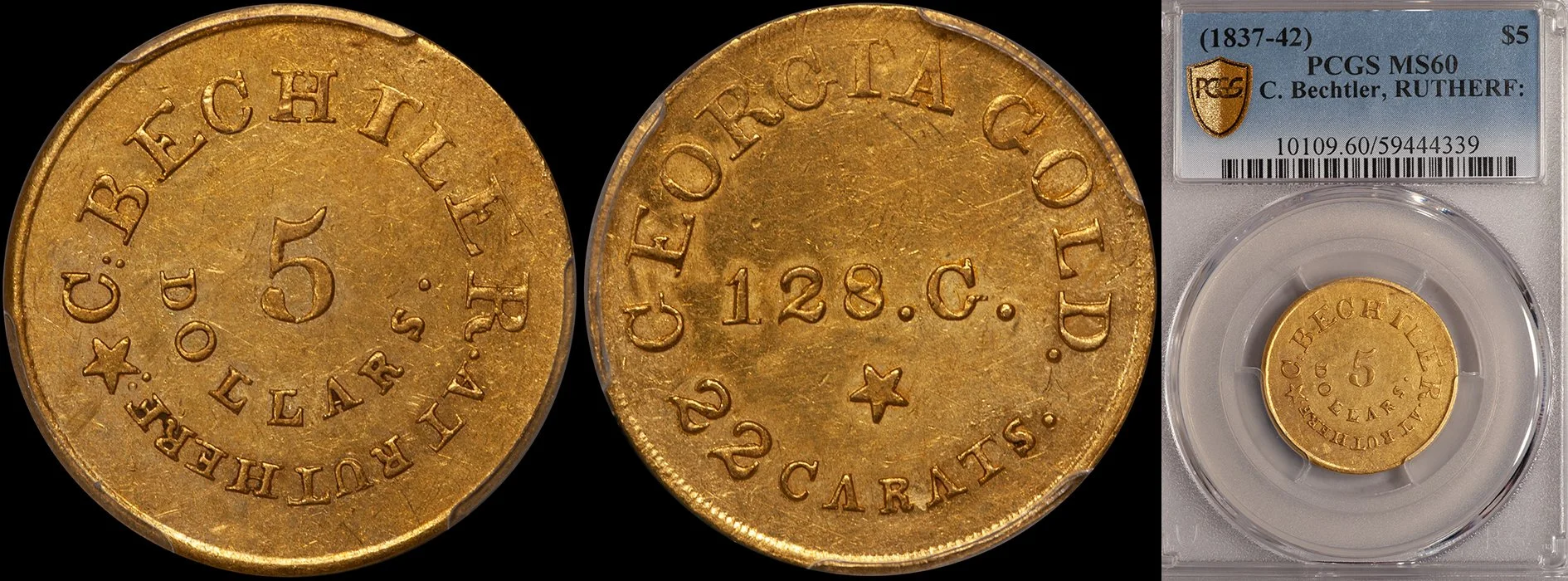
RYK: I would say a resounding "Yes!" A nice Bechtler piece or set complements a southern gold collection nicely, and some of the California private mint or assay gold pieces go well with any set that includes early San Francisco gold. The Colorado, Oregon, and Utah gold pieces are also a good fit for 19th century gold enthusiasts. One drawback is that they are generally fairly expensive, and might burn coin money required for the big hole in the set.

DW: I like Territorials but am not sure that I share RYK's enthusiasm for them in a rare date gold set. Now, if you are collecting Charlotte gold dollars than a C. Bechtler and A. Bechlter dollar makes sense. Or, if you collect Liberty Head double eagles from the No Motto era a Moffat double eagle makes sense. But I'm not sure how an Oregon or a Mormon piece fits into a regular issue set. And as RYK said, the big bucks that such a coin costs might take away needed funds from a regular issue that is more integral to your set.

3. What is your favorite Dahlonega coin for someone wanting just one for their collection?

RYK: In the sub-$2500, an original, choice VF or XF quarter eagle or half eagle from the mid-1840's would be my choice. They are generally well-produced, nearly 170 years old, and made from gold mined in the southeast.

At the next price level, there are two choices that I see: going up in grade from my lower price point selection or choosing a more interesting coin. I would do the latter, like an 1839-D $2.50, 1838-D $5 or 1839-D $5 in original XF-45.

If money is unlimited, I would wait for on of the super high-grade pieces that come on the market once a year or so. The most recent was the 1855-D quarter eagle in 63.

Overall, unless I was a half dime or trime collector, I would avoid the gold dollars as a consideration.

DW: For a first purchase in the $1,750-3,000 range its hard to argue with a nice EF half eagle. Look for an original coin with nice surfaces and color. They still only command a 15% premium over the junky coins I see daily.

For a "tier two" coin, I like Robert's idea of buying something snazzy like a one-year type or a first-year issue. Coins like this have become very popular and the value isn't quite as good as it used to be but the liquidity of, say, a nice EF45 1838-D half eagle is better than ever.

If you are lucky enough to have the budget for a five figure "exotic" issue, I'd look for a high grade example of something really rare, not a high grade example of a common date. I like coins like 1856-D quarter eagles, 1854-D threes, 1842-D Large Date half eagles, etc because they are so seldom seen in high grades.

I disagree with RYK about gold dollars. Don't hate on the little guys, RYK. Gold Dollars are a great series to collect and the 1849-D is a wonderful first coin for the collector. Plus its hard to not like rare dates such as the 1855-D, 1856-D, 1860-D and, most of all, the coveted 1861-D.

4. Is New Orleans gold more popular than Charlotte gold?

RYK: Ten years ago, I would have said that Charlotte gold is more popular, but today, I would say the opposite. One thing that favors New Orleans gold over Charlotte including is that more denominations are available, including the immensely popular $20 Liberty gold and the increasingly popular $10 Liberty gold. I think that the desirability of the New Orleans quarter and half eagles has increased and the scarcity of some of these issues is now more widely appreciated. In Charlotte, there is just not much new, and there appears to be a relatively steady march of coins on the market.

DW: RYK, you ignorant slut...Oh wait....

I'm afraid Robert is correct. As someone who has really helped to "create" the New Orleans market, I'm wowed at how popular these coins have become and much they have appreciated price-wise since, say, the late 1990's. And how Charlotte hasn't.

Charlotte gold is somewhat in the dregs although collector-quality coins are strong. I put an 1841-C half eagle in nice PCGS EF45 on my website the other day and got seven orders for it in less than a five or six hours. But, that's the exception and not the rule. There are alot of good Charlotte coins available right now and if a few heavy hitters decided to get serious, they could put together great sets over the course of a few years.

5. What gold coin or coins is/are currently in greatest demand from rare date gold collectors?

RYK: I think that the single coin that is in greatest demand among rare date gold coin collectors is the 1861-D $5. I recently told Doug that if he had a dozen XF-45s, he could quickly sell them all and for strong money. Honorable mention would go to the 1861-D $1, better date $5's and $10's from the 1860's, 1870-CC $10, and the 1861-O and 1879-O $20's.

DW: Ah, Grasshopper, you have learned well. Oh and where are those dozen 1861-D half eagles?

The market is very rarity-oriented right now and people are looking to buy sexy, low mintage coins with alot of "oomph." Other coins I would add to RYK's list include the 1855-D dollar, 1854-S quarter eagle, 1864 quarter eagle, nearly any pre-1800 half eagle, 1864-S half eagle, 1875 half eagle and eagle, 1841-O eagle, 1883-O eagle, etc.

6. Is collecting San Francisco gold on the rise/falling/stable?

RYK: San Francisco gold is, in my opinion, gaining in popularity. The market demand for the better date coins was evident in th e recent Littlejohn sale, and there was a very interesting San Francisco gold collection in the Heritage FUN sale that did very well, too. It would be great if a rare date gold specialist (ahem) or Western gold specialist would publish a book on SF gold (1854-1880) as I think that this could give these coins some much-needed publicity among potential collectors.

DW: Hey, thanks RYK. Make me do another book, huh?

Actually I have thought about doing a book on SF gold for many years and if I could get a partner to assist me I would (ahem, potential partner, you know who you are...). I think this would help the market for these coins. For years and years, this was a dead area. The popularity of SF double eagles, brought on by the shipwreck discoveries of the last two decades, has spurred demand for smaller denomination coins as well.

I think you have to look at SF coins as two distinct markets: the 1854-1879 coins and the post-1880 cons. The first group is suddenly doing pretty well and I personally am selling alot more interesting SF coinage today than I was two or three years ago. The second group seems dead but I can see the potential for coins like an 1888-S eagle in MS63 (to pick a random date in a random grade) with premiums so low over generic issues.

7. Should coin collectors bother with coin shows?

RYK: Absolutely! Aside from seeing lots of coins, the ability to view auction lots in person, view exhibits at the bigger shows, meet other collectors, and network with dealers makes any coin show worthwhile. I have often said that even if I were broke and had no coins to sell, I could have a great time at a coin show.

DW: To me, coins shows are somewhat of a necessary evil. With the exception of FUN and Summer ANA, most coin shows are too long and aren't always productive. But I'm jaded and have been going to 15-20 shows a year for nearly three decades.

For the collector, shows are great. You can't beat the ability to look at coins, to view auction lots, to look at exhibits, etc. I'd say you have to fine-tune your BS detector as you are going to hear alot of Newspeak.

8. Are auctions good venues to buy in?

RYK: Yes, with an asterisk. It depends a lot on factors including specifically which auction venues, have you viewed the coins, are you using an agent, are you bidding live or by proxy, etc. If you are playing sight-unseen with proxy bids over the internet, you are going to get burned a lot. If you are bidding in person or with a specialty dealer, there may be some opportunities.

I would add is that some coins that are purchased at auctions could be bought outside the auction venue for less money, less risk, and less hassle. If you are considering a 1901-S $10 in 64 in an auction, it makes no sense to bid sight-unseen and compete with others for the coin. If it is lovely and undergraded, someone smarter who has seen the coin will know that and outbid you. If the coin is a pig, you will win it. It's a classic "heads-I-win-tails-you-lose" situation.

DWN: The whole auction market has changed so much in the last five years. The simple way to put this is that they have transitioned from wholesale environments to retail environments.

Many new collectors feel safe buying at auction as they figure that "if there was an underbidder, I'm safe having paid just 5 or 10% more." This is wrong on many levels. And it is even more wrong when you consider that most collectors are bidding at auction on a sight-unseen basis and relying on images.

It's just a matter of time before buyer's premiums at sales rise to 17.5% or even 20% and at that point, I'd say that auctions might not be the best venue to buy in. You have to take this with a grain of salt coming from a dealer who is essentially competing against the auction firms both for product and for buyers but I know that I am now much less reliant on auctions both as a buyer and and a seller than I was a few years ago.

9. What makes a coin desirable?

RYK: This is a very personal thing, and if you ask ten collectors, you will get eleven different answers (because at least one collector will change his mind). The factors that go into desirability include, but are not limited to, design, condition, value, metallic composition, age, scarcity, history, provenance, originality, and market demand. I tend to rank scarcity, numismatic history potential for price appreciation and originality in the more important category, and design, condition, and value in the less important group.

DWN: As a dealer, my answer is bound to be different from RYK's. I am looking for coins that I think will sell well and that I will be excited about handling again and again down the road.

To me, the factors that make a coin desirable include: its level of value (is it a good deal or a bad deal?), its degree of absolute rarity (is its price predicated solely on its grade?), its degree of originality (has it been cleaned, processed or dipped in recent years?), its eye appeal (is it pretty?) and its level of liquidlity (if the market pulled another 2008 contraction, could I sell this coin in 30 days or less?).

Robert and I will be taking our show on the road and expect to see us at a Holiday Inn near your town sometime soon.

Do you more questions that you would like to see answered by the RYK/DWN mashup team? If I can persuade RYK to take some time away from his busy Fantasy Baseball schedule, perhaps we can have a Round Three of the Great Debate sometime soon. Email your questions to me at dwn@ont.com

1883 $3.00 NGC MS63

With an original mintage of just 900 business strikes, the 1883 has one of the lowest production figures of any American gold coin. It is comparable to the 1885 three dollar (which has a mintage figure of just 801) and not as rare as the 1881 (with a mintage of 500). This example is semi-prooflike with attractive medium reddish-gold toning which is most fully developed at the obverse border and across much of the reverse center. There is a small sharp mark on the cheek of Liberty and a few light nicks in the upper right obverse field; the reverse appears to be of Gem quality. Auction appearances for MS63 1883 three dollar gold pieces seem to occur at the rate of about two or three a year and typically examples fetch in the $11,000-12,000 range.

1843-D $2.50 NGC AU58 CAC

Of the three primary denominations from this mint, the quarter eagle is probably the most difficult to find in crusty, original AU58. In the dollar denomination you have the 1849-D which is pretty readily available and there are a number of dates in the half eagle denomiantion that come in nice AU58 (or AU55) with some degree of regularity. This is not the case with the quarter eagles and even the 1843-D, which is the most available date, is infrequently seen in AU58, especially with good color and surfaces. This dark, original piece has superb rich green-gold color that is overlaid with splashes of orange. There is a good deal of dirt in the protetced areas and the strike is bold with almost fully formed centers. The surfaces are immaculate and I can virtually guarantee you that this piece has never been cleaned, scrubbed or dipped. A great looking coin and the best available Dahlonega quarter eagle that you are likely to find for under $4,000.

From the RYK "Dirty Gold" Collection.