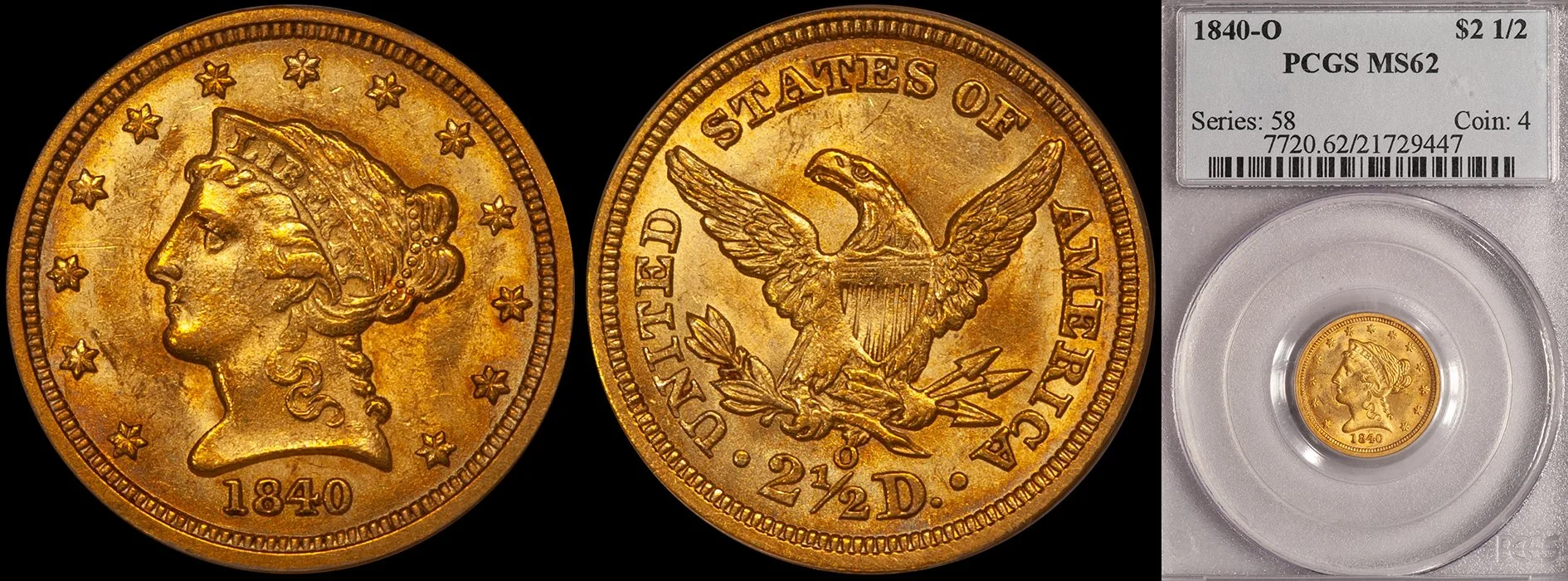
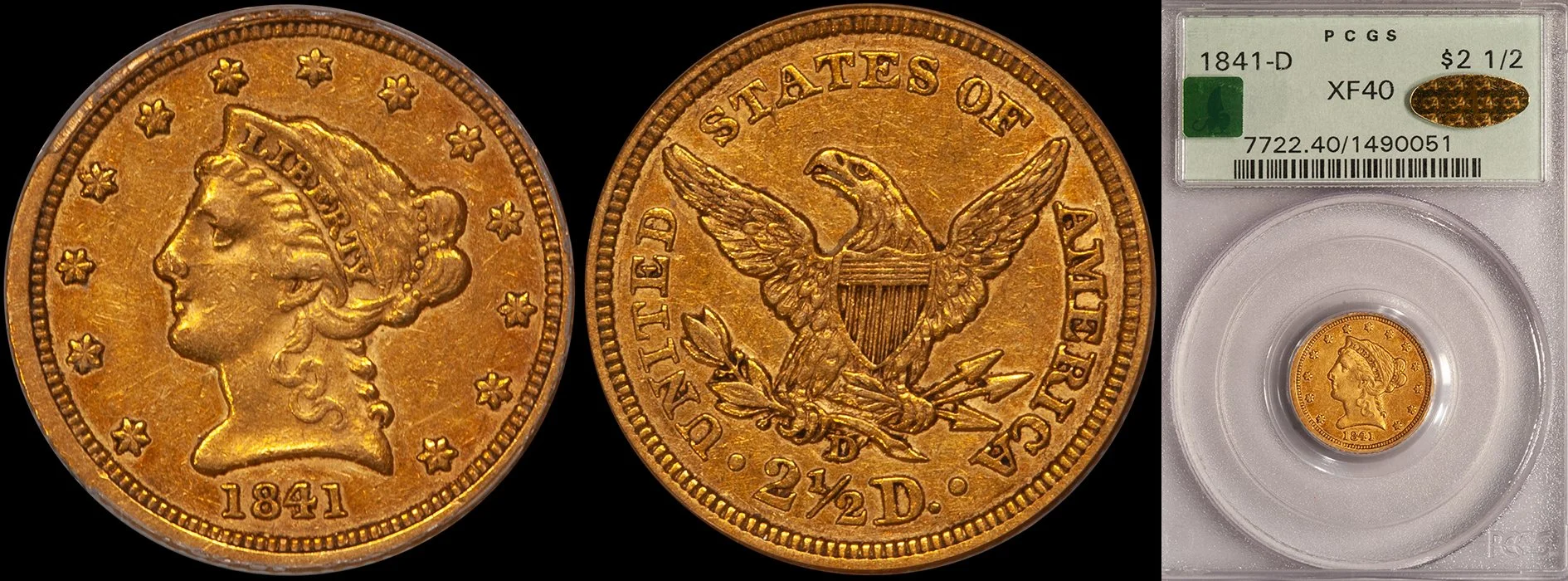
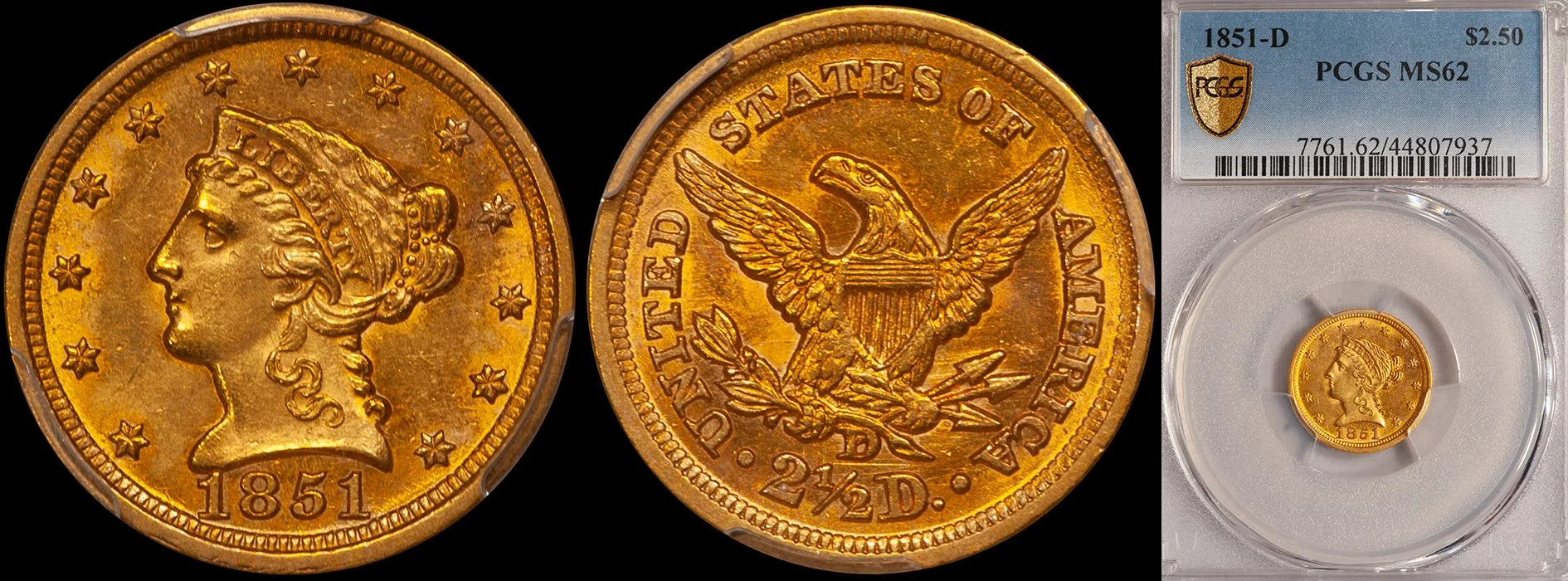
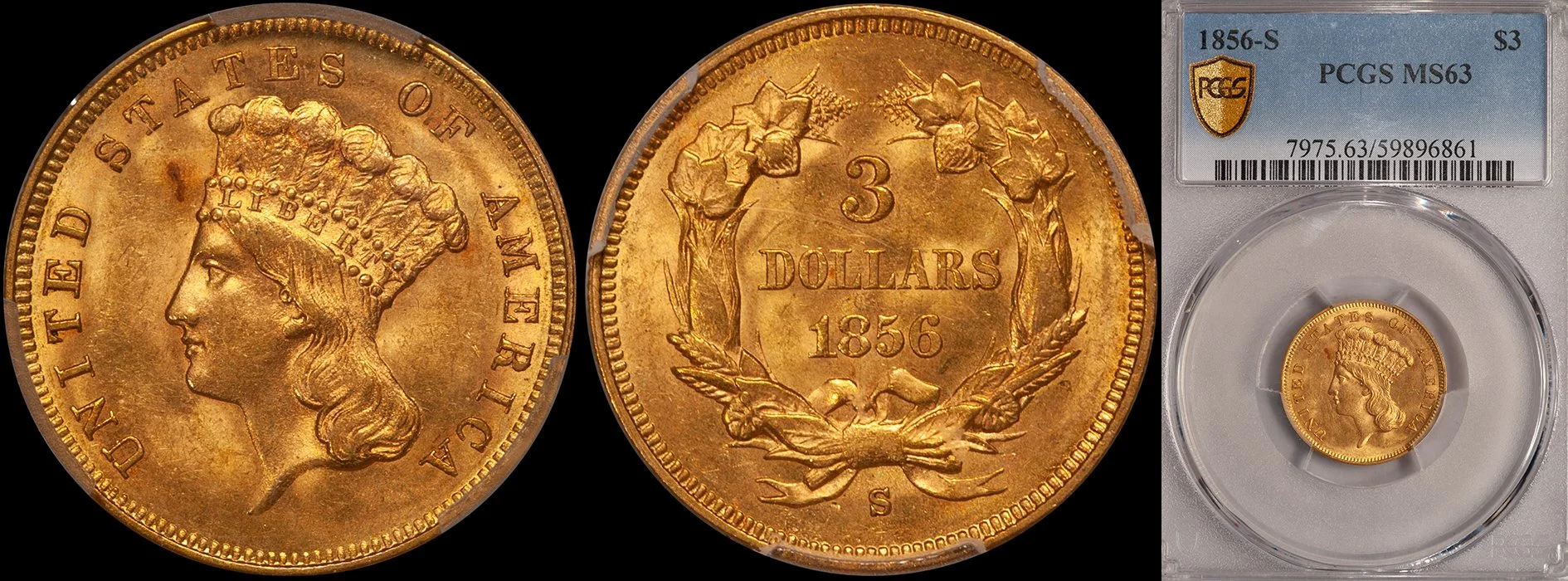
1851-O $20.00 NGC EF40

Everyone wants to own at least one double eagle from the New Orleans mint but with prices approaching five figures for a decent-but-not-mindblowing AU example, not everyone can afford one. How about a pleasing, evenly worn EF piece for a shade under four thousand bucks? This problem-free 1851-O has medium russet color and a bit of underlying luster on both sides. There are no major marks and the naked-eye appeal is excellent for the grade. I've seen damaged examples of this date sell in the $2,500-3,000 range which makes this piece seem like the perfect value play for the collector who longs for a Crescent City double eagle.

1838-D $5.00 NGC AU53

The 1838-D isn't the rarest half eagle from this mint (that honor belongs to the 1842-D Large Date) nor is it the most historically significant (take a bow, 1861-D) but it is the most numismatically significant as it is the first issue from this mint and the only half eagle employing the Classic Head design. The 1838-D isn't really that rare from the standpoint of overall number known but most survivors are in lower grades and the few choice examples that exist tend to be in tightly-held private collections. The 1838-D is seldom seen with original color and surfaces and this fresh-to-the-market example (accompanied by an old handwritten manila envelope) has a considerable amount of natural mint luster visible below medium greenish-gold and pale orange splashes. The detail is excellent for the issue with the centers showing nice definition while there are no surface marks of consequence. There is a small obverse rim bump at 11:00 on the obverse where the coin appears to have been dropped onto a hard surface at one time. This issue is always in demand and with very marginal quality EF-ish coins now selling in the $5,000-7,000, this fully AU example makes sense from a value standpoint.

Ex Stack's Bowers 3/12: 7490 where it sold for $9,775; from the Demarete collection.

First Quarter 2012: A Quick Recap

My take on the first quarter of 2012 was if you ask ten different coin dealers how their business was, you'd get ten different answers. "Isn't this always the case," you ask? "Not really," I'd answer, explaining that depending on the business model of the dealer in question, the response you'd get might be vastly different. Confused? Let me explain. As I have written many times in the past, the coin market has become highly bifurcated in the last decade. But just as the market has changed, so has the way(s) of doing business. Ten years ago, you were a "coin dealer." Today, you can be an "online" dealer or a "brick and mortar" dealer; a "classic coin" dealer or a "modern coin" dealer; a "bullion-oriented" dealer or a "rarities-oriented" dealer...the variations are seemingly endless. And with these endless variations comes potential conflicting answers to the "how was your first quarter" question.

To simplify things, if you are a dealer who sells mostly moderns or generic or bullion-related products, your Q1 of 2012 was not very good. Metals prices were mostly trending downwards during this period and prices were weak as a result. If you are an Old School coin dealer with a good following, a good website and a good supply of interesting coins, you probably had a quarter that ranged from very good to excellent. My own experience for the quarter was excellent.

Here are a few observations that I have about the current state of the market.

1. Rarity Is En Vogue: I noticed a subtle change in the rare gold market around two or three years ago. Coins that I formerly couldn't give away were suddenly in demand; not necessarily in overwhelming demand but at least they could be sold. During Q1 of 2012, it was all about rarity.

Let me give you an example. An 1863-S half eagle in nice EF40 has always seemed like a pretty neat coin to me. It certainly has alot going for it: Civil War date of issue, low original mintage figure (17,000), low survival rate (probably no more than 60 or so known), proven rarity in high grades and overall affordability. But until recently, this is a coin that I might have liked conceptually but the reality was that it was a hard sell. Plain and simple.

This has clearly changed. The rare gold market has become more about rarity than at any time I can remember and suddenly a coin doesn't have to have a C or a D on the reverse (or, in some cases, the obverse!) to be popular. Formerly hard-to-sell coins like San Francisco half eagles and eagles from the 1850's and 1860's and Philadelphia issues of the same era aren't necessarily flying off the shelves but they are newly-popular and certainly enough so that I am embracing them and offering them on my website as often as possible.

2. The Littlejohn Effect. If you collect dated gold, you know about the not-so-secret sale of the Littlejohn Estate that was held in San Francisco in February. It contained oodles of interesting, seldom-seen dated gold issues and it was interesting from a number of standpoints. I've already written about this sale and don't want to beat a dead horse but what I think this sale did was convert some former non-believer coin dealers. It's hard to say if they'll be in the rare gold market after they sell their Littlejohn purchases (especially if they don't get the grades they expected or if they learn they paid too much...)

3. Pricing Hits a Wall. I've expressed my dismay before about current pricing guides and how inaccurate they have become. For me, guides like CDN and Coin World Trends have gone from being essential parts of my business to virtual afterthoughts.

Something happened to me at the recent Baltimore show that illustrates my dismay with pricing guides and made me have a "this is crazy, I need to do something about this" moment. I was able to buy a lovely 1864-S eagle in PCGS VF30. If you are not familiar with this issue, it is a major rarity; the second rarest date in the Liberty Head eagle series after the 1875. I paid over $30,000 for it and was thrilled to do so. I based this on the sale of a much inferior VF30 example in the Littlejohn auction for $34,500 as well as some other transactions (auction and private treaty) that have occurred within the last five years.

And yet...when I went to check Trends on the coin, just for grins really as I had already written a check for it, I saw that this date was "valued" at $5,500 in VF20 and $12,500. In a word: stupid! Yes, I understand that the Littlejohn price record was too fresh to have made it into Trends. But I would have paid more than Trends for this date twenty frickin' years ago, let alone today. Grrr.....

4. The Low Hanging Fruit Theory of Coin Dealing: As gold and silver raced up and up the last few years and people fell all over themselves to buy modern coins, I had this thought on more than one occasion: am I an idiot for stubbornly remaining a dealer in "real" coins? I have coin dealer friends making Monopoly money selling modern junque, why not me?

Well, I'm just fine with my no-moderns policy. But many coin firms who formerly sold large numbers of scarce and semi-scarce gold coins remain modern coin or semi-numismatic dealers. What this has done, in turn, is to evaporate the premiums on many coins, especially in areas like MS63 and MS64 St. Gaudens double eagles. This trend was never more clear than it was during Q1 of 2012. And I would expect it to remain so in Q2 and Q3 if not beyond. The larger coin firms will continue to sell the easy-to-understand moderns and semi-numismatic items as long as they can ride this horse.

5. Good Coins Remain Hard to Find: In spite of a few fresh rare gold deals hitting the market during Q1, it remained hard to locate good coins. And for every neat coin like the aforementioned 1864-S eagle that I was able to buy, I could have sold more. Many more, in the case of the 1864-S.

The market is collector-based right now and that's clearly good. But what's not so good is that collectors tend to hold on to their best coins and this means that once something like an 1864-S eagle is sold, you won't see this coin again for years. So we have a classic "be careful what you wish for scenario." The market is strong, coins are being sold to informed buyers and the overall fundamentals are solid. The one glitch in the equation right now is there is an inadequate supply to meet the increased demand. Its something that I have always said would happen.

What do I expect for Q2? If metals prices remain weak, I don't think the market will be all that robust. However, the economy is clearly rebounding and there is more discretionary income available for things like gold coins. I'm not certain that my own business will be quite as good in Q2 as it was during the first quarter but I think the immediate future of the rare date gold market is very good and it is likely to stay good for a while.

1885 $1.00 NGC PR64 CAM

1105 Proofs struck. Mintages for Proof gold dollars shot up dramatically beginning in 1882 and by the mid-1880's, over 1,000 per year were being produced. That said, survivors from 1885 are not common with the number known estimated at about 150-200. What's great about coins like this is that they are attractive, choice and rare but they are well within the budget of many gold collectors. This specific example would grade at least a PR65 if not higher were it not for a tiny mint-made dimple in the middle of the left obverse field. Otherwise, the coin has a great appearance with very reflective surfaces that have almost no hairlines and strong contrast between the devices and the fields. While not quite a Deep Cameo, this piece has better than average contrast for the date. At this price level, you have to love this 1885 dollar and it would make a great coin for the collector who has always wanted to own a piece of Proof gold but whose budget doesn't allow for major five-figure expenditures.

Assembling a Date Set of Civil War Gold Coins: Part Two, 1863

1863 $1.00

The first installment of this three-part article discussed the various Civil War gold issues struck in 1861 and 1862. The second part looks at the very interesting gold issues from 1863; a pivotal year in the history of the brutal war and a very significant year in the annals of American numismatic history.

1863 Gold Dollar: While 6,200 business strikes were made, this is a rarer date than most casual collectors know. I regard it as the single rarest gold dollar from the Philadelphia mint; rarer even than the 1875 with a mintage of just 400 pieces. The odd thing about the 1863 is that when available, it is likely to be found in the lower Uncirculated grades. As an example, there are a total of forty graded by PCGS but over half of these (twenty one to be exact) are in Uncirculated. There are a few Gems known. The finest is an incredible PCGS MS68 owned by a California specialist that, I believe, is from the Brand collection. There is also a PCGS MS66 that is owned by a collector.

This is an issue that is well made but one which tends to have problems with original surfaces and luster. I have seen a few really nice 1863 gold dollars but most have been cleaned or dipped and have poor eye appeal as a result. Any nice example of this issue is very desirable. For the advanced Civil War collector, the opportunity to acquire a piece grading MS64 or above would be quite special and should be looked at as important.

1863 $2.50

1863 Quarter Eagle: As you might recall from the first part of this series, the mintage for the 1861 quarter eagle was an absurdly high 1,283,878. Thus, there was no real need for business strike quarter eagles in 1863. The 1863 is a proof-only issue with just thirty struck. This makes it a key rarity in the Civil War gold set and, of course, the single rarest (and most expensive) issue from 1863.

There are around twenty 1863 quarter eagles known. Most are in the PR63 to PR64 range but there are a few gems remaining including some with lovely Deep Cameo contrast between the devices and the fields. I know of at least four or five PR65's and there may be a few more. The current auction record for this date is $149,500 for Heritage 1/07: 3107, graded PR66UC by NGC.

I have mixed feelings towards the 1863 quarter eagle. In some ways, I think it is a very undervalued issue as it is the third rarest Liberty Head quarter eagle (after the 1854-S and the 1841) in terms of total known. But if you look at it merely as a Proof issue from this era, it sells for a huge premium over dates like the 1864 and 1865 which are actually as rare--if not rarer--in terms of the total known as Proofs. What needs to be remembered is that if collecting Liberty Head quarter eagles by date ever becomes fashionable, the demand for this date is likely to exceed its supply and today's price levels are inevitably going to seem cheap.

1863-S $2.50

1863-S Quarter Eagle: As you might expect, the 1863-S quarter eagle tends to be overlooked due to the rarity of its Proof-only Philadelphia counterpart. With just 10,800 struck, it is scarce in its own right. There are an estimated 100-125 extent with most in ther VF-EF range. An accurately graded AU50 to AU55 1863-S quarter eagle with nice color and surfaces is scarce and a properly graded AU58 is very rare. There are three or four in Uncirculated including two Gems: ANR 3/06: 1457 that sold for $50,600 (it is ex Eliasberg: 198) and the Dodson: 41 example that brought $18,700 all the way back in May 1992 when it was sold by Mid-American.

There are a few examples known of this date that are very weakly struck at the centers; this seems to be the result of an improper alignment of the dies. Most are well detailed but have unoriginal surfaces. The natural coloration for this issue is a medium to deep rose-gold to reddish hue which can be very appealing. For most Civil War date collections, a nice AU example of the 1863-S quarter eagle will suffice but I think Uncirculated pieces, if available, are good value.

1863 $3.00

1863 Three Dollars: This is one of the odder issues from the entire Civil War era. With just 5,000 business strikes made, you would expect the 1863 three dollar to be a rarity. While it is reasonably scarce from an overall standpoint, it is the most available Civil War issue of this denomination in Uncirculated and there are actually as many as a dozen to fifteen Gem to Superb Uncirculated pieces known. I have seen 1863 Threes that grade as high as MS67 to MS68 and I know of an example in a well-known dealer's collection (graded MS67 by PCGS) that is probably the single best business strike Three Dollar gold from the Civil War era of any date.

Nearly all 1863 Threes have prominent clashmarks at the centers and numerous mint-made die striations in the fields. The quality of strike is usually sharp and the luster tends to be excellent. There are a number of outstanding examples known and the collector should be able to find a great piece for his Civil War set. I'd suggest at least an MS64, if not a Gem.

1863 $5.00

1863 Half Eagle: There were 2,442 business strike half eagles made at the Philadelphia mint in 1863. There are around three dozen known today and while a number have been graded AU50 and better by NGC and PCGS, this is an extremely rare coin in higher grades. It is unknown in Uncirculated and I have seen maybe six to eight that I thought were truly About Uncirculated. The best I can recall was the PCGS AU58 Bass II: 1143 coin which went cheaply at $13,800 and it has been years since I've seen an AU example with even the slightest amount of eye appeal.

This is a date that saw quite a bit of circulation and the few that survived the melting pot tend to have excessive abrasions on the surfaces. In addition, nearly every 1863 half eagle that I have seen has been cleaned or dipped. As a result, examples with even decent eye appeal are exceedingly rare and the collector who only wants nice, original coins for his Civil War date set is going to find the 1863 half eagle to be a very frustrating issue. That said, I'd suggest waiting for the best available piece which is likely to be around AU55 or so.

1863-S $5.00

1863-S Half Eagle: Demand for gold coins remained high in the western states during the Civil War and the mintage figure for the 1863-S half eagle was 17,000; nearly seven times more than for the 1863 Philadelphia half eagle. The 1863-S is certainly not seven times more available than the 1863-P; it saw heavy use in commerce and was later melted extensively. I have seen estimates that as many as sixty to seventy-five are known but this seems high; the likely number is more like fifty to sixty-five with most of these in very low grades. There is a single 1863-S half eagle known in Uncirculated (it is graded MS61 by PCGS) and there are maybe as many as seven to ten in AU. The current record for the date is $25,875 set by the NGC 58 sold as Lot 9489 in Stack's 6/11 auction.

When available, this date is found with better eye appeal than the 1863-P but not by much. The luster tends to be decent but most 1863-S half eagles are abraded (often heavily) and show evidence of cleaning or dipping. Any coin with original color and surfaces is rare and desirable. The Civil War collector should look for a nice AU53 to AU55 for his set.

1863 $10.00

1863 Eagle: And now we get to my favorite 1863 gold issue: the 1863-P eagle. The mintage of this issue is a tiny 1,218 business strikes and by most accounts, there are around thirty or so known. The 1863 is the second rarest Liberty Head eagle from this mint after the 1875 and it is one of the hardest issues of the entire design to locate in all grades despite not being all that well known. This date is unique in Uncirculated (a PCGS MS63) that is ex Bass IV: 683 (at $52,900) and earlier ex MARCA 9/91: 755 (sold to Harry Bass for a then-remarkable $104,500). There are around six to nine known in About Uncirculated and I can't recall having seen more than two or three that I felt were AU55 or AU58.

My comments for this issue are very similar to the 1863-P half eagle. It is a coin that saw rough use in commerce and the few that survive tend to show numerous abrasions, often in obtrusive locations. You can almost forget about eye appeal when it comes to this date, but I'd say that if you ever have the chance to obtain an 1863 eagle with an even remotely decent appearance, I'd suggest you approach it aggressively.

1863-S $10.00

1863-S Eagle: There were 10,000 eagles struck at the San Francisco mint in 1863. This is a rare issue although not as much so as the 1863-P. I believe that there are around fifty or so known with most in the EF40 to AU50 range. As surprising as it seems, there may be as many as three 1863-S eagles known. The best is a PCGS MS61 that is ex Heritage 10/95: 6330 and before this was in the Norweb collection. The Bass IV: 684 coin was also a PCGS MS61. NGC has graded an MS61 that was last sold as Goldberg 2/09:1535. There are also a few reasonably nice AU's known including at least one from the S.S. Republic graded AU58 by NGC.

As with nearly all SF Civil War era gold, the 1863-S eagle is seldom found with natural color and surfaces. It is an issuee that is somewhat better made than in its half eagle counterpart and the few higher grade pieces known have better than average quality luster. This will not rove to be as challenging an issue to find as the 1863-P eagle but it is a rarity in its own right and any collection that has a nice AU55 or better example will probably never need to improve upon this.

1863 $20.00

1863 Double Eagle: After the 1862, the 1863 is the hardest Philadelphia double eagle from the Civil War to locate. There are a few hundred known in all grades with EF40 to AU50 examples being the most often seen. This date becomes scarce in the higher AU grades although it is far more available than, say, the 1863-P half eagle or eagle. In Uncirculated there are around two dozen known with most in the MS60 to MS61 range. The finest known is a single MS64 graded by PCGS; I believe this was once sold as Akers 8/90: 1960 and it brought $41,800 long before the Type One double eagle market was as active as it is today.

This is a well made issue that is better struck than the 1863-S double eagle and generally less abraded as well. The patient Civil War gold coin collector should be able to locate a nice AU example without much of a problem. An Uncirculated coin, at least in the MS60 to MS61 range, will be available from time to time as well. Anything that grades MS62 or finer will prove extremely hard to locate.

1863-S $20.00

1863-S Double Eagle: The mintage for this one issue (966,570) is considerably more than all the other San Francisco gold denominations combined. Much of the newly discovered gold from California and Nevada was being used to produce double eagles and these coins saw active use in commerce.

The 1863-S double eagle is the most common gold coin of this year in circulated grades. It is possible to procure a presentable example in the $2,000-3,000 range and a nice Choice AU for around $5,000. In Uncirculated, the rarity of this date takes on a different profile. The 1863-S is scarce in MS60 to MS61 and very rare in properly graded MS62 with maybe five or six known. In MS63 there are probably another three or four. The finest known is currently an NGC MS64* that recently sold for $43,125 as Lot 5041 in the Heritage 1/12 auction.

As a year, the 1863 is one of the most interesting of the Civil War era. It is a year that has some really scarce coins but unlike the 1861, it has nothing that is impossible to find at any price (the 1861-P Paquet) or expensive due to its rarity and/or popularity. 1863 is a year that will prove extremely challenging to locate in higher grades and there are no "slam dunk" issues like the 1861 and 1862 gold dollars that will be easy to locate even in Gem grades.

In the upcoming third and final installment of this series, we will look at the 1864 and 1865 gold coinage. If you have questions or comments about these--or any--coins, please feel free to contact me via email at dwn@ont.com

1890-CC $20.00 NGC AU55

The "Achilles heel" for many new collectors when it comes to CC double eagles is marks. It is hard for them to buy these coins because they tend to have marks. Lots and lots of marks. But if a markophilic collector is patient a clean CC double eagle can be found now and again. And this piece is clean. Really clean. The satiny yellow-gold surfaces are nearly free of marks, the strike is razor sharp and the naked-eye appearance is more suggestive of an AU58 than an AU55.

1883-CC $10.00 NGC AU58

The 1883-CC is the rarest CC eagle in high grades struck after 1879. It is most often found in the EF40 to AU50 range and many examples (depending on the die variety) are seen with very weak strikes. This highly lustrous piece shows a bare minimum of wear but it does have signs of contact from being knocked around loose while being shipped overseas in a bag. The color is a pleasing light yellow-green with a hint of reddish around the stars and the reverse device. It is extrermely well struck with detail not often seen on this issue. In Uncirculated, the 1883-CC is nearly unobtainable and I doubt if more than three or four exist. Properly graded AU58's are far and away the best most collectors can hope for (and they are priced at around one-third what a so-so MS61 would bring, if available...) The last NGC AU58 to sell at auction was Lot 7106 in the Heritage January 2011 extravaganza and it brought $6,325; the color on that coin can be charitably described as "a bit funky."

1846-D $2.50 PCGS AU50 CAC

This coin would grade at least AU55 but it has been net graded by PCGS due to the presence of a small natural planchet flaw on the reverse at the second S in STATES. It has lovely rich natural color with warm amber-gold hues that are similr in hue and appearance on both sides. The strike is as sharp as any that I can recall on this date with no weakness at the very centers as typically seen. As a date, the 1846-D is relatively available in the lower to middle AU grades but there are very few pieces which show the color that this piece has and even fewer with the aforemetioned definition of strike.