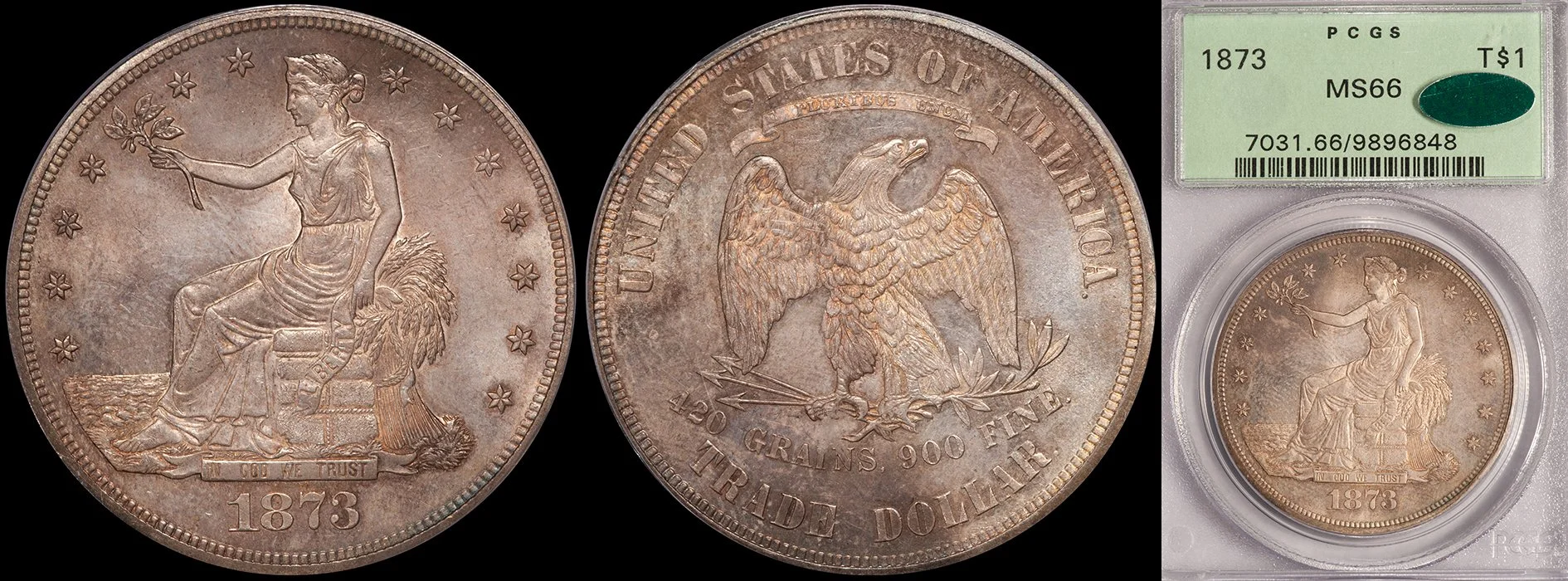
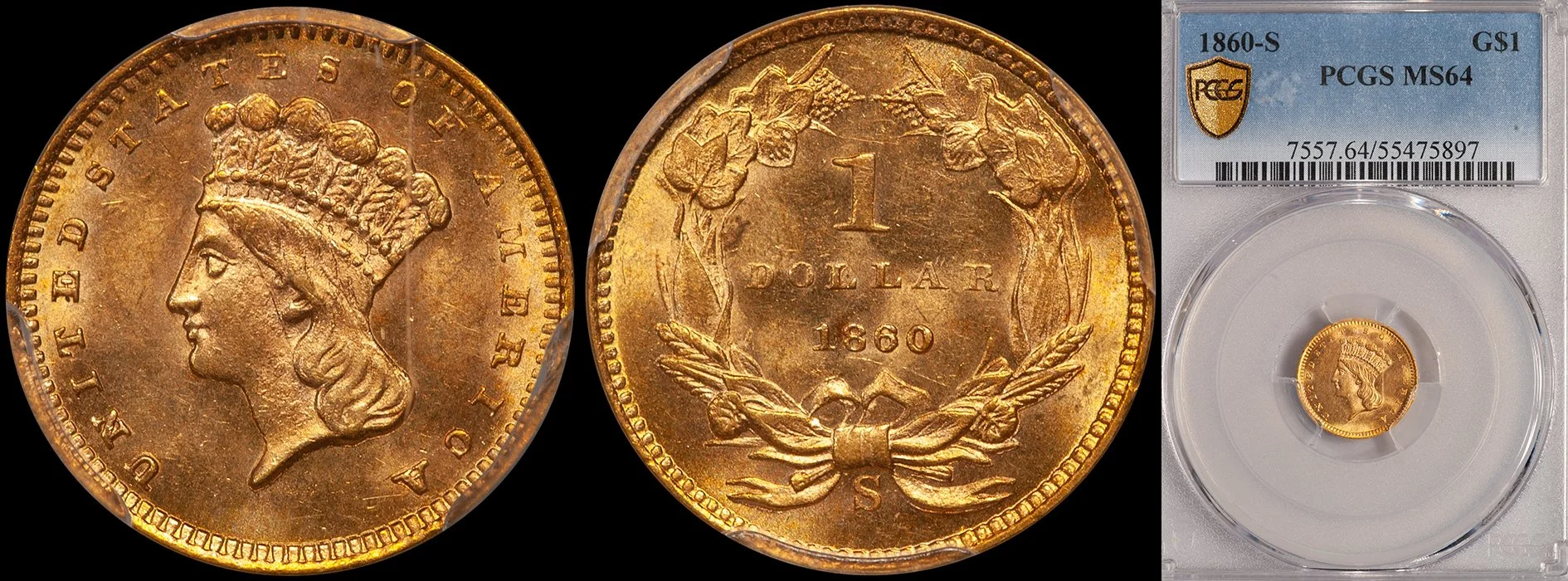
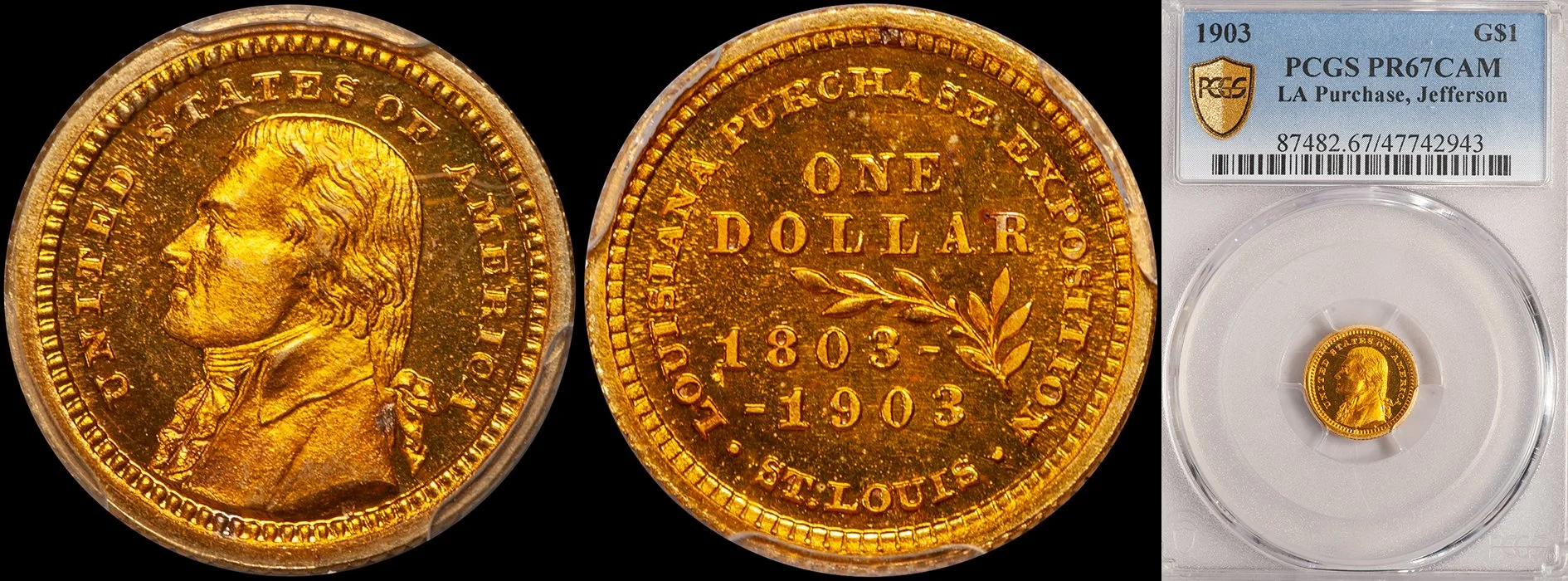
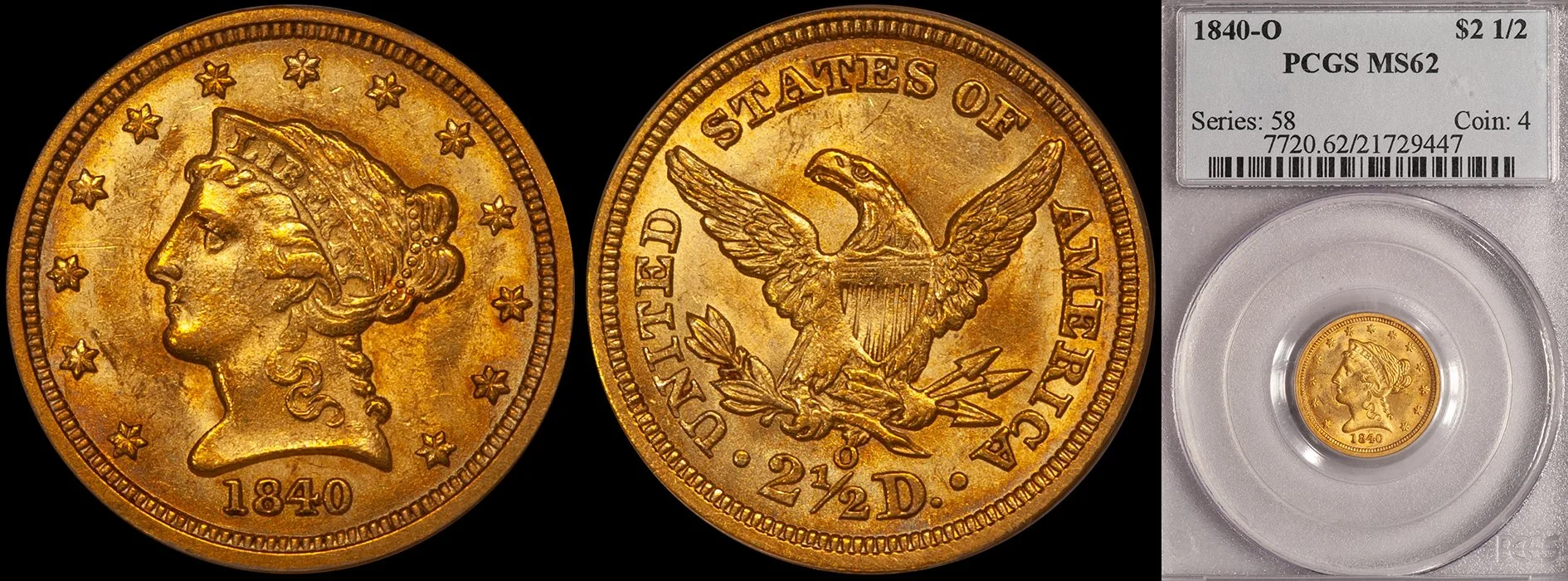
1864-S $20.00 PCGS MS62

Before the discovery of a small number of Uncirculated examples in the S.S. Brother Johnathan and S.S. Republic shipwrecks, the 1864-S was nearly impossible to find above AU55 to AU58 grades. It remains rare in MS62 and it is very rare above this with just a small number (four or five) known in MS63. This example is likely from the "Bro Jo" although it is not indicated as such on the holder by PCGS. It has very slightly granular surfaces but they are not dull or "etched" like many of the coins from these wrecks. Both the obverse and the reverse show lovely rich natural orange-gold color with the reverse deeper and more even in hue than the obverse. There are a few light marks in the obverse fields that limit the grade. However, this is one of the cleanest and most dynamic-appearing examples of this date that I can recall having seen. Since February 2006, there have been five auction appearances for the date in PCGS MS62 with the prices realized ranging from a low of $14,950 to a high of $18,975. A PCGS MS63, if available, would certainly be a $30,000+ coin. For most collectors of Type One double eagles or Civil War gold, this 1864-S is "as good as it gets!"

1862 $10.00 NGC MS60

In the "new" coin market of 2012, Liberty Head eagles have become among the most popular series with rarity-loving collectors. And formerly overlooked dates like the 1862 have grown greatly in stature. The 1862 eagle is scarce in any grade with probably less than 100 known from the original mintage of 10,960. When available, it tends to come in the EF40 to AU50 range and it is extremely scarce in AU55 to AU58. In Uncirculated, this date is a major rarity with just three known to me: the present example, a second NGC MS60 (ex Heritage 2003 ANA: 10437) and an NGC MS63 from the S.S. Republic that is off the market in the finest collection of Liberty Head eagles. The example I offer here is nearly fully lustrous and unquestionably free of wear with rich rose and yellow-gold color. As is befitting an MS60 Civil War gold coin, this piece does have some dense marks but these are mostly confined to the fields and they are shallow and well-dispersed. This is an extremely important coin for the collector of Liberty Head eagles or rare, high grade Civil War coinage and it represents what may be the only chance you have in many, many years to obtain an Uncirculated example of an 1862 eagle.

1862 $20.00 NGC AU58

The 1862 is the "king" of the Civil War double eagles and along with the 1859, it is the rarest double eagle from this mint until the Big Five ultra-low mintage issues from the 1880's and early 1890's. Not only does the 1862 have the loweast mintage figure of any business strike from this era (not including the Paquet issues, of course) but it has a decidedly low rate of survival with just north of 100-150 pieces known from the mintage of just south of 100,000. The 1862 is very scarce in the higher AU grades and very rare in Uncirculated. Prices have risen appreciably for this issue over the years but given the level of demand for it, they are not out of whack. The present example is a lovely slider with the body and appearance of a fully "new" coin but just a few too many small ticks on the surfaces to grade MS60. Unlike most 1862 double eagles, this piece has nice color with flashes of rose and light orange-gold seen atop very frosty surfaces. The strike is sharp and the overall appearance is very high end for the date and grade. There have been three auction records for this date since April 2011 in AU58 and the results have been remarkably consistent: $23,000, $23,000 and $25,300. The level of demand for this issue remains consistent as well and there are numerous Type One double easgle collector and Civil War gold specialists who covet the 1862 double eagle

1881-CC $10.00 NGC MS61

Every Carson City eagle struck prior to 1890-CC is difficult to find in Uncirculated but the 1881-CC is the only issue that is sometimes seen in Uncirculated, albeit in grades from MS60 to MS62. This fresh-from-Europe example has superb deep natural color with even medium reddish-orange hues on the obverse; the reverse is similar but deeper with some natural grease stains around MERI in AMERICA. The underlying luster is frosty in texture with only a few scuffs in the upper left obverse field keeping this piece from strong consideration at the MS62 level. Only four examples have appeared at auction in this grade in the last four years and I have only handled a few examples finer than MS61 including the Eliasberg MS64 coin that is the single finest known. Of the few dozen 1881-CC eagles known in Uncirculated, few have the eye appeal that this coin and only a handful show this degree of originality. A great coin for the date collector or the type collector looking for a single better date Liberty Head eagle for his set dated prior to 1890.

1839 Head of '38 $10.00 NGC EF45 CAC

After a 34 year hiatus, the ten dollar gold denomination was resurrected in 1838. In the first two years of the new Liberty Head design, the portrait featured the first incarnation of the portrait with the coronet tip close to the outer edge of the sixth star and a noticeably curved edge to the neck of Liberty. This designed changed in the later part of 1839 but not before 25,801 examples of this variety were coined. The 1839 Head of 1838 is only a marginally scarce coin until you gert to the AU55/58 range but it is in constant demand as a type issue. It remains very affordable in the lower to middle grades and this Choice EF example, with a CAC sticker, has pleasing deep, even green-gold color with some contrasting reddish hues at the reverse periphery. This is exactly what an EF45 should look like with minimal luster but good details and very choice surfaces without a single detracting mark of note. In the recent Stack's Bowers sale, a more lustrous but less original example graded AU53 by PCGS brought double the amount of this coin, making the present example a great value for the collector who likes gold coins from the highly interesting era (1834-1846) that saw so much experimentation with types and designs of U.S. issues.

An Interesting Collecting Idea

As I was getting ready to post a coin that will be for sale in today's DWN E-Special (an 1846-D/D half eagle in PCGS VG8), it dawned on me that this piece could be the impetus for an interesting specialized collection: a grading set of Dahlonega half eagles. This set would consist of one Dahlonega half eagle of each grade between AG3 and AU58. In total, this is seventeen different coins. Figuring an average cost of around $2500 per coin, you'd be looking at something like $42,500 for a set.

The coins in the set would encompass the following circulated grades:

About Good 3 Good 4, Good 6 Very Good 8, Very Good 10 Fine 12, Fine 15 Very Fine 20, Very Fine 25, Very Fine 30, Very Fine 35 Extremely Fine 40, Extremely Fine 45 About Uncirculated 50, About Uncirculated 53, About Uncirculated 55, About Uncirculated 58

In theory, this set could be expanded by another few coins, if coins with plus or star grade modifiers were available. I would leave this up to the discretion of the collector.

Why would this be a good set for a collector? Would it be hard to assemble and how long would it take to complete? What are some of the pitfalls that the collector might encounter in working on this set? And what are a few bells and whistles that could be added to make it even more interesting?

Some readers of this blog are going to think that a grading set of Dahlonega half eagles is a hokey idea and would wonder why any collector would waste time or money on it. I disagree.

I like this set for a number of reasons. The first and most important is that it will teach a collecor how to grade circulated half eagles. I am often asked the question "how can I learn to grade coins" and the best answer I can give a collector is that you learn from what you buy. Being able to tell the difference between an EF45 and an AU53 half eagle is an important skill for the collector.

Having third-party graded coins available is, of course, going to make it easier to do this kind of set. In the pre-third party grading days, it would have been nearly impossible to assemble a set that had all the various circulated grades as there would have been so little agreement on the grades among collectors (and dealers).

Would this set be hard to assemble and how long would it take? One of the fun things about choosing an interesting collection is that by its very nature its impossible to race through. This is especially true if the collector is picky and wants coins that are not only accurately graded but which are choice and original with good color and eye appeal. My guess is that a set of seventeen different graded Dahlonega half eagles could take a few years to assemble. It will teach a collector patience and it will teach them how to search for the "right" and "wrong" coin.

Ironically, the higher grade coins in the set are probably easier to find than the lower graded ones. Dahlonega half eagles didn't typically see that much ciruclation and undamaged, naturally worn coins that grade below VF35 or so are not easy to find. Coins that grade AG3, G4, G6 and VG8 are likely to be be very hard to find, especially if eye appeal is an important factor.

My guess is that the collector will encounter some anomalies as he works on the set. As an example, a coin in a VF20 holder might actually be nicer in appearance than a coin graded VF25 or even VF30. Some funny situations might occur when a collector buys, say, a VF25 1845-D half eagle which is nice but a bit overgraded and attempts to downgrade it to a VF20 in order to get it into the set(!)

To make the set even more of a challenge, it might be fun to have all the coins graded by one service (either PCGS or NGC). And finding them all nice enough that they will eventually be approved by CAC would make the set even harder.

Would it be possible to do this set with one specific date of Dahlonega half eagle? I guess this is possible but it might not be realistic. I haven't checked the PCGS or NGC population reports but I'm sure some dates don't have any coins slabbed in the lower grades and many have just one or two in AG3 or G4, making the search for these sort of the proverbial needle in a haystack.

I have a few "bells and whistles" suggestions for collectors thinking about this set. First, choose a "look" you like for your coins and try to remain as consistent as possible throughout the course of buying. Remember that some Dahlonega half eagles come with reddish-gold or orange-gold hues while others come with green-gold color. Remember, as well, that some dates are virtually impossible to find in lower grades. As an example, the half eagles from 1855 through 1861 didn't tend to circulate as extensively as the coins from the early to mid-1840's. It is highly unlikely that you will find an 1858-D in VG10, so focus on dates that are more realistic. As you reach the end of the set, don't get silly trying to fill holes. Just because you need a very low grade coin, as an example, don't pay a big "low ball" premium for an AG3 or a G4.

I have a great idea for a collector who wants to work on this set and who is internet savvy. Buy the domain name www.gradingdahlonegahalfeagles.com and put together a website that shows examples of each coin in each grade and which explains how Dahlonega half eagles are graded. A bit nerdy, yes, but it sounds kind of fun to me.

In my opinion, this collection is best looked at as a secondary pursuit. It might work great for someone who collects something like early half eagles by date and who is at the point in his collection when he is lucky to find one or two coins a year. It is a fun collection that is not absurdly challenging, not too expensive and really educational.

For more suggestions on how to assemble a Dahlonega half eagle grading set or other collections in general, please feel free to contact me at dwn@ont.com

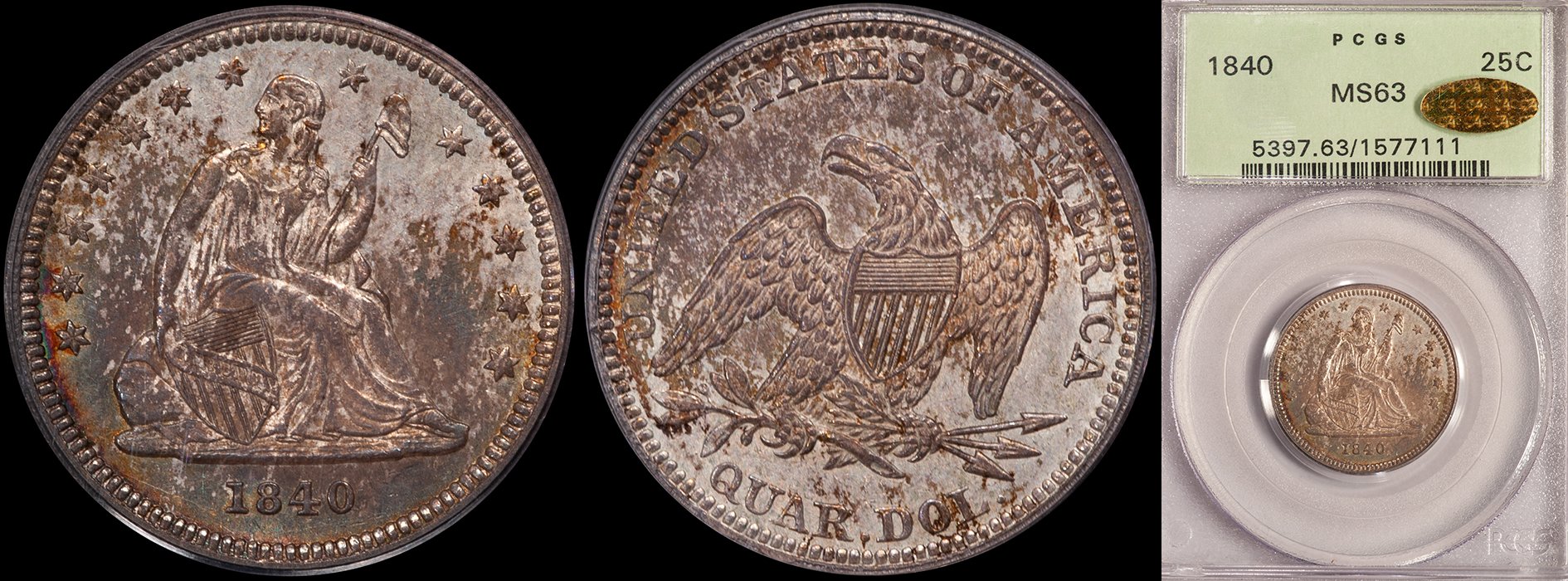
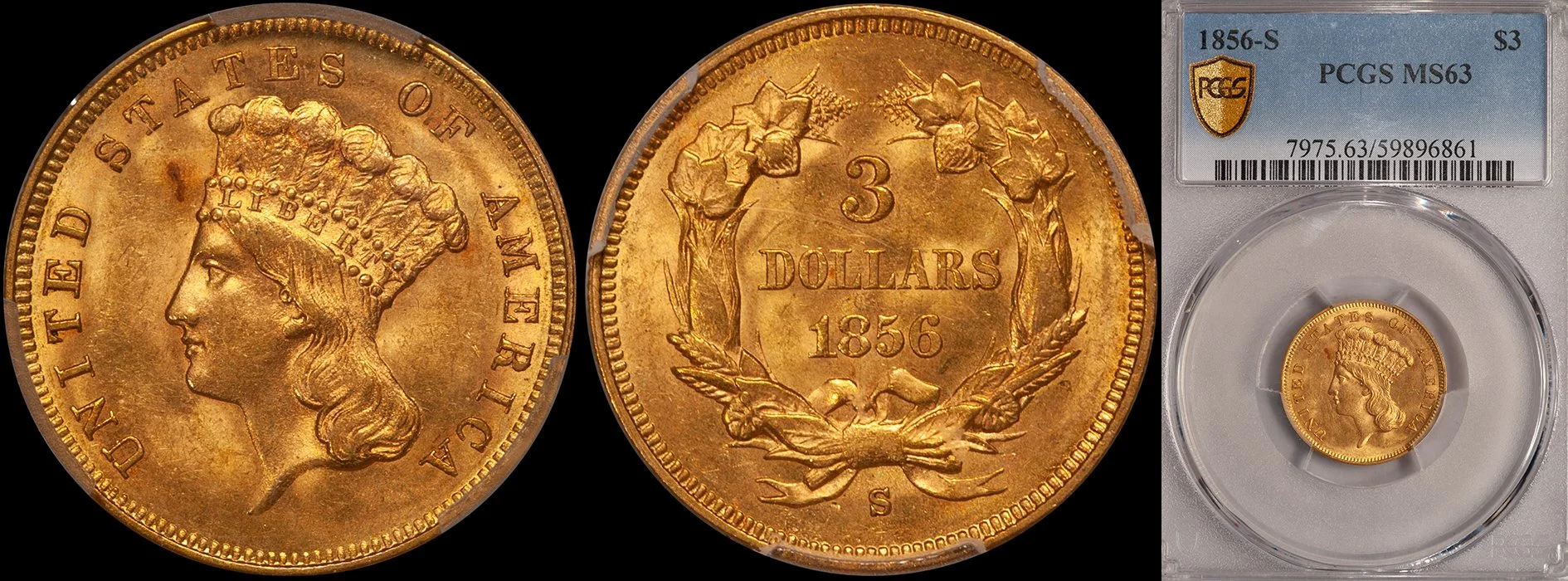
1856-S $3.00 PCGS AU58

Medium S mintmark. This is the variety with recutting at the top right of the mintmark and a crack forming at the left foot of the second L in DOLLARS. The 1856-S is the most available of the San Francisco Three Dollar gold pieces but it is scarce in properly graded AU58 and very rare in Uncirculated. This frosty slider has a considerable amount of luster on the surfaces and just a slight amount of friction on the cheek and hair. A few ticks can be seen on the surfaces but this piece is much cleaner than usual for the date and it represents one of the nicer 1856-S Threes that I have seen or handled in the last few years. The last PCGS AU58 example of this date to trade at auction was Heritage 1/12: 6264 that brought $6,900.

1858 $3.00 PCGS AU58

The 1858 is among the rarest Three Dollar gold pieces from the Philadelphia mint but it doesn't get the publicity of other issues such as the 1865 and 1877. Just 2,133 were produced and this is an issue that is almost never seen above AU55. In fact, there have been no AU58's sold at auction since 9/08 and the last PCGS AU58 to cross the auction block was in 6/06. This lightly worn piece is very lustrous but it does show some scattered ticks on the surfaces as is so common with this date. If you can even find an Uncirculated 1858 three dollar, it would cost around double the price of this nice slider.