1836 Script 8 $2.50 PCGS MS61 CAC

Head of 1835. Most Classic Head quarter eagles in MS61 are clearly not new and are not good values in comparison to nice AU58's. But this example, which is fresh and choice, is not only free of wear, it has great color and really choice surfaces. The obverse and reverse display rich orange-gold and greenish hues and this coloration is exactly "right" for the date. The strike is slightly above average with less weakness at the centers than usual and the surfaces show just a few minor scuffs in the fields as expected on this type. This frosty piece is as nice as most Classic Head quarter eagles that I see in MS62 holders. I remain amazed that a 175 year old American gold coin in Uncirculated can still be purchased for around $4,000. A great type coin for the collector who appreciates lovely "old gold" but who can't afford the five figure price tag of the earlier types of this denomination.
1843-O Large Date $2.50 PCGS AU58 CAC

Large Date variety. This is probably the single nicest circulated example of this scarce issue that I have seen. It displays superb deep green-gold color on both sides with the reverse a bit less intense in hue than the obverse. There is just a tiny amount of rub seen on the high spots but it is likely that this coin never saw any actual circulation. The 1843-O Large Date is probably the second rarest quarter eagle from this mint in higher grades and it is very rare in Uncirculated with around ten to twelve known. I like this coin a lot more than the nice PCGS AU58 that sold for $5,175 as Heritage 3/11: 4629. If you are a fan of really attractive New Orleans gold coins and you don't want to spend the $8,000-10,000+ that it will cost to find a PCGS MS61 1843-O Large Date quarter eagle, this is the right piece for your collection!

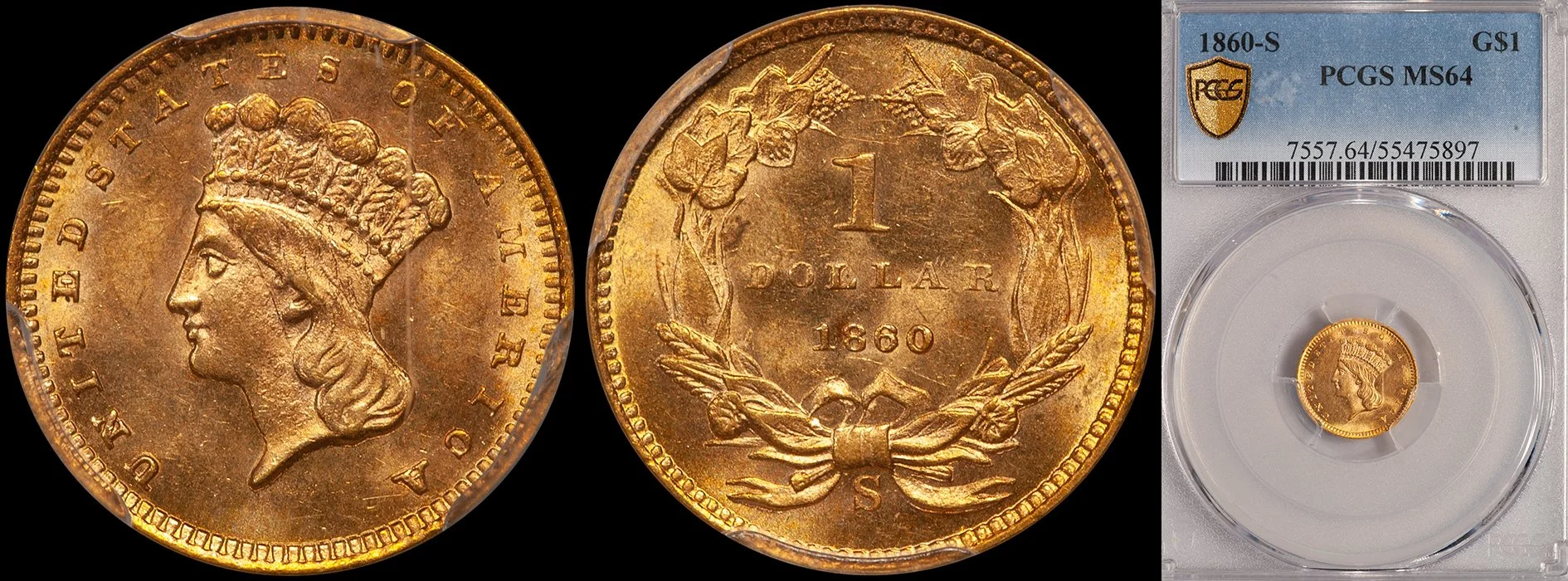
1860-S $1.00 NGC AU53

This is the final gold dollar from this mint until 1870 and just 13,000 were struck. Despite this low mintage and obvious scarcity, the 1860-S dollar is highly undervalued. This is a nice example with good details for the grade. It shows light amber-gold color with smooth, frosty surfaces and a sharp, even strike. The PCGS/NGC population figures seem highly inflated by resubmissions and this date is not often available. At just a bit over $1,000 how can you not love the value this coin offers?

1859-S $1.00 NGC AU55 CAC

Gold dollars were made at the San Francisco mint from 1854 through 1860 and again 1870. None of these issues is common and all are scarce and very undervalued in AU55 and above. This deeply toned, original example is well detailed with nice color and a good deal of underlying luster. The surfaces lack any severe marks and the strike is bold. The seven coin set of gold dollars from this mint can be completed without great expense and it is a fun, interesting set for the gold collector.

1857-D $1.00 NGC AU53

This is one of only 3,533 examples struck and the 1857-D has long been, in my opinion, the most undervalued Type Three gold dollar from Dahlonega. This issue is extremely hard to find with nice color and choice surfaces; two characteristics that this coin has in spades. The obverse and reverse both show nice reddish-gold and green hues; the exact "right" shades for this date. There are just a few circulated 1857-D dollars known that haven't been cleaned and/or processed and examples with nice color are extremely hard to locate. This piece shows a typical strike with the usual weakness at the borders. The surfaces are free of any significant mint-made problems; what looks like a scratch at the upper obverse is mint-made and is seen on most higher grade examples. All in all, this is a very nice example of a scarce issue.

1854-D $1.00 PCGS AU55

The 1854-D is the rarest Type One gold dollar from this mint. Just 2,935 were struck and fewer than 100 are known today. When available, the typical 1854-D dollar grades EF or so and is characterized by bright, unappealing surfaces. This pleasing example is among the most original 1854-D dollars that I have seen. It shows lovely natural green-gold color with considerable reddish splashes on the obverse and, more intensely, on the reverse. The strike is excellent for the issue while the planchet is unimprovable with none of the imperfections that are so common to the issues. The population figures for this date at both services are severely inflated and give the misleading impression that this date is available in AU55. It most clearly as not. Want proof? There has been just one PCGS AU55 example sold at auction in the last seven years: Goldberg 2/05: 2129, ex Goldberg 6/04: 1047. This coin sold for $8,050 and $8,913, respectively, in a market that wasn't as interested in choice, rare Dahlonega gold dollars as is the current one. If you are assembling a set of gold dollars from this mint, the chances are good that you need an 1854-D. And the chances are even better that you won't find a more wholesome, original piece than this one.

1856-D $1.00 NGC MS62 Duke's Creek

Duke's Creek Collection pedigree. Only 1,460 1856-D gold dollars were struck and this is the third rarest date of this denomination from Dahlonega, trailing only the 1861-D and 1855-D. In high grades, it is the second rarest, trailing only the 1855-D. There are just four or five known in Uncirculated and the present example, pedigreed to the famous Duke's Creek collection, is the first to be available to collectors in close to four years. This very appealing example is well-known within the specialist community on account of its flashy deep orange-gold color which highlights the obverse and the reverse. The underlying surfaces are clean save for a pair of shallow blunt marks in the left field and the strike is better than average for the issue with a nearly full date (the 5 is slightly weak) and a bold mintmark. As on all known examples, the U in UNITED is barely visible. The current high grade population for the 1856-D gold dollar is two in MS62 with none better at PCGS and one in MS62 (this coin) with one better (an MS63) at NGC. There are two auction records for PCGS MS62's at over $40,000 (Green Pond: 1009 brought $47,150 in 2004 and ANR 9/03: 425 was bid to $41,400). With the market for high end Dahlonega rarities seemingly as strong as it has been for at least five years, this coin is fairly priced and it represents the chance for the serious gold dollar collector to acquire a famous example of a famous, legitimately rare date.

From the Duke's Creek collection (Heritage 4/06), Lot 1488, where it sold for $40,250

1804 $5.00 PCGS AU55 CAC

BD-7, R-4. Small 8 over Large 8 (also known as the Normal/Large 8 variety). From the standpoint of varieties, the 1804 half eagle contains some of the most visually impressive varieties in the entire early gold series. One of my favorites is the 1804 Small 8 over Large 8 which has among the most dramatic repunchings seen on any American coin ever produced. This variety is moderately scarce with an estimated 100-150 known, mostly in lower grades. This very lustrous example has attractive light yellowish-gold color with slightly deeper greenish hues at the obverse border. From the standpoint of wear (or lack of it) and "meat," this piece grades at least AU58 but it has been net graded down to an AU55 by PCGS due to a small scrape on the obverse from the cap up through the space between IB in LIBERTY. The reverse of this coin is especially choice and it grades at least MS61 on its own accord. Heritage 8/11: 7515, also graded AU55 by PCGS and approved by CAC, realized $12,650. This is one of six examples of this variety to have been approved by CAC in AU55 with nine better.

1807 Capped Bust $5.00 NGC AU58 CAC

Capped Bust Left variety. BD-8, Rarity-2. In 1807, the old Capped Bust Right Heraldic Eagle reverse half eagle design was changed by John Reich. This makes 1807 an interesting transitional year for the half eagle denomination with two distinct design available to collectors. As a set, the 1807 transitional half eagles are highly completable in nearly any desired grade. The present 1807 Bust Left half eagle is as an original an early gold coin of any date or denomination that you are likely to find. It shows superb deep green-gold hues that are accentuated by splashes of coppery-gold in the open fields. There is just a tiny amount of friction seen on the high spots and the quality of the surfaces is outstanding with a virtual absence of marks. Below the toning there is a good amount of luster and if this coin were (gasp!) dipped, it would become apparent that it is a very lustrous coin. Even though this is a reasonably common issue, it has become extremely hard to find examples with this degree of eye appeal and originality. In fact, you could search for along time and not find a nicer AU 1807 half eagle than this!