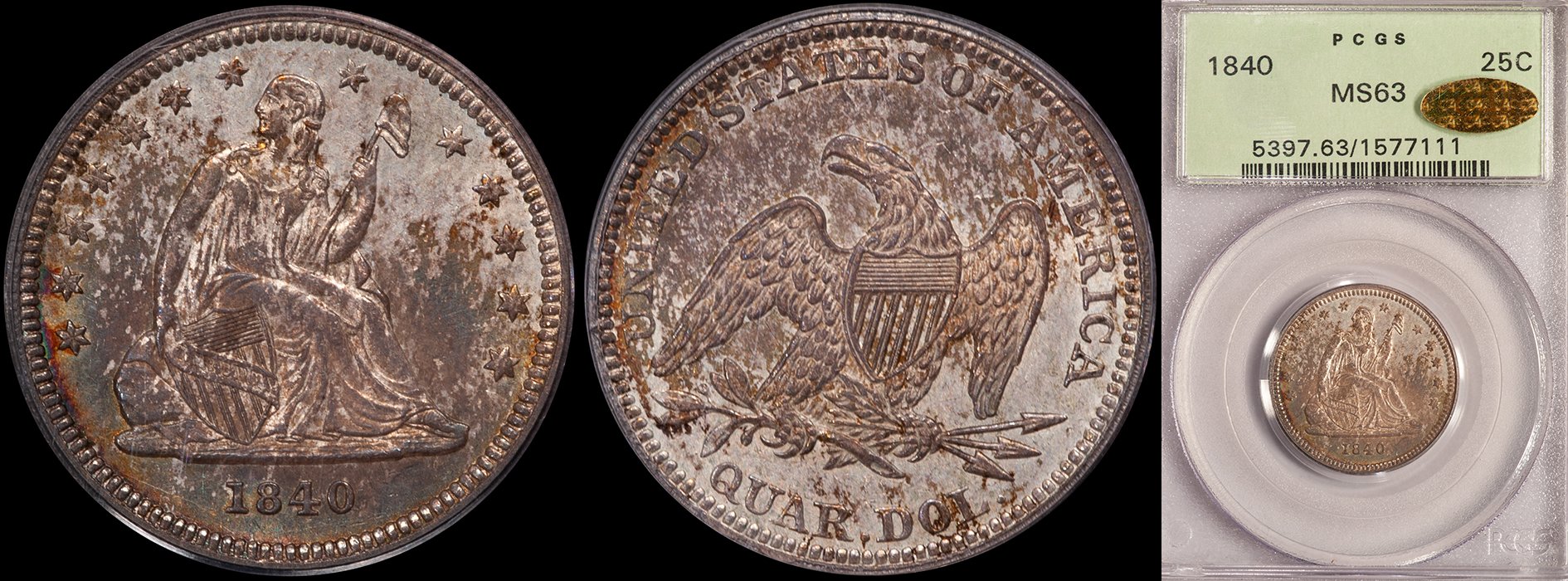
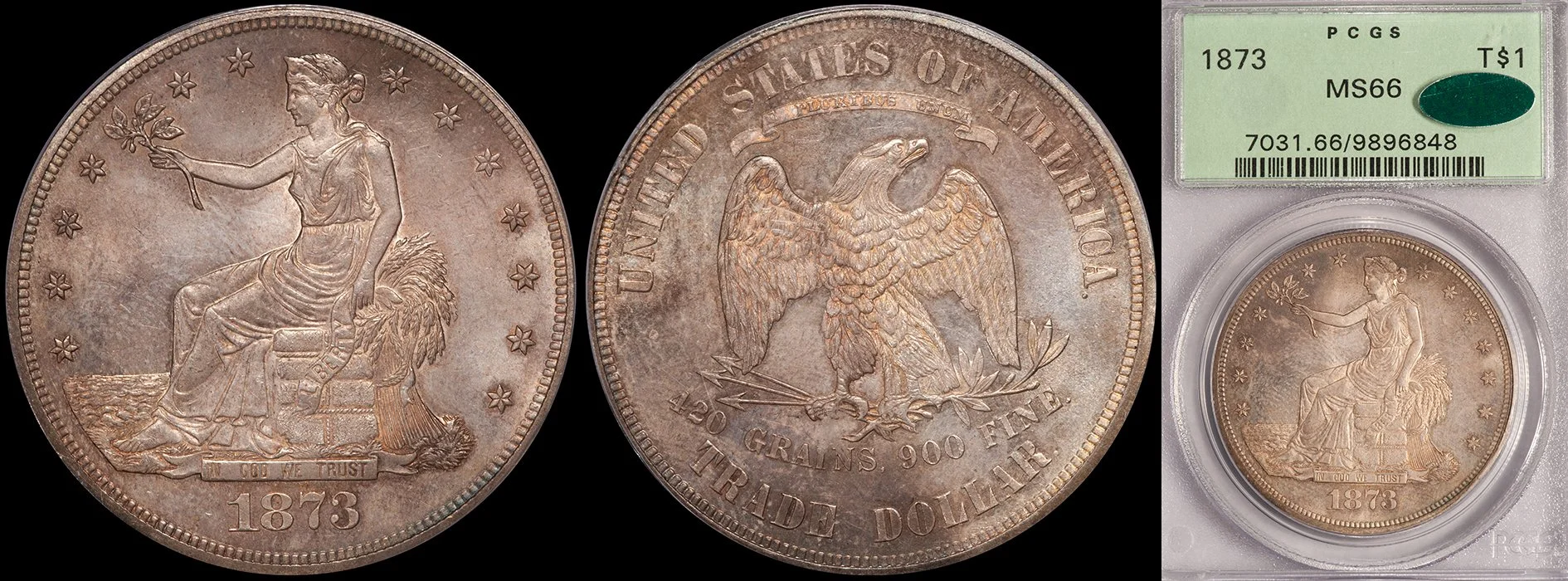
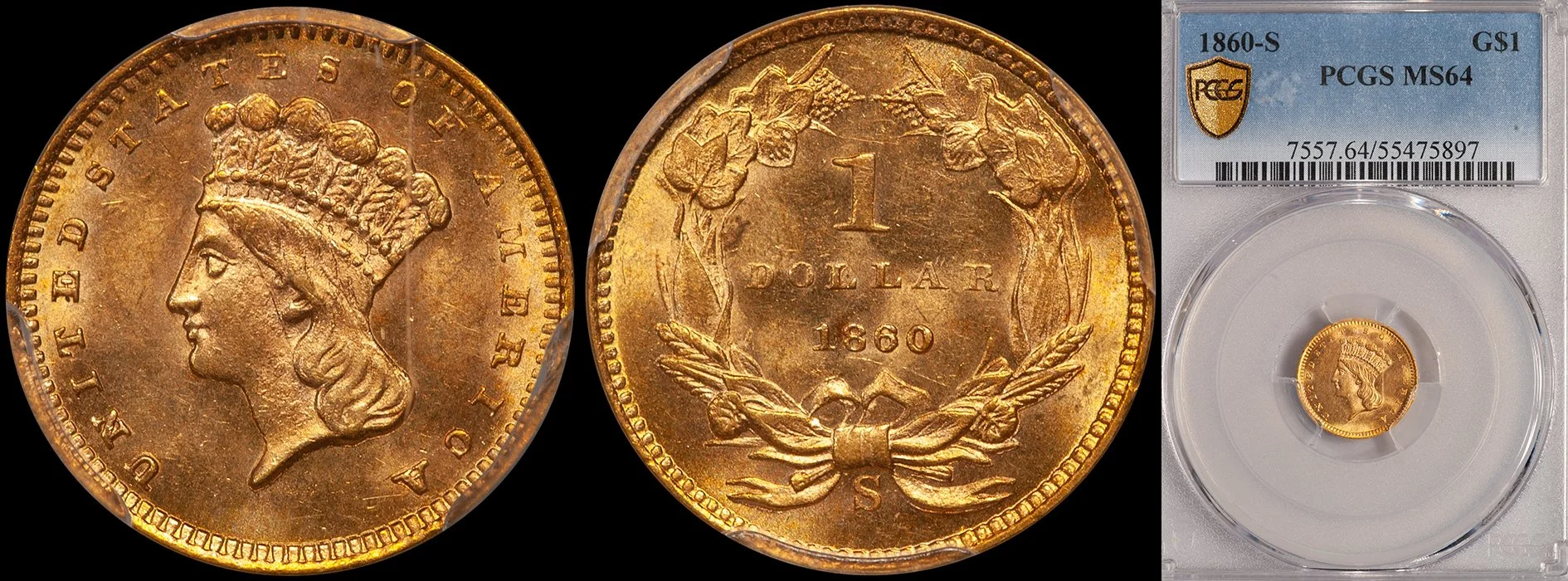
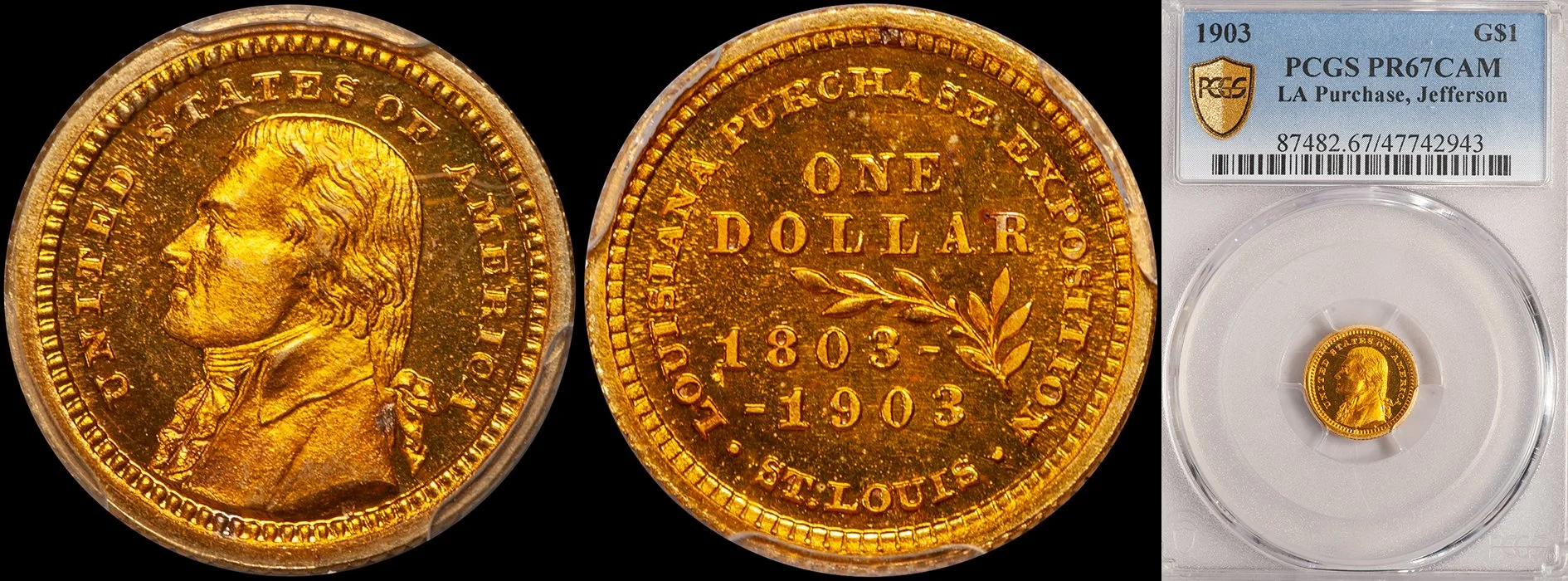
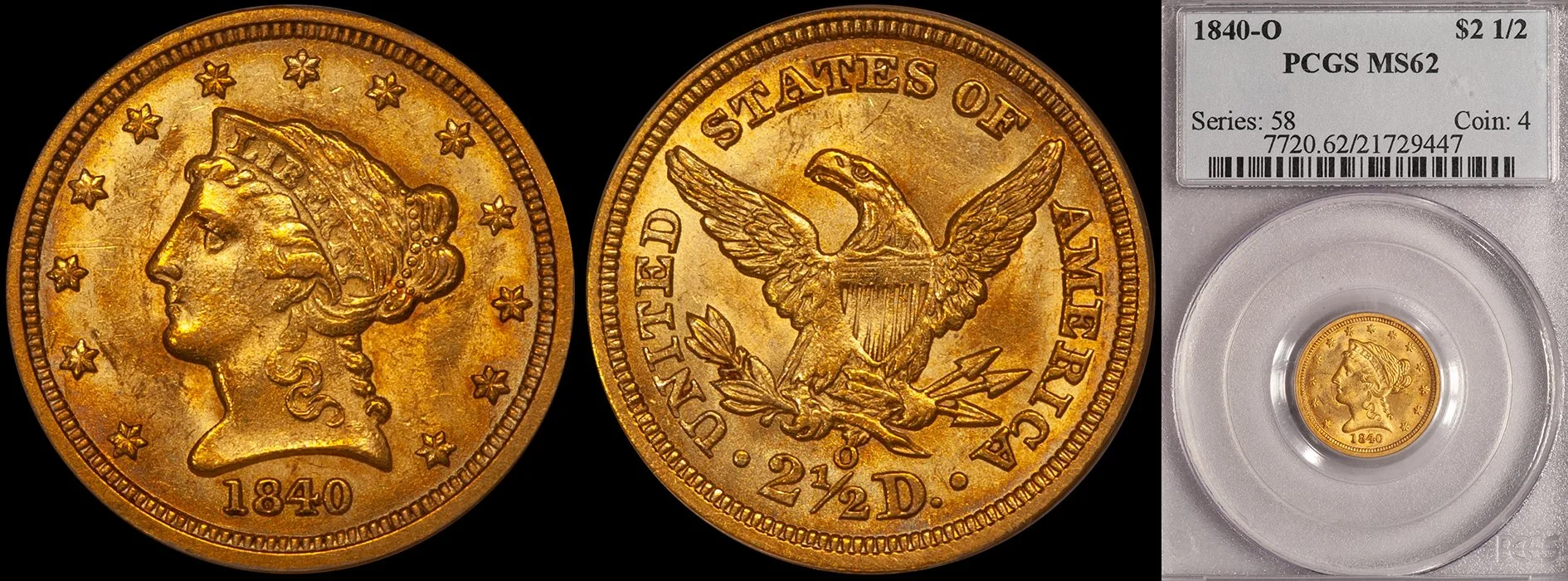
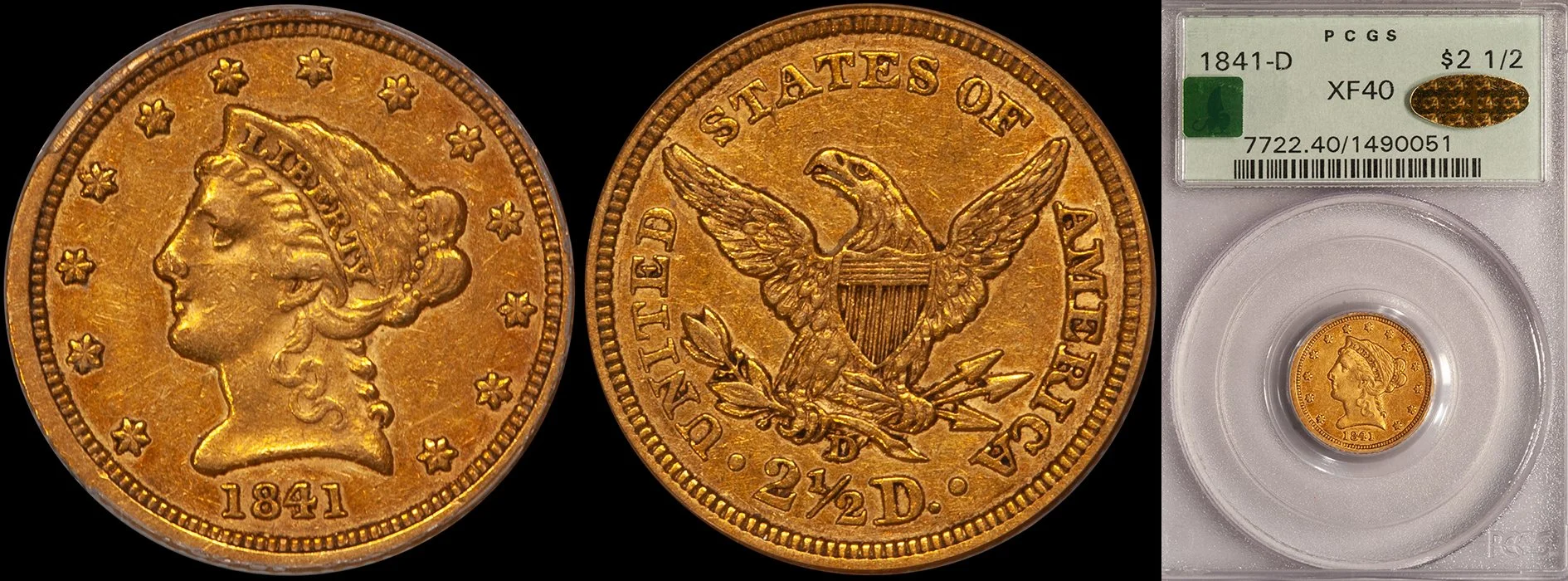
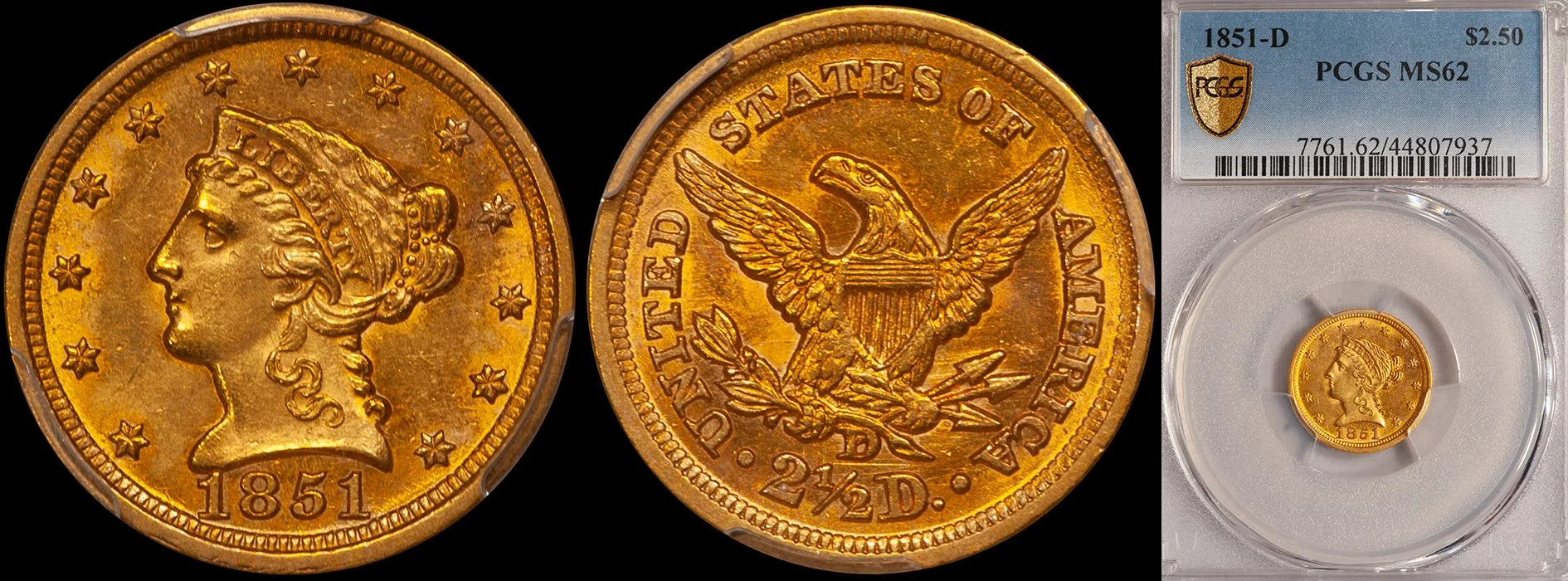
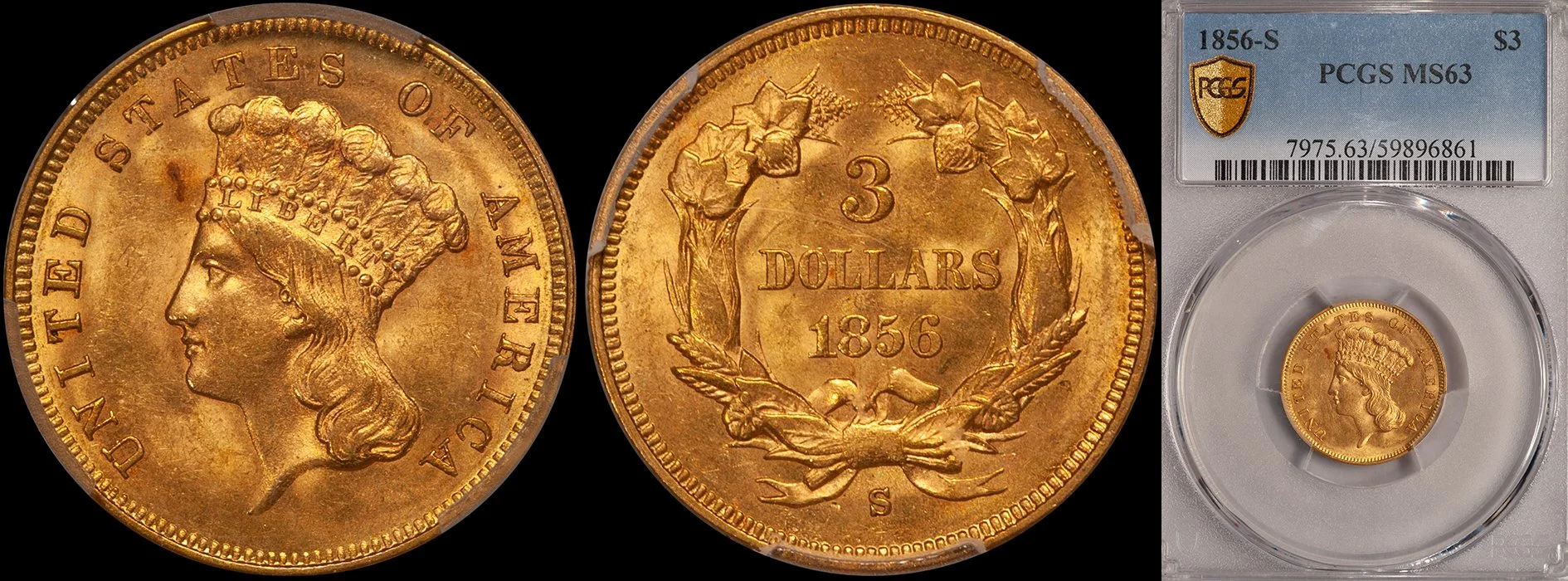
1842-D SD $5.00 PCGS VF35 CAC

Small Date variety. An attractive, evenly worn example with nearly enough to detail to grade EF40 but with a few old, well-hidden surface marks keeping this at the Choice VF level. On both sides, the color is a uniform deep green-gold. A scarce date in any grade and a very hard coin to locate with original color and surfaces. This is the only 1842-D Small Date half eagle in any grade below EF40 to have been approved by CAC.

Building a Basic Type Set of Five Dollar Gold Pieces

The half eagle is the very first gold coin to be struck at the United States mint. This denomination was struck without interruption from 1795 to 1929, and it is the only U.S. gold issue to be produced at all eight United States mints. It is very popular with collectors, but the seemingly endless duration makes it very hard to collect by date. Because of this fact, it is an ideal set to collect by type. Let's take at the eight major types that constitute a half eagle set from 1795 to 1929. The beauty of this set is that while it contains some rare coins, it can be completed by most collectors; even in relatively high grades. While probably not realistic in Gem Uncirculated (although certainly feasible, albeit at a significant price), this set is very realistic in Uncirculated. In fact, many of the coins can be purchased in MS63 and MS64 grades for less than the price of far less rare 20th century gold issues.

1. Capped Bust Small Eagle (1795-1798)

1795 $5.00 NGC AU55

While this type is dated from 1795 through 1798, for most collectors the only two realistic dates for type purposes are the 1795 and the 1796/5. The 1797 is very rare and the 1798 is exceedingly rare with just eight known.

If I were going to be putting this set together, there is no doubt that I would select a 1795 as my Capped Bust Small Eagle type coin. Even though the 1796/5 is much scarcer and probably undervalued in relation to the 1795, the latter is a first-year-of-issue which gives it considerable numismatic significance.

A total of 8,707 1795 Small Eagle reverse half eagles were struck. There are hundreds of coins known, in grades that range from VF+ to EF all the way up to Gem. Depending on the collector's budget, I would suggest either looking for a nice AU50 to AU53 coin or a solid MS62 to MS63. A nice AU coin should be available in the $50,000-60,000 range while an MS62 to MS63 will cost $100,000-150,000.

Due to the price and significance of this coin, I regard it as one of the key members of the half eagle type set. Therefore, the collector should be patient and fussy in his quest for the "right" coin. I think it is important to find an example with choice surfaces and original color. Nice, cosmetically appealing 1795 half eagles used to be available with relative ease a decade ago, but they have become hard to find as so many have been dipped or lightened. A high-end, original coin is worth at least a 15-20% premium over a typical example.

2. Capped Bust Right, Heraldic Eagle Reverse (1795-1807)

1798 Large 8, 13 Stars $5.00 PCGS AU58

This is one of my favorite types of half eagle. It can be neatly subdivided into two categories: those issues struck prior to 1800, and those struck afterwards.

For the pre-1800 issues, there are two dates that make sense for a type set: the 1798 and the 1799. There are a number of varieties of 1798, but the most available (and the one that is best for a type set) is the Large 8 with 13 stars on the reverse. The mintage figure for the 1798 half eagle is reported to be 24,867, and it is likely that no more than 500-750 examples survive in all grades. A nice AU example of the 1798 half eagle should be available for under $25,000-30,000. An Uncirculated coin will cost $40,000-80,000+. In my opinion, the best grades for a type set are AU55 to AU58 and MS62.

The 1799 has a reported mintage of only 7,451 and I regard it as a real "sleeper" in the early half eagle series. It isn't that much more costly than the 1798, yet it is at least two times as rare. I recently sold a lovely PCGS MS62 with CAC approval for less than $45,000, and this seems like truly good value to me.

For most collectors, the best coin to seek for their Capped Bust Right Heraldic Eagle reverse type is going to be a half eagle dated from 1800 to 1807. All of these dates are relatively common, and each has its own merits for inclusion in the set.

If you are going to stick with an AU coin, you should be able to purchase a lovely, high-end example in the $10,000-15,000 range. In Uncirculated, an MS62 will cost around $17,500-20,000+, while an MS63 is $30,000+.

A few important factors to consider when buying this type are originality, color, nice surfaces and a lack of detracting marks. This is a common enough coin that you can afford to be quite finicky when pursuing it. If you don't really like a specific coin, wait until you find the "right" one.

3. Capped Bust Left (1807-1812)

1807 $5.00 NGC MS62

In 1807, Reich again redesigned the half eagle. The new design features a Capped Bust Left obverse and an entirely new reverse.

All six years of this design are basically similar in overall rarity. All six issues also tend to be well made and fairly easy to locate in grades up to and including MS63. This makes it among the easier types in this set to acquire.

What year is "best" for this set? I like the 1812, given its historic association with the War of 1812, but I also like the 1807 for its significance as the first-year-of-issue for the Capped Head Left type. But none of these dates is really "better" than any other.

The best buying tips that I can give for this type are similar with the other early types discussed in this article. If you are purchasing a nice About Uncirculated coins, look for a piece that has the appearance of a Mint State coin but just a slight amount of friction on the high spots. On Uncirculated coins, try and stick with those that are original and those that are minimally abraded with good color and good overall eye appeal.

A nice AU Capped Bust Left should be readily available in the $10,000-15,000 range. A nice Uncirculated coin (one that grades MS62 to MS63) will cost in the area of $20,000-35,000+ depending on the date and grade.

4. Capped Head Left (1813-1834)

1813 $5.00 NGC MS60

The half eagles struck from 1813 through 1834 include some of the rarest and interesting issues of this entire denomination. Unlike some of the very rare half eagles from the 1860's and 1870's, these issues tend not to be rare due to low mintages but because of intensive meltings that began in 1834. The weight of the half eagle was lowered during this year, making the old issues worth more intrinsically than their face value. Most of the issues from the 1820's were almost totally wiped out in the process. The most extreme example is the 1822, of which just three survive from an original mintage of 17,796.

But not all the Capped Head Left half eagles are extreme rarities and it is from the small number of more available dates that the type collector will probably make his selection. The most common issues of this design are the 1813, 1814/3, 1818, and 1820. "Common" is a relative term here, though, as some of these dates, like the 1818 and 1820 are quite rare when compared to the last two types that we discussed in this article.

For type purposes, the 1813 is clearly the best date to choose for this set. It is easily the most available date and it tends to come better produced as well. A nice AU example can be found for less than $15,000 and an MS62 to MS63 is available for less than $30,000.

Let's say that you want to add some real "meat" to this set and decide to include a very rare issue. Is this possible? With patience and a large budget, it is. The 1824, 1825, 1826, and 1827 are all very rare coins but they do become available on average of once (or possibly twice) per year. These issues didn't circulate very much so just a few exist in grades below MS60. If a nice AU coin is available, a collector is looking at an expenditure of at least $50,000-60,000+ while a solid MS62 to MS63 will cost in the $80,000-100,000 range.

In 1829, an important change occurred to the design of this type: the diameter was reduced. Design changes that reflect this include smaller date, letter and star sizes. The 1829-1834 subtype could certainly be included in this half eagle set but it is not absolutely necessary. If it is included, this is a challenging hole to fill as all six issues are quite rare due to the wholesale meltings, mentioned above, that occurred in 1834.

5. Classic Head (1834-1838)

1834 $5.00 NGC PR63 Cameo

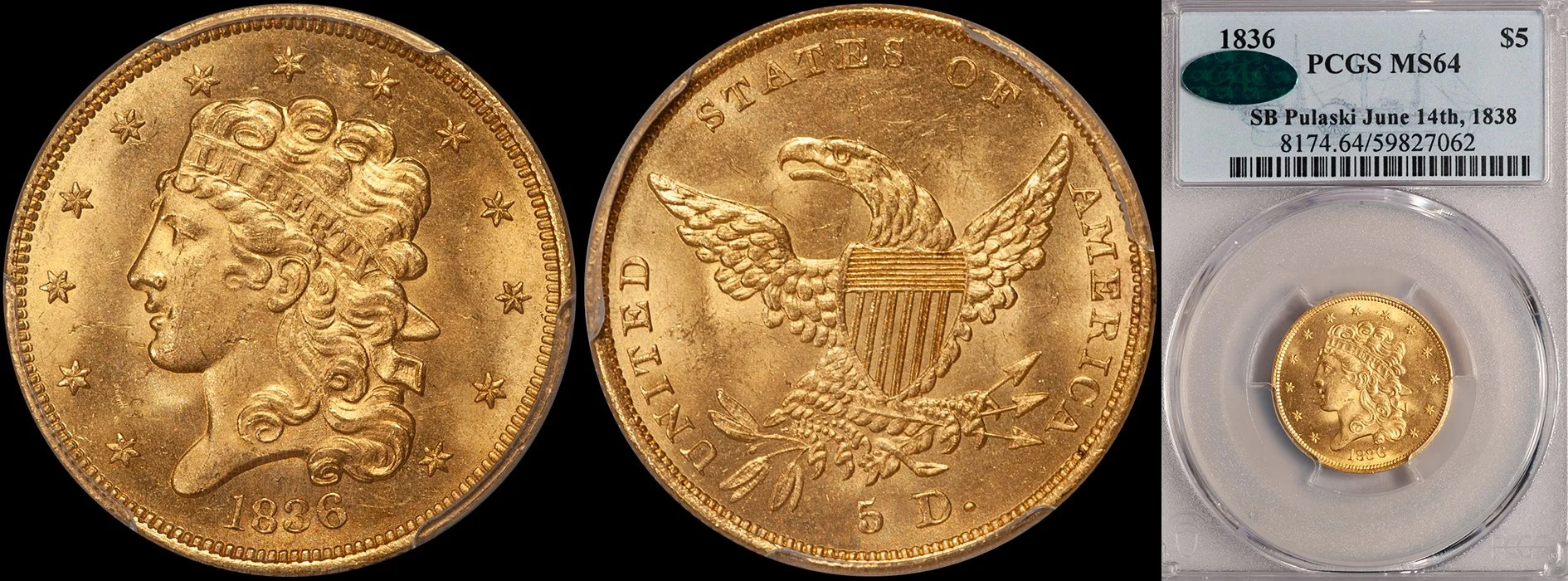
The size and weight of the half eagle was reduced in 1834 and this is reflected by an entirely new design by William Kneass. The Classic Head type was struck from 1834 through 1838. This is a popular and numismatically significant type as it includes the first branch mint issues for this denomination. The southern branch mints at Charlotte, Dahlonega, and New Orleans opened in 1838. The 1838-C and 1838-D issues are scarce and extremely popular, but as they are not readily available in higher grades they are not generally included in a half eagle type set.

Most collectors will select a Philadelphia issue. Due to high original mintage figures, Classic Head half eagles tend to be readily available in circulated grades and are not rare in Uncirculated until you reach the MS64 to MS65 range.

In the highest circulated grades, a common date Classic Head half eagle can be purchased for less than $3,000. Even though these coins are reasonably common, it is remarkable that a classic United States gold coin that is over 175 years old is still so affordable. In MS62 to MS63, a nice coin will cost $6,000-12,000 while an MS64, if it is available, will cost around $20,000+.

Here are some suggestions when buying a Classic Head half eagle. First, if you can, try and buy a date other than the 1834. While interesting as the first-year-of-issue, the 1834 is appreciably more common than dates such as the 1835, 1836, and 1838. Yet in spite of this, these scarcer dates sell for a small premium, even in comparatively high grades. Second, look for a coin with deep, rich natural color. This type is available with good eye appeal and a pretty example is clearly going to add more "oomph" to this set than a washed-out, average quality piece. Finally, try and find a well-struck coin. This design is often weak at the centers so avoid coins that show little central detail.

6. Liberty Head, No Motto Reverse (1839-1866)

1843 $5.00 NGC MS62

The Liberty Head design should be familiar to most collectors as it existed, in this basic format, all the way from 1839 until 1907. The coins struck prior to 1866 did not include the motto IN GOD WE TRUST on the reverse.

Known to collectors as No Motto half eagles, these Liberty Head issues were made at the Charlotte, Dahlonega, Carson City, New Orleans and San Francisco branch mints as well as at Philadelphia.

For most collectors, a Philadelphia No Motto half eagle makes the most sense as a type coin. The more common dates from the 1840's and early 1850's tend to be readily available in the lower Uncirculated grades (MS62 and below) and can be obtained for under $5,000. A collector who wants a nice MS64 will have his choice between a few different dates and should expect to pay around $20,000. Gems of this type do exist, but they are expensive and hard to locate.

1839 $5.00 NGC AU55

The half eagles struck in 1839 are actually a distinct one-year type with a different rendition of the portrait as well as the mintmark on the obverse for the Charlotte and Dahlonega issues. The 1839 half eagle is not rare in circulated grades, but it is scarce in Uncirculated and quite rare in MS62 and above. Expect to pay at least $15,000-20,000 for a higher quality Uncirculated example. A nice AU piece can be found for less than $3,000.

7. Liberty Head, With Motto Reverse (1866-1907)

1893-O $5.00 PCGS MS63

The With Motto Liberty Head is among the more common types in this set. It was produced from 1866 to 1907 in prodigious quantity at the Philadelphia, Carson City, New Orleans, Denver and San Francisco mints.

For type purposes, most collectors will select a common date Philadelphia or San Francisco With Motto half eagle. The lowest grade that should be included in a better-quality set is probably MS63 to MS64 and a really nice coin is going to be readily available for less than $2,000. As a hint, I'd suggest that you look for a date struck prior to 1900, as that adds a "neatness" factor.

This type is actually easy to find in grades up to and including MS66. I'm not certain I'd commit spending a lot more than $10,000 on an example for a type set unless this set involved a "best of everything" mindset.

8. Indian Head (1908-1929)

1909 $5.00 PCGS MS65

The final type in the half eagle set is the attractive and popular Indian Head design. These coins were struck from 1908 to 1929.

This is an easy type to locate in any grade up to and including MS65. An MS64 would be the lowest quality coin I'd recommend for type purposes and these have come down in price to the point where you can buy a nice one for less than $5,000. In MS65, prices have dropped as well and what was once a $20,000-ish coin can now be found for around $12,500.

Here are a few hints when looking for an Indian Head half eagle. First, try to find a slightly better date (like a 1909 or a 1911) that used to sell for a premium, but which is now essentially a type coin. Secondly, be patient and wait for a coin with great color and choice, original surfaces. This is an easy coin to locate so you should wait for a coin that really "speaks" to you.

Assembling this eight (or ten) coin set is a real challenge and quite a bit of fun. Depending on your budget, you could include coins grading from Extremely Fine to Gem Uncirculated. Because of the rarity and cost of the 1795, this is never going to be an inexpensive set, but it is one that I think has the potential to be very desirable in the future.

1844-O $10.00 PCGS MS61

As is the case with most of the New Orleans eagles produced between 1843 and 1848, the 1844-O is common enough in lower grades but it becomes scarce in properly graded AU55 to AU58 and it is very rare to extremely rare in full Mint State. This is clearly the case with the 1844-O. I am aware of seven or eight in Uncirculated (not including the unique Gem Proof example that sold a few years ago in excess of $1 million) and this includes three that have seawater surfaces as a result of having been uncovered in shipwrecks. The present example is the second best I have seen with original surfaces, trailing only the wonderful Byron Reed: 157 coin, graded MS62 by NGC, that brought $31,900 all the way back in 1996. This coin has wonderful soft, frosty luster with lovely natural light orange-gold color on both sides. A few very faint natural reddish spots can be seen; one above the 18 in the date and the other between the two 4's. The strike is sharp and the obverse is clean and choice with just a few minor marks; the reverse has a few more marks with most of these clustered in the field behind the head of the eagle. After years of neglect, high quality No Motto Liberty Head eagles have finally come into their own and are now appreciated for the rarities they are. That said, I think coins like this are still a great value and this lovely 1844-O is among the more exciting New Orleans eagles that I have offered for sale all year.

Ex Heritage 10/10: 4873, where it sold for $18,400.

Where the %$#@ Are All the High Grade Dahlonega Half Eagles?

As I was reviewing my notes on Dahlonega half eagles this morning, I was struck by something very interesting as I updated Condition Census information: many dates haven't had a significant example sold in three, five or even eight years. This, in turn, made me ask out loud where the (naughty word) are all the high grade Dahlonega half eagles? Hence, the topic of this blog. Of the three primary denominations struck at the Dahlonega mint, half eagles are the most popular with collectors. It is easy to see why. The coins are comparatively large, the series is reasonably short and there are no impossible rarities to stop the collector of average means from attempting to complete a set.

As you might expect, even the common date Liberty Head half eagles from Dahlonega are rare in legitimate Uncirculated grades. If you discount the marginally Mint State coins that pop-up and the few higher grade common dates that have been available, the pool of available coins sold during the last few years has been shallow, at best.

Let's look at a few dates.

The 1841-D half eagle is a rare coin in high grades. There are around a dozen known in Uncirculated. Given that number of coins--and given the fact that this isn't an incredibly popular or numismatically significant issue--this would make you think that higher grade 1841-D half eagles should be available from time. Is this true?

Looking back at auction records from the past few years, the last high grade 1841-D to sell was Heritage 6/11: 4626. Graded MS63 by NGC (and approved by CAC) it brought $27,600. To find another high grade 1841-D (not including a few marginal MS61's and an S.S. New York example graded MS61) you have to go back to the Heritage 2008 ANA: 1965, also graded MS63 by NGC, that sold for a reasonable $18,400. And before this, you need to go back another three years to the Bowers and Merena 12/05: 2685, ex Bowers and Merena 1/05: 1554 coin, graded MS63 by NGC, that sold each time for $25,300.

And what if you only bought PCGS coins? How long has it been since a nice PCGS 1841-D half eagle was sold at auction? You'd have to go all the way back to the Green Pond: 1041 coin sold by Heritage in the 2004 FUN auction for $32,200. That's closing in on eight years (!)

Let's look at another date: the 1849-D. There are fewer than a dozen examples in Uncirculated and if you discount the marginal MS60 and MS61 pieces, the number of possible coins a high grade collector could pursue is around five or six.

The last significant 1849-D half eagle to sell at auction was the Bowers and Merena 2/08: 2544 coin, graded MS62 by PCGS, that sold for $24,150. Before this, there were two PCGS MS62 sales in 2004. Three coins in five years seems like a decent amount of availability UNTIL you do a little research and figure out that the 2004 appearances were the same coin and this piece was reoffered in 2008.

Here is one last example: the 1855-D half eagle. This is a tougher date than the 1841-D and 1849-D in higher grades, but it still isn't recognized as a rarity. There are around six or seven in Uncirculated.

There was a flurry of activity for this issue in high grades around 2004-2005. In fact, there were four auction trades for high grade pieces (three in PCGS MS63 and one in MS64) between the 2004 FUN show and the 2005 Summer ANA. That should have been a great opportunity for collectors, right?

Well, not really. You see, all four records are for the same coin and in the final appearance (Heritage 2005 ANA: 10356, at $38,813) the coin had now upgraded to MS64 (and lost its lovely original color in the process, but that's another story...)

But I digress. This blog isn't about coins re-appearing at auction. Its about coins not appearing for sale with much frequency.

So why don't nice Dahlonega half eagles show up for sale more regularly? I have a few suggestions as to why this is the case.

1. With few exceptions, really "new" Dahlonega half eagles are rarer than you think. You can throw-out the numbers in the population reports (especially NGC) as there are many resubmissions of these coins in Mint State. There isn't a single Dahlonega half eagle that isn't truly rare in MS63 and above and most are very rare even in properly graded MS61 and MS62.

2. The few nice coins that exist are in strong hands. The downward trend in the economy since 2008 hasn't brought more than a handful of significant Dahlonega half eagles onto the market. Clearly, these coins are owned by serious collectors who don't plan on owning their coins for a few years and then "flopping" them. And, surprisingly, this appears to be the case for both date and type collectors.

3. No great collections of Dahlonega half eagles have hit the market in at least five years. In fact, unless I'm forgetting something, the last really great collection to hit the market was Green Pond in January 2004. Contrast this with the prior seven to eight years, when you had James Stack, Milas, Pittman, Bass, North Georgia, Chestatee, Miller and others. Looking back at 1995-2003, this was probably the single most fertile time in the history of numismatics for advanced collectors of Dahlonega. Since 2004, we've seen almost nothing in terms of specialized collections.

(Oops. I am forgetting something: the Duke's Creek collection sale in 2006. But this was only dollars and quarters eagles, not half eagles. So my point #3 is still valid, at least as far as half eagles is concerned.)

4. As the supply of great coins has dried up, the number of avid collectors has increased. I can't think of any time that there was more serious collectors of Dahlonega half eagles than there is now. Clearly, the supply is not nearly enough to meet the current demand.

5. Dahlonega gold is one area where the auction companies haven't completely dominated the market since the mid-2000's. I've sold via private treaty considerably more high quality Dahlonega gold coins than what has appeared at auction. But in the case of half eagles graded MS62 and above, this is still isn't a ton of coins.

6. As I've stated countless times, the price reporting mechanism for rare date gold coins is broken and needs to be fixed. In most cases, published prices for higher grade Dahlonega half eagles are down since 2004 despite what most experts believe to be a strong(er) market. This is partly due to certain schlocky, overgraded coins dragging down levels on specific issues and partly due to published references being unable to keep up with the market.

I don't think we're likely to see many changes in the Dahlonega half eagle market, at least not if prices stay unrealistically low. There aren't a lot of good coins around to begin with and I see no hugely compelling reason(s) right now for owners of such coins to sell them.

So what do you do if you are a collector who is specializing in high grade Dahlonega half eagles? Be patient; the right coins will turn up sooner or later. And when they do, be prepared to pay up for them.

Do you have more questions about Dahlonega half eagles? If so, please feel free to contact me via email at dwn@ont.com.

1864 $5.00 PCGS AU53

The rarity of the 1862-1865 Philadelphia half eagles has been misunderstood for decades. Despite low mintages and no real reason why any should have survived, these coins have traditionally been overlooked in favor of less rare branch mint issues. But the word is finally out on the 1864 half eagle and I, for one, think this coin's sudden appreciation with collectors is long overdue. Only 4,170 business strikes were made and I doubt if more than 60-80 are known in all grades. This date becomes very rare in properly graded AU50 and above and the last PCGS 53 to sell at auction was in May 2000. A PCGS 55 just sold for $9,200 in the last Heritage auction (9/11, lot 4316). This lightly toned example has splashes of tangerine-gold color on the obverse and reverse and is nicely detailed. There are a few marks on the obverse including a series of three small abrasions ( a reeding mark?) from the chin and a light mark or two on the cheek. A nice example of this Civil War rarity.

1798 Large 8, 13 Star Reverse $5.00 PCGS AU58 CAC

BD-4, High Rarity-4. This variety is easily recognized by the reverse cuds at ES in STATES and O in OF. There have actually been a fairly decent number of 1798 half eagles on the market in the last few months and with the exception of a few, I have been largely unimpressed. Most had been dipped at one time and most were liberally abraded. I like this coin because it is very original and because it is clean. I think it compares favorably to other 1798 half eagles that I've seen in MS61 holders and it would not look out of place in such a slab. The color of this coin is exceptional with splendid rich orange-gold that deepens to red at the left obverse and throughout much of the reverse. There is a slight amount of friction on the high spots and a number of adjustment marks (mint-made, of course) on the reverse that form a criss-cross pattern within the shield and the inner parts of the wings. As is typical of this variety, the centers are not as sharp as the borders and I have seen similar adjustment marks on a number of 1798 BD-4 half eagles. The originality and eye appeal of this coin make it very special and this is a wonderful piece of 18th century American gold.

1855-O $10.00 NGC EF45 CAC

With a mintage of just 18,000, the 1855-O is a scarce date in all grades. It is tied with the 1856-O as the fifth rarest No Motto eagle from New Orleans and it is really hard to find in choice, original EF. This example was sold by me to a collector around a year ago and he traded it back to me to acquire a nice PCGS AU50 1855-O eagle. It has lovely medium green-gold color that is accentuated by splashes of reddish-gold at the obverse periphery. In addition to showing nice color, this piece has very clean surfaces with just a few inconsequential marks scattered about the fields. There is a small rectangular planchet flaw on the reverse below the beak that is mint-made. An affordable but truly scarce coin that is a great value for the eagle collector.

Grade Distribution of 19th Century Branch Mint Gold Coins

For many 19th century gold issues, it is as important to know the grade distribution as it is the overall rate of survival. In this blog, let's look at grade distribution; namely how the surviving examples of a specific issue are distributed along the lines of grade. It is natural to believe that for the typical mid-19th century issue grade distribution, if plotted on a graph, would resemble a bell curve. If, say, 100 examples of a specific issue are known, it is likely that few survivors would be in very low grades (i.e. VF and below) and few would be in high grades (i.e., Mint State), with most clustered in the middle grades (i.e., EF and AU). To some extent this is true but there are a number of scenarios that can make the grade distribution skew more towards the low end or the high end.

Grade distribution can cluster towards the low end for a number of reasons. One has to do with the need for coins in a particular geographic region. The gold coins from Carson City were eagerly received by citizens of the western states from 1870 through 1874 due to a pressing need. As an example, nearly every known 1873-CC half eagle and eagle grade Extremely Fine or below, indicating that these were issues that saw considerable use in circulation.

There are other issues that tend to be found in lower grades due to heavy use in circulation. These include the Charlotte and Dahlonega quarter eagles and half eagles from the first few years that these mints were open (1838 to around 1843), San Francisco half eagles and eagles from the late 1850's through the mid-1860's and New Orleans half eagles and eagles from the mid to late 1850's.

You will note that all of the issues that I have mentioned so far tend to be medium to larger sized; they don't include gold dollars, quarter eagles and double eagles. For various reasons, these denominations do not necessarily show the same grade distribution pattern as do their larger-sized counterparts from the same era.

Grade distribution tends to be a size-related phenomenon. Because of their size, Double Eagles did not to circulate as much as half eagles or eagles and because of their intrinsic value they were melted to a greater extent in later years. With the exception of certain rare dates like the 1854-O and 1856-O, most double eagles of the Type One design are seldom found in grades below EF.

The same is true with gold dollars. Because of their small size, the likelihood of a gold dollar circulating all the way down to the VF grade range is improbable.

Let's go back to two issues I mentioned above and look at their grade distribution.

The 1873-CC half eagle is an issue that saw heavy circulation in the local economy and, as a result, is typically seen in low grades. PCGS has graded a total of 65 examples of which only 7 (or a shade over 10%) grade above AU50.

Now compare this to the 1893-CC half eagle, a more common issue but one that saw very little circulation in the local economy. PCGS has graded a total of 364 in all grades of which a whopping 283 (or over 80%) grade AU50 or better.

This situation also exists for the 1873-CC eagle. PCGS has graded a total of 52 of which just 14 are considered high grade coins (i.e., AU50 and above). Compare this to the 1881-CC eagle, an issue that saw little local circulaton and is now often repatriated in groups from Europe. This date has a a total population at PCGS of 264 with 137 of them, or more than 50%, in high grades.

Certain rare date 19th century gold coins have a grade distribution that makes sense because of very low original mintage figures. As an example, well-known rarities such as the 1864 quarter eagle, 1875 half eagle and eagle and 1883-O eagle are very rare in higher grade because they have tiny original mintage figures. The likelihood of a coin surviving in higher grades with an original mintage of 100 or 200 (the 1875 eagle and half eagle, respectively) is, obviously, very slim.

But mintage figures alone do not act as a predictor of a coin's rarity. There are certain later 19th century issues, such as the Three Dollar gold pieces from the 1880's, that have very low mintage figures but high survival rates. These issues were saved by collectors, dealers and speculators when they were struck and not only do they exist in far greater percentages than their counterparts from the 1860's and early 1870's, but in higher average grades as well.

What about low mintage issues that are more available in high grades than expected due to hoards? A good example of this is the 1857-D quarter eagle. With a mintage of just 2,364 you would expect this to be a rare coin in all grades. Most Dahlonega quarter eagles have a survival rate of around 3% of the original mintage. This is not the case with the 1857-D.

According to the most recent PCGS population figures, a total of 67 have been graded. Of these, no less than 57 have been graded AU or higher. How can we explain this anomaly?

If you are a student of Dahlonega quarter eagles, you are aware of the fact that most 1857-D quarter eagles (at least the ones that are original) have a similar look: softly struck, very frosty and toned in a rich yellow-gold hue. This similarity in appearance suggests that a hoard of 1857-D quarter eagles existed at one time and has been dispersed.

The grade distribution of an issue can change quickly due to hoards. A great example is the 1857-S double eagle. At one time, this issue was typically seen in EF and AU grades and was actually quite scarce in Uncirculated. But after thousands of high grade examples were located in the S.S. Central America treasure, the grade distribution of this date changed radically. Now, the 1857-S double eagle is seen more often in higher grades than it is in lower grades. The result of this was a radical compression of value. In MS62 or MS63, this date is only worth around three times more than it is in AU55 to AU58. Prior to the discovery of thousands of Uncirculated examples, this ratio was more like ten to one.

I believe that it is important for the student of United States gold coinage to study the grade distribution. By learning how rare a specific coin is in higher grades, the collector can identify the best values in the area(s) in which he collects. Because of third-party grading certification data, this is better possible than ever before.

1813 $5.00 PCGS MS63 CAC

BD-2. R-4. The Capped Head Left, Large Diameter type, struck from 1813 through 1829, contains some of the rarest gold issues ever produced by the United States mint. Only the 1813 is somewhat readily available in the lower Uncirculated grades and this makes it the ideal date for use in a type set of U.S. gold. This example is original and choice for the grade with very nice intense lemon-gold color on both sides. The strike is typical for the date with some softness on the border beads but good overall detail at the centers. There is some light marking in the obverse and reverse fields that limits the grade but the freshness and eye appeal of this coin make it as nice a Fat Head half eagle as you are likely to find in this grade and price range. The next grade up (in a PCGS holder and with a CAC sticker) will cost you over $55,000 if you can even find one!

CAC has given approval to ten examples in this grade and seven higher than this.