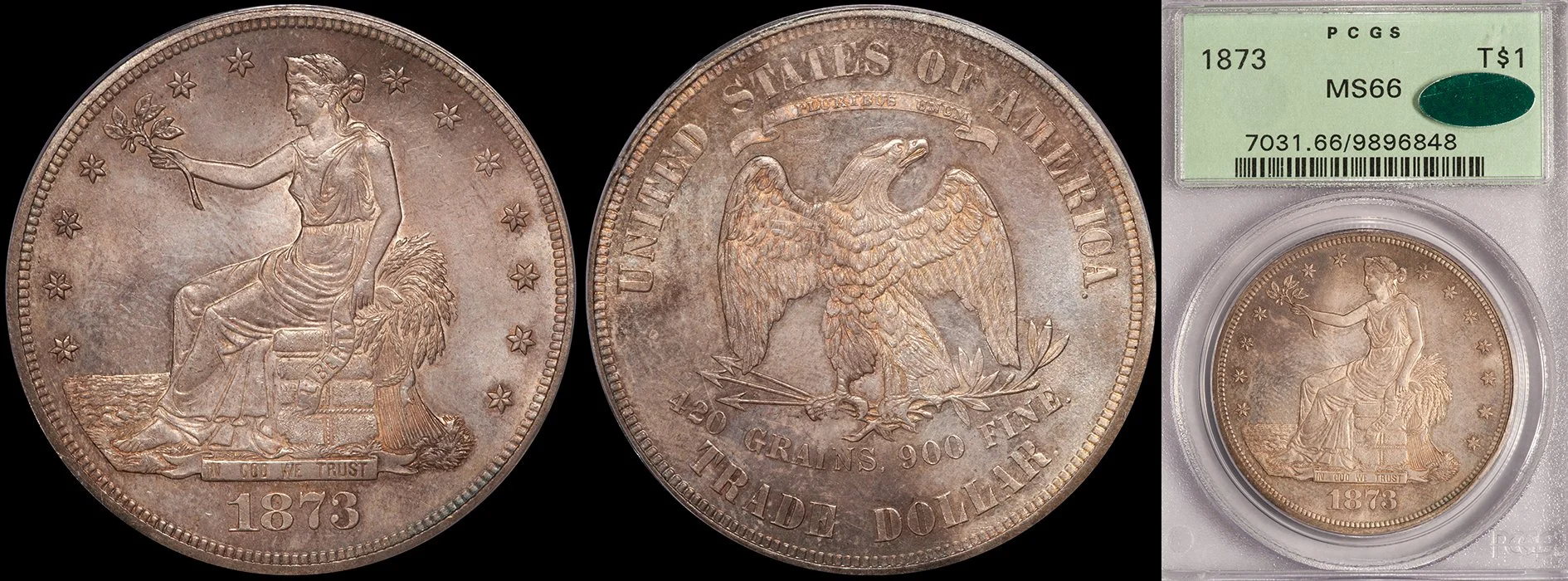
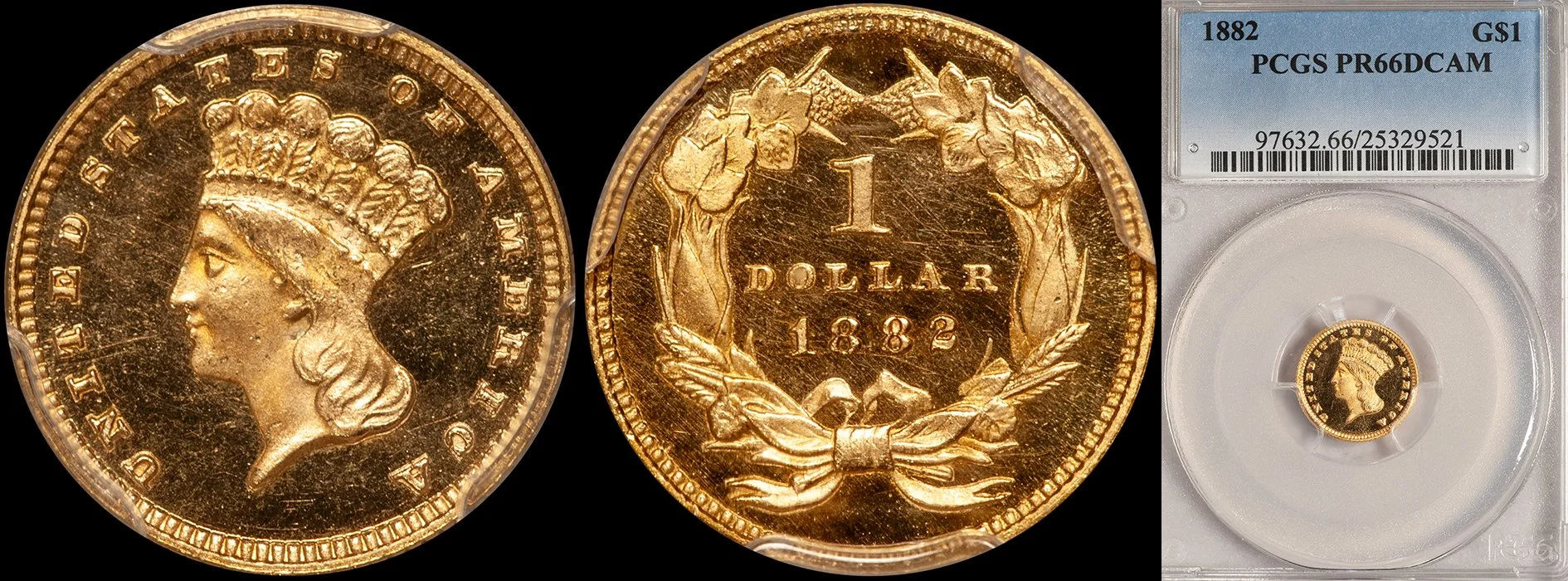
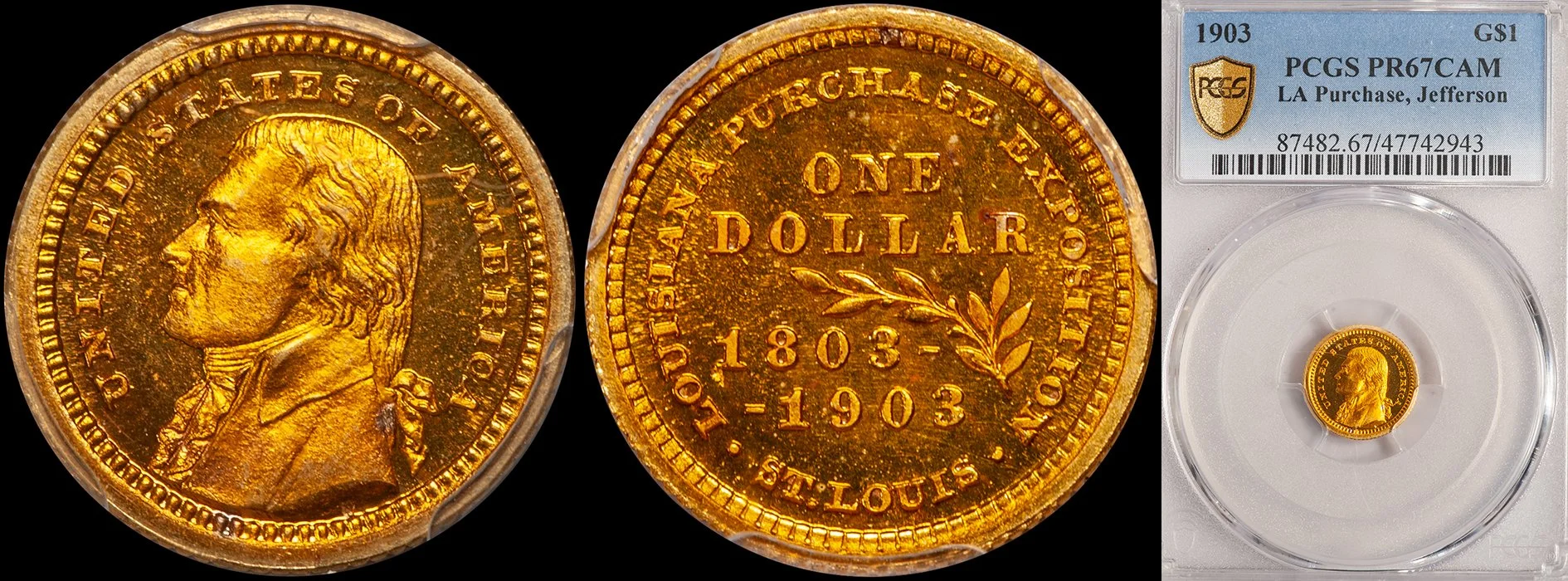
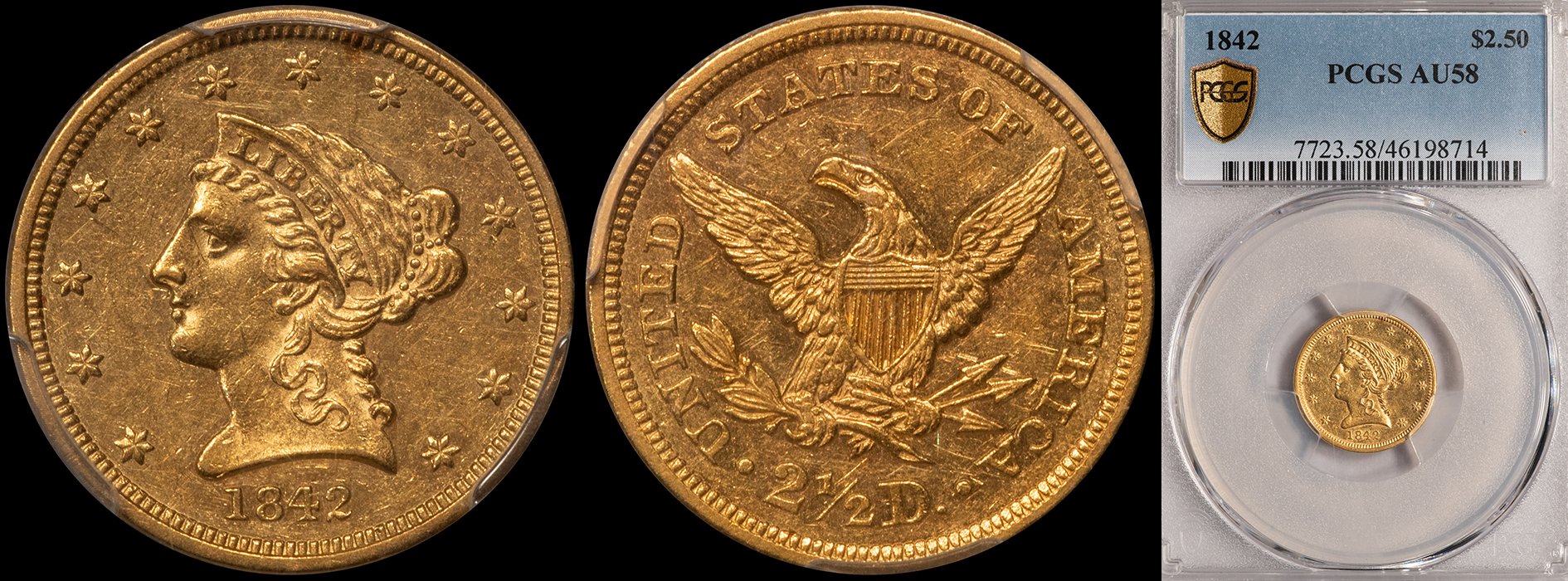
1877-CC $5.00 NGC EF45

While not as rare and undervalued as its eagle counterpart, the 1877-CC half eagle is a scarce issue that is often overlooked when collectors discuss the tough CC dates from this decade. There were 8,680 struck and most of the surviving examples are well-worn. This piece is among the few that I have seen with natural color and surfaces. The obverse and reverse show rich medium russet color with some red and green undertones and darker hues towards the borders. The fields are unusually clean with no marks of note and the detail is better than expected with especially sharp feathers seen on the wingtips and legs. The last NGC EF45 example of this date to sell at auction was Heritage 4/12: 6621 which brought $5,175; the example I offer here is far more original and it shows much better overall eye appeal.

Pricing "Difficult" Coins: A Real World Model

I have written a number of blogs in the past few years about how I price rare coins. Despite this, I still get many questions from new and experienced collectors about pricing. I'd like to share a specific coin that I recently handled and explain how I came up with buy/sell prices. As I have written, I find many of the published price guides to be of little or no use when it comes to complex, infrequently traded coins. When I make decisions at shows, in my office, or in the auction room on what to pay for a coin, I tend to put a lot more credence in auction records. So, if you'd like to play at home, I suggest that you follow along with the PCGS auction archives on pcgs.com as this is a major source of information for me when I make pricing decisions. Here is a "real world" model and the thought process(es) that went along with my pricing decision.

1863 $5.00 NGC MS60 CAC

1863 Half Eagle, Graded MS60 by NGC and CAC approved

This is a coin I handled earlier this year and it is one of the first pieces in a while that, as soon as I saw it, I said "I have to own this." Before I discuss my thoughts about how to price it, let me discuss a little about the issue and about the coin itself.

Only 2,442 business strikes of this year were made and my experience is that the 1863 half eagle is rare in all grades, especially in AU50 or better. I jogged my memory and couldn't recall having seen an example I thought was better than AU53 to AU55 in more than a decade. And, I remembered that this was an issue that typically comes with zero in the way of eye appeal. A quick look online showed me that the PCGS population was none for Uncirculated coins and five for AU58; NGC had graded two in Uncirculated (an MS60 and an MS61) and five in AU58. At the time, CAC hadn't approved a single 1863 in any grade; a good indication that the eye appeal of the typical example was not good.

(How can you, even without my experience, make the same conclusions? Look at the pictures of the 1863 half eagles sold at auction during the last ten years. Are the coin fresh and original or are they bright, abraded and processed? Then, look at the number of auction records. A quick scan of the PCGS archives showed a total of 30 records since 1941. What was immediately impressive to me about this figure was that the highly-regarded 1864-S half eagle had 32 auction records in that time period!)

Of course, all these statistics are just gobbledygook if the coin itself isn't "all there." As you can see from the photo above, this coin had really good eye appeal. In fact, my first question was "why is this only in a 60 holder?" (I recently overheard heard a wholesale dealer, who I regard as one of the top three graders in the world, refer to the MS60 grade as "dumb" and that he "hated it." I tend to agree with him but, in this case, I was smitten with the coin; even it was in the funkiest of all Mint State grades.)

So, at this point I was sold. What would I pay?

With no auction records for an Uncirculated coin, I looked at AU58's. The two most recent sales were $14,950 by Stacks Bowers in August 2012 and $14,375 by Heritage in May 2010. A quick look at images for both coins showed two pieces that were no better, in my opinion, than AU53 to AU55. So, after digesting this, I decided that I would pay at least $17,500-20,000 for a coin that was a real, CAC-quality AU58 (the last "real 58" I had seen was the Bass II coin which sold for $13,800 back in 1999...).

Having concluded that a "real" AU58 was worth as much as $20,000, I figured it would be OK to pay at least $30,000 for a really nice MS60. I wanted confirmation and then decided to see if there were comparable coins that had recent auction records in this grade. Back to the archives I went.

I didn't really find any good comparables for the 1864-P and 1865-P, two dates that I regard as somewhat similar to the 1863; at least in terms of overall desirability. I then looked at the 1863-S; an issue with 17,000 struck but a low survival rate. I believe that this date is about twice as available as its Philadelphia counterpart but, like the 1863-S, it is extremely rare in AU58 and above.

In their June 2011 auction, Stacks Bowers sold a nice NGC AU58+ 1863-S for a remarkable $25,875. This was the single best example of the date that I had seen in years and I thought the price realized would be strong but I was clearly not expecting a winning bid of over $25,000. But this was as good a comparable as I could find and it made me think that if a "gem slider" 1863-S half eagle was worth nearly $26,000 then a somewhat nicer example of a decidedly rarer date (the 1863-P) had to be worth at least $30,000-32,500.

After negotiations, I was able to purchase the 1863 half eagle in this price range. I sent it to CAC where it was approved, thus becoming the first and only stickered example of this date. I listed it for sale in the mid-30's and within a few hours I sold it to a specialist who had been looking for a high grade 1863 half eagle for many years.

And what exactly does this all prove? Here are a few thoughts that I gleamed:

1. With CDN Monthly Summary showing a "bid" of $20,000 for this date in MS60, I knew that I wasn't going to get any help from published price sheets. But that's not a surprise, given that no MS60 coin had ever traded.

2. A few things convinced me to stretch on this coin: its true rarity in all grades, its Civil War date of issue and its great eye appeal. But if I had been offered an 1863-P half eagle in MS60 that was ugly and processed, I might not have figured it for much more than the $20,000 or so that I decided a properly graded, attractive AU58 was worth; maybe even less, in fact.

3. When you are contemplating a purchase of a coin such as this 1863 half eagle, you have to be prepared to stretch. My quick analysis made me think it was a great deal at $25,000 and probably too much of a stretch at $40,000. So, at $30,000 I was still all in and at $35,000 I probably would have been as well but not without some complaining to the seller.

4. How effective is the comparable method I mentioned above for determining value? It can be very effective but it is fraught with potential landmines. Let's say there was just one comparable and it was from over a decade ago--would that be effective? Or what if there were three records and one was 100% higher for a comparable coin) than the other two--would you, as an informed buyer, know the circumstances behind this sale? Is it effective to compare a coin like an 1863 half eagle to, say, an 1863 eagle? Or is this too much of an "apples to oranges" scenario.

5. The bottom line is that no matter how pseudo-scientific we as dealers or collectors try to make pricing, a lot of the numbers that get placed on really rare coins are instinctual. If you are knowledgeable, you'll have a gut feeling that the price is "right" or its "wrong."

Would you like to read more about my thoughts on coin pricing? If so, feel free to email me at dwn@ont.com and fire away with some off your questions.

1894-O $5.00 PCGS MS61

This numismatically significant issue is one of only three With Motto half eagles from this mint and it is the final year of issue of this type from New Orleans. The 1894-O is scarce in the lower Uncirculated grades and it is seldom found above MS61. This lustrous example has typically abraded surfaces but nice luster and color with no signs of rub or friction on the high spots. PCGS has graded just seven finer than this and it has been some time since I've handled a significantly finer 1894-O half eagle.

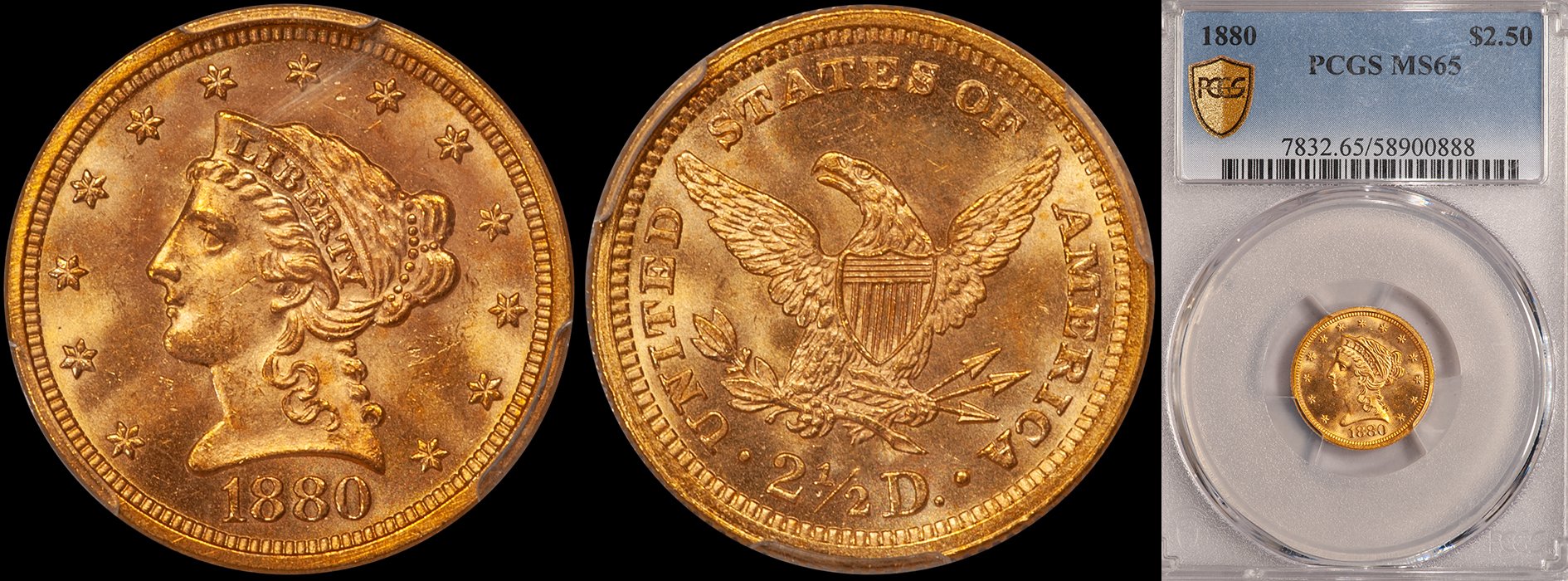
1876-S $2.50 PCGS MS61

With the exception of the high mintage double eagle, all of the 1876-dated gold coinage from the San Francisco mint was produced in small numbers and is scarce. The 1876-S quarter eagle has a mintage of just 5,000 (exactly the same as the 1876-S eagle) but it is more available in high grades and overall than the rare, underrated half eagle and eagle from this year. This very lustrous example is unquestionably new with very bold luster and good overall detail. The raised bar on the throat of Liberty is diagnostic to the issue; some coppery toning at the central reverse is natural and, in my opinion, attractive. I feel that this coin could grade MS62 if resubmitted but with the price difference between an MS61 and MS62 so minimal, I've decided to leave this option to the new owner. Great value at just a spot over three thousand dollars and a lovely little coin.

1847-C $2.50 NGC AU58 CAC

For some reason Charlotte coins with really exceptional color are not seen as often as their Dahlonega counterparts. This 1847-C quarter eagle, while certainly not a rare coin by the standards of this mint, has exceptional color which gives it true character. The obverse and reverse are a deep green-gold with splashes of orange in the fields. As is the case with most examples of this date, the strike is excellent and this piece shows a considerable amount of frosty luster under the aformentioned coloration. This is one of the nicest toned Charlotte quarter eagles of any date that I have seen and it would make a great addition to a set that featured branch mint gold with color.

CAC has approved two in this grade and two finer.

1842-D $2.50 PCGS AU58 CAC

The 1842-D remains one of the very few quarter eagles of any date or mint that appears to still be unknown in properly graded Uncirculated. This statement can be verified by the fact that PCGS, to date, has still not graded an 1842-D quarter eagle higher than AU58 and just four at this level. This is a well-known coin with an illustrious pedigree (see below). It has a good deal of soft, frosty luster remaining and this is highly unusual for the date as most 1842-D quarter eagles are lackluster; even those grading AU50 and higher. The color is a rich natural yellow-gold with a single obverse toning spot at the juncture of the left field and the bridge of the nose. If you know this date, you know that is is extremely rare with eye appeal and this is probably the prettiest 1842-D quarter eagle that I have seen or sold. It should be noted that there is a mint-made depression on the cheek of Liberty; this is seen on many examples of this date and it does not detract. The last PCGS AU58 1842-D quarter eagle to sell at auction was Bowers and Merena 3/09: 1474 that brought $23,000. An extremely important coin for the specialist.

Ex Heritage 1/03: 4660 ($15,525), Heritage 1999 FUN: 7630 ($23,000), North Georgia collection, Stack's 10/94: 870 ($14,300), James Stack collection.

This is the only AU58 1842-D quarter eagle to be approved by CAC. None have been approved in grades higher than this.

1839/8-D $2.50 NGC AU58 CAC

Variety 1-B. This numismatically significant issue has the double honor of being the first quarter eagle made at this mint as well as being the only Dahlonega Classic Head issue of this denomination. The 1839-D is only around twelfth (of twenty) or so in regards to its overall and high grade scarcity but it is clearly one of the most popular issues of any denomination from this mint. This specific coin is very attractive with lovely deep, rich reddish-gold color which is more prominent on the obverse than on the reverse. This is a very late die state with numerous cracks on the reverse and this has weakned the detail at the reverse center. But there is little in the way of actual wear and this piece is very unsual in that it has never been cleaned, dipped or recolored like so many other third-party graded examples. In the last decade, there have been just five AU58 1839-D quarter eagles sold at auction. The last one of these was an NGC coin (Goldberg 9/10: 2764) that brought $13,800.

This is one of just two 1839-D quarter eagles that have been approved by CAC in this grade. Only one finer piece has been approved by CAC.

1855-D $2.50 PCGS AU55 CAC

At one time I felt that the 1855-D quarter eagle was the rarest coin from this mint. I now believe that this honor goes to the 1856-D quarter eagle but the 1855-D is unquestionably the second rarest. Of the 1,123 struck, around four to five dozen are known and almost all are well worn, poorly made and very unattractive. This coin is none of the above, making it exceptional for the date and grade. The quality of the planchet is far above avergae with none of the peels or imperfections seen on many 1855-D quarter eagles and the strike is actually not bad with some detail seen at the center. The surfaces show luster below medium orange-gold color and the overall eye appeal is far above average. I believe that there are no more than 12-15 properly graded AU examples of this date and at least half show prominent mint-made flaws. The last PCGS AU55 to sell at auction was Heritage 10/11: 4694 that brought $17,250. In the Heritage 2/12 auction, a pair of NGC AU55's sold for $17,250 and $18,400, respectively. An extremely important coin for the advanced specialist.

Ex Heritage 1/03: 4704 where it sold for $17,825.

This is the only 1855-D quarter eagle in AU55 to receive CAC approval; there is one finer with CAC approval.

1850-D $2.50 PCGS AU55 CAC

Due to the rarity of the issues from the middle part of this deacde, the 1850-D quarter eagle tends to be overlooked. However, it is a fairly hard coin to find in any grade with around 200 or so known from an original mintage of just 12,148. This nice, lustrous example is very solid for the grade with a good deal of luster present on both sides. The strike is typical for the date with a little bit of weakness seen at the centers but the borders are uncommonly sharp. The last PCGS AU55 example of the 1850-D to sell at auction was Bowers and Merena 6/07: 2534 which brought $4,198; since then, the last seven trades have all been for NGC coins.

CAC has approved three in this grade with five better.