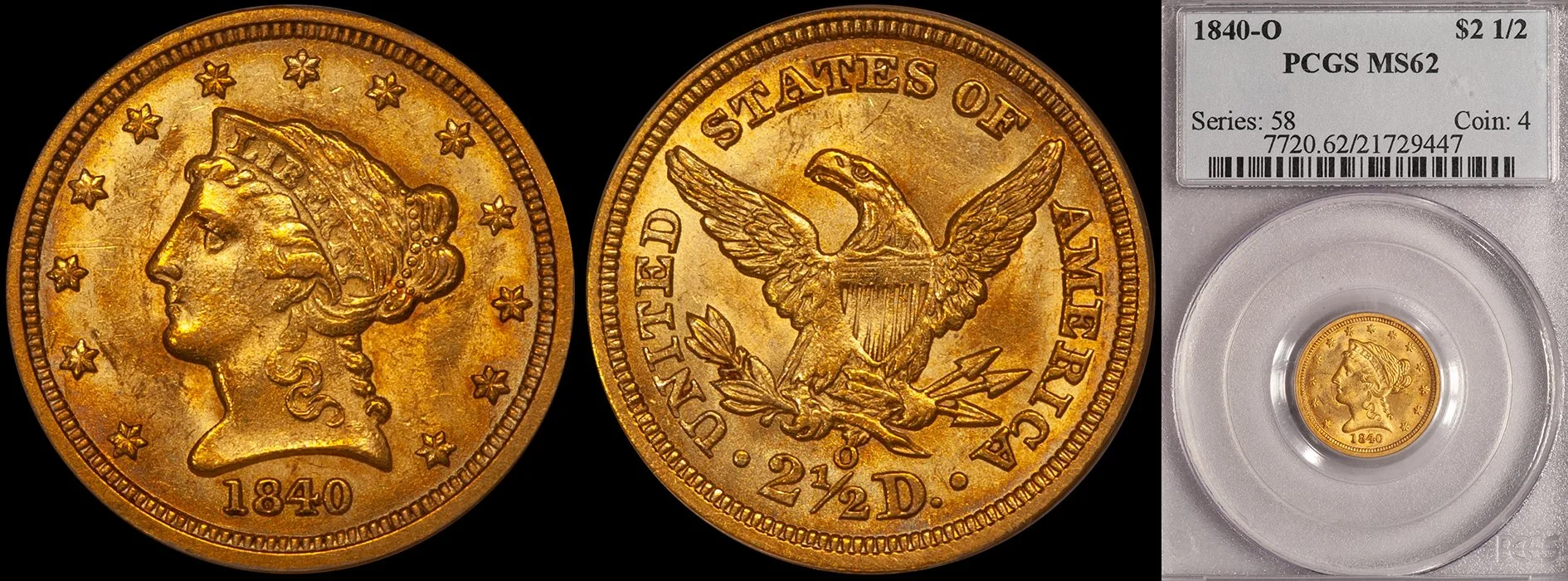
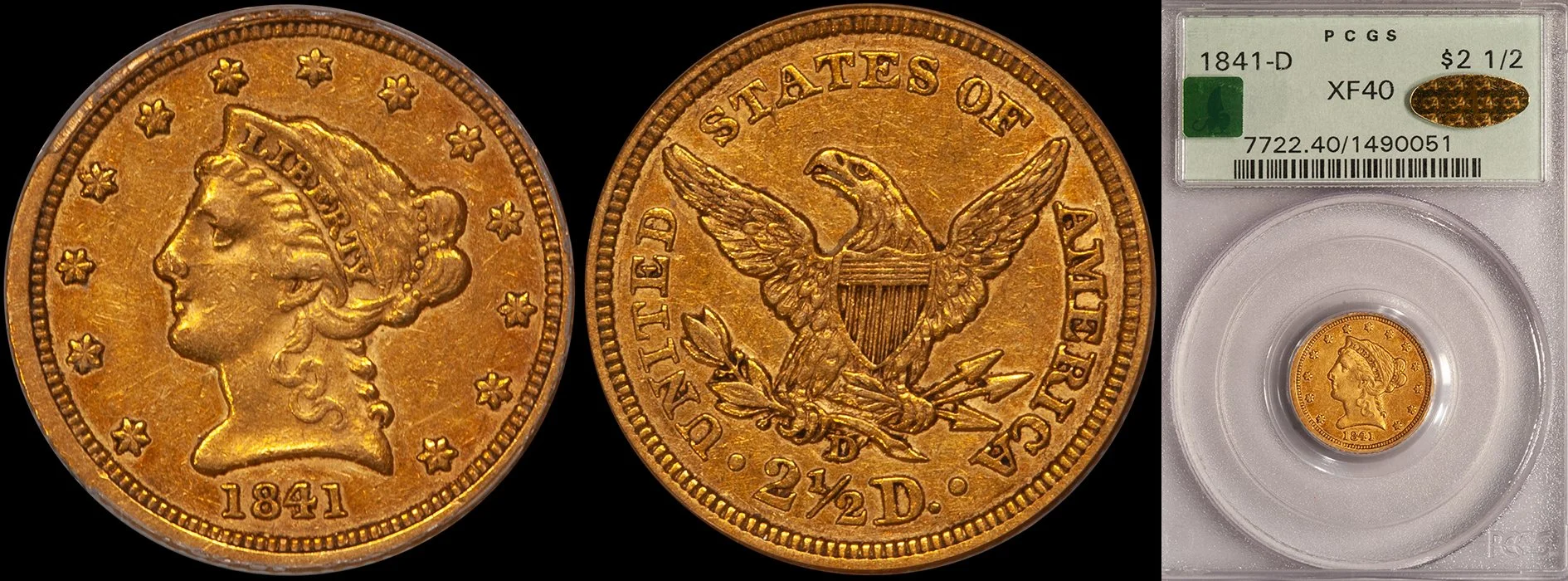
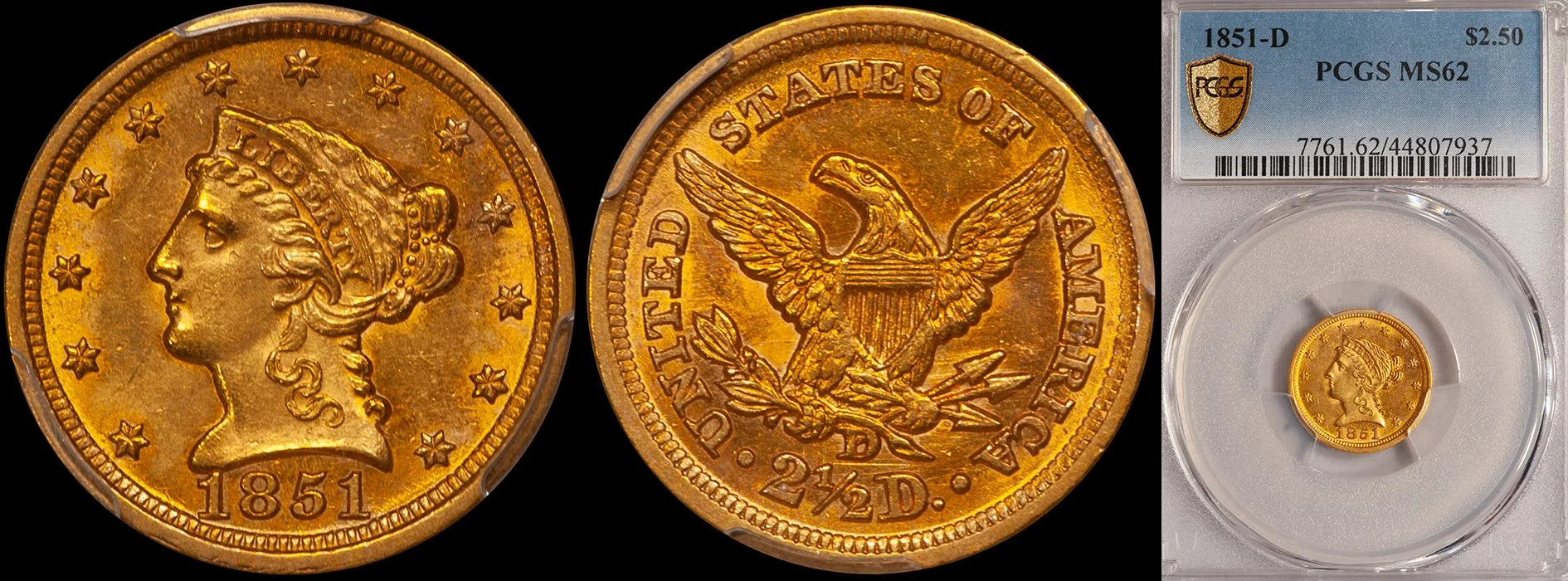
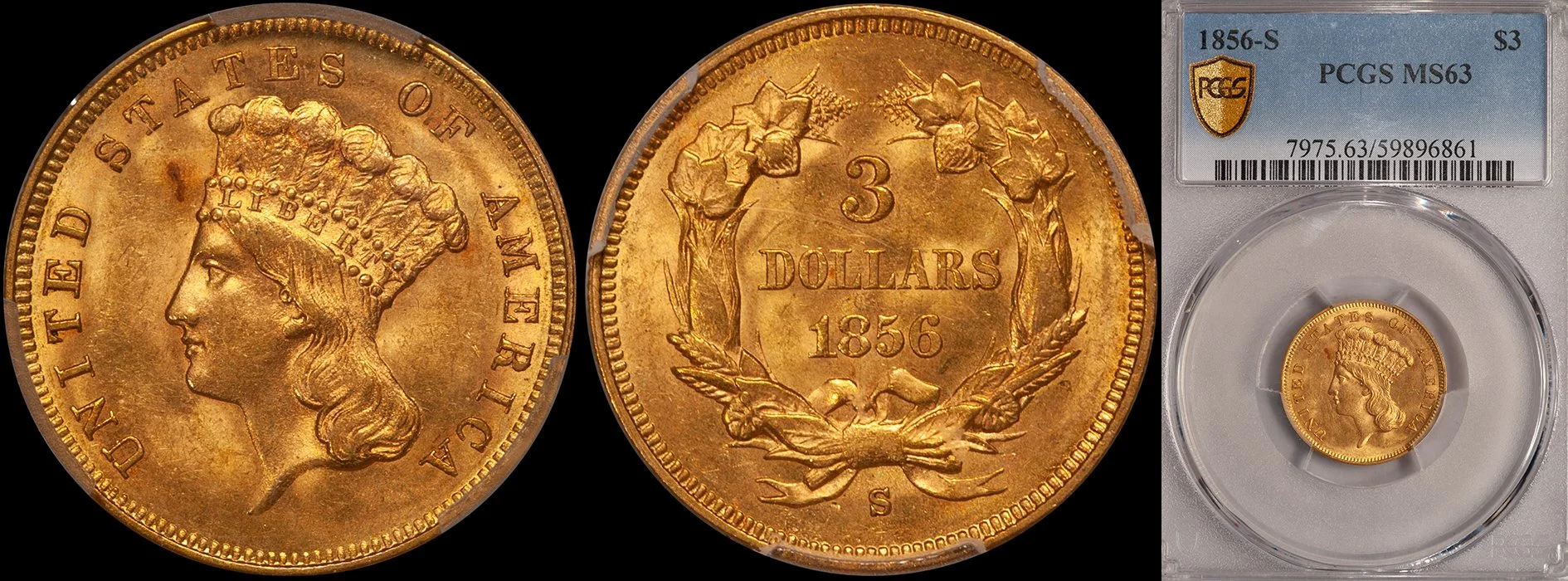
1847-D $2.50 PCGS EF45

If you pay attention to these things, you'll note that the availability of nice, original Dahlonega gold coins of any date or denomination has really dried up in the last year or two. I have a very hard time finding any coins that I like enough to offer to collectors. But it was never easy finding coins like this 1847-D quarter eagle. I have noted in the past that this issue comes with good color more than any other quarter eagle from this mint and this specific example is choice and original with pleasing medium green-gold color. The surfaces are choice and show even wear with plenty of dirt in the recesses attesting to its originality. If you have been looking for a nice, affordable Dahlonega quarter eagle, this piece would be hard to better at less than $3,000.

1851-D $1.00 NGC AU58

As a date, the 1851-D is the second most available Type One dollar from this mint but it is at least two to three times more scarce than the 1849-D. There were only 9,982 produced and this issue tended to see rather heavy circulation with examples usually in the EF40 to AU50 range. Choice AU 1851-D dollars are scarce and examples with natural color and surfaces are quite rare. This piece has some of the most attractive color that I can recall having seen on an 1851-D dollar with both the obverse and reverse showing very deep rich green-gold hues with contrasting shades of russet in the fields. The strike is sharp for the issue with fewer of the usual clashmarks and strong detail seen on the hair, date and mintmark. Below the color, there appears to be a considerable amount of luster and there seems to be no real wear, just a touch of friction on the high spots. This is a superb coin which deserves a strong premium on account of its coloration and it would make a great addition to a Dahlonega set that emphasized eye appeal.

The DWN Market Report: An Appreciation

Around four years ago, a close friend of mine who is not only a very successful businessman but a passionate coin collector made the following comment to me while we were at dinner: "Doug, you need to start a coin blog. Collectors like me are starved for unbiased information, and there's nowhere on the web to find it." With this comment, the raregoldcoins.com DWN Market Report was born.

Around four years later, the number of DWN Market Reports now numbers over 150. At an average of 1500+ words per blog, that's more than 225,000 words or a decent-sized book. I don't think I've repeated too many topics, and I've tried really hard to keep fluff to a minimum. I'd like to think that for many coin collectors, the DWN Market Report has become the go-to source for those who want a high quality educational experience.

So...I'd like to take a few minutes of your time to let you know what the DWN Market Report is--and what it isn't.

About once a month, I get a comment that is somewhere along these lines: "I LOVE your blog. Its like a college course in coins." (or) "I learn more about coins and the coin market from your blog than anyplace else on the web." I love comments like these. To me, an educated collector is a collector who operates out of confidence; not fear. He buys more coins, I sell more coins; we're all happy.

What I try to do with each blog I write is to provide information that any gold coin collector, from beginner to expert, will find useful. Around one-third of the blogs deal with the how's and why's of the market: what to collect, where to find it, what to pay for it, how to grade it, why to sell it, etc, etc. The rest of the articles tend to address specific groups of coins and the collectors who love them: Civil War gold, San Francisco gold dollars, New Orleans double eagles, three dollar gold, etc.

At one time, I wrote blogs that recapped coin shows. I've more or less stopped doing these, except for FUN and the Summer ANA, because they are boring to write and read, and because they are self-serving and trite.

What the DWN Market Report isn't:

-Its not a recap of all the coins that I've sold in the last week. If you want to know what I've sold, look at my website on the day after a major show (when I have the most coins) and three weeks later (when I am nearly out of coins).

-Its not me bragging about how great business is. If you want to know, my business is doing just fine, thanks, but aren't you more interested in Charlotte quarter eagles than my new clients from Charlotte?

-Its not a recap of what I had for dinner last night or how my 45 minute stay in Phoenix was extended to 45 hours due to a thunderstorm.

-Its not an attack on the ANA, the grading services, the PNG, the auction houses or anything/anyone else that I'm feeling cranky about. My Mom always told me to say something nice or don't say anything at all. Mom, I'm pretty certain you were 95% right...

-Its not a lightning rod for controversy.

I've had a few people criticize my blogs for not being more in your face. If you know me at all, I'm not an in your face type or person. I'll teach you how to recognize originality and show you photos of original coins but I'm not going to "out" coin doctors or discuss the latest doctoring techniques. That's just not how I roll. I'll leave that to other coin bloggers...

You came to raregoldcoins.com expecting choice and rare United States gold coins that were fairly priced and for which an active two-way market is made. The DWN Market Report is a reflection of this: clean, concise and taut; the prose equivalent of a well struck, nicely toned early half eagle. And this is what I strive to provide to my readers.

Assembling a Year Set of Civil War Gold Coins: Part Three, 1864

1864 $1.00 PCGS MS67 CAC

In the third part of this series, we look at the gold coinage of 1864. This was, of course, a pivotal year in the war's outcome as well as a very interesting year in the history of American gold coinage. Mintage figures were mostly very low and a number of rare, undervalued coins are known. From a personal standpoint, this is the most interesting year of Civil War numismatics and I still get very excited when I handle a high quality gold coin dated 1864.

1864 Gold Dollar: A total of 5,900 business strikes were produced along with 50 Proofs. The grade distribution of this date is odd, to say the least. The 1864 dollar is not often seen in circulated grades and almost never below AU55. It is seen with some frequency in MS61 to MS63 but, surprisingly, high quality Uncirculated pieces exist in enough quantity to suggest that a hoard existed at one time. There are a few exceptional coins known including four or five in MS68 and a PCGS MS69, ex Superior 2/05: 3402 at $77,000, which is the finest Civil War era gold coins I have ever seen. This issue is known for nice frosty luster and high grade coins show pleasing rose and orange-gold color. Most examples are extensively clashed. The advanced collector of Civil War gold coins should be able to find a really nice 1864 dollar for his set with an MS66 or MS67 not out of the question.

1864 $2.50 PCGS EF45 CAC

1864 Quarter Eagle: As most collectors realize, the quarter eagle denomination was an afterthought at the Philadelphia mint from 1863 to 1865. After a Proof-only emission of just 30 coins in 1863, the mintage for 1864 was 2,824 business strikes plus another fifty Proofs. The 1864 is among the rarest quarter eagles ever produced with an estimated twenty or so known in all grades. As with most of the Philadelphia gold issues from this era, the 1864 quarter eagle didn't see enough circulation to be found in lower grades (unlike the lower denomination gold issues from San Francisco) so most survivors are in the EF45 to AU55 range. There are three known in Uncirculated: an NGC MS61, a PCGS MS61 and an NGC MS67 (ex Byron Reed collection and sold by Spink's in October 1996 for $132,000). This issue is a major rarity and will prove difficult to acquire in any grade. I recently sold a choice PCGS EF45 with CAC approval for $19,500; nice AU's are now bringing in the low to mid 40's.

1864 $3.00 NGC MS62 CAC

1864 Three Dollars: Despite a low mintage of 2,630 business strikes (lower even than the quarter eagle of this year) the 1864 three dollar is only a moderately scarce issue. It is available in circulated grades and can be found in the lower Uncirculated range without much effort. It becomes scarce in properly graded MS63 and it is rare in MS64 and above. Gems are very rare. The finest that I have personally seen is the ANR 3/05: 627 coin, graded MS66 by PCGS, that sold for $36,800. This is a well-made issue with good luster and detail. Many examples show clashmarks in the fields as well as horizontal die finishing lines. For most Civil War collections, a nice MS63 to MS64 will suffice. Slabbed MS65's are extremely rare and many years might pass until one is offered.

1864 $5.00 NGC AU58

1864 Half Eagle: By 1864, the supply of gold bullion available to the Philadelphia mint was extremely low due to hoarding brought on by economic uncertainty. This is evidenced by issues like the 1864 half eagle which had a mintage of 4,170 business strikes plus another 50 Proofs. There are around five dozen 1864 half eagles known with most in the EF40 to AU50 range. This is a rare issue in AU55 to AU58 and it is extremely rare in Uncirculated. I know of just two: the Heritage 9/07: 3436 ($18,975) ex Bass II: 1148 coin (graded MS61 by PCGS) and Milas: 529 (which sold for $14,300 bck in 1995) which was graded MS61 by NGC. This is a coin that is seldom seen with good eye appeal. Most have been cleaned and show impaired luster as a result. For most advanced collectors, an AU55 to AU58 is about the best that can be hoped for.

1864-S $5.00 PCGS VF30

1864-S Half Eagle: Generally, Civil War gold coinage production was higher at the San Francisco mint than at Philadelphia due to more available bullion. This was not the case with the 1864-S half eagle (or eagle; see below) which saw just 3,888 struck. This is one of the great rarities of the entire Liberty Head half eagle series with an estimated twenty or so known. This issue also differs from many of the Philadelphia gold coins of this era in that few survivors exist over EF45. In fact, I can't account for more than three or four properly graded AU pieces. There is one sensational Gem known (graded MS65 by PCGS and better than this by today's standards) that is in a Southern collection and is ex Bass II: 1150 ($178,250) and Norweb I: 875 ($110,000). This is one of my absolute favorite United States gold coins of any date or denomination and a Civil War set that included this piece would truly be "one for the ages."

1864 $10.00 NGC AU53, courtesy of Heritage

1864 Eagle: The 1864 eagle is slightly scarcer than the 1864 half eagle in terms of overall rarity (around fifty are known from the original mintage of 3,530 business strikes) but it is a rarer coin in high grades. Although a few have been graded MS61 by NGC, I have never seen one that I felt was better than AU55/58 and I feel that there are fewer than ten properly graded AU examples known. This is an extremely hard issue to find with good eye appeal as most are very abraded and show impaired luster from having been dipped and/or cleaned. Any 1864 with original color and surfaces is very rare. For most Civil War collectors, an AU50 to AU53 example is about the best coin that may be available. With patience and luck it might be possible to find an AU55.

1864-S $10.00 PCGS VF30

1864-S Eagle: While the 1864 quarter eagle is probably rarer, the 1864-S eagle is the 1864-dated gold coin that most collectors would like to own. Of the 2,500 struck, it is likely that two dozen survive and this includes a number of very well worn or damaged examples. As rare as its half eagle counterpart is in higher grades, the 1864-S eagle is even rarer, I know of just two or three in AU and the best of these is ex Bass III: 656, graded AU55 by PCGS, that sold for $36,800 (it would bring four or five times this amount today, if not more...) The concept of eye appeal is irrelevant when it comes to this issue. Needless to say, any 1864-S with original color and surfaces is extremely rare and highly desirable. A Civil War gold set with the 1864-S eagle in EF would be impressive; a set with this issue in AU50 or higher would be a stunning accomplishment.

1864 $20.00 NGC AU50

1864 Double Eagle: What little gold that was available to the Philadelphia mint in 1864 was used primarily to make double eagles and 204,235 were struck; nearly as many as in 1862 and 1863 combined. Compared to the other Philadelphia issues from 1864 that I have discussed above, the 1864-P double eagle is common. But this being a double eagle, it is far more popular and it must be considered in that context. The collector who is seeking a circulated 1864 double eagle should be able to locate a nice piece without having to spend much more than $5,000. Finding an Uncirculated example is another story as this issue remains rare in Uncirculated, despite the fact that a small number were found in the S.S. Republic treasure. The finest known is a wonderful PCGS MS65 that is ex Heritage 8/11: 7651 (as NGC MS64+) where it sold for a record-breaking $207,000.

1864-S $20.00 PCGS MS62

1864-S Double Eagle: This is easily the most available gold coin dated 1864 as you would expect from its high mintage of 793,660. It is hard to state with certainty how many are known today but the actual number could be as high as 1,500-2,000 as examples are still being found in Europe. This date used to be exceedingly rare in Uncirculated but examples grading MS60 to MS63 were found in the S.S. Brother Jonathan shipwreck and then a smaller number of choice pieces were found in the S.S. Republic.. This second shipwreck s the source of the current highest graded 1864-S, an NGC MS65 that sold for a remarkable $115,000. This is an easy issue to find in nice AU grades and examples with original color and surfaces are still around. Non-seawater Uncirculated examples are very rare. For most Civil War collectors, a nice MS62 or MS63 "Bro Jo" would be a great choice for their set.

The gold coins dated 1864 contain some really rare issues (most notably the 1864-P quarter eagle and the 1864-S half eagle and eagle), but there are no "impossible" coins. As with all Civil War years, these coins are, for the most part, extremely rare in high grades. Ironically, some of the greatest individual Civil War coins are dated 1864: the Byron Reed 1864-P quarter eagle and the Bass/Norweb 1864-S half eagle are the two that come to mind.

In next month's fourth and final installment of this series, we will look at the gold coins dated 1865 and reach some final conclusions about collecting Civil War gold coins.

Please feel free to send my comments and suggestions regarding this article to dwn@ont.com

A Baker's Dozen of San Francisco Gold Treats

Collector K.U. recently asked me to help him construct a compact, meaningful list of San Francisco gold coins to form the basis of his collection. The parameters were as follows: the dates selected must have historic and/or numismatic significance, they must be selected for being the best value grade for the issue in question and, where possible, they should be dated around the Civil War era or earlier. I gave this list some thought and tried to narrow down the list to a dozen or so coins. I eliminated the 1854-S quarter eagle due to financial considerations and the 1854-S five dollar due to realism. I then tried to include at least one example of each of the six denominations of gold coins struck at the SF mint and, because of the collector's taste, limited the set to those issues struck in the 19th century. (I might have included the 1920-S eagle and a rare date Saint or two if the list had been longer...)

As I've pointed out before, San Francisco gold coinage of the Liberty Head design can basically be divided into two groups: the "golden era" issues struck from 1854 through around 1878 and the other issues made from 1878 until the new 20th century designs were incorporated in 1908. I personally find the former much more interesting due to their low mintages, the fact that they tended to be actively used in commerce and are thus often exceedingly rare in higher grades and their low overall survival rates.

Without further ado, here is the list:

1. 1854-S Gold Dollar: In my opinion, one of the ways in which to make this set more interesting was to include as many first year of issue coins as possible. The 1854-S is an ideal choice for inclusion in this set given its first-year status. With a mintage of 14,632 this is not really a scarce coin but it is not really easy to locate in higher grades. I am fond of the 1854-S because it tends to be much better made than the other branch mint gold dollars of this era and I find it to be quite undervalued. A nice Uncirculated example could be located in the $5,000-7,500 range and for the collector on a more limited budget, it is possible to acquire a really solid AU 1854-S dollar for less than $2,000.

2. 1856-S Gold Dollar: I wasn't originally going a second gold dollar in the set but the numismatic significance of this issue is hard to overlook. The 1856-S is the only Type Two gold dollar from this mint and it is also the only Type Two from any mint that was made in 1856; a transitional year in which the new Type Three design was struck at the Philadelphia and Dahlonega mints. The 1856-S is fairly easy to locate in lower grades and becomes rare only once the MS62 to MS63 level is reached. Many examples show a dramatically double punched mintmark which doesn't add value but which does increase the "coolness" factor exponentially. A choice circulated example can be purchased for $3,000 to $5,000 while a nice Uncirculated piece has become a bit pricey at $7,500-15,000 and up.

3. 1862-S Quarter Eagle: The obvious picks for quarter eagles are not so obvious. The 1854-S is out of the question due to its hefty price and the next few "early dates" (the 1856-S and 1857-S) aren't that interesting. So, given the collector's interest in Civil War issues, I selected the rarest Civil War quarter eagle from this mint: the 1862-S. Only 8,000 were produced and I have found the 1862-S to be a tough, elusive coin that is still not entirely recognized by rare date gold collectors. I've only handled one Uncirculated 1862-S in 25+ years of buying choice SF gold (the finest known PCGS MS63+ I purchased in the February 2012 Goldberg sale for $43,250) and know of just one or two others. A nice EF example, when available, is still affordable (in the $2,500-3,500 range). A mid-range AU is hard to find but still not priced at more than $5,000-7,500.

4. Scarcer Date 1870's Quarter Eagle in Uncirculated: You can't have just one quarter eagle in this set, right? But there really isn't a date from the post-Civil war era that stands out to me so my suggestion is to buy a better date issue from the 1870's (such as the 1871-S or 1872-S) in MS62 or MS63. These coins are legitimately scarce in this grade (with on order of five to ten known) but are not that expensive with prices ranging from around $4,500 up to $7,500 and more. What I like about these types of coins is that they tend to be well made, attractive and there are very few known in grades higher than MS63. A few sleeper dates are known and these include the 1870-S, 1873-S and 1876-S but even these aren't terribly expensive...yet.

5. 1855-S Three Dollar: To be varied and complete, this set needs a Three Dollar gold piece so why not include the first-year-of-issue 1855-S? Only 6,600 examples were made but this issue is generally available in EF and AU grades. And prices remain very reasonable for this issue, despite its numismatic significance. I recently sold a choice, original EF45 with CAC approval in the mid-3's and also sold a decent PCGS AU55 in the low 10's. In high grades, the 1855-S becomes very rare and I am aware of only three to five Uncirculated examples as well as a unique branch mint proof which is now in an East Coast specialist's complete set of Proof Threes.

6. 1855-S Half Eagle: Even if this collector had unlimited funds, he wouldn't be able to buy an 1854-S half eagle. So, for all intents and purposes, an 1855-S is the first-year-of-issue for the half eagles from this mint. As you might expect with a coin that had 61,000 struck, this isn't a real condition rarity and decent EF's are reasonably plentiful and very affordable. Lower end AU's remain a good value in the $2,000-3,000 range but properly graded AU55 to AU58 examples are rare and undervalued. I can only recall having seen one Uncirculated example (a PCGS MS62, ex Bass II: 1077). A piece of advice about 1855-S half eagles: be patient. There are a lot of crummy examples out there but a few nice ones do exist and with prices still so reasonable for this issue it pays to be selective.

7. 1864-S Half Eagle: This formerly obscure issue is becoming famous and well it should; it is the second rarest Liberty Head half eagle and a very rare issue in all grades with around two dozen or so known from the original mintage of just 3,888. Despite this coin's great rarity, it is not yet priced at the level that I believe it should be. I recently sold a PCGS VF30 for $21,500 which seems like a lot for a coin graded VF30 but, when you consider this date is far rarer than a number of coins that sell for six figures. I don't often say this but here is an issue that you should throw caution to the wind and be very aggressive if one becomes available. I think the 1864-S half eagle has great upside potential and as San Francisco gold grows more and more popular, this has the potential to be a six figure coin.

8. 1876-S Half Eagle: This has been a favorite "sleeper" date of mine for years. Only 4,000 were struck and it is an issue that exceeds the better known Civil War issues from the 1861-1863 era in terms of overall rarity. I regard it as the second rarest collectible half eagle from this mint (after the 1864-S) and I believe that there are fewer than fifty known in all grades. It is an easy issue to identify as all known examples have a dramatic ring-like punch in Liberty's earlobe. There is one known in Uncirculated: the Garrett I: 487 coin that sold for $34,000 back in November 1979 and which I think is one of the single most desirable (and least well known) Liberty Head half eagles of any date or mint. From time to time, EF's are available and they still can be had for less than $5,000 (cheap!!) while a decent AU will cost two to three times this amount.

9. 1854-S Eagle: The 1854-S is not even close to being the rarest early date SF eagle of this denomination but as the first-year-of-issue its certainly the most historic and a great Gold Rush artifact. The 1854-S has a high original mintage of 123,826 and there are certainly 500+ known in all grades (making it arguably the most available coin in this collection). But it has a coolness level that is off the proverbial charts and it is affordable. I sell nice AU's in the $2,500-3,500 range and I recently sold a great-looking PCGS AU58 for $5,750. Most examples are very abraded and few have original color; hold out for pieces that are relatively mark-free and nicely toned. I have only seen or heard of one Uncirculated 1854-S eagle, an NGC MS61 that was sold privately by a West Coast dealer around six years ago.

10. 1864-S Eagle: I've written extensively about this issue so I won't flog a dead horse. But I will say, for the dozenth time, this coin is rare, rare, rare. It is the second rarest Liberty Head eagle after the 1875 and it is certainly a coin that would sell for six figures if it were in almost any series other than the Liberty Head eagles. I just offered a lovely PCGS VF30 with CAC approval on my website and was surprised (but not really surprised) to get multiple orders for it within the first day it was listed. I would offer the same comments with this issue as I would with the 1864-S half eagle: if you get the chance to buy one that you can live with, act quickly and decisively.

11. 1854-S Double Eagle: The 1854-S is an odd coin. It seems like it shouldn't be that rare (over 140,000 were made) and the population figures aren't all that low. But the survival rate is astonishingly low with just a few hundred known. And what PCGS or NGC figures won't tell you is that nearly all the Mint State 1854-S double eagles are from the S.S. Yankee Blade shipwreck. This means that examples in any grade with original surfaces are rare and I have only seen two examples in Uncirculated (a PCGS MS60 and an NGC MS61) that didn't have seawater surfaces. After years of being inexpensive, the 1854-S got discovered a few years ago and it has probably tripled in price in the last three years. I still think its not a bad value and, in fact, just sold a PCGS AU50 for less than $9,000.

12. 1857-S S.S. Central America Double Eagle in MS64 to MS65: I wasn't going to put this issue in the proposed San Francisco collection but after some thinking, I just had to add it. How can you collect San Francisco gold from the 1850-1880 era and not own a nice SSCA 1857-S? They are big, beautiful, historic coins that beg to be included in any set. My parameters are pretty straightforward on this issue: buy a coin in the original gold foil SSCA PCGS holder, get the original bells and whistles that came with it and avoid a piece that has turned in the holder. That leaves probably over a thousand available coins in the $10,000-15,000 price range.

13. 1861-S Paquet Reverse Double Eagle: The thirteenth--and final--coin in the set is probably the most expensive but certainly among the most interesting. The story of the Paquet has been told many times before but I think the important things to remember about this issue is that it was virtually unknown until examples were found in Europe in the 1950's. It jumped dramatically in price a few years and mid-range AU's were topping out at over $125,000. Prices have receded since then but I note that demand for this issue is coming back. It is extremely hard to find examples with good eye appeal and many of the "real" EF's have been scrubbed into AU50, AU53 and even AU55 holders. My advice: if you see a good looking Paquet and the price isn't goofy, get aggressive. I'd budget at least $75,000 for a nice Paquet.

Do you need help devising a collection of United States gold coins? Email me at dwn@ont.com and perhaps I can answer your questions with a blog just like this one.

1844-D $2.50 PCGS MS62 CAC

Most of the 1844-D quarter eagles that exist in higher grade are not well struck and the present example, despite being produced from clashed and slightly rusted dies, is very sharply impressed with nearly full centers. The color on this piece is excellent with rich yellow gold color in a concentric ring around lighter centers. A small reeding mark on Liberty's chin, from contact with another coin, is all that keeps this piece from a higher grade. There are an estimated dozen or so 1844-D quarter eagles in Uncirculated and I have never seen one better than MS63. Since 1999, five auction appearances for PCGS MS62 examples of this issue have occured and the prices realized have ranged from a low of $10,350 to a high of $17,250. The coin offered here, which is housed in an older pre-barcode holder, is the only 1844-D quarter eagle in MS62 that has been approved by CAC and none finer have received this coveted seal of approval. An important coin for the advanced Dahlonega specialist.

1842-O $2.50 NGC EF45 CAC

Around half of the known 1842-O quarter eagles have strikes that range from "weak" to "are you kidding me??" This example is actually quite well struck with no serious weakness at the centers. It is also original with nice deep green-gold colors seen on the obverse and reverse and some dirt in the protected areas. The 1842-O is the second scarcest quarter eagle from this mint after the 1845-O and it is a hard issue to find with good eye appeal. Excellent value at less than $1500!

1879-CC $5.00 PCGS MS62 CAC

Tied for Finest Known. This fresh-to-the-market example is not only tied for the finest known 1879-CC half eagle (more on this below), it has a great backstory as well. Around six months ago, it walked into a coin store in Nevada raw, along with a group of otherwise unspectacular bullion-related gold. It was then sent to PCGS where it graded MS62 and was just sold to me. It is stone cold original with superb deep natural green-gold and orange-gold hues seen on the obverse and reverse. There are a few light ticks in the fields but the appearance of this piece is exceptional and this is one of the best CC gold coins from the 1870's of any denomiantion that I have seen. The previous finest known 1879-CC half eagle is a PCGS MS62 in the Battle Born collection that brought a staggering $69,000 when it was sold as Heritage 2/11: 4474. That coin, like this, was totally fresh and had been found in a group of common date gold coins in Europe. It is remarkable that the two finest known 1879-CC half eagles have been introduced to the numismatic community.

Why I Made Collector X Mad

The phone rang early Saturday morning. It was a collector calling. The conversation went something like this: "Hi Doug, this is "collector X" (the names have been changed to protect the innocent) and I'm getting ready to enter the convention hall. I want to see your coins. What's your table number again?"

"Ummm...it was Table 201 but I left the show last night and I'm currently in my office working up my new purchases so they can be on the website this afternoon."

"You what?!? You left?!? Isn't the show on Saturday? You HAVE to be there. That's not right..."

"I'm really sorry, sir, but I arrived in Schaumberg on Tuesday and I thought three and a half days was enough time to spend at the show. I was around all day Thursday and much of Friday."

"But I work and can't get the time off."

We talked back and forth for a few more minutes. I felt bad that Collector X had driven a few hours to the show and he was about to discover that some of his favorite dealers (not just me) had left on Friday.

Which brings us to the major question at hand: why did I leave early and why will I continue to leave shows (with one or two exceptions) on Friday?

The short answer: most coin shows are too long. Many open on Wednesday and go through Saturday or even Sunday. If you ask ten dealers if they need a coin show to be four or five days, I'm guessing that nine (or more) will say "no." Exceptions to the rule: The January FUN show and the Summer ANA show which are busy enough that most dealers are OK with attending them for the extra day or two.

Here's my take on shows: not only are they too long, there are too many of them. I look at shows as a necessary evil. I have to go to them because this is where I buy a lot of my coins. But if I could figure a way to reduce my show schedule to, say, three or four a year, I'd do it in a heartbeat.

As Collector X was quick to remind me, coins shows are important for him. He gets to see coins, he gets to schmooze with his favorite dealers, and he can buy some stuff. I see his points but I'd offer the following retorts:

1: Most dealers don't put their good coins out at shows, choosing instead to offer them to selected clients via want lists or placing them on their websites.

2: At most shows, dealers are highly stressed-out and a relaxin' chat with a collector isn't practical. If a collector wants to speak to a fully focused, well-rested dealer, he'd do much better speaking to that individual on the phone a week or two after a show, when the dealer is decompressed and relaxed.

3: As a collector, wouldn't you rather make a buying decision in the comfort of your own home, using your own lighting (at most shows the lighting is abysmal...) and not being pressured to make a quick "yes or no" decision?

If you ask ten dealers what they go to shows for, I'm sure you'd get ten different answers. I go to shows primarily to buy. I believe that the excellence of my website means that I have a better delivery method for coins than putting them out in a showcase once per month. That's the reason why when you go to my table at most shows, you see around eight coins laid out in the case. Where are the rest of them? Put away in my safe, waiting for me to image and describe them and place them on my website.

As I mentioned above, I feel that my website is excellent and my inventory is best served by the good images and descriptions found on www.raregoldcoins.com. In order for me to buy coins at shows, I have to get there early.

I told Collector X that the problem with a show like Central States is that it's "front-loaded." By this, I mean that, as a dealer, if you arrive on Wednesday afternoon, you've probably blown your chance to get an early shot at the fresh coins other dealers have for sale. If I had a staff, I'd have them come in the day I was departing in order to man the table while I went home and processed the new purchases. The problem is, most collectors, like Collector X, want to talk to me and not a staff member. Which sort of leaves me between a rock and a hard place.

The ideal solution to this problem is to start shows first thing on a Thursday and end them in the mid-afternoon on Saturday; lean and efficient, please. And I like the idea of having "day tables" where I might be able to vacate my space at the front of the room on Friday and have a smaller dealer from the back of the room move up to my spot.

Collector X, when you read this blog please realize that I feel your pain. Taking the time to drive to a major show and then having many of your favorite dealers not there is no fun. Please know that I was hard at work all day on Saturday (and much of Sunday) on the two nicest days of the year so far in Portland (you have no possible idea how much I wanted to go hiking...) so that you and other DWN customers would be able to have a shot at over fifty new coins by late morning Saturday. Next time I'm in your neck of the woods, let's go have a cocktail, let's go talk about gold coins and let's bury the hatchet.

Sincerely,

Doug Winter