1843 $2.50 NGC MS62 CAC

The 1843 is an enigmatic date in the early Liberty Head quarter eagle series. It has a high mintage figure of 100,546 but it is comparable in rarity to dates such as the 1846 and 1847 which were struck in much lower quantities. The 1843 is a very scarce issue in Uncirculated but, like so many of the quarter eagles from the 1840's, it is undervalued. This butter-yellow example is fully struck and shows nice luster. There is an area of friction in the left obverse field that limits the grade but the overall appearance is very nice for an MS62. The last NGC MS62 example to sell at auction was Heritage 2/11: 4331 that brought $3,594; the present example is clearly superior in my opinion.

1877 $2.50 PCGS MS63 CAC

Even if you have no interest in purchasing this coin, click on the photo icon and take a long glimpse at its appearance: it has the "look" that I find more appealing than on any other gold coin. The luster is very intense with a hybrid appearance that combines rich frostiness with flashy reflective luster. This excellent appearance is compounded by superb natural medium yellow-gold color that shades towards rose and green hues as the coin tilts towards a light source. The obverse is a virtual Gem in appearance; the reverse shows a few very hard-to-find marks at TE in STATES. The 1877 is a rare, low mintage issue with just 1,652 struck. It is a bit less rare overall than this tiny figure would suggest but it is rare in Uncirculated and very rare in MS65 or higher. There are no Gems known and maybe three exist in MS64 with the last one, Heritage 10/11: 4731 (graded by NGC and approved by CAC) having been purchased by me for $14,950. No PCGS MS63 1877 quarter eagles have sold at auction since October 1999 when Bass II: 593 brought $8,740. A great coin that combines beauty, rarity and eye appeal in one neat package.

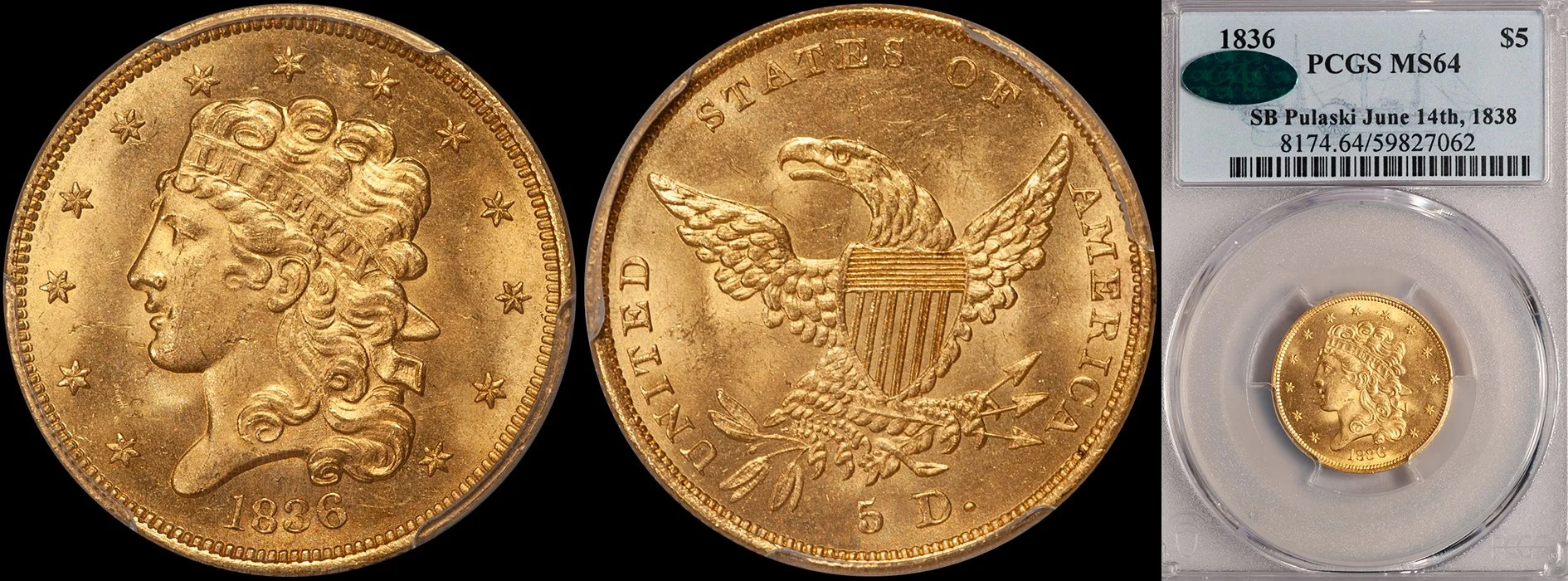
1838-D $5.00 PCGS EF40

I can't think of a Dahlonega issue that is more popular than the 1838-D half eagle. It is the first coin of this denomination made at this mint and it is a one-year type with the popular Classic Head design and the presence of the mintmark on the obverse. It is not a major rarity but it is an issue that appears on nearly every Dahlonega specialists' want list; as well as on many non-D mint collectors as well. This moderately worn example is given above-average eye appeal by its rich reddish gold color that outlines the devices on the obverse and reverse. As is typical for the issue, there are some scattered marks in the fields. The originality of this piece is further demonstrated by the presence of dirt in the protected areas of the obverse. It has been quite a while since I have had an affordable, middle grade example of the 1838-D half eagle in stock and I expect this coin to sell quickly.

Assembling A Year Set of Liberty Head Eagles, Part Two: 1867-1907

In the first part of this article, I discussed the ins and outs of assembling a year set of Liberty Head eagles from 1838 through 1866. In case you've already forgotten the premise, it's that a collector can purchase one example of each year that this denomination/type was produced in order to save money and still be an active participant in this very interesting (and very long-lived) series. Without further ado, let's go to the videotape, Bob...

1867: Only two mints struck eagles this year. Philadelphia is rarer and less expensive than San Francisco. I'd go with a nice 1867-P eagle and might even stretch a bit as it is undervalued.

1868: Neither the Philadelphia or San Francisco eagle of this year is hugely rare or even all that interesting. Either one, in EF45 to AU53, seems like a good purchase. Look for a coin with nice original surfaces.

1869: The 1869-P is a rare, low mintage date that is still not all that expensive. I'd go with a nice example with original surfaces and would even stretch for a high end (AU50 or better) example.

1870: This is a numismatically significant year as the Carson City mint began operations. The 1870-CC would be a great choice for this set but it is rare and expensive. The P and S mint eagles are both scarce and undervalued. It is hard to choose from one or the other!

1871: The 1871-CC is among the more affordable eagles from this mint produced before 1880 so it would be a good choice for this set. The 1871-P has a mintage of only 1,820 and it is very undervalued in all grades.

1872: The only affordable eagle dated 1872 is the San Francisco coin which is fairly common up to AU55. The 1872-P is very rare as is the 1872-CC. I'd probably settle for a nice AU 1872-S.

1873: For gold collectors, this is a banner year with many interesting issues. I love the 1873-P with its mintage of 800 and the 1873-CC is one of the three rarest eagles from this mint. Even the 1873-S is scarce but it is the most available of the three. Still, I'd splurge and go for a nice 1873-P.

1874: Mintages increased this year and the 1874-CC is the most available CC eagle struck before 1880. I'd look for a nice example in EF45 to AU55.

1875: The stopper this year is the 1875-P which has a mintage of just 100 business strikes and fewer than ten survivors. San Francisco didn't make eagles this year so your only realistic option is the 1875-CC which is very scarce but not impossible like the 1875-P.

1876: Another very interesting year with three possible dates available and all scarce. I personally like the 1876 as just 687 business strikes were made. The 1876-S is a sleeper which is far rarer than its mintage of 5,000 would suggest. A nice example of any of the three issues would be a great addition to this year set.

1877: The Philadelphia eagle is very rare (797 struck) while the CC is very scarce. The 1877-S is fairly common but a bit boring. I'd personally look for a nice AU 1877.

1878: Mintages increase beginning with this year as does availability. While the 1878-CC is very rare, the 1878-S is only semi-scarce in AU and the 1878-P is the first date in this set that is actually available in Mint State for less than $10,000+.

1879: For the first time, four mints struck Liberty Head eagles as the New Orleans mint reopened. I personally love the 1879-O, given its very low mintage (1,500 coins) and its numismatic significance. The 1879-CC is very rare also but much more expensive than the 1879-O.

1880: Another four mint year. Nothing struck this year is rare although the CC and O issues are extremely hard to llocate in AU58 and above. I'd select a nice 1880-O or 1880-CC in AU55 to AU58.

1881: Yet another four mint year. The scarcest issue is the 1881-O while the 1881-CC is actually somewhat available in higher grades. I think I'd pursue a nice 1881-CC.

1882: The second to last of the four mint years and another with no real rarities. I would look for a nice 1882-CC or 1882-CC in the middle to upper AU grades.

1883: The last four mint year of the eagle denomination for many years (until 1906) and one with a notable rarity: the 1883-O which had a mintage of only 800 coins. This issue has become quite expensive so it might make sense to look for a nice AU example of the 1883-CC.

1884: The New Orleans mint stopped making gold coins until 1888 so only three mints made eagles this year. The scarcest is the 1884-CC. The 1884-P is a sleeper and I would look for a nice, original MS62.

1885: Only two mints made eagles in 1885. Both are common and not especially interesting.

1886: Same comments as with the 1885. Look for a nice MS62 to MS63 coin.

1887: Ditto. The 1887-P is slightly scarcer and undervalued in MS62 to MS64.

1888: The New Orleans mint restarted production of eagles in 1888 and I'd suggest an 1888-O in MS62. The 1888-P is scarce and undervalued in Uncirculated.

1889: Of the two issues made this year, the 1889-P is the more interesting with a low mintage of only 4,485. It is very rare above MS62.

1890: Carson City resumed production of eagles in 1890 but San Francisco ceased striking this denomination until 1892. I personally like the 1890-CC in the lower Uncirculated grades as a choice for this set.

1891: Only the Philadelphia and Carson City mint made eagles in 1891. The 1891-CC is common in grades up to MS63 and a nice, original example is sure to add some "oomph" to this year set.

1892: After a three year hiatus the New Orleans mint struck eagles again. The 1892-O is available in MS62 for less than $2,500.

1893: As this is the last year that Carson City struck coins, I'd go with an 1890-CC as a ceremonial sign-off to this mint's coins. It is very rare in Uncirculated but available in AU grades.

1894: For the nest two years, there were three mints making eagles. The 1894-S has a mintage of just 25,000 and it is very underrated.

1895: The same is true with the 1895-S. A nice MS61 to MS62 is a hard coin to find and a good value at current levels.

1896: Now we are back to two issues: Philadelphia and San Francisco. The 1896-S is moderately scarce and probably more interesting than the dirt common 1896.

1897: And now we're back to three as the New Orleans mint resumed eagle production. I would go with an MS62 1897-O.

1898: A ho-hum year with two common issues, the 1898-P and the 1898-S.

1899: This year sees three issues with the 1899-O being the scarcest and most interesting. This is the hardest of the late date New Orleans eagles to find. Look for a nice MS62 to MS63 example.

1900: New century, two issues, both kind of nondescript. I'd go with the 1900-S.

1901: The 1901-S is the single most available Liberty Head eagle in higher grades. Buy a beautiful MS65 coin so that your set has at least one Gem coin.

1902: Two choices, both boring.

1903: New Orleans resumed operations this year and a nice MS62 to MS63 would make a good addition to the set.

1904: Two choices this year with the New Orleans being the more interesting. I would opt with a nice MS63.

1905: New Orleans didn't make eagles this year but San Francisco did. The 1905-S is actually a bit of a sleeper.

1906: We are back to a final four issue year as Denver made eagles for the first time in 1906. While the 1906-D is a common coin, I would include a nice Uncirculated piece as it is numismatically significant.

1907: The last year of issue. Three coins are available with the 1907-S being the scarcest. Your choice here, Mr. Eagle.

Do you have questions about assembling a set of Liberty Head eagles? If so please contact Doug Winter by email at dwn@ont.com.

Greatest. D Mint Quarter Eagle. Ever.

Unlike their gold dollar and half eagle counterparts, high grade Dahlonega quarter eagles are very rare. This denomination is extremely hard to find in Uncirculated grades and there are a number of dates, especially the rarities, that are virtually non-existent. That's why a recent purchase of mine so excites me. Here's some information about the coin and my take on why it lays claim as the single most significant quarter eagle of any date from this mint. (Please note that this coin is not currently for sale and that this isn't an ad masquerading as a blog in order for me to sell this piece)

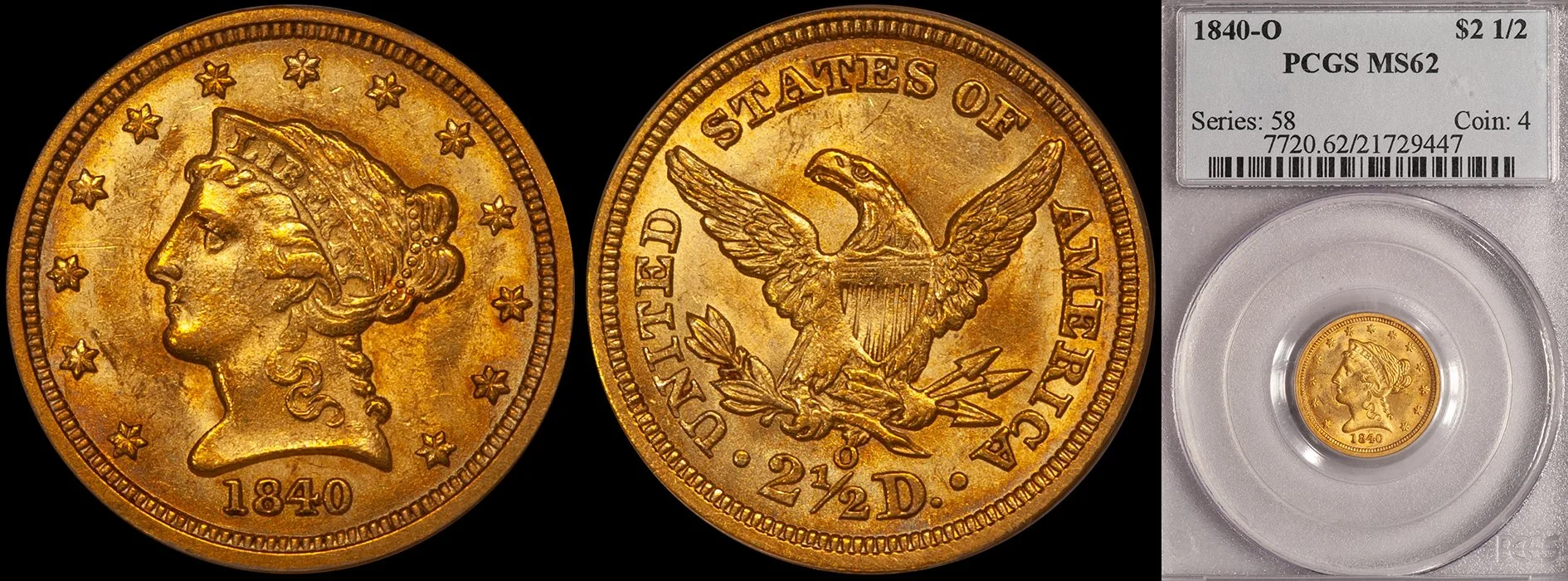
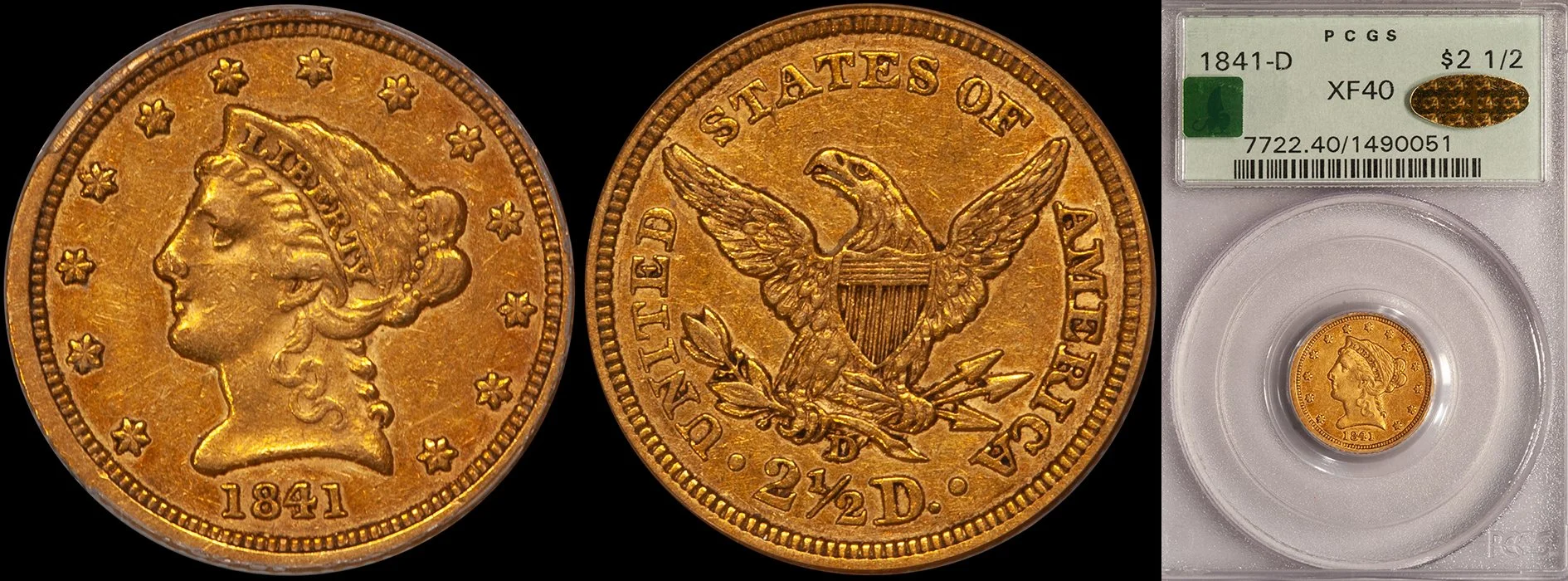
There are essentially six rarities within the Dahlonega quarter eagle series: 1840-D, 1841-D, 1842-D, 1854-D, 1855-D and 1856-D. Each of these dates has fewer than 100 known in all grades and most of them are High R-7 to R-8 in Uncirculated (meaning that around one to three properly graded Mint State pieces are known).

The two rarest Dahlonega quarter eagles from the standpoint of high grade rarity are the 1855-D and the 1856-D. These have the two lowest mintage figures for any quarter eagle from this mint. The total numbers struck are 1,123 for the 1855-D and 874 for the 1856-D, respectively.

Both of these dates are major rarities in Uncirculated. Before the recent discovery of the 1855-D in PCGS MS63 (more on this in a second), the 1855-D was more or less unknown in Uncirculated. I say "more or less" because while a few examples had been graded in the MS60 to MS61 at PCGS and NGC, none of these were coins that I think had unanimous approval as being truly Uncirculated. The same holds true for the 1856-D.

The story behind this newly discovered 1855-D is interesting. It was part of a collection of coins, with an emphasis on Charlotte and Dahlonega gold, put together by William and Beuelaress ("No, I can't pronounce this either...") Hemel from Orlando, Florida.

1855-D $2.50 PCGS MS63, courtesy of Goldberg

I know nothing about the Hemels from the standpoint of collecting. They flew well under the radar and from the look of their recently-sold collection, they appeared to be hole-fillers who primarily bought cheaper, more affordable C+D coins including many cleaned or damaged pieces. But they had a few great coins in their collection and the 1855-D quarter eagle was clearly the best piece that they owned.

From the scant pedigree information that the Goldberg sale contained, it seemed that the Hemels were most active with their coin buying in the 1970's. They bought a few coins out of auction but a quick perusal of Stack's and Paramount sales from this era shows no 1855-D quarter eagles that fit the description of the coin in the Hemel sale. We'll probably never know where this coin came from but perhaps it was from a local dealer that the Hemels had contact with or maybe even an accumulation of coins from a Southern family that had put the 1855-D away a century before.

I have handled virtually every higher grade 1855-D quarter eagle that is known and I have never seen a truly nice one. The strike of this issue is irregular, to say the least, and a significant number of the coins that I have seen in higher grades have planchet irregularities and/or have been processed in an attempt to hide these surface problems.

The coin in the Goldberg sale was truly special. It was extremely well made with a great quality planchet and it had, by far, the best luster that I have ever seen on this date. In fact, now that I think of it, I'm not sure that I've ever seen an 1855-D with enough luster remaining to really know for certain what the "right" texture for this issue actually is. The look of the coin was really exceptional as well with lovely natural yellow-gold color. It was clearly an original piece and, as I said above, this is unusual for a date that is nearly always found with "improved" surfaces.

When I was figuring what to pay for this coin, I thought that the best comparable was the 1854-D quarter eagle graded MS63 by PCGS that Heritage sold as Lot 4690 in their October 2011 sale. That coin brought $86,250. But, and this is a huge but, that coin had something "interesting" lurking in its past. The very same piece, as recently as 2004, had been graded MS62 by PCGS and had brought just $34,500 in the Heritage June Long Beach sale of that year. So, in my opinion, the 1855-D in the Goldberg sale was clearly a "better" coin.

I wound up purchasing the 1855-D for $86,250; a record price for the date but, I think, a very good value.

After the sale, I starting thinking: what are the greatest single Dahlonega quarter eagles? If I made a Top Ten list, which coins which I include on it? And after I made this list, where would the 1855-D place?

In chronological order, here is my Top Ten list of D Mint quarter eagles along with some comments:

1. 1839-D PCGS MS64, ex James Stack. Finest Known Classic Head D Mint.

2. 1840-D NGC MS62, ex Duke's Creek/Bareford. Unique in Mint State.

3. 1841-D PCGS MS63, ex Green Pond. Finest known of four in Mint State.

4. 1842-D NGC MS62, ex Duke's Creek/Norweb. Finest known of 2 or 3 in Uncirculated.

5. 1847-D NGC MS65, ex Duke's Creek. One of two known D Mint quarter eagles in Gem.

6. 1850-D NGC MS65, ex Duke's Creek/Eliasberg. The other Gem D mint quarter eagle.

7. 1854-D NGC MS64, ex Duke's Creek. Finest known.

8. 1854-D PCGS MS63, ex Heritage 10/11: 4690. Record price at auction for any D mint quarter eagle.

9. 1855-D PCGS MS63, ex Goldberg 1/12: 1209. Tied for record price and finest known of the date.

10. 1856-D NGC MS61, ex Duke's Creek. Finest known of the rarest D mint quarter eagle.

After thinking about the coins on this list, I think a few can be eliminated for being "common coins in uncommon grades" while others can be knocked off for "only" grading MS61 or MS62. I think the best candidates for the Best D Mint Quarter Eagle of All Time are the 1839-D in MS64 and the 1855-D in MS63. The 1855-D wins my vote for the better of the two given the relative availability of the 1839-D in MS60 to MS62 grades.

For more information on this 1855-D quarter eagle or on any other Dahlonega gold coinage, please feel free to contact me at dwn@ont.com.

1824 $5.00 NGC MS60 CAC

BD-1, High R-5. A total of just 30-40 examples are known for this date. As with most of the half eagles from the 1820's, this issue was almost completed eradicated by melting. The 1824 is at least twice as rare as the 1823 and comparable in rarity to the 1826. I regard it as just a hair rarer than the 1827. As with nearly all the dates from this era, the 1824 saw very little circulation and many of the survivors grade MS63 to MS65. The present example has no real wear but it does show some cabinet friction on the high spots and light, scattered marks on the surfaces including a small dig below the second S in PLURIBUS on the motto. The color is a pale green-gold and the luster is satiny in texture. I don't generally like coins graded MS60 but this piece has very good eye appeal and it is clearly nicer than what you'd expect to see in an AU58 holder. As one might guess, there has never been an MS60 example of the 1824 half eagle sold at auction. The last piece to sell was a superb PCGS MS63 that I bought out of the 2012 FUN sale (as Lot 4675) where it brought $126,500. In the same auction, a nice PCGS AU58+ example of the 1827 (a date that I personally think is just a tiny bit more available than the 1824) sold for $54,625; it is now on another dealer's website priced at $65,000. Fat Head half eagles from the 1820's and 1830's are finally being recognized for their extreme rarity and it may be years before the collector has another chance to purchase an 1824 in any grade.

Coins That I Never See With Good Eye Appeal Part Two: Quarter Eagles

In the first installment of this multi-part feature, I discussed some of the gold dollar issues that are rarely seen with good overall eye appeal. In this, the second part, I am going to look at quarter eagles that do not generally come with good eye appeal. Note that I said "good eye appeal." This doesn't mean that I'm focusing on the rarest dates in the series. Obviously, issues like the 1841 and the 1854-S are very rare in all grades and rarer still with good eye appeal. But that's not my emphasis here. Rather, I am interested in coins that while scarce or even rare based on their overall availability, are especially rare with choice, original surfaces.

As a rule, most pre-Classic Head quarter eagles are scarce to rare in all grades and harder still to find with good eye appeal. One issue that comes to mind as a coin that is just about never seen with good eye appeal is the 1796 With Stars. As you would suppose from a coin with just 432 struck, it is a rarity in all grades. But what most people do not realize is that nearly all survivors are either unoriginal and unappealing or they show multiple planchet imperfections as on many other of the gold issues produced during this year.

The last nice 1796 With Stars to be offered for sale was Stack's-Bowers 2011 ANA: 7593, graded MS63* by NGC, that sold for $287,500. It was earlier sold as Lot 1791 in the Stack's 5/99 auction and was part of the fabulous specialized collection of 1796 coinage assembled by John Whitney Walter. But the best 1796 With Stars of them all is the incredible Gem (NGC MS65) from the Byron Reed collection that was later sold for $1,006,250 in the Heritage 1/08 auction.

Other early date quarter eagles that I believe are very hard to find with good eye appeal include the 1797 and both varieties of 1806 (1806/4 and 1806/5).

The Classic Head quarter eagle that is hardest to find with good eye appeal is a date that will surprise you: the 1839. While not a really rare coin in terms of its overall number known, this issue is rare in properly graded About Uncirculated and very rare in Uncirculated. I have only seen three or four that I would call Uncirculated and none finer than MS62. The single best 1839 quarter eagle that I have seen was Bass II: 309, graded MS62 by PCGS, that sold for a reasonable $10,925.

In the long-lived Liberty Head quarter eagle series, there are numerous individual dates that are hard to find with good eye appeal. To make it a bit easier to analyze them, I'm going to break down the series into a mint-by-mint list.

There are many Philadelphia quarter eagles of this type that are hard to find with good eye appeal. The one that comes to mind as perhaps the most difficult is the 1842. With a mintage of just 2,823, you would expect this coin to have a strong degree of overall rarity. But it is far rarer in higher grades than most collectors realize. I can't recall having seen more than four or five in any grade that I thought were above-average quality and the finest of these, by a mile, is the Superior 9/99: 1863 coin, graded MS62 by PCGS, that I purchased out of this sale for $31,050. A few years later I handled this coin again and sold it to a Midwestern collector who still has it in his world-class set of quarter eagles.

Other dates from this mint that are very hard to find with good eye appeal include the 1844, 1848, 1864, 1865, 1869 and 1870.

There are a few Charlotte quarter eagles that stand out as being especially hard to locate with good eye appeal. In my experience, the ones that are the hardest to locate are due to being poorly made. These include the 1842-C (a date that is actually not poorly made but is, rather, generally seen well worn), 1844-C, 1846-C, 1852-C and 1856-C.

The 1842-C is one of my favorite Charlotte quarter eagles. It is reasonably well made but its lack of eye appeal tends to be as a result of the fact that it was an issue that was used extensively and not saved. There are two or three known in Uncirculated (the finest is the amazing Elrod MS65 coin that was last sold by Heritage in the 2/99 sale) and a small number in properly graded AU55 to AU58.

The other dates on this list are rare with good eye appeal because they were not well made. As an example, the 1856-C is nearly always seen on poor quality planchets and with grainy, unappealing surfaces. The 1846-C is another date in which is invariably the case although there are a few more decent-looking examples around than for the 1856-C.

Eye appeal is not as much of a problem with the quarter eagles from New Orleans is it is with the other branch mints. That said, there are still a few issues that are hard to locate with good appeal. One that comes to mind is the 1856-O.

This is a peculiar date. It is not rare from an absolute standpoint as there are as many as 200-300 known. For some reason, this issue is extremely hard to find with original color and surfaces and even a nice AU55 to AU58 is very hard to find. In Uncirculated, this date is extremely rare. There are at most four to five known and none are better than MS62. It has been years since an Uncirculated example has been available.

Other New Orleans quarter eagles that are hard to find with good eye appeal include the 1842-O, 1845-O and 1846-O.

There are a number of Dahlonega quarter eagles that are hard to find with good eye appeal. I would have to say, though, that one date is notorious for lacking eye appeal. In fact, this date is so rare with "eye appeal" that I'm not certain that a good-looking example exists. This date is the infamous 1865-D.

Only 874 examples were produced, making the 1856-D the only issue of any denomination from this mint with a mintage lower than 1,000. Due to improper preparation of this dies (and possibly the planchets as well) every known example of this date has an appearance that could be called--charitably--"odd." The strike is weak and blurry and the surfaces are often rough and full of raised defects. This makes the 1856-D an extremely hard issue to grade and a hard one for the non-specialist to appreciate.

Other Dahlonega quarter eagles that are very hard to locate with good eye appeal include the 1840-D, 1842-D, 1854-D, 1855-D and 1859-D.

The final mint that produced quarter eagles was San Francisco. The issues from this facility tend to be well made but there are a few that, for various reasons, are hard to locate with good eye appeal.

In my experience, the San Francisco quarter eagles that are hardest to locate with good eye appeal are the Civil War issues, especially the 1862-S and the 1863-S. There are a few plausible reasons for this. To begin with, they are low mintage coins. As with all gold coins of this era, they were melted in large quantities. And because of the fact that no quarter eagles were struck in San Francisco during 1864, the 1862-S and 1863-S seem to have circulated a little harder and a little longer than other dates of this era. Both of these dates are seldom found above AU55 and even when seen in comparatively high grades, the tend to exhibit bright, abraded surfaces. Choice, original pieces are rare.

Some of the other San Francisco quarter eagles that are not often seen with good eye appeal include the 1859-S, 1860-S and 1866-S.

There are dozens of date in the quarter eagle denomination that are hard to locate with good eye appeal. Not all of these are expensive and a few, the 1839 as an example, can be found in presentable grades for around $1,500.

For more information on quarter eagles with or without good eye appeal, please feel free to contact Doug Winter via email at dwn@ont.com.

1823 $5.00 PCGS AU55

BD-1, High Rarity-4. There are probably no more than 100 or so known for this date and it is considerably harder to find than the 1818 and 1820, its two rivals in the Fat Head series when it comes to overall rarity and price. This piece is lightly circulated but its slightly weak strike makes it appear a bit more worn than it actually is. The fields are quite reflective as is typical for the issue and there are a few minor marks noted including some in the left obverse field that seem to be the result of handling. There have been no AU55 examples of the 1823 half eagle thaat have appeared at auction since February 2002 and in October 2011, an NGC AU58 example with CAC approval brought $20,700. After the recent sale of the Jacobson collection of Fat Head half eagles, these coins are finally realizing the attention that they deserve.