1872 $20.00 NGC MS61 CAC

While slightly more than 250,000 examples were struck, the 1872 is a scarce coin in Uncirculated and an issue that is very rare in properly graded MS62 and above. Most of the surviving Uncirculated examples are in the MS60 to MS61 range and are characterized by excessively abraded surfaces and bright, character-free luster. This example, which was recently uncovered in Europe, has just about the best color that I can recall having seen on an 1872 double eagle with very intense glowing orange-gold and pale greenish hues. There are some light scuffs in the fields but none are deep and detracting and the high spots lack any friction or signs of wear. There have been five auction records for MS61 examples of this issue since March 2008 and the results have ranged from a low of $8,625 to a high of $9,775. There is a huge price jump for this date from MS61 to MS62, making a high end MS61 coin like this a great value for the advanced double eagle collector.
1892-CC $5.00 PCGS MS61 CAC

Lustrous and original with nice rose color that deepens at the borders. This piece has the body of an MS62 but it has some clusters of abrasions in the obverse fields that keep it at an accurate MS61. The 1892-CC half eagle is many times scarcer than the 1891-CC but it doesn't sell for a premium that reflects this rarity disparity. CAC has approved six in this grade with seven finer.

1875-CC $20.00 NGC AU58 CAC

This choice slider is totally free of wear but it is a bit too "ticky" on the obverse to grade MS61. But it has the look and eye appeal of many CC double eagles graded higher. The surfaces are frosty with rich natural rose and orange-gold color. The depth and richness of these hues show clearly that this is a totally original coin which has never been dipped or brightened. The 1875-CC is the most available Type Two double eagle from this mint which makes it ideal for type purposes. A very nice example which is head and shoulders nicer than most seen in AU58 holders.

1891-CC $10.00 PCGS MS61

Graded by PCGS at their Paris facility and clearly a fresh coin from Europe with lovely rich color and a two-tone "Euro" appearance. Just a bit too scuffy to grade MS62 but very high end for an MS61 and obviously never dipped, processed or otherwise "improved." The 1891-CC is the most common Carson City eagle by a mile which makes it an ideal coin for type purposes. I love the appearance of this example.

1804 14 Stars $2.50 NGC EF40

BD-2, Rarity-4. There are two distinct varieties known for this issue. The first, with thirteen stars on the reverse, is extremely rare. The more common variety has fourteen reverse stars and it is estimated that around 150-200 are known. Early quarter eagles didn't circulate with much regularity, so the 1804 is most often seen in About Uncirculated and the lower Mint State grades. It is extremely hard to find a problem-free piece in a "collector grade" and that's why this 1804 is a special coin. It is evenly worn with lovely rich natural green-gold color on the obverse and reverse. The obverse is well-defined and has the sharpness of a "45'; the reverse is weakly detailed at the border and there is a noticeable old scratch from the rim through the E in UNITED and into the right wing. The overall eye appeal of this coin is really quite exceptional and if you have been looking for a comparably affordable type coin to represent the Capped Bust Right quarter eagle issue, this piece is perfect.

1863-S $20.00 PCGS MS62 CAC

As with most of the Civil War era San Francisco double eagles, the 1863-S is a condition rarity. Some Uncirculated pieces are known from the discovery of the Brother Jonathan and S.S. Republic shipwrecks but pieces in MS62 and above with original surfaces are very rare. This fresh-to-the-market example has a remarkable appearance for the grade with natural frosty luster and appealing light yellow-gold color. As on all known examples, the obverse strike is not totally defined while the reverse is considerably sharper. The surfaces have the body of an MS63 to MS64 but there are two small reeding marks near Liberty's bun that narrowly remove this piece from a higher grade. The last PCGS MS62 to sell at auction was Heritage 12/09: 1923 (at $18,400) which, while not designated as such, was clearly a shipwreck coin with dull, lackluster surfaces. This is the finest 1863-S double eagle that I have owned in a number of years and it is one of just three in MS62 approved by CAC with none finer. A very important piece that is destined for a world-class set of Type One double eagles.

1869 $20.00 PCGS AU55

The 1869 is in the second-tier of Type Two Philadelphia double eagle scarcity along with the 1870 and 1871. This issue is not often seen choicer than AU55 to AU58 and it is seldom found with original color and choice surfaces. This fresh example has lovely rich natural orange-gold and rose color with some darker highlights from bag storage. There are just a few small marks on both sides and I have seen a number of inferior 1869 double eagles graded AU58. No PCGS AU55 examples of the 1869 double eagle have appeared at auction since Heritage 1/10: 4127 and that example realized $4,025. This date becomes very expensive as you go up the grading ladder and for most collectors a solid AU55 such as this will fit well into their Type Two set.

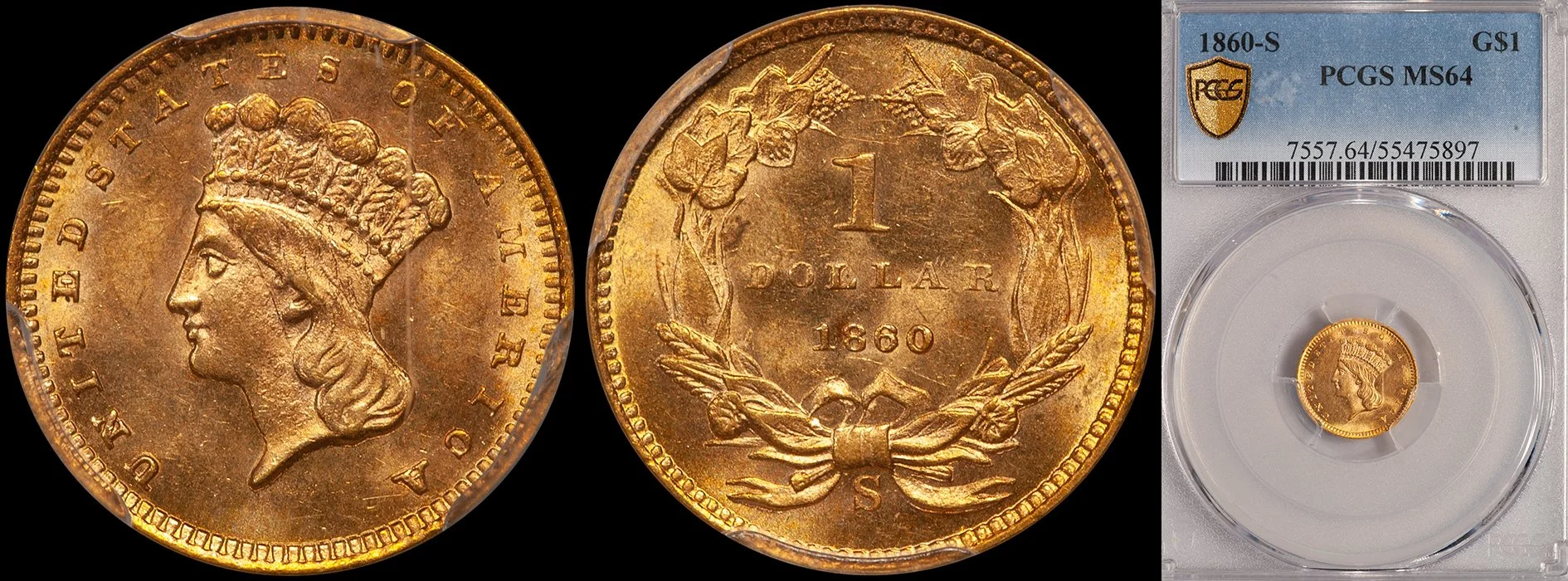
1854-S $1.00 NGC MS61

The 1854-S is historically significant as the first gold dollar from the San Francisco. It is also a scarce, undervalued issue in Uncirculated that is seldom seen above the MS61 to MS62 range. This example is strictly "new" with nice light rose and orange-gold colors and an excellent strike. A few small, scattered marks on the obverse keep this at the 61 level but the reverse is quite choice and it grades at least a point higher on its own. The last auction price realized for an MS61 example of this issue was Heritage 4/11: 6265 (graded by NGC) that sold for $2,990. Only five MS61's have appeared at auction since the beginning of 2005.

1854-O Large Date $10.00 NGC AU55 CAC

Large Date variety. This extremely original coin is probably sourced from Europe as it has a distinctive "Euro" appearance with very rich orange gold surfaces accentuated by darker contrasting hues on the high spots. This coin has seen very little in the way of actual circulation but it does have some scattered scuffs on the surfaces including a small vertical line in the cheek of Liberty. This fascinating variety employs a silver dollar date logotype that is way too big for the available space. Many die varieties exist and on this piece, there is a significant die crack between the 18 in the date going up to the base of the neck. The 1854-O Large Date eagle is moderately scarce in properly graded AU55, rare in AU58 and very rare in Uncirculated. At under $3,000 for a nice AU example, I think this coin is great value.