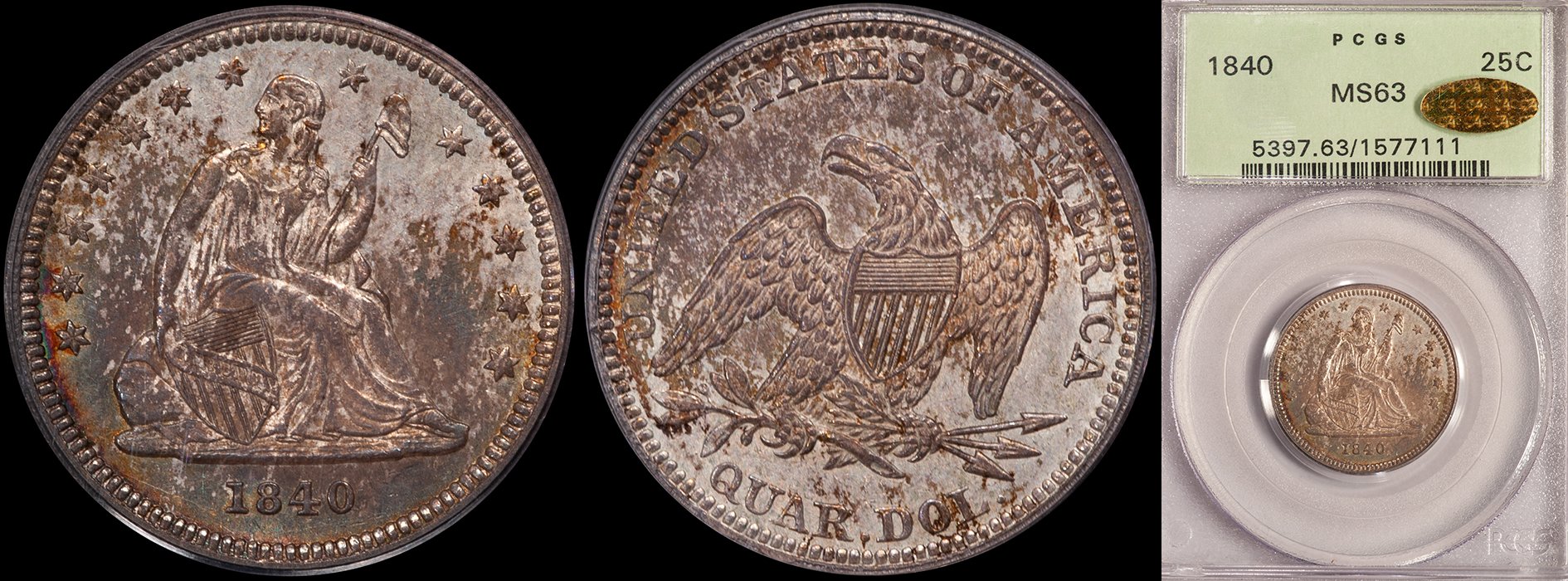
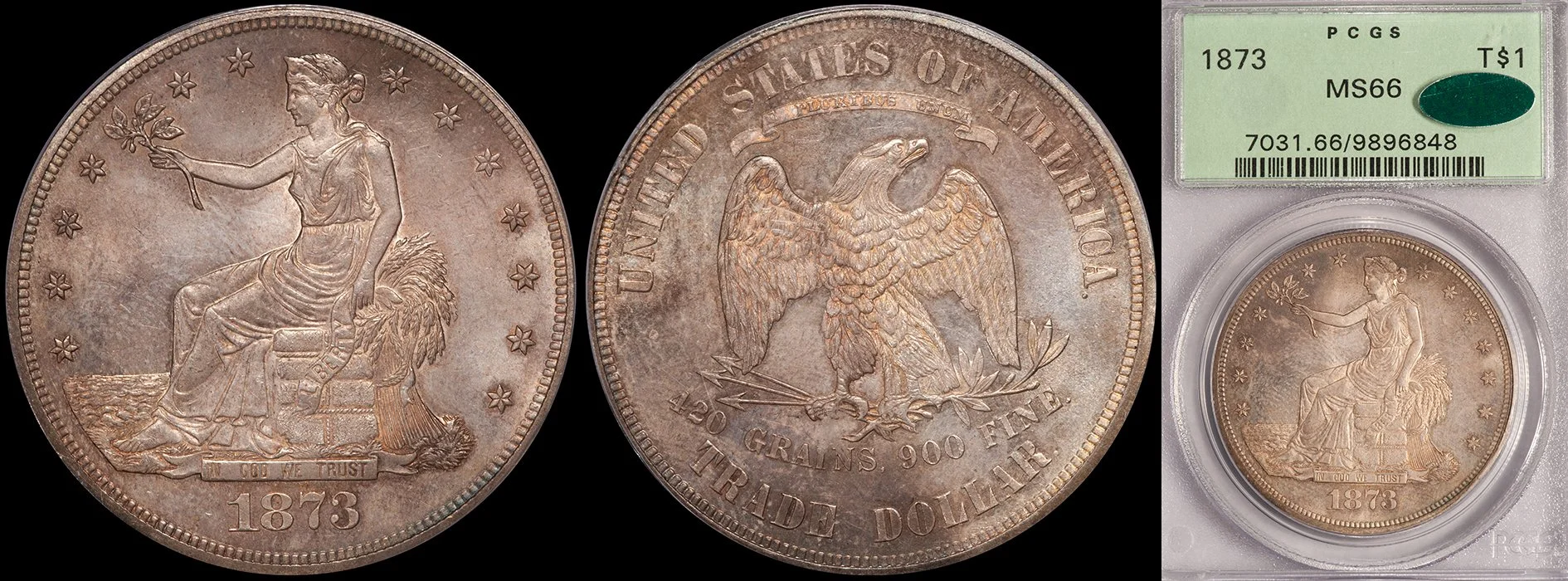
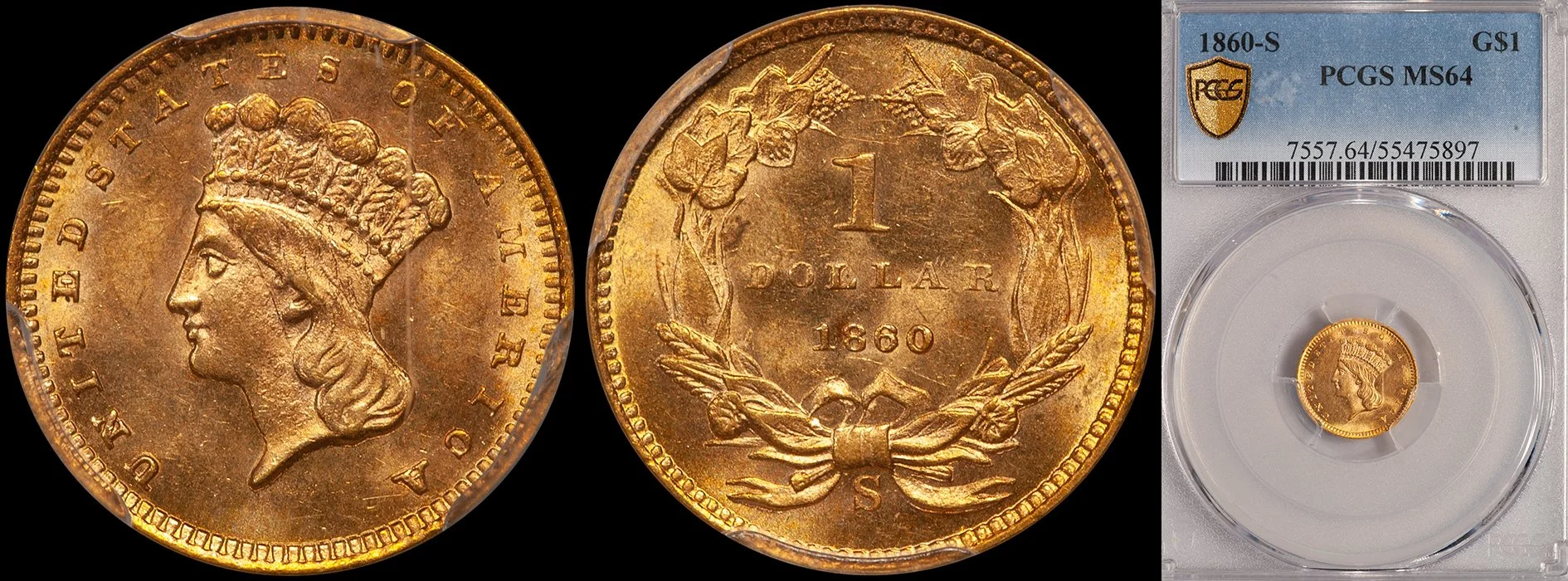
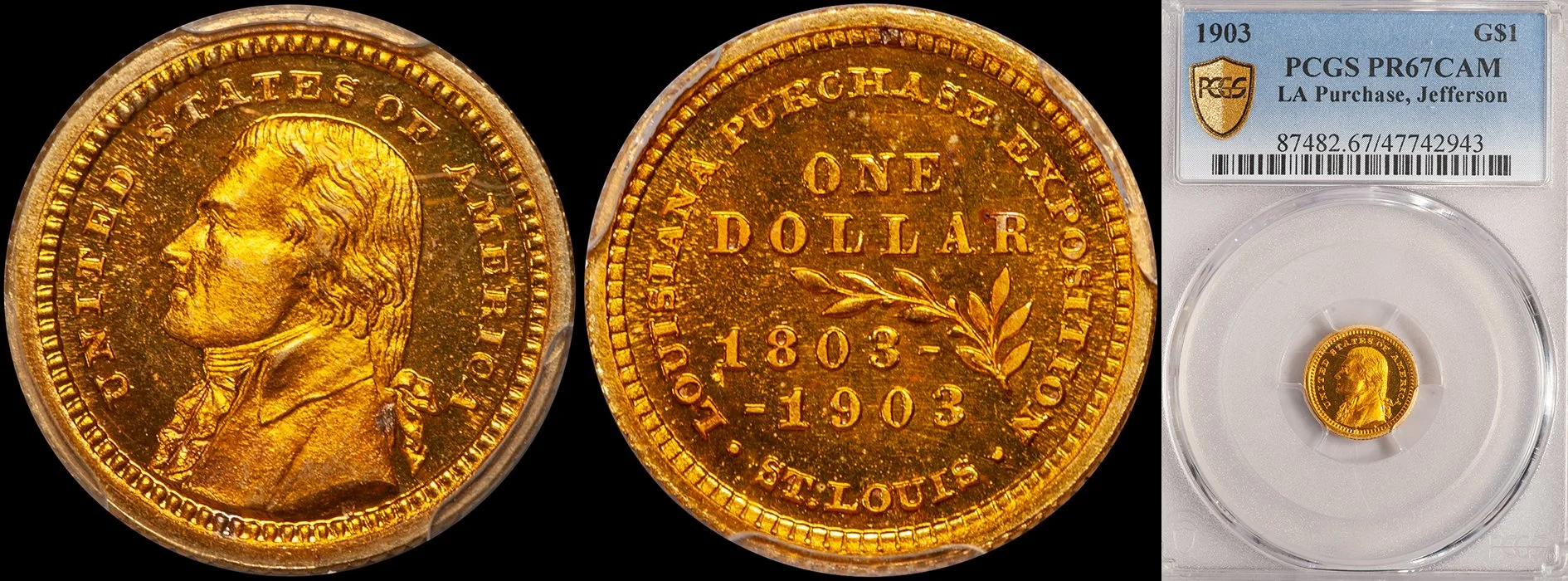
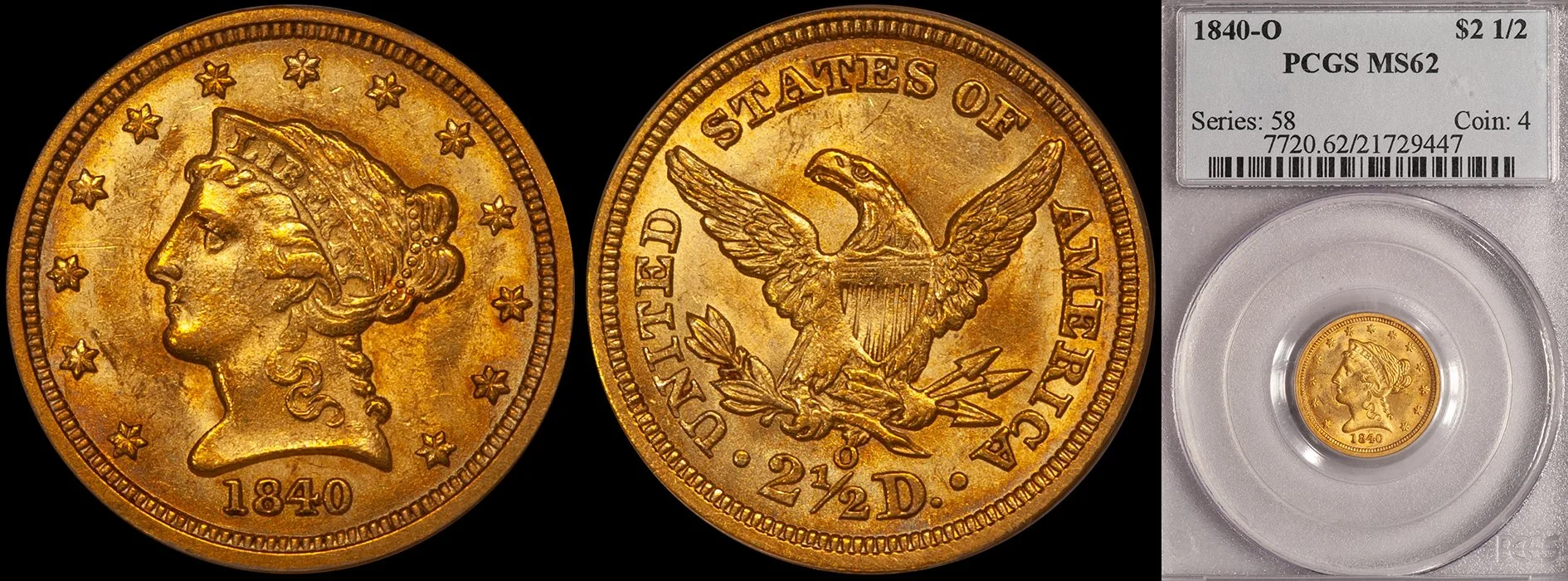
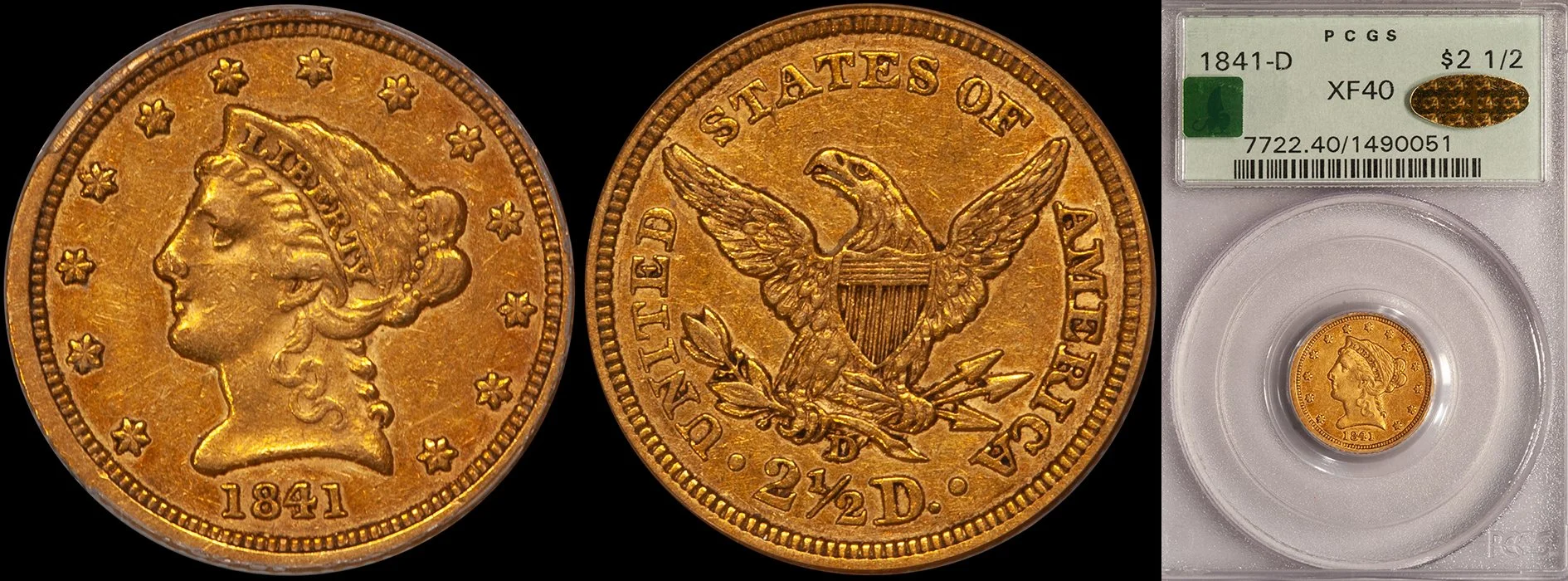
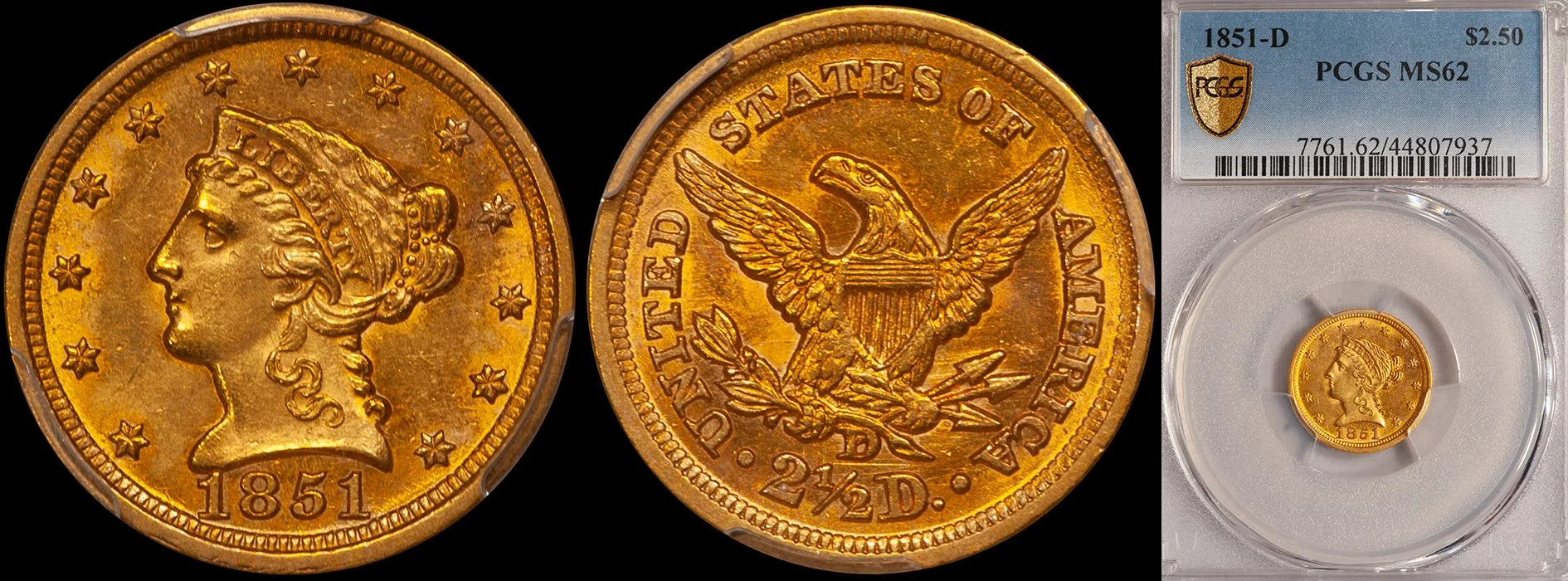
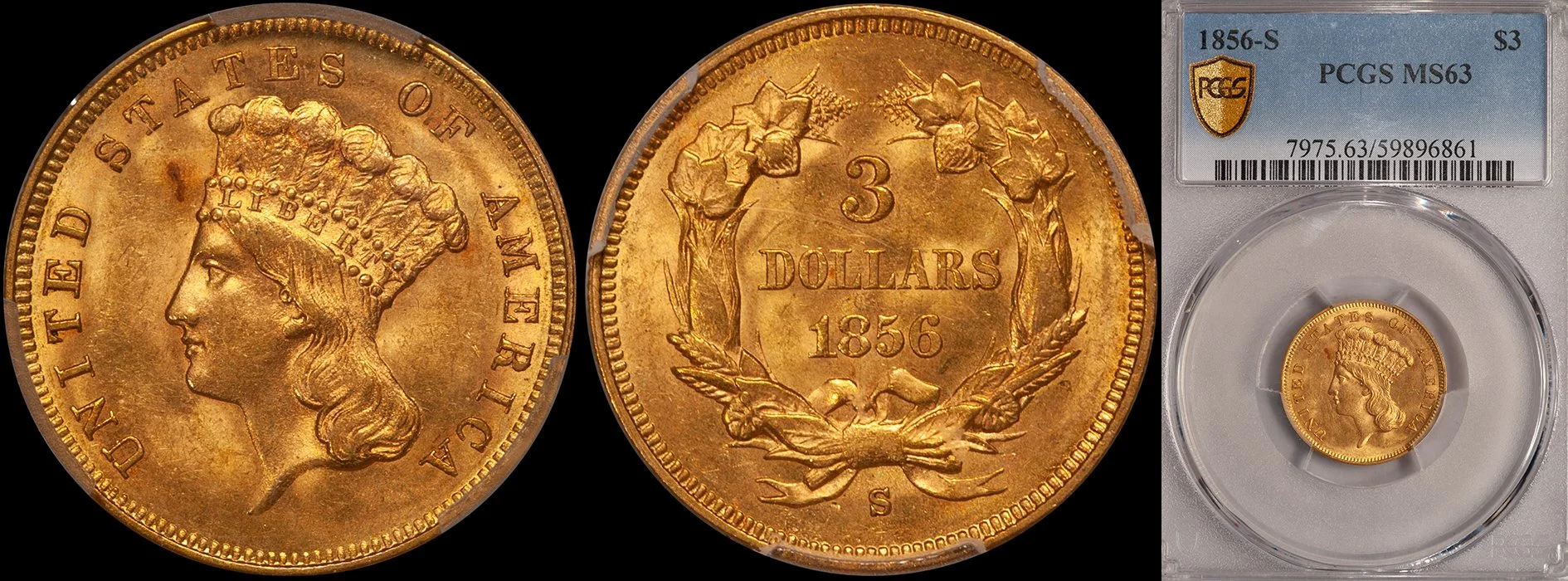
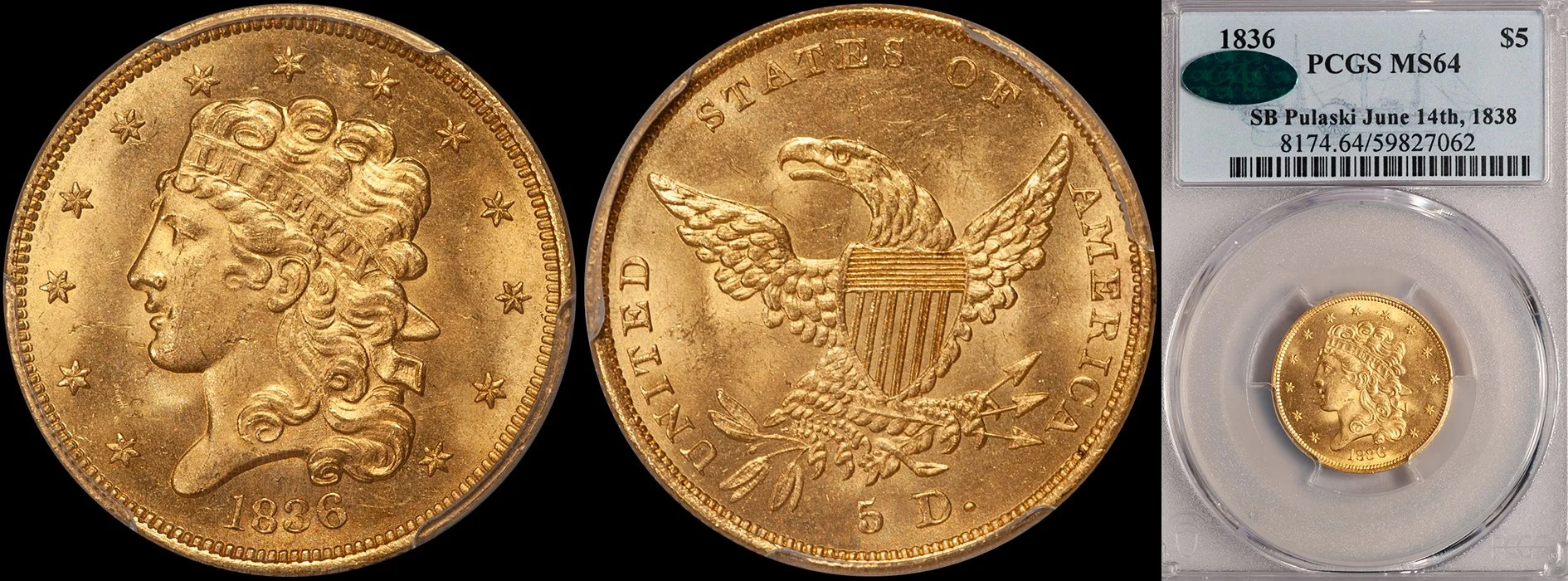
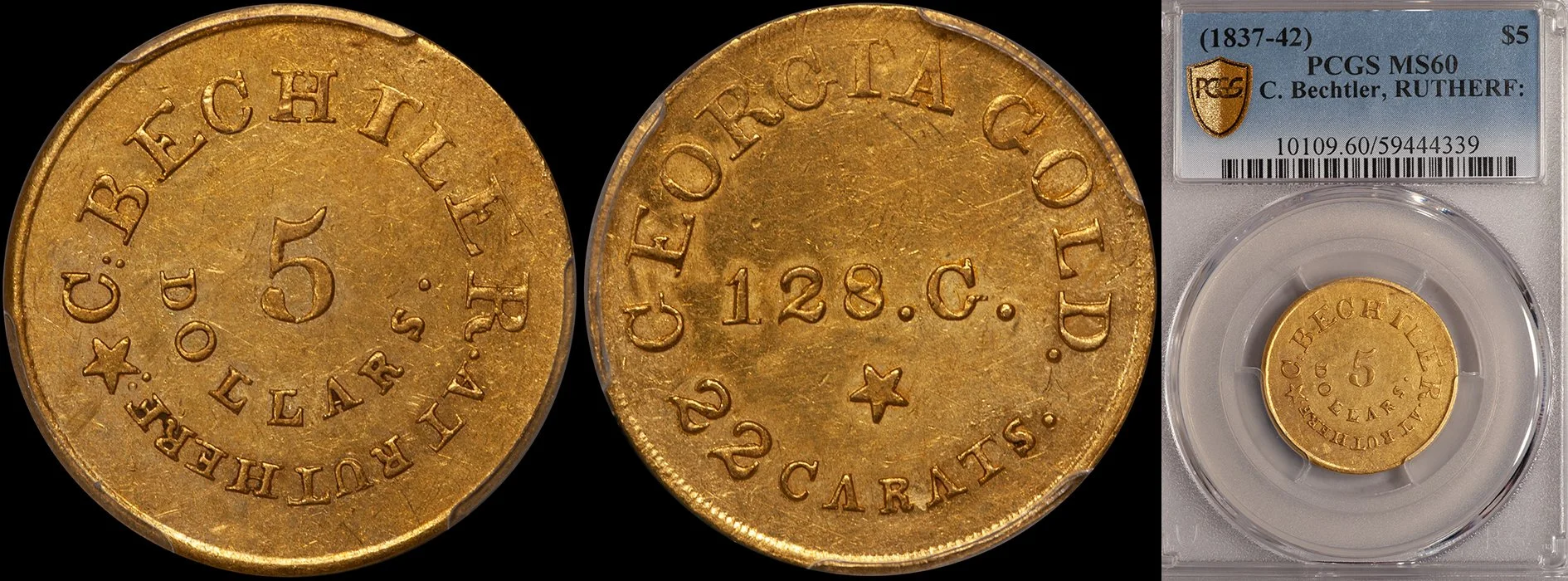
To my way of thinking, early gold coins (i.e., those struck prior to 1834) and among the most collectible and interesting areas in all of American numismatics. No, these coins aren't cheap and they are, in reality, somewhat overvalued when you compare them to many mid-19th century Liberty Head issues. But there is a pride-of-ownership factor associated with owning a 200 year old gold coin that you get from nothing else.
1. An Overview
When we refer to "early gold," this typically includes quarter eagles, half eagles and eagles produced at the Philadelphia mint from 1795 through 1834. I'd also like to include the Classic Head coinage of 1834-1838 as these pieces are more affordable and this article will then be of greater relevance as it will cover a more broad scope of collecting budgets.
The various types of early gold are as follows:
Quarter Eagle: No Stars on Obverse, 1796 only
Quarter Eagle: Capped Bust Right, 1796-1807
Quarter Eagle: Capped Bust Left, 1808 only
Quarter Eagle: Capped Head Left Large Size: 1821-1827
Quarter Eagle: Capped Head Left Reduced Size: 1829-1834
Quarter Eagle: Classic Head, 1834-1838
Half Eagle: Capped Bust Right, Small Eagle, 1795-1798
Half Eagle: Capped Bust Right, Heraldic Eagle, 1795-1807
Half Eagle: Capped Bust Left, 1807-1812
Half Eagle: Capped Head Left Large Size, 1813-1829
Half Eagle: Capped Head Left Reduced Size, 1829-1834
Half Eagle: Classic Head, 1834-1838
Eagle: Capped Bust Right, Small Eagle, 1795-1797
Eagle: Capped Bust Right, Heraldic Eagle, 1797-1804
The total number of types that most collectors pursue are fourteen. This includes six each of the quarter eagle and half eagle, and two eagles. The rarest and most expensive of the individual types are the 1796 No Stars and 1808 quarter eagles, and the 1829-1834 Capped Head Left, Reduced Size half eagle. For each of these three types, "entry level" coins will approach six figures and choice, significant pieces can run into the mid-six figures.
2. What to Buy to Get Started
Before you begin an early gold collection, I think its a good idea to spend $500-1,000 putting together a library of reference works.
The best book for new collectors is the Bass/Dannreuther reference that is published by Whitman. While it is oriented more towards die varieties than general collecting, it is still an extremely useful book.
I have written some good general articles on collecting early gold and these can be found in both the "articles" and "market reports" section of my website.
There are not many other books that deal specifically with early gold. The Akers books on United States gold coins are out-of-date but still of use. And the Harry Bass Research Foundation website (hbrf.org) has wonderful images of extremely choice gold coins in all three denominations, including extremely rare Proofs and specimen strikes.
One of the best sources of information for collectors of early gold are auction catalogs. Some of the sales held during the last few decades that had very strong holdings of early gold include Eliasberg (1982), Norweb, Bass, Keston, the "Apostrophe" sales, Archdiocese of Buffalo, Ed Price and many of the Heritage FUN and ANA Platinum night sessions. Do a search on the web for coin book dealers (there are a number of good ones) and ask for their help in putting together a nice group of 15-20 catalogs that are essential additions to any early gold library.
3. Deciding What to Collect
After you've decided to collect early gold, your next question is what direction is your collection going to take.
Basically, there are two paths that a new collector can take: collecting by type or specializing in a specific series and collecting by date. The path you take will depend on your budget.
Collecting early gold coins by date is ambitious (to say the least) due to the number of very rare coins in each of the three denomination. A date collection can be modified and made less expensive by deciding to collect only by date and not by variety. As an example, a collector working on early quarter eagles might opt to purchase only an 1804 with 14 stars on the reverse due to the fact that the 13 star variety is very rare and very expensive.
The decision to collect early gold is, of course, predicated on a collector's budget. If the collector has a reasonably modest budget, my suggestion would be to focus on the half eagles struck between 1800 and 1812 in the Extremely Fine and About Uncirculated grade range. This is a great date run as there are no rare issues (except for varieties) and every coin will be available in the $7,500-12,500 range depending on grade.
If a collector has a healthy budget available, the possibilities are almost limitless. A high quality type set, featuring one example each of the fourteen issues listed above, would be challenging and numismatically significant.
Two sets that I have been able to work on for clients are date runs of quarter eagles from 1796 to 1834 and Capped Head Left half eagles from 1813 to 1829. These are both truly challenging. There is a tremendous amount of subtle strategizing inherent in both sets as they include many issues that might come up for sale once every three to five years. It can be hard to figure out what to pay for a very rare date whose last auction record was as much as a decade ago!
4. Where to Buy
As a collector you have two options on where to purchase your early gold coins: from a specialist dealer or at auction. As a dealer who specializes in early gold, I obviously would suggest that you buy from me, but the answer is not so cut and dry.
Early gold can be quite complex to collect. Many early gold coins have been cleaned or "doctored" and it takes an expert to determine which are nice for the grade and which are average. This is an area that a collector would be smart to deal with a specialist and he will need to do some research into who he should buy from, as there are only a handful of United States coin dealers who really know the intricacies of the early gold market.
Certain very rare early gold coins are almost never offered for sale except at auction, so the auction market is always going to be a factor for the collector. I suggest hiring a dealer and paying him a standard 5% fee for viewing and executing bids.
Be forewarned that you are never going to buy a good coin "cheaply" at auction. Auctions are best used to pursue very rare coins or very high grade coins. They may not be the best source for more run-of-the-mill pieces (and I am not saying this in a derogatory sense) which a specialist dealer will have access to at more reasonable prices.
Some auctions are great sources for early gold coins because they offer pieces with impressive pedigrees. I am an advocate of buying early gold with strong provenance when possible and, for better or worse, many such coins wind-up in auctions. I know of at least a few collectors who are as interested in early gold coins with pedigrees and they are in the coins themselves. They would consider buying a duplicate or even a triplicate of an issue they already own because it has a great pedigree.
5. CAC or non-CAC?
There are areas of the rare coin market that CAC has made strong inroads on and others where it has had little or no impact. In my opinion, early gold is an area where CAC has made a very strong impact. CAC typically rewards originality and as the vast majority of early gold coins aren't original, CAC examples are often selling for premiums that range from 5% to 20%.
I think the early gold coins that are most impacted by CAC approval are common date pieces in higher grades. So many of the Capped Bust Right and Capped Bust Left half eagles that I see in MS63 to MS65 holders have been played-around with that I think a CAC stickered coin is an important purchase for the inexperienced collector.
I think CAC stickers are not as important on very rare early gold coins and more common issues in lower grades.
If you are looking at an early gold coin with a total population of a few dozen coins, you are not able to be as selective as with an issue which has hundreds of coins surviving. While I would never suggest buying a very rare early gold coin with problems (such as damage, signs of harsh cleaning, repairs, etc) I would (and will continue to) buy a coin like an 1804 14 star reverse quarter eagle or a half eagle from the mid-1820's that was decent-looking but not nice enough to be approved by CAC.
I also note less of a premium being given to less expensive early gold coins with CAC approval but I wouldn't be surprised if this changes as buyers of these coins are becoming more sophisticated and want nicer quality pieces.
6. Value Plays/Best Value Grades
Every collector wants to buy coins that are good value. Collectors of early gold are no different. There are some issues that I think are very good values. (important note: I think that any properly graded, choice early gold coin with natural surfaces is a good value but the following list are coins that are the best values).
Virtually all pre-1834 quarter eagles are rare and until a few years ago, they were priced at levels similar to the far more available half eagles of this era. This isn't the case anymore and a nice example of a reasonably available date of the Capped Right design (such as the 1802, 1805 or 1807) is now a $15,000-20,000 coin.
Early quarter eagles that I find to be undervalued include the 1798 (the only relatively affordable 18th century issue) and the 1806/4.
I like the Capped Head Left type of 1821-1827 and find this to be the most undervalued early quarter eagle type. Survival rates tend to be low and the five issues of this design are often overlooked. My two favorite dates of this type are the 1821 and the 1826/5.
There are so many early half eagles that I feel are undervalued that instead of listing them by date and discussing them, I'm going to focus on "best value grades" instead.
For circulated coins, I like AU55 and AU58 grades. An early half eagle graded AU55 to AU58 is going to show minimal wear and have a decent amount of remaining luster. There isn't a huge price spread between an AU50 and an AU58 common date early half eagle (the spread right now is a few thousand dollars at most) and if you are collecting half eagles by type, it makes sense to me to go for an AU55 or AU58.
In the Uncircuated grades, I tend to shy away from MS60 and MS61 coins (which are often "rubby") and stick with MS62's which, for the most part, are actually "new."
For type collectors with higher budgets, a nice MS64 early half eagle typically makes more sense to me than an MS65 at multiples of the price. The last few common date early half eagles that I have sold in MS64CAC have been nicer than some of the low-end MS65 non-CAC coins that I've seen offered at auction.
Since there are not many early eagles, there are few coins that I regard as undervalued. Among the common dates, I actually prefer the 1799 to the 1801 or the 1803 given its 18th century origin.
7. Let's Not Forget Classic Heads....
I mentioned at the beginning of this article that I wasn't going to overlook the Classic Head quarter eagles and half eagles. These designs were produced from 1834 to 1838 at the Philadelphia, Charlotte and Dahlonega and New Orleans mints. The branch mint issues include the 1838-C, 1839-C, 1839-D and 1839-O quarter eagles as well as the 1838-C and 1838-D half eagles.
The great thing about Classic Head gold is its affordability. As an example, I just sold an absolutely beautiful 1834 Classic Head half eagle graded AU55 by PCGS and approved by PCGS for just a touch over $2,000. Nice examples of most of the Philadelphia quarter eagles and half eagles of this type can be obtained for $2,000-4,000. Even Uncirculated examples, at least in MS60 to MS62, are not out of the price range of most early gold collectors.
I would suggest that if you are purchasing a Classic Head gold coin for type purposes that you be extremely selective. These coins are not rare and really nice examples can be found with patience. Pay a little extra for original coins with great color and, if possible, buy a slightly better date like an 1837 quarter eagle or an 1836 half eagle for just a small premium over the common 1834.
Classic Head gold can be collected in a number of different ways. You can buy just two coins and have a complete type set, or you can buy eleven coins and have complete year sets of both denominations. The addition of the branch mint issues will add some cost to a Classic Head collection, but these issues are still affordable in the EF40 to AU50 grade range.
8. Some Final Words
Its hard to convey in 2000~ words the ins and outs of collecting early gold coins, but hopefully this article will serve as motivation to become involved in an aspect of the hobby that I find fascinating. If you have any specific questions about early gold, please feel free to contact me via email at dwn@ont.com and I will do my best to answer them.