1849-O $10.00 PCGS EF40 CAC

This appealing coin has very deep rich orange-gold color that is suggestive of having been stored in a source such as an old coin album, a manila envelope or even a leather pouch. This sort of coloration is not often seen on examples of this date, especially pieces with this amount of circulation. As is typical for the issue, the strike is flat on the obverse and this gives the impression of more wear than what is actually present. Other than a few small, scattered marks on the obverse, the surfaces are clean and this is among the more attractive 1849-O eagles in this price range that I can recall having seen.

The Art Basel Fair Versus The FUN Show: An Analysis

I recently returned from a week long trip to Miami where I attended the Art Basel art fair. I went primarily to look at art and to purchase some pieces for my collection but I also went to closely observe what has become the most significant art fair(s) in the world. For a person like myself, who attends many coin shows each year and who had never been to Art Basel, I found the contrast to be both educational and totally fascinating. I thought it would be interesting to compare and contrast the annual Art Basel show with the upcoming FUN convention that will also be held in Florida. For those of you who aren't familiar with Art Basel, I think a little background information is in order. This was the 11th annual edition of Art Basel in Miami and this show is a spin-off of the original fair that is held each year in Switzerland. The main Art Basel show was held in the Miami Beach convention center and it featured virtually all of the leading dealers in the world. I believe there were in the area of 400-500 dealers and I saw booths hailing not only the United States but from all over Europe, Latin America, South America and the Far East.

I could go on and on about comparing/contrasting Art Basel with the FUN show but I will keep the points to a manageable number and try to be as relevant as possible.

*Art Basel is a far more international fair than any coin show I have ever attended. The FUN show is not an especially international show and a better comparison is the NY International show which, ironically, is held at exactly the same time as FUN and which, therefore, is now impossible for me to attend. At various times at the fair, I felt like English was a second language. It was an interesting polyglot of Spanish, Italian, Portuguese, Chinese, Russian and more. The international scope of the attendees and the material at the fair was really, really exciting.

*Art Basel has thematic dealer exhibits; something that is not typically done at a coin show. Because of the theme(s), some dealers at Art Basel had very challenging exhibits (bananas in cars, scattered boulders on the floor, odd video, etc). This was a definite contrast to the FUN show which is more straight-forward.

*A table at the FUN show for the average dealer costs around $1,500-2,500. At Art Basel, I was told that for most dealers, a table was upwards of $50,000 and that some of the prime tables were $250,000 and up. When you combine this along with the cost of attending the show, crating and uncrating the art, setting up and breaking down the booth and countless other expenses, the cost for a dealer to attend Art Basel is staggering. Thus, prices were reflective of this (more about this in a minute...)

*At Art Basel, if you weren't Puffy Combs, an A-list collector or introduced/escorted by a well-known dealer, forget it. I was ignored for three days at the main fair. At the FUN show, the average collector isn't ignored and if he is lucky, he can interact with such luminaries as Q. David Bowers, Mark Salzberg and David Hall. At Art Basel, dealers like Larry Gagosian or Edward Acquavella wouldn't have thrown water on my if I was ablaze (unless I was about to set one of their works on fire; then they would have sent an assistant to douse me).

*The iPad is clearly changing the way collectors and dealers buy and sell art. I noticed that most booths no longer had exhibit catalogs but now used an iPad to show collectors images of artists whose art wasn't on the walls or of paintings they might have had in stock but which they didn't bring. On at least two occasions, I searched for quick information about a specific artist I liked but wasn't familiar with on my iPad. You are starting to see iPads at coin shows but they seem to be more the province of dealers than collectors.

*I paid careful attention to which artists were common at the show and which were not; just like I do at a coin show. I noted an abundance of Leger, Miro, Dubuffet and Picasso. These are artists whose works typically sell for high six figures to well into seven figures. They are the art world's equivalent of High Reliefs or Stellas: expensive, beautiful and with a sexy back story but ultimately common and typically available except in the highest grades.

*Art Basel is a show that celebrates dealers and the relationship between the dealer and the collector. There are no auctions taking place during the show and it is not like FUN that sometimes seems like a huge Heritage auction with the bourse floor thrown-in as an afterthought. Art dealers have strange, conflicted relationships with auction houses and for good reasons. Sotheby's and Christie's are not only openly competing for clients but they also have retail departments, trust and estate planning services, consultation services and offer financing. This situation is a bit different in the coin markets where dealers tend to be able to co-exist, more or less, with the two major auction firms.

*I was surprised at how out-in-the-open deals were at Art Basel. I expected deals to be done in secret areas of each booth or, more likely over dinner but I saw collectors openly writing checks.

*I was also surprised at how poorly marked most booths were at the fair. I didn't expect most paintings or sculptures to have clearly marked price tags but I was very surprised at how few pieces had name tags. I was able to identify some paintings I saw but others, especially those that were from new artists or foreign painters, were unidentifiable. And there were definitely times that I didn't want to ask...

*It was hard to tell how well the art was selling. For whatever reason, many of the A-level dealers appear to think it is tacky to stick a red-dot (equating something is sold) on a $5 million dollar painting. I can certainly see their point but the dealer in me was hoping to have a vicarious thrill or two see a $5 million dollar painting with a red dot next to it.

*One of the major differences between Art Basel and the FUN show was the level of enthusiasm exhibited by collectors at the former. At a coin show, buyers seem excited to be there but at Art Basel the adrenaline level was palpable. Maybe Picassos are just sexier than Dahlonega quarter eagles or maybe I've been to so many coin shows that it's become hard for me to be excited but the buzz at Basel, especially as the week wore on, was great.

*To me, probably the most impressive thing about Art Basel was how it literally changed the entire city of Miami for a week. There were tens of thousands of people at the show and they were not bashful about booking the best rooms in the best hotels, the best tables at the best restaurants and generally pouring money into the local economy. I don't know what the impact of the FUN show is on Orlando but the average person at Art Basel, independent of his or her art purchases, was a lot more lavish than at FUN (where I have seen collectors who spend $25,000 on a coin balk at spending $250 on a nice room).

In case you can't tell, I came away very impressed with Art Basel. It was well-attended, very entertaining (unbeatable people watching!), extremely well promoted and it seemed flawlessly run. The FUN show, in my opinion, is about as good as it gets in the numismatic world but it seemed like a bake sale compared to the fair!

Gold Coins of the Dahlonega Mint 1838-1861

Due to heavy demand, Doug Winter's "Gold Coins of the Dahlonega Mint 1838-1861" was released in a completely revised second edition in 2003. This new book contains all new information on rarity and Condition Census, superb new photographs by Mary Winter of coins from the Green Pond collection, new research on Dahlonega varieties and auction records that are current through 2003. The first edition of this book, now sold out, had become out-of-date and the new, revised second edition will provide collectors of Dahlonega coins with the newest information on these fascinating, highly collectible coins.

Available for sale at www.zyruspress.com

1883-CC $20.00 PCGS AU50 CAC

Old Green Holder. By today's grading standards, I feel that this coin is at least an AU55. It has beautiful deep natural orange-gold color atop slightly prooflike surfaces that exhibit relatively few marks for the grade. This coin is almost certainly from an overseas source and it has a "Euro" look but with less darkening on the surfaces than usual. The typical dipped, processed AU50 example of this date is an easy sale to a dealer who doesn't care about quality for $3,000 or even a bit more. For a few hundred dollars extra, you can purchase a gorgeous, unmolested example that is one of just eight 1833-CC double eagles in AU50 that has been approved by CAC.

1868 $20.00 PCGS AU53

The 1868 is the scarcest Type Two double eagle from the Philadelphia mint. In fact, it is the hardest non-Carson City issue of this popular type to locate in all grades. When available, the 1868 tends to grade in the EF40 to AU50 range and is characterized by bright, excessively abraded surfaces. The present example is among the most original 1868 double eagles that I have seen. It has rich straw-gold color that strongly suggests that it has never been cleaned or dipped. There is some friction in the left obverse field and some marks around star eight on the obverse; the reverse is exceptional and grades AU58 on its own. There are no auction records for a PCGS AU53 example of this date since January 2008 (a coin that was sold by Bowers and Merena for $7,188) and I can't recall the last time I handled an example with the eye appeal that this piece shows. A special coin for the savvy double eagle collector.

Are Gem Type Two Gold Dollars Underpriced or Overpriced?

I recently bought and sold a coin that I hadn't handled in quite a few years: a Gem Type Two gold dollar. For those of us of a certain age, this is an exciting coin and one that got me to thinking: is this a type that is underpriced or overpriced? My thoughts on this subject follow. Back in the 1980's, my mentor in the rare coin business, Paul Nugget, told me an interesting story about Type Two gold dollars. He said that in the 1970's, Type Two gold dollars were essentially unknown in Gem Uncirculated and were very hard to locate even in what, today, would represent the MS63 to MS64 grade range. I have always found it curious that this once-rare type became so much more available in the ensuing years; a subplot to this story that I'll touch on in a moment.

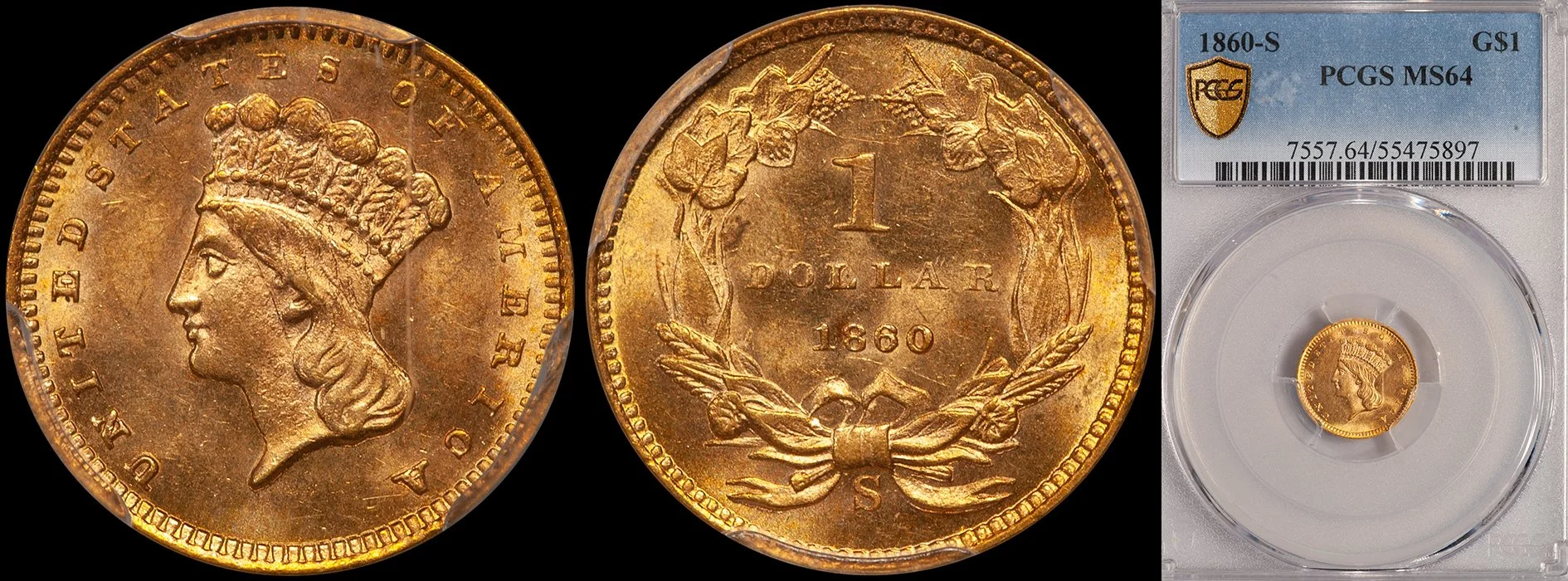
For those of you who are wondering "what is a Type Two gold dollar," it is a short-lived design type of gold dollar that was introduced in 1854 and replaced in 1856. It features a small Indian Princess portrait on the obverse and it is a type that is notorious for strike-related problems such as clashmarks and weakness at the centers as a result of a flawed design that made it nearly impossible to fully strike up.

The two issues of this design that are seen most often are the 1854 and 1855 Philadelphia dollars. When people refer to "Type Two dollars" as a specific type coin, it is likely that they are speaking about one of these. Type Two dollars were also made, for one year only, in Dahlonega (1855-D), Charlotte (1855-C), New Orleans (1855-O) and San Francisco (1856-S). The branch mint issues are scarce to rare and remain very popular with collectors.

When collecting gold coins by type was in its heyday, the Type Two dollar was the single rarest and most expensive member of the twelve-piece type set. I can remember Type Two gold dollars in MS65 trading for over $50,000; in some cases as much as $55,000 to $60,000.

Today, the same coin is worth $30,000 at most (if the coin is really nice, in a PCGS holder and CAC approved) and more likely around $27,500.

What happened?

As far as I can tell, there were at least four things that occurred, all of which conspired to really hurt this market. The first is gradeflation. When Type Two gold dollars were worth $50,000+, they were superb coins. Today, I see many (if not most) Type Two gold dollars graded MS65 and I go "meh..." The coins range from not-so-nice to decent but very few are what I feel are Gems. This lessening of standards has clearly hurt the market for this type.

The second factor is a change in collector taste. In the 1980's and 1990's, many rare coin firms encouraged new collectors and investors to assemble twelve coin gold type sets. When these sets were in vogue, the Type Two dollar was the key issue. But these firms have stopped selling Gem U.S. gold for type sets and the whole concept has, for all intents and purposes, fallen off the map. When no one is collecting gold type sets, the demand for Gem Type Two gold dollars drops appreciably.

The third factor is an inversion of the classic supply and demand ratio for these coins. A decade ago, there were always people looking for Type Two gold dollars in Gem for their sets but very few coins around. Today, there are few people looking for them but a reasonably large supply. As I write this article, PCGS and NGC have combined to grade 149 Type Two gold dollars in MS65. Even factoring in resubmissions, it is still likely that as many as 90-110 Gem Type Two gold dollars have been graded, not to mention another 37 combined by PCGS and NGC in MS66. Clearly there are not 100 collectors who want Gem Type Two gold dollars.

(Interestingly, the level of demand for branch mint Type Two gold dollars has soared in the last decade. By virtue of being scarce, interesting and numismatically significant due to theit status as one-year types, coins like 1855-C and 1855-D dollars have risen in value--dramatically in the case of the latter--and are far more in demand than high grade examples from the Philadelphia mint).

I think there is one more factor that has hurt the value of this type: its small size. Let's face it, coin collectors are not getting any younger and the typical demographic of collectors who can afford a $30,000 Type Two gold dollar is over 55 and unable to see a coin this small without strong magnification.

Before closing, I'd like to address one point I raised earlier in this article. I mentioned that there is an aura of mystery around Gem Type Two gold dollars. How did a type that was virtually unknown in Gem thirty years ago become a coin that is featured for sale in every major auction these days? Part of it is certainly gradeflation but I think the answer is deeper than this. I don't know for certain but I think there is/was a hoard of high quality Type Two dollars that was quietly and brilliantly released into the market, a few at a time, for years. I don't know the specifics about it but how else can you explain a coin going from virtually unknown to nearly ubiquitous?

So what's my conclusion? Are Gem Type Two gold dollar undervalued or overvalued? Given the current state of the market, I'd have to pick overvalued. At $30,000 or so for a real Gem, they just don't seem like a good buy to me. At $15,000 for an MS65 I am certainly a buyer and maybe even at $20,000 for the right coin. But at $30,000 I'd rather have a nice, well struck 1855-D dollar in Choice AU or a properly graded MS63 1855-O dollar.

Some Thoughts on Proof Gold Survival Rates

As someone who handles a decent amount of rare and interesting Proof gold coinage, I've been thinking about survival rates. I'd like to share some thoughts about typical survival rates and why certain issues don't comply with the "basic laws." First, a little background. The United States mint struck proof gold coins as far back as the 1820's, but production became more established by the 1858-1860 era; which neatly coincides with the beginning of coin collecting as a hobby in this country. Production of most proofs remained small until the early to mid-1880's, when collectors and dealers became more interested and a decent-sized mania for Proofs began to take hold.

For most United States Proof gold coins, I believe that the following survival rates are pretty consistent:

*Pre-1870 gold issues, with exceptions, appear to have a survival rate of around one-third of the original mintage.

*Issues from around 1870 to around 1890, with exceptions, appear to have survival rates of around half of the original mintage.

*Issues from 1890 until the end of the Liberty Head design (1907) typically have survival rates that range from one half to two-thirds of the original mintage.

Let's now take a look at some of the factors that influence survival rates of Proof gold coins. Please note that these are not listed in order of importance.

1. Original Mintage Figures. This seems pretty obvious but it is an important factor that needs to be discussed. A gold issue with a low mintage (say 25-50 coins) tends to be rarer than an issues with a relatively high mintage (100 or more).

However, there are some notable exceptions to this rule.

There are some years that mintage figures are incorrect. An example of this is the 1861 gold dollar with a reported mintage of 349. This figure has never made sense to me and given the small number of survivors (two to three dozen) and the unlikely scenario that nearly all of the supposed "349" struck were melted.

The opposite situation exists with Proof Three Dollar gold pieces dated 1875 and 1876. These are Proof-only issues; i.e, they were made only in a Proof format with none made for business strike purposes. The reported mintage figures for these two dates are 20 and 45, respectively.

But there are probably more than 20 and 45 known of these dates. As an example, looking at the PCGS and NGC population data for the 1876 three dollar, we see that eighty examples have been graded. Even if we discount, say, 30 of these as resubmissions, this still means that 50 examples may have been graded.

It is my belief that both the 1875 and 1876 three dollar gold pieces were restruck, in order to fill a demand among collectors, either later in the year(s) or, perhaps, a year or two later.

2. The Size of the Coin. Small sized Proof gold (i.e., gold dollars and quarter eagles) tends to have a higher survival rare than larger sized coins.

The reasons for this are fairly obvious. The face value of a small gold coin means that it was more likely to survive the Depression era where a number of larger Proofs were spent or melted by collectors because of their high face value and low numismatic value.

3. The Era in Which it Was Struck. I mentioned above that proof gold from the 1890's was saved with greater regularity than those issues from the 1860's.

In the 1890's, coin collecting was a well-developed hobby. But in the 1860's, there were far fewer collectors. It is a known fact that many Proofs struck in the 1860's and 1870's went unsold to collectors and were later melted by the mint. Even if the number melted was not great (say five or ten coins) with issues that mintages of just 25-50 coins, this small number becomes significant.

As far as we know, proofs were still melted up to the early 1900's but not as often as with earlier issues.

4. Economic Issues I mentioned meltings during the Depression in the second bullet point above. This is an important factor, worth repeating.

As remarkable as it seems today, a Proof double eagle in the early 1930's had very little numismatic premium. For some collectors, it made more sense to spend a Proof double eagle from the 1880's then it did to try and sell them to a coin dealer or place them in an auction. Many higher denomination proofs (specifically eagles and double eagles) were lost in this fashion. Some were melted while others circulated so much that they are barely recognizable as Proofs today.

There are other issues that were produced during years in which the economy suffered. The Panic of 1893, while not as well known as the Depression, was a short-lived but highly significant downturn in the economy. It is likely that proof gold coins from 1892-1894 were unsold and melted due to collectors suddenly not being able to afford luxuries such as coins.

5. Contemporary Hoarding Not unlike with today's modern coins, dealers and collectors speculated with smaller denomination proof gold in the 1880's and early 1890's. If you look at mintages for gold dollars, they increased dramatically in the 1880's: from a low of 36 in 1880 to a high of 1,779 in 1889. This was due to significant demand from hoarders and speculators; a situation not all that much different than what we see in 2011 with the hoarding of the 25th anniversary ASE sets!

These issues that were hoarded tend to have higher survival rates than earlier issues, due to the fact that they went into numismatic channels.

How exactly does a collector determine the survival rate of a proof gold issue he is contemplating buying? I think the best way is to study auction appearances over the years. A close study will often reveal interesting anomalies. An example: I recently bought an 1870 gold dollar in PR65. I did a little research and realized that I had only handled one example in twenty+ years and not an especially nice one at that. A study of auction records showed that only a few Gems have ever been sold and nothing better than PR65. My sort-of-cool coin suddenly seemed very cool, not to mention exceedingly rare.

1843-D $2.50 NGC MS61

Small D mintmark variety. This lovely example has great eye appeal for a Dahlonega quarter eagle. It is semi-prooflike and shows very pleasing deep green-gold and reddish colors, in different configurations, on the obverse and reverse. The strike is very sharp with just a touch of weakness on the curl above the ear while the surfaces show a few scattered ticks in keeping with the assigned grade. This coin is nearly identical in appearance to Heritage 10/11: 4651, graded MS62 by PCGS, that brought $12,650. In fact, it is so similar that I did a double take when I bought it, thinking it might actually be the aforementioned example. As a date, the 1843-D is the most common quarter eagle from this mint. It is scarcer in Uncirculated than most people realize and nearly all of the fifteen to twenty known in Uncirculated grade in the MS60 to MS61 range. I have never seen an 1843-D that I grade MS63 and only three or four MS62's. An affordable yet special coin that would be perfect for a type collector seeking a single, special quarter eagle from Dahlonega.

1872 $2.50 PCGS PR64 DCAM

One of only 30 Proofs struck. Looking at population statistics and auction records over the last two or three decades, I believe that there are no more than 12-15 Proofs known and only a handful of these grade PR64 or better. This example is a virtual Gem with strong black and white contrast between the frosted devices and the watery fields. There are no significant hairlines noted below magnification; the obverse has a pair of small mint-made lintmarks in the left field and a tiny dark spot immediately above the eagle's left beak. There are no auction records whatsoever for this date in Proof DCAM or Proof UCAM and the last 1872 quarter eagle in Proof to sell was Stack's 8/07: 3125 (a PCGS PR64CAM) that realized $20,700. This coin is tied with two others as the best Proof 1872 quarter eagle graded by PCGS; NGC has graded a pair of PR65's and a single PR66 with Ultra Cameo contrast. Proof gold coins of this rarity and significance are almost never offered for sale except at auction and few coins that I have offered for sale in some time offer the value that this fantastic quarter eagle possesses in spades.