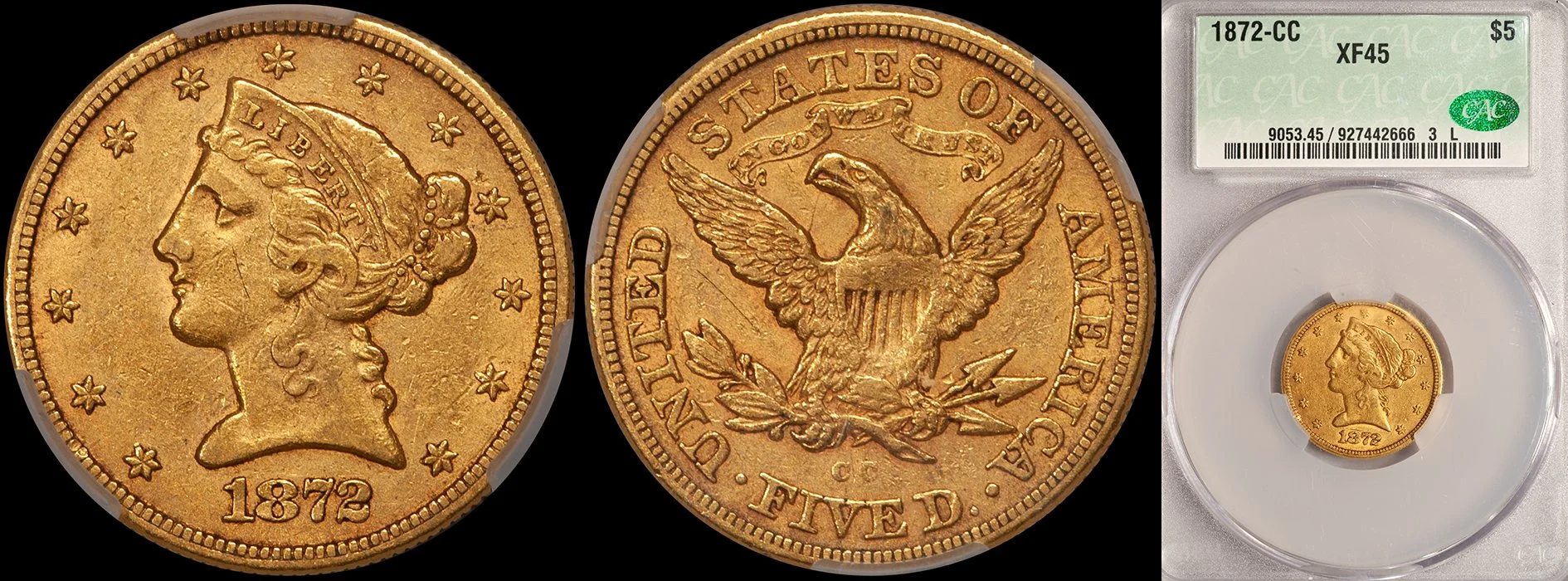
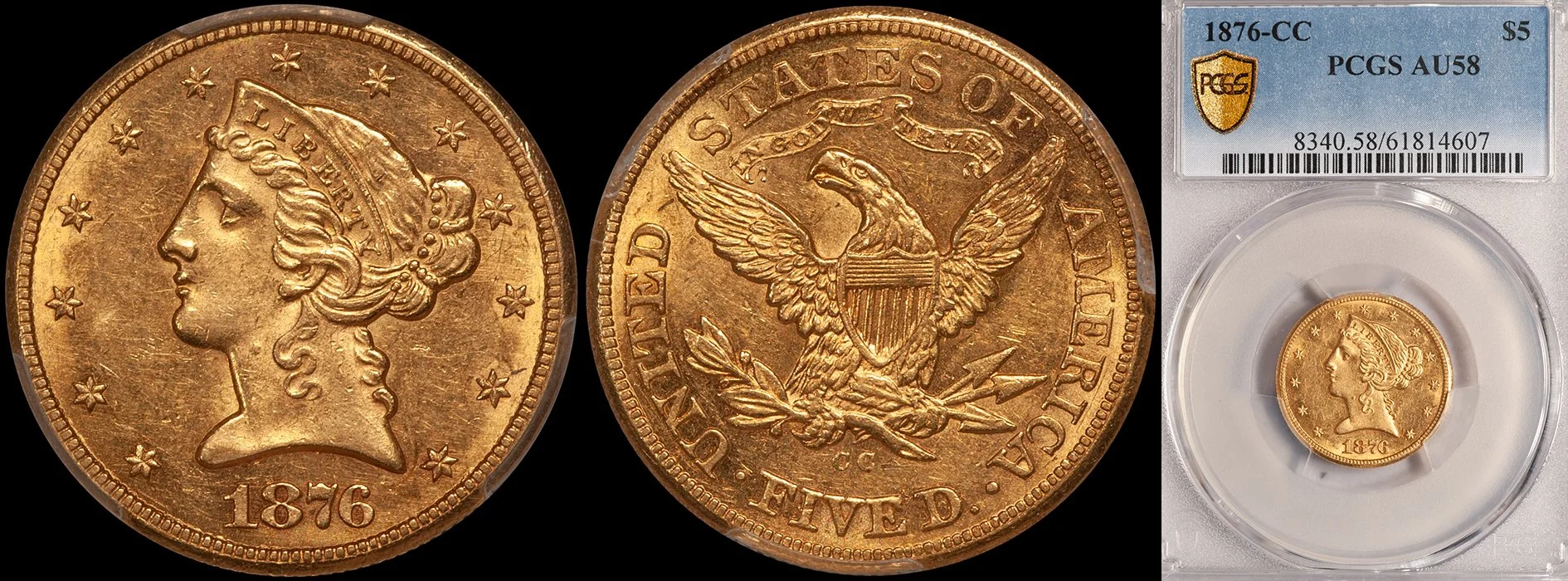
Are 1870-CC Eagles Undervalued in Comparison to their Double Eagle Counterparts?

Without a lot of fanfare, we have seen the dispersal of one of the most amazing collecting of Western branch mint gold coins in the history of numismatics. So far in 2014, the various sales of the Bently/Nob Hill Collection(s) of US Gold Coinage has seen no less than six examples each of the rare 1870-CC eagle and double eagle with the promise of more to come.

The sale of this quantity of 1870-CC eagles and double eagles has made me reconsider the rarity and price structure of both issues. It has not only allowed me to get an excellent idea of exact valuations for both issues in a variety of grades, it has led me to ask an important question: is the 1870-CC eagle undervalued in comparison to its double eagle counterpart?

Before I attempt to answer this question, let’s take a quick look at both issues.

A total of 5,908 1870-CC eagles were struck. This is the rarest Carson City eagle (although the 1879-CC makes a strong claim to the rarest coin in the series) and there are an estimated 50-60 pieces known with most in the VG-VF range.

There were 3,789 1870-CC double eagles struck. It is the rarest CC gold coin of any denomination and I feel that there are 35-45 known in all grades; mostly in the VF-EF range.

Let’s look at the current PCGS population figures for each issue:

$10.00 G-VF : 23; EF: 18; AU: 10; UNC: 0; Total: 51

$20.00 G-VF : 6; EF: 22; AU: 5; UNC: 0; Total: 33

These numbers tell us a few things. First, as expected, the 1870-CC double eagle is around twice as rare as its counterpart the 1870-CC. Interestingly, the eagle is seen more often in lower grades (the average example grades VF) while the average grade for the double eagle is EF. Both issues are extremely rare in properly grade AU and are unknown in anything close to Mint State.

We might make the quick conclusion that based on rarity alone, the 1870-CC double eagle should be worth around 2x what an 1870-CC eagle is worth in VF, EF and AU grades.

Based on the sales of so many 1870-CC eagles and double eagles in 2014, I’d suggest the following valuations for each denomination:

1870-CC $10.00 PCGS EF45

$10.00

  • VF: $25,000-40,000 (depends on grade/grading service)

  • EF40: NGC $40,000-45,000; PCGS $45,000-50,000

  • EF45: NGC $45,000-50,000; PCGS $50,000-55,000

  • AU50: NGC $60,000-65,000; PCGS $70,000-75,000

  • AU55: NGC $125,000-135,000; PCGS $150,000-175,000

1870-CC $20.00 PCGS EF45

$20.00

  • VF: $175,000-225,000 (depends on grade/grading service)

  • EF40: NGC $235,000-250,000; PCGS $250,000-265,000

  • EF45: NGC $260,000-280,000; PCGS $275,000-290,000

  • AU50: NGC $285,000-295,000; PCGS $310,000-330,000

  • AU55: NGC $325,000-350,000; PCGS $400,000-425,000

Assuming that the price structure for the 1870-CC double eagle is “correct” (and I think it is, based on the number of coins which have sold over the last few years), why is the 1870-CC eagle not priced at around half the level of its counterpart?

I think there are a few answers to this. The 1870-CC double eagle is a more famous coin with a lower mintage. It is larger in size and it is part of a set (Carson City double eagles) which ranks as among the most avidly collected in all of upper-echelon American numismatics.

Double eagle rarities have multiple levels of demand, and the 1870-CC is a coin that often sells to a collector or investor who might not be a tried and true specialist.

I think we are beginning to see a strong shift in the eagle market and this denomination is now gaining in popularity and price. CC eagles aren’t as popular (yet) as double eagles, but the metrics for these series is clearly changing.

My conclusion is that the 1870-CC eagle is undervalued. If a nice quality EF45 1870-CC double eagle is worth in the $275,000-295,000 range, an 1870-CC eagle at $50,000-55,000 seems substantially undervalued. Given that the 1870-CC eagle in EF is pretty similar in rarity to the 1870-CC double eagle (see the chart above), it is hard to believe that it is worth only 1/5th as much. I can easily see the 1870-CC eagle in EF and AU grades doubling in price in the next five years; I’m not sure I can say the same for the 1870-CC double eagle.

What are your thoughts about the price and rarity of the 1870-CC eagle and double eagle? I would love for you to comment below.

Do you buy rare gold coins?

Do you have coins to sell?

Would you like to have the world’s leading expert help you assemble a set of coins?

Contact me, Doug Winter, directly at (214) 675-9897 or by email at dwn@ont.com.

Is it Time to Buy Indian Head Half Eagles?

I am generally not a participant in the generic gold market as I tend to favor scarce and rare dates over more common ones. But I like Indian Head half eagles a lot and a recent experience made me ask the question: “is it time to buy Indian Head half eagles?” I bought a nice, fresh deal of Indian Head half eagles about six weeks ago. All were in very old holders and I broke them out and sent them off to grading. My results were excellent and nearly every coin graded MS64 or MS65. As I got ready to cash in on my windfall, I did some price research and was shocked. Unless they stickered at CAC (more on this in a few moments) the levels I was going to have to sell them left me breathless…and not in a good way.

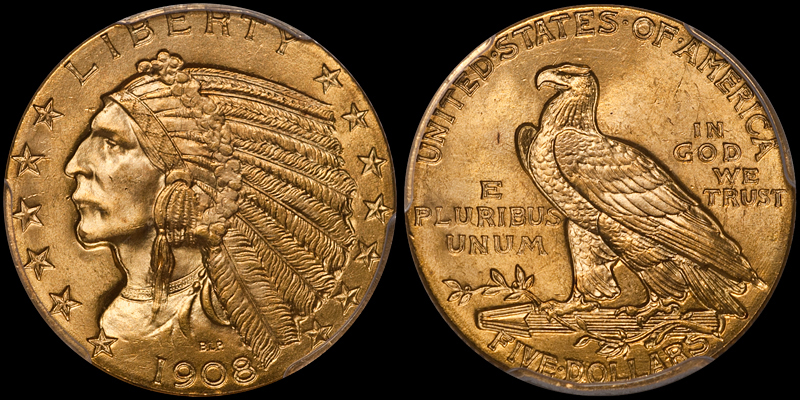
1908 Indian Head $5.00 PCGS MS65 CAC

If you are like me and you don’t really follow the generic market on a day-by-day basis, it can be mystifying to see how cheap most issues have become in the last few years. My non-CAC MS64 Indian head half eagles were worth around $1700 per coin if they were in NGC holders and a bit more in PCGS holders. I was more shocked at how cheap MS65’s have become: around $9,000 for NGC coins and a smidge over $10,000 for PCGS coins. And that’s not to mention the fact that you basically have to twist buyer’s arms to get them to buy any quantity of these even at these cheap, cheap, cheap levels.

Why are Indian Head half eagles so inexpensive in MS64 and MS65? There are a number of answers.

1. Traditional Sellers of Generic Gold Now Sell Other Products

Firms like Blanchard, Swiss America, and Goldline used to sell lots of better quality generic gold coins; items such as MS64 or MS65 Indian Head half eagles. Today, they either sell few generics or if they do, they are focused on those coins with CAC approval. The supply of MS64 and MS65 Indian Head half eagles has stayed consistent as coins are continually found in Europe or upgraded from current holders. The demand has not kept up with the supply, however, and this has resulted in plummeting prices.

1911 $5.00 PCGS MS65 CAC

2. Owners of Generic Gold Don’t Want to Cost Average Their Positions

Let’s say you bought a few nice MS65 Indian Head half eagles for $15,000 each back around 2006-2007. You are clearly not a happy with today’s prices so much lower than when you purchased your coins. But why not by a few more and use cost-averaging to lower your overall price point(s)? This logic makes sense to me, but for most coin investors it is exactly what they do not want to do. They feel “burned” by Indian Head half eagles and probably want nothing more to do with them. This lack of continuity in the generic market, due to poor price performance, has clearly not helped this market.

3. The CAC Effect

One of the primary reasons why CAC was created was to identify those generic gold coins, particularly in series such as Indian Head half eagles, where the perception was that many coins in MS64 and MS65 holders were over-graded or not, at the very least, “solid” for the grade. CAC has proven to be very tough on Indian Head half eagles, and only a small percentage of the MS64 and MS65 coins sent in for approval have received a green sticker. As a result, stickered MS64 and MS65 Indian Head half eagles sell for very strong premiums; in most cases 25-50% over non-stickered coins. The market perception of non-stickered MS64 and MS65 Indian Head half eagles is they are not “good” coins and, as a result, the price gap between non-CAC and CAC stickered generic gold coins is widening. My gut feeling is that non-stickered MS65 Indian Head half eagles could ultimately be worth half as much as their CAC’d counterparts.

4. The Plus Grade Effect on MS64

It is a matter of opinion whether coins graded MS64+ are actually “better” than coins graded MS64, but the market perception is such that plus-graded coins have begun to sell for significant premiums, even in the generic market. If you are a new collector and you are offered a “regular” MS64 Indian Head half eagle for $1,750, or an MS64+ example for $2,250, the chances are good that you will spend the extra $500 and get the “better” coin. This has clearly hurt the market for MS64 Indian Head half eagles, and it is likely that we will see further price separation between MS64 and MS64+ coins.

5. Changing Tastes Amongst Gold Coin Buyers

More than anything else, the generic gold coin market has been hampered by a lack of demand. Past generations of new collectors and investors were introduced to numismatics by the assembling of the basic 11 or 13 coin U.S. gold coin type set. Today, new collectors are more inclined to collect something which is rare. For $10,000, an AU 1864 half eagle (slightly over 4,000 struck and under 75 known in all grades) is a more sensible purchase than an MS65 1909-D half eagle (nearly 3.5 million struck and over 100 graded in MS65 at PCGS alone) in the minds of these new collectors. It will take a large marketing promotion and lots of re-education to get new collectors to re-think this.

1912 $5.00 PCGS MS65 CAC

So what is my conclusion? Is it time to buy Indian Head half eagles in MS64 and MS65? I’d like to say yes, but I think that prices could easily drop another 20-30% on these coins in the next year or two. In my opinion, if levels get down to $1,500 for nice MS64’s and $7,500 for MS65’s, I would jump in the market, likely in a big way. For now, I’d avoid this coin unless you need one for a gold type set or if you are a contrarian with some tolerance for risk.

What’s your take on the Indian Head half eagle series and generic gold in general? I’d love to hear from you and encourage you to add your comment(s) in the section below.


Do you buy rare gold coins?

Do you have coins to sell?

Would you like to have the world’s leading expert help you assemble a set of coins?

Contact me, Doug Winter, directly at (214) 675-9897 or by email at dwn@ont.com.

10 Undervalued, Affordable US Gold Coins from the Old West

Everyone likes good value when they buy coins, and more collectors than ever opt to buy coins from the two western branch mints located in Carson City and San Francisco. So why not write an article on said topic? And let’s double your enjoyment, dear reader, by selecting affordable coins in the $2,500-7,500 range; coins which are actually available from time to time, so that this guide is actually usable. In fact, let’s go whole hog crazy and even suggest the best value grades (BVG) for each issue!

And away we go….

1870-S $1.00 PCGS MS62 CAC

1. 1870-S Gold Dollar, MS62 to MS63

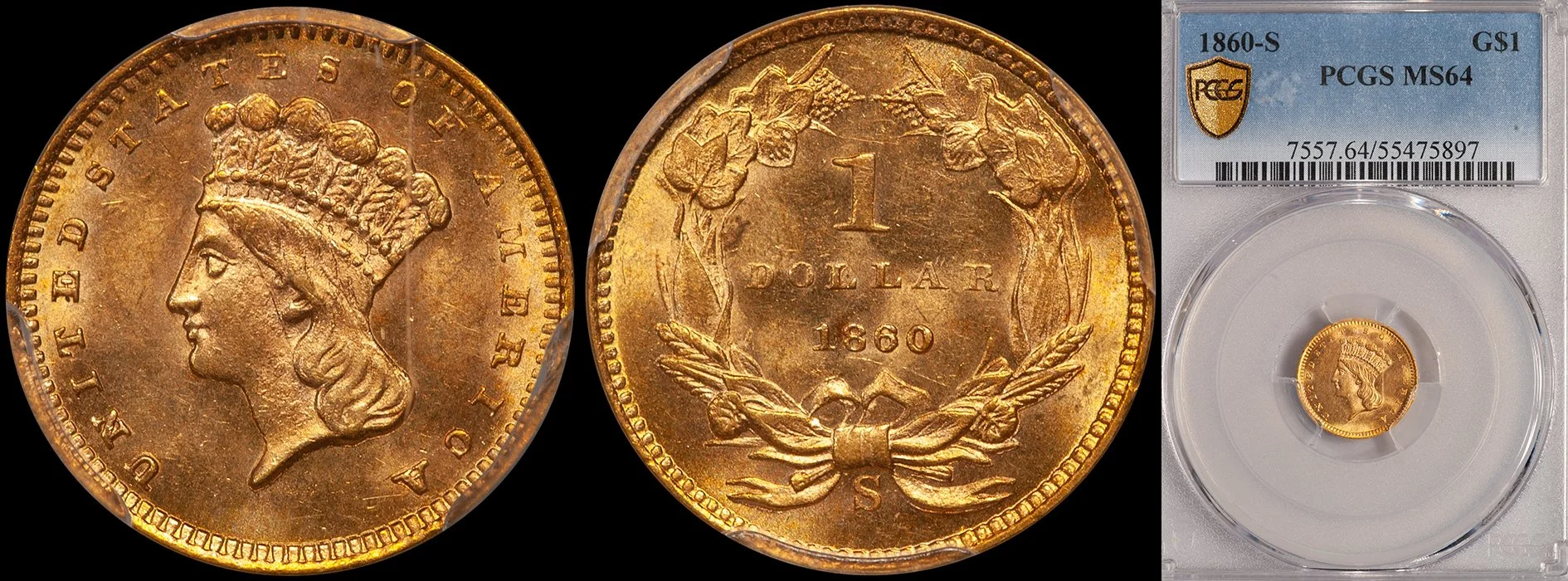
The 1870-S gold dollar is a numismatically significant coin as it is the final year in which this denomination was produced at the San Francisco mint. It is a low mintage issue with just 3,000 struck, and the coins which survive are pretty evenly spread out between the AU50 to MS63 range.

In MS62 to MS63, the 1870-S is quite a scarce coin but not an impossible one to find. An MS62 currently is valued in the $4,500-5,500 range, while a properly graded MS63 can be found in the $6,500-7,500 range.

I like this coin for a number of reasons. It is a low mintage issue which is one of just seven gold dollars made at the San Francisco mint. It also has “date appeal” due to the extreme rarity of its Big Brother, the unique 1870-S Three Dollar.

1861-S $2.50 NGC AU55

2. 1861-S Quarter Eagle, AU55 to AU58

Despite its status as a Civil War issue, the 1861-S is an overlooked scarcity in the Liberty Head quarter eagle series. Only 24,000 were struck and the survival rate of this issue is extremely low. There are likely fewer than 100 known today with most in the VF-EF range. Properly graded AU’s are very scarce, and this date becomes really rare in AU55 to AU58. I know of just two or three in Uncirculated, the finest of which is a PCGS MS62+ that I purchased for $25,300 in the Heritage 8/11 auction.

In AU55, an 1861-S quarter eagle will cost between $3,500 and $5,000+, depending on the quality. In AU58, the price range will run from around $6,000 to over $8,000 for a very choice piece.

This date is starting to show some signs of life, but I still feel it is much undervalued, especially in the higher AU grades.

3. 1879-S Quarter Eagle, MS61 to MS62

This date has been a favorite of mine for years and, I must admit, it was an issue that I once hoarded (but no longer do). It is numismatically significant as the last year of issue for quarter eagles from this mint, and it is scarcer than its mintage of 43,500 would suggest. While fairly easy to obtain in circulated grades, this issue is rare in Uncirculated with probably no more than 15 or so known. Despite its rarity, this issue remains affordable.

In MS61, the 1879-S quarter eagle can be purchased for $1,750 to $2,250. I’d actually recommend a potential buyer wait for a nice MS62—which is valued at $2,500 to $3,000—as said coin is likely to be nicer despite its small premium over a 61.

I doubt if this coin is likely to ever be regarded as “collectable” as others in this group of ten. But I am including it as I regard it as one of the best values available from the San Francisco mint.

4. 1855-S Three Dollar, AU50 to AU53

I have written about this date extensively and it remains among my very favorite dates in the Three Dollar series. It is numismatically significant as the first San Francisco issue of this denomination, and it is the rarest collectible Three Dollar piece from this mint. There are an estimated 300-400 known with most in lower grades. For the sake of not climbing above the $7,500/per coin limit we set for coins in this article, I am suggesting collectors focus on AU50 to AU53 examples, although I would suggest that an even higher grade coin would be a great addition to a set.

In AU50, an 1855-S three dollar is worth $4,500-5,500. In AU53, an example will sell for $5,000-6,500.

A quick buying hint or two: most 1855-S three dollars have been dipped or processed and naturally toned, choice pieces with good eye appeal are very scarce. Be patient and if you see the “right” coin don’t be afraid to pay a premium.

5. 1858-S Half Eagle, EF45 to AU50

Collectors are finally getting wise to the rarity—and excellent value—of the San Francisco half eagles. But most of their attention has been focused on the Civil War issues, meaning that certain dates struck before 1861 and after 1865 remain very under-priced. I could list a number of these but am going to focus on just one or two to keep this article a manageable length.

I like the 1858-S both in terms of its overall and high-grade rarity. It is unlikely that more than 50-60 are known from an original mintage of 18,600. This issue saw active use in local commerce and most survivors are in the VF-EF range.

If you can find a nice, original EF45 1858-S half eagle (it will be a challenge, I can promise you that!), it will cost in the area of $2,500 to $3,000. An AU50 will cost $4,000-5,000 and will present even more of a challenge.

A quick FYI: the 1859-S and 1860-S are two other San Francisco half eagles which are almost as tough as the 1858-S and both are affordable—and undervalued—as well.

6. 1881-CC Half Eagle, AU50 to AU53

With few exceptions, all of the 1870’s Carson City half eagles are scarce to rare, and most are out of the price range for coins in this article. The five CC half eagles produced during the 1880’s are more available but will prove challenging to the collector who likes choice, original coins.

The 1881-CC is the rarest post-1870’s half eagle from this mint. There are around 125-150 known in all grades, mostly in the EF40 to AU50 range. This issue is well produced and is known for pleasing color and luster. A nice quality AU50 should be buy-able in the $4,500-5,500 range, while an AU53 will set you back $5,500-6,500.

Buying hint: more and more CC half eagles from this era are being dipped-n-stripped, leaving sophisticated collectors with fewer available nice coins. Don’t be afraid to pay a premium for the “right” coin if you see it.

7. 1855-S Eagle, EF45 to AU50

The San Francisco mint began production of eagles in 1854 and many of the early issues are more available than one might think; at least in circulated grades. An exception to this is the 1855-S of which only 75 or so are known from the original mintage of just 9,000. In higher grades, this date is extremely rare and priced far out of the range which we have set. But rich guys shouldn’t have all the fun, right? You can still afford a nice 1855-S eagle even if the upper end of your coin budget is in the high four figures.

A nice EF45 example of this rare date will cost around $3,500 to $4,500 and enough exist to make this a real possibility for the collector. An AU50 will prove much harder to find and is likely to cost as much as $6,500-8,500 depending on the quality.

Another buying hint: virtually any San Francisco eagle struck prior to 1877 is highly undervalued and if you can locate nice pieces in the $2,500-7,500 range I’d buy them aggressively.

8. 1882-CC Eagle, AU53 to AU55

You need a big coin budget if you want to collect the Carson City eagles from the 1870’s as even the most available dates (1871-CC and 1874-CC) are big bucks in EF45 and above. But the issues from the 1880’s, while not as scarce, are still pretty good value and you can purchase a pretty scarce coin in a pretty impressive grade for not a whole lot of scratch.

My favorite later date CC eagle is the 1882-CC. Only 6,764 were made and this date is extremely hard to find in grades above AU55. An AU53 is currently priced in the $5,000-7,000 range while an AU55 will run $6,500-8,500.

Two other later date CC eagles also worth consideration are the 1883-CC and the 1893-CC; the former in AU53 to AU55 grades and the latter in AU55 to AU58.

9. 1895-S Eagle, MS61 to MS62

You take a risk when you buy post-1877 San Francisco gold coins as many were shipped to Europe or South America and are still being repatriated. I would be cautious of coins like the 1895-S but I think nice MS61’s are probably safe, given their current affordability.

Along with the 1894-S, the 1895-S is the key date in the later San Francisco Liberty Head eagles. It is pretty easy to locate in AU55 and AU58, but it is scarce in properly graded MS61, and very rare in MS62 and above. MS61 examples currently sell in the $2,500-3,500 range and given the fact that they have a PCGS population of just six in this grade with seven higher, they seem like great value. An MS62, if you can find one, will cost $5,500-7,500.

Remember, hoards of this date are a possibility so don’t spend your life savings cornering the market on Uncirculated 1895-S eagles.

1884-CC $20.00 NGC AU58 CAC

10. Common Date Carson City Double Eagles, Gem AU58

No area of the U.S. gold market has been more active in recent years than Carson City double eagles. We’ve seen dramatic price increases, especially for common dates in EF and AU grades. I can’t call any CC double eagle “undervalued” at current levels but I think “gem sliders” are the best value in this market.

Before I go further, let me explain what a “gem slider” is. It is a coin graded AU58 that is really choice with nearly no visible luster breaks, clean surfaces and pleasing natural color. Only a small percentage of coins graded AU58 by the services are “gems” for the grade.

Let’s look at a specific issue: the 1884-CC. It is common enough in circulated grades but it is becoming hard to locate in properly graded AU58. A gem slider coin in a 58 holder is currently worth around $7,500. Compare this to an average quality MS61 1884-CC which would easily bring $15,000-16,000 in the current market. Which seems like better value to you?

If you are going to play in the CC double eagle market, I suggest you look at really nice AU58’s (or even top quality AU55’s) as these represent the best value in a series in which your $2,500 to $7,500 per coin budget might no longer go as far as it once did.

This list could have easily been twenty or even thirty coins. Which issues did I leave off which you like? Please feel free to add your comments below.

Do you buy rare gold coins?

Do you have coins to sell?

Would you like to have the world’s leading expert help you assemble a set of coins?

Contact me, Doug Winter, directly at (214) 675-9897 or by email at dwn@ont.com.

Your Blogger Swoons at an Auction Announcement

The last few years have been fertile, to say the least, for auction sales involving all-time great collections. We’ve seen the sales of the Newman collection, are seeing the current selling off of the Gene Gardner sets, and have also witnessed the not-as-splashy sales of a number of important general and specialized sets. But none of these sales affected me as much as the announcement of the upcoming sale(s) of the legendary Mac and Brent Pogue collection.

Around a week ago I read a press release stating that the Pogue collection would be sold by Stacks Bowers in a series of auctions “over the next several years.” My reaction? Unprintable in this blog (hint, starts with: Holy) but understandable, given that it is well-known within the dealer community that this is quite probably the greatest collection of American coins ever formed, and that there were no rumors floating around that it might be sold.

After pondering the Pogue Situation for a few hours, I’ve reached a few initial reactions which I’d like to share with you.

1. This Collection is Even Greater than You've Heard

Other than a handful of people, there are not many numismatists that are aware of the complete inventory of this collection, and I am not one of the lucky few. Over the years, I’ve been shown little date runs from the collection (I can remember looking at a phenomenal group of early quarters at Dave Akers’ table at an ANA convention 10-15 years ago that belonged to the Pogues and, at another ANA show maybe 15 years ago a group of Fat Head half eagles which were mind-blowing) and have received tidbits of information from Brent about what he has. But this is truly a once-in-a-generation collection and it is certainly the only collection that I would actually pay to see in person.

2. This Collection is More Valuable than You've Heard

It is nearly impossible to know the value of a collection which you haven’t seen in person and don’t even know for sure what it includes. If I had to give a good guesstimate, I’d say the collection is easily worth $150 million, and it could ultimately be worth $200 million or even more. It contains a coin which is likely to set a record for most valuable United States issue ever sold at auction (the Childs/Pogue PCGS PR68 Original 1804 Dollar) and it contains at least two other coins (the 1822 half eagle and the 1854-S half eagle) that could break the $5 million dollar barrier. There are scads of mid to high six-figure coins in the Pogue collection, and I wouldn’t be surprised if there are a number of other coins which will break the $1 million dollar mark when they are sold at auction.

3. This Collection Will Severely Impact the Very Highest Segment of the Coin Market

If you collect finest known or Condition Census early American gold or silver coinage, the news of this sale impacts you critically. There are going to be countless once-in-a-lifetime opportunities for collectors and you will need to start planning your strategy sooner than later. If you are planning to sell high quality coins in the near future, you have to ask yourself: will the prices I realize for my coins be impacted by Pogue? If you are planning to buy an expensive early American coin, how will prices be impacted by Pogue?

One fallout I see happening is a rush to trade-in certain coins which are nice but which are exceeded in quality by Pogue. Some collectors will trade in coins wisely, others will make poor decisions. Working with a smart, informed dealer is the best way to make your decisions the right ones.

4. The International Factor

For the most part, the impact of foreign buyers in American coin sales has been insignificant. Sure, a few foreign buyers bid in American sales but not enough to have a serious impact. This could change with the Pogue sales.

Stacks Bowers has made strong inroads selling foreign coins via auction in Hong Kong and, if I were them, I’d take the Pogue coins to exhibit in Hong Kong and at least one other location in the Far East before the dates of the sales. There is a better-than-average chance that they will interest at least one or two wealthy Chinese buyers in these great American coins, and I wouldn’t be shocked if a not insignificant amount of the dollar value for some of the sales went to foreign bidders.

Now that I think of it, I’d probably take the coins to London as well and expose them to European and dual national buyers in this important market.

5. The Draw of the New Internet

As we witnessed with the Saddle Ridge Hoard discovery and subsequent sale, the newest incarnation of the internet has forever changed the rare coin market.

When the Eliasberg and Bass sales were sold in the 1980’s and late 1990’s, there was essentially no internet. The Pogue collection is the first truly great American coin auction which will be picked up by world-wide press outlets and which will receive untold amounts of publicity on internet news outlets.

Stacks Bowers has the potential of reaching nearly every wealthy person in nearly every country with relative ease. All it takes is a few Indian men of extreme wealth, Russian oligarchs, Chinese and other far Eastern billionaires, and American hedge fund managers to bring the Pogue collection to a new pool of ultra-wealthy buyers who might not have known about rare American coins. What seemed far-fetched a few years ago seems possible today.

6. "It's 1995-1999 All Over Again"

A smart dealer friend made this comment when looking at the current embarrassment of riches when it comes to auctions. He was referring to the point in time when we had scads of sales of great coins in the mid to late-1990’s: James Stack, Pittman, Childs, Eliasberg (silver), and Bass were all sold within a span of less than a decade. If you were in the market then, you remember how great coins were suddenly everywhere and you’d see coins like Proof 1868 three dollar gold pieces or Proof 1877 half eagles sitting, unsold, in dealers cases; coins which would sell quickly today if available.

The impact of these 1990’s sales was profound. After some temporary weakness in the market, a run of boom years began around 2001/2002 which lasted all the way up to the economic issues of 2008/2009. In part, this boom was fueled by the availability of great coins from these great old collections. After all, you can’t have a bull market in coins if there are no great coins to sell.

And this is what could happen after the Pogue coins sell. The coins which don’t get bought by collectors and which don’t get “black holed” are likely to sit in dealer’s inventories and impact dealer’s cash flow. If, say, the Pogue sales begin in 2015 and conclude by 2017, we might see an oversupply of coins in 2018, 2019 and 2020. This could, in turn, weaken the market.

But, to take another perspective, perhaps the market will be deep enough this time around (due to the amazing amount of global wealth) to absorb the Pogue’s $200+ million without skipping a beat. We shall see…

7. How Will Pogue Impact Me?

At this point you are thinking, “OK enough of the babbling, Winter, how is this sale going to impact me?"

Fair enough.

Not every coin owned by the Pogues is a finest known six figure rarity, so it is likely that if you are a regular DWN client, there are going to be some coins in the sales that interest you, anywhere from casually to obsessively. So let’s operate under the assumption that you might want to consider expanding your coin budget in the next few years.

If you are the typical DWN client who feels comfortable spending $5,000 or $10,000 on a neat American gold coin, the Pogue sales aren’t going to have a huge impact on you. The sale of the finest known 1838-C half eagle (the Pogue collection contains a gorgeous PCGS MS63) isn’t going to impact the value of a nice AU50 example that I sold you in 2010.

I see the sale of this collection as a positive. Coins will become better known across the world thanks to the internet-driven publicity of the Pogue collection and, if it is done as well as I think Stacks Bowers will do it, the number of serious collectors of serious American coins could increase. A lot.

The greatest impact will be on the very top of the market; the 1% if you will. There will be a lot of juggling and jostling to see who has the best 1794 half dollar or the finest 1795 half eagle after the grades of the Pogue coins become better known.

Given the fact that the Pogue collection really came of age after the family bought heavily in the 1982 Eliasberg gold sale, I think the Eliasberg pedigree will become even more important than it is today. When today’s new collectors see how many great Pogue coins are from the Eliasberg sale, the legacy of the Eliasberg pedigree will grow and grow.

I am curious to hear your thoughts about the Pogue sales. Please leave your comments at the end of this blog or write me at dwn@ont.com.


Do you buy rare gold coins?

Do you have coins to sell?

Would you like to have the world’s leading expert help you assemble a set of coins?

Contact me, Doug Winter, directly at (214) 675-9897 or by email at dwn@ont.com.

Trophy Coins for the Rest of Us

The last article I wrote was about Trophy Coins. It generated a lot of buzz among my readers, not all of it positive. The negative comments I heard, not all underserved, typically went something like this: “You are an elitist, writing about coins which are $50,000, $100,000 and more.” I can understand these comments, although I would counter with the argument that a true Trophy Coin is by its very nature meant to be exclusive.

Is it possible to own a true Trophy Coin at a more realistic price point? I would resoundingly say that yes it is, although I would still place the minimum amount required to attain Trophyness, at least in the arena of United States gold coinage, to be in the $5,000-10,000+ range.

Here is a list of ten Trophy Coins for the 99%, plus “pitches” which quickly explain what makes each coin so clearly identifiable as being “special.”  I’ve also listed some “runners-up” which can be considered Trophy Coins in their own right.

1875  $1.00 PCGS MS65 CAC

1. 1875 Gold Dollar

The Pitch: Only 400 business strikes were made, giving this the lowest reported mintage of any gold dollar.

The 1875 gold dollar is a coin which was famous soon after it was made but whose popularity has diminished over the years. Most non-specialists are aware that it has an absurdly low original mintage, but they have little knowledge of this coin’s special attributes above and beyond its mintage. Interestingly, for some collectors the 1863 has replaced the 1875 as the “go to” Philadelphia issue of this denomination as a result of its status as “rarest Civil War gold dollar.”

The appearance of this issue is unusual for a gold dollar of this era. Many of the 100-150 which exist show fully reflective mirror surfaces which carefully resemble those seen on Proofs of this year. The typical example grades AU50 to low end Uncirculated and a very presentable 1875 gold dollar can be obtained, with patience, for around $7,500. In the higher grade range, there are at least five or six gems known including a PCGS MS66+ owned by collector Bob Simpson and Steve Duckor’s PCGS MS66; these are the two finest I have seen and am aware of.

While not as rare as its low mintage would suggest (clearly, examples were saved at the time of issue by dealers and collectors), the 1875 gold dollar is a significant scarcity whose value would quickly increase were it better known.

Runners Up: 1855-D gold dollar (rarest collectible branch mint issue), 1863 (rarest Civil War issue).

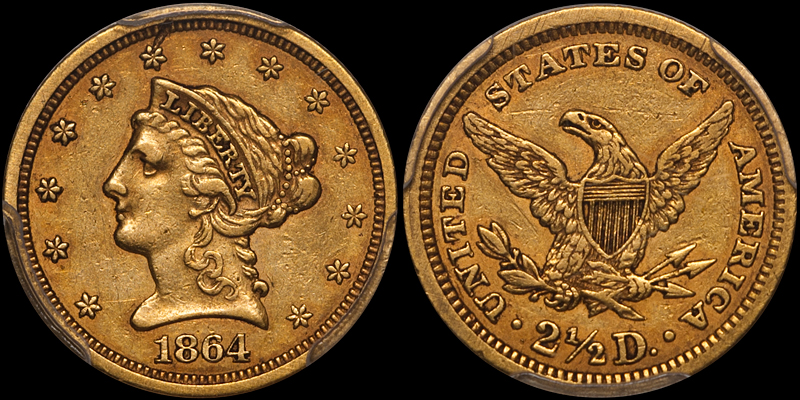
1864 $2.50 PCGS EF45 CAC

2. 1864 Quarter Eagle

Pitch: The rarest collectible business strike Liberty Head quarter eagle and a key Civil War issue.

For many years, the 1864 quarter eagle was a “sleeper” within a series (Liberty Head quarter eagles) replete with undervalued issues. But with the increased interest in Civil War issues, the true rarity of the 1864 quarter eagle became better known and, quickly, values escalated.

It is likely that no more than two dozen examples exist from an original mintage of 2,824 with most in the EF45 to AU55 range. The finest known is a superb Gem, graded MS67 by NGC and ex Byron Reed. The last few examples which have appeared at auction have brought in the $40,000-60,000 range; a level which is out of keeping with the spirit of these Trophy Coins but which, in my opinion, still represents fair value for an elite rarity.

With the exception of the extremely rare 1854-S, this is the rarest Liberty Head quarter eagle produced in an unquestioned business strike format, and it is clearly the rarest of the ten Trophy Coins on this list.

Runners Up: 1838-C and 1839-D (popular first year of issues), 1856-D (rarest Dahlonega quarter eagle), 1875 (lowest business strike mintage of the series except for the 1854-S).

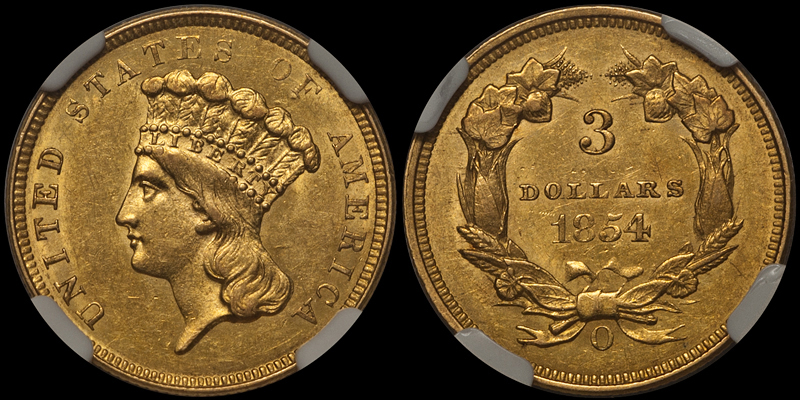
1854-O $3.00 NGC AU58+ CAC

3. 1854-O Three Dollar Gold

The Pitch: Popular first year of issue and one year type.

My natural inclination was to include the 1854-D as an obvious Trophy Coin, but at $50,000 this didn’t fit in with the spirit of this list; especially after I just listed a $50,000 item as coin #2. So, I chose the “poor man’s 1854-D,” namely the 1854-O.

As with its expensive cousin, the 1854-O is a one-year type and a first-year-of-issue. It is a surprisingly plentiful issue given its relatively low mintage of 24,000; over 1,000 exist, mostly in the EF40 to AU50 range. Accurately graded AU53 to AU55 examples with natural color and choice surfaces are still affordable and, in my opinion, they are very scarce due to the fact that 90+% of the surviving 1854-O threes have been cleaned and/or processed.

I handle dozens of 1854-O Three Dollar gold pieces every year, in grades ranging from EF40 to MS61, and this issue continues to fascinate me.

Runners Up: 1855-S (first SF issue), 1865 (rarest Civil War date).

1800 $5.00 NGC AU55+ CAC

4. Draped Bust Half Eagle

The Pitch: Old gold.

I’ve specialized in rare United States gold for close to three decades and I don’t think I’ve ever met a collector who didn’t like early gold. What’s not to like? These coins are historic, hefty, attractive and rare. Of the three denominations struck from 1795 to 1834, the half eagle is the most affordable and the most obtainable.

Narrowing down our choices for a Trophy Coin, I would select a Draped Bust half eagle, struck from 1798 through 1807. Nearly all collectors confronted with a choice of dates for this denomination would select an 18th century issue, but the 1798 and 1799 are not cheap; thus, I suggest focusing on an 1800-1807. Nice AU coins are available, with some patience, in the $10,000-12,000 range. These coins have been excellent performers over the years (they have essentially doubled in price over the last decade) and they remain at the top of the list for many collectors’ dream coin.

Runners Up: Capped Bust type (1807-1812; cool but not as cool as the earlier Draped Bust type), 1813 (the most affordable Fat Head half eagle).

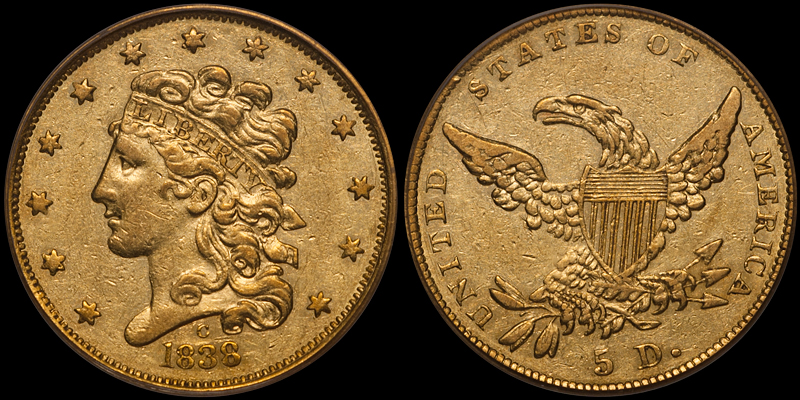
1838-C $5.00 PCGS AU50

5. 1838-C or 1838-D Half Eagle

The Pitch: Very popular first year of issues and one year types. Mintmark on the obverse. Popular!

It was too hard for me to choose one or the other so I picked both…and for good reason. Both the 1838-C and 1838-D half eagles have become extremely popular in recent years and together they form a wonderful two coin collection.

The 1838-C is the more common of the two but it is much rarer in high grades than its counterpart. I have only seen one truly Uncirculated 1838-C half eagle (the Elrod/Bass coin graded MS63 by PCGS) and no more than five or six really nice high end AU examples.

The 1838-D is scarcer but it seems to have been saved in higher grades and as many as 10 are known in Uncirculated.

More than nearly any other southern gold coins (except for the 1861-D dollar and half eagle) these two issues have near-universal collector appeal.

Runners Up: 1840-O (first year of issue), 1842-D Large Date (rarest half eagle from Dahlonega), 1863-1865 (rare Civil War issues).

1909-O $5.00 PCGS MS61 CAC

6. 1909-O Half Eagle

The Pitch: Popular one-year type coin and the last gold piece ever struck at this mint.

After discontinuing the manufacture of half eagles in 1894, the New Orleans mint struck 34,000 half eagles—seemingly out of the blue—in 1909-O. This has been a popular issue for many years and it has a grade distribution not unlike the 1854-O Three Dollar. The 1909-O is common in EF and lower AU grades, scarce in properly graded AU55 to AU58 and rare in Uncirculated.

I have handled dozens of 1909-O half eagles in the last few years ranging from affordable EF45 examples to the finest known, the incomparable Eliasberg MS66 which I purchased for a client in the January 2014 FUN auction. This issue appeals to a wide range of collectors and for good reasons: it is a unique issue with a great back story.

For most collectors a nice AU50 to AU53 example will fit well in their collection. A Trophy Coin aficionado could easily spend $50,000 or far more for a nice Uncirculated 1909-O.

Runners Up: CAC approved common date Indian Head half eagle in MS64 or MS65.

1838 $10.00 PCGS EF40

7. 1838 Eagle

The Pitch: First year of issue with a neat short-lived design.

The eagle denomination was discontinued after 1804 and upon its resurrection in 1838 it became, again, the largest denomination of American coinage. Only 7,200 eagles were made in 1838 but this date is a little more available than one might think. But most 1838 eagles show considerable circulation, and properly graded AU50 and higher examples are quite scarce.

I have been a big fan of this date for many years and I don’t think I’ve ever had a nice quality 1838 eagle that hasn’t a) sold quickly and b) received multiple orders off my website when available. The 1838 is a coin with strong demand from non-specialists, and while prices have risen accordingly over the years, $7,500-10,000 will still buy you a decent example. If you are willing to spend $15,000-20,000+ you can buy a smoking 1838 eagle, although many of the coins offered in recent years (in both NGC and PCGS holders) have had originality “issues.”

RUNNERS UP: 1841-O (first New Orleans eagle), 1865-S Inverted Date (very cool blundered date), 1873/1876/1877 (very low mintage issues).

1854-S $10.00 NGC AU58 CAC

8. 1854-S Eagle

The Pitch: Affordable first-year-of-issue San Francisco gold coin and a great Gold Rush memento

There were many other Liberty Head eagles I thought about, including the first-year 1870-CC, the low mintage 1879-O, and 1883-O, not to mention some of the rare, interesting Indian Head eagles. But I chose the 1854-S for a variety of reasons.

1854 is a magical year for San Francisco gold coinage. The mint opened its doors this year and produced five denominations. Two, the quarter eagle and half eagle, are formidable rarities. The eagle is actually the most common denomination from this year with hundreds known in EF40 to AU55 grades.

I wouldn’t call a marginally decent AU55 example of the 1854-S eagle a Trophy Coin. But a properly graded AU58, especially with a CAC sticker, is a great value at current levels ($5,000-7,000) and it is the best available quality for this date as the 1854-S is exceedingly rare in full Mint State.

Runners Up: See above.

1857-S $20.00 PCGS MS64, SSCA

9. 1857-S SS Central America $20.00 in MS64

The Pitch: A borderline Gem 150+ year old big gold coin for around 10 grand.

Before the discovery of the SS Central America, I could have counted the number of Gem Type One double eagles that I had seen on one hand. This discovery brought thousands of superb pieces into the market. It not only made owning a superb quality Type One double eagle a reality for most collectors; it also jump-started the still-hot Liberty Head double eagle market.

Some readers of this article will bristle at my inclusion of this as a Trophy Coin. But consider this: there are hundreds of new collectors who began buying rare gold coins as a result of dipping their toes in the water with an SSCA. And an MS64 still seems like the sweet spot of this issue: the coins tend to be lovely and the price is reasonable when compared to an MS65 or an MS66.

My ideal SSCA coin has been carefully selected by a knowledgeable dealer to not have discoloration or signs of chemical reaction to the conservation performed after the coins were salvaged. I like the coins with all the “bells and whistles” you can add on: they should be approved by CAC, in the original packaging and accompanied by the presentation box and COA as issued.

Runners Up: 1850 (first year of issue), 1862 and 1863 (rare Civil War issues), 1865-S Bro Jo.

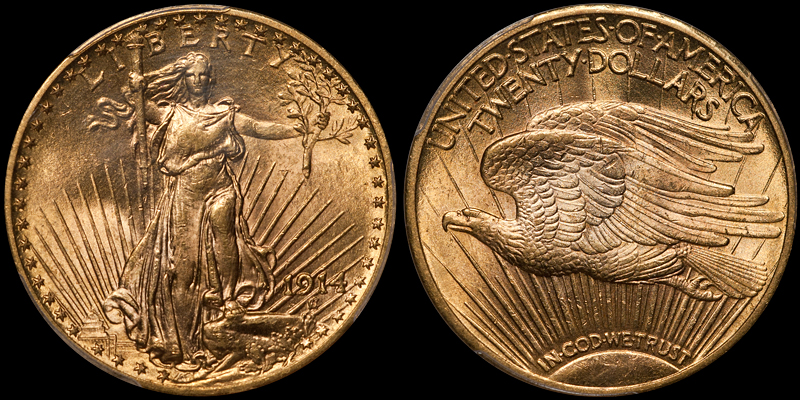
1914 $20.00 PCGS MS66

10. Common Date Saint in MS66 with CAC Approval

The Pitch:  A beautiful coin in a beautiful grade at a beautiful price point.

Remember: this is a group of Trophy Coins for collectors who can’t afford, say a High Relief in Gem Uncirculated. Everyone loves Saints and the Next Best Thing for the more casual gold collector is a Gem MS66 common date.

But we are talking Trophy Coins here so this common date Saint must somehow be uncommon. And for this I suggest buying a pretty, CAC approved MS66. To buy one you have to pay a strong premium over an average quality coin. You can find quantities of MS66 saints without CAC stickers for less than $3,000. CAC approved coins bring a 50+% premium but they are worth it. The quality of many of the MS66/CAC Saints I have seen has been superb with great color and luster and just a few small marks in the fields.

If you could add or delete coins from this list, what would they be? Feel free to leave comments or contact me directly at dwn@ont.com.


Do you buy rare gold coins?

Do you have coins to sell?

Would you like to have the world’s leading expert help you assemble a set of coins?

Contact me, Doug Winter, directly at (214) 675-9897 or by email at dwn@ont.com.

The Bently Effect

As I have discussed in prior blogs, a paradigm shift has occurred in the rare date gold markets in the last two-three years. Formerly unpopular areas of the market such as San Francisco half eagles and eagles and No Motto Philadelphia eagles (and others) have gone from “cool but hard to sell” to “top of the food chain” in a short period of time. There are a number of reasons why this has happened; some obvious and some not-so-obvious. What I find interesting is that the two collections responsible for this Tipping Point weren’t great old-school holdings like Eliasberg and Bass.

In January 2012, the San Francisco stamp auction firm of Schyler Rumsey sold the Broadus Littlejohn collection of US gold coins. This little-known collection hinted that something was afoot in the rare date gold market. Instead of focusing on traditional bellwether rare date gold items like Charlotte and Dahlonega quarter eagles and half eagles (of which there were extensive date runs in the sale), the strength was in the eagle date run, especially the rare San Francisco coins from the 1860’s and the rare low mintage Philly coins from the 1870’s.

The Littlejohn sale was off the radar for many collectors and dealers, and even though I wrote a detailed analysis about the prices realized, I don’t think its impact was felt at the time.

What most dealers didn’t know (confession: myself included) was that there had been an all-consuming rare date gold buyer way off the grid. The Bently Collection, which focused on Western rarities from San Francisco and Carson City, was being quietly amassed, and it contained quantities which seem borderline unimaginable.

The Bently collection was a strange amalgam of coins ranging from no-grades to Condition Census pieces. Mr. Bently was a voracious consumer of certain issues (as an example, he appears to have had a “thing” for 1870-CC double eagles, and he owned more of them at one time than any other collector in history) and if he liked an issue, he’d buy it in “VG details” or MS65.

Which brings me to the gist of this story: the Bently Effect. How ironic is it that a little-known uber-accumulation of coins is probably more responsible for impacting the rare date gold market than once-in-a-lifetime master collector like Harry Bass? How much of it is the coins themselves, and how much is it the timing of the sale(s)? How much of it is the impact and reach of the internet? How much of it is just pure blind luck and changing trends within the market?

While I have been dazzled by the scope and breadth of the collection, I have been mostly underwhelmed by the coins themselves. For every nice, original coin in the Bently holdings, there are numerous coins that are either damaged or heavily processed. Bently was, I doubt, a bottom feeder and I doubt he was buying solely with price in mind. From what I know about Mr. Bentley, he was an older gentleman who sold his company and decided to enjoy his final years enjoying nice things. His primary supplier was faced with the age-old dilemma with this sort of numismatic supernova: do I sell my super-secret mega customer a few nice coins every week or do I sell him everything I can get my hands on? I would have chosen the former, but some dealers would choose the latter… (And who’s to say that this isn’t the better strategy from a business standpoint?)

A very curious set of circumstances happened while the Bently coins were being accumulated. Carson City double eagles became extremely popular and rose significantly in price; not as a result of Mr. Bently’s purchases but rather as a consequence of new collectors in the market and two large wholesale promotions. That Mr. Bentley had hundreds and hundreds of CC double eagles ranging from common dates in VF to rarities in Uncirculated was understandable given his interest in double eagles and western coins. That his estate came on the market at exactly the perfect time is one of those delightful coincidences that seemed to follow Mr. Bently around; a smaller version, perhaps of his life story.

A sophisticated collector recently asked me an interesting question about this collection; would Bently have been better off buying two or three nice 1875-CC double eagles (say MS62 to MS63) than twenty marginal (EF40 to AU50) examples? Possibly. But for many rare issues in the first three Bently auctions, the appearance of the coins themselves has had little consequence to their prices realized.

If you accept my statement that market areas such as rare San Francisco eagles are currently very hot, and you accept my premise that many buyers of such coins don’t really know the difference between a nice original coin and a processed but commercially acceptable one, you’ll suddenly understand why I have been pretty awed at the prices that a lot of the Bently coins have brought. As a dealer who has lived through decades of malaise for coins like 1860-S half eagles, to suddenly not be able to buy an AU58 after bidding close to $20,000 seems mystifying.

But we live in an era of Instant Numismatic Expertise and any collector can suddenly be armed with the same rarity and price information that an expert collector or dealer has taken years to accumulate. (Of course, accumulating this information and actually being able to make sense of it are two entirely different things…)

Looking back at the remarkable Bass sales of 1999-2001, one thing that instantly hits me is that could just as easily have been conducted by the Chapman Brothers in 1899-1901. I remember that the insanely great Bass II sale in 1999 was essentially carved up by ten or so bidders with no internet and almost no mail bidding. Imagine something like this happening today.

The Bently Effect is a set of circumstances that have come together to create the Perfect Wave in the history of the dated gold market. A market hungry for rare coins like 1864-S half eagles and eagles. A lack of availability of these coins (partly due to the fact that Mr. Bently had bought nearly every available example in the last 5+ years). A shift in taste in the dated gold market with Big and Western suddenly being the new “in” coins. The ability of Heritage to properly catalog, market and sell these coins (Kudos to whoever is managing the Bently collection and resisting the temptation to sell too many duplicate coins at once, as have other ultra-comprehensive sales in the past). And, last but not least, the power of the new Internet-driven market which has forever changed the coin business, in ways in which we still do not (in 2014) totally understand.


Do you buy rare gold coins?

Do you have coins to sell?

Would you like to have the world’s leading expert help you assemble a set of coins?

Contact me, Doug Winter, directly at (214) 675-9897 or by email at dwn@ont.com.

San Francisco Gold Coins with Numismatic Significance

If you read the coin descriptions on my website you will note that I often refer to a coin having what I term “numismatic significance.”  I’d like to explain and discuss this term, and then specifically apply it to gold coins from San Francisco.

The term “numismatic significance” is pretty straightforward. It refers to a coin which has indisputable importance for a collector. What are some of the ways in which this significance might manifest itself?

  • first year of issue

  • one year, or very limited, period of issuance

  • very low mintage figure

  • the rarest collectible issue of a popular type

Let's take a look at some of the San Francisco gold coins which, in my opinion, have numismatic significance.

1854-S $1.00 PCGS MS64 CAC

1. 1854-S Gold Dollar

The production of regular issue coins began at the San Francisco mint in 1854. Five denominations were made: the gold dollar, the quarter eagle and half eagle, the eagle, and the double eagle. Two of these (the quarter eagle and half eagle) are exceedingly rare. The most common of these first-year types is the 1854-S dollar.

A total of 14,632 gold dollars were struck at the San Francisco mint in 1854, and this issue is common and affordable in all circulated grades. There are as many as four or five dozen known in Uncirculated, with most in the MS60 to MS62 range. In MS63 this issue is scarce, and it is quite rare in MS64. There are two or three Gems known and the finest is a PCGS MS65+ in the Duckor collection, which was formerly in the Pittman collection.

I like this issue for a number of reasons. Obviously, it is a first-year-of-issue and it is also a one-year type; it is the only gold dollar from this mint which employs the Type One design. It tends to be very well made and it is probably the single best produced of all the gold dollars from this mint. If you can find a nice MS62 at the current going price of $4,000-5,000 I think this is excellent value and it seems like an issue with real upside potential.

1856-S $1.00 NGC MS64 CAC

2. 1856-S Gold Dollar

The decision to scrap the Type One design and replace it with the Indian Head Type Two design was not one of the mint’s shining successes. The design proved challenging to strike given the too-small size of the portrait and its placement opposite the highest spot on the reverse. It was quickly scrapped, but not before the San Francisco mint made 24,600 Type Two gold dollars dated 1856-S.

As with the 1854-S, this is an issue with two important items of numismatic significance. It is a first-year type and it is a one-year design. The same holds true for the 1855-C, 1855-D and 1855-O dollars, and all three issues are popular for the same reasons.

The 1856-S gold dollar is easily located in all circulated grades and with as many as three dozen known in Uncirculated, it can be found in the MS60 to MS62 range as well. It is very scarce in properly graded MS63, and very rare in MS64. I have never seen a piece which I graded MS65, and the finest I am aware of is a PCGS MS64 owned by Steve Duckor, which has been approved by CAC.

While values have increased for this date over the last decade, I still regard it as good overall value. A nice AU55 to AU58 can still be purchased for around $5,000, and $12,500 will buy you a very solid MS62.

1870-S $1.00 PCGS MS63

3. 1870-S Gold Dollar

I wasn’t going to add a third gold dollar to this list but there has always been something intriguing to me about this issue. The last San Francisco gold dollar had been struck in 1860 and production of branch issues ended in 1861 with the striking of the 1861-D. Yet for some reason, the mint decided to strike 3,000 gold dollars at the San Francisco mint in 1870. The uniqueness of this issue and its status as the final branch mint gold dollar from any mint gives the 1870-S dollar its numismatic significance. In addition, the 1870-S date is magical as it serves as a connection to the unique 1870-S three dollar.

The 1870-S dollar has an interesting grade distribution for its surviving population which is totally unlike the other four Type Three dollars from San Francisco. It is seen more often in Uncirculated than in circulated grades and there are actually some nice pieces known. I am aware of at least five or six Gems including a single PCGS MS66 and a PCGS MS65+ owned by Steve Duckor.

The 1870-S is probably a bit overvalued compared to the scarcer 1857-S, 1858-S, 1859-S, and 1860-S but it is an excellent value given its “coolness” factor. A nice MS62 is currently valued at around $5,000 while an MS63 is worth in the area of $7,500+.

1856-S $2.50 NGC MS61 CAC

4. 1856-S Quarter Eagle

The 1854-S is the first quarter eagle from this mint and it is a coin with great numismatic significance. But, it is extremely rare and very expensive and, for most readers of this article, it is not a coin likely to be added to their collection in the foreseeable future. This makes the 1856-S, the next quarter eagle from this mint (none were produced in 1855) the first-year-of-issue for most collectors.

Mintages for gold coins in San Francisco were relatively high in 1856 and 1857 due to strong demand, and 72,120 1856-S quarter eagle were made. There are a few hundred known today including a few Gems. The finest known 1856-S quarter eagle is a magnificent PCGS MS67 from the S.S. Central America which brought $46,000 in Christie’s 12/00 auction. It is the best San Francisco quarter eagle of any date which I have ever seen.

This issue doesn’t have the numismatic significance which many of the other coins on this list have. But it is the earliest available date of this denomination from San Francisco and this makes it a tangible relic of the Gold Rush.

1855-S $3.00 PCGS MS61

5. 1855-S Three Dollar

Three dollar gold pieces were produced at the San Francisco for just five years and one of these—the 1870-S—is unique. I think all of these San Francisco threes have numismatic significance but the date which I give the highest degree of multi-level demand to is the 1855-S.

The 1855-S is the first year of issue for San Francisco threes. Only 6,600 were made and of these as many as 400-500 are known, mostly in the EF40 to AU50 range. In higher grades, this issue is very rare and it is likely that the 1855-S is the only three dollar gold piece from this mint that actually saw heavy service in commerce. I am aware of three or four Uncirculated examples (plus a unique Proof) with the finest of these being a raw MS63 to MS64 in the Bass collection, currently housed in the ANA Museum.

The 1855-S can be lumped with the better-known 1854-O and 1854-D three dollar gold pieces as all are first-year-of-issues from the branch mint. The 1855-S, however, is not a one-year type as are its southern counterparts. That said, it is still a coin with real numismatic significance and it is a major rarity in Mint State.

1864-S $5.00 PCGS VF30

6. 1864-S Half Eagle

The excessively rare 1854-S is the half eagle which even the most well-heeled specialist in San Francisco gold coinage is likely to never own. The next rarest issue is the 1864-S and this is a coin with clear numismatic significance.

Only 3,888 were produced and this is the second lowest mintage of any half eagle from this mint after the 1854-S which had a run of only 268 pieces. There are an estimated 25-35 known in all grades including a Gem PCGS MS65+ which sold for $178,250 as Bass II: 1150 in October 1999.

The first really nice 1864-S half eagle to be available in close to a decade was recently sold as Heritage 3/14: 30328. Graded EF45 by NGC, it brought a strong $79,913; the same coin had last realized $31,050 in a July 2004 auction.

The numismatic significance of the 1864-S half eagle is a bit more obtuse than some of the other issues on this list, but it is perhaps the rarest coin listed here. The 1864-S is, along with the 1864-S eagle, the rarest obtainable gold coin from this mint. Its low mintage figure and Civil War issuance makes it appealing to a wider group of collectors than other rare San Francisco half eagles and it is a coin which I find greatly desirable.

1866-S No Motto $10.00 NGC AU58

7. 1866-S No Motto and With Motto Half Eagles

In 1866, the motto IN GOD WE TRUST was added to the reverse of all United States silver and gold coins in which this design element could fit. The 1866-S No Motto and With Motto gold issues are known for half eagles, eagles and double eagles and these are popular with collectors for a variety of reasons. For reasons of space, we are going to focus on just the two half eagles but the comments made here apply equally to the other two denominations.

The reason for the two distinct varieties of 1866-S half eagle is decidedly low-tech. There were 9,000 1866-S half eagles with the old No Motto reverse produced before word could get to the San Francisco mint to changeover to the new With Motto design; 34,920 of the latter were struck.

The 1866-S No Motto half eagle is a bit less scarce than one might assume. But many of the 60-80 which exist are very well worn and this date is quite rare in properly graded AU. I have never seen a Mint State 1866-S No Motto half eagle and the finest known to me is a choice PCGS AU58 which brought $25,300 back in October 1999 as Bass II: 1155. The 1866-S With Motto, on the other hand, is rarer than its comparatively higher suggests. There are an estimated 70-90 known with a few more in EF and AU than its No Motto counterpart. But this date is also unknown in true Uncirculated (NGC has graded an MS61 which I feel is no better than AU58).

The 1866-S No Motto/With Motto gold coinage are the only transitional design pairs from the San Francisco mint. This makes these three sets numismatically significant and the rarity of the half eagles and eagles make higher grade assemblages extremely challenging.

8. 1930-S Eagle and Double Eagle

The 1930-S eagle and double eagle are the two final gold coins struck at the San Francisco mint. They are issues with a similar story: reasonably high mintages (96,000 for the former and 74,000 for the latter), almost none released for circulation, and extremely low survival rates.

The 1930-S is not only the last eagle made at the San Francisco mint, it is the only issue of this denomination made after 1920. Almost all of the original mintage was melted and of the 200-300 known, essentially all are Uncirculated. There are a number of Gems and the finest known is likely the Duckor/O’Neal PCGS MS67 which sold for $299,000 in Heritage’s January 2009 auction.

The San Francisco mint produced double eagles more actively in the 1920’s than they did eagles and the last issue prior to 1930 was the 1927-S. The 1930-S has the fourth lowest mintage of any St. Gaudens double eagle, but it is the rarest San Francisco issue and the rarest of the famous Fab Five late dates from this series. Probably no more than 60-70 are currently known, and nearly all are in Uncirculated and none appear to have been released by the Mint for general circulation. The Simpson Collection has a lovely PCGS MS66+ which is likely the finest known.

The 1930-S eagle and double eagle are coins which combine condition rarity with numismatic significance and they appeal to many collectors for these reasons.

1861-S Paquet $20.00 NGC AU53

9. 1861-S Paquet Reverse Double Eagle

A strong case can be made for terming this the rarest Type One double eagle from San Francisco (its only competitor is the 1866-S No Motto) and it is certainly an issue with multiple levels of demand. The Paquet reverse is noticeably different from the regular Longacre design with taller letters and a naked-eye “look” which is clear to even a neophyte collector.

The 1861-S Paquet was mostly unknown to collectors until the 1950’s when examples were located in Europe. It remains a very scarce coin although there are now an estimated 200-300 known, mostly in lower grades. I do not believe that a genuinely Uncirculated example is known, and I am aware of no more than two or three properly graded AU58 pieces.

For many years, this variety was undervalued and prices really only began to rise after it became well-publicized in the 1980’s and 1990’s. Values peaked around 2007-2008 then dropped, but have now climbed back. To own a really nice Paquet, you are looking at spending at least $75,000, and a Condition Census example is now worth upwards of $175,000-200,000.

I regard the 1861-S Paquet as the most numismatically significant double eagle from this mint and it is a coin whose level of demand in the Type One series is exceeded only by the rare 1854-O and 1856-O.

Do you buy rare gold coins?

Do you have coins to sell?

Would you like to have the world’s leading expert help you assemble a set of coins?

Contact me, Doug Winter, directly at (214) 675-9897 or by email at dwn@ont.com.

The "Ten Favorite Coins in Ten Weeks" Series: A Look at Some Interesting US Gold Coins

If you are a sports fan, you are probably aware of the wonderful ESPN series 30 for 30. As I watched an episode a few nights ago about the sad demise of the Big East conference, I thought about doing a blog series which looked at 30 of my favorite coins over the course of 30 days. After realizing this was waaaaay over ambitious, I tempered my initial enthusiasm to ten coins in ten weeks.

So here’s the skinny.

Every week I’m going to choose a coin which, after my nearly three decades as a professional dealer, still gives me goosebumps to buy. You’ll be surprised by some of my choices. Some won’t be gold coins but will be nostalgia-based due to my early days in the coin market (hint: I’m still intimidated by those gaping holes for the 1856 and 1877 in my circa 1968-70 Flying Eagle and Indian Head Penny set). Others won’t be rare in the true sense of the word, but will have a design or an historical element which still appeals to me. And yet others won’t be specific dates but rather types (Fat Heads!) which get me hot and bothered to this day.

While this is probably a social media pipe dream, I’d love for this series to be interactive and for you to share with me (and the readers of this series) your thoughts on the coins I select and your own "10 in 10."

Look for this series to begin next week.

I Bought a Modern Coin...and I Liked it.

Those of you who know my numismatic taste knows that it tends to run to coins dated 1890 and earlier, and coins which are truly rare. I have mostly avoided the modern coin market for a variety of reasons but one stands out: I generally don’t like the designs of modern coins (exceptions: the High Relief St. Gaudens and Buffalo revivals), and the thought of collecting them doesn’t personally appeal to me.

Confession time:

I participated in the recent offering of 2014 Baseball Hall of Fame commemorative issues, and did so in the most mercenary way: I bought them, paid extra for NGC and PCGS gimmick labels (early release or something of this ilk) and flopped them as fast as I could get my greedy little hands on them.
When I arrived at the recent Baltimore coin show, I had just barely heard that the new Hall of Fame coins were going to be released in limited quantities. Being a lifetime baseball fan, these coins appealed to me from a historic perspective. Being an art aficionado, the revolutionary new designs of these coins appealed to me as well.

Baseball Half of Fame Commemorative

I didn’t really have time to formulate a game plan, but I knew these coins were going to be winners. I also knew that there would be a decent opportunity to buy them and flip them for a decent profit. I quickly realized that given the limits of how many coins I could buy, and the fact that this would take away from my main reason for being at the show (buying and selling rare 18th and 19th US gold coins), my participation in the Great Baltimore Baseball Coin Flip was going to be modest at best. Still, for Mr. Rare Coin Snob, any sort of participation in the modern market seemed like a blog topic at the very least.

To make a long story short, my wife (who was with me at the show) got on line around 10am, somehow was third in line, and waited until 10:58am when she texted me that the line was starting to move, and to get over to the Mint booth ASAP.

We each bought our full allotment, and quickly ran the coins over to be graded. On the way there, a friend suggested that I split the coins in half to “hedge” my grading. This seemed like a pretty clever idea so while I submitted them to NGC, my wife walked them over to PCGS. A day and a half later we had them back, all in MS/PR69 and 70 holders, and looking pretty spiffy if I may say so.

Since I promised my wife the full profits from this deal as she was the one who patiently waited in line (her impatient husband doesn’t “do” lines very well…) I then asked her how she wanted to sell the coins. I gave her a few options: we could flip them immediately and make a pretty decent profit, we could hold them for a few weeks or months and see how the market for these coins played out, or we could sell them on E-Bay. She chose her own option: she decided to consign them to Great Collections where, even as we speak, they are being offered for sale.

A few quick observations about my foray into moderns:

 1. The U.S. Mint could turn me into a Libertarian.

I don’t often deal with the mint so I didn’t realize I was dealing with such a low-tech operation. When it was time for our orders to be filled, they were both done incorrectly and done without barcodes and scanners. I heard that the fulfillment issues grew worse as the line grew longer.

Some other news that might make me embrace Ron Paul: the Mint ran out of gold coins a few hours into the sale and had no contingency plans to bring more coins in; even though they could have sold hundreds if not thousands. The Mint had no idea that they were going to be so successful, and didn’t even bring stanchions for the long lines which even a Modern Coin Newbie like me knew would inevitably form. The Mint personnel at the show seemed nice and they seemed overwhelmed. Perhaps a little marketing meeting before the sale might have helped…

2. I LOVED the design of the coins.

I had vaguely followed the story about the Baseball HOF coins in the numismatic press and from the printed/online images they looked OK. In person, they were far better. The concave/convex design is unique in American numismatics and it is an impressive feat from a technological standpoint. The design was “different” without being hokey and as a collector, this is a modern coin I might actually want to own. I liked the gold coins the best and I liked them as Proofs better than I did as business strikes.

 3. Modern coins are a PITA

One of the reasons I don’t deal in modern coins is that they are extremely labor intensive. As an example, when I got them graded, I had to remove all the coins from the original packaging; taking care not to destroy the packaging or discarding the COA’s. Yes, I know this sounds very wimpy, but it was time consuming and really kind of a pain. The whole key to buying and selling modern coins is a mastery of logistics. I’m a pretty good coin dealer, but I am crappy at logistics, hence my decision to stick with what I know best.

4. The Mint hit a home run with the Baseball HOF coin.

I couldn’t write a blog about baseball with using this cliché. Just couldn’t. Sorry.


Do you buy rare gold coins?

Do you have coins to sell?

Would you like to have the world’s leading expert with you assembling a set of coins?

Contact me, Doug Winter, directly at (214) 675-9897 or by email at dwn@ont.com.