1897 $20.00 NGC PR64 ULTRA CAM

One of 86 struck. There are an estimated thirty or so known Proofs for the date and this tends to be an issue that is not often seen with full deep cameo contrast. This piece has a stunning black and white appearance with nicely frosted devices offset by watery fields that are free of hairlines. Were it not for a few very small ticks in the obverse fields, this piece would be a Gem and it would be an $80,000-90,000 coin. There have been no PR64 DC or PR64 UC examples of the 1897 double eagle to sell at auction since the Goldberg 5/08: 4474 example (slabbed by PCGS) that realized $46,000 and which had very questionable orange-gold color on both sides. If you have been searching for a Proof Liberty Head double eagle in I believe is a very practical grade and price range, this might be exactly what you've been waiting for.
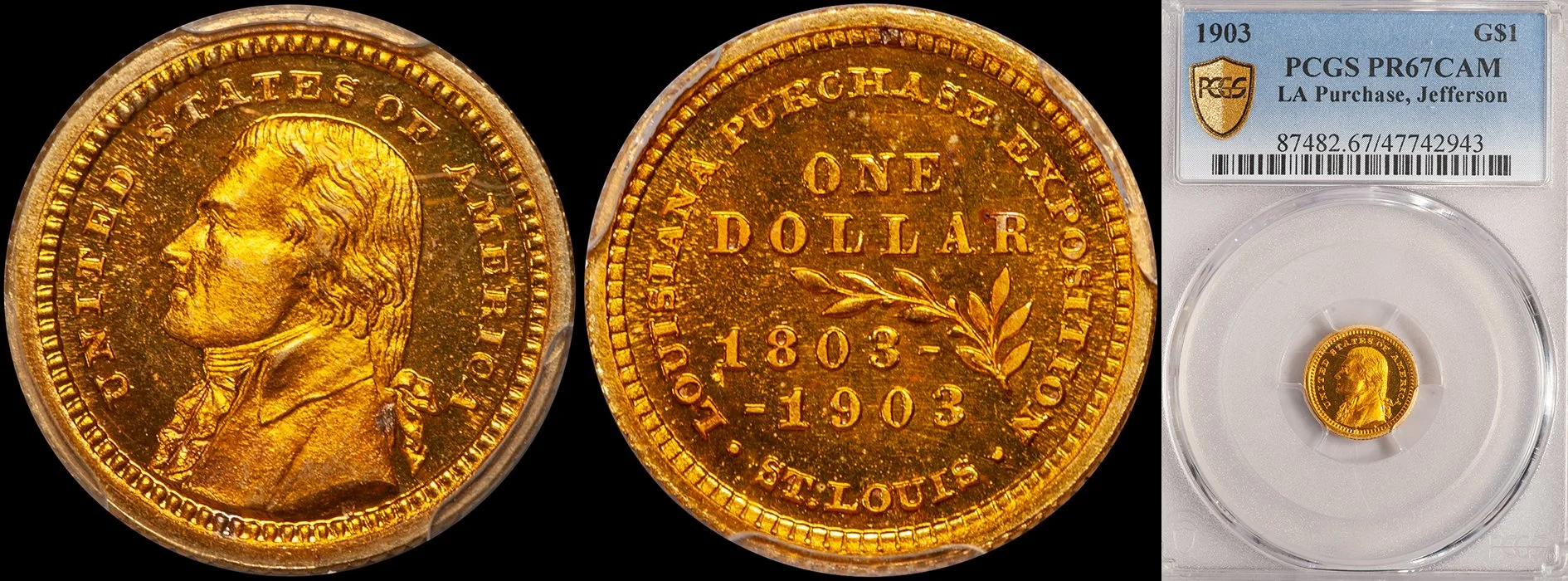
1860 $1.00 NGC PR66 UCAM

While the reported mintage for this issue is a very high 154 coins, it is probable that many were melted after going unsold. Today, it is doubtful if more than forty or so survive with most in the PR63 to PR64 range. This example is tied with a few others as the finest 1860 gold dollar graded by a third-party service and I feel that items like this are tremendously undervalued when compared to other areas of United States numismatics. As for the coin itself, it is a full-blown Gem with great contrast and surfaces that are free of hairlines. There are a few microscopic planchet imperfections in the obverse fields as seen on nearly all gold Proofs of this era and the reverse can be quickly identifieid by the presence of four tiny mint-made lintmarks at the center. The last similar example to sell at auction was a PCGS/CAC PR66 (not given a cameo designation but close to Deep Cameo, in my opinion) that sold for a strong $27,600 i9n the Heritage 2012 FUN auction. Thie present piece is clearly finer than Heritage 1/07: 3367 (graded PR66 CAM by NGC that brought $19,550. An important coin for the advanced collector of gold dollars.

1875 $20.00 NGC MS62+

Around a month ago I owned a virtual twin to this coin and it sold quickly to a type collector who was searching for an affordable high grade Type Two double eagle. This second example is just a few obverse ticks away from being an $8,000+ coin and, I believe, it represents great value for the collector who wants a high quality example of this conditionally scarce type.

CAC has approved nineteen examples of this date in MS62 (they do not breakdown these figures into MS62+) with just one finer (an MS63).

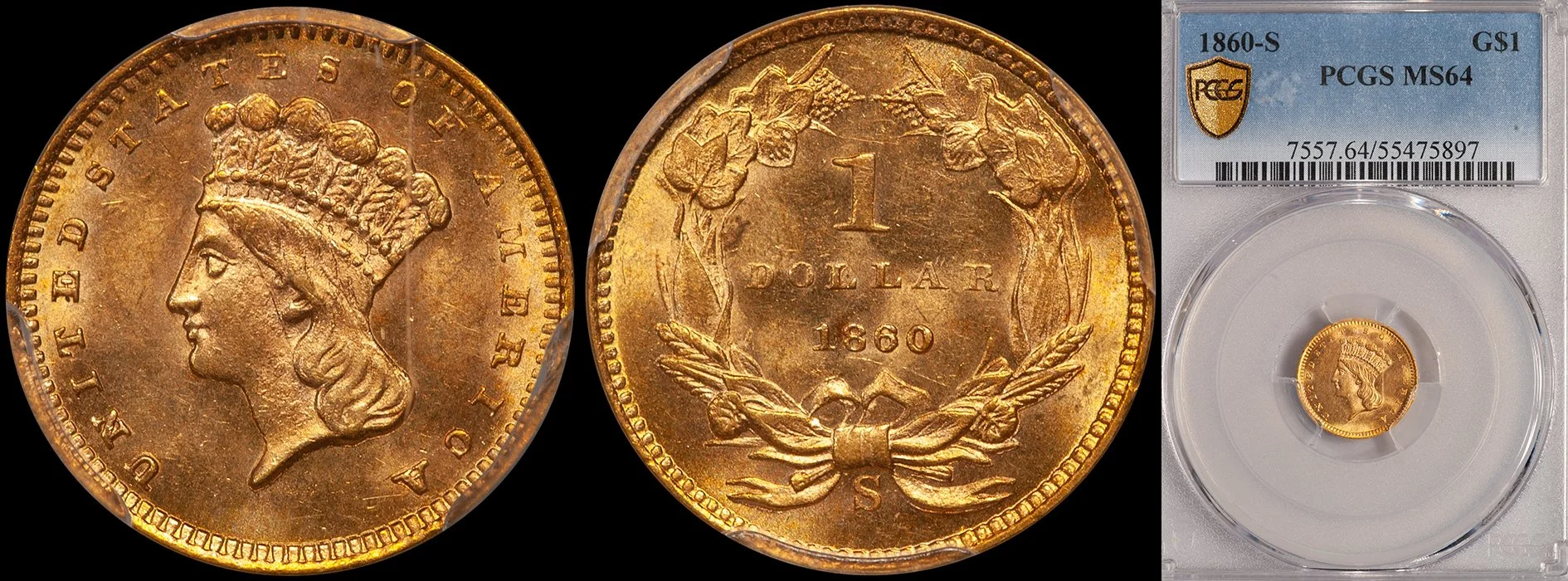
1860-S $20.00 PCGS MS62

As with nearly all of the San Francisco double eagle of the Type One design (except for the dates that have had their populations swelled by Treasure coins), the 1860-S is a date that becomes progressively rarer as you climb the grading ladder. It is only moderately scarce in the lower to medium grades but it is a hard coin to find in properly graded AU58. Uncirculated coins are extremely scarce and almost all of the known pieces are MS60 to MS61 with deep, detracting abrasions. The present example is the single finest 1860-S that I have owned and it is quite possibly the finest that is currently available to collectors. The frosty surfaces are nearly free of marks and were it not for a few light lines in the left obverse field, I could see this coin grading a point higher. The reverse is amazing and grades MS63 to MS64 on its own. The combined PCGS/NGC population for this date in MS62 is just a dozen with a scant two coins higher. An MS63 would cost upwards of $50,000 if it became available. The last PCGS MS62 to sell was Bowers and Merena 11/09: 3856 which brought a reasonable $14,375 and only four PCGS MS62's have sold at auction since the beginning of the 1990's. A major opportunity for the serious Type One collector.

1860 $5.00 NGC AU58 CAC

Most of the gold coinage dated 1860 from Philadelphia follows a similar pattern of rarity: it tends to be available in VF-EF grades but it is very scarce in properly graded AU58 and quite rare in Uncirculated. The half eagle of this year trails only the eagle as the rarest 1860-dated Philadelphia issue and it is quite underrated in AU58 as the current PCGS and NGC population figures suggest. This lightly circulated example shows good luster and a very sharp strike with full details seen at the centers. There are some scattered marks in the fields which is typical for the issue. For the money, this coin represents excellent value as do many of the No Motto half eagles from this mint.

CAC has approved two examples in this grade with none finer. A total of five have been approved for the date in all grades combined.

1854-C $2.50 NGC AU55 CAC

The 1854-C is the first of three very difficult mid-1850's quarter eagles from this mint. Only 7,295 were struck and most of the 100-125 surviving examples are well-worn and lacking in eye appeal due to extensive abrasions and poor quality of strike. This is one of the nicer circulated 1854-C quarter eagles that I have seen in some time as it shows a good overall quality of strike, a majority of its natural frosty mint luster and very attractive fiery reddish-gold toning about much of the obverse and reverse periphery. This date is rare and quite expensive in Uncirculated, so for most collectors a Choice AU such as this is a smart choice for their Charlotte quarter eagle set. Very few AU55's have sold at auction in the last five years. The only two records, both for PCGS coins, were $6,613 in February 2012 (Goldberg) and $6,325 in January 2008 (Heritage).

CAC has approved two 1854-C quarter eagles in AU55 with one finer. A total of six in all grades have been approved.

1850-D $5.00 PCGS EF40

The 1850-D is among the scarcer half eagles from this mint both in terms of overall and high grade rarity. It is one of the single hardest issues to find with good eye appeal due to poor quality of strike and most survivors having been cleaned. This example is fully original with deep orange-gold and green colors that change to purple as the coin is tilted towards the light. The mintmark is not as sharp as on other issues of this era but it is fully legible. A far above-average example of this challenging issue.

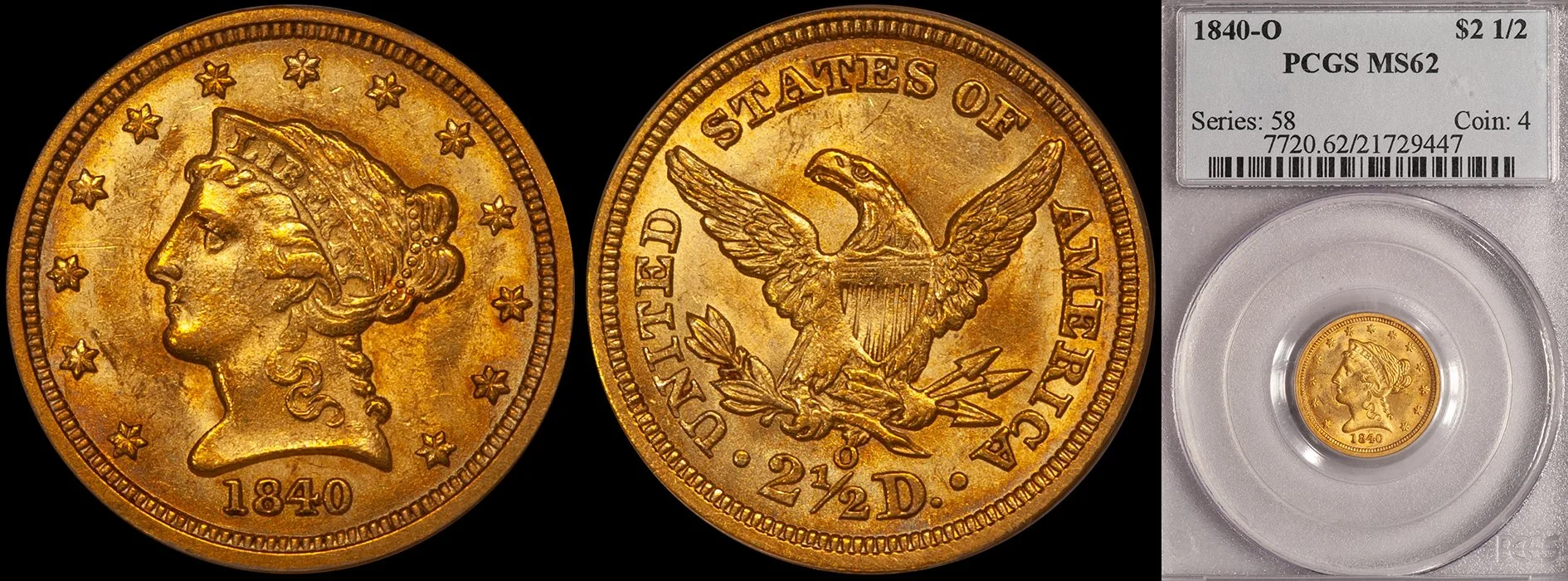
1840 $2.50 PCGS AU58 CAC

This numismatically significant issue (it is the first Liberty Head quarter eagle from the Philadelphia mint) is a scarce and misunderstood date. There were 18,859 produced but the survival rate is quite low with maybe as few as 150-200 known. It is usually seen in VF-EF grades and the few that are known in Uncirculated come from a small hoard found in the 1990's that contained some superb frosty pieces in the MS62 to MS64 range. In the higher circulated grades, this date is rare and extremely underrated especially with original color and surfaces. This is the first 1840 quarter eagle I can recall having seen with deep, attractive color and the rich reddish-gold and green-gold hues that rest on both signs are just marvelous. This coin has no real wear, just some slight friction from numismatic handling and its eye appeal is off the charts. If you go strictly by auction records and price guides, this coin is going to seem expensive but it is one of just two graded by PCGS in AU58 and the other, ex Bass II: 321, brought $3,451 all the way back in 1999. I really like this coin and if I were a collector with a budget of around $5,000 per item, this is exactly what I would be buying.

This is the only CAC approved 1840 quarter eagle in AU58. There is one finer: an MS64.

1850 $20.00 PCGS AU50 CAC

Its status as a first collectable year of issue makes the 1850 among the most sought-after Type One double eagles. This date has become rather pricey in the higher AU grades but nice AU50's still seem reasonable to me. This is an uncommonly clean coin for the date and grade with very few abrasions seen on satiny surfaces. The color is a nice natural yellow-gold shade and there is plentiful luster seen on both sides. Here's an interesting factoid about this issue: of the 134 that have been graded by PCGS in AU50, only six (or less than 5%) have been approved by CAC. Even factoring in resbmissions, I think its safe to say that fewer than one in ten examples of this date in AU50 are nice enough to be stickered by CAC.

From the RYK Collection.