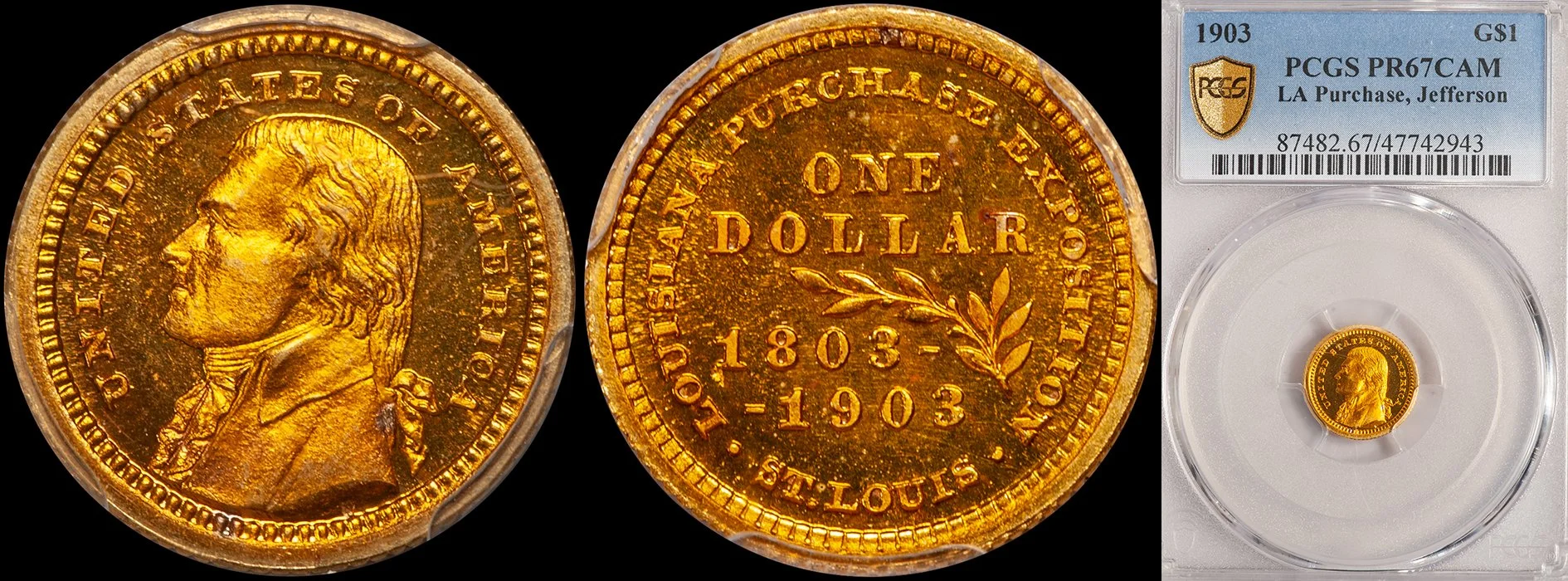
1849-C Open Wreath $1.00 PCGS AU50 CAC

This issue is popular as a first-year-of-type for the denomination and from this mint as well. It is considerably scarcer than the 1851-C, 1852-C and 1853-C and is second only to the 1850-C in terms of overall rarity from this mint for Type One dollars. This coin is a full AU55 that has been conservativekly graded by PCGS, probably on account of a small mark behind the lower portion of Liberty's bun. It is well detailed with good luster and nice light greenish-gold color. Unlike many 1849-C dollars, this piece has good balance between the obverse and the reverse. I highly recommend this piece for the new collector of Southern gold.
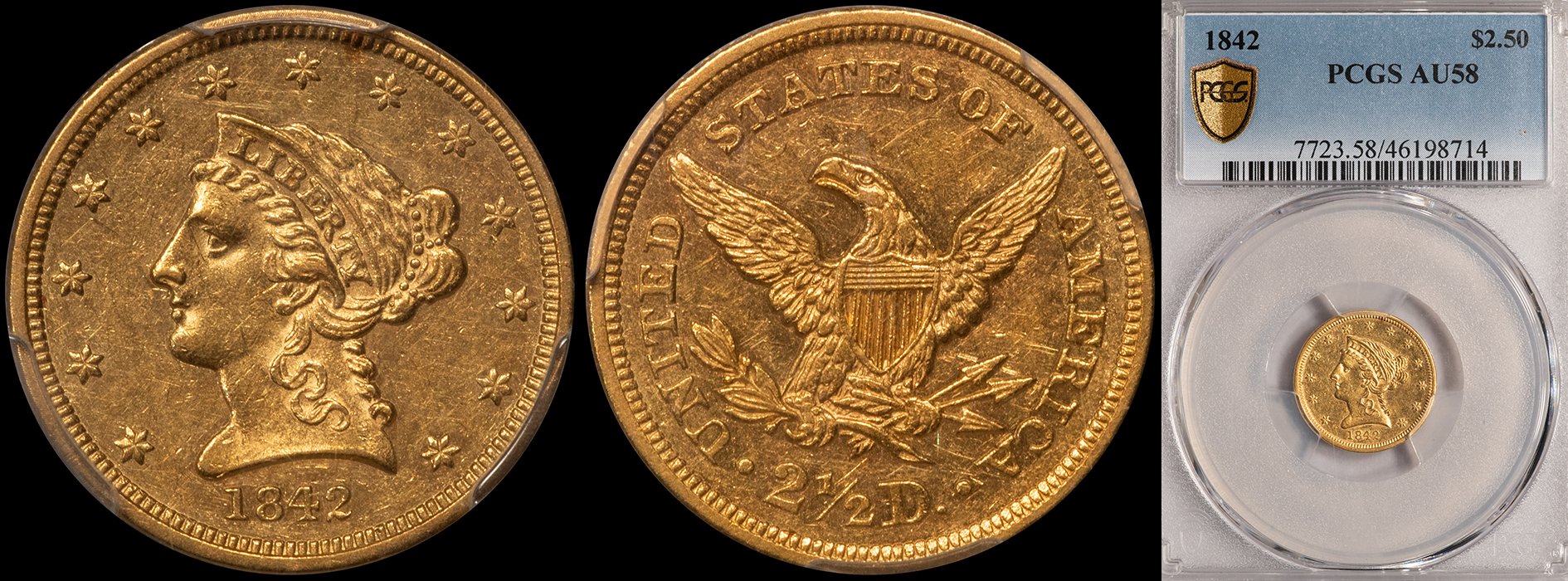
1843-D $2.50 PCGS AU50

Small D mintmark variety. With decent EF examples of this date now bringing in the $2000-2250+ range, how can you not like a solid-for-the-grade PCGS AU50 for just a few hundred bucks more? This example is dirty and original with deep natural green-gold color that is accentuated by a swath of darker color in the right obverse field. As is typical for the date, the strike is bold and this would make a great (and affordable) D mint quarter eagle type coin.

1879 $5.00 NGC PR64+ CAM

Only 30 Proofs were struck. Given the fact that just eight auction records for Proofs have been noted since 2000, it likely that as few as ten or so are known to exist with only two or three of these being Gems. This superbly toned example has a reddish-orange obverse with some pale ice-blue splashes at the center; the reverse has really neat color with more even rich orange-gold shades framed by a concentric ring of pale blue. There is almost enough contrast to call this coin an Ultra Cameo and a Gem grade is removed solely by the presence of some light lines in the left obverse field; the reverse is superb. The last Gem Proof 1879 half eagle to sell was Goldberg 5/06: 4439 (graded PR65 CAM by PCGS) that sold for $60,375. Rare, important and absolutely beautiful!

1876 $1.00 NGC PR65 CAM

Only 45 struck. Of these, there are probably no more than twenty or so known with most in the PR64 to PR65 range. This piece is easily recognizable as a Proof on account of its reflective surfaces and a small die line running out to the right from the base of the right foot in the first A in AMERICA. Both the obverse and the reverse show very deep natural toning; the kind that you used to see from time to time on Proof gold before so many coins were dipped in order to gain a Cameo or Deep Cameo designation. The underlying fields appear to be choice with just a few old lines. An attractive example of a rare, historically significant issue.

Ex Heritage 10/11: 4628 where it sold for $16,100

1881 $1.00 NGC PR65+ UCAM

Prior to this year, mintage figures for Proof gold dollars was tiny. Beginning in 1882, production climbed as collecting (and speculating in) Proofs of this denomination became popular. 1881 is sort of a "final year" for low mintages with just 87 pieces struck; it is likely that around half of these are known. What I like about this date is that is sells for just a small premium above the late 1880's dates but it is decidedly scarcer, especially in Gem. This example is as close to being a PR66 as you could imagine and I feel that the only thing that kept NGC from grading it as such is the presence of a few tiny lines in the left obverse field. That said, I have seen inferior coins graded PR66 by both services and I have seen few Proofs of this era with the stunning black and white contrast that this piece displays. Both sides have extremely deep mirrors that display some light natural color that gives them further overall eye appeal. This is the only PR65+ Ultra Cameo of this date currently graded by NGC with only five finer for the date with the UC designation. It is my belief that Gem Proof gold dollars such as this are very good values right now, especially when one considers what larger denomination Proof gold in this grade costs.

1864-S $20.00 PCGS MS62

Before the discovery of a small number of Uncirculated examples in the S.S. Brother Johnathan and S.S. Republic shipwrecks, the 1864-S was nearly impossible to find above AU55 to AU58 grades. It remains rare in MS62 and it is very rare above this with just a small number (four or five) known in MS63. This example is likely from the "Bro Jo" although it is not indicated as such on the holder by PCGS. It has very slightly granular surfaces but they are not dull or "etched" like many of the coins from these wrecks. Both the obverse and the reverse show lovely rich natural orange-gold color with the reverse deeper and more even in hue than the obverse. There are a few light marks in the obverse fields that limit the grade. However, this is one of the cleanest and most dynamic-appearing examples of this date that I can recall having seen. Since February 2006, there have been five auction appearances for the date in PCGS MS62 with the prices realized ranging from a low of $14,950 to a high of $18,975. A PCGS MS63, if available, would certainly be a $30,000+ coin. For most collectors of Type One double eagles or Civil War gold, this 1864-S is "as good as it gets!"

1862 $10.00 NGC MS60

In the "new" coin market of 2012, Liberty Head eagles have become among the most popular series with rarity-loving collectors. And formerly overlooked dates like the 1862 have grown greatly in stature. The 1862 eagle is scarce in any grade with probably less than 100 known from the original mintage of 10,960. When available, it tends to come in the EF40 to AU50 range and it is extremely scarce in AU55 to AU58. In Uncirculated, this date is a major rarity with just three known to me: the present example, a second NGC MS60 (ex Heritage 2003 ANA: 10437) and an NGC MS63 from the S.S. Republic that is off the market in the finest collection of Liberty Head eagles. The example I offer here is nearly fully lustrous and unquestionably free of wear with rich rose and yellow-gold color. As is befitting an MS60 Civil War gold coin, this piece does have some dense marks but these are mostly confined to the fields and they are shallow and well-dispersed. This is an extremely important coin for the collector of Liberty Head eagles or rare, high grade Civil War coinage and it represents what may be the only chance you have in many, many years to obtain an Uncirculated example of an 1862 eagle.