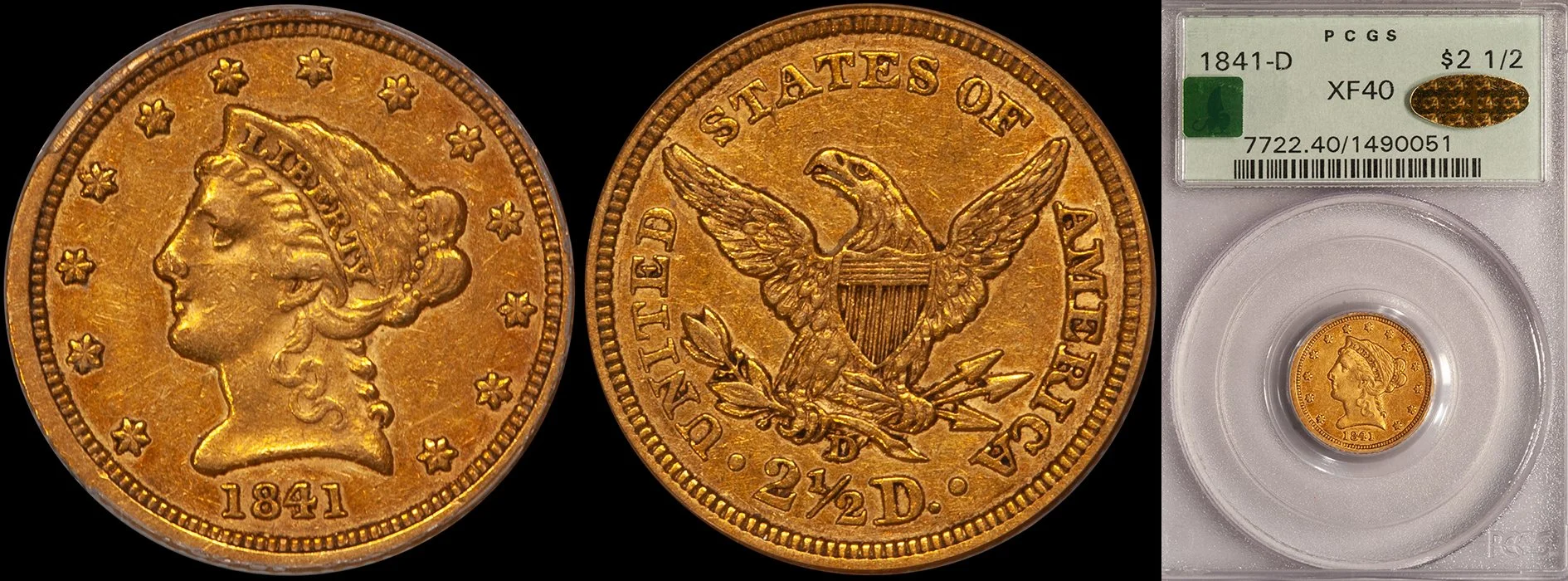
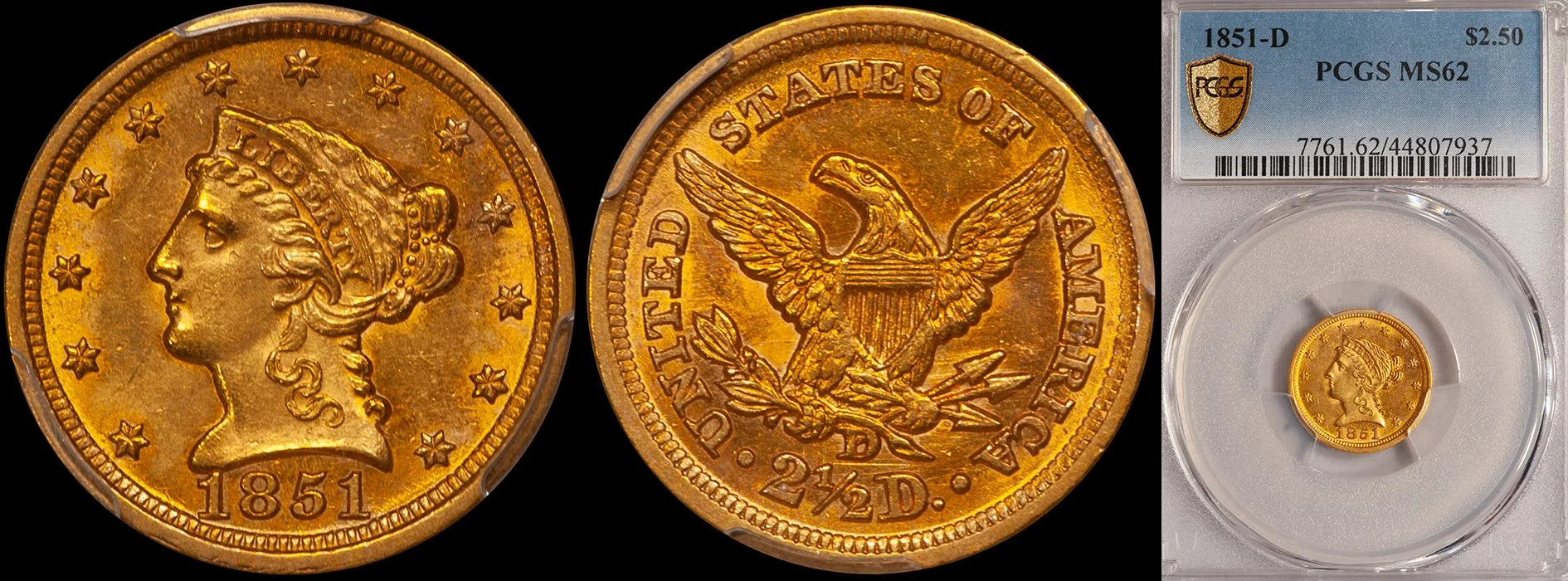
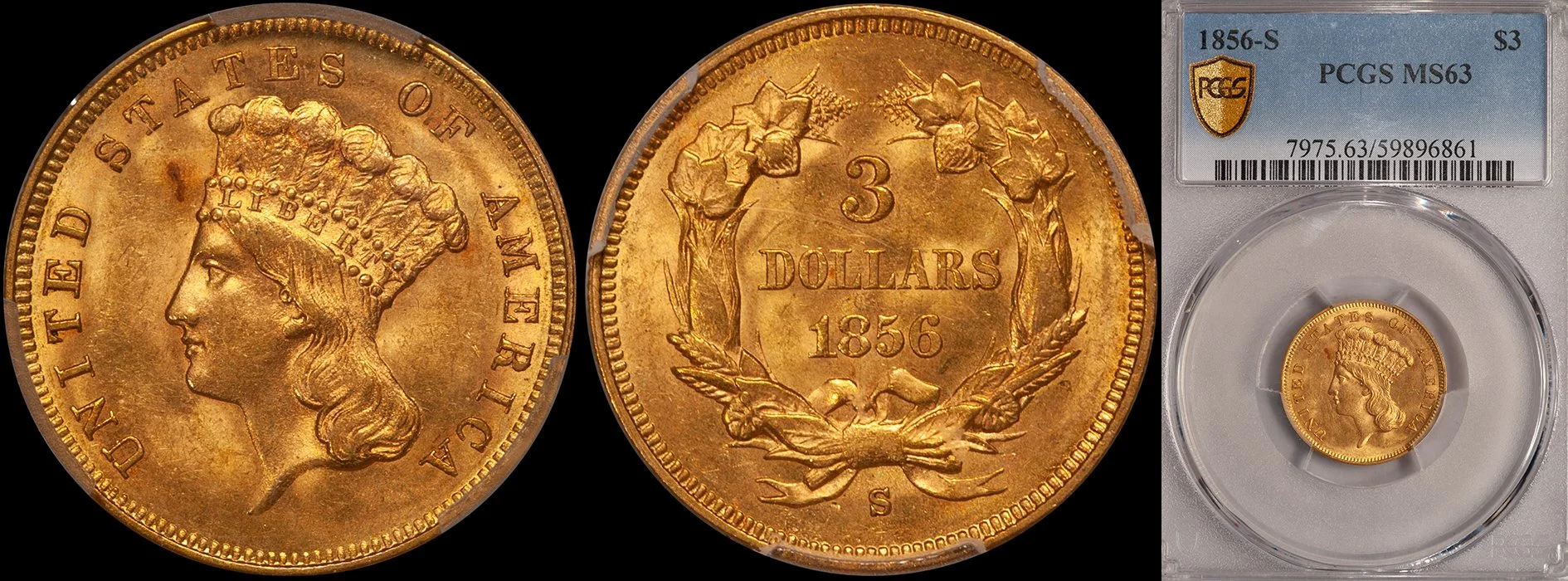
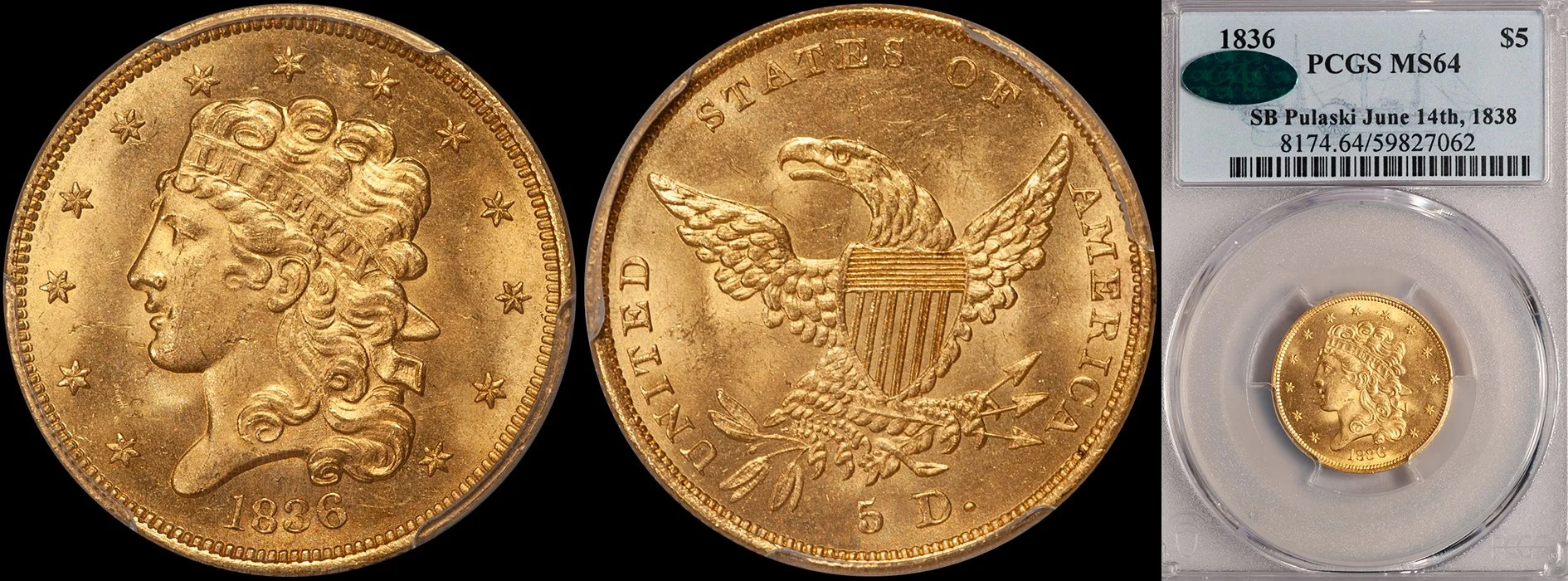
1846-D $2.50 PCGS EF45

Without much fanfare, I've noted that the demand for nice EF40-AU55 collector quality Dahlonega quarter eagles has shot up dramatically in the last year. Price levels are going up (finally) as a result but these coins remain affordable with nice examples still being offered, from time to time, for less than $3,000. This piece is solid for the grade with good detail and nice medium yellow-gold color. Some dirt can be seen in the crevasses on the reverse. A few old scratches in the lower right obverse are not out of keeping with the assigned grade. As a date, the 1846-D sells for no premium over issues such as the 1844-D, 1845-D and 1847-D but I think it is harder to find with good eye appeal.

The San Francisco Surprise

Around four or five months ago, I got wind of a soon-to-be-conducted rare gold coin auction in San Francisco that sounded interesting, to say the least. I heard that it contained long date runs of Liberty Head gold and it featured such rarities as an 1854-S quarter eagle and an 1856-O double eagle. I live for "secret deals" like this. I'd fly to Fog City, spend in the high six figures, make a ton of money on my new purchases and have fun in the process. It was going to be SO easy... Except for one big thing. There are no "secret auction deals" anymore. The internet has made all information so accessible that deals like this tend to attract just enough of the big players in a specialized field like rare gold that they are extremely competitive. No, the San Francisco Surprise was going to be a bloodbath.

There were a number of factors that made this auction unusual. For one, it was being conducted by a stamp company (Schuyler Rumsey) and it would be interesting to see how they handled their foray into a new field.

So how did the sale do? And what does this sale tell me about the market and the rare coin auction market? The answers are interesting; far more so, in my opinion, than merely going over some auction highlights.

I thought prices for the sale ranged from sort of weak (for the very common pieces and the generics which probably would have been better sold outside of the auction venue) to exceptionally strong (for the very rare date $10 Libs). The few six figure coins in the sale were a touch on the weak side (they probably would have brought 10% more in a Heritage auction) while coins that appeared to have potential for upgrading or "improving" were strong to exceptional.

Did the heirs to this collection make a mistake choosing a stamp company and not going with an experienced coin firm like Heritage or Stacks Bowers? Typically I would have said a resounding "yes" but I thought Schuyler Rumsey did an outstanding job in nearly all respects. Their catalog was a bit amateurish but in the end this made no difference. Its hard to say for certain but I think many of the coins in this sale actually did better in this little, obscure auction than they would have at a major auction. Heritage may have 400,000+ registered members in their community and unparalleled technology but Rumsey reminded me of a few important facts about the auction business in general.

First, as I said above, if you get the right five to ten dealers in the room (or on the phone), the number of registered bidders or the number of hits on your website mean nothing. At least 50% of the value of the sale went to these five or ten dealers. The best way to make money in this sale would have been to lock these guys in their hotel rooms.

Secondly, Rumsey's technology was far, far better than I would have expected. It was easy to bid on their website and, to be honest, it seemed to be faster and every bit as efficient as Heritage's. It might not have had all the bells and whistles that Heritage's system has but let's not forget that Rumsey is located in San Francisco and with Silicon Valley technology available to the firm they clearly have figured out how to effectively run an IT system.

Thirdly, in the words of Mr. Costner, if you build it, they will come. The sale contained some really rare coins (issues like 1863-1865 half eagles, 1861-D gold dollars and half eagles, Civil War date eagles plus an 1873 and 1876 eagle). Avid collectors know how rare these coins are and either they or their advisers found them. Many of these rarities sold to phone bidders and, in the case of at least a few bidders, they were sold sight unseen.

Which leads me to the next point. Rumsey was smart enough to know that they weren't coin experts. So they got some good advice. Smart move: they sent most of the coins to PCGS so this gave bidders confidence. Smarter move: they advertised the sale in Coin World and gave out catalogs at the Long Beach show. Smartest move: they got at least one bidder to look at all the coins before the sale and give them bids on nearly all the lots. I feared that $10,000 coins would open at $2,000 and we'd sit through interminable slogs waiting for them to hit their true value. This didn't happen. Three weeks ago I attended a coin auction put on by a firm that has 30+ years of experience and it was so maddeningly slow that I left early in fear that I was going to have an anxiety attack. The Rumsey sale was smoothly run and almost hitch-free.

Another point: the fight against coin doctoring must not be going all that well because I saw people paying pretty confident prices for coins that needed "help." As an example, there was a cleaned 1861-D half eagle (Lot 661) that seemed to me to not only be a "no grade" but to be one that would have to be extensively resurfaced to ever get in a holder. It had the detail of an AU55 but I thought it was a risky purchase at much more than $20,000. It sold for $40,250. The person who bought this coin--and he is a smart, veteran dealer--obviously thinks this coin can be fixed, it can wind up in an AU55 or AU58 holder and it can be sold for more than $50,000. Caveat emptor....

Yet another point: this was a fresh deal and the market is STARVED for fresh coins. Note that I didn't say it was a nice fresh deal. I thought around 10% of the coins were really nice and another 20-30% were kind of nice. But many of the coins were downright ratty. These didn't seem to matter to buyers. Nor did the fact that many of the not-very-nice coins were hard to sell as is and would become even harder to sell when they were scrubbed (or re-scrubbed) and upgraded.

A few highlights and my comments:

Gold Dollars: The 1855-D in PCGS VF35 sold for $12,650. It was a decent coin but nothing great. I guess this means that "basal value" for any example of this date in a holder is now in the low five figures. The nice AU53 1861-D gold dollar sold for $51,750 to a phone bidder who, I'm told, never even saw the coin. It's an AU55 and you paid an awful lot for it...

Quarter Eagles: The 1842 in PCGS 45 was estimated at $750-1000. It sold for $5,175. If only it was even remotely attractive. The very nice 1848 CAL in PCGS 55 sold for $63,250. I liked the 1849-C in PCGS 55 (I graded it a solid 58) but someone liked it better and it brought a solid $12,650.

Half Eagles: The only early half eagle I liked was the 1814/3 in AU58 but I was not willing to grade it MS62 like the successful bidder did at $25,300. The C+D half eagles were decent and I bought the coins I liked the best; sometimes at considerably less than my maximum bid. The Civil War coins were pretty schlocky but they brought strong prices anyway; the 1862 in AU55 was bid up to $12,650.

Eagles: Uggghhh...did I get blown away. I thought there were some pretty nice coins in this part of the sale. So did everyone else. The great AU55 1852-O? It sold for $18,400 (!) The undergraded 1865-S Normal Date in EF45? (I thought it was an AU53). It brought $24,150. The lovely EF45 1870-CC that I graded AU53? How about $97,750? Many, many price records were set.

Double Eagles: It was back to reality as prices for this denomination were strong but not insane like the Eagles. The nice 1856-O in EF45 sold for $276,000 which seemed like the "right" number. The 1861-S Paquet in VF35 sold for $51,750 while the 1866-S No Motto in AU55 went very strong at $83,275. There were some very pleasing CC double eagles in the sale and they all brought strong prices.

1877 $3.00 NGC AU58PL

The 1877 is among the rarest business strikes Three Dollar gold pieces struck at the Philadelphia mint. There were just 1,400 made and there are well under 100 known in all grades. This fully prooflike piece is clearly a business strike as it has some frost in the surfaces and the rims lack the squared configuration seen on Proofs. It is very lightly worn in the fields and on the high spots with pleasing peripheral color on the obverse. A few small ticks are visible in the fields but this piece is uncommonly clean and wholesome for an issue that is seldom seen with good eye appeal. In addition to the regular population figures listed below, NGC has graded two examples in AU58 with a PL designation and five finer than this. The last NGC AU58PL to sell at auction was Heritage 2008 ANA: 1921 which brought $20,700. In my opinion, the present example is nicer and the market seems more appreciative of truly rare coins like 1877 Threes in early 2012 than it did in the Summer of 2008. This is one of two approved by CAC in this grade with none better. An important piece for the specialist.

1851-O $20.00 NGC AU53

While certainly not a "rare"coin in this grade, it has become quite challenging to locate an AU50-55 example of the 1851-O (or the 1852-O, for that matter) that has good overall eye appeal. I like the present example quite a bit for the grade on account of its pleasing orange-gold and reddish color and abundant remaining luster. In fact, this piece has the skin and body of an AU55 but it is just a hair too abraded to accurately encapsulate as such. There is a scrape (from contact with another coin) on Libery's hair below star eight on the obverse as well as some other scatterered signs of contact; the reverse is clean and choice. This piece is from an early state of the dies with full stars on the obverse and good detail seen at the centers. In any grade higher than this, you are looking at a low five-figure expenditure, making a choice AU53 example like this the "sweet spot" for many collectors.

1851-O $20.00 NGC EF40

This is a solid coin for the grade with nice natural medium green-gold color that shows some underlying flashes of reddish-gold most noticeably at the upper reverse periphery. Struck from a late state of the dies with lapping having partially removed some of the stars on the obverse; stars six and seven are actually somewhat hard to see with the naked eye. There are a few small, scattered marks seen on the obverse including a cluster before the lips of Liberty; the reverse is clean and choice. This is an affordable example of one of the two affordable double eagles from this mint.

1856-D $2.50 PCGS AU55 CAC

The 1856-D quarter eagle has the lowest mintage figure of any coin ever struck at the Dahlonega mint and it is the single rarest issue from this mint. Only 874 were produced of which an estimated three to four dozen exist. The coin that the 1856-D quarter eagle offers an interesting comparison to is the 1854-D three dollar of which just 1,120 were struck. The 1856-D, in my experience, is easily twice as rare and in Choice AU it is maybe three times as rare. In spite of this, the 1856-D is currently valued at around 25% less than the 1854-D three dollar in comparable grades. The present example is the nicest 1856-D quarter eagle to come onto the market in at least a year and I think it is considerably nicer than the NGC 58 that Heritage sold as Lot 4697 in their October 2011 auction for $40,250. I purchased this coin from one of the sharpest "crackout" dealers in the business and he spent at least six months trying to get this coin into a Mint State holder. I actually think he's got a point on this example and it really does seem to be free of wear and deserves consideration to be in an Uncirculated holder. As with all 1856-D quarter eagles, it is crudely struck but it shows better than average overall detail. There is dirt in the protected areas and the color is a nice medium rose and green-gold hue. The coin is easily identifiable by a small spot on the reverse in the field below the left base of the A in STATES. Overall, this is a simply outstanding coin. If you collect Dahlonega gold you are certainly aware of its significance but I'd also give it a glowing recommendation to the individual who is looking for a great piece to salt away for a few years.

Ex Scotsman 10/11: 389 where it sold for $41,975. This was before it was approved by CAC.

The Numismatic Versus: Comparing Coin Collecting Methods

Cats versus dogs. Coke versus Pepsi. Good versus evil. You get my point: two camps competing for your heart, your affection or your soul. Its not that far-fetched to stretch this analogy out to some of the basic issues in coin collecting. No, its not the Satanic Verses; its the Numismatic Versus. OK, to be a bit more serious: there are basic issues in numismatics that split collectors down the middle. There is no real right or wrong when it comes to collecting and I am a big advocate of doing what "feels right" for the collector. That said, I think my 30+ years of experience as a dealer qualify me to render an opinion on some of these issues and that's what I'd like to do here.

1. Specialist Collecting versus Type Collecting

I have many customers who are specialists and many who are focused more in a "generalist" fashion. I respect both camps.

A specialist picks a small area of collecting and focuses on this. Dahlonega quarter eagles. New Orleans half eagles. First year and last year of issue coins. All of these are great choices for the specialist.

What I like about specialist collecting is that by having a more narrow focus, the collector can become knowledgeable more easily. As I have written before, if your collecting focus revolves around 25 half eagles from one mint, you are far more likely to learn this series as well as the typical dealer than if you are trying to learn about all the half eagles produced during the 19th century.

But there is something to be said for a more general approach. I love the concept of collecting by type. I love the fact that a type collector buys something different every time he pulls the trigger.

2. Condition Rarity versus Absolute Rarity

A coin that is a "condition rarity" is one whose primary value is based around its grade. An example of this would be an 1887-S eagle in MS65. Such a coin is extremely rare and it would sell for five-figures if available. But the same date in MS60 is extremely common and it sells for essentially no date premium.

A coin that is an "absolute rarity" is one that is rare in all grades and is desirable whether it is quite worn or superb. An example of this would be an 1862-S eagle. This is a low mintage issue with a very low survival rate to its Civil War date of issuance. This coin is desirable if it grades Very Fine or if it grades Uncirculated.

What a collector should always ask himself is "would the coin that I am buying have value if third party grading were to suddenly end?" A coin like an 1887-S eagle in MS65 might not carry a great premium if third-party grading ceased to exist. A coin like an 1862-S eagle in EF45 would still be considered desirable no matter what dictates the future of grading.

The best coins are the ones that combine absolute and grade rarity. If a coin like an 1862-S eagle in Mint State were to be discovered in Europe (I have never seen one close to Uncirculated) it would be very desirable as it combined both types of rarity in one neat package.

3. Business Strikes versus Proofs

Business strikes are coins that were made for circulation. Proofs are coins that were specially made for collectors and VIP's. The coin weenie in me likes business strikes more than Proofs because of the fact that these were coins that were used as coins are supposed to be used.

But the coin snob in me likes Proofs as well. There is no getting around the fact that a Gem Proof Liberty Head double eagle is incredibly impressive. And you have to like the Proof issues that were struck in such tiny quantities during the 1860's, 1870's and 1880's.

I tend to be a more selective buyer when it comes to proofs than business strikes. I vastly favor very rare Proofs (example: an 1878 gold dollar) than a not-so-rare Proof in a mega-grade (example: a 1904 quarter eagle in PR67 Cameo).

Can a collector buy business strikes and Proofs simultaneously? I don't see why not. In certain series, like Type Three Liberty Head double eagles, there are Proof-only issues that are collected side-by-side with business strikes. Like owning a dog and a cat at the same time, I say "yes!" to the collector who buys interesting Proofs and business strikes together.

4. Gold versus Silver versus Copper

You are reading this article on a website whose URL is raregoldcoins.com so you don't have to be a rocket scientist to figure which of these three coinage metals I favor.

But let me at least explain why I do.

Gold is a precious metal with strong demand around the world. Egyptian Pharaohs were buried with spectacular gold ornaments. The last time I checked, there were no silver or copper trinkets in the pyramids.

Try to explain to a wealthy Chinese collector why he should spend $100,000 on an Indian Cent. Not easy, right? But don't you think this same individual would more likely "get" the concept of an Uncirculated 1871-CC double eagle at $75,000?

Copper coins are great and I personally collect Liberty Seated silver coins and love them. However, as far as being a dealer goes, I'm pro-gold and more so now than ever.

5. 19th Century versus 20th Century

When I began specializing in United States gold coinage back in the early 1980's, I decided to focus on 19th century coins because they were more affordable and because they seemed like better value. Three decades later I still believe this.

Now don't get me wrong. I think 20th century coins are great. I think St. Gaudens double eagles and Indian Head eagles are the most beautiful regular issue coins that the U.S. Mint ever produced. And the incuse designs of the Indian quarter eagle and half eagle series really appeal to me. But 20th century gold tends to be the ultimate in condition rarity and, as I discussed in #2 above, I have always been more of an absolute rarity kinda guy.

I look at 20th century gold as the Contemporary Art of the numismatic world. Its fairly regularly available, its pretty macho to collect, the market is fluid due to collectors coming and going rapidly and the value levels don't always make sense.

I personally like 19th century gold better as I view it as a more cerebral area to collect. It's clearly not as pretty (there is no doubt that Gobrecht and Longacre couldn't hold a candle to St. Gaudens as far as artistic talent is concerned) and it more monotonous as it goes on and on (and on). But if you have a budget of, say, $5,000 to $10,000 per coin, you can be a big player in 19th century gold while still being pretty much a nobody in the 20th century arena.

What are your takes on the Numismatic Versus that I compared and contrasted above? Email me at dwn@ont.com and let me know what you think.

1836 Script 8 $2.50 PCGS AU58

While common enough in scrubbed-up AU grades, a choice, original AU58 example of the 1836 quarter eagle is not an easy coin to find. This piece is as fresh as these come with dusky russet-gold colors on the obverse and reverse. Weakness of strike is seen at the centers and this is typical for the issue. To find a better example of this date (or type) you'd have to step up to the MS61 level and spend more than twice the price of this piece.

1892-O $5.00 PCGS AU53

After a 35 year hiatus, production of half eagles resumed at the New Orleans mint. Only 10,000 were struck and the 1892-O is scarce in any grade. But unlike the No Motto issues from this mint, the 1892-O is more of an absolute rarity than a condition rarity. Very few circulated examples are known and this date is most often seen in the AU58 to MS61 range. There hasn't been a slabbed AU53 example at auction since the advent of third-party grading and just two slabbed AU55's since 1987. The present example is orginal and pleasing with natural deep color at the borders ringing the lighter centers. This piece would grade at least AU55 were it not for an abrasion that runs from below the throat into the left obverse field. There are few US gold coins that are better value than the 1892-O and this is among the most affordable examples I've handled in years.