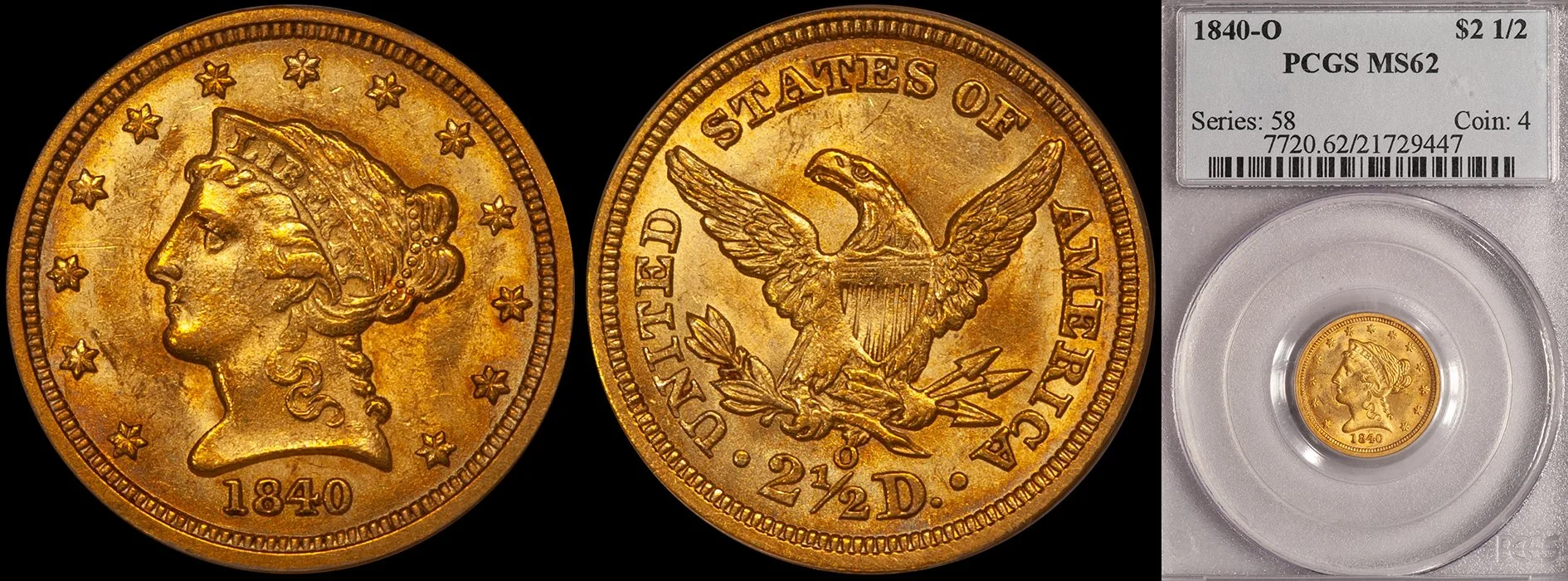
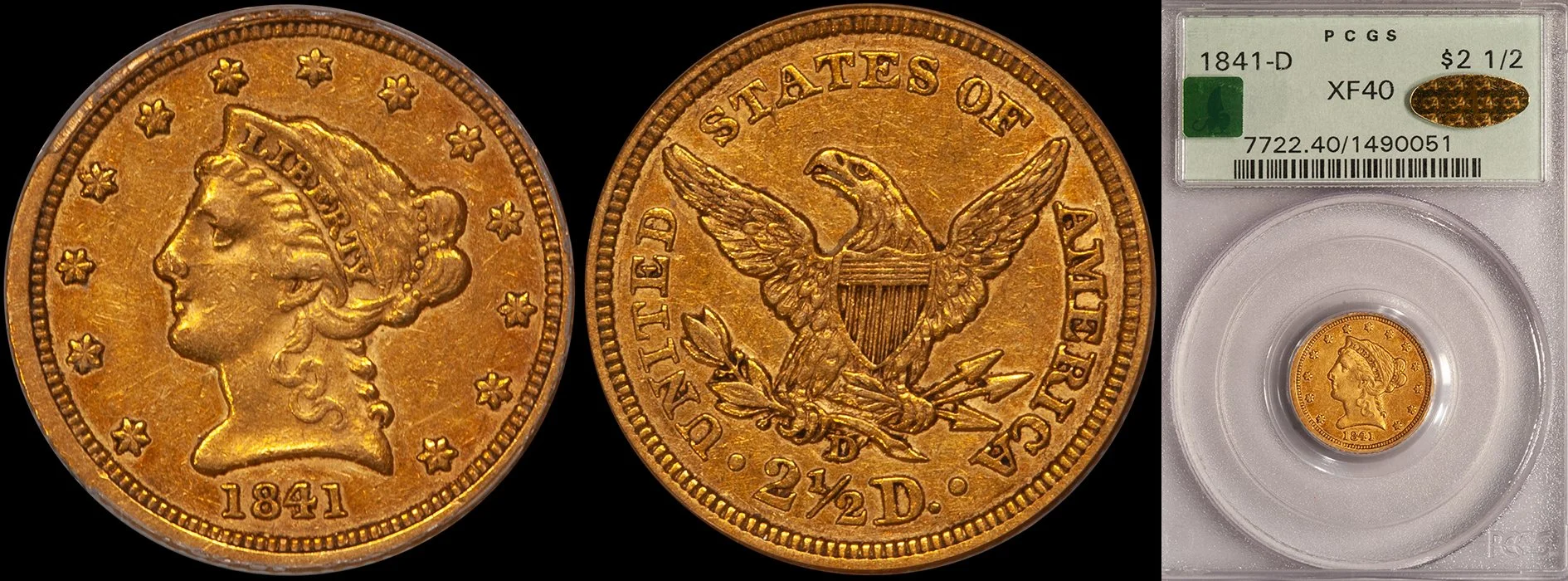
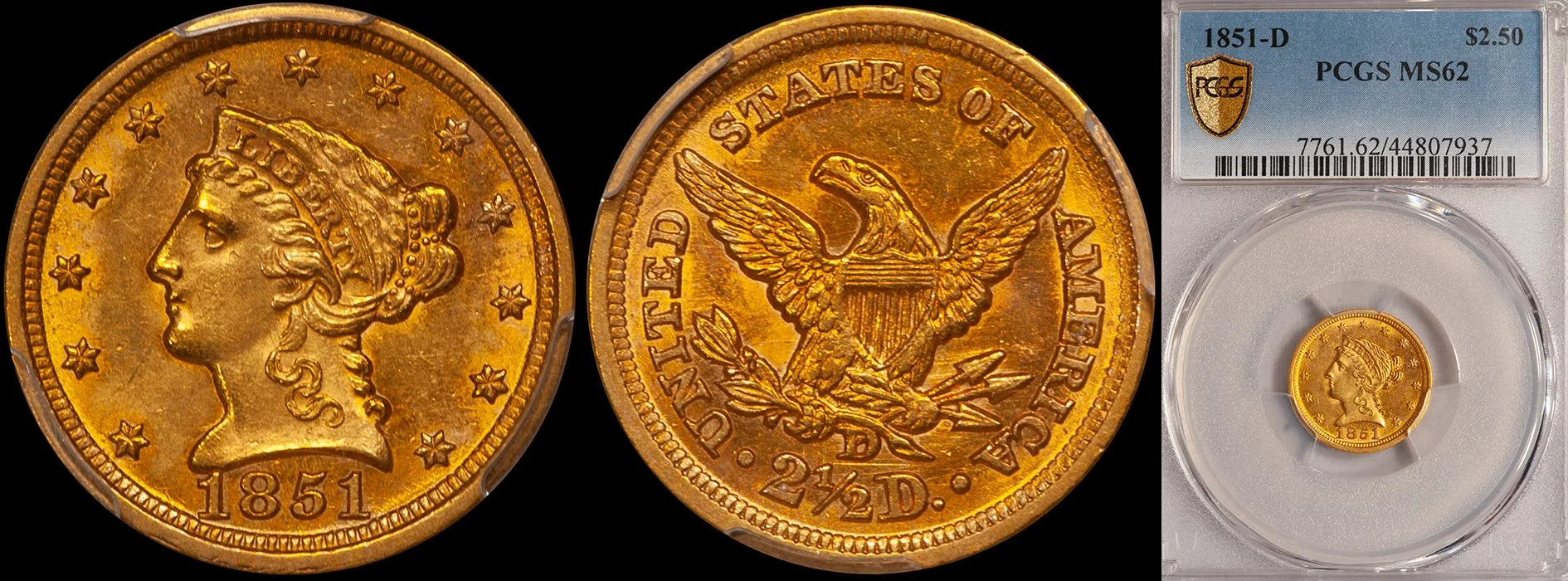
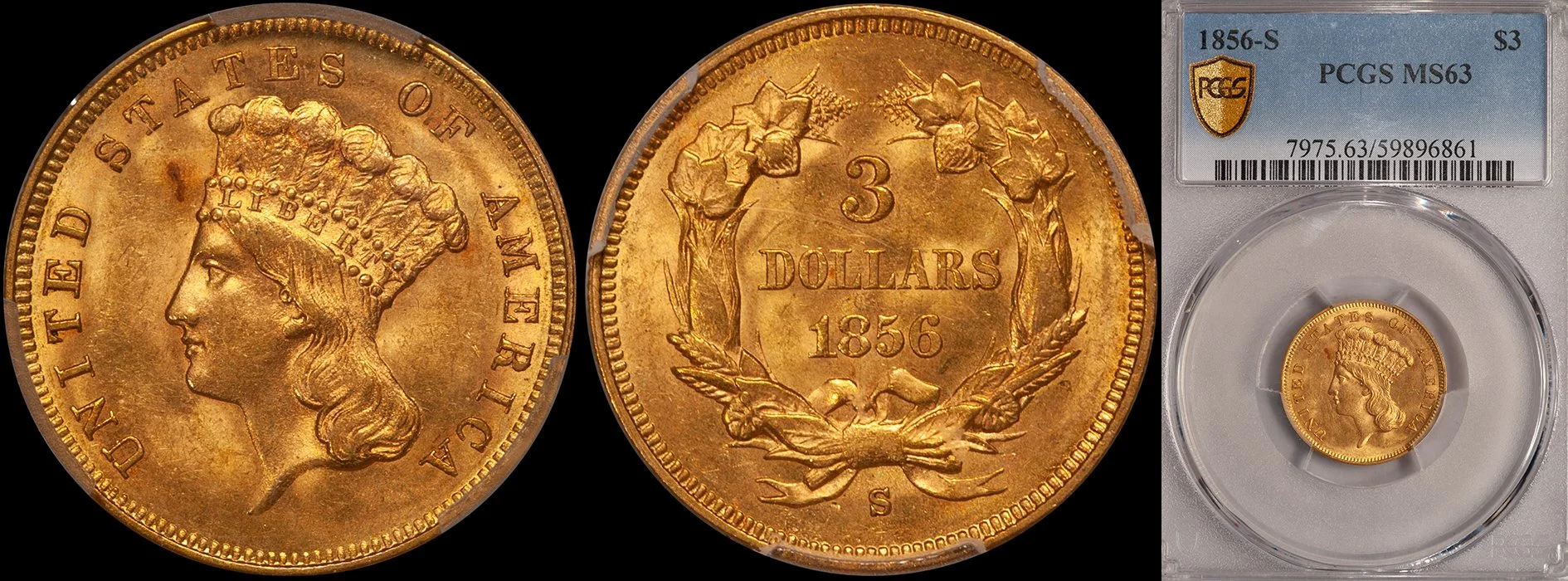
1847-D $2.50 NGC AU58+ CAC

Two dates in the Dahlonega quarter eagle series are well-known for having great color: the 1847-D and the 1849-D. I have owned about seven or eight of the former with really neat deep rich original hues and this example is the most recent addition to this illustrious list. The obverse and reverse show a blend of rich russet, green and bluish-gold hues with the obverse a bit more intense in shade than the reverse. The underlying surfaces are clean and frosty and this piece has no real wear, just the slightest amount of friction seen on the high spots. If you like your D mint gold well struck, then you'll love this coin: it is absolutely hammered with totally full details seen on the hair and feathers. NGC tends to be pretty sparing with the "plus" sign, especially on AU58 coins, and it was clear that they liked this piece as much as I do.

When Is Deep Cameo/Ultra Cameo Proof Gold Worth a Premium?

Having recently handled a considerable number of impressive Proof gold coins, I've been thinking about when a specific coin is worth a premium because of is status as a Deep Cameo (PCGS' modifier) or Ultra Cameo (NGC's modifier). After a brief explanation of these terms, I'd like to use a few examples of the coins I've sold to illustrate scenarios in which I feel a premium is merited. Proof gold coins are struck specially for collectors in very limited numbers. They are made with care using specially prepared planchets and typically struck with multiple blows of the dies. One of the features of most pre-1900 American gold coins in Proof is that they show cameo-like contrast between the devices (which are frosted) and the fields (which are watery and reflective). Collectors appreciate this appearance; as well they should, as a gold coin with deep, strong cameo contrast can have wonderful eye appeal.

The question most collectors ask about cameo proof gold coins is when are such pieces worth a price premium.

Given the fact that most pre-1900 proof gold coins have very low mintage figures, we can assume that nearly every piece is going to show some degree of cameo. But there are a few coins for each year that have extreme cameo contrast. We can assume that these are either the very first pieces produced or they were coins that were made with extra care for their visual appeal.

Let's look at a proof gold coin with an original mintage figure of 30 coins as an example. The typical survival rate for a proof gold coin struck between 1860 and 1880 is around 50% (for large denominations such as eagles and double eagles this figure is probably more like 25-33%). Given this figure, let's say that fifteen or so are known.

Of these fifteen, there are probably at least a few that are either impaired or they have been cleaned and/or processed to the point that they do not have an original appearance. So let's say the number of pertinent coins is around ten. There might be seven or eight that have been graded by PCGS and/or NGC and given the designation "cameo." Then let's say that the other two or three coins have been designated as "ultra cameo" or "deep cameo." How much more are these coins worth?

In my opinion, if these coins have great eye appeal and are not overgraded, they are probably worth a 10-20% premium over a regular cameo example. This is making the assumption that they are significantly rarer than their regular cameo counterparts. In the case or large denominations, where eye appeal is so critical, this premium might even be a bit higher.

I'd like to use two specific coins to illustrate my theory about ultra cameo/deep cameo premiums. These are a pair of gold dollars that I recently sold.

The first coin is an 1862 gold dollar graded PR66 Deep Cameo by PCGS and awarded a sticker by CAC.

1862 $1.00 PCGS PR66 DCAM CAC

This Civil War issue has an original mintage figure of 35 coins of which slightly fewer than half survive. In my experience, the mint did an excellent job of producing proof gold coins in 1862 and the overall quality of most of the gold dollars I've seen has been above average. In other words, Proofs of this year are supposed to come with good contrast and there should be no premium whatsoever for a coin that is a regular cameo.

But if you take even a casual look at this specific coin, you'll see that it has incredible eye appeal. The appearance is "black and white" with the type of contrast that can literally be seen across the room. I felt that this was one of the best looking Proof gold dollars that I had ever viewed and this was a reason that I purchased the coin at the 2012 FUN show.

As I was figuring a value for this coin, I had to decide on what sort of a premium its beauty would compel me to pay. I certainly wouldn't have paid a 50% premium (although in certain silver series, a premium of this sort isn't uncommon) but I felt a 10-20% premium was certainly in keeping with its stunning appearance.

This was an instance where I wasn't so much paying a premium for an ultra cameo coin's rarity (there are a few other 1862 gold dollars known with a deep cameo/ultra cameo appearance) as I was for its beauty. What was even more appealing to me was the fact that this coin has a "natural" deep cameo appearance.

You almost never seen proof gold coins anymore with the old-time, deep, hazy look that you used to see when collections like Norweb, Pittman, Eliasberg or Childs were sold. In fact, I would venture to say that most collectors and dealers who have entered the hobby after 1990 have seen virtually no truly original Proof gold coins (a welcome exception to this was the amazing Henry Miller collection of Proof gold that Heritage sold at their FUN auction in January 2011. While not every coin in this group was original, some were just amazing and it was refreshing to see Proof gold coins that looked like this after so many years of character-free pieces being offered...).

What's even harder to find these days are "old time gem" proof gold coins that aren't so hazy or richly colored that they don't show deep cameo contrast. That's why a coin like this 1862 dollar is special, in my opinion, and it merits a strong premium. It was original yet it was commercially viable for those collectors who don't "get" originality.

The next coin I'd like to discuss is a PCGS PR65 Deep Cameo 1871 gold dollar also awarded approval by CAC. While this coin has a mintage which is close to the 1862 (a total of 30 versus 35 for the 1862) it is rarer due to the fact that it appears that a portion were melted after they went unsold in 1871. It is possible that as few as eight to ten are known and this is actually one of the single rarest Type Three dollars in proof.

1871 $1.00 PCGS PR65 DCAM CAC

One interesting fact about this date is that it is not a year that tends to come as well made as the 1862. In 1871, the amount of contrast wasn't as great and many survivors in all gold denominations show lintmarks or slight planchet irregularities. It is also a date that, as a Proof, tends to be a little rarer than the 1862 in higher grades. I believe that this 1871 is the second finest known, trailing just a single PR68 at NGC.

This coin has nice cameo contrast although not as much so as on the 1862. In the case of this coin, I think its premium is predicated more on rarity than on extreme eye appeal. It is the only PCGS example in PR65 or better to have been designated as a Deep Cameo and this fact, I believe, gives it at least a 10-15% premium over a regular cameo example in the same grade.

In summary, I feel that the two reasons to ascribe a strong premium to any proof gold coin due to its status as a deep cameo/ultra cameo are either extreme eye appeal (or beauty) and extreme rarity (status as the only example of an issue with this designation or else the single highest graded with this designation). Obviously, the best scenario is a proof gold coin that is both extremely rare and extremely beautiful. In this case, the premium could be very high; maybe as much as 25-50%.

1842-C Large Date $5.00 PCGS MS61 CAC

Large Date variety. The 1842-C half eagles is known with a Large Date and Small Date variety. The former is more available and this adds date pressure as many collectors of high grade Charlotte fives do not want to spend $100k or more on an Uncirculated Small Date. The 1842-C Large Date is rare in Uncirculated with an estimated dozen or so known, including at least three or four coins in the MS64 to MS65 range. This semi-prooflike example has uncommonly good eye appeal for the grade with light yellow-gold centers framed by rich orange-gold at the borders. The strike is quite sharp for the variety and there are just a few marks seen on the obverse, noticeably clustered on the lower portion of the cheek. This coin has a freshness about it that you do not see on many high grade Charlotte half eagles any more and it would be a great coin for the collector who wants a single choice early date issue for a type set.

1838-D $5.00 PCGS MS62

The 1838-D is certainly not the rarest half eagle from this mint (this honor belongs to the 1842-D Large Date and the 1861-D) but it is clearly the most popular. This is due to its twin status as a first-year-of-issue and the only Classic Head half eagle from this mint. The 1838-D has become incredibly hard to locate in higher grades, due to the extreme popularity of this issue with multiple buyers: type coin collectors, fancy coin collectors, Classic Head specialists, half eagle collectors and, of course, Dahlonega dudes. There are around ten to twelve known in Uncirculated but the only one that has been available in the past few years is the wonderful Heritage 1/11: 5105 coin, graded MS63 by PCGS, which sold for $57,500. The last example in MS62 to sell is this coin which was last offered in 2007 (see the pedigree below) and none had been offered for a few years before this. The present example is unusual in that it is prooflike and especially well struck; this suggests that it may have been among the very first made and most 1838-D half eagles have a frosty texture. The color is light green-gold and there are not many marks on the surfaces save for a few scattered marks in the obverse fields. I don't often say this but passing on the coin could result in waiting another five years or more in locating a good qualty high grade 1838-D. If you need to fill this hole in your collection of Dahlonega half eagles, consider the opportunity cost!

ex Heritage 2007 ANA: 1919 where it sold for $37,375

The 2012 FUN Show: Some Observations

I can count on one hand the number of coin shows that, after close to three decades in the business, I still enjoy. The FUN show is one of them. It is well run, well-attended, and even when the market is just so-so, it tends to be an excellent show for me. I'd like to share a few observations about the recently-concluded 2012 FUN show. Unlike the ANA show(s), what I like best about FUN is that it is concise and to the point. No pre-shows, no PNG day...the doors open on Wednesday and I stay crazy busy until I close up on Friday night. For someone like myself, who views coin shows as a work environment and not a place to schmooze, this makes me happy. I start working and then, typically, I say to myself: "I'm hungry." I look at the clock and its already 2:15; I've worked six+ hours straight without a break. I like that.

I found it hard to buy nice coins at the show but not more so than at other recent conventions I've attended. I look back at a show like FUN ten years ago and marvel at the great coins I would be offered for sale or stumble upon as I combed the bourse. As a dealer, I have to rely on good connections and lots of hard work to find one nice coin here and another there. I talked to a few dealers who told me it was one of the driest shows they have ever attended. I didn't find this to be the case. There were coins to buy, but they were hidden and you had to work like a numismatic banshee to find them.

I met a number of serious new or relatively new collectors at the show. Combined with the high number of new collectors that are contacting me through my website, I have the feeling that numismatics is gaining a lot of new advocates. After the economy went bad in 2008, the number of new collectors seemed to drop appreciably. Even though I don't think the economy is robust, I do see a lot of new interest in coins. That seems like a good thing to me...

Two types of coins that I actively make a market in but which seem to have suddenly all but disappeared are Dahlonega gold (especially nice EF45 to AU58 collector-quality quarter eagles and half eagles) and better date Liberty Head eagles. This isn't exactly a new observation; both areas are popular and have been hard to locate at shows for at least a few years. But at the FUN show I think I bought a whopping four or five Dahlonega coins (all of which are already sold, by the way) and maybe three Liberty Head eagles.

The Heritage sale was a highlight of the FUN show and the second Platinum Night, featuring gold coinage, was of particular interest to me. The session began with the sale of Dr. Steve Duckor's St. Gaudens double eagles. Steve is a good friend of mine and I was rooting for him to hit a home run. The results of the sale were probably just a bit disappointing for him, mainly due to one or two of the expensive coins which didn't do as well as expected. This isn't a reflection on the coins, which I thought were magnificent. It's more a reflection on the fact that the Saint market isn't that strong right now and the Magic Billionaire that Heritage had hoped would develop a sudden need for rare Gem Saints didn't materialize.

For me, the highlight of the sale was a date run of fat Head half eagles including a few issues (1819, 1821, 1828, 1828/7 and both varieties of the 1829) that come up for sale on average of once or twice a decade. The quality of these coins ranged from so-so to superb but prices were very, very strong. To me, this is a validation of a point that I've been making for years: these coins are extremely rare and they have been overlooked and undervalued in the past. I expect price guides to reflect significant increases in this series and deservedly so.

I personally had an excellent show. I made it back to Portland late in the afternoon on Saturday and by Sunday I had posted close to forty new purchases. In the last few days more than half of them have sold and this includes a few of the "big" coins like a PR66 1862 gold dollar and a PR65 1871 gold dollar. The market seems healthy right now and there is no doubt in my mind that good coins, in a variety of price ranges, are selling.

1869-S $2.50 NGC MS61

This is a nice, fully "new" example of a date that is seldom found in higher grades. I doubt if more than ten to fifteen are known in Uncirculated with most in the MS60 to MS62 range. The nicest thing about this coin is its color with a band of rich reddish-gold at the obverse border and outlining the details on the reverse. A few small marks limit the grade but this piece is really attractive. The SF quarter eagles from this era are very undervalued and offer the collector with a challenging but not overly expensive area.

1856-D $5.00 NGC AU58

This coin has the look of an example from the hoard of 1856-D half eagles that is known but I don't think it is from there as it does not have the hairlines that these pieces tend to show. What is does have is luster; lots and lots of luster. In fact, this piece totally deserves to be termed a slider as it looks like an MS61 to the naked eye but there is a small amount of friction in the obverse fields. The 1856-D remains one of the scarcer Dahlonega half eagles from the standpoint of overall rarity and this piece is a great alernatuive to a five-figure Uncirculated example.

1859-O $20.00 NGC AU50

Only 9,100 were struck and the 1859-O is the fourth rarest double eagle from this mint trailing the 1854-O, 1856-O and 1855-O. There are less than 100 examples known in all grades with around twenty or so in the various AU grades and another three in Uncirculated. For most collectors, the 1859-O (along with the 1860-O) represents one of the biggest expenditures in their Type One double eagle set. But this is a frustrating issue as it is rarely seen with good eye appeal as a result of poor strike and heavy abrasions. And that's why I think that this is a special example. It is better struck than usual for the date with good overall detail at the centers and borders. The surfaces show a few minor, scattered marks but are free of the deep abrasions that are so often seen. The color is a pleasing light, even green gold hue and this rests atop some prooflike flash. Since March 2007, there have been five seperate APR's at Heritage for AU50 examples of this date: three in PCGS holders and two graded by NGC. Prices have ranged from a low of $34,500 to a high of $37,375. An important coin for the advanced New Orleans gold collector.