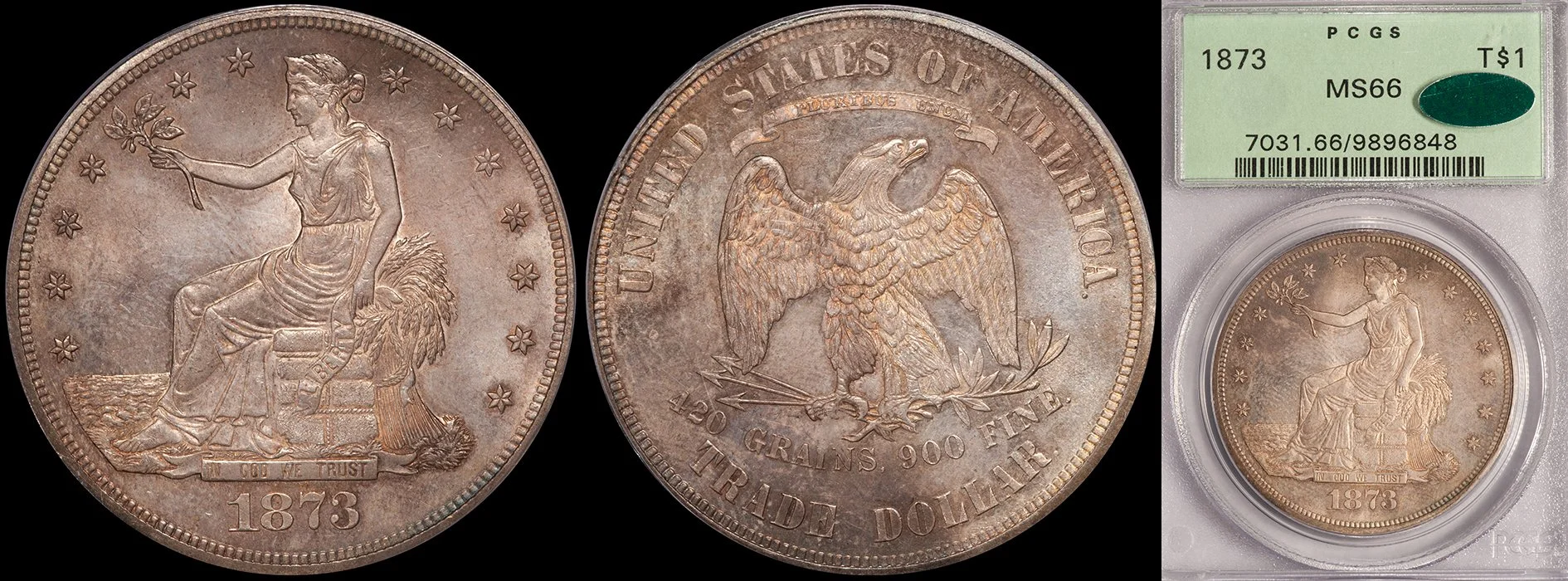
1851-O $20.00 PCGS EF40

When this coin walked up to my table at the FUN show, my first reaction was "there will be at least five people who order it within the first few hours it's posted." Not only is this a clean, evenly worn example with a great naked-eye appearance, it has a "surprise" feature which I only discovered as I tilted it towards a light source. Outlining the devices are intense iridescent purple-blue flashes which could well be the result of this coin having been stored in a leather pouch or old coin album. This helps to give it a "circulated cameo" appearance that is both novel and very fetching. This is one of only two affordable New Orleans double eagles and locating a more attractive 1851-O for less than $5,000 might be just about impossible.

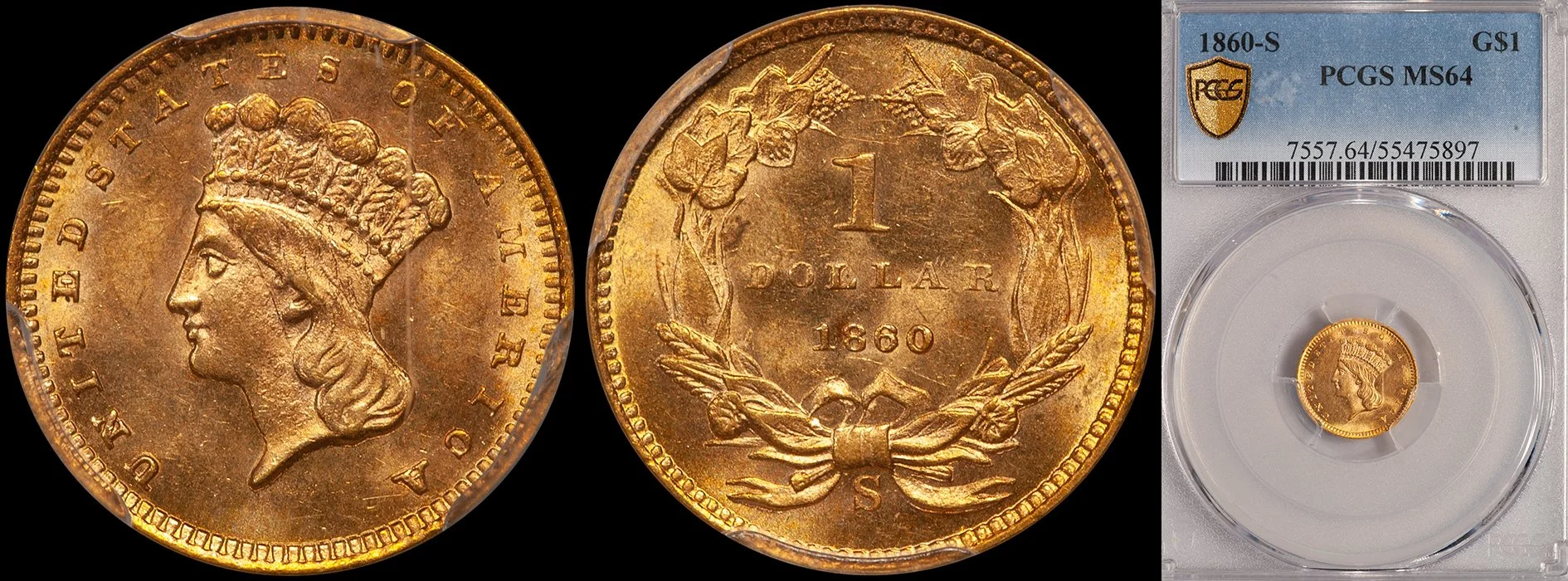
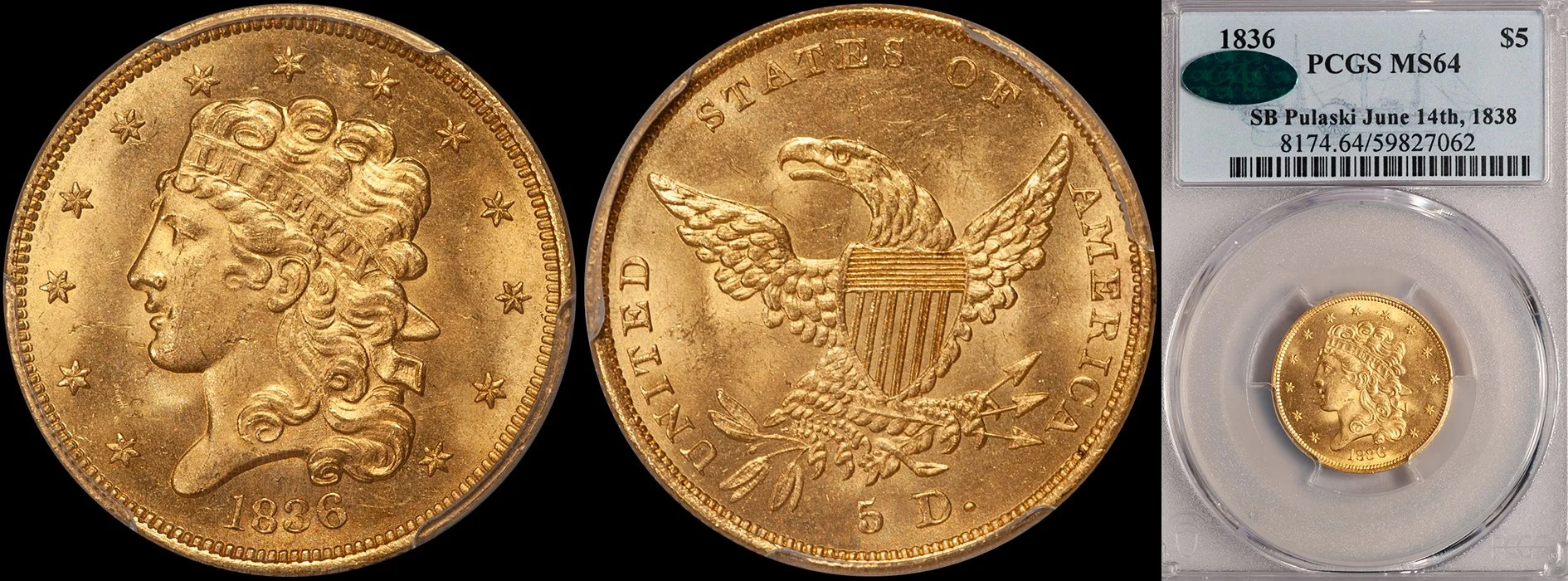
1855-S $3.00 PCGS EF40 CAC

There were just 6,600 examples struck and this is a numismatically significant issue as the first San Francisco issue of this denomination. The 1855-S is the rarest of the four available San Francisco Three Dollar gold pieces and it is seldom seen in affordable collector grades, especially with natural color and surfaces. This choice, fresh example shows lovely deep natural amber-russet color atop smooth, evenly worn surfaces. There are a few small marks in front of the O in OF but the overall eye appeal of this coin is far above average for the date and grade. This is one of just two examples of this date in EF40 to have ever received approval from CAC (six finer have been recorded as well). The other example, ex Heritage 4/10: 3557, sold for $2,645. I bought that coin out of the aforementioned sale and I think the present example is nicer. This is a great historic branch mint piece for the new collector.

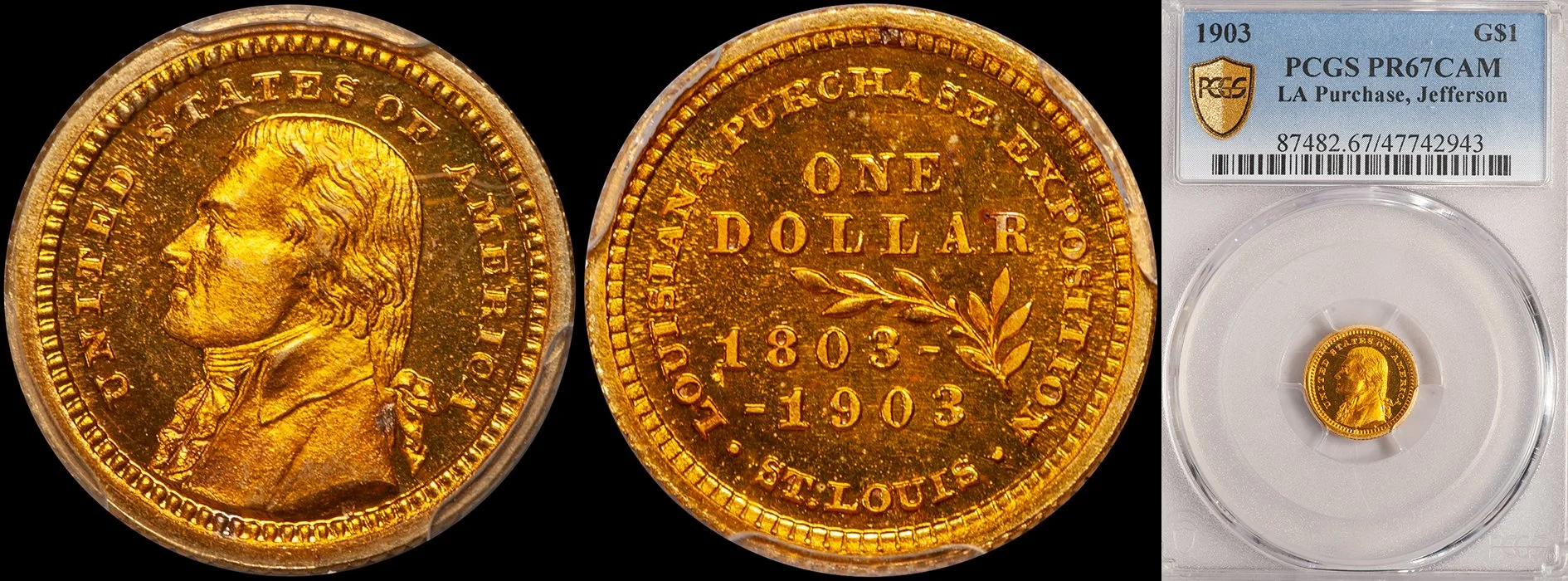
1880-CC $10.00 NGC AU58 CAC

Beginning with this issue, Carson City eagles become more available and there are over 200 examples of this date known. That said, the 1880-CC is scarce in properly graded AU55 to AU58 and very rare in full Mint State. This frosty slider has nearly full luster and it shows nice central rose color that deepens to a fiery orange-gold about the border. There are some marks noted in the fields but there is just the slightest amount of wear. It is my opinion that this issue is a good value in AU58 as an Uncirculated coin is worth at least $15,000-20,000; if you can even find one. The last auction trade for an NGC AU58 was Heritage 1/11: 7288 that brought a strong $6,900. This example is one of five 1880-CC eagles approved by CAC with just one finer (a PCGS MS61 in a private collection that sold for nearly $50,000 a few years ago). A good addition to a high quality date set of Carson City eagles.

Assembling A Year Set of Liberty Head Eagles: Part One, 1838-1866

For most collectors, assembling a comlete set of Liberty Head eagles is a daunting task, to say the least. There are 184 different issues (including major varieties) struck from 1838 to 1907. While none of these individual coins is impossible to locate, many are rare to very rare and nearly every issue struck prior to 1878 is rare in higher grades and quite expensive. So how can a collector of more average means approach what, in my opinion, is one of the most interesting and overlooked denominations in all of American numismatics. The answer is to assemble a year set of Liberty Head eagles. This set would include one example of each year that this denomination was produced. Instead of being close to two hundred coins in order to finish the set, it is now only 69 coins. Even better, the savings is immense as it eliminates some of the very costly issues like the 1863, 1864-S, 1870-CC and 1875 and lets the collector replace these with interesting but much less costly alternatives.

Let's take a look at each year from 1838 until 1866 in this set (in Part Two, we'll look at the 1867-1907 issues). I'll list what I think is the best issue for each year in this set along with suggested grades.

1838: Only one issue, from Philadelphia, is available. This issue is very popular and significant as the first eagle produced with the new Liberty Head design and it is the first coin of this denomination produced since 1804. I'd splurge on this and buy as nice a coin as you can afford; certainly at least an EF40.

1839: This is another one-mint year but with two types available: Head of 1838 and Head of 1840. The former is far more available and can be obtained in nice EF without great difficulty. This is another issue I'd splurge on as it is a limited type with a novel design.

1840: The last of the three Philadelphia-only issues at the beginning of the set and a significant first-year coin. I've always liked the 1840 eagle and find it to be underrated. I'd buy a nice AU53 to AU58 for this set.

1841: This is the first year in which more than one mint made eagles as the New Orleans facility began production in 1841. The 1841-O is a really neat issue but it is rare and expensive, so I'd probably go with an 1841 Philadelphia. I'd choose a nice original AU55 to AU58 coin.

1842: Beginning this year, the collector can select from Philadelphia and New Orleans issues. In a year like 1842, both are reasonably common although the 1842-O becomes very rare in higher grades. I'd go with the 1842-O in the AU50 to AU55 range.

1843: Surprisingly, the Philadelphia eagle dated 1843 is scarcer than its high mintage New Orleans counterpart. I'd go with a nice Choice AU 1843.

1844: The little-known 1844 is actually a rare coin in all grades and a real stopper in AU50 and above. Thus, I'd go with the 1844-O and look for a nice mid-range AU that had good color and surfaces.

1845: Again, the Philadelphia eagle is rarer but the 1845 is not nearly as hard to locate as the 1844. I'd look for a nice 1845-P in the lower AU grades as I think this issue is very good value in this range.

1846: This is the last of the tougher date Philadelphia issues for the next decade+. I'd stick with a nice AU50 to AU55 and I'd be patient for one with good color and fewer marks than average. In my opinion, nice 1846-P eagles remain undervalued at current levels.

1847: Both the 1847-P and 1847-O are common issues. I'd go for a nice AU55 to AU58 example of the New Orleans coin.

1848: The 1848-O isn't really rare but it is a tough coin to locate above AU53 to AU55, especially with original color and surfaces. I'd look for a nice example, keeping in mind that all pieces known have weak overall strikes.

1849: I'm a big fan of the 1849-O eagle as a date and believe that nice examples in all grades above EF40 are much harder to locate than generally believed. The Philadelphia issue is affordable in grades up to and including MS61/62.

1850: There are two varieties of 1850-P eagle: the Small Date and the Large date. The former is much scarcer and it is very overlooked. I'd look for a nice mid-range AU example.

1851: Both the Philadelphia and New Orleans eagles from 1851 are fairly non-descript issues. I'd stick with an 1851-P and look for a pleasing AU58.

1852: The 1852-P is very common while the 1852-O is a scarce to rare issue. I like the latter quite a bit and would probably rather have a pleasing EF45 for the same price that I'd be spending on an MS60 to MS61 1852-P.

1853: The most interesting issue struck in 1853 is the 1853/2 overdate from Philadelphia. This is the only confirmed overdate in the entire Liberty Head eagle series and it is an underappreciated coin in all grades. I'd look for a nice AU50 to AU55.

1854: With the opening of the San Francisco mint, the number of facilities coining eagles grows to three in 1854. The 1854-S isn't a really scarce coin but it is a neat date and it is certainly the issue I'd choose to represent this year for my date set. Look for an AU50 to AU55 example with minimal bagmarks.

1855: Of the three eagles struck in 1855, the Philadelphia coin is common, the New Orleans coin is scarce and the San Francisco coin is rare. I would personally choose the 1855-O and I'd look for a coin in the EF45 to AU53 range.

1856: For this year, Philadelphia and San Francisco are common while the 1856-O is scarce to very scarce. I like the 1856-O eagle and would vote to include a choice EF45 to AU53 example in my year set.

1857: The mintage figures for all three issues are lower in 1857 than they were in the previous few years. The 1857-P is a sleeper that is still a good value in circulated grades while the 1857-O is undervalued. But I'd probably go with the 1857-S because of its historic association with the popular S.S. Central America double eagles dated 1857-S.

1858: The 1858-P is a famous rarity with just 2,521 struck. If you can find (and afford) a pleasing EF example, I'd strongly recommend including it in this set. The 1858-S is a rare coin as well. For practical purposes, you might want to pursue the more affordable 1858-O in AU50 to AU55.

1859: As this decade draws to a close, mintages continue to shrink. The 1859-P is fairly common while the 1859-O is very rare and the 1859-S is rare. To keep your powder dry for the rare coins that await in the 1860's, I'd suggest looking for a choice AU 1859-P.

1860: This is the final issue from New Orleans until 1879 so it seems natural to choose the 1860-O. The Philadelphia issue is common while the San Francisco issue is very rare. An 1860-O in AU50 to AU55 is affordable yet historic.

1861: Beginning with this year, we are back to two mints striking eagles: Philadelphia and San Francisco. The former is common while the latter is scarce to very scarce. I'd choose a nice AU58 to MS61 1861-P eagle as it is by far the most affordable Civil War issue.

1862: Until recently the 1862-P was an undiscovered sleeper but prices have risen as collectors learn of its true scarcity. The 1862-S is very rare and seldom seen above EF45. I'd stick with an Extremely Fine example of the 1862-P.

1863: This year is among the most challenging in this set as both issues are very rare. The Philadelphia eagle is a major rarity with just 1,248 examples produced. The San Francisco eagle has a mintage of 10,000 and it is more available. I'd stick with a nice EF example of the 1863-S but if a sensible 1863-P became available I'd consider it strongly as it is still very undervalued.

1864: Think the 1863 eagles were tough? Try the 1864. The 1864-P is rare with 3,580 struck while the 1864-S is one of the great rarities in the series with only 2,500 struck. You really can't go wrong with either coin for your set but as you as more likely to find an 1864-P than an 1864-S, I'd have to suggest going for the former. I'd splurge on this date and buy the nicest quality you can afford.

1865: Things don't get much easier in 1865. The Philadelphia issue is very rare while there are two varieties from San Francisco: the Normal Date and the Inverted Date. I'd choose the latter due to its "coolness factor" and the difficulty of locating the other issues. An EF40 to AU50 is going to be about the best you'll see for this year.

1866: This is a numismatically significant issue as it represents a transitional year. The San Francisco mint struck eagles with and without the motto IN GOD WE TRUST on the reverse while Philadelphia only made with motto coins. I'd opt for the rare 1866-S No Motto which had a mintage of only 8,500. Anything grading higher than EF45 will be very expensive.

So there you have it. A total of 28 issues make up the No Motto part of the Liberty Head eagle set. There are three mints to choose from for some years and only a few dates (the 1863, 1864 and 1865 in particular) that will be hard to find and high priced. Assuming you follow the suggestions for dates and grades that I made above, we are probably talking about an overall average per coin cost of around $4,000-5,000. This translates to a low cost of around $112,000 and a high cost of around $140,000. If you were to pick the most common issue for each date and stick with coins in the EF40 to AU50 range, this would probably lower the cost to less than $100,000.

In Part Two of this article, which will be published in February 2012, we will look at the 1867-1907 dates. We'll see the introduction of the Carson City mint, the resumption of the New Orleans mint, the short duration of the Denver mint...and we'll have a good ol' numismatic time.

2011 Heat Index: What's Hot and What's Not

A popular feature of the www.raregoldcoins.com blog is the "what's hot and what's not" article that I write at the end of every year. As its the very end of what's been an interesting and active year, let's take a look at what was in demand in 2011 and what you, literally, couldn't give away. We'll look at a number of areas in the market and determine a "heat index" based on my personal experience in the 2011 coin market. 1. Gold Dollars. This was a mixed market area but overall it was fairly strong and in some cases it was very strong. The segments of the gold dollar market that were strongest were superb, one-of-a-kind Type One and Type Three issues (especially "wonder coins" graded MS68 and MS69) and very high quality Dahlonega issues (especially better dates such as the 1855-D, 1856-D, 1860-D and 1861-D). Areas that remained flat or trended downwards in 2011 include mid-level Uncirculated New Orleans pieces and San Francisco issues. The weakest segments of the gold dollar market included Gem common date Type Two issues and MS65 through MS67 common dates from the 1880's.

2. Quarter Eagles. Early quarter eagles were a strong area in the market. This was especially true for attractive, original coins in the EF40 to MS63 range that were priced at $50,000 and below. A few nice 1796 No Stars quarter eagles sold in 2011 and these generally saw prices that were higher than in the previous couple of years. Early quarter eagles priced at $100,000 and up remained hard to sell, unless they were either very rare or very nice or, ideally, a combination of the two.

The Liberty Head series saw mixed results in 2011. Nice circulated Dahlonega pieces were good sellers and even Charlotte coins, at least those in the $2,000-5,000 range, sold well if they possessed good eye appeal. The very high end of the market was strong. Ultra rare issues such as the 1841, 1854-S and 1863 all saw strong price increases in 2011. The surprise "trendy date" of the year was the 1864 which, in a short period of time, saw explosive price growth as collectors realized how rare it was.

Most quarter eagles dated 1870 and later remained hard to sell, even those with low mintages. There were a few exceptions (the low mintage 1875 became popular in 2011) but this seems like an area in the market that offers good growth potential for collectors with a budget of $1,000-5,000 per coin.

3. Three Dollars. After a rough patch of five or so years, the Three Dollar market showed more strength than I can remember. Buyers were fussy and coins that were not high end were hard to sell. The most popular dates included the 1854-D, 1855-S, 1861-1864 and the low mintage issues from the 1880's. Dates that were hard to sell included the 1854-O, 1865 and 1877. The rare Proof-only 1875 was a good seller while the not-as-rare Proof 1876 was harder to sell.

Prices on better dates in MS63 to MS65 have dropped to levels that make them prime for a promotion in the coming years. There are enough nice to very nice coins available (not factoring in common issues such as the 1854, 1874, 1878 and 1889) that I would not be surprised to see prices for nice coins rise.

4. Half Eagles. The market for early half eagles was very quality conscious in 2011. As an example, a common date early five such as an 1803/2 in AU55 to AU58 was worth 5-10% more if it were CAC-quality as opposed to the typical washed-out, unappealing example. The grade range that really began to see price separation due to quality was MS63 to MS64. There are early half eagles in MS63 holders that are hard to sell at $25,000; the exact same issue in the same grade with a CAC sticker and real eye appeal can be an easy sale at $30,000+.

The market for very rare early half eagles was hard to gauge in 2011 due to so few pieces trading. But in the Heritage 2012 FUN sale there is a superb date run of rare half eagles including an 1819, 1821, 1825/1, 1826, 1828, 1828/7 and both varieties of 1829. I expect these coins to bring record prices and the "heat" that they generate is likely to spread to the rare but more more obtainable dates of this era.

The Liberty Head half eagle market was generally good in 2011. The areas that were strongest include collector quality Dahlonega pieces, rare Civil War dates and high quality New Orleans issues. Areas that began to show some tentative strength included No Motto Philadelphia issues in AU and Mint State grades and rare but formerly unpopular low-mintage dates from the 1860's and 1870's. The market for Carson City half eagles in 2011 was mixed. There were not many nice coins on the market and the better dates that did sell only brought solid prices if they were very choice.

5. Eagles. While not everyone realizes this, eagles were probably the strongest denomination in the gold coin market in 2011. Nearly all areas were as stronger or stronger than in 2010 with the exception of early eagles (1795-1804) which remained off their market highs of a few years ago. But this statement needs to be clarified. Most of the early eagles that are offered for sale are very low end for the grade. Nice early eagles sell for 10-20% premiums over their low-end counterparts.

The Liberty Head eagle series came into its own in 2009 and since then, prices have been strong for choice examples of rare and low mintage dates. In my opinion, prices of rare, low mintages issues such as the 1863, 1864, 1865, 1872, 1873, 1876 and 1877 are still very low in comparison to less rare but more popular double eagles from this era.

The Carson City eagle market was similar to that described above for the half eagles. If a coin was choice and rare, it sold for a strong price. If it were just so-so, the price ranged from decent to slightly above average. But if a real "pig" was offered (and some of the CC eagles in holders are grossly overgraded) it might bring a distortingly low price. Collectors are urged to work closely with an informed specialist and to learn how to distinguish a choice, original piece from an overgraded low-end example.

6. Double Eagles. For the last five years, the Liberty Head double eagle market has seen an inexorable march upwards in price. In the second half of 2011, this area of the market seemed to weaken a bit, probably due as much to the steep rise in bullion prices as a natural correction.

The always-popular Type One market softened a bit but remained strong. CAC approved coins brought good premiums, especially for issues like the rarer New Orleans mint coins where eye appeal was a real concern. Premiums for rare shipwreck coins remained very strong in 2011. If an S.S. Central America, Brother Jonathan or S.S. Republic coin that had a population of just a few coins was available at auction it brought many multiples of a non-shipwreck coin's price.

The Type Two market was a bit stronger than in the last past few years. The market for common dates in MS62 through MS64 dropped rather significantly but scarcer dates (such as the 1868, 1869, 1870 and 1871) rose in AU and Uncirculated.

The bullion-related Type Three issues and the condition rarity market declined in 2011 but the market for truly rare issues (1881-1886 and 1891 Philadelphia) was strong.

7. Proof Gold. This was a strong area of the market in 2011 and part of the reason was a greater supply of choice coins than in recent memory. Strong prices were seen at the Heritage 2011 FUN sale where the Henry Miller collection, which contained dozens of superb rare date Proofs, brought very strong prices. Coins that were in demand include very low mintage issues and virtually all pre-1880 half eagles, eagles and, especially double eagles.

8. 20th Century Gold. The various 20th century series saw a mixed year in 2011. Common date generic issues saw significant shrinking in premiums over spot and in some series, coins were trading for tiny premiums.

A series that was stagnant in 2011 but which is primed for attention is the St. Gaudens double eagle. The upcoming sale of the Dr. Steve Duckor collection, to be sold by Heritage next week in their FUN auction, includes many very choice, very rare issues which are likely to bring record prices. This may not necessarily impact lower quality examples of these dates but it will clearly bring a lot of attention to a series that has been flat since the Morse Collection sale of 2005.

A series that seemed to be quietly attracting collector and investor attention in 2011 was the Indian Head eagle. I only handled a few interesting Indian Head eagles in 2011 but the coins I did own sold quickly and generally to smart dealers.

All in all, I look at 2011 as being a good year for the rare gold coin market. Not a great year but certainly a stronger one than 2009 or 2010. It was a year that rarity and originality became more in vogue. It was a year that soaring bullion prices were a big story during the first three-quarters. My firm DWN had an excellent year in 2011 and I am personally excited about the coming year and what it will bring.

Coins I Never See With Good Eye Appeal Part One: Gold Dollars

As I was viewing auctions lots for Heritage's 2012 FUN sale in Dallas the other day, I got to thinking about a topic that I think most gold coin collectors will find interesting: which issues are really hard to find with good eye appeal. I've decided to begin a multi-part study of this and the first featured series is gold dollars. Eye appeal is a combination of factors that makes a coin visually pleasing. These factors include strike, luster, color and surface preservation. For some collectors, original color is the key component; for others it is a sharp strike. But no matter which component is deemed most important, most sophisticated collectors will be able to agree if a coin has good overall eye appeal or not.

The concept of eye appeal doesn't necessarily go hand in hand with rarity. You can have a rare or very rare coin that, when available, tends to come with good overall eye appeal (an example of this would be an 1828 half eagle). Or, you can have a coin that is merely scarce but which, for a variety of factors, is seldom seen with good eye appeal (an example of this is a 1796 eagle).

Let's take a look at some of the gold dollars that, in my experience, are very difficult to find with good appeal.

In the Type One issues (produced from 1849 through 1854) there are a number of coins that are seldom seen with good eye appeal. The first that comes to mind is the 1852-D. Due to die clashing, this issue is frequently seen with multiple clashmarks that develop into a very "busy" area in the left obverse field. In addition to this phenomenon of strike, most 1852-D gold dollars have been cleaned or processed. I can't recall having owned more than a handful of 1852-D dollars that were cosmetically appealing.

Another Dahlonega issue that is very hard to locate with good eye appeal is the 1854-D. In the case of this issue it is not so much strike as it seems that nearly all known examples have been cleaned or dipped. I would be surprised if as many as ten nice examples were known and I have seen just a few in the last decade.

The Charlotte and New Orleans Type One gold dollars are easier to locate with good eye appeal than their counterparts from Dahlonega. The hardest Type One dollar to locate from Charlotte with good eye appeal is the 1850-C. While relatively well struck and well made, it seems that nearly every piece that I see offered either has inferior luster, "chewy" surfaces and poor color from having been recently cleaned or dipped.

The New Orleans Type One dollars tend to be well made and boldly detailed. Locating examples of virtually all the dates isn't a problem although finding a choice, orignal 1850-O with very good eye appeal can be somewhat of a challenge.

While issued only from 1854 to 1856, the Type Two issues tend to be hard to locate with good eye appeal. This is more true for the branch mint pieces than for the Philadelphia coins.

The 1855-D is the rarest Type Two gold dollar from a rarity standpoint but I have actually seen more nice 1855-D dollars in all grades than I have the 1855-C. The 1855-C is typically found with numerous planchet imperfections, poor strike and bright surfaces from dipping. In the Heritage sale, I saw a nice PCGS AU58 example (which was, in fact, sort of the impetus for the theme of this series of blogs...) and it got me to to thinking how long its been since I'd seen a nice, crisp, wholesome example. I'm not certain I have the exact answer but I do know that the 1855-C dollar in any grade with truly good eye appeal is a rare coin indeed.

The Philadelphia coins of the final type of this denomination (known to collectors as the Type Three) are generally seen with good eye appeal. There are a few issues, though, that can prove to be tricky to find as such.

The 1863 is an issue that was melted extensively. When found in circulated grades, survivors almost always seem to have poor eye appeal. There are a small number of really superb pieces known (around a half dozen Gems that grade MS65 to MS67) but these are off the market in tightly held collections.

While not as well known or as highly valued as the 1863, the 1865 is another issue that is not readily encountered with good eye appeal. As with many of the smaller denomination gold issues of this era, the 1865 typically comes either really nice or really wretched and coins that fall into the latter category seem to be what's available to collectors these days.

The 1875 is a date that most collectors believe is very rare and, from the standpoint of availability (or lack of it) I couldn't argue. But this is an issue that tends to have good eye appeal when it is available. Due to its low mintage figure of just 400 business strikes, all 1875 dollars are seen with prooflike surfaces. If an 1875 dollar hasn't been harshly cleaned or mishandled, it will have great eye appeal due to the depth of its reflectiveness and bold details.

The hardest Type Three issues to find with good eye appeal are, as one would expect, the coins from Charlotte and Dahlonega.

Only two Charlotte gold dollars were struck during this era (the 1857-C and the 1859-C) but both are hard to find with good eye appeal. This is especially true for the former as this is an issue that is typically seen with planchet waviness, roughness as made and really bad overall eye appeal. I recently sold an NGC AU58 with CAC approval to a collector and, as I told him, it was just about the only really attractive example of this issue that I could recall having seen.

Nearly all of the Type Three gold dollars from Dahlonega are hard to find with good eye appeal but I think the two that are the hardest are the 1857-D and the 1860-D. The former is hard to find due to a combination of quirky strike and hard commercial use. The latter is a much scarcer coin but it is almost always found softly struck and with poor, unnatural coloration.

The San Francisco Type Three issues are short-lived but do not lack for difficultly to locate with good eye appeal. I personally find the 1857-S and 1858-S to be the two hardest dates to find with good eye appeal. Both are typically found with a fair amount of wear and seldom show good color. I haven't seen or handled a nice Uncirculated example of either date in years.

Unlike other series, there are no impossible coins to find in the gold dollar denomination (not counting, of course, the excessively rare 1849-C Open Wreath), there are a number of specific issues that are extremely hard to find with good eye appeal. I'd say that the five toughest to find, in chronological order, are as follows:

-1850-D -1852-D -1854-D -1857-C -1860-D

The next article in this series will focus on Liberty Head quarter eagles. Pre-1834 and Classic Head issues will be covered in another article that focuses on early gold in all denominations.

Any questions about eye appeal and gold dollars? I can be reached via email at dwn@ont.com

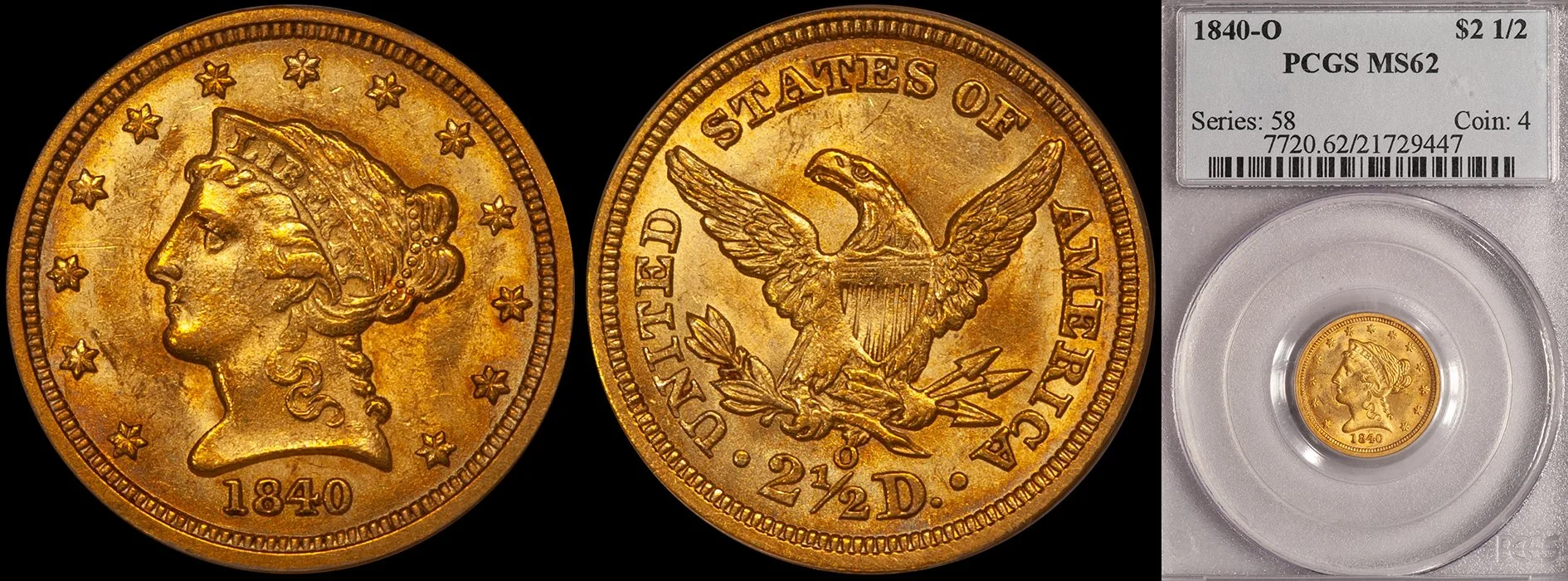
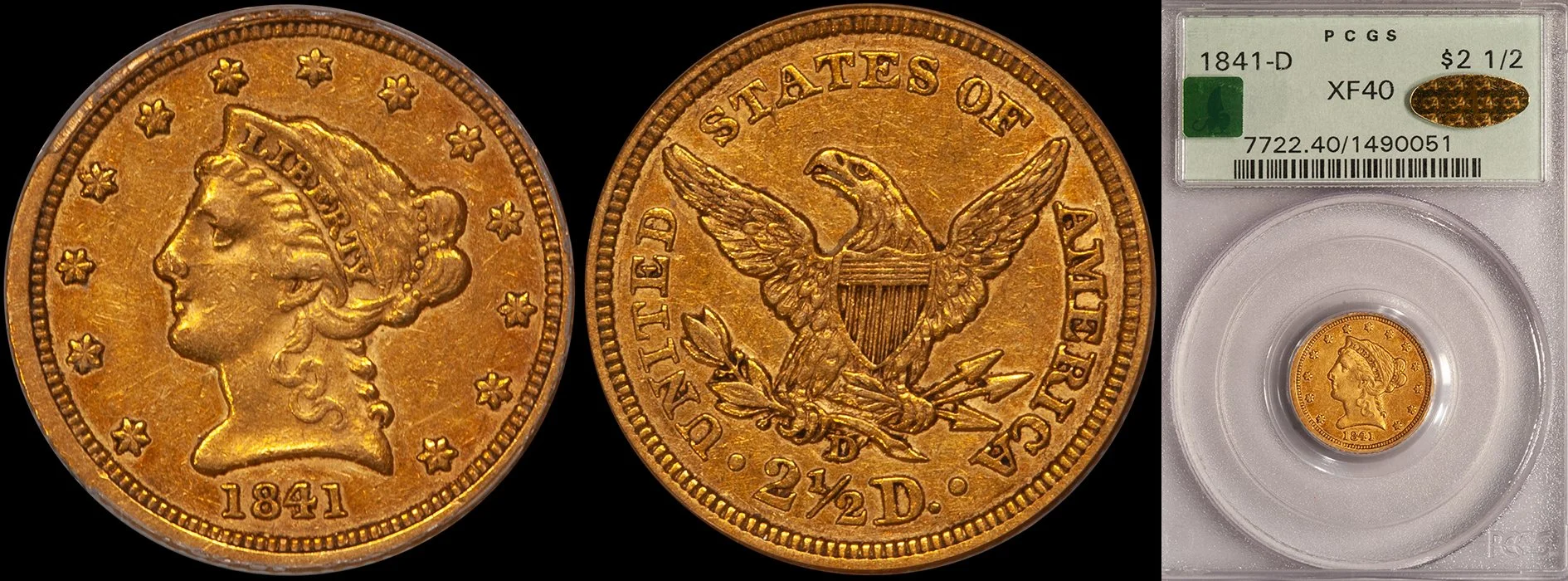
1866-S WM $5.00 PCGS EF40

With Motto variety. 1866 is an important transitional year in American numismatics. During this year, the motto IN GOD WE TRUST was added to the reverse of all coins large enough to fit it. While the transition was smooth in Philadelphia, it didn't go as well in San Francisco and issues are known with both No Motto and With Motto reverses. In the half eagle series, the With Motto 1866-S half eagle is the more available of the two with a reasonably high mintage of 34,920. Many of these were melted, however, and the 1866-S WM half eagle is very rare above EF40. This example is totally original and problem-free with nicely blended green-gold, rose and orange-gold hues atopn clean, problem-free surfaces. The stars at the left are weak as a result of an uneven strike; this is common for this issue. Since 1982, only five EF40 examples of this date have been sold at auction. No PCGS EF40's have sold since Superior 9/98: 2065, which brought $1,955 well over a decade ago. Coins like this are being recognized (finally!) as true scarcities but they are still very good values.
Br> From the RYK Collection.

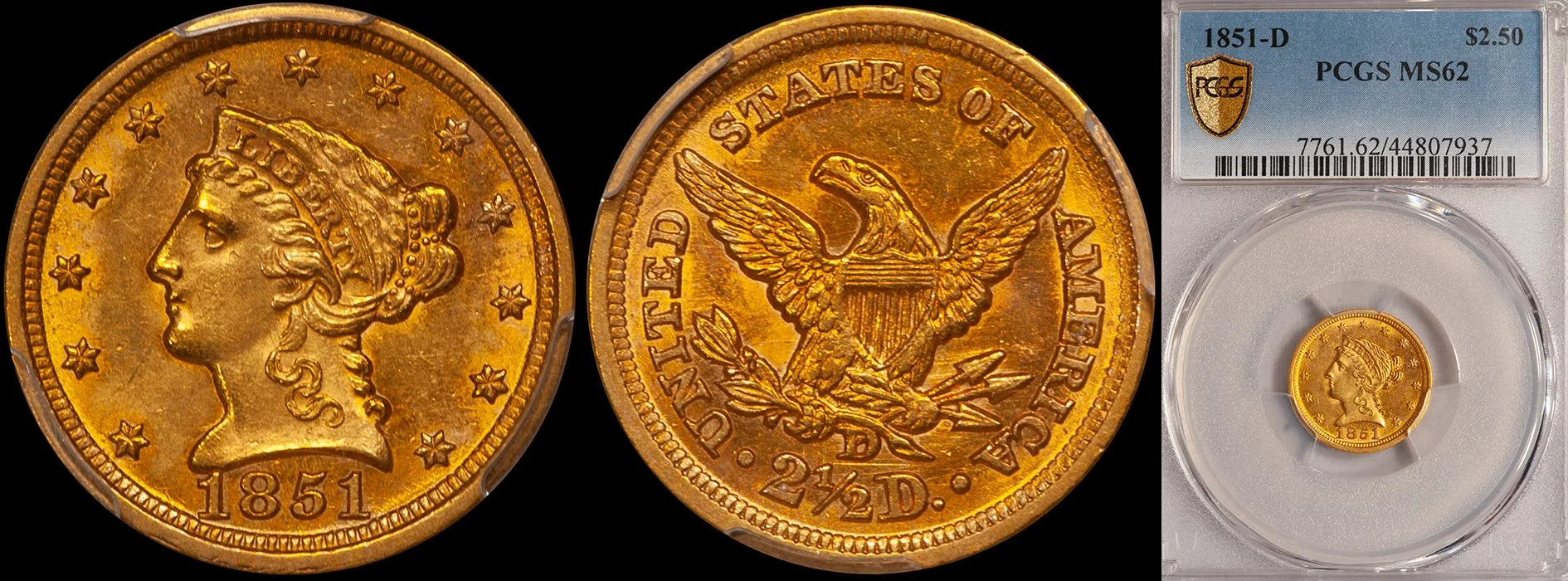
1867 $5.00 PCGS EF45

Few coins offer better value than the Reconstruction Era half eagles from the Philadelphia mint and the 1867 is amongst my favorite dates from this period. Only 6,870 business strikes were made and fewer than 100 pieces exist today. PCGS has graded just 34 in all grades and this date is seldom found in grades above the EF45-AU53 range. This example is just about perfect for the grade with nice medium to deep orange-gold color that is contrasted by deeper hues at the borders. The surfaces are very clean with fewer marks than usual for the date and grade. The last two auction prices realized for examples in this grade were both $2,070; these are for an NGC and a PCGS coin back in $2,070. Interestingly, only two other APR's for EF45 examples have been recorded since 1999. A whole lot of coin for not a whole lot of money.

From the RYK Collection

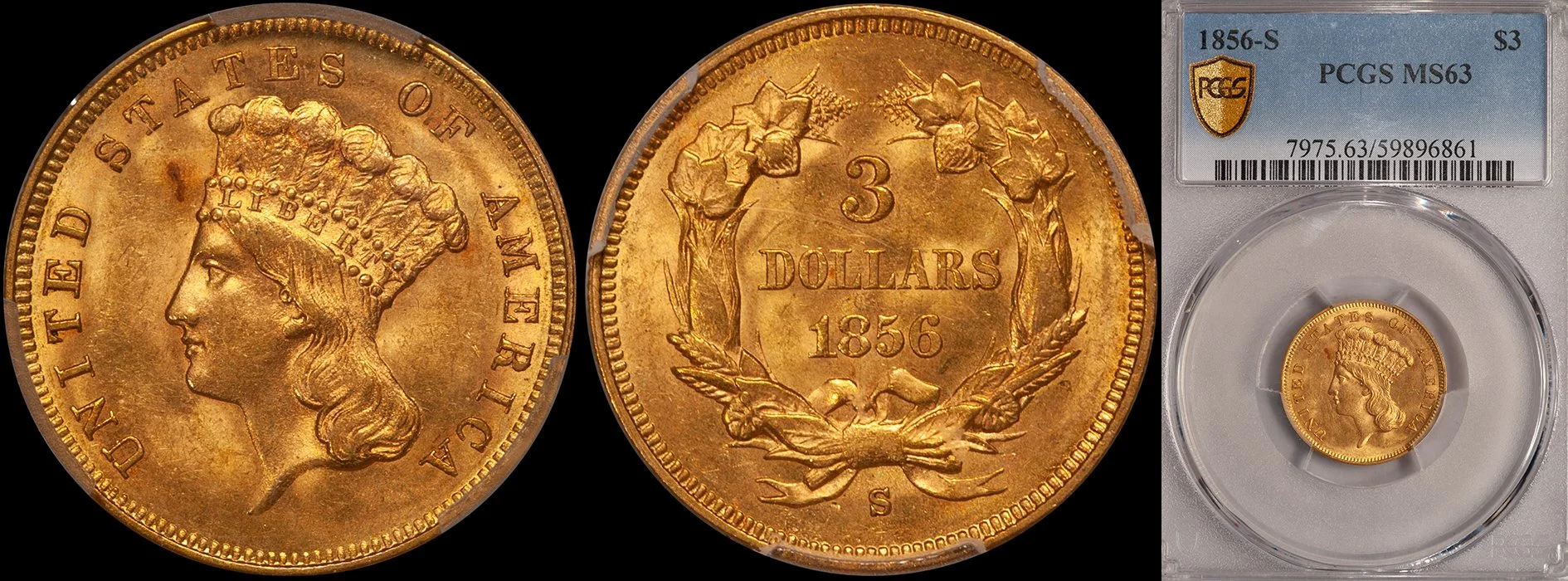
1871 $3.00 NGC AU58

This is one of my favorite "sleeper" dates in a series that, as of the end of 2011, offers as much value on a per coin basis as any group of gold coins in all of American numismatics. This bright, highly lustrous slider has the naked-eye look of an MS61 to MS62 piece but there is just the slightest touch of rub on the high spots. The surfaces are very clean and the eye appeal is very high for the date and grade. Only 1,300 business strikes were made and, unlike the low mintage Threes of the 1880's, this date was not hoarded by contemporary collectors and dealers. At around double the price of a common date issue like an 1854, 1874 or 1878, this is a remarkable value for the savvy collector.