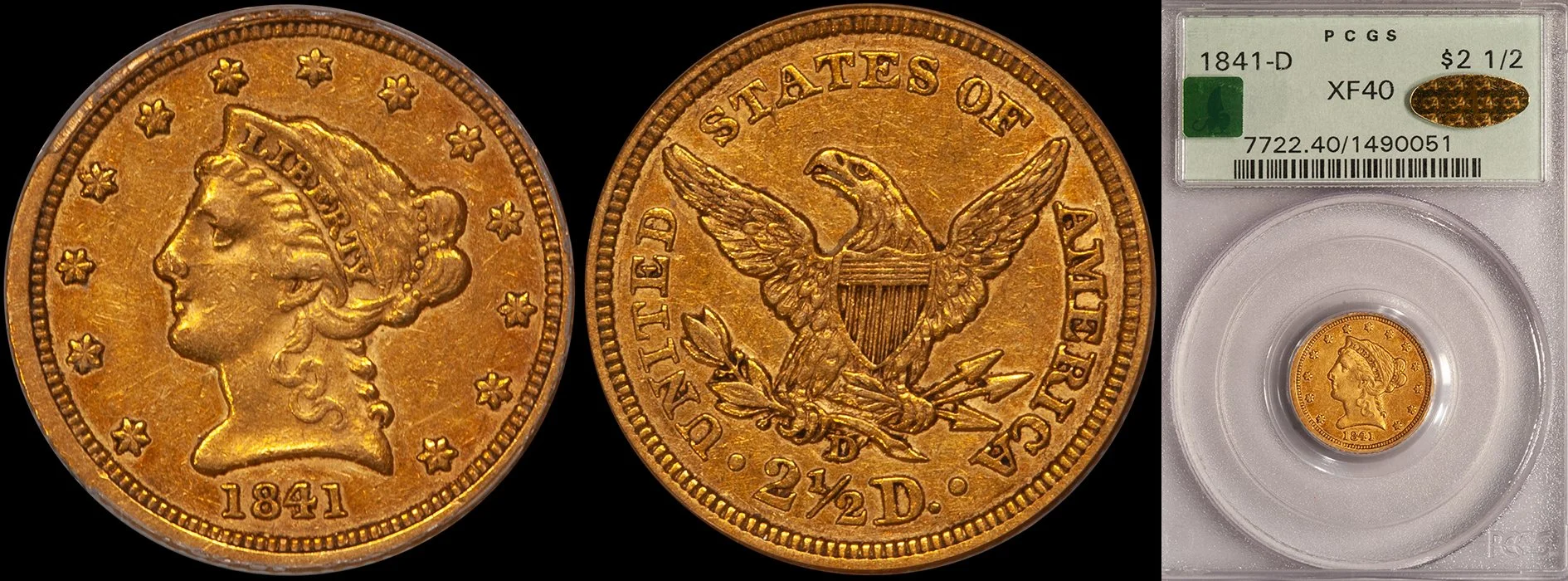
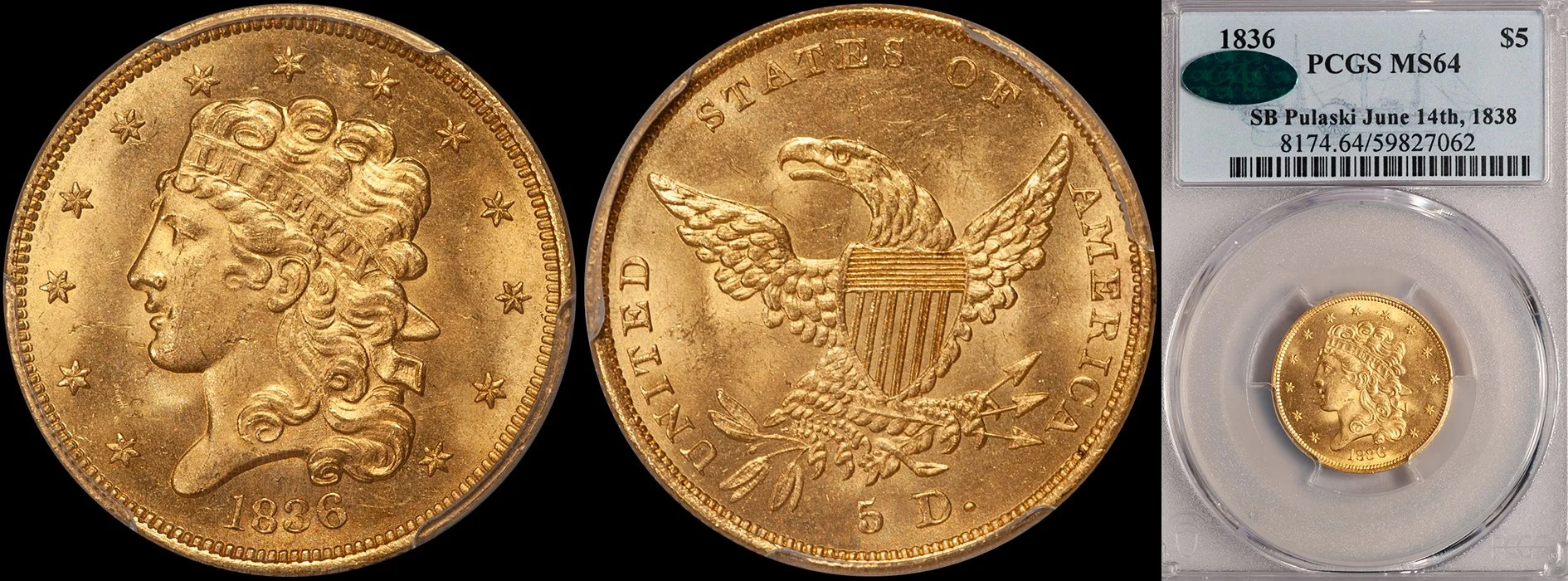
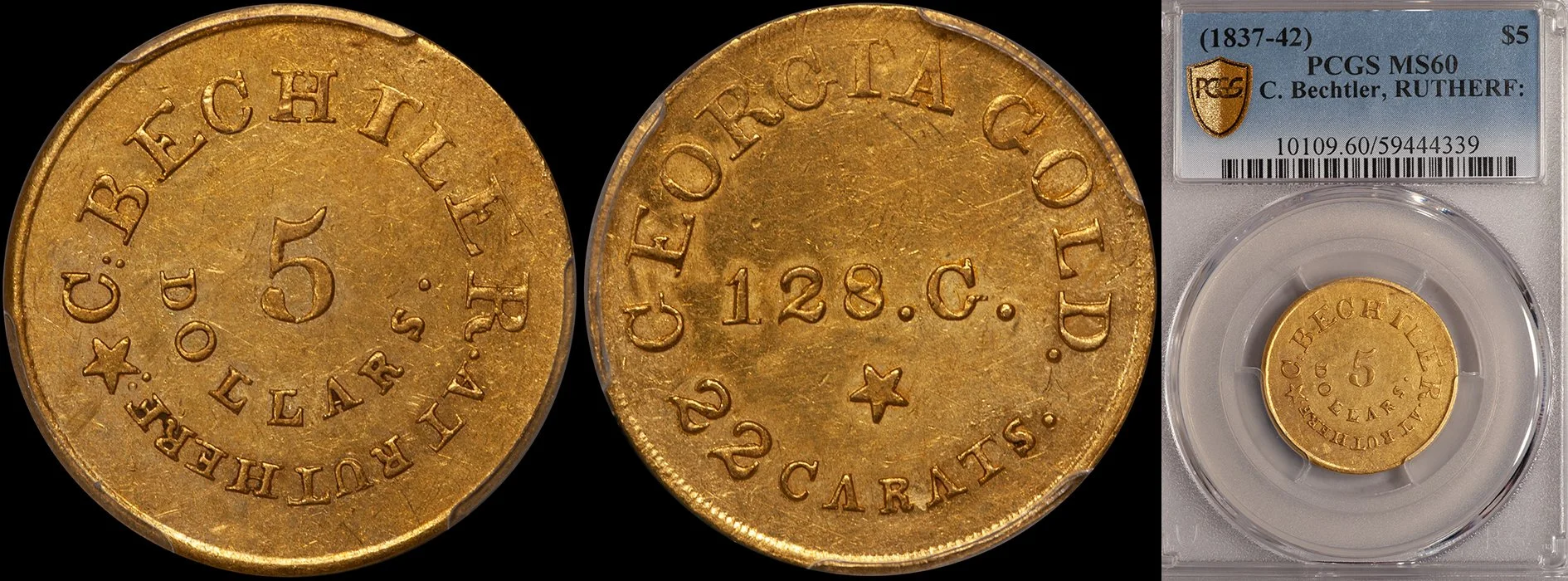
In their recent October 2011 Pittsburgh auction, Heritage Auctions sold a comprehensive collection of Liberty Head quarter eagles. This collection contained many of the rarities in this series and I'd like to take this time to analyze the coins themselves and the results that they garnered. One of the rarest collectible Liberty Head quarter eagles is the 1841. It has now been decided with near-certainty that this issue, formerly believed to have been Proof-only, was struck in both Proof and business strike formats.
I am of the opinion that the 1841 quarter eagle is still an undervalued coin. There are fewer than 20 known, and it is clearly among the rarest individual dates in this series. If the Liberty Head quarter eagle series were to become more collected by date, I could see a nice example in the PR50 to PR60 range range having a base value of $250,000+, given what other less rare U.S. gold coins are currently selling for.
It was hard to determine if the 1841 in the Heritage sale (graded PR55 by NGC) was a business strike or a Proof, as it had been fairly harshly cleaned at one time and most of the original surface had been stripped away. I actually thought the coin might have been a Proof but would need to see the coin out of its holder to be more certain.
This coin sold for $132,250 including the buyer's premium. I thought that this was a reasonably strong price, considering that the coin was really not attractive. The last example to sell was Heritage 7/09: 1230, graded NGC PR58, which was considerably nicer.
There were some interesting Dahlonega quarter eagles in the sale. The most interesting was a really nice 1854-D graded MS63 by PCGS. It is the second finest known of around five or so in Uncirculated, and this is a date that is scarce in all grades with an original mintage of just 1,760.
This exact coin had appeared in Heritage's June 2004 Long Beach sale (as Lot 6200, in a PCGS MS62 holder) where it brought $34,500. It then appeared as Bowers and Merena 3/10: 3623, in a PCGS MS63 holder, where it sold for $63,250.
I was bidding on this coin in the Heritage sale for a client and before the sale began, I estimated that it would bring around $50,000-55,000. Shortly before the sale began, I realized that this range was too low and I raised my bid accordingly.
I wound-up being the underbidder on the coin, and it sold for a record-setting $86,250. The previous high for this date was $80,500, set by the Duke's Creek: 1511 coin (which I purchased), graded MS64 by NGC and the finest known.
The Heritage sale showed me that the market for very high quality Dahlonega quarter eagles is quite strong. But the market is also very discerning and more sophisticated than in the past. An 1844-D quarter eagle in NGC MS63 was impressive if you look at the numeric grade assigned the coin, but it was softly struck and over-graded in my opinion. It sold for just $18,400; a far cry from the $30,800 it had brought back in May 1998 when it sold raw in the Pittman auction.
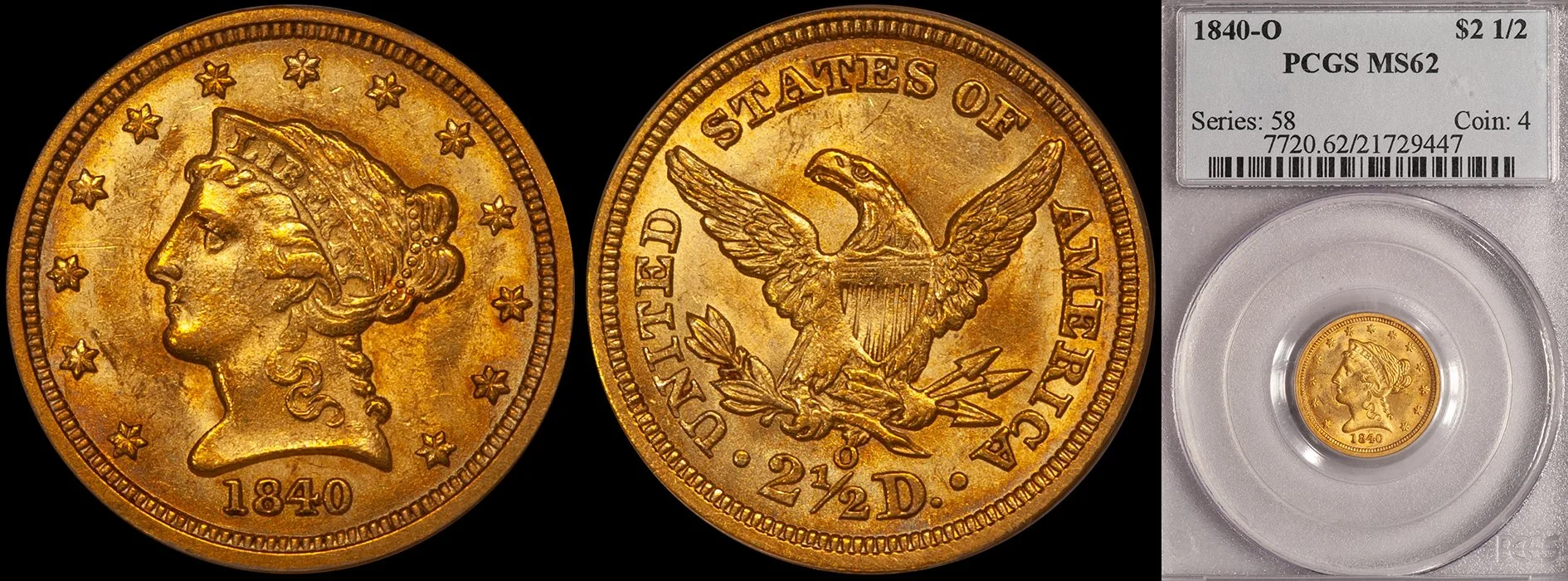
I also thought that the nicer New Orleans quarter eagles in the sale did well. A sharply struck 1840-O graded MS62 by PCGS realized $17,250, a softly struck but fresh-looking 1846-O in an NGC MS64 holder was bid to $23,500 and a decent quality but not especially choice 1847-O in PCGS MS63 brought $14,950.
Another major rarity in the collection was a PCGS VF35 1854-S. This coin has the distinction of being the rarest regular issue Liberty Head quarter eagle with an estimated 12-15 survivors. Unlike other very rare issues, the 1854-S is nearly always seen in low grades with only one known in AU (an NGC AU53 that is ex Bass II; 472) and two or three in EF.
I spoke with a number of knowledgeable dealers about the 1854-S in the sale and the reaction was mixed. Nearly everyone agreed that the coin wasn't attractive, and that if it weren't a rarity like an 1854-S quarter eagle it might not have been graded by PCGS. But I think they are missing an important point: very rare coins have always been given certainly allowances by collectors and dealers alike, and in the world of 1854-S quarter eagles, this coin was better than most.
The coin in the October 2011 Heritage sale brought $253,000. This is almost exactly what I expected it to bring.
A damaged "no grade" 1854-S in the Stack's Bowers 2011 ANA sale had just brought $201,250, which meant that the coin in the Heritage sale was a shoo-in to sell for more than this. The best comparable result for an 1854-S was the Heritage 2009 ANA: 224 coin, graded VF35* by NGC, which was sold for $253,000.
If the Heritage 10/11: 4692 coin had been a nicer piece for the grade and still in a PCGS holder holder, I think it would have sold for over $300,000. Its scratched surfaces and lack of overall eye appeal held back the final price realized but, as I said, above this is such a rare coin that eye appeal is not as big a factor as on more common issues.
That said, the NGC EF45 Lee coin (ANR 9/05: 1128) that I purchased six years ago for $253,000 is now looking like a very, very good value.
One final rarity in the sale that I though was interesting was Lot 4716: an 1864 graded AU58 by NGC. For years, the 1864 was perhaps the single major "sleeper" issue in the Liberty Head quarter eagle series. Only 2,824 were made, and business strikes are extremely rare with fewer than three dozen known.
I didn't like the coin in the Heritage sale. In fact, I thought it was an Impaired Proof that had been misidentified as a rarer business strike. The coin brought $40,250 which I thought was a pretty lackluster result, given that Heritage had sold another NGC AU58 for $46,000 as Lot 5333 in their April 2011 auction.
Their were a few other things I noticed about the sale. The first was that the CAC coins typically brought significant premiums over the non-CAC coins. The coins that had CAC stickers were generally nicer than their non-CAC counterparts, and assuming that Heritage sent all the coins to CAC, it wasn't hard to figure which coins were the "best." There were exceptions to this. The aforementioned 1854-D, which should have been stickered as it was really a nice coin, did fantastically and some of the rarities mentioned above (1841 and 1854-S) did just fine without them.
But there some examples of coins in this collection whose value was greatly improved by the presence of a CAC sticker. I'll give you a few examples. Lot 4714 was an 1862-S graded AU58 by PCGS and approved by PCGS. This coin sold for $8,625. In their October 2010 sale, Heritage sold the same date in the same grade but without a CAC sticker for $6,900.
Another strong CAC-generated price was realized by Lot 4715, an 1863-S graded AU58 by NGC. It sold for $9,775. Compare this to the $6,900 that Heritage 12/10: 4325 brought (it was non-CAC stickered) and you'll see the value of the "green bean" to certain buyers.
My overall take on the sale was it did well but was not a "run-away." There were some coins that flew under the radar but very few bargains were to be had. The coins that appeared to sell for low prices weren't very nice. What I found surprising what that some of the coins that were nice but which were "hard sells" seemed to do just fine, even though there are not all that many end-users for them.