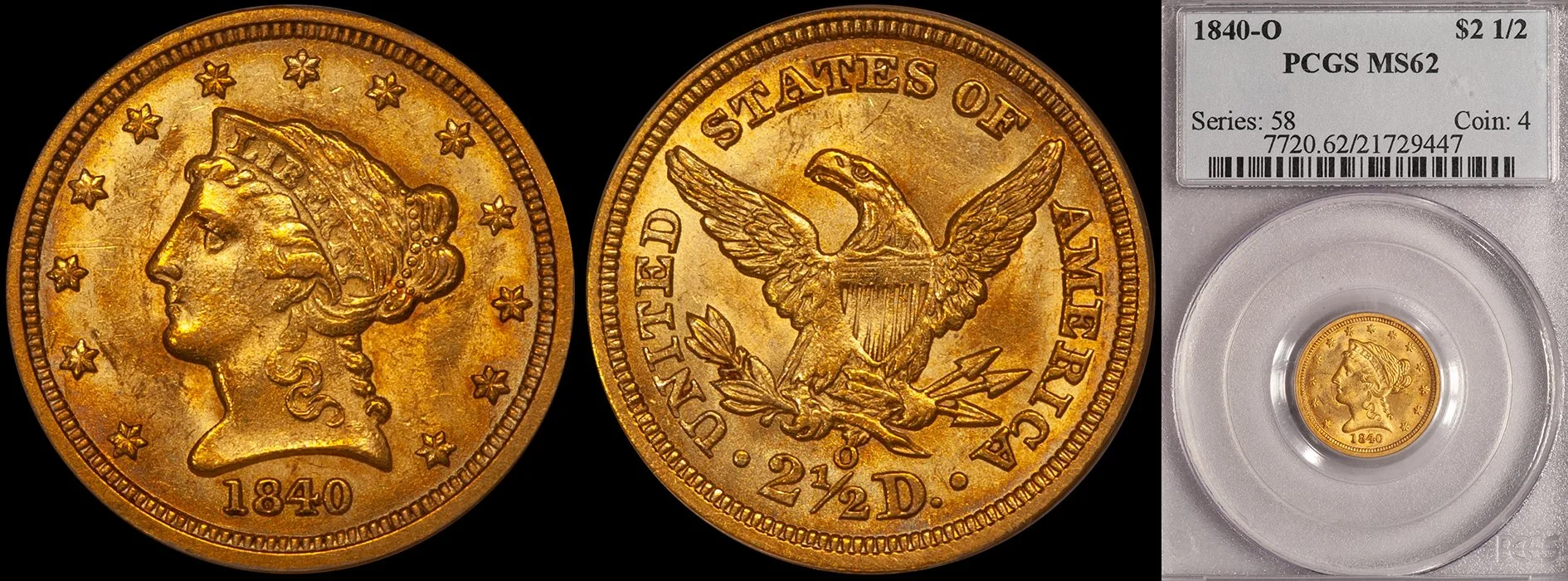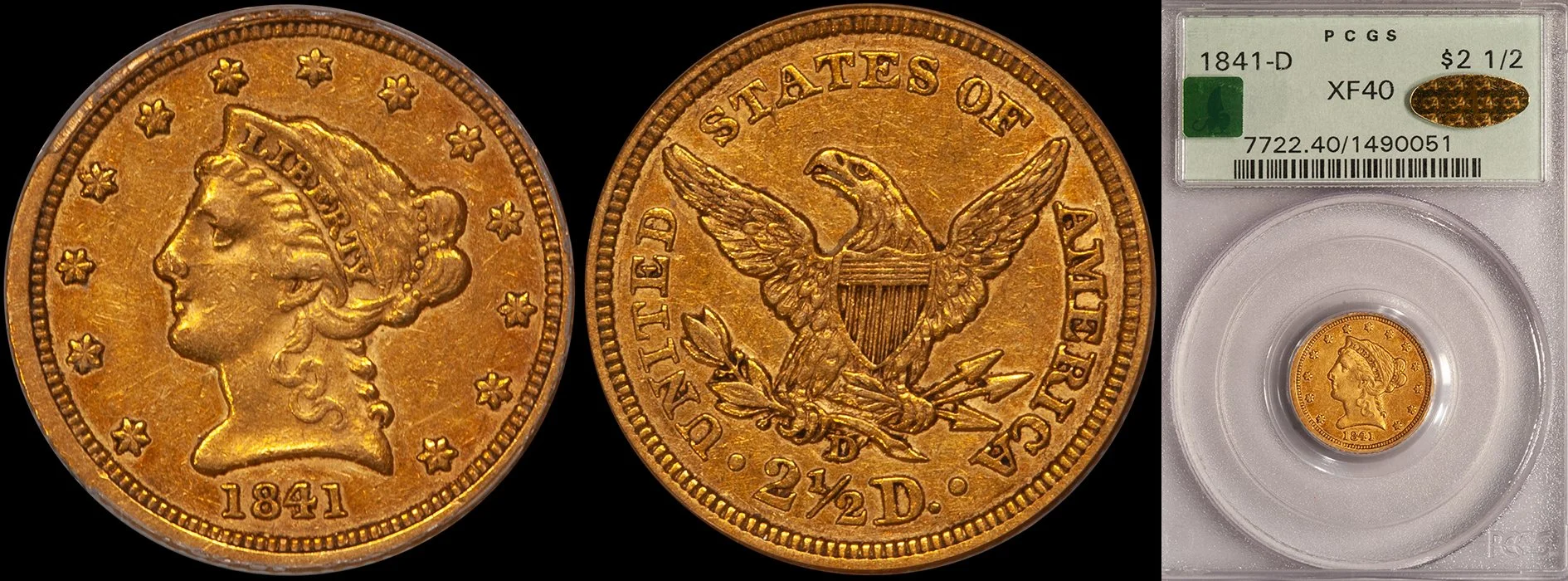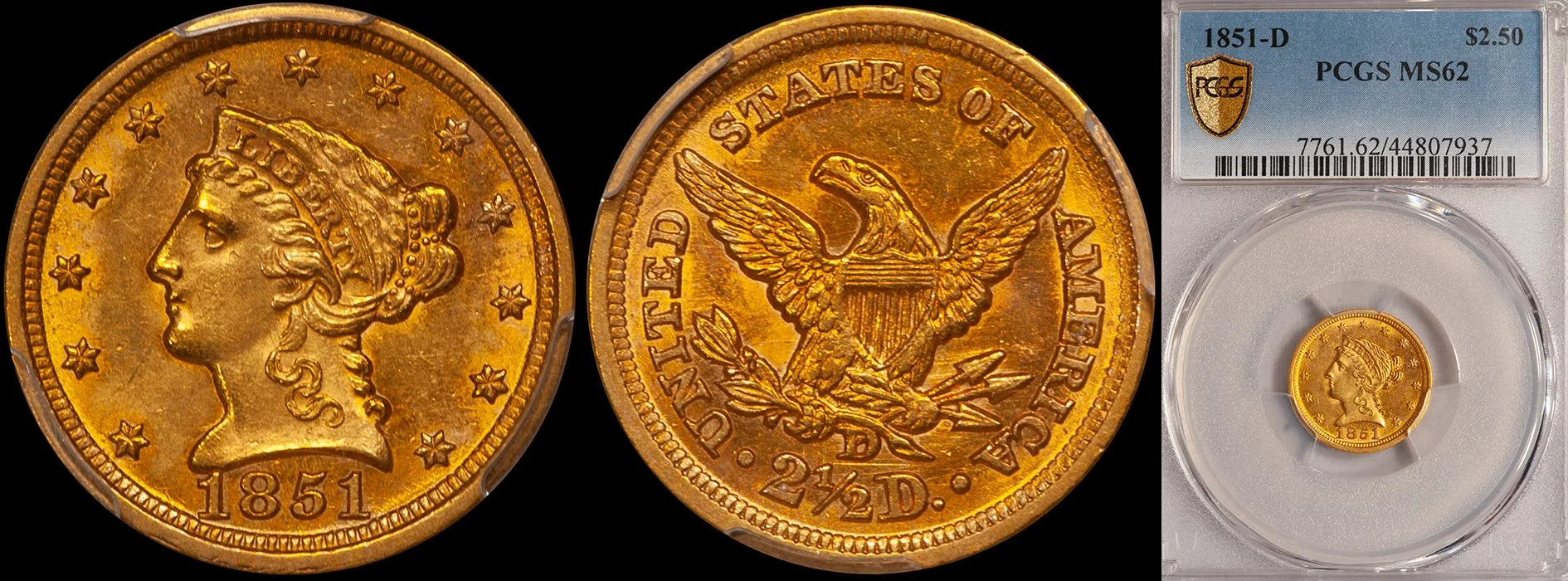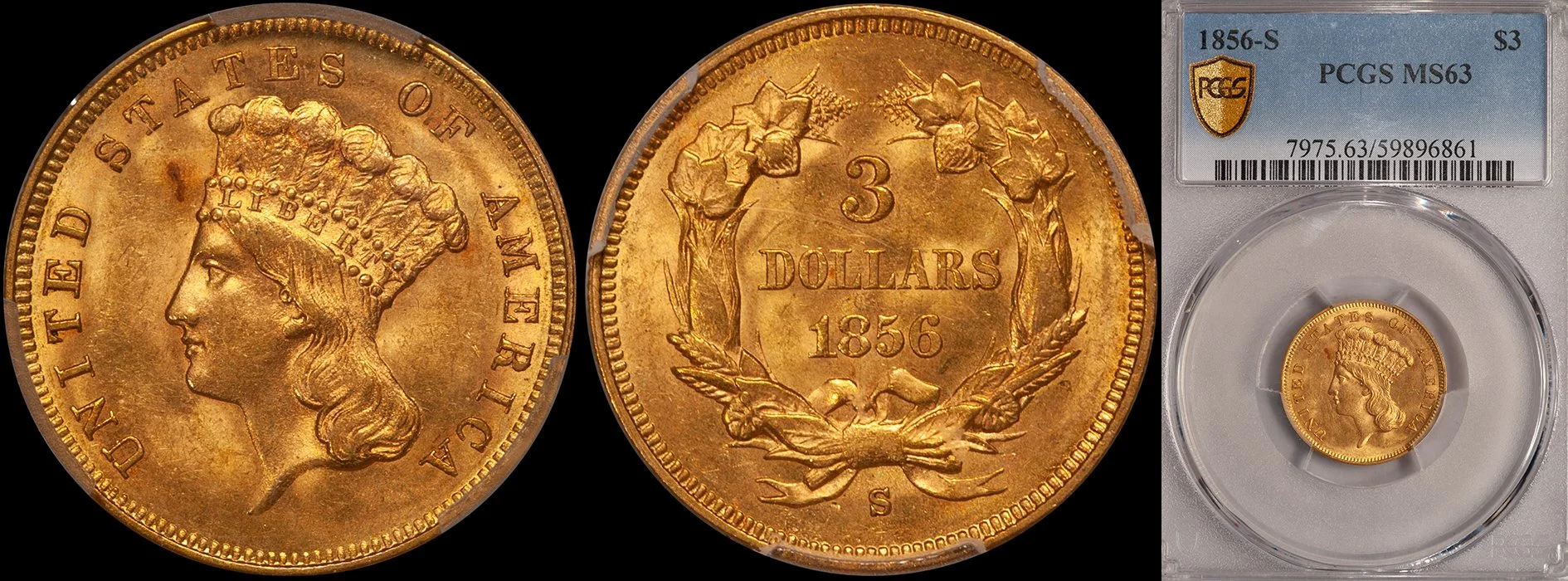
1852-O $20.00 NGC EF45+ CAC

I have handled at least a dozen EF45 1851-O and 1852-O double eagles (combined) in the past year and I'd have to say that this example may be the most attractive, at least from the standpoint of originality. The obverse and reverse show lovely deep original green-gold color with no lightened areas from prior dippings or cleanings. The surfaces are remarkably choice for a New Orleans double eagle of any date with a near-total lack of marks. My guess is that this coin was recently found overseas but it doesn't have the too dark/too splotchy color that many of the O mints that are found in these sources display. The "+" designation from NGC was certainly the result of this coin's great eye appeal and I think a collector would be hard-pressed to find a nice New Orleans double eagle of any date for less than $5,000.

1847-D $5.00 PCGS EF45 CAC

Deep reddish-gold hues are seen on the obverse and the reverse with the reverse the darker of the two sides. The underlying surfaces show some scattered marks that are consistent with the assigned grade. Well detailed, appealing and a perfect type coin for the collector seeking a single affordable example of a half eagle from the popular Dahlonega mint.

1881-CC $10.00 PCGS AU58 CAC

A tremendously appealing "slider" example with fully original deep orange-gold and reddish color that is contrasted by some deeper hues on the relief details. This coin probably never saw circulation but it has light friction on the high spots from being transported overseas in a bag. That said, it is still more attractive than most CC eagles that I see in MS60 and MS61 holders. The 1881-CC is the most available Carson City eagle from the 1880's but it is still many times more scarce than the 1890-CC, 1891-CC and 1892-CC both in terms of overall and high grade rarity. Most of the nicer 1881-CC eagles that rare available have been found in overseas sources in the last decade or so. This date remains scarce in Uncirculated and very rare in properly graded MS62 and higher. The last PCGS AU58 to sell at auction was Heritage 1/11: 7092 which brought $3,738; the present example is far more original and far more appealing in my opinion.

1839 $2.50 NGC EF40

The 1839 is, by far, the scarcest Classic Head quarter eagle from Philadelphia. In terms of its overall rarity, it is actually harder to find than the 1839-C, 1839-D or 1839-O yet it is priced at a fraction of these Southern branch mint issues. This evenly worn example is a bit lightly struck but is reasonably original with some orange-gold splashes seen on the obverse and reverse. A tremendously undervalued coin and an issue that I find hard to believe is still available in nice EF grades for less than $2,000.

1846-D/D $5.00 PCGS AU53 CAC

D over D mintmark variety. I'm going to go out on a limb here and state that this is one of the loveliest circulated Dahlonega half eagles of any date that I have seen in some times. Both the obverse and the reverse are covered with thick warm amber-gold color which is slightly more intense in hue on the reverse than on the obverse. The fields are extremely clean with no marks of note and the strike is excellent with sharp, even detail seen at the centers and borders. A few spots of dirt can be seen on the reverse above and below the D in UNITED. Locating Dahlonega half eagles of this quality has always been difficult and the 1846-D/D is an extremely scarce variety with this degree of originality. A great coin for the connoisseur who appreciates extreme originality.

The 1846-D/D is a spectacular naked-eye variety on which the original mintmark punch was too high and then another was placed directly below it. It is scarce in terms of overall availability but it is actually seen more in high grades than its Normal Mintmark counterpart.

1869 $10.00 PCGS EF45

Only 1,830 examples were struck and well under 100 are known in all grades. Despite the obvious rarity of this issue, the 1869 eagle remains an affordable coin in circulated grades and one which is, in my opinion, decidedly undervalued. This is a choice, wholesome example for the grade with rich orange-gold centers that are contrasted by blasts of natural purplish-red color on the obverse and, to a greater extent, on the reverse. There is some PL surface remaining on both sides and the detail is suggestive of an AU coin. Some handling marks in the fields can be seen but these tend to be shallow and do not detract from the overall attractiveness. Looking at auction records, nice EF examples of this issue are available at the rate of around once per year. I note considerable interest in coins like this as the market becomes more sophisticated and oriented towards overall rarity.

1851-D $5.00 PCGS EF45

In collector grades (i.e., VF and EF) the 1851-D is one of the more difficult Dahlonega half eagles to find. When available, it is inevitably softly struck, bright from having been dipped and heavily abraded. This deeply toned, sharply struck example is a welcome exception. It displays rich natural russet-gold color with some purplish iridescence surrounding the stars, date and reverse lettering. The surfaces are free of any significant marks and the strike is exceptional for the date with completely defined centers and a strong mintmark placed far to the right. On the reverse, there is a good deal of dirt adhering to the lettering and within the lines of the shield. In my experience, this date, along with the 1848-D, is the most underrated half eagle from this mint and pieces of this quality are genuinely scarce.

Some Interesting New Coins That DWN Has Recently Sold

Unless you check my site regularly, there are probably some interesting pieces that fall though the cracks. They might be very rare and very desirable, but they often sell so quickly that if you don't check the website every day, chances are good that you will miss them. The common theme here is the half eagle denomination, and the coins that I have sold in the last 30 days that I think are worthy of closer examination are: a 1799 Small Stars in PCGS MS62 (with CAC approval); an 1827 graded MS62 by PCGS (and approved by CAC); an 1871 graded MS61 by PCGS and approved by CAC; and an 1874 graded MS62 by PCGS which wasn't sent to CAC, but which would almost certainly being approved if it was.

Let's take a look at each coin, learn a bit about each, and discuss what makes each of these coins so special.

1799 Small Stars $5.00 PCGS MS62 CAC

This coin was one of my favorite purchases at the Chicago ANA and it was obtained in a private treaty sale with a leading wholesaler who, to be honest, I don't generally do that much business with. But I saw this coin in his case, immediately fell in love with it, and bought it for what I thought was a fair price.

The 1799 is among my favorite 18th century half eagles. It has a reported mintage of 7,451 but I think this figure is a bit on the low side and some coins dated 1799 were struck in 1800 and later. The probable mintage figure is more likely in the 10,000-12,500 range but this is still a scarce issue in all grades.

For variety collectors, the 1799 is a very interesting year with no less than nine varieties known. Most show small stars on the reverse. The variety illustrated here is BD-2, which has an estimated surviving population of fewer than 50 in all grades.

As a date, the 1799 is scarce but it becomes quite rare in Uncirculated. This coin was the first 1799 in PCGS MS62 to be made available to collectors since ANR 11/09: 3667 (which sold for $43,700 and was slabbed by PCGS). The only finer example to sell in the last five years is Heritage 5/07: 2278, graded MS63 by PCGS, that brought $63,250.

As you can see from the photo, this 1799 half eagle is a really attractive coin with semi-prooflike fields covered with splashes of reddish-gold and orange color. It is well struck, well-made, and high-end with just a few marks in the obverse fields keeping it from a higher grade.

1827 $5.00 PCGS MS62 CAC

I purchased this 1827 half eagle via private treaty at the Chicago ANA convention. It came from a good supplier of mine and, as far as I can tell, it is fresh to the market.

While 24,913 half eagles were produced in 1827, virtually all were melted by 1834 when the intrinsic value of the Capped Head Left type exceeded the actual face value. As a rule, the half eagle from the 1820's and early 1830's are very rare, and the 1827 is no exception with an estimated three dozen or so pieces known to exist.

Nearly every 1827 half eagle that exists is in Uncirculated due to the fact that this issue saw virtually no commercial use. The few that weren't melted were saved and eventually came into the possession of collectors. There are a few really superb examples known including an NGC MS66 that sold for $322,000 in the Stack's 2008 January auction.

For the grade, this 1827 half eagle is extremely pleasing. As always, the luster is a blend of prooflike reflectiveness and satiny texture. The detail is very sharp and the only noticeable mark on the coin is a small, curving line on Liberty's face that is as made.

After all these years of specializing in rare US gold coins, I still get a thrill from Fat Head half eagles like this and I was pleased to sell this 1827 in MS62 to an advanced collector who appreciated its beauty and rarity.

1871 $5.00 PCGS MS61 CAC

This next coin is an 1871 half eagle graded MS61 by PCGS and given CAC approval.

The 1871 is a scarce and under-appreciated date. There were only 3,200 examples struck and well under 100 are known with most in the EF40 to AU50 range. This date is characterized by heavily abraded surfaces and the marks on most of the known examples are amplified by semi-prooflike reflectiveness.

There are two examples of this date graded MS61 by PCGS and none finer; NGC has graded three in MS61 with none better. The present example is the only Uncirculated 1871 half eagle that has been approved by CAC and it shows wonderful natural orange-gold color atop frosty, lightly abraded surfaces. The other PCGS MS61 last sold as Heritage 7/06: 11559 where it brought $10,063; there have been four NGC auction records for MS61 coins since August of 1996 with prices ranging from a low of $8,625 to a high of $9,488.

I purchased this coin from another dealer at the recent Long Beach show and was pleased to place it with a collector who is working on a set of high quality Liberty Head half eagles. It is quite possible that this piece is the single finest known 1871 half eagle.

1874 $5.00 PCGS MS62

The last of the four interesting half eagles that I have sold recently is an 1874 graded MS62 by PCGS. This coin was never sent to CAC for approval, but I imagine it would garner a sticker as it is extremely choice for the grade with lovely color and choice, frosty surfaces.

As with the 1871, this date is overlooked by most non-specialists. Only 3,488 were struck and well under 100 exist in all grades. The 1874 is probably just a hair more available in Uncirculated than the 1871. I believe that there are as many as three or four Uncirculated 1874 half eagles known as compared to two or three (at most) of the 1871.

As I stated above, this coin was graded MS62 by PCGS and it had a wonderful appearance. The only example I know of that is finer is a PCGS MS63 that is ex Heritage 11/06: 2229 (at $20,700) and was earlier Bass II: 1194 (at $20,125).

I was fortunate to handle these four great half eagles in August and early September 2011. If these are the sort of coins that you collect and you were either not aware of them or we are not currently doing business, please feel free to email me at dwn@ont.com and we can discuss your collecting goals.

1839-C $5.00 NGC AU58

After employing the Classic Head design for just one year, the Charlotte mint produced the first of the Gobrecht Liberty Heads in 1839 only. This design is readily identifiable by a different configuration of the portrait and the presence of the mintmark on the obverse. As a date, the 1839-C is only the ninth rarest of twenty-four half eagles from this mint but it is the sixth rarest in high grades. In AU55 and above, this is an extremely scarce coin. The present example shows nice natural green-gold color with some deeper reddish-orange hues at the borders. The strike is bold and there are just a few light abrasions viisble on the surfaces. A small obverse rim nick at 10:00 doesn't detract; a small rim cud below the 18 in the date is as made. An important one-year type that, along with the 1839-D, is one of the few Southern branch mint half eagles that has multiple levels of demand.