1847-D $2.50 PCGS EF45 CAC

If I had to choose one date as the ideal type coin in the Dahlonega quarter eagle series, it would probably be the 1847-D. When available, there are some pieces with superb color and I have handled some in the EF and AU grades that have had absolutely scintillating deep original color. This choice example has lovely rich green and reddish-gold color which is characteristic of uncleaned, natural 1847-D quarter eagles. It is lightly and evenly worn with good detail and both sides have choice surfaces save for a few faint, shallow nicks in the left obverse field that are consistent with the grade. Dahlonega quarter eagles of this quality are becoming really hard to locate.

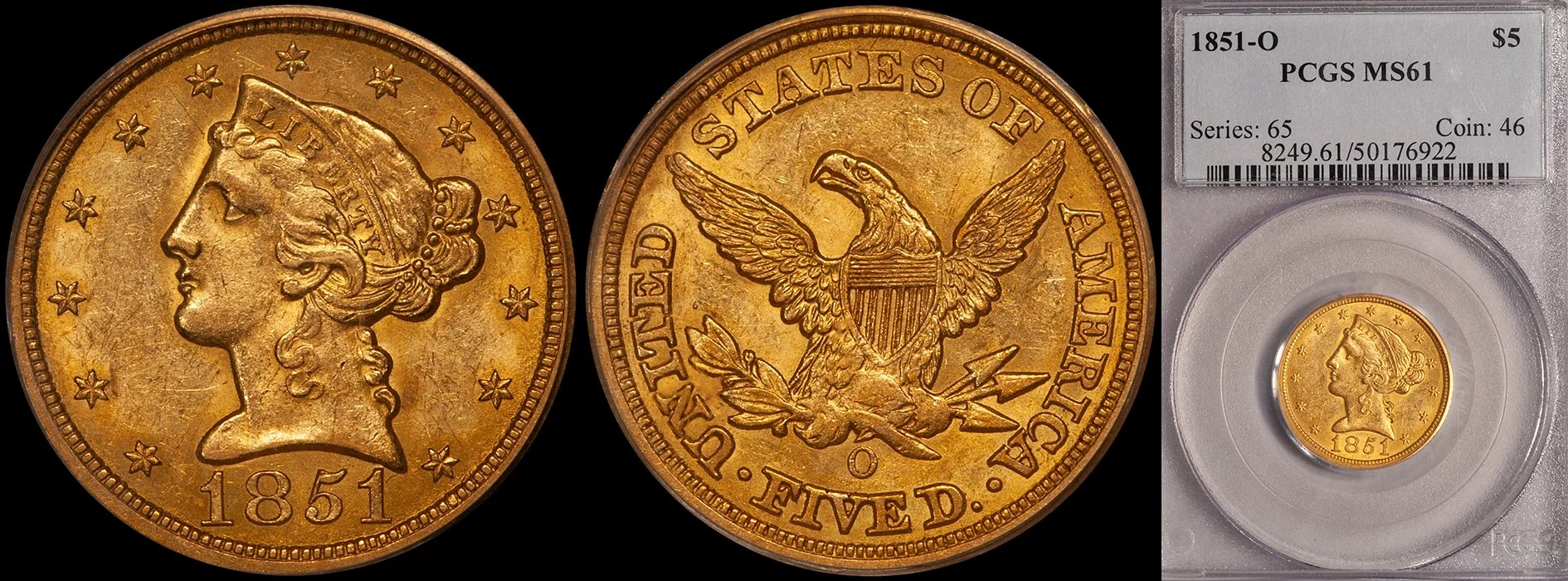
1851 $20.00 PCGS MS61

The 1851 is the second year of issue for the Type One design (not including, of course, the 1849) and while common in all circulated grades it is rare in Uncirculated, especially in MS62 or above. When this date comes nice it tends to have much better eye appeal than the 1852-1854 dates and this example clearly shows wonderful overall eye appeal. The naked-eye appearance of this coin resembles an MS63 with superb natural green-gold color and a razor-sharp strike. There are a few very fine lines in the fields that limit the grade but these are hard to see unless the coin is tilted towards a light source. I personally like this coin more than the small handful of MS62's that I've seen sell at auction in the last few years (generally in the $13,000-16,000 range) and it would fit well into even the finest set of Liberty Head double eagles.

1852-O $20.00 NGC AU58 CAC

I'm going to go out on a limb here and state that this coin is one of the single finest AU58 New Orleans double eagles of any date that I have ever seen. In arecent auction appearance it set an all-time record price for an AU58 1852-O (more on this below) and with good reason: it is absolutely stunning. In the very same sale in which this appeared,there was an 1852-O double eagle graded MS65 by NGC. While that coin was certainly incredible, I'd personally rather have this coin at one-fourteenth of the price and use the leftover funds to acquire other neat coins. Before this coin recently surfaced, it had been off the market for at least two decades as part of the Henry Miller collection. It has the naked-eye appearance of an MS62 to MS63 with superb deep original orange-gold color, semi-prooflike surfaces and a virtual absence of marks. There is just one small little area of rub on the obverse and since it is located on the cheek of Liberty, it is more obvious to the eye than if it were, say, in the fields. Interestingly, the buyer of this coin in the Miller sale was one of the sharpest wholesale "breakout" dealers that I know and, as he told me when I was buying this coin from recently, this is exactly the sort of coin that NGC (and PCGS) have called MS61 (or finer) in the recent past. The new owner of this coin can count on having one of the most attractive New Orleans double eagles known--of any date or in any grade!

Ex Heritage 1/11: 5242 where it sold for $19,550. Previously, it was in the Henry Miller collection and it was probably obtained sometime before 1980.

1854-S $10.00 NGC AU55

As a rule, I like coins with real historic significance and the 1854-S eagle certainly falls into this category as it is the very first Liberty Head eagle struck at the San Francisco mint. Unlike the exceedingly rare quarter eagle and half eagle dated 1854-S, the eagle is a relatively obtainable issue although it is uncommon in AU55, rare in AU58 and extremely rare in Uncirculated. This example is clean for the issue with just a few small marks noted on the obverse. The light gold surfaces retain a bit of luster and the strike is very sharp for the issue.

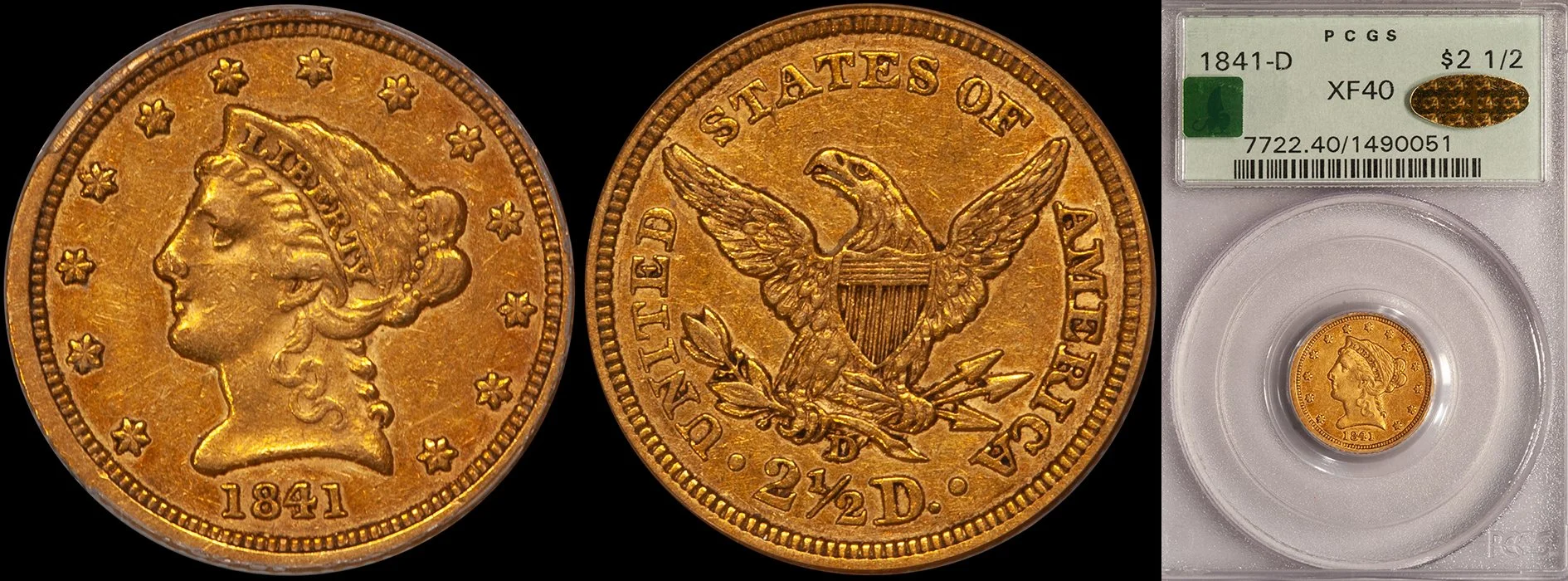
1845-D $2.50 NGC EF40 CAC

Of the three primary denominations struck at the Dahlonega mint, the quarter eagle is probably the most difficult to locate in choice, original Extremely Fine. Despite how hard it is to find such coins, these pieces are not out of reach for most collectors and I think they are amongst the best values in the rare date gold arena. This pleasing, original EF 1845-D quarter eagle has nice medium to deep green-gold color and plenty of residual dirt in the crevesses of the obverse and reverse. There is some weakness at the central obverse due to strike and a few old nicks and marks on the obverse that are well-hidden by the natural toning. A perefect Dahlonega quarter eagle for the first time buyer who is ready to take the plunge.

The 1856-S Eagle: A Study of Mintmark Varieties

I'd like to thank collector John Toffaletti for writing this interesting study of 1856-S eagles and contributing it to raregoldcoins.com for publication. I think you'll find it very interesting and it contains information that has never been published before. There appears to be new interest in the older gold coins from the San Francisco mint. This is especially true for the double eagles, but also for the other denominations.

In searching the eagles from this period, I have noticed that the 1856-S comes in two very different mintmarks: a large S located farther to the right between the arrow feathers and the stem of the right branch and a medium S, located to the left of these same arrow feathers and the eagle’s right claw (left claw as you view the coin).

I started searching the Heritage Auction Archives for this date and mint mark and noticed that the large S was sometimes described as “very rare” because that’s how it was described in Breen’s Complete Encyclopedia of US and Colonial Coins. To me, “very rare” means a coin that is really difficult to find, so I was puzzled when the two most recent 1856-S Eagles in the Archives for April 2011 were both large S types.

Continuing to look farther down, the Archives appeared to confirm that the large S was less common among the images that I viewed: of the first 20, 14 were medium S and 6 were large S. Still, not what I would call “very rare”. However, I was really interested by now, so I continued down the list until I got to 1999, at which point Heritage did not include images in their Archives.

All told, there were 80 1856-S Eagles sold from April 1999 to April 2011, with 55 being the medium S and 25 being the large S variety. So the large S would certainly appear to be rarer by about a 2 to 1 ratio.

Now for the “double S,” as in Steam Ship. I noticed one P55 1856-S eagle had an exceptionally high price for the grade. This was a shipwreck coin from the SS Central America. In a recent article, Doug Winter mentioned that certain shipwreck coins were selling at markedly increased prices relative to their landlubber cousins. Winter noted that the greatest differential was for such coins with low “shipwreck populations”.

As an example, the very common 1857-S shipwreck double eagle sells for a small premium in the middle Uncirculated grades, while most others would sell for a significant premium. Since the large majority of coins found at shipwreck are double eagles, eagles would certainly have low shipwreck populations. Here is a list of the 1856-S shipwrecked coins on the Heritage Archive:

April 2010 N25 SS Republic $1955.00 March 2010 P55 SS Central America $7475.00 May 2008 N50 SS Republic $2990.00 June 2008 N45 SS Republic $1610.00 January 2002 P58 SS Central America $3450.00 (typical 58s sold for around $2600 at the time)

While I much prefer an original, attractively toned coin that survived actual circulation with minimal wear and damage, it is clear that these shipwrecked coins sell for a premium.

Now back to the mintmark search. Breen states that the medium S variety has at least 2 positional varieties. As I looked at the medium S eagles, I noticed that one of the medium S mintmarks really stood out. It seemed to be much lower and to the right than the other medium S’s that I had seen (but still an obvious medium S).

I saved this image and another of the more common medium S coin with the mintmark located in the upper left area. Now able to clearly compare these two images, I confirmed that the two medium S’s were located in distinctly different locations.

The more common medium S is more toward the left and tucked up between the arrow feathers and the left claw, with a line along the right tips of the S pointing almost directly through the left bar of the “N” in “TEN” [for an example, see the coin sold in the Heritage January 2011 auction, graded P58].

On the other type, the right tips of the S point almost to the middle of the same “N” and the top of the S is no higher than the lower tip of the arrow feathers [for an example see the coin sold in Heritage’s April 2008 sale, graded P40].

Also, I felt that another of the medium S marks seemed a little different than the others. Indeed, this third type of medium S variety is somewhat between the other two: the right tips of the S point down to the right of the left bar of the “N” in “TEN” and the top of the S is just above the lower tip of the arrow feathers [for an example, see the Heritage March 2010 coin graded P58 CAC. This same coin was later upgraded to an N61 and sold in the September 2010 auction by this firm].

Breen speculated that the large S eagles may have been the last of three deliveries by the San Francisco mint: Jan 1856: 14,000; Sept: 55,000; Dec 2,500. However, the relative rarity figures of the Heritage Archives do not support this.

Since the 1854-S eagle has a large S, while the 1857-S eagle has a medium S in the lower right position, this suggests that the first shipment of 14,000 were the large S variety. Most of the 55,000 shipment (from September) were the upper left medium S, while the final shipment was the lower right medium S. These numbers are congruent with the Heritage Archive numbers.

The rarest variety appears to be the medium S in the lower right position, followed by the large S, then the upper left medium S. The center medium S is relatively scarce also, perhaps about the same as the large S type.

In closing, I have to tip my hat to Walter Breen, who amassed much useful information about a huge number of coins without the grading service population reports or the great convenience of the Heritage Archives.

1880 $1.00 NGC PR66 CAC

Funny thing: as much as I dislike business strike Morgan dollars (I have basically shunned this popular series since I was a kid) I've always liked this series in Proof. In the not-so-distant past it was possible to find superbly toned Proofs of this series and I've personally owned a few pieces that had simply glorious color. But with the advent of the Ultra Cameo/Deep Cameo designation, the grading services have tacitly encouraged dealers to dip toned Morgans in the hope of getting a high grade with a spiffy adjective. That's why nearly every Proof Morgan you see these days is blast white. This "old school" Gem has superb deep multi-colored toning on the obverse and reverse with strong underlying reflectiveness. There is enough contrast seen between the portrait of Liberty and the fields to wonder why NGC didn't at least designate this as a Cameo. As a date, the 1880 is among the more available Proofs of this design and it tends to be well-made. I think Proof type of this quality remains an excellent value in today's market and this superb example would be a perfect representative of a Morgan Dollar for the collector who wants one special piece for his set.

How Much Do You Have to Pay to Play?

I get calls from potential new gold coin collectors nearly every day. Some of them have spent a good deal of time researching the gold coin market and have a good idea what the coins that they may be buying will cost. Others have no clue and are almost charmingly naive about what they can buy given their budget. This leads me to the topic of today's blog: how much does a collector realistically have to commit per coin to put together a nice collection of rare gold coins? I've stressed in numerous articles and blogs the importance of specializing when it comes to coin collecting. Collections that are all over the map tend to have "issues" (putting it nicely) and having a greater in-depth focus makes for a better, more productive collector. But a collector's chosen specialty needs to be in sync with his budget.

If a collector calls me and tells me he wants to put together a set of Indian Head eagles on a budget of $1,000-2,000 per coin, my first reaction is that he's not going to get far. Only a few coins in this series can be purchased in this price range and these tend to be either the generic issues like the 1926 and 1932 or relatively lower grade (Extremely Fine and About Uncirculated) versions of the slightly better dates.

This doesn't mean that a collector with a $1,000-2,000 budget can't play in the rare date gold coin market, there are some reasonably interesting coins available.

The collector with a $1,000-2,000 budget needs to make one immediate decision: does he care more about comparatively high grade than rarity?

If the collector with this budget is grade-oriented, there are a number of options that he can pursue.

One nice set that comes to mind are Philadelphia gold dollars struck from 1877 through 1889. This set consists of 13 coins and all of them can be found in MS63 for less than $1,500 per coin. And, if the collector in question wants to step up to MS64 examples, all the dates in this set can be found for less than $2,000.

Once this set is completed, the collector can focus on many other of the gold dollars from Philadelphia. All of the Type One issues from 1849 through 1854 can be had in MS63 for less than $1,500. And many of the Type Three issues from the mid-1850's, 1860's and early 1870's are very affordable in MS60 to MS63 grades.

If the collector on a fairly tight budget is more rarity oriented, the Liberty Head quarter eagle series offers a number of potentially interesting options. Most of the Philadelphia issues from the 1840's are scarce, and nearly all can be obtained in the lower to mid-AU grades for $1,000-1,500.

Many of the Civil War era quarter eagles--from both the Philadelphia and San Francisco mints--offer a great amount of bang for not a lot of buck. Let me pick a random example to illustrate my point. The 1867 quarter eagle has an original mintage of just 3,200 business strikes and it is likely that fewer than 125-150 are known. Yet, when available, a nice AU55 example of this date should cost $1,500-1,750.

The low mintage quarter eagles from 1880 to 1894 are intriguing. With the exception of the ultra low mintage 1881 and 1885, most of these dates can be obtained in the AU55 to MS62 for under $2,000.

There are a number of interesting half eagles that can be purchased for less than $2,000 per coin. This includes many of the No Motto Philadelphia coins in About Uncirculated and a number of the New Orleans issues as well. This includes some interesting dates, such as the 1843-O Small Letters and Large Letters, 1845-O, 1846-O and 1851-O in Extremely Fine.

Speaking of New Orleans coins, is it possible to have a budget of $1,000 to $2,000 per transaction and still purchase the popular Charlotte and Dahlonega issues? The answer is a qualified yes. I regularly handle common date C+D gold coins grading VF35 to EF45 that are priced from around $1,750 to $2,500. You aren't necessarily going to get a coin that is a candidate for beauty-prize winner at the price/grade level but you'd be surprised at the interesting lower grade issues that come available from time to time.

What about larger size coins?

At the $1,000-2,000 it is possible to buy as many as twenty to thirty different No Motto eagles in the EF40 to AU55 range. Most of these will be Philadelphia coins but there are many New Orleans eagles that can be found in EF grades for around $1,500 to $2,000.

Your dollars are going to go much further in the eagle denomination if you stick with the With Motto coins. The issues struck from 1878 to 1907 are readily available in the $1,000 to $2,000 range and you can find many of the more common dates in MS63 for $1,500-2,000. Given the fact that eagles have nearly half an ounce of gold and thus melt for around $700-800, that you can buy reasonably interesting coins for $1,000 seems like great value to me.

Since a Liberty Head double eagle has a basal value of nearly $1,500 worth of gold, your $1,000 bill isn't going to do much damage in this denomination. But if you can swing a $2,000 purchase, you'd be surprised at what you can find. Case in point: I recently sold a lovely PCGS EF45 1858-S double eagle with a CAC sticker for around $2,000. This coin isn't a great rarity but it isn't easy to find, its over 150 years old and it has a great association with the Old West.

I'm a big advocate of having a smaller collection of cool coins as opposed to a large collection of widgets. To me, the rare gold market's "sweet spot" is around $2,500 to $7,500 per coin. In this range you can start to purchase some really interesting pieces, both in terms of grade and rarity.

At this level you won't find much in the way of early gold. But you will be able to buy nice quality Classic Head quarter eagles and half eagles including some of the mintmarked coins.

There are some great values in the Charlotte and Dahlonega market in this price range. For $3,000 to $5,000 you can buy really nice half eagles in About Uncirculated from either mint and this includes some better dates from both the 1840's and the 1850's. You won't be able to buy the keys like the 1842-D Large Date or 1861-D half eagles but there are not many other dates you won't be able to afford in the price range.

Even if have around $7,500 per coin to spend, you'll probably find Proof gold to be well out of your range. But how about nice Uncirculated No Motto half eagles or eagles in the MS61 to MS62 range for around $5,000 per coin? These still exist and the quality of tends to be well superior to comparably graded C+D mint issues.

At the $5,000 price point, you can purchase some really interesting Liberty Head double eagles. Want some examples? Some of the coins that I've personally sold for five grand or so in the last 45 days include a trio of nice EF45 1851-O's, an 1855 in AU58, an 1856 in AU55, an 1864 in AU55, and an 1865 in AU58. All of these were approved by CAC, all had good eye appeal and all are "out of the ordinary" dates in above-average grades.

There is so much more to select from at the $5,000 to $7,500...the list could go on and on. Better date Three Dollar gold pieces or common dates in nice MS63 to MS64. Rare, seldom-seen San Francisco issues of all denominations. Nice common date Carson City double eagles in About Uncirculated.

New collectors are often intimidated by the better date United States gold coin market and they don't need to be. There are a tremendous amount of interesting coins out there at $7,500 or $5,000 or even $2,000.

Do you have questions about how much you have to pay to play in the rare gold market? Feel free to ask me via email at dwn@ont.com or leave your comments below.

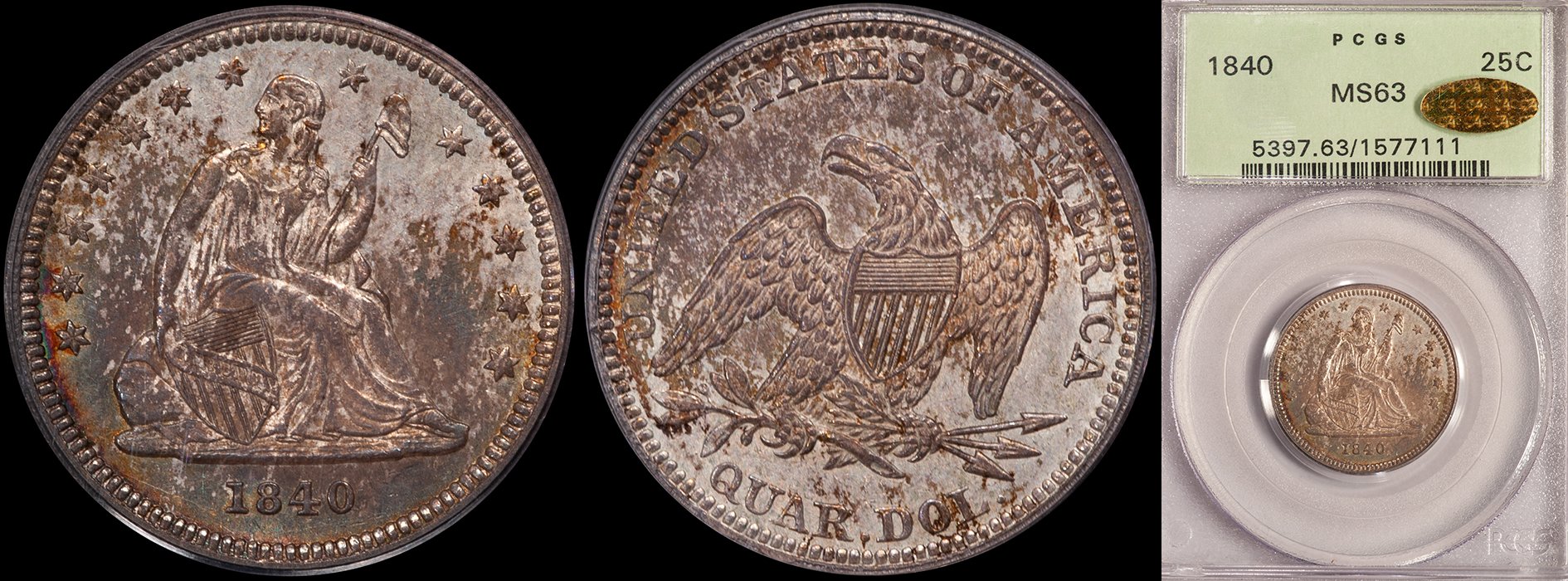
1856-O $10.00 NGC AU53 CAC

There are four premier rarities in the New Orleans eagle series: the 1841-O, 1859-O, 1879-O and 1883-O. In the second tier, there are a small group of dates that include the 1849-O, 1852-O, 1855-O, 1856-O and 1857-O. Each of these five is scarce in AU50 to AU55, rare in properly graded AU58 and extremely rare in Uncirculated. The present 1856-O is among the most wholesome examples of this date that I have seen in some time. It is clean, well struck and superbly toned with deep rich honey-gold and greenish hues on the obverse and reverse. There have been only two examples of this date in this grade that have appeared at auction during the last two years. The first, Heritage 1/11: 7937, was in a PCGS holder and it brought $4,025. The second, ex Heritage 1/10: 4027, was slabbed by NGC and it sold for $3,738. Neither had the original appearance that this piece displays and neither was approved by CAC.