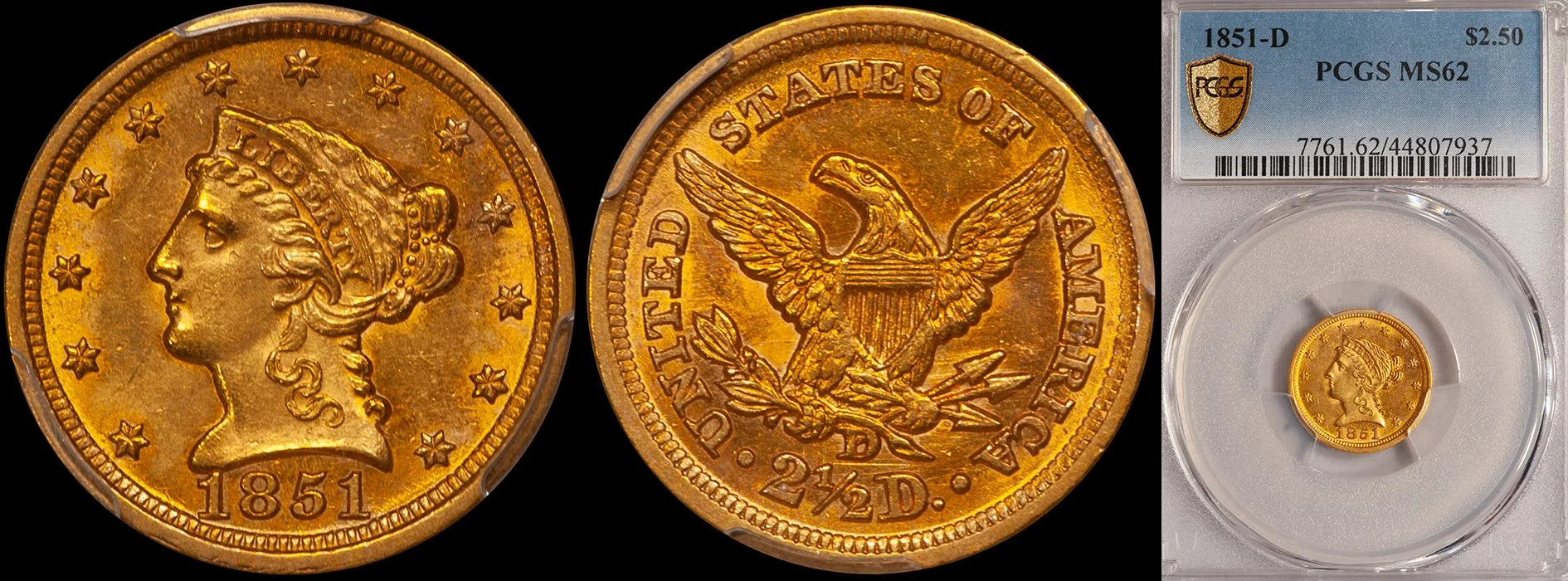
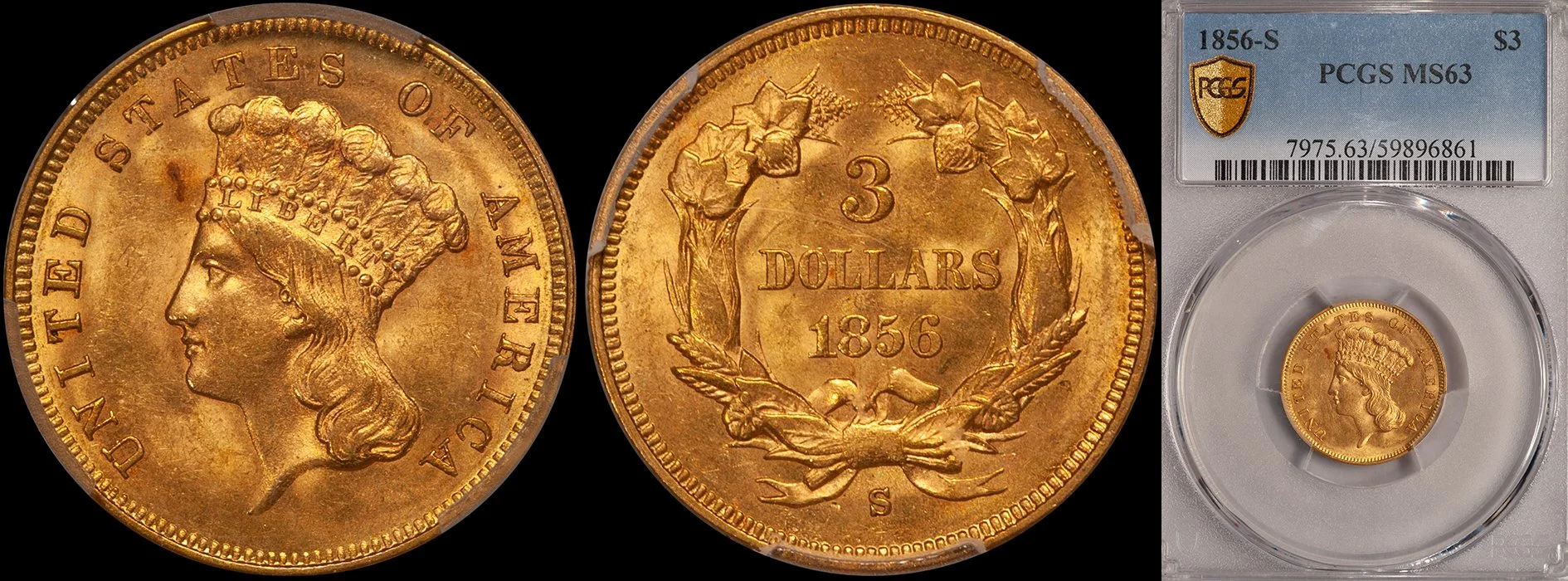
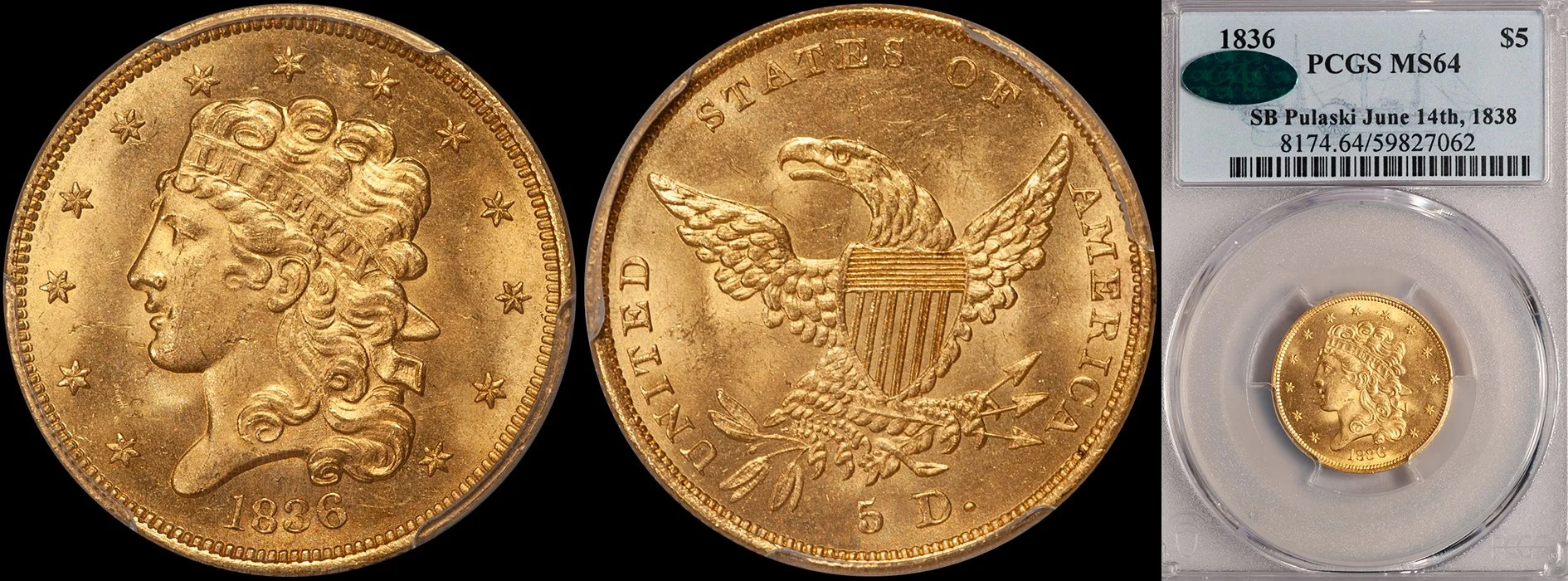
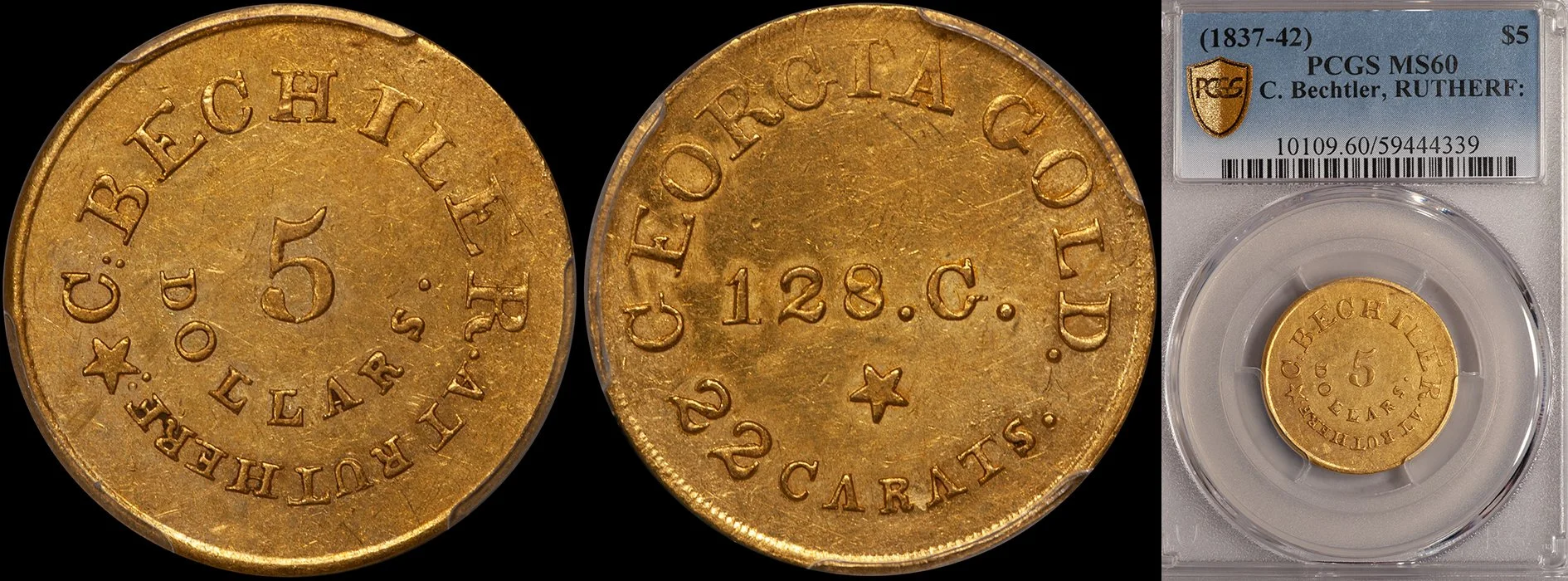
1811 Small 5 $5.00 PCGS EF45

BD-2, Rarity-3. Small 5 variety.There are two varieties of 1811 half eagles known: the Small 5 and the Tall 5. Neither brings a premium although, in my experience, the latter is a bit more scarce. As a type, the Capped Bust Left is both short-lived (it was issued from 1807 through 1812) and desirable. It is also completable, as there are no rare dates; just rare varieties. The present example shows deep mottled coppery and green-gold toning that is suggestive of having been kept in a leather storage pouch for many years. There is no remaining luster but the detail is excellent and the surfaces appear clean for the grade with just a few small marks in the left obverse. As a rule, early gold is very hard to find in grades below AU50 as it just didn't circulate enough to garner this degree of wear. many examples in the VF-EF range are damaged or have negative eye appeal and this pleasing, richly toned piece has very good eye appeal. An affordable and interesting early half eagle.

1847-C $5.00 NGC MS60 CAC

This is the second lovely Uncirculated example of this conditionally rare issue that I have handled this year; earlier, I sold an NGC MS61 with a similar appearance as part of the Logan's Landing Collection. When you hear the grade "MS60" you typically think of a coin that is riddled with marks or which is characterized by some sort of flaw. This MS60 1847-C half eagle is fully original with attractive deep green-gold color that changes to subtle coppery-red hues in the fields when the coin is tilted towards a light source. The strike is razor sharp and the surfaces are extremely clean with just a few small, unobtrusive marks on the cheek and in the left obverse field; the reverse is clean, choice and would grade at least MS62 on its own. This is one of fewer than a dozen known examples in Uncirculated and it is certainly one of just a tiny handful that are totally original.

Why the Rare Coin Market Isn't the Art Market

As much as coin dealers--myself included--try to compare the coin market to the art market, the more you look at coins, the more you realize how insignificant this market (currently) is when compared to art. Will the coin market ever "catch up" to the art market and is it fair to make any coin vs. art comparisons? I'd like to share my thoughts on this with you. If you look at art from an outsider's perspective, the prices that great objects bring seem baffling. $50 million dollar Warhols? $100 million Giacometti sculptures? And what seems all the more baffling are that prices like this are for items that not everybody agrees is a masterpiece.

But examine the art market with a little bit more perspective and the prices that make coin dealers exclaim that MS64 Indian Head half eagles at $3,500 are a smoking value seem less relevant.

The market for seven, eight and even nine figure art objects is extensive and it is world-wide. If a Vermeer painting was discovered and authenticated, there would be a deep pool of buyers waiting to purchase it; even if the final price realized at auction was in excess of $200 million. Compare this to a famous rare coin like a 1913 Nickel or an 1804 Dollar. Sure, these are famous and desirable coins and an example of either would bring $5 to $10 million in the right market conditions. But the number of buyers who would be competing for these classic rarities is probably less than ten; maybe even as few as five.

The lack of depth in the coin market is even more apparent in thinly traded areas like Territorial gold or Patterns. A coin can be extremely rare and there might only be three examples known. But if there are only two strong buyers for that issue and both already have the coin, the thinness of the market is detrimental. This tends not to be the case in the art market which is deeper and which has institutional buyers as well.

There are hundreds of art museums in the Western world and a small but significant number of these have the money available at most times to buy great art that fits into their collection. Sadly, the Mint Museum in Charlotte has no budget (or desire) to purchase a great Charlotte quarter eagle if it becomes available. The Getty Museum, on the other hand, has been a major buyer of antiquities and photography for years and has helped to push values upwards in those areas.

The art world does a wonderful job of cultivating new buyers. In addition to museums there are active art scenes in cities like New York, London, Berlin and Los Angeles that have beautiful, high-end galleries where collectors (or potential collectors) can go to learn about new art, view exhibits and socialize with other collectors. The number of high-end coin stores in the United States is next to none, and I somehow can't imagine hedge-fund directors in New York or trust-fund kids in London spending Saturday mornings chatting with the proprietor of the local coin shop.

While I personally love rare coins and I do think the market has come a long way in the past decade or two, it still has a long, long way to go as far as self-promotion goes. Art shows are much more upscale than coin shows, and gallery exhibits introduce new works to collectors or reinforce the greatness of existing masters. When's the last time you went to your local museum to see a coin exhibit?

The rare coin market has become increasingly internet-driven and I think that's a great thing; I know that it has certainly helped my business immeasurably. But the personal interaction between dealers and collectors in the art world remains more sophisticated and "better" than in the coin world and I think the art world is healthier for this.

Another thing to remember about the art market is that it is far more international and cosmopolitan the the coin market. When a great French Impressionist painting is offered at auction, it is possible that the winning bidder might be American, British, French, German, Swiss, Russian, or even Chinese. When a great Liberty Head half eagle is made available, the chances remain very strong that it is going to sell to an American buyer.

Buying art serves an important social function that doesn't yet (and may never) apply to coins. When a billionaire Russian oligarch wants to makes a splash in the West, he does three things: buys an English Premier League soccer team, purchases a great apartment in New York, and makes a splash at the season's Christie's and Sotheby's Contemporary and Modern Art sale.

Coins are not on the radar of many big money buyers because they are too small to display and you can't impress your friends by laying out a PCGS box full of Gem rare date Saints.

But I think that the transportability and compactness of coins may ultimately appeal to big money buyers. Its a lot easier to move your coins from New York to London to Dubai than it is your art collection. As the world becomes a more complex, dangerous place the ability to quickly transport significant amounts of personal wealth gains in importance.

Would the rare coin market have a sudden transformation if coins, as a category, were suddenly included in Sotheby's and Christie's roster of sales? Probably not. There are not enough expensive coins around to keep these two firms interested in maintaining departments and both firms don't appear to want to fool with art objects that are worth much less than $25,000-50,000 and up. And even when Sotheby's and Christie's had coin departments, their sales were primarily attended by American dealers.

If anyone is going to take the coin market to an international audience, it's Heritage and I would assume that selling coins to Chinese industrialists is on their radar. And let's not forget that both PCGS and NGC have overseas offices and are focusing considerable time, energy and marketing dollars on appealing to foreign collectors and dealers.

For the United States coin market to become more like the art market, I think a few things need to happen. Some of these are possible, some are already happening, and others seem more like a pipe-dream.

1. There needs to be more and better high-quality general numismatic reference books. We are in a golden age of numismatic research but most of the books published appeal to a narrow range of specialists. We need more books like "The 100 Greatest U.S. Coins." A superb quality coffee table book on United States gold coins, for example, would be a great way to get more high net worth individuals interested in coins.

2. There needs to be a few upscale coin stores in New York. Manhattan remains the financial and social capital of the world and it is filled with superb art galleries. But there is no place a hedge fund manager can go and look at great coins for sale in comfort and privacy. Heritage has launched a New York office and Stack's-Bowers will become more retail friendly (I assume), but there is still a huge void in New York.

3. The Smithsonian collection needs to reopen and there need to be touring exhibits of great American coins at locations more accessible than coin shows. There are hundreds of places in the United States to view great American art. There are only a handful of institutional collections available to view in this country.

4. There needs to be at least one or two upmarket coin shows in New York every year. Captains of Industry aren't going to fly to Rosemont or Long Beach to go to shows. I doubt if an Armory-style show for coins would work but I'd be curious to see what happened if a coin dealer were allowed to exhibit at a fancy east coast art and antiques show.

5. The coin market needs to think with a long-term perspective. Dealers need to be thinking about the market in 2021 and 2031, not just in 2011. Coin doctoring is bad for the long-term health of the rare coin market just like scandals in the art market can hurt that industry in the long run. In a good market, coin dealers are too busy to promote numismatics and in a down market, they are too poor. There are times I wish there was a Benevolent Dictator in the coin business who told us dealers what to do and how to do it.

6. The professional side of the coin business desperately needs an infusion of fresh young faces. The art market has the advantage of hundreds--if not thousands--of smart, enthusiastic Art History majors who enter the market each year from college. The coin market has a lot of the same faces who have been around for two, three, and even four decades.

That said, I still like the future of the rare coin market. I think there is real value in selected areas of American numismatics. The relative affordability of Classic American Rarities is a compelling factor for wealthy collectors used to seeing average quality artwork priced in the millions of dollars. And the fact that the $5 Indian in MS64 that I mentioned above is within the price range of most upper middle-class Americans means that coins have the potential for much more widespread appeal than great (or even good) art.

What are your thoughts about the coin market versus the art market? Leave your comments about this below.

The State of the Liberty Head Double Eagle Market: 2011

The level of popularity for the Liberty Head double eagle series, struck between 1850 and 1907, shows no signs of abating. In fact, I think these are the most avidly collected United States gold coins by date. How has the market fared for $20 Libs. in the last three to five years and what does the future portend? Let's take a look at the State of the Market for Liberty Head double eagles. 1. The Impact of Bullion Prices on $20 Libs

At the end of May 2006, the price of gold stood at around $660 per ounce. Five years later, gold hovered near $1,530 and it had reached a high of over $1,600 earlier in the Spring. Obviously, this huge increase has had an impact on the market for twenty dollar gold pieces.

In May 2006, a generic Liberty Head double eagle in MS63 would have cost a collector around $900. Today, the same coin costs around $1800-1900. The first thing that is noticeable from this is that the value of a generic double eagle relative to its gold content has dropped appreciably. In fact, the spread between the spot price and the numismatic value is as low, in May 2011, as I can recall.

While generic prices have dropped, the demand for scarce and rare collector-oriented Liberty Head double eagles has increased considerably. Let's take a look at two examples.

In May 2006, an AU55 example of the popular 1850 double eagle would have cost a collector somewhere in the area of $3,000-3,500. Today, the same coin typically sells for $5,500-6,000. This is interesting as this is one of the few areas in the numismatic market where a rare coin (the 1850) has actually performed as well as the generic issue since 2006.

Let's also look at a common date Carson City issue. In May 2006, an AU58 example of an 1875-CC was likely to sell in the $2,500-2,750 range. Today, the same coin will bring $4,000-4,500. From an investment standpoint, the $20 Liberty Head market has performed well in the past five years. But this is not a blanket statement and certain areas have done better than others. We will explore these later in this article.

2. What's Popular in this Market in 2011?

As someone who buys and sells hundreds of Liberty Head double eagles each month, I have a good feel for what's popular and what's not. In my observation, I can see a strong level of demand in certain areas. These include nearly all Type One issues in the $2,000-5,000 range, most affordable Carson City double eagles, very scarce and rare dates in all three types, shipwreck coins (more on these later), and coins with exceptional eye appeal. If I had to name some of the specific dates that seem to be in particularly strong demand right now, I'd include the following: 1854-S, 1856, 1859, 1862, 1863, 1868, and 1880.

Areas in the market that seem weak include generics, grade rarities (an example of this would be a coin like an 1888-S in MS64 which is a fairly common date in grades up to and including MS63 but a "rare" and expensive one in grades above this), rarities that showed huge price increases in the middle of the last decade, and coins that have poor overall eye appeal.

3. The Market For Rare Date Liberty Head Double Eagles

The top end of the Liberty Head double eagle market showed incredible strength during the 2000's. Let's look at a few examples.

The 1866-S No Motto was an issue that was considered esoteric 10-15 years ago and I can remember literally begging clients of mine to buy nice EF and AU examples as they seemed incredibly undervalued to me at the time. This issue caught fire and prices soared. In the early part of the 2000's, an AU50 1866-S No Motto double eagle could be purchased for $8,000-10,000. By 2007-2008, the same date in this grade would have realized $40,000+ at auction; and probably would have been far less attractive, for the grade, as the example(s) available in 2000. Today, this same coin is worth in the low to mid-30's.

Possibly the most dramatic price swings in the $20 Lib. series have been for the major rarities like the 1854-O, 1856-O, 1861-S Paquet, and the 1870-CC. These coins became very expensive by the 2006-2008 boom years and, quite frankly, they became priced out of range of all but the wealthiest collectors and investors. These four issues have seen drops of 20-30% since their market highs, but I am noticing that they are starting to percolate once again and prices are raising. I think that buyers of these very rare issues are far more particular than they were five years ago and if a coin that is priced at $250,000 and up doesn't have good eye appeal it will prove to be a hard sell.

4. The Strength of the Market in Cool "One of a Kinds"

While the classic rarities in the Liberty Head double eagle series have taken a bit of a hit lately, the upper end of the market is far from weak. In fact, the market for really cool, really nice condition rarities is exceptionally strong and deep. Usually, coins of this sort wind-up at auction. I can think of a number of these; for the sake of brevity let's look at two.

In the recent Heritage Central States sale (April 2011) there was a gorgeous PCGS MS63 CAC 1869 double eagle. The coin had great color and surfaces and was fresh, choice and high end. Its a population four coin with two graded higher at PCGS and it was the second best I'd ever seen. Trends at the time was $28,500 and I expected this coin to bring in the low to mid-30's. It sold for $45,885. A great coin, yes, but a really robust price especially considering that Type Two double eagles are somewhat out-of-favor with collectors right now.

Another interesting "one of a kind" coin was the NGC MS65 1852-O that was sold as lot 5243 in the Heritage 2011 FUN sale in January. While I wasn't absolutely crazy about this coin from a quality standpoint (I graded it MS64 but didn't think it was a Gem) there was no denying it was a special coin for an O mint double eagle. And the fact that it remains the only New Orleans double eagle of any date meant that it was destined to bring a strong price. It sold for $276,000; not "crazy" money but still a heckuva lot for a common date New Orleans double eagle!

What's interesting to note right now is that any double eagle that is either finest known or well up in the Condition Census is destined to sell for a record price while some of the more classic rarities in the Liberty Head series might still be a bit soft.

5. Shipwreck Coins

No denomination of United States gold coinage has been more affected by shipwrecks/hoards than double eagles. The S.S. Brother Jonathan, S.S. Central America, and S.S. Republic hoards have added thousands of interesting Type One double eagles into the market.

For many years the supply of these coins far outstripped the demand. You couldn't wander through a coin show without tripping over a stack of 1857-S double eagles. (OK, a slight exaggeration but...)

As double eagles became more popular, the appeal of the shipwreck coins grew. There are now a number of retailers who actively sell these and the trend appears to be strongest for dates that have low "shipwreck populations."

Here's an example. Let's say you have an 1851 double eagle in AU58 from the S.S. Republic shipwreck. This coin could bring as much as $5,000 if it were put in an auction. The exact same coin without a shipwreck pedigree might bring $3,000 if it were extremely high end; $2,750 or so if it were just "average."

The shipwreck double eagles that seem to be in the greatest demand are the ones that appear infrequently. In other words, if you have a double eagle from the S.S. Central America that isn't a commonly seen issue (i.e., its not an 1857-S) then it is considered "scarce" by shipwreck collectors.

The entire shipwreck double eagle phenomenon is sort of a mixed blessing to me. I like the fact that these coins attract new collectors and I respect their history and pedigree. But I think many are cosmetically unappealing and I have a hard time justifying the premium that some of these coins are getting. Is a $3,000 double eagle worth $5,000 (or more) because its from a shipwreck? To me, no. But to a number of collectors the answer is clearly yes.

6. Tracking the Market by The 1856-O Specimen

Many collectors feel that the single most desirable Liberty Head double eagle is the unique Specimen-63 example of the 1856-O. The coin first surfaced in the late 1970's/early 1980's and it has bounced around quite a bit more than you'd think.

In Heritage 2002 FUN sale, the coin sold for $345,000. The owner held it for two years and then placed it in the Heritage June 2004 sale where it brought $542,800. It was purchased by an investor who, as I recall, had never purchased another Liberty Head double eagle before and he held it for five years, placing it in the Heritage May 2009 sale where it brought a record-smashing $1,437,500.

In just seven years, the price of this special coin has increased by nearly 5x. Given the fact that there are now numerous United States coins that have brought over $1 million at auction or via private treaty, I am not surprised at the value level of the 1856-O. I would have to think that if it appeared for sale again in the near future it would bring over $2 million.

7. Tracking the Middle Market

This article has been more focused on the upper end of the market than the lower and middle end and this is not representative of the $20 Lib market as there are a lot more transactions in the $2,500-5,000 range than in the rarefied air of six figure coins.

I make a strong two way market in Type One and Carson City double eagles in the $2,000-10,000 range and I find this area of the market to be quite strong. I have a few interesting observations to share.

I find the grading of these coins to generally be more consistent than on smaller denomination coins. That said, I still find inconsistencies. I love lustrous, unmarked "sliders" graded AU58, but see coins in 58 holders that range from terrific to terrible. In my experience, really nice AU58 coins with great eye appeal are now bringing at least 10-15% more than average quality coins and I think that this spread will increase in the future.

In the Type One series, there are certain dates that I literally couldn't keep in stock even if I had multiple examples. Collectors love the Civil War dates and the underrated Philadelphia issues from 1854 through 1859 have become very popular as well.

Carson City issues are collected both by date and as type coins. I find that the key issues like the 1878-CC, 1879-CC, 1885-CC, and 1891-CC are very popular in circulated grades and in Uncirculated as well. The more common dates (priced in the $2,500-5,000 range) are extremely easy for me to sell as long as they are attractive, lustrous coins with fewer-than-average bagmarks. Coins with CAC stickers are especially in demand amongst type collectors or collectors who, while not working on date sets, want to buy groups of four, five, or six different pieces to salt away.

8. In Conclusion: What does the Future Hold?

I think the future for collector-quality Liberty Head double eagles is as bright as for any other type of United States gold coin.

As gold continues to go up in value, more investors become aware of gold coins. For various reasons, more wind-up buying double eagles than any other type of numismatic "product" and due to good marketing, more of these will be steered toward Libs than towards Saints.

The beauty of the 20 Lib series is that, marketing aside, the coins themselves are very interesting. They were issued at a tumultuous time in US history and at significant mints such as Carson City, New Orleans, and San Francisco. And they come in a tremendous array of prices; you can buy $2,000 coins or you can buy $200,000 coins.

I think the more affordable $20 Libs have a really bright future; coins in the $2,000-5,000 range that are interesting, reasonably scarce and which contain nearly an ounce of gold are just about irresistible to collectors. The super high end coins will continue to shine as well; coins priced at $50,000 and up that are very rare or that represent the highest available quality for a specific issue.

The real question is what about the middle market? I could sell as many 1859-O double eagles as I could find in choice VF and EF grades and I'm sure I could sell the first, second, and third finest known(s) of this date. But what about the so-so quality AU50 and AU53 coins? How will those fare in the future? Check back in 2014 when I update this article and we'll see!

1872-CC $5.00 NGC AU58 CAC

The 1872-CC remains one of the two Carson City half eagles that is unknown in Uncirculated (the other is the 1878-CC). Despite gradeflation and the sale of some high quality pieces in the Bass sale a decade ago, the 1872-CC is very rare in any AU grade and nearly impossible to locate above AU55. This example is one of the best 1872-CC half eagles that I have seen. It is original and very lustrous with lovely rich natural orange-gold color. There is very little actual wear noted and the strike is better than average with good detail seen at the centers.

1852-C $5.00 NGC MS64 CAC

There have been two small hoards of high grade this date: the first was found around 20 years ago; the second just a few years back. This particular coin comes from the second group and it is an amazing quality Charlotte half eagle. I owned all four coins from this second group (two in MS63 and two in MS64) and this is clearly among the best of the four. It is literally "as struck" with incredible thick, frosty luster and splendid rich orange-gold and lemon colors seen on the obverse and reverse. What is most impressive about this coin is its total originality.

1808/7 $5.00 PCGS MS63 CAC

One of around three dozen examples known of this die variety; earlier die state than the Bass Foundation plate coin but with a noticeable obverse crack from the rim through the right side of the first 8 and up through the portrait to the top of the obverse near 1:00. The surfaces are fresh and choice with just a few minor scuffs. This is an issue that is nearly always found with very choppy surfaces and this piece is very clean for the issue. The 1808/7 is the rarest date in the Bust Left half eagle series in higher grades. It is scarce in MS60 to MS62 but extremely rare in MS63 and virtually unknown above this.

"Stick With The Keys..."

Strategy For Collecting Rare Gold Coins

When I was a kid just beginning to get serious about coins, an older local dealer made a comment that has stayed with me for years. When discussing his buying philosophy he said, "Stick with the keys, kid, you'll never go wrong." What he meant, of course, was that if you bought the rarest, most desirable coins in a specific series, you would do well over time.

His advice was sound, and key date coins in nearly all series have performed brilliantly during the last decade. This was even further reinforced this morning by a key date that I had just purchased at a show.

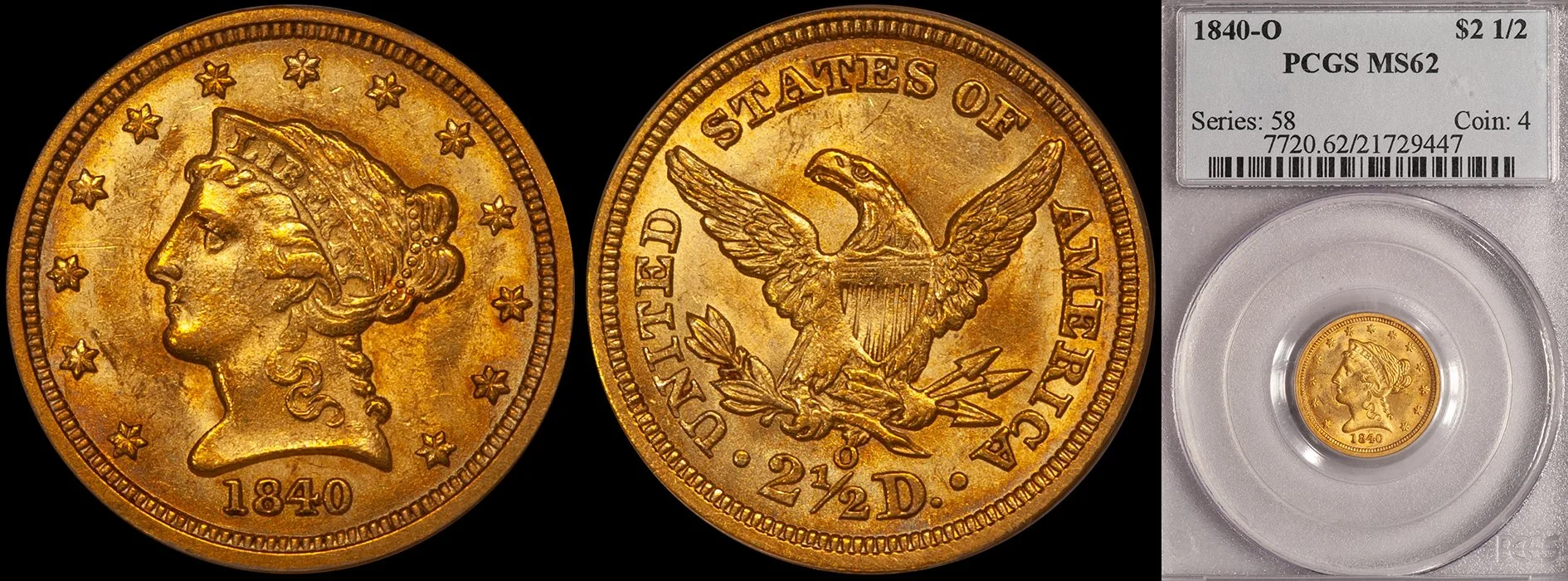
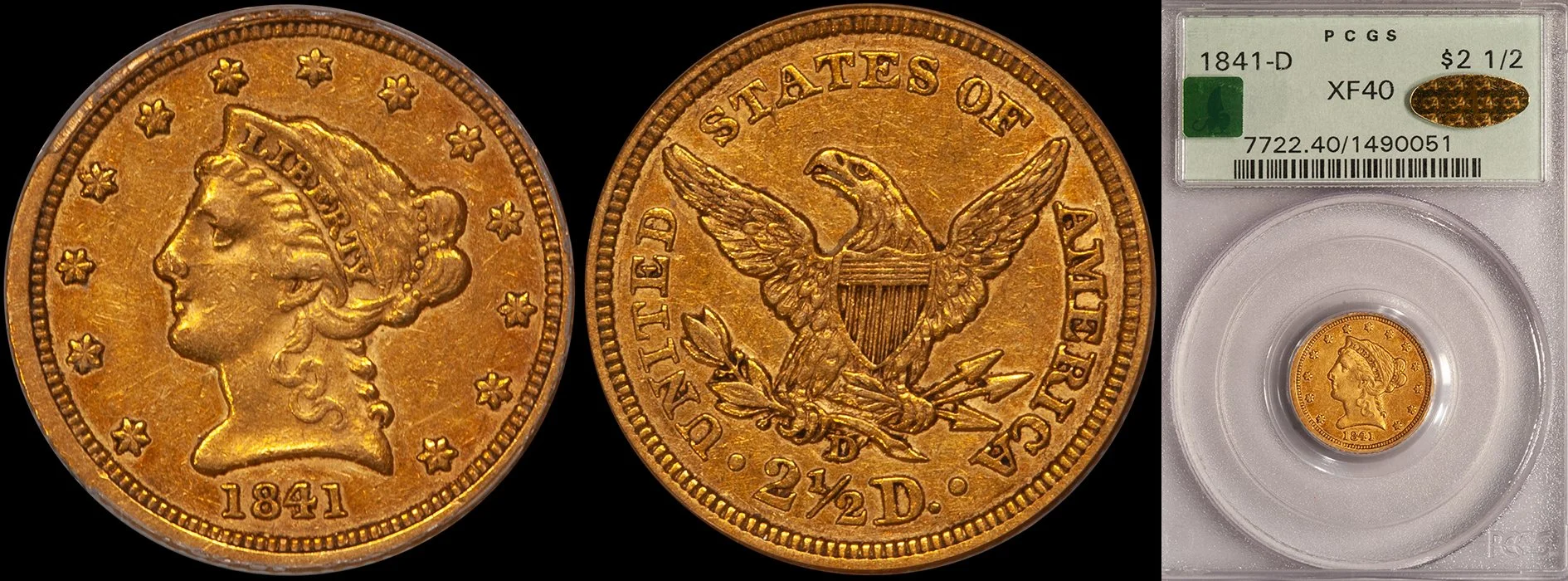
I listed an 1854-D quarter eagle in PCGS AU58 CAC on my website this past weekend. Within one day I had no less than six people inquire about it (all the more impressive when you consider I was asking $18,000 for it) and this got me to thinking about a hypothetical situation involving buying key date rare gold coins.

Let's say a collector had around $100,000 to spend over the course of a few years on Dahlonega quarter eagles. Would he be better off trying to assemble a complete (or near-complete) set in the EF grades or trying to spend all the money on as many nice 1854-D, 1855-D, and 1856-D quarter eagles as he could find?

I'm not certain that there is a "right" or a "wrong" answer for this. He could spend his $100,000 on processed, over-graded examples of these three dates and have a group of coins that, while rare, will prove hard to sell when the times comes to do so. In this case, I'd rather see the collector purchase thirty nice $3,000-3,500 coins.

But assuming our collector friend was patient, savvy, and well-connected and was able to acquire a few nice key dates would he have a "better" collection? I'm not certain that a small group of key dates actually constitutes a collection per se but as someone who buys a lot of Dahlonega quarter eagles, I'd personally be more interested in a small group of rarities than an assortment of more common examples.

Let's talk about "key" dates.

There are key dates that aren't especially popular (the 1842-C Small Date half eagle comes to mind) and there are key dates that seem fully priced at current levels (some would say the 1870-CC double eagles fits this category although I wouldn't necessarily agree with this). The three Dahlonega quarter eagles that I mentioned above fall into the category of key dates that are popular and priced at levels that make sense.

What makes one specific key date more desirable than another? In the area of rare date gold, I'd list a few specific factors.

The first is the overall collectibility of the series a coin is a key in. If a series is actively collected by date (say St. Gaudens double eagles) than a key date within that series is likely to be highly prized--and priced. If a key date is part of a series that is not terribly popular (say San Francisco quarter eagles) than a key issue might not be in strong demand.

Certain key issues aren't necessarily rare but they are in strong demand due to the nostalgia factor. When you were a kid, you were probably obsessed with the 1909-S VDB Cent, right? There was that gaping hole in your blue coin folder that you knew you'd never fill and that pesky S-VDB haunted your dreams for years...until you became successful and could afford a nice one. In its own little way, for a coin geek buying a nice 1909-S VDB Cent is like becoming the starting quarterback for your high school team or dating that hot girl from your 10th grade English class who'd never make eye contact with you.

For a more sophisticated coin collector, the concept of the key date has other ramifications. Is the coin rare in all grades? What is the "right" grade to buy the specific key date? Is the issue in question historically recognized as a key or is it an issue whose rarity is recently noted?

But I digress...

Getting back to our original hypothetical question, I think I would choose the key threesome Dahlonega quarter eagles if I were presented the question I asked earlier. I'm basing this decision on the fact that whenever I do list any of these three dates on my website they get multiple orders and seem to attract collectors who don't necessarily specialize in the series.

This last point is important. A key issue is iconic if it has multiple levels of support. A coin like a 1795 half eagle or a 1907 High Relief St. Gaudens double eagle isn't truly a "key" issue from the standpoint of true rarity but both are issues that are sought by collectors or investors who aren't specialists in early half eagles or Saints.

I haven't met many gold coin collectors who focus exclusively on key issues and after thinking about this, I'm sort of confused as to why more collectors don't do exactly this. How cool would it be to see a collection of Liberty Head half eagles that contained Condition census examples of the ten rarest issues or a Liberty Head eagle collection that focused on rarities such as the 1858, 1864-S, and 1875?

What are your thoughts on key dates? Please feel free to share them with me in the comment section below.

What's Hot and What's Not: Spring 2011

One of the more popular entries in the DWN Blogospehere is the "Hot/Not" feature. Its been a while since I've written one of these, and with groundbreaking ideas not exactly teeming in my little coin brain right now, it seems as good a time as any to analyze which coins are in demand right now and which aren't. WHAT'S HOT

1. Virtually any coin that is either finest known or which appears as such according to the PCGS/NGC population figures.

There have been some really incredible auction results (and private sales) in the last few months involving United States gold coins that were "population one with none better." Obviously, there has always been a great level of demand for coins like this. But in the past the "make your mouth drop" prices tended to be for very actively collected areas like Carson City gold or New Orleans double eagles.

A recent market trend is for even esoteric coins that are indisputably great to bring big bucks. An obvious example is the $103,500 1862-S eagle that I blogged about recently. This is a coin that as recently as two years ago (or less) would have probably flown under the radar. Today nothing is "too" esoteric; as long as it is a nice coin and it has that all-important "pop top" feature going for it.

Will this continue? I see no reason why not. There is clearly a very strong ultra high-end segment of the market right now; investors and collectors who are seeking the best of the best and will pay virtually whatever it takes. And here's the rationale behind this: a really great finest known United States gold coin from the mid-19th century is still buy-able, from time to time, in the $50,000-100,000 range. Compare this to prices on great American art (or other collectibles) from the same era. Coins at the upper end of the market still make lots of sense when viewed from this perspective.

2. Rare Proof Gold

Another area that I've written about recently is rare Proof gold. By this I am generally referring to pre-1890 issues with mintage of fifty or less; more often than not in the eagle and double eagle denominations.

This is an area that appeals to well-heeled collectors and investors who are typically relatively new to numismatics. These coins are indisputably rare, tend to be visually impressive and are large in size; three perfect factors in determining their increased level of demand.

A coin like an 1870 double eagle in Proof was never "not hot." The fact that coins like this have actually become available in the last six months to a year is a factor in their record-setting prices at auction. A coin can't be "hot" if it is never available and before this recent mini-spate of high-profile Proof gold it had been a considerable amount of time before such coins were available.

3. Interesting Early Gold

If you are a collector of early gold, you've probably noticed a real drought of interesting pieces available in the last year of so.

This scenario is even worse at coin shows. I typically buy four or five interesting early gold coins at a major show. So far this year I've been nearly shut-out in my early gold buying at shows; even at such large events as FUN and Central States. Most of what I do see is either the same group of over-graded retreads that remain in stale inventories or semi-generic issues (1813 half eagles, 1803 eagles, etc) that just don't appeal to me unless they are fresh and lovely.

What's with this lack of product? I think it has to do with a couple of factors. First is the strength of the hands that the good stuff rests in right now. A lot of strong buyers focused on early gold during the 2005-2010 era and they aren't selling right now. Second is the fact that nice quality early gold is tougher to find than most people realize. Now I'm talking about 1821 half eagles and 1798/7 eagles here; I'm talking about relatively common coins like 1805 quarter eagles or 1803/2 half eagles. Crusty, eye-appealing and affordable gold is hard to find in any market and especially so in this quality and rarity-oriented era in which we collect.

If a sale of early gold that contained a few dozen really fresh, really appealing early gold coins were to occur (the early gold equivalent of the Miller sale held by Heritage at this year's FUN convention) I think you'd see crazy, crazy prices.

4. Solid Value Collector Coins

It doesn't matter if were talking rare date San Francisco half eagles in Fine to Very Fine or New Orleans eagles in Extremely Fine or crusty Dahlonega quarter eagles. If the coin is a solid value, if its priced in the $1,500-5,000 range and if it has something "special" about it (great visual appeal, estimated population of under 100 pieces, low mintage, etc.) it is in very high demand right now.

You'll notice that most of my first three "hot" series dealt with expensive to very expensive coins. While it is true that the very high end of the market is good right now, the same can be said with the true collector end of the market.

People are little less scared to spend money now than they were two or three years ago. I'm noticing that collectors who might have sat on the sidelines in 2009 and even 2010 are now returning to the market. But these same collectors are more particular with what they are buying.

I'm noticing that it has become harder and harder to find attractive, interesting coins in this price range. And this is even with me broadening my horizons and dealing in areas that I shunned in the past (Philadelphia and San Francisco issues come to mind here).

I'm going to limit the "hot" areas to four but there are other coins that seem really strong right now. These include but are not limited to Dahlonega quarter eagles and half eagles, Type One double eagles, Carson City double eales, rare date Liberty Head eagles and Civil War era gold.

WHAT'S NOT HOT

1. Off Quality Better Date Saints

I've discussed in detail in previous blogs as to why the St. Gaudens double eagle market has floundered in the past. Its most definitely in a floundering mode right now and the coins that seems to be in the least demand are the semi-keys in off grades. Examples of such coins would be a 1924-D in MS63 or a 1925-S in MS62.

Why are these coins that nobody wants right now? There are a host of reasons. These All these better dates are available in higher grades and with the exceptions of true rarities like the 1921, collectors don't want to settle for grades. Saints in MS62 and MS63 grades typically are not attractive and many of these coins are rubby "sliders" that have low-end eye appeal. And the populations of these faux better dates are high in these grades. A mintmarked Saint from the 1920's might have a population of well over 100 coins in the MS62 to MS63 range with another 50+ higher yet still be priced in the $5,000-15,000 range.

Unless promoted, I don't see the market for these coins getting better anytime soon.

2. Commemorative Gold

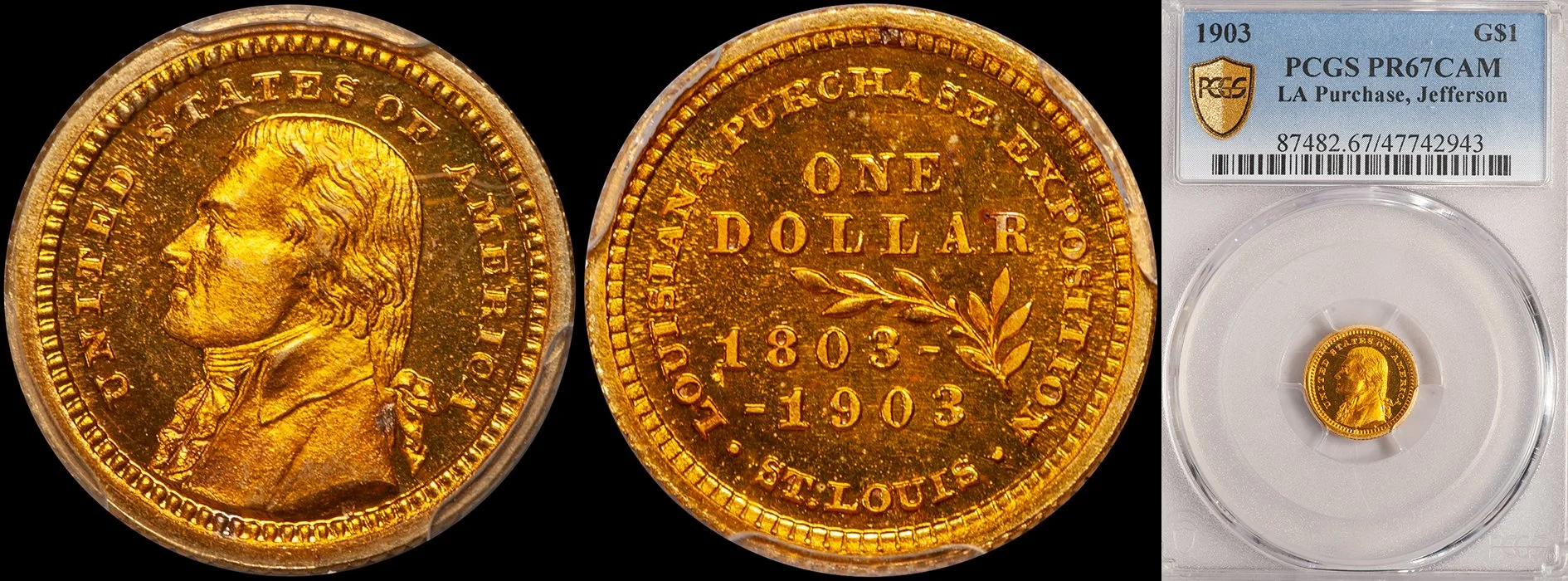
In nearly three decades of being a professional rare coin dealer, I can't recall having met anyone who actually collected gold commemoratives. I've looked at collections/holdings/portfolios that contained collections of gold commems but these were invariably sold as investments.

Every five years or so, someone promotes commemorative gold, makes a lot of money and escapes before the market deflates. I think its been at least five years since this area of the market has been promoted and I'd have to think these coins are overdue. That said, I personally hate them.

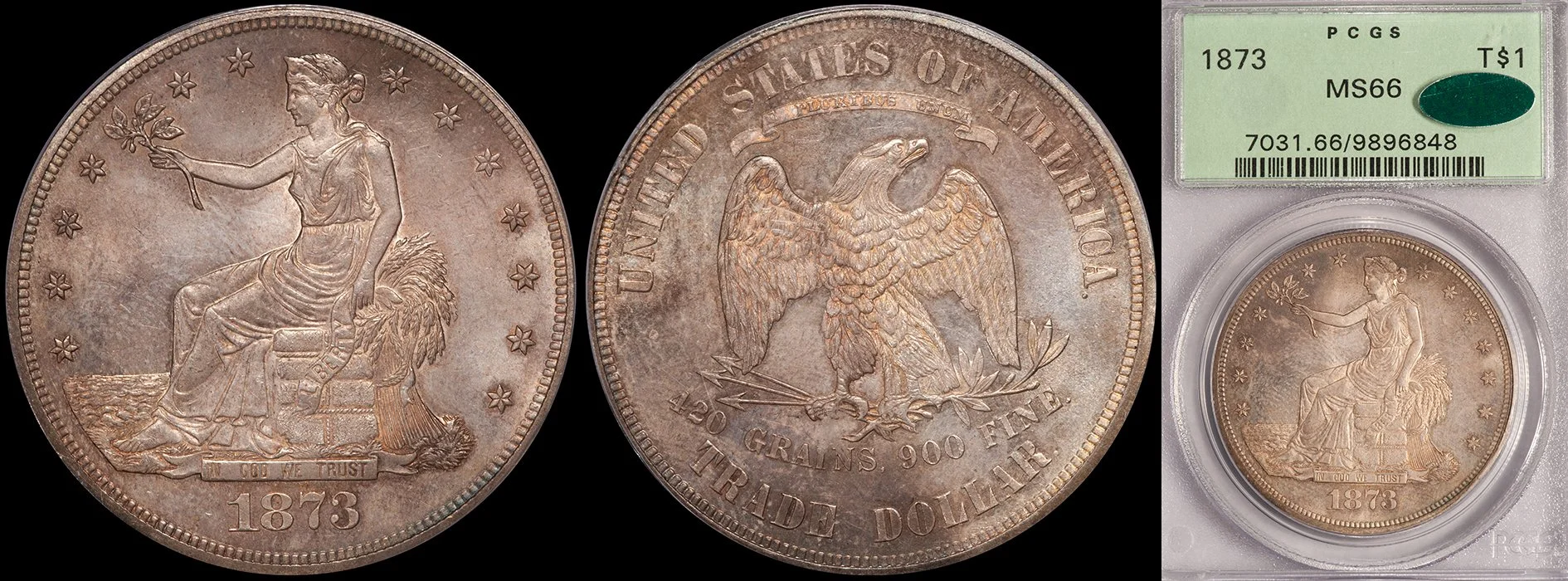
Why? Too small, too common, banal designs, no challenge for the collector; everything that as a numismatist I find boring in one small package. There are two notable exceptions: the Pan-Pac $50 Round and Octagonal issues. These seem as popular as ever and despite some drop in the price a few years ago I think these are a safe and solid "big ticket" item for the well-heeled investor.

3. Indian Head Quarter Eagles

As I've mentioned before, this series was "hot" for many years; mainly due to outstanding promotion(s) by a small group of marketers. For the most part, these firms have stopped selling Indian Head quarter eagles and there appears to be a glut of coins on the market.

Prices are down quite a bit in this series and I'm not sure if now might not be a good time for contrarians to take a position (at least a small one). If you could find real Gem common dates at current levels they seem like a fair value. The same might even hold true for the better dates (especially the 1914 and 1914-D) if you can find Gems with CAC stickers and great eye appeal.

The key 1911-D has taken quite a beating price-wise and bid has dropped down to $54,000. I'm guessing that a CAC-approved Gem would bring a lot more than this if one were available. I've mentioned before that I find this to be one of the most overpriced American coins of any date/size/shape but....

4. Off Quality Material

Looking through many cases and boxes at coin shows, I'm amazed at the large number of really awful coins that are still around. I almost never price this sludge but sometimes, just for grins, I'll pull out an especially nasty coin and ask for a price; just for educational purposes, of course. Sometimes, the answer sounds almost desperate: "I dunno; what will you pay?"

Since the advent of CAC and with the scrutiny given coin doctoring by the grading services, perceived quality has become fashionable among collectors. (Note that I say "perceived" since I think many collectors who think they are buying quality coins do not really know what a quality coin is). This has increased the demand for "A" quality coins and "B" quality to an extent while making "C" quality very illiquid; especially in the $5,000 and up category.

I see no change in this. Collectors will continue to seek nice (or at least nicer coins) and this will increase the spread between these and blatantly unoriginal, low end pieces.

Other areas in the market that seem "not hot" to me but which didn't make the List of Shame include PR70/MS70 moderns, generics, MS64 and MS65 Indian Head half eagles, many Indian Head eagles and faux-scarce date Type Three Liberty Head double eagles.