1813 Half Eagle PCGS MS63
/Choice, original early gold is a specialty of DWN. This 1813 half eagle is a magnificent, high end example with great color and luster.
Learn about buying, selling and collecting rare U.S. gold coins with Douglas Winter Numismatics and read related articles on this blog.
Choice, original early gold is a specialty of DWN. This 1813 half eagle is a magnificent, high end example with great color and luster.
A good client of mine recently asked me the question “are early gold coins overpriced?” As with most intelligent questions, I don’t think that this one has a pat answer. My feeling is that some early gold coins are poor value at current levels while others are good to very good values. Read on for my take on the current early gold market and my suggestions of where the best values are. Appearance and eye appeal are, obviously, critical factors in determining the desirability of any coin. In the area of early gold, I think these factors are especially important. The reasons are fairly obvious: these are hand-made coins that vary in quality literally from year to year, many survivors have been cleaned, abused or damaged and the third-party services tend to be inconsistent (to say the least) when it comes to grading early gold.
A fairly general statement that I think can be made about the early gold market is that only a small handful of the coins that exist have good eye appeal and a pleasing overall appearance. I personally feel that virtually every early gold coin that is choice and original remains a good value while most every good early gold coin that is low end for the grade and unoriginal is poor value. But this observation is fairly simplistic and needs to be expanded.
As with most markets, early gold issues can generally be divided into three categories: common or “generic” dates, better dates and rarities. And in the case of early gold we might even be able to create a fourth category: the “super-rarity.” How are each of these categories doing?
Even if you know very little about early gold, you might guess that the area most prone to showing weakness in a downward market turn would be the common dates. An example of what I would term a “generic” early gold coin would be an 1806 Round 6 Half Eagle. There are as many as 1,000 examples known of this issue and it is fairly readily available in grades up to and including MS63 to MS64.
If you go to a major national coin show you are likely to see a decent number of 1806 Round 6 half eagles. These would generally be available in the AU55 to MS62 grade range. (Lower grade 1806 Round 6 half eagles are difficult to find because the nice, affordable examples tend to be closely held by collectors; the very high end MS63 to MS64 tend to either show up at auction or they are placed in tightly-held, high end collections and do not trade with frequency). The examples available for sale tend to be low end and unattractive. At current price levels, I think they are not especially good values. Why is this?
As recently as five to six years ago you could buy a nice, fresh AU 1806 Round 6 half eagle for $5,500-6,000. At this affordable level, this coin was a good value, despite the fact that it wasn’t really “rare” in the sense of most early gold. Today, a similarly graded coin will cost you at least twice this amount. The problem is that these coins now tend to not be nice for the grade and the new price range of $11,000-13,000 no longer qualifies as “affordable.” Are coins such as this overpriced? If they are typical low to middle quality coins, the answer is a fairly resounding yes. If they are accurately graded and solid, choice pieces I would say that they are really overpriced but that they are relatively marginal values at these levels.
An example of an early gold coin that I regard as a “better date” would be a 1799 half eagle. This issue is not truly rare but it is available with far less frequency that an 1806 Round 6 half eagle. I think the market for an issue like this has held up rather well; even if a 1799 half eagle in, say AU55 is currently valued at least twice as highly as it was five or so years ago. Collectors still expect an AU55 example of this date to have good eye appeal and ugly examples are harder to sell than they might have been a year ago but I think this area of the market is solid. Are coins like this overpriced? I would say, pretty resoundingly, in fact, that they are not; especially in the solid collector grades of EF40 to AU55.
A “rare date” early gold coin would be, as an example, an 1826 half eagle. This popular Fat Head issue has a surviving population of maybe three dozen and it tends to be offered for sale at the rate of one or two coins per year. This is another issue that has seen significant price increases in the last five years but the fact is that the supply of 1826 half eagles in virtually all grades is nowhere near the (current) demand. Yes, coins like the 1826 half eagle are currently expensive. But given their unquestionable rarity I would have to say that coins like this remain fairly priced.
And what about our fourth and final category—the so-called “super-rarity?” An example of this would be an 1815 half eagle; an issue that is extremely rare in all grades and which typically appears for sale at the rate of approximately once per three to five years. My gut feeling is that these major rarities, in all the various early gold series, are still reasonably priced. There is an 1815 half eagle coming up for sale in the 2009 FUN auction (graded MS64 by NGC and pedigreed to the Garrett collection) that is almost certain to shatter all price records for this date and which could be one of the highlights of the 2009 Numismatic Year.
What about issues like the 1796 No Stars quarter eagle or the 1808 quarter eagles; coins that aren’t “rarities” in the classic sense of the word but which are exceptionally popular and numismatically significant? I think, in theory, that these are overpriced given their big-picture rarity. Given their strong level of demand I would still buy them for inventory. However (and this is a BIG however) I think the market has become far more selective on coins like this. If they are not CAC-quality, they have become hard to sell unless discounted in price. And this scenario is likely to continue as long as decent 1796 quarter eagles command prices in excess of $125,000-150,000+.
After a probable absence of over a century, perhaps the most important New Orleans gold coin in existence is coming back to its ancestral home. My friend Paul Hollis, a coin dealer from Metairie (a suburb of New Orleans), has arranged for the unique Proof 1844-O eagle to be placed on exhibit at the New Orleans mint. This coin, with an estimated value of $2.5 million, goes on public display November 1 and will also be taken around Louisiana on tour by Hollis.

The New Orleans Mint began producing coins in 1838. The very first issue struck by this mint was a group of 20 half dollars to inaugurate coinage and a small group of Proof half dollars were made in 1839 (plus at least one Dime dated 1839-O is known that has been designated a “Specimen” by NGC). So, we know that the New Orleans mint had experience with making Proof coins and that the quality of these was comparable to that seen at the Philadelphia mint.
In 1844, the New Orleans mint produced at least one example of a Proof half eagle and eagle. Remarkably, both still exist and, even more remarkably, both are superbly preserved. Why were they produced and who were they struck for?
Unfortunately, contemporary documentation does not exist that gives the definitive answer to these questions, so we have to make some assumptions. I think it’s safe to say that the Proof 1844-O gold set was struck in commemoration of either a special event or, more likely, a visit to the Mint by some special VIP or dignitary. My guess would be that they were made for personal presentation to President John Tyler.
What is interesting about these 1844-O Proofs is that there were no other Proof gold issues produced at the branch mints until 1854 when San Francisco struck a double eagle in this format. But in the case of the 1854-S double eagle, the reason for producing the coin is obvious as it was made to commemorate the opening of the new mint. One would think that if New Orleans were to have made gold Proofs, they would have struck a small number of Proof quarter eagles in 1839 or half eagles in 1840. But if these were ever made, they have disappeared without a trace.
The earliest numismatic reference to the 1844-O Proofs appears to be in the Seavey descriptive catalog that was published in 1873. In 1890 when they were sold as part of the famous Parmelee collection the eagle sold (as Lot 1151) for the princely sum of $16 while its companion half eagle brought just $9.50. It was next seen in the collection of William Woodin who was famous both as a coin collector and as Secretary of the Treasury for Franklin D. Roosevelt in 1933.
Woodin sold his primary collection at auction in 1911 but I am not aware if the Proof 1844-O set was included in either of his two sales (it would be easy to check these in the sale catalogs but my library does not contain them). It is documented that Woodin also sold many of his coins privately to the leading collectors and dealers of the day. I do not know this with certainty but I surmise that the 1844-O Proofs went into the Brand collection.
From here on, the pedigree chain for the 1844-O half eagle and eagle gets murky. In fact, I think it is possible that the coins were split up when the Brand collection was being sold in the 1920’s and 1930’s.
The half eagle was in all likelihood sold to Waldo Newcomer and then likely went into the Colonel Green collection. From there it is believed to have been sold to King Farouk and remained in this collection until it was forcibly sold at auction in 1954. It was later sold to a prominent Texas collector (not Harry Bass, by the way...) by Abe Kosoff in 1959. I was shown the Proof half eagle in the early 1990’s by the Texas dealer Michael Brownlee. It was still in the original flip with Kosoff’s writing on it. I used it as the cover coin of the first edition of my New Orleans book. The coin is a superb Gem.
Brownlee told me soon after showing me the Proof 1844-O half eagle that he believed the Proof eagle existed but he didn’t know where it was. In fact, he claimed, he had been searching for it for many years as he desperately wanted to reunite the two coins in the prominent Texas collection (which he had built and was, rightfully, very proud of).
If Newcomer did, in fact, buy both the half eagle and eagle, it is not likely that Col. Green would have purchased the eagle as he was not specializing in this denomination. What would be interesting to learn was, if the coins were indeed split up, in which collections did it reside between the 1920’s and the 1990’s.
Did Brownlee know where this coin was all along? I have my theories but won’t expound on them here. I will say, however, that his search for the elusive Proof 1844-O eagle was rewarded when, in the late 1990’s, he announced that the coin was “rediscovered.” It was sent to NGC where it was ultimately graded PR66 Cameo. Then, it was offered for sale by dealer Robert Leece at various price levels for a number of years.
Finally, the coin was sold to a Florida collector in 2006 by Louisiana dealer Chuck Bloomfield. The price was reported to be $1.5 million.
I have had a chance to examine the Proof 1844-O eagle and it is a simply amazing coin. It is 100% unquestionably a Proof with incredible cameo contrast and a deep “black and white” appearance that one wouldn’t expect to see on a Proof gold coin from this era, let alone one from New Orleans.
If you are going to be in the New Orleans area in the coming months, I urge you to take a look at this great coin and to visit the New Orleans mint.
If you are like most people, the last few months have been tough on your pocketbook let alone your psyche. We are, at least for the immediate future, in tough economic times. For some people, there are difficult decisions that have to be made: which bills get taken care of, can the mortgage be paid, do we eat dinner or fill the tank with gas. Fortunately most coin collectors are faced with decisions that are much less dramatic. When people are feeling wealthy, spending discretionary income on something like coins is a no-brainer. You see something you like and you buy it. In a Recession, such purchases become far less impulsive. But I don’t think the coin market is going to come to a screaming halt. Prices may come down (in some cases they may actually raise) but I sense that there will be activity. Simply put, there are just too many people who enjoy numismatics and there is just too much money (in the United States and world-wide) for established hobbies like numismatics to crash. And, if we enter an inflationary period as many experts believe, there could easily be a rush into tangible assets.
That said, I think people’s buying habits will change quite a bit in the next few years. The Irrational Exuberance we saw in the middle part of the decade could be over forever. As someone who has survived a number of lean Numismatic Cycles, I’d like to share some observations on how you can still add coins to your collection, even in tough times.
1. Buy Smart. I can’t begin to tell you the number of purchases I saw in the last few years that were just plain dumb. Collectors battling to the death at auction over coins that weren’t really that nice or rare. Dealers falling all over themselves to buy old holder coins in one grade and paying a price that assured them they would possibly break even if the coin upgraded three points...sheesh!
Being a smart coin buyer means being informed, confident and well-connected. In my opinion, this means taking the time to carefully research the coins that you are contemplating buying, fully understanding the buying and selling process(es) and having a good relationship with a small group of dealers.
I am a huge believer in first impressions being correct. In numismatics, this means having a good feeling about a coin’s appearance, a coin’s price and the person who is selling it. If you have to convince yourself that you like a coin, don’t buy it. If you have to make irrational justifications about a coin’s price, pass. If the person who is selling the coin makes your skin crawl, have a trusted dealer make the transaction for you—or shop somewhere else.
2. Look for Value. I think value is going to be a real buzzword in the coming coin market. You the collector are going to be bombarded with this word but do you really understand it? And, if so, how does it apply to what you collect?
Here’s an example of how I form opinions in regard to value. I have spent quite a bit of time in the last few days doing pricing for the 2010 edition of the Redbook. As I was going through the various sections, one thing that really grabbed my attention was the pricing structure of Extremely Fine Charlotte and Dahlonega half eagles. As an example, virtually every C+D half eagle in EF40 is priced at basically the same amount. Sure, there are a few exceptions but we are talking about issues with a wide range of rarity and availability being priced exactly the same. For instance, the 2010 Redbook prices for an 1854-C and an 1858-C half eagle in EF40 are both $2,500. That’s great except for the fact that the 1854-C is a considerably scarcer coin in this grade (and in all grades higher than EF as well). As a value conscious buyer, I’m going to be looking for the 1854-C half eagles of the numismatic world.
When money is tight and you don’t have as much to spend on your hobby as in the past, make your purchases as value-conscious as possible.
3. Think Long Term. There are many collectors who have never known a slow coin market and they’ve been spoiled. In the past few years, they’ve been able to bail themselves out of trouble when they’ve bought “bad” coins by throwing them into auctions and letting the next buyer come along. In some cases, they’ve been able to turn handsome profits on coins that they had no business buying, let alone selling, for a profit. In a slow market, these “unburials” are going to happen with less and less frequency.
There’s a pretty basic solution to this problem. Buy the “right” coins and buy for the long term. You don’t have to become a numismatic “black hole” who never sells any coins (in fact, I urge you to sell from time to time so that you better understand how this part of the market works). But buy every coin as if you were going to hold it for a reasonably long period of time.
4. Eye Appeal, Eye Appeal, Eye Appeal. If the coin market were to tank in the next few years, the coins that are going to maintain their value better than anything else are the ones that are aesthetically appealing. This is particularly true if you collect a series in which the coins aren’t really rare from the standpoint of total number known. Let’s say you collect Proof Seated Liberty Quarters. If you have a set of coins that are all bright white and which show average quality contrast, the chances are good that these coins will devolve into semi-widget status (unless they are in very high grades). The same set with all beautifully toned original coins or with a mix of toned coins and superb black and white cameo pieces is probably likely to retain more of its value and interest levels even in a poor market.
Coins do not have to be expensive to be pretty. And they don’t have to be in ultra high grades to be considered great eye appeal pieces either. Savvy, sophisticated buyers are often more content to purchase a nice EF45 example of a rare date than a marginal quality AU55. The only time you should allow yourself to buy a coin with marginal eye appeal is if essentially every known example of the type or issue is crudely made. But even in the case of an issue like this (an example would be the 1856-D quarter eagle) there are still pieces that despite a crude or “ungainly” appearance have a certain charm to them that make them clearly desirable.
5. Be Patient. I’m a strong believer of being patient even in a bull market. In a slower market, patience is, I believe, imperative. Back in the day, collectors looked at their collections as long-term endeavors. The collector who was assembling a set of Carson City gold looked at his challenge as something that would take many years, not just a few months. I blame the short attention spans of many new collectors on the internet mentality that says “I want it, I must have it NOW!!” Sure, it is possible to complete a set of Carson City gold in a few months. But the collector who rushes his way through a set is certain to make some potentially big mistakes and he is missing out on the fun of the big, long-term picture.
One thing I’ve learned over the years is that many so-called “rare” coins are not rare at all. Unless you collect a series that is replete with truly rare coins (Liberty Head eagles would be an example of a series that contains dates that ARE truly rare, in my opinion) don’t sweat it if you missed out on a certain coin on a dealer’s website or at auction. You’ll probably find another one in a few months.
6. Buy Special Coins. Whether you collect Roosevelt Dimes or Proof Liberty Head double eagles there are clearly coins which exist that are “special.” In other words, there is something about them that make the viewer stop and look twice. As an example, when I view lots at an auction, I tend to plow through the coins and after a while they literally all begin to look the same. But then some lot will pop up that make me stop, take a deep breath and exclaim, “man, is that cool/pretty/neat.”
For the Roosevelt Dime collector, this “special coin” might be a piece with monster toning or one that is fully prooflike and very unusual as such. For the Proof Liberty Head double eagle collector, his special coin might be a piece with a Bass, Eliasberg or Norweb pedigree or one with splendid natural hazy orange-gold color.
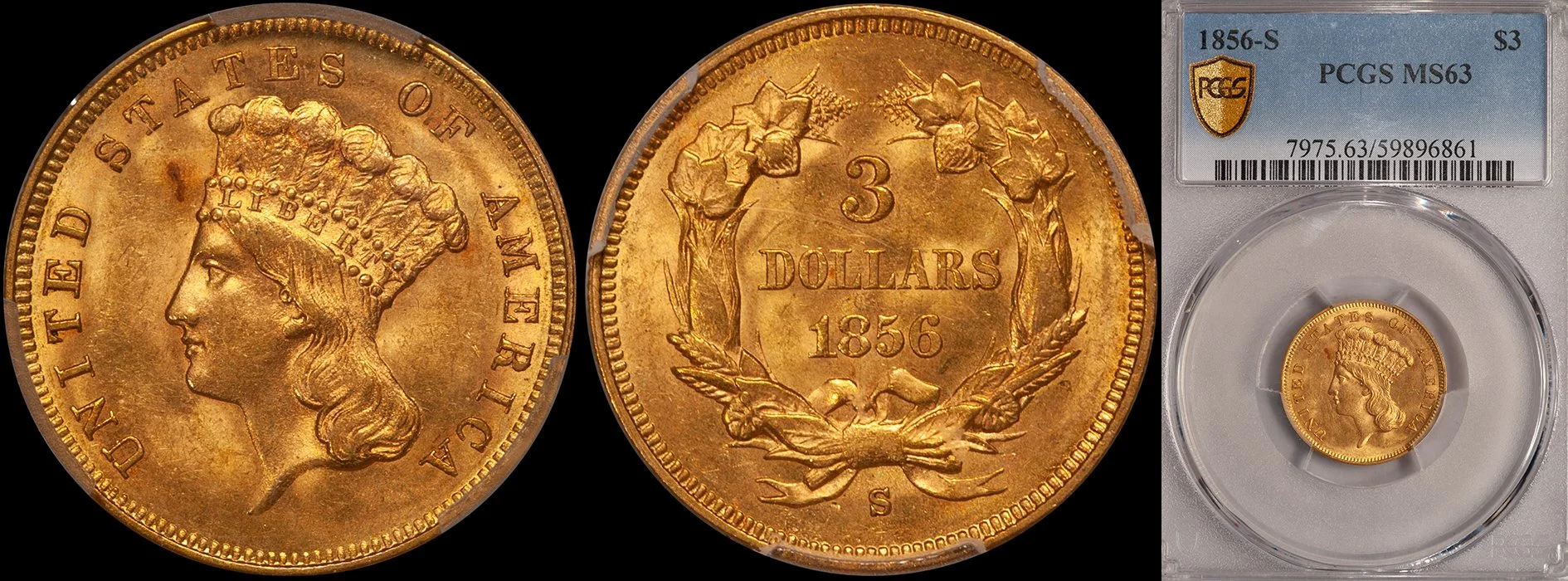
Special coins can also be pieces that have a great story to tell. I have always liked coins that are one-year types or first-year-of-issue pieces because they can be appreciated by someone who knows nothing about the specific series. Even if you could care less about Dahlonega gold or three dollar gold pieces, the chances are good that you’ll still think an 1854-D three dollar is a pretty interesting coin.
One last thought. In tough economic times, the natural instinct for many people is to panic. Your sense of fear may be played on by some of the numismatic newsletters or ads that you read. Don’t buy into this shameless marketing. If you like collecting coins and you can afford to keep buying them, do so. If you think the world’s economy is going to hell in a hand basket, putting 10% or so of your net worth into a nice coin collection probably isn’t the worst thing you can do. Coin collecting is a great hobby and I hope that you’ll call on me to help you with your purchases whether the Dow is 12,000 or 3,000.
 The first edition of "Gold Coins of the Charlotte Mint, 1838-1861" was printed in 1987 while the second edition was released in 1997. In 2008, Doug Winter produced the third edition of his groundbreaking work on Charlotte gold coins. The most recent version is notable for its extensive use of color photographs, totally revised information on rarity and Condition Census, new listings of finest known and significant pieces and advice on how to collect these fascinating coins. Of special interest is completely updated die variety listings, including close-up photos that make attribution easy even for the beginner. All collectors of gold coins will welcome the addition of this superb new reference into their libraries.
I’m going to turn this blog over to Mary Winter. For those of you who are not aware of this, my wife is the numismatic imager, par excellence, whose coin photos are part of what makes raregoldcoins.com, in my opinion, a very special numismatic experience. Mary recently had a training session with Mark Goodman whose coin photography skills are quickly becoming legendary with collectors all across the US of A. Take it away, Mary...
I have a confession to make. All I know about coin imaging I learned from Mark Goodman. No, let me rephrase. All I know about GREAT coin imaging I learned from Mark. I have been DWN’s coin photographer since raregoldcoins.com became a website in the mid-1990’s. I was initially self-taught…and it showed.
Anyone who has ever tried on their own to take a photo of a slabbed coin knows how hard it can be to have an image turn out decent, let alone good. After years of trying everything I could think of, the Numismatic Gods (NG’s) smiled on me and quite serendipitously, one of Doug’s customers mentioned a man he knew who was an excellent coin photographer. Desperate and intrigued, I got the contact information on this person and emailed him straightaway.
As I recall, I initially just asked him questions by email. It became quickly apparent that he knew his stuff – and was self-taught to boot….gulp. But I swallowed my pride and continued to ask questions. I found he was not only extremely talented, but willing to share his expertise.
Once DWN relocated to Oregon in 2006, the NG’s smiled once again as Mark Goodman is also located in Oregon, within traveling distance of our office. I asked him if he would ever consider training me in person – and he agreed. That was perhaps 1.5 to 2 years ago. After my initial training, I saw quite a difference in my photography. But there was more to learn…
This year Mark wrote a book, “Numismatic Photography” (available for sale at www.zyruspress.com) which is a must-have for anyone wanting to improve their coin imaging skills. Doug “suggested” I study it…ALOT. I was blown away at the amount of research Mark had put into the book, as well as its ease of use for the layman. And his color photographs tell it all. I was once again humbled and knew I needed more help.
Hat in hand I contacted Mark again. He was as gracious as before and willing to help me again. I sent him a request for further training and he agreed. This session went levels beyond where I was before and I hope my photography from here on out will do him justice.
As I said, and can’t say enough, thank you Mark Goodman – everything I know about great coin imaging has come from you!

Before Goodman.....D'oh!

After Goodman.....Aaahh!
To paraphrase that esteemed numismatist Mark Twain, the reports of the death of the coin market seem greatly exaggerated. That is, at least, if you take a look at the prices that Heritage got for a nearly complete set of Liberty Head double eagles that was sold at their Dallas auction on October 24. As anyone who even remotely follows the dated gold market knows, Liberty Head double eagles have been one of the most solid performers in the coin market during the bull market run-up of the past few years. This market has proven to have more depth than I would have ever imagined and there are, clearly, more advanced collectors assembling comprehensive specialized sets of these coins than in probably any other area of the 19th century gold market.
The question I was asking myself a few days ago, though, was: would these collectors still play in this market after the Economic Malaise of the past month? The Type One, Type Two and Type Three sets are full of many big, macho “stoppers” and I was very interested to see how these coins would do.
The two key collectible Type One double eagles are the 1854-O and the 1856-O. These have appreciated in value more than virtually any other United States gold coin in the last five to seven years and, certainly, the New Market wouldn’t be able to continue its frantic pace when it came to these two issues, would it? The 1854-O in the sale was a PCGS AU55 and it sold for $603,750 which is an all-time auction record for the date. The 1856-O was graded AU58 by NGC. I thought it was comparable in quality and appearance to the PCGS AU55 example that I had sold earlier this year and the Heritage coin brought $576,150 which is the second highest price ever at auction for this rarity.
The second-tier New Orleans Type One issues were extremely strong as well. An 1859-O in PCGS AU58 brought $97,750 which is a record price at auction while the 1860-O in PCGS AU58 sold for an identical price and, again, set what I believe to be a record at auction. One coin that I thought would be a real litmus test for the O mint double eagle market was the 1861-O in NGC AU55. This is a date that seems to have really come out of the woodwork in recent years and Heritage had sold a comparable coin in their January 2008 sale for $46,000. The one in the Dallas sale was bid all the way up to $57,500; a price that I thought was pretty remarkable.
My single favorite Type One double eagle in the sale was a PCGS MS65 1854-S. As I have written in the past, this date is very rare and much undervalued in Gem and the example in the Baltimore Collection was one of the two best I had ever personally seen. This was a coin that I felt certain I would buy, and I was willing to stretch quite a bit in order to procure it. I stretched and stretched and still came up short as it sold for a staggering $115,000.
Even the boring dates in the Type One series did quite well and most of the lots sold for levels exceeding what I would regard as “retail” numbers for these dates.
The Type Two double eagles in this collection were relatively uninspiring as it appeared that the Baltimore collector focused most of his energies on the Type One and Three issues. A not especially nice 1870-CC in VF30 with a large natural planchet flaw on the reverse sold for $230,000. I think this is a pretty reasonable amount for this in-demand rarity but I think it was more a reflection of the coin’s lack of eye appeal than it was a softening of the market. Many of the other scarce Carson City issues in the sale did well, including an 1871-CC in NGC that was bid to $66,125, an 1872-CC in PCGS AU58 that brought $23,000, an 1878-CC in PCGS AU58 that hit the $25,300 mark and an 1879-CC in NGC AU58 that brought $21,850. My take on these prices is that they were pretty much exactly what I would have expected these coins to sell for before the economy went south and that I would have expected them to sell for 10-20% less in these Troubled Times.
The Type Three rarities in the Baltimore Collection were impressive but I was unsure if the market for these issues would remain as strong as it had been. The first test was the 1879-O in PCGS AU58. I expected it to bring in the $50,000-55,000 range but it raced up to $74,750. The very rare 1881 was a PCGS MS61 that I did not like as a result of its funky color and surfaces but it brought $138,000 which is exactly the same price it sold for when offered as Heritage 1/07: 3203. An 1882 that was graded AU58 by ICG but which appeared to have a problem on the cheek of Liberty that was not mentioned by the grading service still managed to garner a bid of $63,250.
For many years, the 1885 was the most affordable of the very rare Type Three dates. The NGC AU58 in the Heritage sale brought $48,875 which I am reasonably sure is an all-time record price for a circulated example of this date. The 1886 in PCGS AU55 sold for $86,262.65. This exact coin had brought $24,150 when it was offered as Lot 7437 in the Heritage 2004 FUN sale. The previously-overlooked 1891 appears to have captured the attention of most specialists in this area and the PCGS AU58 in the Heritage sale realized $48,875.
There are three very rare Proof-only dates in this series and the Baltimore Collection was missing the very rare 1883. It did, however, have an 1884 graded PR64 by PCGS. This coin had sold for $126,500 when it was last offered as Heritage 6/04: 6376. Four years later, it was bid up to $207,000 which I thought was an exceptionally strong price. The 1887 was a PCGS PR64 Deep Cameo and it sold for $155,250. This is almost the same amount as the far superior Heritage 1/07: 3145 (graded PR65 Deep Cameo) realized a year and a half ago.
All in all, I would say that prices were anywhere from 10-30% higher than I would have expected. I was really surprised at the prices that the dozen top coins in the collection brought, given that the economic climate doesn’t dictate large purchases right now and given that Heritage conducted this sale without the benefit of a concurrent convention to attract much floor action.
I recently returned from the St. Louis Silver Dollar coin show and the Scotsman auction, which was held in conjunction with the show on October 17th. I wasn’t originally going to attend this event as I’m not a big fan of St. Louis and wasn’t really anxious to travel right now. But the combination of a collection of superbly pedigreed gold coins (see below) and a desire to get a handle on this confusing coin market inspired me to make last second plans to go to the City with the Large Arch. First, let’s talk briefly about the show. The facility, in suburban St. Charles, is as nice as you are going to find for a medium-sized regional convention. The attendance, from a dealer perspective, was decent with many national firms manning tables. The public attendance was another story with a very small number of collectors in evidence.
My take on the activity at the show was that wholesale transactions were better than what I might have expected. There certainly weren’t a lot of five figure coins trading but I did see some good sized invoices being written. Yes, a lot of the coins that were selling were generics or bullion-related. But the market for reasonably interesting coins in the $1,000-10,000 price bracket doesn’t seem to be as adversely affected by the current economic slowdown as I might have expected.
The main reason I went to St. Louis was to attend the Scotsman auction. The lead consignment in this sale featured an intriguing group of 81 U.S. gold coins that had last appeared in the Eliasberg sale. For those of you that are not familiar with this collection, here’s a brief recap.
Louis Eliasberg was a Baltimore banker who, in the 1940’s and 1950’s, formed the greatest collection of United States coins ever assembled. The base of the collection was obtained from the Clapp family in 1942 and Eliasberg upgraded and filled-in holes for the next decade and a half. The U.S. gold coins from this collection were sold at auction by Bowers and Ruddy in October, 1982. That sale set countless records and is regarded as one of the most important auctions in the history of the American coin market.
I really had no idea which coins from the Eliasberg sale were going to be in the Scotsman auction until I arrived and, to be honest, the selection was a bit on the disappointing side. Around half of the coins were what I would basically describe as semi-numismatic (coins like an 1886-S eagle in NGC AU58) or off quality (an 1850-O quarter eagle that had been harshly cleaned). Clearly, the person who bought these coins from the Eliasberg Sale in 1982 was no connoisseur but he had still managed to acquire a few great pieces.
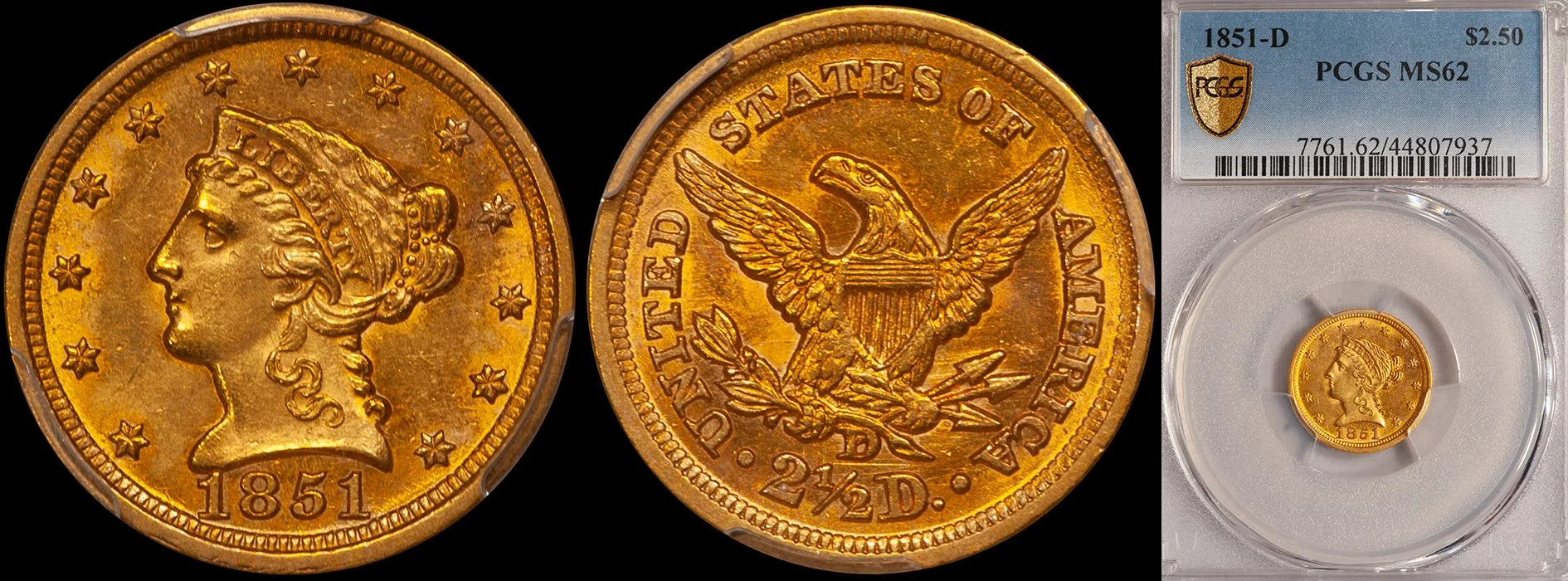
There were four great coins in the Eliasberg Redux sale. The first was an 1862 Gold Dollar graded PR67* Ultra Cameo by NGC. In 1982, it had been graded PR67 and it sold for $8,800. Twenty-six years later it sold for a healthy $48,875. The second great coin was an 1851 quarter eagle graded MS67* by NGC. In the 1982 Eliasberg Sale it was graded MS67 and it sold for a then-strong $7,425. In the Scotsman auction, it brought $28,750. The highlight of the consignment was an NGC PR66 1880 Flowing Hair Stella. In the 1982 Eliasberg Sale it had been graded PR67 and brought just $55,000. It sold for $494,500 in the 2008 auction which, I would assume, is a record price for any coin in a Scotsman sale. The last of the Big Four was an NGC MS65 1930-S $20 that had only been graded MS60 in the original Eliasberg sale. It brought $18,700 back in 1982 and it brought $195,500 in 2008.
But what about the lower priced coins in the sale—how did they do? I figured that there would be a considerable amount of interest and I was personally willing to pay a 15-25% premium for the coins that I liked on account of the fantastic pedigree. For the most part, my levels came up short. I did buy around a half dozen coins and was underbidder on another ten or so but on many ho-hum lots my bids were far too low.
I came away from this sale with a couple of Deep Thoughts. The first is that collectors DO care about pedigrees and there is still no pedigree that is more magic for gold collectors than that of Louis Eliasberg. There were dozens of collectors in the audience at the sale and bidding online who were willing to, say, pay $1,500 for a coin that was probably only “worth” $1,000 to $1,200. And I can absolutely see their point. As a collector myself, I find pedigree to be extremely important and a coin that combines good eye appeal and rarity (or at least scarcity) with an interesting provenance is pretty irrestible to me.
The second is that I was really impressed with the way Scotsman conducted the auction. I have never participated in one of their sales and I found them to be gracious, easy going and honest. In fact, I can think of a few older, more established auction firms that could learn something from the way that Scotsman promoted the sale, produced the catalog and made it a pleasure to do business with them.
If the Financial Crisis has proven anything, it’s that people seemed to have forgotten that stocks are volatile and that investing in the markets entails a degree of risk. Enough risk that you have to question the sagacity of middle-class people having the majority of their retirement funds tied-up in something as speculative as stocks. Through all of this chaos, tangible assets such as precious metals and rare coins appear to have held up pretty well. As I mentioned in my last blog, the demand for bullion-related coins such as Liberty Head double eagles and Saints has been nothing short of incredible and after a few very slow weeks, I’ve noted on a personal level that collector coins are beginning to sell again; albeit on a scale that is certainly reduced from what I was seeing a couple of months ago.
One comment I’ve heard from a number of clients in the last few weeks is that they are looking at their collections from a much different perspective now than prior to 9/15. Before the stock market imploded, many high net worth individuals viewed their coins as a minor part of their overall portfolio and thought of numismatics as a sort of a plaything. Now, after these individuals have lost 20%, 30% or even more of their net worth, their coin collections are suddenly a much more significant portion of their assets. And I believe that this will cause them to regard coins in a more serious light than in the past.
As someone who has lived through any number of bad coin markets, this one feels like it may be different. I can recall markets where you literally could not get other dealers to look at your coins and you could literally beg clients to buy something because it “was such an incredible deal” and they would pass. At this point in time, dealers are still buying coins and serious collectors seem to still want to make purchases; just maybe not at the level they might have been before.
It’s going to be really interesting to see what the new levels on rare coins are going to be in the coming months. There is no doubt in my mind that certain coins are worth 10-30% less today than they were a few weeks ago. The question is, of course, which ones are and which ones aren’t. I’m not sure that even the most sophisticated experts know with certainty.
One thing I do know is that in spite of the substantial losses in the markets there is still a lot of cash in the world. I can’t imagine that Joe Investor is going to be hugely anxious to run back to Wall Street or to buy real estate. And returns on conservative investments are so bad right now that once people get over their fear and we see a few days of decent to good economic news (and we will see this sometime in the not-so-distant future) they will regain their sea legs and look for something that provides them with a hedge against inflation and that offers some future potential.
I’m not naïve enough to think that tens of thousands of Intel and Oracle investors are going to come running into the coin market. But is it so hard to think that a small number of investors are going to turn to coins? And I’ve got to think that the part of the market that will benefit most from this is gold.
To be more specific, I think an area that will see a real surge in demand in the coming months will be slightly better date large-sized coins in the $1,000-5,000 range. Even without any of the expected promotions that are likely to occur in the near future, the specific sort of coins that I think will see renewed interest are slightly better date Liberty Head eagles (I particularly like reasonably priced but attractive New Orleans eagles given their ability to be collected as a set), pre-Civil War era Type One double eagles and better date Saints with little or no (current) market premium factor.
I also have to think that really rare material is going to retain a good amount of its value in the long run. If you own a gold coin that is among the finest known of a popular issue or it is one of just 50 known in all grades combined, there is enough money left in the world for the demand level on these kinds of coins to remain high—and maybe even to become higher in the future.
Going back to something I mentioned earlier in this blog, I think it is important to regard your collection right now as an important asset in your overall financial portfolio. I’m not necessarily saying that coins should become a greater percentage of your net worth (the housing, stock and credit markets actually already did that for you, like it or not...) but I think the current economic slowdown should not preclude you from buying coins. In fact, I think it should encourage you, given the fact that your stock picking abilities are likely to be far inferior to your ability to by nice coins.
These next few weeks are going to be very interesting times in the markets. Perhaps I’m biased, but I’m focusing my energies on coins—the one market that I understand.
PO Box 4383 Portland, OR 97208 | 214.675.9897
DWN collects all applicable sales taxes from HI, KY, ME, MN, MS, NV, NJ, NM, NY, TN, VT, WV, WI, DC.
© Douglas Winter Numismatics 2012-2024 | All Rights Reserved.
Photography by Jenna Van Valen.
Site design by Sarah Moon.