Economic Impact on Numismatics

Coin dealers are lousy economists so I don’t want to waste your time discussing the economic background of the last few days. What I would like to share with you is my take on how it’s impacted my business and what I see are the short term effects of the credit crunch, liquidity crisis, Dow meltdown, etc. on the coin business. My business was screamingly active in July and August. It slowed down considerably in September and it has been extremely slow in October. I have read on a few dealers’ websites that they are still selling lots of rare coins and that they have people calling from out of the blue purchasing items from their inventory. I think this is a crock. Unless you are a dealer selling bullion right now, you probably (there are exceptions...) are not doing much coin business. You might be purchasing coins from clients who bought them a year or two ago but selling your existing inventory right now? I doubt it.

That’s not to say that the coin business has shut down entirely. It definitely has not. I’ve sold some nice collector grade coins in the past week and my wholesale business is actually a bit better than I would have expected. But my regular clients are taking a wait and see attitude towards the coin market, as am I. With the Dow dropping hundreds of points every day, it’s hard to be excited about the coin market right now.

As recently as a few weeks ago, I commented that the generic gold market was very weak and that premiums for $20 Libs and Saints were as low as at any time I could remember. You literally could not give away double eagles. Three weeks later and the world of generics is a very, very different place. As I write this, gold has a spot price of around $863 but Brilliant Uncirculated (MS60 to MS61) double eagles are worth between $1250 and $1300 each.

I actually recommended in one my recent blogs that it might be a good idea to stock up on gold as the premiums got so low and, for once (!) I was right. I think the moral of the story is that it’s a good idea to have a small position in double eagles for your personal protection and to move in and out of as premiums ebb and flow. My guess is that the premiums will stay very high for a while.

Here are some more thoughts and suggestions for rare coin collectors in these uncertain economic times:

1. If you are looking to time the market perfectly and sell at the height, you are probably too late. It looks like the peak for certain series may have been the spring of 2008. While I think it’s safe to say that faux rarities, widgets and low end “stuff” have seen their best days, I don’t necessarily think that the good times are over for really neat coins or really popular coins or coins that seemed undervalued as recently as thirty days ago.

2. If you were smart enough to buy double eagles at last month’s low premium, pat yourself on the back and start selling into the market. Yes, there is a good chance that gold will continue its upward climb but once the panic buyers have established their positions I would think that the currently high premiums will erode. I would certainly keep some of your position but I would strongly consider selling some of what you have at a nice profit and to maybe even considering putting the profit into rare coins.

3. Clearly, there will be new price levels soon for many series. If you collect early gold or Type Two double eagles or even modern Proof gold, the chances are pretty good that what you were buying on September 14 probably isn’t worth what it is on October 7th. No one—not even a connected expert like myself—is exactly certain what the new levels will be. Part of this depends on the willingness of dealers to sell coins for losses. I expect that the smart dealers out there will take the losses that make sense to them while the not-so-smart dealers will be stubborn and refuse, at least for now, to sell anything for a loss. I would think we’ll really start seeing what the new levels are at the 2009 FUN show and at the auctions surrounding this convention.

4. Whatever you do, don’t be a panic seller. Hopefully you bought coins with discretionary income and you made the decision to be a long-term collector who would stick with their coins through thick and thin. The last year or two was a good time to prune your collection and to get rid of mistakes, duplicates, widgets, etc. Hopefully you listened to my advice and did this. Hopefully you’ll also listen to me when I tell you that selling anything now that isn’t totally top quality might not be the best idea.

5. The “wild card” effect of the current economic chaos is that we may see a dramatic upward movement in gold, a wild run away from anything resembling stocks or bonds and even the return of rampant inflation. Any of these factors would have a significant impact on the rare coin market.

6. If prices do begin to drop and you have the assets available to allocate on coins, it might be a great time to buy. I heard lots of collectors complain that they’ve been priced out of their end of the market in the last few years by Nouveau Riche Accumulators. What if the majority of these NRA’s go away and you can suddenly afford to collect nice coins again?

A Secret Hoard of No Motto Liberty Head Eagles Revealed

With little fanfare, an important group of half eagles and eagles were sold at the recent Heritage Long Beach auction. I was intrigued by the source of this group of coins and since the Heritage catalog had nothing about their origin, I decided to do a little digging. What I found out is extremely interesting for any collector of No Motto Liberty Head gold. The coins that initially got me intrigued were a small group of eagles produced between 1844 and 1847. The two coins that I thought were especially interesting were an 1846 eagle graded MS62 by NGC (Lot 3852) and an 1846-O eagle graded MS62 by NGC (lot 3858). I am pretty aware of all the high grade examples of these two dates and the two coins in the Heritage sale were unknown to me.

1846 $10 N62

But what really got my interest were some of the secondary coins surrounding these two eagles. Lot 3851 in the Heritage sale was another 1846 eagle. This would also have graded MS62 except for the fact that it had hairlines from a cleaning and also a slight “environmental damage” sort of appearance which, in my opinion, looked liked the result of having been buried at one time. Another odd coin appeared as Lot 3857. This was an 1846-O eagle that had the sharpness and details of an MS62 but which had a dull and very grainy reverse with a very “ED” appearance.

My first reaction was that these coins might have been from shipwreck; specifically from the S.S. New York which contained some high quality gold from this era. But why, I asked myself, would coins from this wreck not be packaged in the special NGC holder that designated these coins as being from the shipwreck? After all, the recent Stack’s 7/08 sale of these coins had conclusively proven that the S.S. New York pedigree added considerable value.

The answer to the mystery was solved when I looked at Lot 3851 in the Heritage sale. This was an 1846 eagle with Uncirculated details but which had reverse rim damage at 2:00. When I saw this damage I thought “backhoe.” And when I thought “backhoe damage” I thought “Jackson, Tennessee hoard.”

Let me explain. Back around 1984-85, while a parking lot was being excavated in the little town of Jackson, Tennessee, a sizable hoard of gold coins was uncovered by workers. Upon the discovery of these coins there was a literal feeding frenzy and dozens of workers ran off with “loot” in their pockets. Because of this fact, there has never been a full inventory of what was in this hoard but as far as I know, there were Philadelphia, Charlotte, Dahlonega and New Orleans coins ranging from around 1843 to as late as 1858.

I have personally owned dozens of coins from this hoard. And once you’ve seen a Jackson, Tennessee coin, it is fairly easy to identify. Most of the coins from this group show some signs of environmental damage; probably from iron oxides in the earth which have attacked the gold in the two centuries in which they were buried.

The quality of the coins in this group has also ranged from the spectacular (the two finest known Dahlonega gold dollars of any date) to the average (a group of 1853 Philadelphia quarter eagles in EF/AU grades that were attractive if not terribly impressive). The eagles (and half eagles) in the Heritage sale from the Jackson hoard seem to fall within the parameters of grade and appearance of coins from this group.

So what coins from Jackson were in the group? As far as I can tell, they included the following:

  • Lot 3649, 1844-O Half Eagle, NGC MS62. NGC #3165682-005

  • Lot 3651, 1845 Half Eagle, NGC MS62. NGC #3165682-007

  • Lot 3653, 1846 Half Eagle (Large Date variety), NGC MS62. NGC #3165682-009

  • Lot 3655, 1846 Half Eagle (Large Date variety), NGC MS63. NGC #3165682-010

  • Lot 3656, 1846 Half Eagle (Small Date variety), NGC AU58. NGC #3165682-008

  • Lot 3658, 1846-D/D Half Eagle, NGC MS62. NGC #3165682-011

  • Lot 3850, 1844-O Eagle, NGC MS60. NGC #3165682-012

  • Lot 3851, 1846 Eagle, NCS "Uncirculated details"

  • Lot 3852, 1846 Eagle, NGC MS62. NGC 3165683-002

  • Lot 3857, 1846/5-O (sic) Eagle, NCS "Uncirculated details"

  • Lot 3858, 1846-O Eagle, NGC MS62. NGC #3165683-005

This list is interesting for a number of reasons. First of all, it is clear to note that the coins were submitted in consecutive order on at least two different invoices. And given the numbers of the invoices (the “316” series) I know that they were submitted by Heritage and not by the consignor(s).

Even more interesting is the fact that the next Heritage auction (October 2008 in Dallas) is going to have still more coins from this deal including another 1846 eagle in MS62 (NGC #3165683-001) and an 1846-O graded AU58 by NGC (#3165683-004). There are also high grade but damaged examples of the 1845-O eagle (with reverse rim damage) and the 1846-O eagle (reverse scratches).

It will be very interesting to monitor how many more of these half eagles and eagles appear at auction in the coming months. If I were a collector of Condition census quality No Motto gold, I would watch these offerings very carefully to make certain that the populations of many currently-rare issues such as the 1846 and 1846-O eagles do not take large upward jumps.

Can A Collector Learn How to Grade?

Many articles about coin collecting (including more than a few written by yours truly) have suggested that it is extremely important for collectors to learn how to grade. In theory, this makes sense. But is this realistic? Can a person with a family, a job and interests besides coins realistically learn how to grade coins? I think that the “learn how to grade” advice that I mentioned above is fine, at least in theory. However, is this really any different than a doctor suggesting that in order to better care for myself that I learn brain surgery, anatomy and how to read X-rays in my spare time? I’m obviously not about to become an expert in any of these fields and I wonder if it is unrealistic for me—a professional coin dealer—to suggest that a collector become an expert grader.

I think there is really only one way to become good at grading coins. You have to look at thousands and thousands of coins in person. And then you have to buy and sell coins so that you have the confidence to determine that your skill level is there.

But even if you look at thousands of coins in person, if you do not have innate grading abilities, it probably does not matter. I know a number of dealers who have been viewing coins for years and years and I still don’t think they have a clue how to grade because they just don’t have a good eye. As I’ve written before, I think the ability to grade a coin is genetic. Either you have the ability to do it written into your genetic code or you don’t.

That said, is there a way that the collector can acquire grading skills that make buying coins a safer and more pleasurable experience? I think the answer is a resounding “yes” and I have some suggestions:

1. As I said above, there is no substitute for viewing coins in person. I think the best way to do this is to attend a major auction (especially the FUN or ANA sales) and spend a full day viewing as many coins as you can. It’s important to remember that as you are learning how to grade that you need a base line to compare coins. And it is also important to remember that you need to grade according to PCGS and NGC standards. Looking at coins that are already in slabs and which run the gamut from very low end to very high end is a great way to hone your skills.

2. For the basics in grading, taking the ANA grading class is a pretty unbeatable experience. The instructors at these classes are highly skilled professionals and the chance to work with experienced dealers or professional graders is pretty unique in this hobby. If you have a week to spare, I highly recommend this class. And if you have already taken the beginning class, the advanced class is even better. (For more information on the ANA grading classes, visit their website at www.money.org)

3. Any collector who decides that he is going to learn to grade a wide range of coin types or series in a short period of time is probably being unrealistic. I have always suggested becoming a specialist and one of the main reasons why is that a specialist has fewer things to learn about grading than a generalist. As an example, if you make the decision to collect New Orleans gold, it is not unrealistic to think that you can become a reasonably competent grader in a few years time. But if you decide to collect, say, all early gold coins produced from 1795 through 1834, there is an awful lot to learn and you are likely to have a number of gaps in your ability.

4. As you learn to grade, be less focused on numbers (i.e. MS63 versus MS64) and more focused on learning what constitutes eye appeal and quality in a specific series. I believe that most collectors are too focused on micro-grading and are not focused enough on the big picture.

5. In many cases, the most important thing a collector can do is to establish a good relationship with one or two dealers to help them buy nice coins, establish grading and eye appeal standards for a set (or sets) and to help make them better and less impulsive coin buyers. I will be the first to admit that not every collector needs a dealer’s guidance. If you collect ultra modern issues, you can most certainly go it alone and I know some other collectors who have built lovely collections pretty much on a solo basis.

Let me give you an example of a collector/dealer partnership that over the course of many years has been highly successful. Dr. Steve Duckor (who is probably just about the most competent collector of American coins that I have ever met) was very fortunate early in his collecting career to meet and become a customer of David Akers; a dealer who I think has a rare and exceptional combination of ability and integrity. Together, these two individuals worked on a number of collections that have proven to be marvelous in terms of quality and scope. It’s truly been a win-win relationship for both individuals. And it’s exactly the sort of business relationship that I’d encourage you, as a collector (although with me, not David!), to aspire towards.

If you aspire to become a competent grader I commend you and hope this article will spur your interest and enthusiasm. Just remember that grading skills take a lifetime to develop and refine (I’ve been doing this professionally for over a quarter of a century and am still humbled at what I, from time to time, need to learn...)

1834 Fat Head Quarter Eagle

When you list the great rarities in the quarter eagle denomination, there are issues that everyone knows about. The 1796 No Stars and With Stars, the 1804 13 Stars, the 1841, the 1854-S and the 1863 are famous coins that are well-regarded outside of the specialist community. But there is one issue that is every bit as rare as the ones that I mentioned above although its fame is not as widespread. This is the 1834 With Motto and it’s the subject of a brief look in today’s blog. (NOTE: throughout this article the terms With Motto and Capped Head are used interchangeably for this variety. Both terms are numismatically correct). The background of this issue is very interesting. As the Mint was preparing to strike gold coins in 1834, the price of this metal was rising quickly. By the time the quarter eagles were ready to be released into circulation, they had an intrinsic value of $2.66. This, obviously, meant that any pieces that were released would be melted by speculators or bullion dealers. As a remedy, the Mint passed the Act of June 28, 1834 which lowered the weight of this denomination by nineteen grams as well as the quality of the gold used from .916 fine to .899 fine.

Of the 4,000 quarter eagles struck in 1834 with the old Capped Head design, only a small number escaped the melting pot. Estimates of survivors range from a low of twelve to fifteen (Breen and Akers) to a high of twenty to twenty-four (Dannreuther). Given the (un)availability of this issue over the past decade, my personal feeling is that Dannreuther’s estimate is too high and that the total known is somewhere in the area of fifteen to eighteen. This includes at least two that are impounded in museum collections (Smithsonian and ANA/Bass) plus two that are impaired or damaged.

Breen has suggested that all 1834 With Motto quarter eagles may have begun life as Proofs. I believe that this is incorrect. All of the other Capped Head quarter eagles do exist in Proof but in extremely limited numbers. There is no reason that the quantity of Proofs produced in 1834 should have escalated dramatically and I think that there are only two or three true Proofs known (Smithsonian and Eliasberg: 100 are unquestionable Proofs while the ANA/Bass Foundation piece is possibly a Proof). The other higher grade pieces are prooflike business strikes and they lack the depth of strike, squaring of the rims and reflectiveness that are found on true Proofs of this era.

One thing that is certain about this issue is that it is exceedingly rare in higher grades. PCGS has graded a total of eight including four in Uncirculated (63-62 and two in 61) while NGC has graded a total of nine including two in Uncirculated (63-61). I am not certain where the coin graded MS63 is currently but assume that the PCGS and NGC listings are the same piece. The PCGS MS62 coin is ex: Superior 10/95: 929 (at $50,600) while the NGC MS61 is ex: Heritage 3/97: 6323 where it sold for $36,800. I have never personally seen an Uncirculated 1834 With Motto quarter eagle.

Since 1997, there have been a total of eleven auction records for the 1834 Capped Head quarter eagle. This probably represents four to six separate coins. A remarkable “mini-hoard” was sold in 1997 when the Archdiocese of Buffalo collection was dispersed. Heritage sold two in their June 1997 Long Beach auction (an NGC AU50 and an NGC AU58) and then two more (another NGC AU50 and an NGC AU55) at their 1997 ANA sale. Since then, the number that have appeared for sale have been sparse, to say the least.

I think that one of the best ways for me to gauge the rarity of the 1834 With Motto quarter eagle is to look back at my records to see how many I have handled in the past decade. After racking my brain for all of three seconds I can give you the answer: just one example; a piece graded AU53 by NGC. During this same time period I have handled three different 1841 quarter eagles, three different 1854-S and four 1863 quarter eagles.

Now that I’ve (hopefully) shown you that this is a genuinely rare coin, you are probably wondering why it is so overlooked and why it is never mentioned in the same breath as other Classic Rarities in the United States gold series. I have a few suggestions as to why this is the case:

1. The 1834 Capped Head quarter eagle has never received much publicity because it is so rare. It doesn’t have a cute nickname like the “Little Princess” (1841 quarter eagle) and it didn’t become a numismatic flavor of the month as the 1854-S has in recent years. With virtually no pieces having appeared at auction in the last decade, the lack of publicity for the 1834 has been remarkable.

2. Neophyte collectors are probably confused by the fact that there are two distinct types of 1834 quarter eagle: the extremely rare No Motto and the extremely common With Motto. Given the availability of the common Classic Head type, it takes some explaining to the new collector that not all 1834 quarter eagles are available by the boatload.

3. Few people collect Capped Head quarter eagles by date, so the 1834 is not given the attention of a coin in a more popular series. This is a little bit surprising, given the fact that other early gold issues that are not necessarily from “popular” series (Fat Head half eagles come to mind...) command strong prices and considerable respect from non-specialists. If the Capped Head series became even a fraction as popular as, say the Indian Head quarter eagles series, just imagine what this would do to prices...

Numismatics and the Current Economy

If you follow economic news in even the most cursory fashion you are, no doubt, aware of the fact that the news has been pretty grim for the last few days. Lehman Brothers is gone, Merrill Lynch has been sold in a distress situation to Bank of America, AIG is looking perilous and the stock market yesterday had its single worst day since immediately after 9/11. How does this affect the rare coin market? The first thing to remember about the coin market is that no matter how “big” we’d like to say it is, in reality it is a tiny, tiny blip on the financial horizon. Most investors don’t know that there is a coin market, let alone understand the actual dynamics behind it. So from the “drag down” perspective I don’t think we have a lot to worry about. In other words, your set of Gold Dollars isn’t going to lose X% of its value because AIG stock is in the proverbial toilet.

It is pretty obvious to me that the short term affect of the meltdown of the financial sector is not good for the coin market. When the stock market loses close to 5% of its total value in one day and the economic picture looks painful (to say the least), many people’s focus turns away from pursuits like coins. By the same token, you could say that in these times, people turn to pleasurable pursuits like coins exactly because of the fact that it helps them forget about the Big Picture.

I think the medium to long term outlook for the coin market may be better than most realize. Once things settle down (at least until the next round of consolidation in the financial sector) people are going to be seeking new asset classes and markets like precious metals and coins may possibly prove appealing to a new wave of investors.

If you have read this blog over the last few years, you know how I feel about short-term investments in coins. I still do not like being short in any area of numismatics, but if gold continues to drop I would strongly consider buying something like generic double eagles to have a position. It seems to me that the long-term outlook for gold is rosy and given the scary things that we are seeing right now with banks and financial institutions, having something tangible like a little gold position might not be such a bad decision.

I do not expect to see really good coins getting cheaper any time soon. If you are a serious long-term collector, this is a good time to reflect on what your goals are. Hopefully, you didn’t expect to be in and out of the market in a year or two and, hopefully, you will not panic and decide to dump your coins.

I think this is an important point to address. Panic selling is never a smart thing to do and I think anyone who takes their collection to the next major show and announces that they “have to sell” is setting themselves up to get sliced and diced. Yes, the economy looks scary right now. But hopefully you haven’t been buying coins with funds you need for essentials (food, clothing, shelter, etc.). Just sit back, take and a deep breath and enjoy what you’ve got.

I’ve stated repeatedly that your coin collection needs to be viewed as a long-term work in progress. If the market goes up, that’s great. You’ll make some money on your purchases and everybody likes some paper or actual profits. If the market goes down, you might be able to buy the key date that seemed pricey a few months ago for 75 or 80 cents on the dollar. We’ve been in a bull market that’s lasted a long time and many new collectors are spoiled. Just ask a collector who was active in the 1980’s and 1990’s what it was like to slog through a seemingly unending bear market.

The bottom line is I’m not ready to call an end to the Good Times in the coin market. I think people will be more tentative in the next few weeks because of the financial crisis and the overall weakness in precious metals but we’ll continue to see strong prices for nice coins whether at auction or via private treaty sales. The 4th quarter of 2008 is certainly going to be interesting, to say the least.

"Faux Rarities"

One of the ways to determine the strength of the rare coin market is to look at the pricing of coins that I like to call “Faux Rarities.” A Faux Rarity is a coin that, despite a high valuation, is relatively common. Three examples of Faux Rarities are 1879 Flowing Hair Stellas, high grade St. Gaudens High Reliefs and Panama-Pacific Exposition Octagonal $50 gold pieces. It is my opinion that once coins like this start decreasing in price, the market is weakening. Despite the fact that it is technically a pattern, the 1879 Flowing Hair Stella is still collected as a regular issue and this has helped to make it a far more valuable item than if it were regarded solely as a pattern.

An estimated 425 examples were produced but I believe this number is too low and does not factor in Restrikes that were produced later. There appear to be at least 400-500 examples known in grades that range from Damaged Very Fine to Superb Gem Proof. Stellas are most often seen in Proof-63 to Proof-65 and it is hard for me to consider them truly rare when they seem to be available in quantity in every major auction; not to mention in the cases of a number of dealers at major shows.

If you purchased a Gem Proof Stella back in 2000 (at the beginning of the current bull market in rare coins) you probably paid $100,000 or so. If you were a bit later to the party (say 2003 or 2004), a similar coin would have cost you around $200,000. Today, the same quality Stella (graded PR66) might cost as much as $300,000. The problem with the PR66 Stella market is that, due to gradeflation, a PR66 now has a combined PCGS/NGC population that is north of fifty coins. A second thing to consider is that most of the Stellas in today’s PR66 holders have been conserved; unlike the Gems back at the beginning of the decade that tended to be original and very attractive.

I regard the St. Gaudens High Relief in MS66 as probably the ultimate Faux Rarity. Yes, this is a beautiful coin and, yes, it is an historic issue. But it appears to me that as much as 90% of the original mintage still exists and most remaining High Reliefs tend to be very choice.

In 2000, I can remember selling MS66 High Reliefs for around $40,000-45,000. By 2004, levels had risen to $70,000. Today, a nice MS66 will cost the collector around $100,000 or possibly a bit more. Considering the fact that PCGS and NGC have a combined population of 180 High Reliefs in MS66 (plus an additional fifty-one in grades higher than this) it is pretty difficult for me to say with a straight face that this is a “rare coin.” It has been brilliantly promoted but I doubt this issue can sustain enough demand to continue to appreciate in price.

Another classic Faux Rarity is the massive 1915-S $50 Panama-Pacific Octagonal. A total of 645 examples were produced and it appears that virtually all of the original mintage still exists. When the gold commemorative series is popular, there is legitimate collector demand for this issue. But gold commemoratives have been as a dead as a doorknob for a number of years so this level of demand tends to be more artificial. This, I believe, is a characteristic of all Faux Rarities.

Despite an apparent lack of specialized collector demand for this issue, it has been well-promoted during the last few years and Octagonals sell easily at coin shows and auctions. An MS65 example is currently valued at around $125,000, which is an impressive gain over the $100,000 or so it was worth a year or two ago. Five to seven years ago, if you could find an MS65 Octagonal (it is only in the last few years that PCGS started grading MS65’s of this design with any regularity; back in the day, virtually all Gem quality examples were graded MS64) it would have set you back $50,000.

As I mentioned above, I think that these Faux Rarities represent a sort of harbinger for the overall state of the high end of the coin market. When these issues begin to free fall in price (which I think is inevitable given how much they have risen in price in five years) this could well be a sign that the market as a whole is ready to begin a correction. Will truly rare coins get dragged down along with these Faux Rarities? I’m not sure. In the past they have but it appears to me that the market has enough depth this time around that perhaps the Drag Down Effect will not be as strong this time around.

The Proof Gold Market

For those of us who experienced the coin market’s ups and downs in the 1980’s and 1990’s, perhaps the biggest surprise has been the relatively quiet Proof gold market of the past few years. While prices for Proof gold have certainly risen since the beginning of this decade, new collectors don’t seem to regard these coins with the same degree of awe that was seen in the recent past. If you are a Proof gold collector, please do not misinterpret the introductory paragraph I just wrote. I personally love Proof gold and there is no arguing the fact that a $25,000 purchase made in this area in, say, 2001 isn’t worth considerably more today. What makes me sit back and scratch my head a little is the fact that Proof gold just doesn’t seem to be as active a market right now as early gold or key dates from the 20th century. Why?

I have a few theories. The first is the fact that a huge number of Proof gold coins quietly went off the market between 2000 to 2006 to a specific overseas buyer. Today, the supply of interesting Proof gold is the lowest I can remember. If you look at the typical major auction, there are just a few pieces of Proof gold for sale and they tend to be coins struck after 1890 and, more often than not, smaller denominations. When years go by between appearances for rare Proof gold issues, it is difficult for there to be an active two-way market which then results in a lack of pricing information or stimulus for new collectors.

This brings me to theory #2. This lack of material has meant relatively little promotion of Proof gold in the past five years or so. A dealer like me can write articles about how great Proof gold is, how rare Proof gold is and what an excellent value Proof gold is, but if I don’t have any coins available to sell to potential new collectors or investors, what’s the point? If you look back over time, various dealers were always promoting Proof gold. I think the relative lack of supply has caused marketers, retail dealers and other traditional advocates of Proof gold to search elsewhere for trophy coins to sell to new clients.

Something odd that happened in the Proof gold market was an oversupply in the late 1990’s/early 2000’s. The coin market was not especially strong back then and within a few years you had at least four huge collections of Proof gold come on the market at once (Pittman, Reed, Childs and Bass). Proof gold issues that seemed incredibly rare in 1995 all of a sudden seemed kind of common in 2002. As an example, I can remember owning no less than three Proof 1869 quarter eagles at the same time in 2002. This is an issue with an original mintage of 25 and an estimated nine or ten examples known. How was I going to convince a collector that this issue was rare when I owned three of the darn things? Needless to say, I wound-up losing money on two of them.

Another thing that hasn’t helped the Proof gold market is the lack of original coins. I think this is especially true with 20th century issues. I know that I personally pretty much quit buying coins like Proof Indian Head quarter eagles, half eagles and eagles as well as Proof Saints a few years ago because it was so incredibly hard to find coins that hadn’t either been doctored or over-conserved. And it’s often hard for me to pay $25,000, $50,000 or more for a 19th century Proof gold coin that looks like the Gallery Mint produced it last month. I can’t imagine that I’m the only dealer (or collector) who feels that way.

I think what would really give the Proof gold market the shot-in-the-arm that it needs is if a fresh, interesting collection were to come onto the market. It would be especially interesting if this were an out-of-the-woodwork collection where the coins had been bought in the 1950’s and 1960’s; before the era of dipping and conserving (and more) became so prevalent in this area.

Do you have questions or comments about Proof gold? Please feel free to contact me via email at dwn@ont.com and I would be happy to assist you in any way that I can.

The Ten Rarest Liberty Head Quarter Eagles

The response to the article that I wrote last month on the ten rarest Liberty Head eagles was so overwhelmingly positive that I’ve decided to extend this format to other denominations of Liberty Head gold. This month’s topic: quarter eagles. The Liberty Head quarter eagle series was produced from 1840 through 1907. Unlike the larger denomination issues of this type, quarter eagles were never produced at the Carson City or Denver mints. Thus, these coins were produced at five facilities: Philadelphia, San Francisco, New Orleans, Charlotte and Dahlonega.

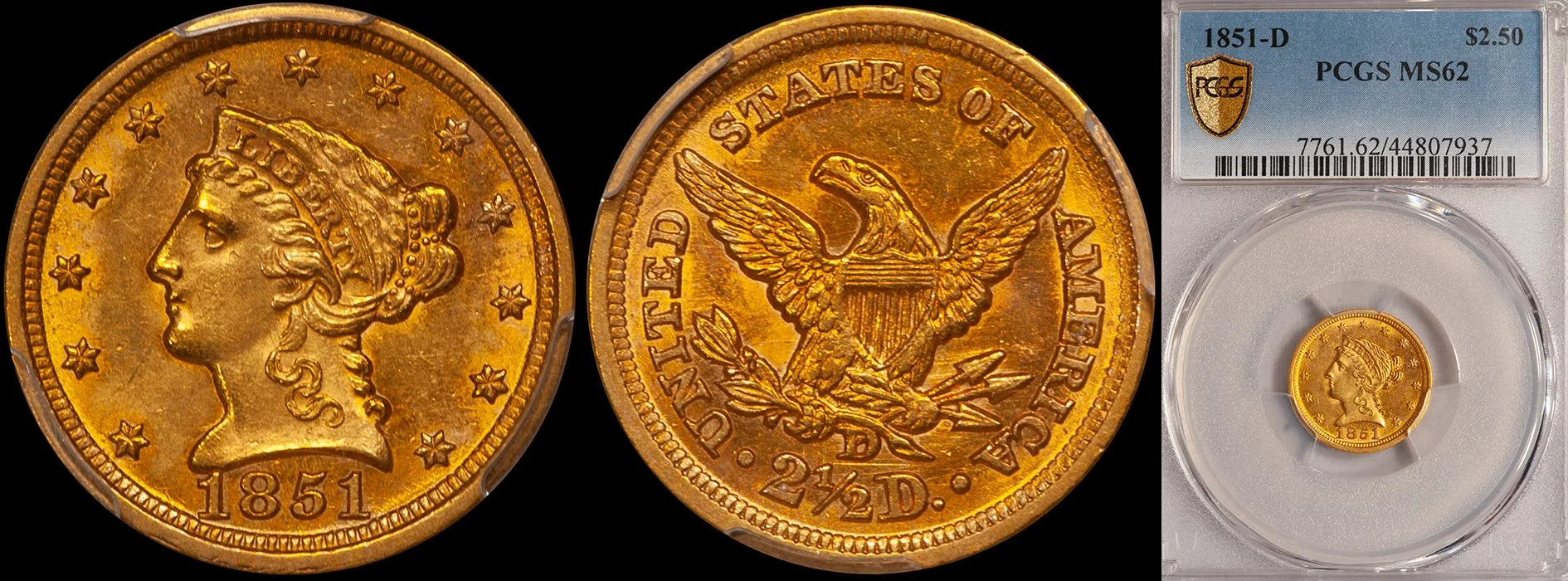
There are numerous ways in which to collect Liberty Head quarter eagles. Most specialists focus on the issues from a specific mint. The most popular individual mint is Dahlonega, followed by Charlotte and New Orleans.

A small but dedicated cadre of collectors attempts to put together a complete set of Liberty Head quarter eagles. Such a set can be completed although at least two or three issues are very rare and quite expensive. This set is impossible to complete in Uncirculated due to the unavailability of at least one issue (the 1854-S) in Mint State. Every other issue, however, is known in Uncirculated although a number of these are extremely rare.

Some of the collectors who are attempting to assemble a complete set of Liberty Head quarter eagles also include significant varieties. These are generally limited to the ones that are recognized by PCGS and/or NGC.

One interesting way to collect this series would be to focus on the major rarities or key issues. But in the case of the Liberty Head quarter eagles, the most famous coins are not necessarily the rarest. Most readers of this article will be surprised that I have not included the famous 1848 CAL in the list of the ten rarest issues of this type. Even though this is clearly one of the ten most popular (and most desirable) issues, it is less scarce than generally acknowledged and it does not make the Top Ten list.

Without further ado, here are the ten rarest Liberty Head quarter eagles along with pertinent information about each issue:

1. 1854-S

2. 1841

3. 1863

4. 1864

5. 1865

6. 1856-D

7. 1855-D

8. 1875

9. 1866

10. 1842

1. 1854-S: The 1854-S is the rarest Liberty Head quarter eagle by a fairly large margin. There are around a dozen examples known from the original mintage of just 246 coins. Something that I have always found interesting about this date is the fact that most of the survivors are extremely well worn. At least five or six of the dozen known either grade VF20 or less or show damage. In fact, I am aware of just two examples that grade EF (by my standards) and a single coin that grades AU. For many years, the 1854-S was overlooked and, in comparison to other great U.S. gold rarities, it was greatly undervalued. The first example of this date to sell for a six-figure price was Bass II: 472 (now graded AU53 by NGC) that brought $135,700 in October 1999. In September 2005, I purchased an NGC EF45 example that was previously unknown to the collecting community out of an ANR auction for $253,000. This record was broken in February 2007 when a PCGS EF45 brought $345,000 in a Heritage sale. My best guess is that prices will continue to rise for this issue and the next comparatively choice example that is made available to collectors will set another price record.

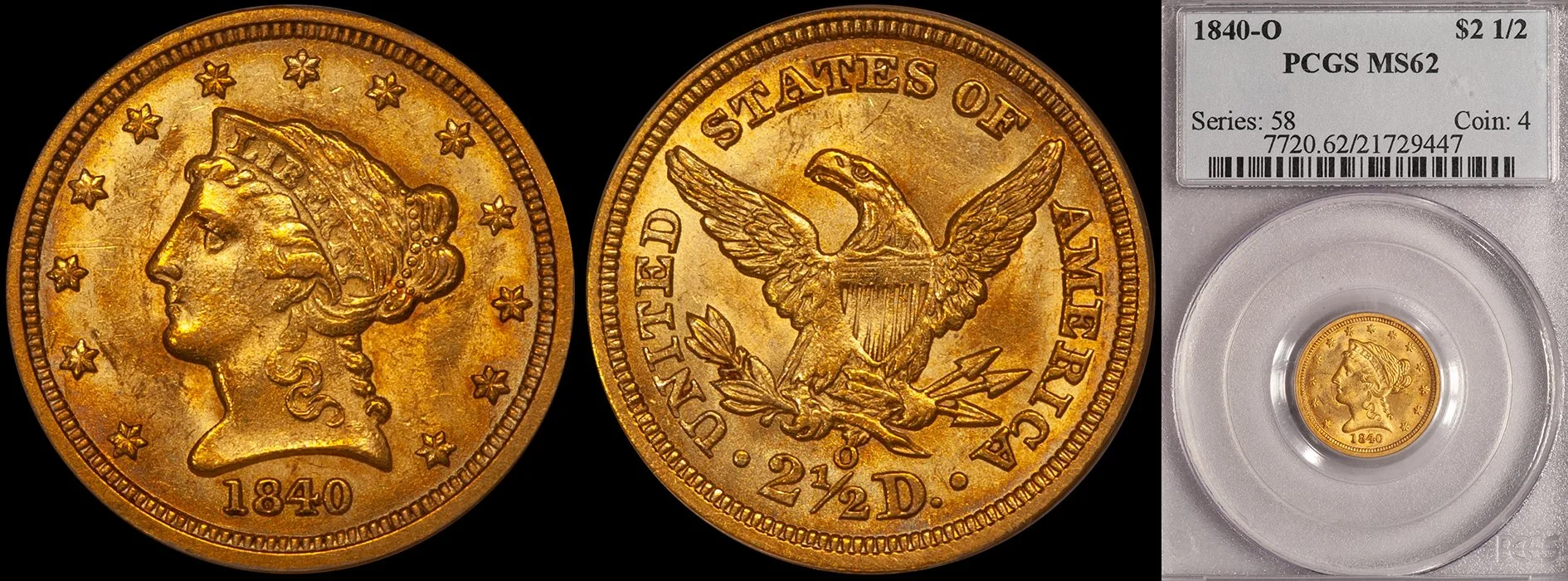
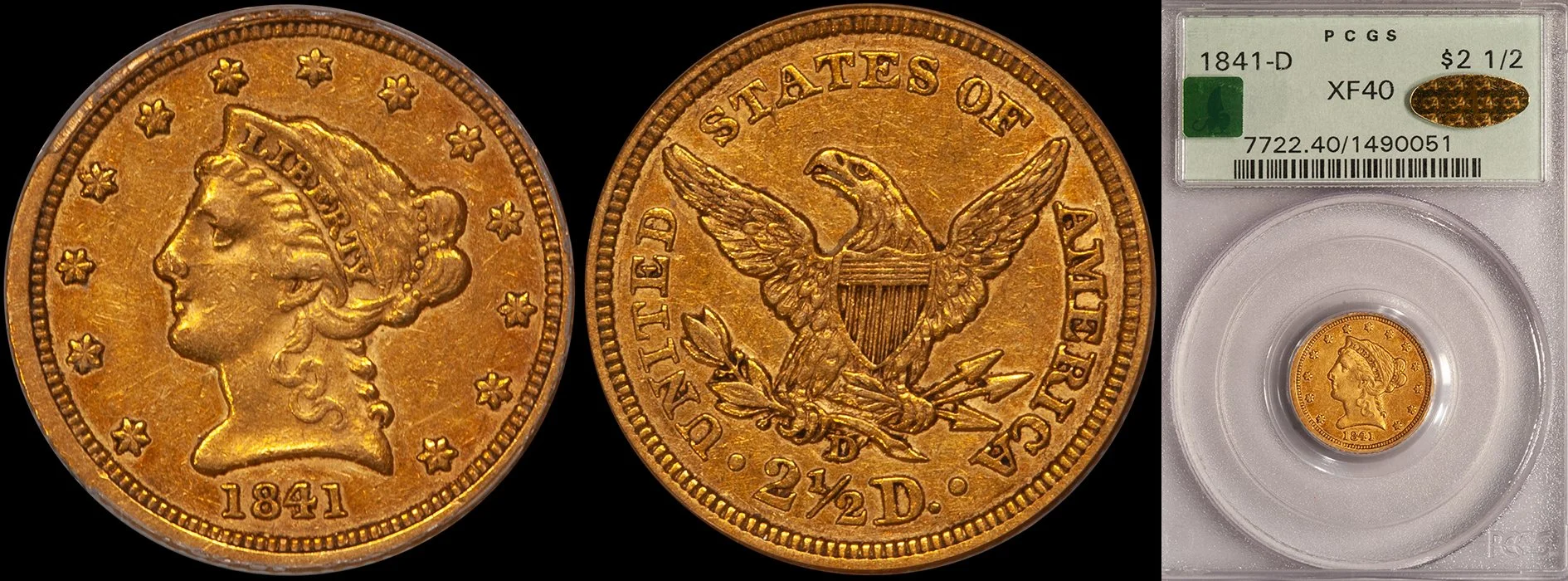
2. 1841: This is probably the most famous date in this series and, for many years, it was the issue that traditionally sold for the highest price when it appeared at auction. Known as “The Little Princess,” it has been stated that “20 pieces” were struck. For many years, numismatic tradition has stated that these were produced only as Proofs. It is my opinion that some (if not most) were also struck in a business strike format. It is also my opinion that the reported mintage is too low and that as many as 50 or so were made. To the best of my knowledge, the current auction record for this issue is $253,000 which was set in June 2004 when Heritage sold an NGC PR65; this broke the previous record set by Bass III: 105 (graded PR64 by PCGS) back in 2000. I believe that a Gem 1841 quarter eagle, if available today, would sell for considerably more than this.

Note: For more information on this issue, please click here.

3. 1864: Placing this date as #3 on my Top Ten list may be a surprise to many collectors who probably expected the 1863 to make the #3 spot. But I feel the 1864 is clearly rarer than the 1863 and that it is one of the most overlooked and undervalued 19th century American issues. Only 2,824 were struck but, as with most gold coins from this era, the survival rate was very low due to significant meltings. I believe that around 15-20 examples are known. This includes an amazing NGC MS67 (ex: Byron Reed collection) that sold for $132,000 back in 1996 as well as two other Uncirculated coins, an NGC MS61 and a PCGS MS61, that are owned by two different collectors in Kansas. There are another six or seven that grade AU and the rest are in the VF-XF range. Despite this coin’s rarity, it is still affordable (especially in comparison to #1, #2 and #4 on this list).

Note: For more information on this issue please click here.

4. 1863: The 1863 is the single Proof-only quarter eagle of this type (although the 1841 has traditionally assumed to be as well; see above for my refutation of this belief). There were a total of 50 pieces struck of which I would estimate that around 20 or so exist. I place this coin as #4 on my Top Ten list based on the fact that I have seen far more 1863 quarter eagles available for sale in the last ten years than 1864 quarter eagles. Nonetheless, this is a very rare coin and it has always been a stopper for date collectors of this denomination. As recently as the middle of this decade, prices for this issue were relatively modest, considering this date’s rarity and significance. Nice PR63 to PR64 examples were selling for $35,000-50,000+ until a few years ago when prices began to jump; as they did for all Classic Rarities. The all-time auction record for this issue was set in January 2007 when Heritage sold an NGC PR66 Deep Cameo for $149,500. I have handled three examples of this date in the last four years. The 1863 quarter eagle is generally found with light hairlines but excellent contrast and very deep mirrors. It is a date whose importance is only now being fully realized and I believe that it is an issue whose price levels will continue to soar as this series becomes more popular.

5. 1865: Due to the fact that it has a mintage of just 1,520, some people have assumed that the 1865 is a rarer date than the 1864. This is not the case as the 1865 appears to have a slightly higher survival rate. My best estimate is that there are 25-35 examples known. According to the PCGS Population Report, there is an example graded MS63. I am not aware of this piece but assuming that it exists, it is by far the finest known and it is the only Uncirculated 1865 quarter eagle that exists. Both PCGS and NGC show an abnormally high number of coins graded AU58 and this is as a result of multiple resubmissions. I believe that there are around six or seven properly graded AU’s known as well as another ten or so in EF. When available, this date tends to have below average eye appeal due to very scuffy surfaces. I haven’t seen more than a handful of 1865 quarter eagles that were totally original and choice. At current price levels, I think this coin is excellent value as it is a major rarity that can be purchased in a Condition Census-level grade for less than $20,000.

6. 1856-D: There may actually be one or two quarter eagles that I placed lower on this list that are scarcer than the 1856-D. But these don’t have the little “D” mintmark placed on the reverse; a feature that makes this coin so endearing to specialists. Oh—and they don’t have an original mintage of just 874 coins either. The 1856-D is the rarest Dahlonega gold coin of any denomination with an estimated 45-55 pieces known. It is generally seen in EF grades with many advanced collectors holding out for a nice AU coin for their collection. As I have mentioned in past writings, this is probably the single hardest United States gold coin to properly grade due to the fact that it was poorly struck from improperly prepared dies and many examples have the luster and surfaces of one grade but the detail of another, far lower grade. The current auction record for an 1856-D was set by yours truly when I purchased the Heritage 4/06: 1513 coin for $71,875. This piece graded MS61 by NGC and it is certainly among the finest known.

Note: For more information on this issue please click here.

7. 1855-D: The 1855-D is the second rarest Dahlonega quarter eagle. For a number of years, I believed that it was the rarest but this is mistaken as the 1856-D (see above) is clearly rarer. Only 1,123 1855-D quarter eagles were struck and an estimated 50-60 are believed to exist. This issue tends to be a bit better struck than the 1856-D but it is another issue that the eye appeal tends to be negative. Any 1855-D that is well struck and which shows original color is very rare and worth a significant premium over the typical example. Most are seen in the VF to EF range and properly graded AU’s are very rare. I have only seen one or two that I regard as Uncirculated. The finest known is the example in the Smithsonian that is said to grade MS62 or thereabouts. The all-time auction record is Heritage 4/06: 1512 (graded MS61 by NGC) that realized $54,625.

Note: For more information on this issue please click here.

8. 1875:If this article had been written a few decades ago, it is likely that the 1875 would have ranked much higher up the list. With an original mintage of just 400 business strikes, it is easy to see why this date was once believed to be an extreme rarity. It appears that the 1875 is actually a bit more available than one would assume (this is also the case with the ultra-low mintage gold dollar of this year) with as many as 50-60+ pieces known. That said, the 1875 quarter eagle is still extremely popular and I love the fact that the collector of average means can still purchase a decent EF example, given the fact that these still trade in the $4,000-5,000 range. The 1875 becomes rare in properly graded AU55 and it is very rare in Uncirculated with four to six known. The finest I have seen is Goldberg 5/99: 666 (graded MS64 by PCGS; it sold for $25,300) while the second best is probably the Bass II: 587 coin (graded MS62 by PCGS; it brought $17,250 back in 1999). The 1875 quarter eagle is nearly always found with fully prooflike surfaces but it is easy to distinguish from a Proof due to an entirely different date position.

9. 1866: As you can tell from this list, the Philadelphia quarter eagles from 1863 to 1866 include many of the rarest individual issues in this entire series. The 1866 is not quite in the same league as the 1864 or 1865 but it is another rarity with an original mintage of just 3,080. There are around 55-65 known with most in the EF40 to AU50 range. The 1866 is extremely scarce in the middle AU grades and rare in properly graded AU58. There are around five or six known in Uncirculated. Interestingly, this date was unknown in Uncirculated at the time Akers wrote his seminal guide to quarter eagles. I am aware of at least two Gems and another coin that grades MS64. The all-time auction record is held by Heritage 5/07: 2239 (graded MS65 by PCGS; it sold for $40,250). All 1866 quarter eagles have satiny luster and surfaces that show pronounced horizontal die striations.

10. 1842: This is probably the least well-known date in my Top Ten list and, honestly, I think I am slighting it by ranking it as “only” #10. The 1842 quarter eagle is very scarce in all grades and around 50-60 are known from the original mintage of just 2,823. Unlike the 1866 and 1875, this issue is generally seen in very low grades and it becomes extremely rare in AU. I doubt if more than five to seven properly graded AU’s exist and in Mint State the 1842 is unique. I sold a PCGS MS62 a number of years ago to a Kansas collector who owns the finest set of Liberty Head quarter eagles ever assembled. I had earlier bought the coin from the Superior 9/99 auction where, as Lot 1863, it sold for $31,050. Despite this issue’s unassailable rarity, it is still very reasonably priced. I have seen examples in EF grades bring between $3,000 and $5,000 at auction which seems downright cheap for a coin that is many times rarer than its better-known (and more expensive) branch mint counterparts from this era.

There are a number of other Liberty Head quarter eagles that I think are worthy of Honorable Mention status. These include the 1844, 1845-O (if the Top Ten list featured bonus points for popularity, I would have certainly included this date instead of the far less popular 1866 or the more obscure 1842), 1862/1, 1863-S, 1867 (possibly the most underrated date in the entire series) and the 1872.

Improving Your Collection Without Spending Alot

Someone recently asked me a question that I thought was interesting and that merited a detailed response. To paraphrase this question, they basically asked me this: can you tell me some ways that I can improve my collection while spending little or no money? Are there any actual ways that you can make your collection better without dropping a lot of coin (bad pun intended)? I believe that there are and here are a few that came to mind:

1. Bring Out Your Dead. Every collector has them. Duds. Bad deals. Low end duplicates. You know what I’m talking about: the Dead Zone of your collection. These coins may represent more value than you realize. As an example, I recently had a relatively expensive double eagle in stock that a collector wanted for his set but he had no extra money at the time. I had him send me a list of the dead coins he owned; bullion, generic Saints, Morgan dollar rolls, etc. The value of his “stuff” was considerably more than he realized and he was actually in a nice profit position on his bullion. The choice to trade spillage for one nice, rare coin was easy for him to make. And the good news was that he had enough money left over so that he can actively pursue another neat coin or two.

2. Attribute Your Coins. If you collect series like Bust half dollars or large cents you are probably already a die variety collector and all of your coins are properly attributed. But what if you are a collector of early half eagles and you have never bothered to attribute your coins to Bass-Dannreuther variety numbers? And what if one of your supposedly common half eagles turns out to be a very rare die variety that is worth a 30-50% premium? Seems like a no brainer to me. Even if you collect a series for which there is no standard reference work, it makes sense to examine your coins with a 10x glass and see if anything interesting is happening. Who knows, maybe you’ll discover a previously unknown mispunched date or a cool double date that has not been recorded.

3. Invest $500 to $1000 in improving your library. If you collect early gold coins you probably own the Bass Dannreuther book and a few other standard references. But do you own pertinent auction catalogs? It has long been my belief that one of the best uses of your money is a good library. You’ll get more enjoyment out of your coins if you know more about them and there is no better way to learn about a series, especially one that is somewhat obscure, than reading books and catalogs. If you don’t know which books or catalogs to pursue, ask a specialist dealer which ones he refers to or, better yet, contact a numismatic literature dealer and ask for some suggestions.

4. Improve your peripherals. If you are using an old, slow computer you are missing out on the “full experience” when it comes to coins. Not everyone has the luxury of owning a sporty, brand-new computer but with the price of monitors having dropped so considerably in the last few years treat yourself to a 16 inch or 18 inch flat screen monitor. It’s just a few hundred bucks and it sure beats viewing coin images on an old, low resolution screen. Spend some money on a good quality new magnifying glass and a high quality lamp to view your coins as well. You’re looking at $50-100 for a world-class loupe and around $100-150 for a professional quality halogen coin lamp.

5. Research the pedigrees of your coins. This area is not relevant if you a collect fairly common series. If you are working on a set of business strike Indian Head quarter eagles in MS60 to MS62, it will be virtually impossible to determine the pedigree of these coins. But if you specialize in an area like Dahlonega quarter eagles or Fat Head half eagles, it is quite possible that some of the coins in your collection come from famous collections. Not everyone reading this will agree with me, but I believe that the “right” pedigree adds value and collectability to a coin and to discover that your 1847-D quarter eagle is from the Norweb collection or the Green Pond sale is pretty darn exciting. And if you collect Colonials or early cents, there is a possibility that a coin you own could have a pedigree that goes back over 100 years.

6. Start a cheap secondary collection. I’ve mentioned before that there is nothing more frustrating than being a collector who is either cash-strapped or at a point in his collection where there are no easily available holes to fill. In a scenario such as this, I always recommend having a cheap but interesting secondary collection to fulfill your “need” to buy something and to keep out of trouble. How about 18th century British Condor tokens? They are fascinating, well-designed and you can buy lovely examples for less than $100. Start a “one country one coin” collection where you purchase one coin from every country that currently makes coins. Or, focus on a certain year (say 1899), figure out every country that existed at the time and buy one copper or silver coin from each of these nations.

7. Immortalize your collection. Let’s say you’ve worked on a neat specialized collection for a number of years but you are currently “out of gas” due to finances or unavailability of stopper dates in the series. Why not create a website that focuses on your coins and/or the series you collect. As an example, say that you are working on a set of No Motto Liberty Head eagles. There’s never been a book that has specifically focused on these coins; just works such as my New Orleans reference that has included them as specific issues within a larger context. You could buy the URL nomottoeagles.com and create a research site that lists the finest known pieces, varieties for each year, auction records, etc and which had photos of each of your coins. I have seen this done for a few specific types (as an example, a collector has done this for Trade and Seated Dollars and the results are extremely impressive). Doing this is a win-win for everyone involved. It gets people more interested in the series you already collect and it gets potential buyers more interested in your coins when you are ready to sell. Plus, it seems like a fun thing to do in your free time.