Numismatic Miscellany

It’s another depressing, rainy day in Portland. What better way to share the love than to touch on some miscellaneous topics which while interesting are probably not “deep” enough to write a full blog on. A friend of mine recently made an interesting observation. In the six years since the final Bass sale, there has been any number of great specialized gold coin collections offered for sale at auction. This includes but is not limited to the Duke’s Creek collection of Dahlonega gold, the Old West and Morgan collections of Carson City gold, the Kutasi collection of Indian Head gold, the Lang collection of Carson City gold, etc. But in this time period, there have been no great specialized collections of early gold coinage, particularly quarter eagles and half eagles (specifically from 1813 to 1834).

Clearly, these coins are popular. And they have doubled or tripled in price in the past six years so you’d think that the new price levels would have brought a collection or two on the market. So where are these coins? If you look through most typical auctions these days you might find decent examples of the 1813, 1814, 1818 and 1820 half eagles. But where are the rarer dates?

I’m not certain that I know the answer but my guess is that a) these coins are rare enough that even if a relative “flood” were to come on the market you’d still only be talking about two or three examples of dates like an 1827 quarter eagle or an 1826 half eagle every year and b) the collectors who own coins like this tend to be deep-pocketed and the sort of people who once they buy a nice quality 1827 quarter eagle or 1826 half eagle keep it in their collection indefinitely with no intention to sell it. Option C, which I subscribe to a bit less, is that there are really no “collections” or coins like this in the first place, given their rarity and the high price per coin that collecting these series entails.

In the past month I’ve had no less than four or five clients mention to me that they really dislike NGC holders, particularly when it comes to small-sized coins. Before I start in on this point, let me make myself clear as I realize what I just said is a bit ambiguous and it could be misinterpreted. These people were commenting on the aesthetics of the NGC holder itself and not on the ability of NGC to grade coins.

After carefully looking at a few of the gold dollars and quarter eagles in my inventory which are in NGC holders, I think I can see their point. Small sized coins don’t look good in NGC holders. The coins look jammed into their openings and the rims are often lost. Many pieces wind up tilted at a rakish angle because they don’t fit properly. My suggestion to NGC would be to enlarge the openings for smaller coins. In PCGS holders, these coins appear to “float” and look more spacious because of the fact they are placed in a membrane which gives them more space.

I’m sure that NGC has more important items on their plate but when a number of sophisticated collectors all complain to me about their dislike for these holders (and voice their complaints completely independently of one another) it makes me think that NGC might have a big problem with small coins (sorry, couldn’t resist that pun…)

I recently read in a numismatic book dealers catalog (of all places…) that it was time to retire the auction catalog and have all coin auction catalogs appear on-line or on CD’s. While this sounds like a great theory in practice and it makes me feel all Jetsons-like to think that I could live my coin life paper-free, I do not agree with this idea.

There are two reasons that I like auction catalogs. The first is their tangibility. I may be showing my age here but I’m the sort of person who likes spending an hour every morning reading actual newspapers and not waking up with my cups of joe and the New York Times online. There is something visceral about having a newspaper in my hands that gives me pleasure. The same is true with a coin auction catalog.

The other reason I like the auction catalog format is that I can make notes in a paper catalog when I view the coins. If I’m perusing the latest Heritage or Stack’s sale online, I can’t make notes unless I print out pages. And if I have to resort to doing this, why not just have a catalog?

One thing I would suggest to the auction firms is to give their bidders a chance to custom design their catalogs. Customization is a huge new trend in retailing and it allows someone, as an example, to design a pair of Nike sneakers online according to their personal specifications. I would personally prefer that I get a Heritage catalog in the mail that contained only the series which interest me. This would reduce the bulk of the typical catalog and it would make me feel a bit more “green” knowing that I saved a few hundreds pages of paper every month. Given the technology which is ready available in the area of printing and customization, I would suggest that specialized catalogs are something that could be done easily and cheaply.
An Analysis of Carson City Eagles Through Recent Major Auction Results: Part Two

Last month we looked at how the sale of the Old West and the Morgan collections of Carson City gold coinage impacted the market for half eagles from this mint. This month, we’ll look at the results as they apply to Carson City eagles. Just a few refreshers before we get right into the number crunching. The Old West collection was sold at auction by ANR in August 2006. It contained a nearly complete set of CC half eagles and a complete set of eagles. I sold all the eagles to this collector in the 2004-2005 time period and I had previously handled many of them from 1995-2000 when they comprised the Orange County collection. The Morgan collection was sold by Stack’s in January 2007. It was a complete set of CC half eagles and eagles and all had been purchased from me between 1990 and 1995. All of the coins were in older PCGS and NGC holders and many were good upgrade candidates based on today’s more liberal standards.

In this article, the Old West Collection will be abbreviated as OW while the Morgan Collection will be abbreviated as MC.

1870-CC OW: PCGS AU55, sold for $115,000 MC: PCGS EF45, sold for $46,000

The PCGS AU55 example in the Old West collection was the finest known 1870-CC eagle and it shattered all price records for this date. The price realized for the Morgan collection coin was reflective of the fact that most viewers graded the coin AU50. It subsequently upgraded to NGC AU50 and is now for sale on a dealer’s website for $52,500. After these two sales I think we will see continued price appreciation for this rare and important date.

1871-CC OW: PCGS AU55, sold for $25,300 MC: NGC AU55, sold for $25,300

I wasn’t personally crazy about either of these coins. I think we can assume with a good deal of certainty that an average quality AU55 example of this date is worth around $25,000.

1872-CC OW: PCGS AU55, sold for $34,500 MC: NGC AU55, sold for $34,500

I liked both of these coins quite a bit and thought that they both had a chance to upgrade to AU58 (although I don’t think either has…yet). Again, after these two sales I think it’s safe to say that a nice AU55 example of this date is worth around $35,000.

1873-CC OW: PCGS AU50, sold for $32,200 MC: PCGS AU50, sold for $43,700

The 1873-CC in the Old West collection was decent but nothing special. The example in the Morgan collection was clearly nicer and I graded it AU53. It sold to a dealer who currently has it listed on his website (in an NGC AU53 holder) for a reasonable markup ($48,500). It is nice to see that this date is finally getting some recognition for its rarity in AU grades.

1874-CC OW: PCGS AU58, sold for $37,950 MC: NGC AU55, sold for $19,550

The Old West coin is the third finest known 1874-CC eagle and its price realized was very strong. It later appeared in the Goldberg February 2007 sale (still in a PCGS AU58 holder) where it failed to hit its reserve and was bought back by its consignor, a California dealer. The Morgan collection coin also realized a strong price for the grade.

1875-CC OW: PCGS AU53, sold for $32,200 MC: PCGS AU53, sold for $29,325

I personally liked the Morgan collection coin better than the Old West piece. Considering that it brought nearly $3,000 less, I think it was a relatively good value. These two auction appearances confirm my belief that a nice quality AU53 example of this date is worth around $30,000-32,500.

1876-CC OW: PCGS AU58, sold for $39,100 MC: PCGS EF45, sold for $12,650

The Old West coin was superb and I purchased it for a collector. The price realized for the Morgan collection example was strong for an EF45. The coin, incidentally, is now in an NGC AU50 holder. Both of these sales show that there is demand for this date but the coins offered were so far apart in quality that one can not make any good conclusions based on comparing them.

1877-CC OW: PCGS AU53, sold for $27,600 MC: NGC AU55, sold for $27,600

I thought that both of these had the potential to upgrade: the Old West coin to AU55 and the Morgan coin to AU58. I would have to say that the Morgan coin was a much better value given the fact that it was nicer yet it sold for the exact same price.

1878-CC OW: PCGS AU55, sold for $39,100 MC: PCGS AU50, sold for $20,700

This was an instance where I thought the Old West coin sold for a little too much while the Morgan coin went a little cheaply. The Old West piece was clearly nicer than its counterpart but I do not think it was worth nearly $20,000 more.

1879-CC OW: PCGS AU55, sold for $32,200 MC: PCGS AU50, sold for $27,600

Here is an example where if you hadn’t seen both of these coins in person, the prices realized might not make sense. The Old West coin was properly graded but it lacked good overall eye appeal. The Morgan coin was clearly undergraded (it is now in an NGC AU58 holder) and it brought a strong price as a result.

1880-CC OW: NGC MS61, sold for $18,400 MC: NGC AU55, sold for $4,140

Due to the difference in quality between these two coins, the prices realized do not really lend themselves to comparison. The 1880-CC in the Old West collection was extremely nice for the grade and it sold for a very strong price. I’m not certain if the coin ever upgraded to MS62 but even if it didn’t whoever purchased it now owns one of the finest known examples of this date.

1881-CC OW: NGC MS64, sold for $74,750 MC: PCGS MS61, sold for $10,350

These are two of the finest known examples of this date (the Morgan collection coin, which I purchased, is now in an NGC MS62 holder) and their strong prices realized reflect this. I was pretty surprised at just how high the bidding went on the Old West coin. I purchased this exact piece in B+M’s July 2002 sale (in an NGC MS63 holder) for $25,300. It had previously brought $6,600 in the 1982 Eliasberg sale.

1882-CC OW: NGC MS62, sold for $41,400 MC: PCGS AU55, sold for $8,625

Here is another instance when the difference in quality between these two coins makes a comparison irrelevant. The Old West coin, which I purchased, is probably unique in Uncirculated and I thought it was good value, given what other Carson City eagles from this era were selling for in the auction.

1883-CC OW: PCGS AU58, sold for $14,950 MC: NGC AU58, sold for $5,750

I think these results are extremely interesting. Same date, same grade yet the coin in the PCGS holder brought more than two-and-a-half times as much. Why? I think part of the reason is the fact that the PCGS coin was clearly nicer. But I also think part of the reason is that because of the PCGS Set Registry, collectors are looking for certain CC eagles in the highest possible grade at PCGS. I wonder if in the future we will continue to see such price disparity based on the brand of the holder?

1884-CC OW: PCGS MS62, sold for $46,000 MC: NGC AU58, sold for $6,038

Reasonably big difference in quality, extremely big difference in price. The Old West coin is probably the second or third finest known 1884-CC eagle and it sold for a price commensurate with its rarity. This was a record price for the date and I’m certain that in the future, other Uncirculated 1884-CC eagles will be compared with this Old West coin.

1890-CC OW: PCGS MS62, sold for $10,350 MC: NGC MS62, sold for $6,900

These were both very nice for the grade but at least two bidders clearly thought the Old West coin was an upgrade. Here’s a bit of sobering thought for those of you who like to calculate risk: if the coin grades MS63, its worth $12,000-13,000. If it stays in an MS62 holder its worth $5,500. What you have here, then, is $5,000 worth of downside risk with around $2,000 of upside. This is why coin dealers are not CFO’s of large companies.

1891-CC OW: PCGS MS63, sold for $7,188 MC: NGC MS64, sold for $17,250

The Old West coin was solid for the grade and it had the added benefit of a Pittman pedigree. With average quality MS63 examples of this date readily available in the $4500-5500 range, perhaps the buyer of this coin thought it might upgrade. Clearly, the buyer of the Morgan collection coin did see his new 1891-CC as a strong candidate to eventually reside in an MS65 holder. I thought it had a pretty decent shot as well but was not willing to gamble $17,250 to find out.

1892-CC OW: PCGS MS63, sold for $41,400 MC: NGC MS61, sold for $4,370

The 1892-CC eagle in the Old West collection was remarkable and its price clearly reflected that a number of bidders thought it would grade MS64 if resubmitted. The Morgan coin was decent for the grade but nothing special. Here is clear evidence, in case you needed more, that collectors of Carson City eagles will pay strong prices for high quality coins which are exceptional for the date and grade.

1893-CC OW: PCGS MS61, sold for $16,100 MC: NGC MS60, sold for $8,625

I bought both of these coins. Take a guess which one I consider to be the better deal. I find it interesting that of the eight or nine known Uncirculated examples of this date that two of them sold within a few months of each other. This is further evidence of how important these two sales were for collectors of Carson City gold.

I’m not certain that we will see comparable collections of Carson City half eagles and eagles sold again for a long period of time. If you are a collector of Carson City gold, 2006 and early 2007 have been important (and expensive!) times for your set.

The Single Greatest Indian Head Eagle in Existence

There has never been an Indian Head eagle which has shattered the $1 million dollar mark. This is soon going to change, though, when Heritage sells Dr. Steven Duckor’s incredible 1920-S eagle in their March 2007 National Money Show auction in Charlotte, North Carolina. I fully expect this coin to break all previous price records for an example of this design type. If you were to ask five experts in 20th century US gold coinage the question “what is the single greatest Indian Head eagle in existence,” I’m reasonably certain that the answer would be unanimous: The Duckor 1920-S eagle which has been graded MS67 by PCGS.

This coin is very important for at least two significant reasons: it is very possibly the finest known Indian Head eagle of any date (it was graded MS67 by PCGS many years ago and by today’s standards I would think it had a pretty decent shot to upgrade to MS68) AND it just so happens to be the rarest date in the series in Gem Uncirculated. I can not think of many other situations in which a finest known single coin also happens to be a rarity as well.

In 2005 I first had the pleasure of viewing this coin in person. I was doing some other business with Steve Duckor and he asked me if I’d like to view his coin collection. There were a lot of memorable coins in his sets but I think the one that stuck with me most was the 1920-S Eagle. And I could tell that this coin held a special place in Steve’s heart as well.

This coin was first sold by dealer Jerry Cohen to another dealer, Dennis Forgue, in 1968 for $3,500. It was placed in the collection of Dr. William Blackwell until the Stack’s June 1979 auction where Dr. Steven Duckor purchased it for $85,000; an enormous amount of money at the time for an Indian Head eagle. After remaining in Dr. Duckor’s collection for over a quarter of a century, it will be sold on March 16, 2007 as Lot 2134 in the Heritage auction.

I can personally think of at least three or four serious collectors who are going to really want to add the Duckor 1920-S eagle to their collection. This should create a level of competitive bidding that leads to a world-record price for the date and for the entire denomination.

Given the fact that the outstanding MS66 1920-S eagle in the Kutasi collection was recently sold by Heritage for a record price of $402,500, I think it’s pretty safe to say that the Duckor coin is going to bring considerable more; maybe even three times as much.

I’m personally very excited to witness the sale of this coin in Charlotte on the night of March 16th. Its going to be a great piece of Numismatic Drama and yet another feather in the cap of Dr. Steve Duckor; a personal friend and one of the greatest collectors I have ever known.

Undervalued Areas in the Rare Coin Market

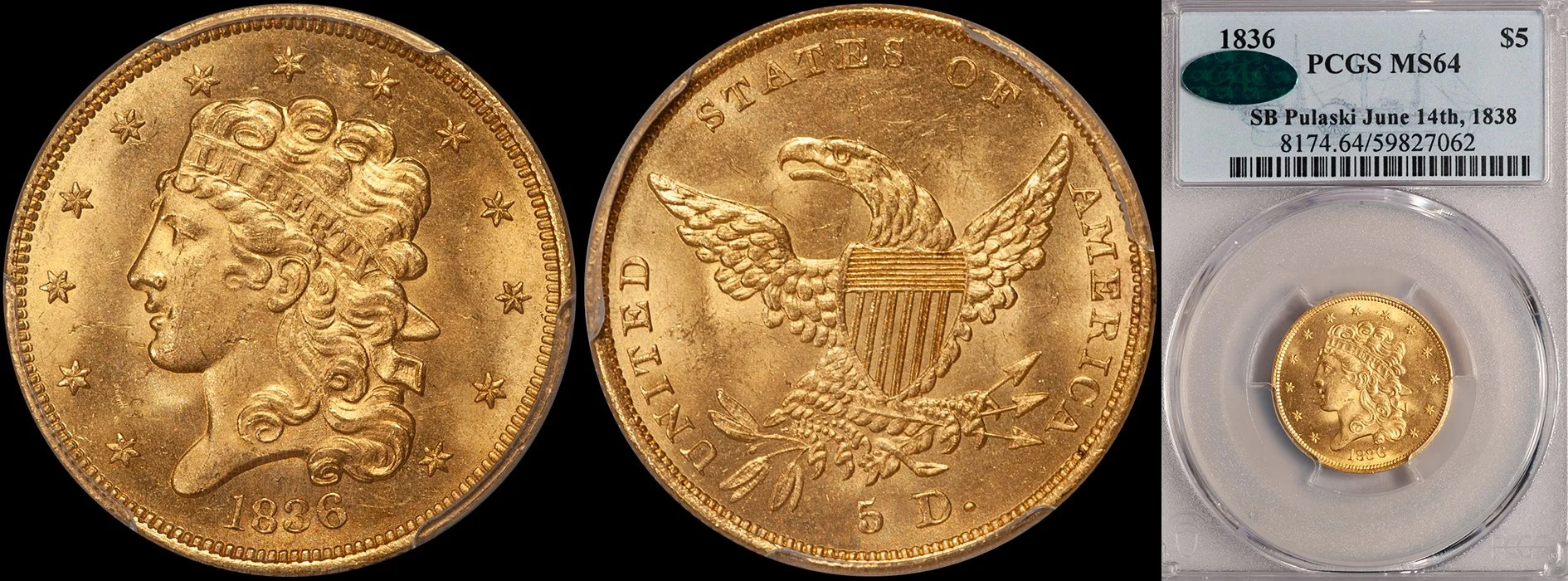
While I don’t claim to have a crystal ball, I usually have a pretty good sense of which areas in the field of rare gold coin collecting are poised to show an increase in interest in the coming years. Here are some areas which I feel are undervalued and which have the potential of becoming the Next Big Thing. 1. Classic Head Gold Coinage: If you are a regular reader of my blogs you know that I am a big fan of Classic Head gold coinage. I think the design of these coins is attractive and I like the fact that they neatly bridge the gap between “old gold” and the more familiar Liberty Head design that was employed for nearly 70 years.

One reason why Classic Head gold has not become very actively collected by specialists is the lack of a good Winter-esque style guide book. What I find very interesting about this series (in addition to the fact that it is short-lived and thus very completable) is that there are a number of fascinating varieties in both the quarter eagle and half eagle series. Many of these are touched on in the Breen Encyclopedia while others are described in detail and illustrated in the Bass catalogs. While I’m not a variety guy, per se, I do find a number of the varieties in these series very interesting and if someone were to better catalog and illustrate them clearly showing the differences, I think they would become very widely collected.

Another reason I like Classic Head gold is the interesting branch mint issues contained in both the quarter eagle and half eagle series. Clearly I am not a lone voice in the wilderness when it comes to issues such as the 1839-O quarter eagle or the 1838-C and 1838-D half eagles as these have seen considerable price increases in the last few years. Despite these increases, I still think the branch mint Classic Head gold issues are comparatively undervalued and if the Classic Head series becomes more widely collected by date then these issues will show even further appreciation in the coming years.

You need to remember that many of these varieties are quite rare to begin with and this is not a collecting specialty which could support more than a few serious collectors at any given time. I think the area which is likely to see the greatest number of specialists is the Capped Bust Large Eagle half eagles struck between 1795 and 1807; particularly the issues produced between 1800 and 1807. Dates like the 1804 and 1806, of which there are seven and six different varieties, respectively, are not prohibitively expensive on a per-coin basis as long as the collector is content to purchase nice EF and AU coins.

2. High Grade New Orleans Eagles: I base this prediction on how well coins like this sell for me when I list them on my website. I am referring primarily to common date New Orleans eagles (such as the 1901-O, 1903-O, 1904-O and 1906-O) in MS63 and higher grades.

Here’s why I love a coin like the 1901-O eagle in MS63. The current PCGS population for this date in this grade is forty-two with just nine graded better. Trends is currently $3,500 and when I have these available I generally ask in the area of $3,250-3,350. Now look at a common date like the 1901-S which has a PCGS population of 3,920 with 3,209 graded better. These routinely sell for $1,100 in MS63 and you can literally buy them by the wheelbarrowfull at any major show. In my opinion, the 1901-O at a three times premium above the 1901-S is great value.

A coin like a 1901-O eagle in MS63 traded for around $2,500 a year or two ago so the market has clearly started to rise. But at the same point in time, a 1901-S traded for around $1,250. This means that the premium factor has only risen from 2x to 3x. It would not surprise me if in the next year or two, the premium factor grew to at least 4x and possibly as high as 5x.

3. Civil War gold: It’s just a matter of time before someone starts promoting date runs of Civil War gold issues. It’s been done before and it seems like such a no-brainer promotion I’m sure it will be done again.

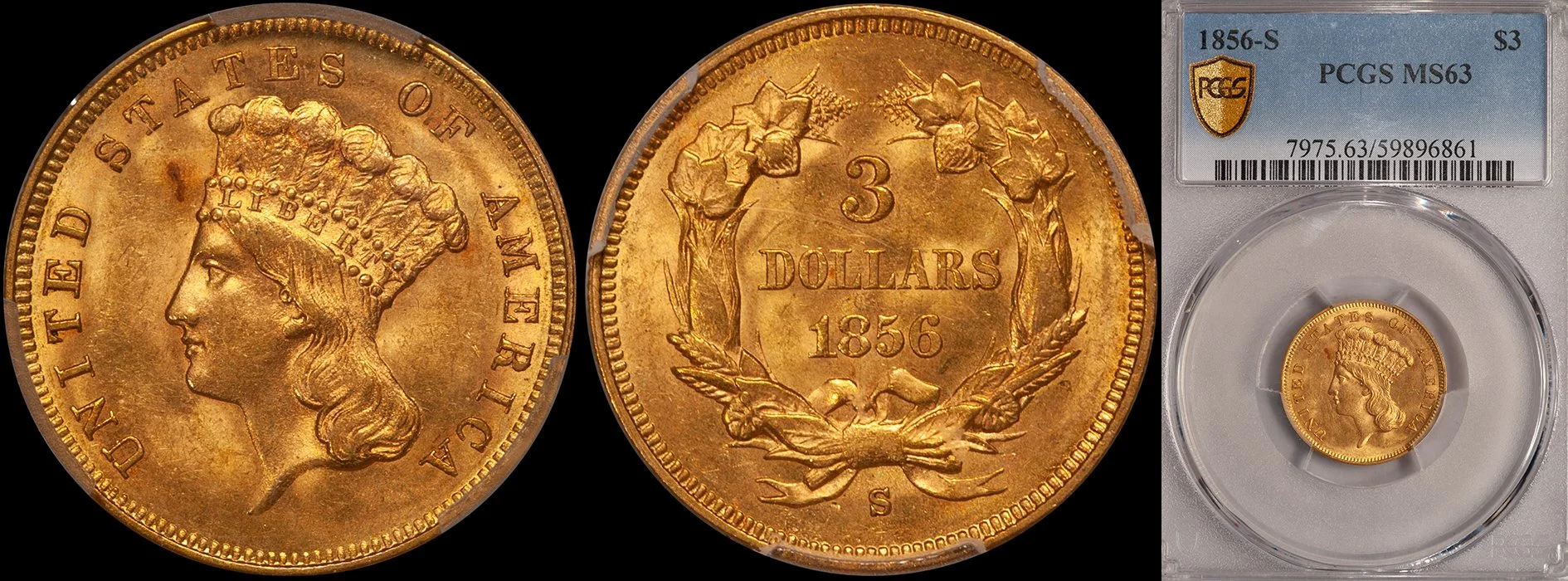
The only problem with doing a comprehensive promotion of Civil War era gold is, of course, finding enough quantity to make such a promotion worthwhile. As an example, the gold dollars from 1861 to 1865 seem easy enough to promote but just try to find a quantity of 1863’s in any grade. You can forget promoting quarter eagles from this era due to the extreme rarity of the 1863 and the 1864 issues - and the 1865 Three Dollar is rare enough to put the kibosh on this series. I guess if I had the answer I would be running the promotion myself right now. But I can just see that beautiful full-color brochure with the battlefield scene and the 1862 three dollar gold piece imposed on top of it….

1841 Quarter Eagle Observations

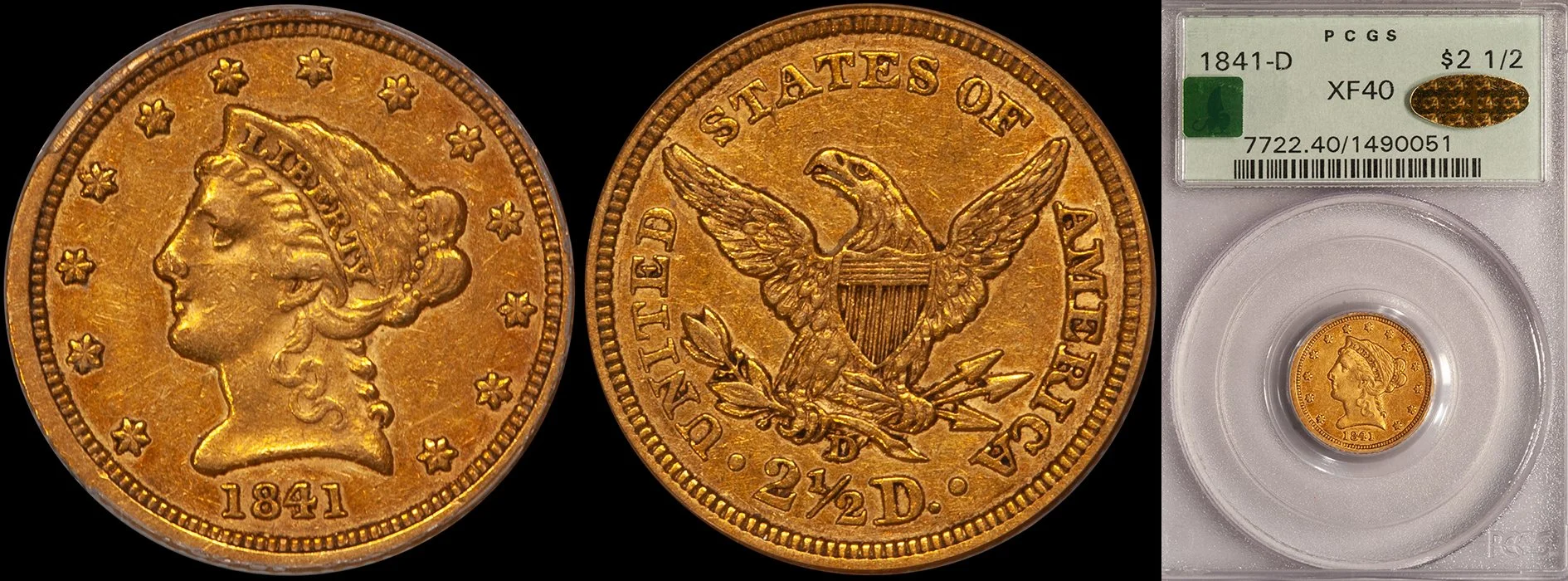
I recently studied an 1841 quarter eagle graded PR53 by PCGS which was offered by Heritage in their February 2007 Long Beach auction. Numismatic tradition states that around 20 1841 quarter eagles were struck, all as Proofs. Numismatic tradition, in this case, is wrong.

The 1841 in the Heritage sale was unquestionably produced as a business strike. I’ve seen at least three other examples which I believe were produced for circulation as well.

Here are a few observations about the 1841 quarter eagle which I’d like to share:

1. Given the fact that around fifteen 1841 quarter eagles exist, let’s assume that the actual original mintage figure is more like 25-30 instead of the presumed 20 (I actually think it could be as high as 50). Then, let’s look at one other important fact: the mintage figure for Proof quarter eagles during the 1840’s is, with the exception of the 1841, less than ten coins per year. In some cases (i.e., 1847 and 1849) Proofs from this decade do not even exist. Why is the Proof mintage figure so high? Especially given the fact there is nothing “special” about this year; nothing, that is, which would cause so many Proofs to be struck.

2. Proof gold coins from the 1840’s look like Proofs, even when they are well-circulated. The 1841 in the Heritage sale did not look remotely like a Proof. It had absolutely no reflectiveness in the protected areas, the rims were not squared and the overall “look” of the coins did not suggest that it had been made for presentation purposes.

3. There are 1841 quarter eagles that exist in grades as low as Very Good to Fine. No other Proof gold coins from the 1840’s are known in very low grades so why should 1841 “Proofs” be found with this degree of circulation?

4. Despite having its own nickname (the “Little Princess”) the 1841 quarter eagle is a coin whose status as a Classic American Rarity seems to have diminished in recent years. My guess is that this is because specialists feel that since it is considered to be a “Proof-only” issue it isn’t necessarily an integral member of a business strike set of Liberty Head quarter eagles. It is curious that the 1854-S quarter eagle, an issue that was traditionally valued at lower levels than the 1841, is now regarded as a “better” coin and is bringing higher prices.

David Akers, who I regard to be the most knowledgeable expert of all-time on the subject of United States gold coinage has stated in his seminal work on quarter eagles that he believes that the 1841 quarter eagle was struck in two formats: as Proofs and as circulation strikes. However, in their 2006 book “Encyclopedia of United States Gold Coins,” Jeff Garrett and Ron Guth state that “only Proof quarter eagles were produced in 1841; circulated examples are said to exist, but these are actually mishandled Proofs that entered circulation.” I am clearly in the Akers camp in this debate and the 1841 quarter eagle I just viewed at Long Beach makes me feel more strongly than ever that business strike 1841 quarter eagles DO exist.

February 2007 Long Beach Show Review

nother Long Beach week has come and gone and this February’s version provided some interesting insights into the current state of the rare coin market. For me, the week began with attending the Goldberg auction in Beverly Hills. This sale contained quite a bit of rare gold coinage, including extensive runs of early half eagles, numerous high grade Charlotte and Dahlonega gold coinage and some impressive double eagles.

I thought that the overall results of this sale were mixed. The early gold coinage was stronger than I expected with the coins consistently bringing 10-20% over current market values. I found that buyers weren’t hugely picky as, in a number of cases, coins that were substandard for the grade did not sell for much of a discount versus examples that were high end.

An area that definitely saw buyer discrimination was Charlotte and Dahlonega issues. The Goldberg sale contained a host of coins in the MS60 to MS62 grade range which had problems. Nearly all were passed on by bidders but attractive, medium priced pieces brought strong prices. It seems that there are still a number of overgraded, unoriginal coins overhanging this market and until some of these go away, they will drag down the desirability of the nice coins with them.

Liberty Head double eagles continued to be very popular. A number of bidders at the Goldberg sale paid strong prices for Type I and Type II issues. As expected, New Orleans pieces led the way but I saw surprising strength in the Philadelphia and San Francisco areas as well. In Type Three issues, some of the nice, high grade Carson City double eagles in the sale brought very strong prices.

I found the Long Beach coin show itself to be among the slowest editions of this convention that I have attended in years. I go to shows primarily to buy coins and I was extremely disappointed by the near-total lack of interesting material at the show. I looked at box after box of dealer’s coins and was routinely left shaking my head wondering where all the interesting coins were. Overall, I spent around one-quarter the amount of what I spent at the FUN show which I regard as one of the best buying shows I’ve ever had. Click here to see a full list of all my new purchases with images and descriptions as well.

A curious trend at the show saw the bottom falling out of the generic gold market; despite the fact that bullion is as strong as it as been for years. Buyers could purchase VF and EF Liberty Head double eagles at melt levels and it was possible to buy the same coins in MS62 holders for only a $20-30 premium over spot; essentially melt plus slabbing fees. I mostly attribute this to cash flow problems with many of the larger market makers in the generic gold market. While I hesitate to make investment recommendations, generic gold seems like an interesting play right now with premiums as low as they have been in some time.

The highlight of the Heritage sale was a fresh-to-the-market 1854-S quarter eagle graded EF45 which sold for a record price of $345,000. As many of you know, the 1854-S is an issue which I have championed for many years and I have had the good fortune to sell three of them in my career. It is interesting to quickly recap the ascendancy of this issue into the status of Classic American Gold Rarity.

In the October 1999 Bass II sale the probable finest known example of this issue brought $137,500 which was, by a considerable margin, a record price but which, in my opinion, was still cheap for a coin which, by all rights, should be considered one of the most significant of all 19th century United States gold coins. This piece was resold a few years later in the $175,000-185,000 range. Then, around a year and a half ago, I purchased the second finest known (graded EF45 by NGC) for a record price of $253,000. This clearly raised the bar for the 1854-S and I remember a number of savvy dealers complimenting me after the auction for what they thought was a great purchase. Even after the new record price realized at the Heritage sale, I still think the 1854-S is undervalued in relation to other comparable rarities.

The market for New Orleans gold coinage seems as strong as I can remember it. Many of the bread and butter issues that I like to buy (such as 1888-O eagles in MS62 or 1893-O half eagles in MS62) were completely missing from dealer’s inventories and this makes me feel that a number of marketers are now selling these “introductory O mints” to their clients.

There are two significant shows in March (Baltimore and Charlotte) and I expect these to be excellent indicators of exactly where the market will be heading as we slide into the second quarter of the year.

An Analysis of Carson City Half Eagles Through Recent Major Auction Results: Part One

Two major auctions of Carson City gold coinage have enabled specialists in this series to make some interesting observations regarding the strength of this series. The first of these auctions was the sale of the Old West Collection and it was conducted by ANR in August 2006. The second was recently held by Stack’s in January 2007 and it featured the Morgan Collection. For the sake of convenience, in this article the Old West Collection will be referred to as “OW” while the Morgan Collection will be abbreviated as “MC.” 1870-CC OW: PCGS 58, sold for $80,500 MC: NGC 55, sold for $37,375

In my opinion, the Old West coin was exceptional and its price realized at auction reflected this. The Morgan coin was not as nice but I think it was an extremely good value at less than what the Old West coin brought. Clearly, this date is in strong demand due to its rarity and status as the first-year-issue half eagle from this mint.

1871-CC OW: PCGS 58, sold for $27,600 MC: NGC 45, sold for $10,350

Given the big spread in grade, it is hard to make a valid comparison between these two coins. The Old West example was among the finest known and it brought strong money while the Morgan coin was, in my opinion, a lock AU50 in today’s grading environment. This date remains quite rare in AU.

1872-CC OW: NGC AU58, sold for $29,900 MC: PCGS AU50, sold for $23,000

These coins made for an interesting comparison. In my opinion, the NGC AU58 was more like an AU55 while the PCGS AU50 was an AU55; hence, the similar prices realized. The 1872-CC half eagle appears to be more available in AU than I remember it being in the past and I wonder if a small hoard hasn’t been uncovered in the past few years (?).

1873-CC OW: None present MC: NGC AU50, sold for $28,750

This was one of just two CC half eagles missing from the Old West collection which should tell you how scarce it is. The Morgan coin was definitely an upgrade candidate and its price realized reflected this. I am convinced more than ever that this is the rarest Carson City half eagle and that coins grading AU50 or better with any amount of eye appeal are truly rare.

1874-CC OW: PCGS 58, sold for $27,600 MC: PCGS AU55, sold for $18,400

These were two of the nicer 1874-CC half eagles that I have ever seen. The Old West coin set a record for a circulated example of this date while the Morgan Collection coin was, in my opinion, a piece with a good shot to upgrade to AU58. I think both of these were very solid prices and indicate that collectors will pay strong prices for choice, original coins; even for dates that, by the rigorous standards of 1870’s Carson City half eagles, are somewhat common.

1875-CC OW: PCGS 55, sold for $17,250 MC: NGC 63, sold for $103,500

These two coins are really like comparing apples to oranges, given the extreme difference in quality. What is interesting about the Morgan Collection coin is that I sold this piece to the consignor for around $60,000 over a decade ago. Given how superb-and rare—it was, I think it was an exceptional buy and I expected before the sale that it might sell for as much as $125,000-150,000.

1876-CC OW: None present MC: PCGS 53, sold for $17,825

This is another date that, like the 1872-CC, seems to be more available now in the AU53 to AU58 range than I can remember it being in the past. I think the Morgan Collection example brought a strong price since it was judged to have a good shot to grade AU55 if resubmitted.

1877-CC OW: PCGS 55, sold for $17,250 MC: NGC 55, sold for $18,400

I thought these were both nice coins and very comparable in terms of quality. After these two sales, I think we can safely conclude that a nice quality AU55 1877-CC half eagle is worth somewhere in the range of $17,000-19,000.

1878-CC OW: PCGS 50, sold for $16,100 MC: NGC 45, sold for $12,650

Here is an instance where having some knowledge about these two coins answers some interesting questions; namely, why did an EF45 coin bring nearly as much as one graded AU50? The answer is simple: the AU50 was not very nice and had funky color while the EF45 was original, choice and perceived to have upgrade potential.

1879-CC OW: PCGS 58, sold for $12,650 MC: PCGS 58, sold for $13,800

Two coins, same date, same grade, nearly similar prices realized. End of story, right? In this case, no. In my opinion, the Old West 1879-CC was just gorgeous and I could see it grading MS61 on a good day. I did not care for the Morgan Collection example (disclosure: I sold both of these coins and I clearly missed the fact that the Morgan Collection example had been recolored a number of years ago as attested by the fact that it had turned a deep Cheeto Orange shade…).

1880-CC OW: PCGS 62, sold for $29,900 MC: NGC 60, sold for $12,650

I liked both of these coins a lot and their prices realized indicates that a number of other bidders did as well. Both coins sold in excess of current Trends and/or CDN Bid and the reason is simple: they were really nice, original coins with great eye appeal. Simple lesson: buy nice coins, build an interesting specialized collection, realize strong money when you sell them.

1881-CC OW: NGC 62, did not sell but later resold by Stack’s in their November 2006 auction for $46,000 MC: NGC 63, sold for $57,500

Given the fact that only three or four Uncirculated 1881-CC half eagles exist, it is a wonderful coincidence that two of the better ones sold at auction within a few months of each other. Given their results, I would say that the new owner of the MS63 example from the Morgan Collection got himself an amazingly good deal as he was able to buy a coin which I though was a lot nicer than the Old West specimen for just a 20% premium.

1882-CC OW: PCGS 62, sold for $32,200 MC: PCGS 61, sold for $21,850

I’ve been surprised at the strength of the market for Uncirculated examples of the 1882-CC, given that at least four have sold in the past six months that either grade MS62 or will be in an MS62 holder at some point. As a point of reference, the MS62 in the Old West collection was extremely choice for the grade while the MS61 in the Morgan Collection was clearly believed to be an upgrade candidate.

1883-CC OW: PCGS 58, sold for $9,775 MC: PCGS 58, sold for $12,650

Ah, the magic of the old PCGS holder. The Morgan Collection coin, while not appreciably better than the one in the Old West Collection, brought nearly 30% more. I would have to say that a good reason for this was the fact that it was a fresh coin in a very old PCGS green label holder.

1884-CC OW: PCGS 58, sold for $12,650 MC: PCGS 61, sold for $29,990

These were two of the nicer 1884-CC half eagles that have sold recently and the market seems to have finally recognized the fact that this date is quite rare and undervalued in higher grades. In fact, the example in the Morgan Collection is quite possibly the Finest Known and I thought it was among the most important pieces in this memorable collection of Carson City half eagles.

1890-CC OW: PCGS 64, sold for $9,775 MC: NGC 63, sold for $8,050

The NGC MS64 in the Morgan Collection should probably grade MS64. But here’s why buying coins at auction can be risky. If the coin stays as an MS63 it’s worth $5,500. If it upgrades, it’s worth around $10,000. So the buyer has around $3,000 in downside and $2,000 at most in upside. For most dealers, this upside/downside ratio is acceptable but for many collectors it isn’t.

1891-CC OW: PCGS 65, sold for $43,700 MC: PCGS 64, sold for $13,800

As far as I know, both of these are record prices for slabbed examples of this popular common date. The MS65 in the Old West Collection is probably the finest known 1891-CC and I was impressed by what it sold for. The MS64 in the Morgan Collection was awfully nice for the grade and given that it brought more than twice what the typical MS64 brings, I would guess that at least two people thought it had a good shot to grade MS65.

1892-CC OW: PCGS 63, sold for $5,750 MC: PCGS 62, sold for $4,140

This was an instance where I thought the coin in the lower grade holder (i.e., the Morgan Collection MS62) was nicer than the coin in the higher grade holder. This is why you can’t blindly look at auction records when determining a coin’s value. Clearly, not every 1892-CC half eagle in MS62 is worth $4,140.

1893-CC OW: PCGS 62, sold for $4,600 MC: NGC 63, sold for $8,625

The Morgan Collection coin was in an older holder and was exceptionally nice for the grade (I thought it had a very good chance to grade MS63). Here is another coin that can mislead the new collector. Not every MS63 1893-CC half eagle is worth $8,625. In fact, I recently sold a nice properly graded PCGS MS63 for $6,500.

No Motto Liberty Head Eagles

was recently working on a research project involving No Motto Liberty Head eagles and I was amazed at just how rare most of these coins are, especially in higher grades. Even the “common” dates like the 1847, 1849 and 1853 still have relatively low surviving populations in the higher AU grades and in Mint State. But there were a few dates that really stood out. One of my favorite No Motto eagles has always been the 1839 Head of 1840. There were two varieties of eagles produced in 1839. The first—and more common—has the same type of head as that seen on the popular 1838 eagles. The rarer shows the same style of Liberty head as seen on eagles produced in 1840. Unlike with the 1839 Head of 1838, there do not seem to have been many 1839 Head of 1840 eagles saved. I doubt if more than four or five dozen examples are known and most of these grade EF40 or lower. The finest known example of this issue is the Pittman II: 1912 coin which is now in an NGC MS64 holder. One other Uncirculated piece is known: a PCGS MS62 which is probably from the 1976 ANA sale and earlier from the Charles Jay collection sold by Stack’s in the 1960’s.

Another date that always been a favorite “sleeper” of mine is the 1843. With an original mintage figure of 75,462 you would think this date would be common but it isn’t. I would estimate that 175-225 pieces are known but the vast majority are in circulated grades and this date becomes really hard to find in AU55 to AU58. But where this date is truly rare is in Uncirculated grades. Both PCGS and NGC have just graded one example in Uncirculated and both of these coins are in MS61 holders. The PCGS MS61 was last sold by Superior as Lot 414 in their April 2003 sale where it realized $15,525. Imagine what this coin would have brought if it were struck at the New Orleans mint or, better yet, at Carson City!

A date that gets virtually no recognition but which is rare in all grades is the 1855-S. With an original mintage figure of 9,000 you’ve got to figure this issue is rare and the combined number graded at PCGS and NGC is just 73 coins. My best estimate is that 60-80 examples are known but at least 80% of these are in EF45 and lower grades. In AU the 1855-S is a major rarity and I have never personally seen an example that graded better than AU53 to AU55. Despite this fact, you can buy a nice EF45 example for around $3,000 and an AU50 will run in the $5,000-7,000 range. No, it’s not a popular coin and yes I realize it’s an S Mint $10 but, man, that seems like a lot of coin for the money.

Speaking of rare but unsalable San Francisco eagles, how about the 1860-S? Until the recent discovery of two Uncirculated pieces in the S.S. Republic treasure, this date was unknown in Mint State and I had never seen one better than AU55. It’s still a majority rarity in all grades with an estimated total population of 25-35 pieces. If San Francisco gold coinage ever gets the recognition it deserves, a coin like this will be considered a stopper in the eagle series.

What is the rarest No Motto Liberty Head eagle? I would have to say that the unquestioned rarity of this type is the 1864-S. Until an example was sold at auction in the Summer of 2006, I think at least three to five years had passed since an example was offered for sale. (I know for a fact that the best collection of Liberty Head eagles assembled in recent history was missing this date until recently). Only 2,500 examples of the 1864-S eagle were struck and I’d be very surprised if more than 20-25 are known. What is very interesting about this date, though, is the fact that it has been offered for sale so infrequently in recent years. One has to wonder if someone hasn’t quietly put together a small hoard of pieces and has kept these off the market.

If your budget can handle coins in the $2,500-20,000 range I’d give the No Motto Liberty Head eagle series some serious consideration. It’s a completable set but one which is very challenging and lots of fun to collect.

The Contrarian Opportunity of Charlotte Gold Coinage

Charlotte gold coinage is about as unpopular right now as at any time I can recall in the past two decades. Why are the coins from Charlotte getting no love when their Southern counterparts from Dahlonega and New Orleans are as popular as they’ve been in some time? Read on for a few suggestions. There’s no exact, scientific reason(s) which I can point to which “prove” why Charlotte coinage currently seems to be lagging Dahlonega and New Orleans when it comes to popularity. I can think of at least six possible reasons which, when taken together, have conspired to make these coins currently out of favor with collectors.

1. I’ve written two books on Charlotte gold coinage. The second—and most current—was published in 1997. This book is not only out of print and hard to find, it is out of date as well. Until I get around to publishing a third edition of this book (and I plan to get to work on this sometime in 2007 and hope to have it available by the end of the year) new collectors will not have access to current information. In my experience, whenever I publish a new (or revised) book on gold coinage, the popularity of that series tends to surge immediately. I anticipate that this will happen again by the end of this year or the beginning of 2008.

2. No significant new players for Charlotte coins at the top end of the market have come around in the past few years. In the 1970’s, it was Harry Bass, while the 1980’s saw Stanley Elrod and the 1990’s were dominated by Paul Dingler. Each of these individuals built world-class sets of Charlotte coinage that focused on very high grade pieces. During this time period, other collectors like Ed Milas could be counted on to purchase significant, high grade issues as well. The Charlotte market needs a new “Mr. Big” to step up and take some of the very high end pieces off the market.

3. There are no significant dealers in the Charlotte area who are building a local collecting base. One of the reasons why Dahlonega gold coinage has always had such a strong local following is that Georgia dealers like Hancock & Harwell, Al Adams, John Hamrick and Larry Jackson have loyally supported the market for Dahlonega coinage for three decades. Despite its status as the undisputed #2 city of the New South, Charlotte still does not have the solid dealer community that characterizes Atlanta.

4. Many of the Charlotte coins currently on the market, especially those in the AU50 to MS61 range, are overgraded, unoriginal and genuinely ugly. It’s hard to get collectors or dealers enthusiastic about coins with minimal eye appeal. One reason why the VF and EF segment of the Charlotte market is comparatively strong is that the coins tend to be decent and collectors are more active. If a fresh deal of attractive, original Charlotte coinage came onto the market in the next year or so, it might act as an excellent jumpstart.

5. A number of the telemarketers who have always been an outlet for the not-so-nice-for-the-grade Charlotte gold coinage have stopped selling these coins. I can think of at least two marketers who I’ve sold hundreds of thousands of dollars of Charlotte gold coinage to over the years who are currently out of the market because their sales forces are tired of selling Charlotte coins or they strongly believe that point #4 I made above is true.

6. In the coin market, tastes are cyclical. After years of neglect, New Orleans gold is currently popular. For years, no one liked early quarter eagles, but now everyone wants them. The market for Charlotte coinage is cyclical as well and happenstance dictates that we are currently in a down cycle. It is very possible that an up cycle of popularity could begin again very soon.

OK, so what has to happen for these coins to get popular again? First we need a new Charlotte book. Then, we need a couple of dealers (myself included) to fall in love with Charlotte coins all over again and start spreading the love. Then we need a couple of wealthy guys from North Carolina to discover how neat these coins are and for them to make a decision that they want to be the Paul Dingler or the Stanley Elrod of the 2000’s. Assuming that at least one or two of these three things happen, I think we can look forward to a renaissance of interest in this area of the market in the coming years. Until then, can you say “contrarian opportunity?”