State of the Market Report: New Orleans Gold

On Monday January 22nd, I posted the Pinnacle Collection of New Orleans gold coinage for sale. This superb collection contained seventy-one choice, high grade examples of New Orleans gold coinage. By Tuesday evening, nearly three-quarters of the coins were sold and as I write this, a mere four days after the initial posting of the collection, all but four coins have been sold. From the conversations I had with the over thirty collectors who bought (or attempted to buy) coins from this collection, I think I learned quite a bit about the State of the Market regarding New Orleans gold—and rare date gold coins in general.

My first observation is that the market is always hungry for attractive, fresh deals of coins. It didn’t take an expert to realize that these coins were exceptional for the grade and date. People liked the fact that they were all in PCGS holders and they really liked the fact that virtually every piece in the collection had dark, crusty surfaces; unlike the dipped-n-stripped material that is usually seen in auctions and other dealers’ inventories.

My second observation is that the publication of my book on New Orleans gold coinage a few months go has definitely spurred interest in these issues. One sophisticated collector who called me commented that New Orleans gold seemed really undervalued in relation to gold coins from other mints, especially given the very low population of high grade pieces from this mint. As a basis of comparison, he noted that $10,000 would go a long way towards buying a Condition Census piece in the New Orleans market while the same amount of money in the Carson City gold market would buy you a coin that was not close to Condition Census level. This is a good point.

Another observation is that people always want key date coins, no matter what series you are discussing. As an example, I had numerous people ask me about the 1841-O, 1859-O, 1879-O and 1883-O eagles and I probably could have sold multiple examples of these dates. The same holds true with the 1845-O quarter eagle and the 1842-O and 1847-O half eagles. My gut feeling is that if New Orleans gold continues to become more popular, these key issues are going to be the coins that show the greatest amount of price appreciation. The same holds true with the popular one-year type issues such as the 1855-O gold dollar, 1839-O quarter eagle and 1854-O three dollar, although these have already seen a good amount of price increase in the past three years.

A number of people complimented me on the presentation of the Pinnacle Collection and I believe that the in-depth descriptions, excellent images (and here I must give a shout out to my photographer Mary Winter who I think outdid herself with this project…) and an attractive overall “look” made shopping at the Pinnacle Collection Store a fun proposition.

I also think people liked being able to purchase fresh, interesting coins in a non-auction environment. A number of people told me that they are beginning to tire of the endless cycle of auctions and having to pick through hundreds and hundreds of lots of junk in order to find the occasional kernel.

So, what’s next for the New Orleans gold market? Clearly there are a number of avid collectors, both new and old, who are in this market. The interesting question is will there be enough coins to go around to satisfy them? Yes, I can sell five 1883-O eagles in the next month but am I going to be able to find even one of them? And what about prices—will Trends and Coin Dealer Newsletter show enough in the way of price increases to fuel a possible New Orleans gold fire?

Stack's January 2007 Sale Review

For collectors of New Orleans and Carson City gold coinage, the Stack’s January 16-17, 2007 Americana auction offered an important selection of high grade coins. Billed as the Morgan Collection, these were pieces which I sold to a Midwestern collector between 1992 and 1999. Many were listed in the Condition Census in my books but had never appeared for sale at public auction. In the gold dollar section, the most important piece by a substantial margin was a superb 1850-O graded MS64 by NGC. I had sold this coin to its owner over ten years ago and, like all of the coins in this collection, it remained in an old holder. I purchased it for $16,100 which I thought was very reasonable for the unquestioned finest known example of the rarest New Orleans gold dollar.

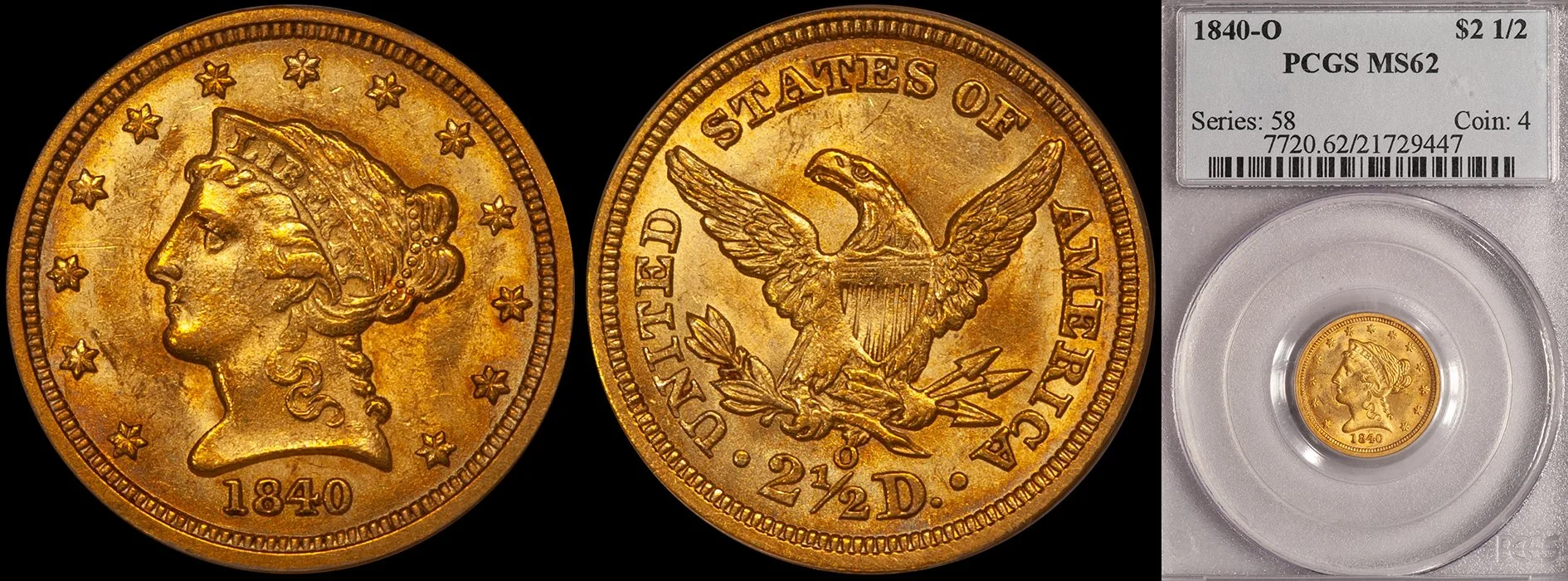
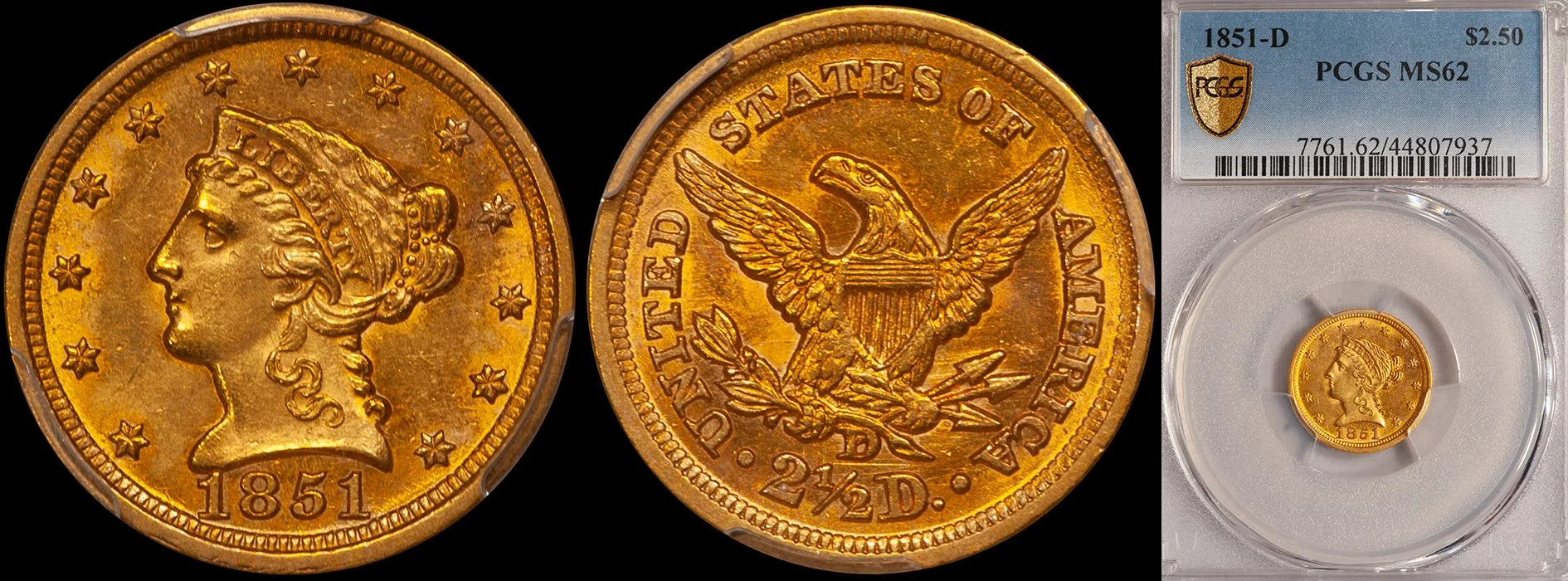
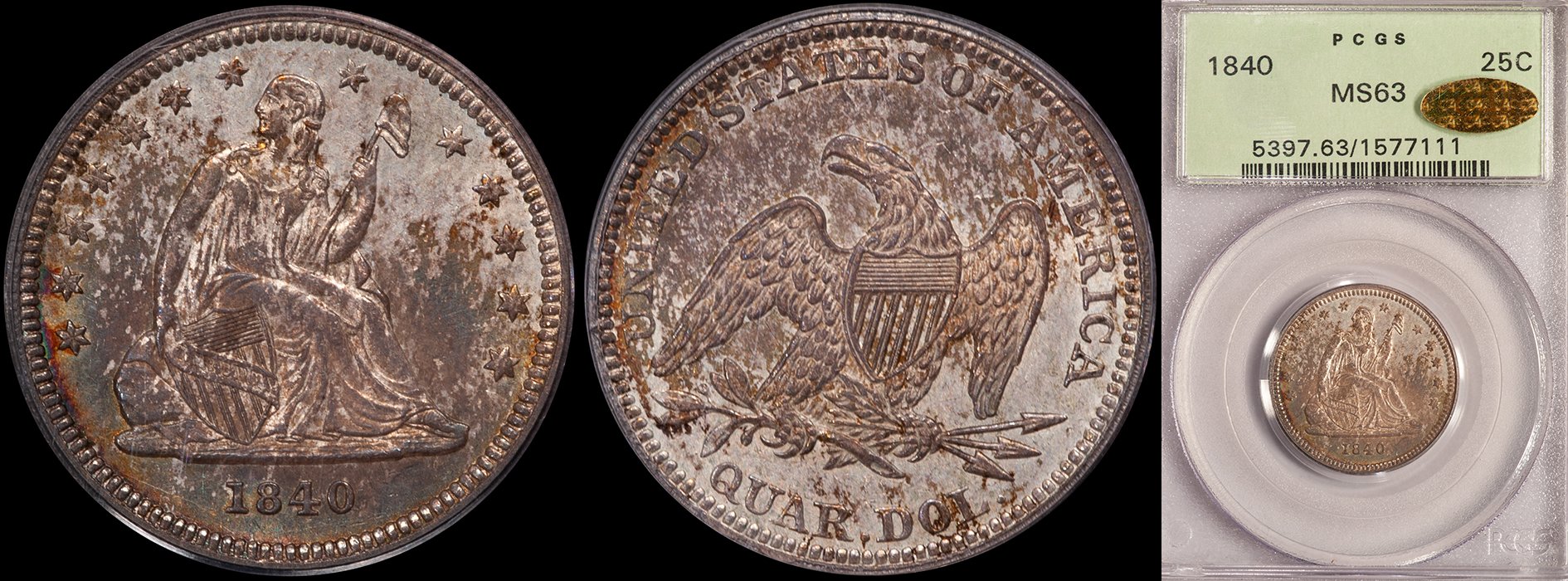
A nice PCGS MS62 1840-O quarter eagle sold for $18,400 against a current Trends value of $17,000 in this grade.

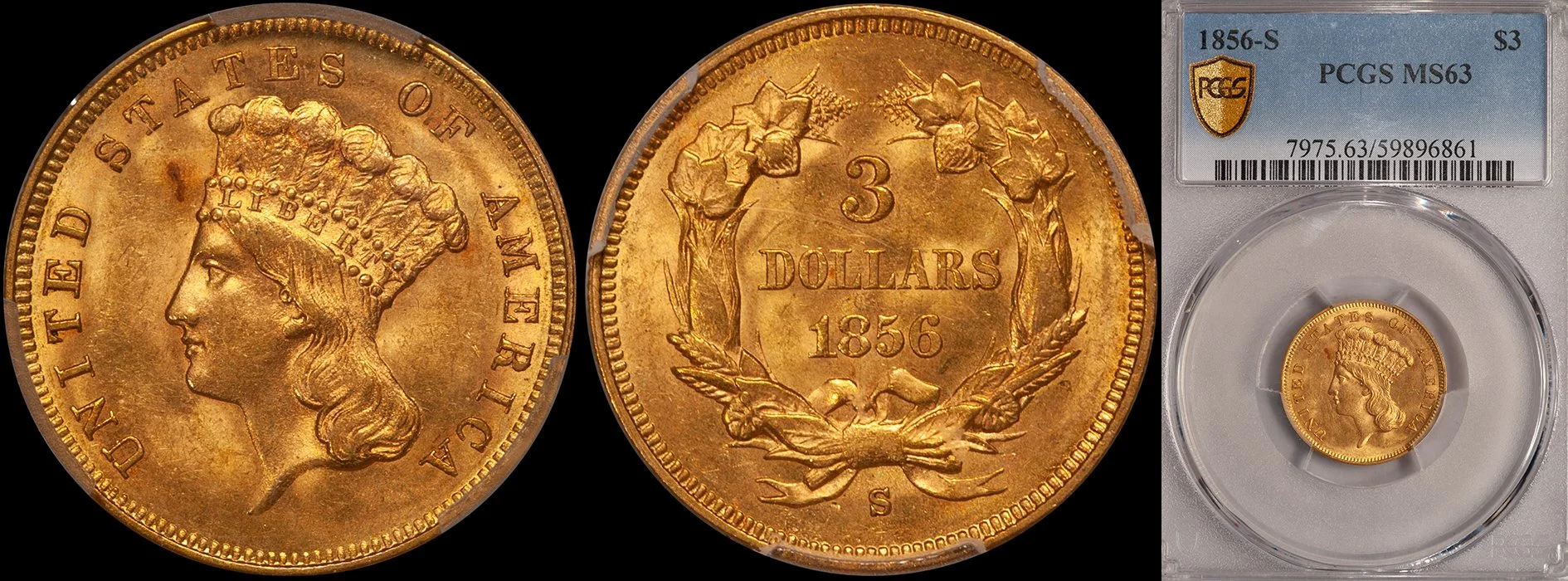
One of the most interesting coins in the sale was not part of the Morgan Collection. This was an NGC MS62 1854-O Three Dollar gold piece which I thought was one of the two best examples of this issue that I’ve seen. It brought $74,750 which is easily a record auction price for this date but which fell short of the reported high five figure price which a PCGS MS62 example traded for via private treaty in 2006.

A number of lovely New Orleans half eagles were offered. I purchased a superb NGC MS63 1840-O for $34,500, a high end 1843-O Large Letters in NGC MS62 for $18,400 and a dazzling fully Prooflike NGC MS63 1844-O for $16,100. Two coins I liked but was outbid on were a PCGS MS61 1854-O which sold for $11,500 and the Pittman 1855-O in MS61 which brought $21,850; a record price for the date.

The Carson City half eagles in the Morgan Collection included a number of very important pieces. A choice AU55 1870-CC was sold for $37,375 and a really nice NGC AU50 example of the very rare 1873-CC realized $28,750 which is surely a record price for an 1873-CC in this grade. My favorite coin in the collection and certainly one of the single neatest coins I’ve ever owned was a glorious 1875-CC in PCGS MS63. It sold to a New York dealer for $103,500 and I think it was an extremely good value. Another lovely and important coin was an 1881-CC in NGC MS63. Like the 1875-CC it was the finest known example and it sold for $57,500; again, a reasonable price considering this coin’s rarity and significance.

Other notable prices realized for Carson City half eagles in the sale include $29,900 for the finest known 1884-CC (a PCGS MS61) and a strong $13,800 for a PCGS MS64 1891-CC.

The set of Carson City eagles in the Morgan Collection was complete and it rivaled the set sold in ANR’s Old West sale this summer as the finest group offered at auction since the Bass sales of 1999-2001. A PCGS EF45 1870-CC went strong at $46,000 and an impressive NGC AU55 1872-CC brought $34,500. One of the strongest prices in the sale was the $43,700 realized for an 1873-CC in PCGS AU50; Trends for this date is $30,000 in this grade. A lustrous but heavily bagmarked 1875-CC in PCGS AU53 brought $29,325 and an 1876-CC in PCGS EF45 realized $12,650 against a Trends value of $12,000 in this grade.

I was very happy to purchase a choice AU55 NGC 1877-CC for $27,600 as I thought it was comparable to the Bass coin which had sold for $41,400 back in 1999. Among the latter date Carson City eagles, a PCGS MS61 1881-CC with superb original color sold for $10,350, a gorgeous NGC MS64 1891-CC was bid to $17,250 and a fresh, attractive 1893-CC in NGC MS60 went very reasonably at $8,625.

There were not many New Orleans eagles in the collection but the star attraction, the only Uncirculated example known of the rare 1879-O, was a coin which I felt was one of the most important gold coins of this mint ever offered for sale. I was shocked to buy it for what I thought was an extremely reasonable $52,900. I also purchased a very choice 1880-O in NGC MS61 (I think it is the second or third finest known) for $16,100 which was also considerably less than what I would have paid. An NGC AU55 example of the rare 1883-O was bid to $20,700 and a choice NGC MS63 example of the vastly underrated 1899-O sold cheaply at $5,750.

My overall take on this sale is that prices were mixed. I think there were some incredible bargains and I think some prices were considerably higher than what I would have expected. I think this sale was hurt by the fact that it occurred less than two weeks after the mammoth FUN auctions and that the lots were not available for viewing during the FUN convention at Stack’s table as ANR used to display lots for upcoming sales.

When I communicated with the owner of this collection about his selling it, I suggested that he allow me to resubmit the coins for grading as I thought nearly every piece in the group would upgrade; some considerably. He didn’t take my advice and I wonder if this cost him money or not. It’s hard to say but when I start seeing how I did on these coins I bought after they’ve been resubmitted, perhaps I’ll have a better idea.

Timing in the Coin Market

Assuming you want to sell coins at auction, does it make a difference when you do? In my opinion, timing in the coin market is everything. Here are some tips about when to sell and when not to sell at auction. Traditionally, people have assumed that it made more sense to sell coins at auction during major conventions like FUN or ANA. In the past, this was definitely true. Today, with the emergence of the Internet and a new mentality that an auction could occur on Mars and the buyers would still be there, I do not feel this is necessarily true.

It is expensive for a firm like Heritage to conduct a sale at a major convention. In addition to the fees that they have to pay to the organization who conducts the show (ANA, FUN, CSNS, etc) it costs more to run a sale in a major urban area. A seller has to ask himself if it is worth more money to sell coins at a major show than a not-so-major one. If it costs 4 or 5% more to put coins in the ANA auction that a pre-ANA sale, is this worth it?

This last question is an interesting one to ask. I can see the validity of both a yes and a no answer. Some people will contend that an ANA or FUN show brings out more buyers than, say, a Long Beach or Central States show and it is worth paying the extra money. Others people feel that, as I mentioned above, the buyers are going to find the coins regardless of what show the auction is being held in conjunction with and paying the premium price is a waste of money. I tend to agree with the former theory rather than the latter.

From experience, I have learned a couple of tricks as far as selecting a time and place in which to sell coins at auction. If I had a collection of “sophisticated” or historic coins (like Colonials or early type), I would sell them at an east coast sale since that’s where many of the buyers for these coins live. Logic dictates that a collection of Charlotte or Dahlonega coins should be sold in a venue like Atlanta although this is not always the case. And, as I will discuss below, New York City is an exception to every rule because of its incredible size and wealth.

There is no question that in 2007 Manhattan is the undisputed center of the world as far as selling art. Incredible amounts of money are in or near New York and it’s nice to think that some of this will be flowing into the coin market. I think this is true from the standpoint of people who already like coins and there are certainly a lot of serious collectors in the New York/New Jersey/Connecticut tri-state area. But it’s a pipedream to think that the guys who just dropped $15 million at the Christie’s Contemporary Art auctions are going to wander into a New York coin auction and be factors there.

When you are deciding on when to sell your coins at auction, use a calendar and a little common sense. This year’s pre-FUN auctions didn’t do well because in order to properly view the lots and figure your bids, you had to fly down to Orlando on either December 31st or January 1st. Realistically, how many people (even coin dealers) don’t have better things to do on New Year’s Eve or New Year’s day than flying to Orlando and slogging through a bunch of coins?

Is the auction you are considering being held on the Jewish holidays? Even those of us who don’t attend services think it’s tacky to be spending the High Holy Days at a coin auction.

Certain times of the year are traditionally slow in the coin market. November and December are always slow months due to the fact that there are few major shows and traveling becomes difficult due to bad weather and holiday conflicts.

Certain venues are traditionally bad coin towns as well. I have a personal grudge against St. Louis as a coin town and despite the fact that I’ve probably gone to ten coin shows there in the past two decades, I have had continually bad numismatic experiences in the Gateway City. Therefore, I’m just not going to put coins in an auction that occur in St. Louis; even if Tony LaRussa personally comes to my office and solicits a consignment.

What about when there are numerous auctions stacked up against each other during short periods of time; like before and during the ANA when three or four competing firms all have sales? Which sale do you pick—the first one (when people will be fresh and have money to spend) or the last one (when they will be burned out and broke)? The answer is not as cut and dry as you might think.

2007 FUN Show Review

To borrow from a Chinese Proverb, after this year’s FUN show it looks like we will be living during interesting numismatic times in 2007. I would give the FUN show a grade of B (or possibly a B+) on the Winter Coin Show Grading Scale. It wasn’t the best FUN show I’ve had but certainly not the worst. Most of the dealers I spoke with had similar mixed results.

I go to coin shows mainly to buy and from that standpoint, FUN was a rousing success. I was thrilled with what I was able to purchase (much of which is already listed on my website, FYI. I try to have the majority of my new purchases described and imaged within 24-48 of returning from a major show, even if it means working all day on Sunday). Through a combination of luck and hard work, I was able to purchase some of the most interesting United States gold coins I’ve owned in some time.

You are, no doubt, wondering what was hot at the show and what wasn’t. Unlike last years’ FUN convention where just about anything that was round and gold flew out of my case, buyers were more selective this year. I noted a lot of interest in choice, original coins (I think my years and years on the Originality Soapbox may finally be paying off!) in a number of areas. Nice, affordable Charlotte and Dahlonega issues in all denominations were in demand but were, as usual, hard to find. Rare Liberty Head double eagles were highly sought after as were interesting, truly rare early gold coins. Carson City gold also seemed to be in strong demand, especially rare dates in higher grades and nearly all CC double eagles priced in the $1,500-15,000 range.

What wasn’t hot? Coins which were schlocky. By this I mean coins which had an obvious “processed” look; items which, although over 100 years old, had surfaces which seemed irradiated. These were nearly impossible to sell, although they were very easy to buy. Generic gold wasn’t helped by the fact that bullion dropped around $30 per ounce while we were at the show.

I had wondered if the gigantic Heritage sales would take the wind out of the FUN show. While over $75 million in coins sold at auction in the space of just four days, it didn’t have as big an effect as I thought. No, there were no Numismatic Tumbleweeds blowin’ down the aisles while crowds swarmed at the auction. I guess if you had a coin like a 1930-S eagle (of which there were no less than five in the Heritage auction) you were going to have a hard time selling it at the show. But if you had nice, attractive coins they were selling.

Being the Numismatic Contrarian that I am, my FUN strategy was probably different than most other people. Instead of focusing on the auctions as a place to buy coins, I figured that I would aggressively pursue my various dealer contacts on the bourse floor. As I mentioned above, I think it really paid off. There weren’t all that many interesting dated gold coins in the Heritage sale but I found many neat items on the floor.

You might also be curious to know what my take was on the Heritage sale. Basically, any really fresh, really nice coin brought big bucks. Tired coins brought prices which ranged from downright cheap to surprisingly strong. There were instances where too many examples of the same date or same type appeared in the sale and in these instances, the lower quality coins tended to really suffer. I will be very interested to see how many of the big coins which were sold reappear in sales a few months from now and how many go away. I’m guessing more of the latter than the former will occur.

One observation I made from attending the auctions is that the day of the Instant Expert Investor may be coming to an end. The market has been so good for the last few years that it was possible for a new investor/collector to roar through a high dollar set in a year or two, place it in an auction and reap good rewards. In my opinion, these days may be coming to an end. In 2007, buyers seem to be more sophisticated than in the past and they will pass on certain coins in order to merely fill holes. This is just fine with me as I have been preaching patience when in comes to collecting for as long as anyone would listen.

I will be adding some more comments about the show in the days to come and invite you to check back for these.

2007 Crystal Ball Survey

I was recently asked to participate in the annual Crystal Ball survey published by Maurice Rosen. Although some of these questions are not totally pertinent to the area of rare gold coinage, I think there is quite a bit of interesting reading here. 1. We had a great market till May, then a slump. What's your outlook for 2007/2008? Please explain in detail.

I think the coin market is going to be very two-tiered in the next year. I think that really good/really interesting coins will continue to show strong demand while average quality/uninteresting coins will be very soft. We’ve had a great run the past few years but it seems inevitable to me that certain areas will slow down. I think the market weakness that we saw in 2006 reflected the fact that many areas which had performed well the past few years were strong because of dealer promotions. When the promotions stopped or the dealers decided to take profits, the demand for these series dropped quickly.

I think the price of gold will fluctuate between $500 and $600 throughout the year and we will see occasional run-ups in generic prices but nothing spectacular.

I’ve noticed that coin buyers are becoming more sophisticated and I think that choice, original coins will be strong in 2007. As an example, if you have two MS65 Bust Halves for sale at an auction and one is a true Gem with nice color while the other is dark and shows obvious rub on the high spots, the nicer of the two might bring 50%+ more. This schism between true quality and junk will be more graphically illustrated in 2007 (and beyond).

2. What areas of the market look to be the best performers for 2007/2008? Please explain why.

I think better date Seated Liberty coinage in Mint State will do well in 2007. There are still some really good values in this area, especially in the quarter and half dollar series. I love just about any No Motto Seated coin in MS64 or better. Attractive, properly graded examples of many of the so-called common dates are much, much harder to locate than people realize.

Early gold will continue to be strong but buyers are becoming more selective in this area. I really like pre-1834 quarter eagles. They are many, many times rarer than comparable half eagles and eagles yet are often priced at considerably lower levels.

Proof gold will continue to be a strong performer, especially larger denominations. My favorite coins are the pre-1890 issues with mintages of 50 coins or less in PR64 to PR66. These coins are really rare and they are very appealing to wealthy investors.

I really like the potential of New Orleans gold coinage, especially No Motto half eagles and eagles. People have finally realized how rare these issues are in higher grades and they like the fact that Condition Census coins can often be acquired for less than $10,000.

It seems that Commemorative Gold is about due for a promotion and this looks like a good area right now for speculators. I like most of the issues in MS65 and MS66.

Variety collecting has really become popular and I think that very rare varieties in popular series will do quite well in 2007. It always impresses me to see what serious collectors will pay for very rare Sheldon or Overton varieties in specialist auctions.

3. What areas of the market look to be the worst performers for 2007/2008? Please explain why.

Small sized type coins like Three Cent Nickels, Shield Nickels and Liberty Nickels are cheap right now but for a good reason. These coins are boring. No one really collects these series any more (except as type coins) and I can’t see any real reason for these series gaining in popularity.

With certain exceptions, I think that Barber coinage will remain soft as well. There are not many collectors working on complete sets of Barber coins and unless a very rare, very low population piece is offered (or a nice mid-grade circulated example of a rare date) most issues show little demand.

I think many key date 20th century (and late 19th century) coins are overvalued. Issues like 1901-S quarters and 1916 Standing Liberty quarters have dramatically increased in value and I think they are now very overpriced.

Common date Bust Dollars in Fine-Extremely Fine have gotten pretty pricey in the last few years and I would not be surprised if this market shows some correction. Lots of the pieces I see in this grade range are very overgraded. That said, I still like nice AU and better Bust Dollars as long as they are original and attractive.

It seems like you just can’t give slightly off-quality Silver Commemoratives away and I think this market will stay soft unless some large marketing firm decides to promote Commemoratives. If a Commemorative isn’t gorgeous, it is very hard to sell.

In nearly all series, I think low-end, marginal coins will be harder to sell in 2007. Even in really popular areas like early Type, coins that are clearly ugly for the grade just aren’t going to be as liquid s they were back in 2005 or early 2006.

4. Since the lows of 2001, gold almost tripled, but rare coin performance severely lagged gold. Some indices show gains of 20%-40% from 2001 to the highs of 2006! (A) What accounts for the disparity? (B) What does this portend for the future?

I think the weakness in generic gold has to do with the fact that many of the older telemarketing firms who used to promote these coins are no longer actively supporting the market. They’ve moved on to other areas with larger profit margins and that’s why the demand for bread and butter generics like MS65 Saints is nowhere what it used to be. If there is no real level of demand for generic gold, then I expect levels to continue to lag the performance of gold.

5. (A) Do you think that "Ohiogate" had a detrimental impact on the market? If yes, how so and why. If not, why not? (B) What lasting effects can we expect from "Ohiogate?"

I originally thought it would have a very detrimental short-term effect, given the fact that a huge amount of coins were being dumped on the market under the direction of a liquidator who had no clue how to properly market them. I was surprised that the market was, for the most part, able to absorb the Fund’s coins. However, I do not think the full ramifications from the scandal have been clearly felt yet. The Fund was a huge entity in the market with their fingers in a lot of pies. It will be very interesting to see what happens in the next year or two.

I think the biggest lasting effect we might see from Ohiogate is that larger intuitional investors who might have previously toyed with the idea of getting into coins might not be as anxious after they hear the gory details from this story.

6. (A) What will it take for a large financial institution to make a commitment to the coin market? (B) What specific sectors of the market would be most likely emphasized in the portfolio of a large coin fund?

I’ve spoken with clients of mine who are involved in hedge funds or private equity groups and most of them won’t do a coin deal because the numbers are just too small. These guys are looking at doing $250 million+ deals (in many cases more than this) and a little $25 million to $50 million coin deal is just too small for them. That said, there is always the chance that a hedge fund guy who loves coins might do a fund as sort of a lark. But every time we’ve seen large funds in the coin market, the results have not been good.

If a fund were to be established, it needs to be run by someone like John Albanese who is very smart and very ethical. I assume that a fund run by someone like John would focus on really rare coins like Proof gold, early type (silver and gold), classic rarities and popular individual issues like High Reliefs, Pan-Pac Octagonal and Round $50’s, etc. This is essentially what the Ohio Fund was focusing on and I think they did a very good job in terms of buying coins and focusing on specific market areas.

7. As we close 2006, how do you assess the state of coin grading? This is a broad question. I leave it to you to comment any way you want.

My complaints about the services today are the same as they were ten years ago. I do not think that either of the majors rewards originality and I see lots of coins in holders that I think are very, very marginal at best. In my area of specialization (rare date gold), I think both services have really diminished the market’s expectation of what an AU58 should look like. Coins with little or no original mint luster are graded AU55 or AU58 and this has lessened the price premium for certain dates in these grades.

On a related note, kudos to NGC for having the best customer service I’ve ever seen in a company that I do business with on a regular basis.

8.(A) How important are Modern Coins becoming to the market? Despite many people deriding them, many coins bring high prices in super-grades. (B) What are your overall views and recommendations for investors?

I’m sure every answer you’ll get about modern coins is that they are horrible, the market is totally one-way, the coins are ugly, etc. Although I basically agree with these points, I can’t completely denounce the modern coin market. I don’t like the coins and I can’t see why anyone would want to collect them but, by the same token, I can see how someone might not be as turned-on by 18th or 19th century classics as I am. I take a “live and let live” attitude with moderns. I do not plan to ever deal in them but if someone chooses to collect these coins, more power to them. They are affordable, easy to buy and, hopefully, are a good stepping-stone to more sophisticated market areas.

That said, I would NEVER recommend any modern coin as an investment. As far as collecting these coins, I think at $50 or $100 per coin, moderns are just fine. But I would caution the investor to avoid expensive PR70 and MS70 moderns as they have lots of downside risk, in my opinion.

9. Two sophisticated investors come to you to invest for the long-term. One has $25,000, the other $250,000. Each investor wants only a few coins. What do you recommend to each and why? Please state the upside potential for your picks.

For a $25,000 package, I would suggest the following. I would choose an interesting No Motto Seated quarter or half dollar in MS64 or MS65 in the $7500-10,000 range. I’d try to find a coin with a population of fewer than ten coins with relatively few higher and a piece that was original and very attractive. Then, I’d find a New Orleans half eagle or eagle in the AU58 to MS62 range that was Condition Census quality in the $7,500 to 10,000 range. With the remaining money, I would find a piece of Proof gold that was relatively affordable (around $10,000) but which had a lower mintage figure than a “common” date. I think this would be a small but neat group of coins.

For a larger budget collection, I would start with two pieces of early gold. I’d try and find a rare Fat Head half eagle struck in the 1820’s or 1830’s in Uncirculated in the $25,000-35,000 range and a quarter eagle from this era in MS62 or above in the same price range. I would then look for a really neat piece of Proof gold; something like a PR65 quarter eagle from the 1870’s or a high end PR64 half eagle from this decade. I’d figure to spend another $25,000-30,000 on this piece. Then, I would look for a Gem Large Size Bust quarter in the $15,000-20,000 range or a killer MS66 Bust half dollar. After this, I would try and buy one great early copper coin; something like a 1794 cent in Uncirculated with a great 100+ year pedigree. I’d budget around $20,000 for this coin. Next, I’d buy a sexy $10,000 Colonial coin with a Ford pedigree. The Ford sales have been a little under the radar to those who don’t specialize in Colonials but this is easily the greatest offering of early Americana in our lifetime. I’d look for a high grade example of a popular issue like a Pine Tree shilling or maybe a New Jersey or Massachusetts or Connecticut copper. I would finish off this collection with a few great 19th century gold coins; maybe a couple of very high grade Carson City or Dahlonega pieces or some killer New Orleans coins. I would be highly selective here and focus on really nice, really high end coins. If I had another $5000-10,000 left I would buy a few great plated Chapman auction catalogs. These are rare, undervalued and incredibly neat.

If I had a chance to buy an 1838-O half dollar or an 1876-CC twenty cent piece I’d choose one of these two classic rarities as my $250k portfolio and punt the group of coins listed in the paragraph(s) above. I’ve always felt that these were the two “Great American Rarities” that were truly undervalued, even though they have appreciated significantly in the past few years.

10. Increasing government regulations, further losses of privacy, more taxes, these are all likely to impact our lives in the years ahead. (A) How might they impact the coin market? (B) What specific advice do you have for today's investors?

I don’t really feel qualified to answer this question so I am not going to delve into it…except for one quick comment. I’m going to assume that a big issue in the coming years for the coin business will be an Internet sales tax. My business has grown exponentially over the years due to the Web and I think that an Internet VAT-type tax could really hurt the growth of the coin market.

11. Your Best Buys for Type Coins in MS and Proof.

As I mentioned above, I love No Motto Seated quarters and halves in properly graded MS64 and above. These coins are really rare and really good deals. New Orleans half dollars from the 1840’s in MS63 and above seem to be one of the best values in the market right now. It’s hard to find these coins but when they are available you can purchase some legitimately great coins for under $7,500. I’ve always had a soft spot for Flying Eagle cents in Gem Uncirculated. If you can find coins that are well struck, free of mint-made defects and which are not dark, they are great values at current levels. For many years, I’ve thought that Proof Braided Hair half cents in 64RB and better are really cheap at current levels. I’m not saying that they are great “investments” but they seem like a lot of coin for the money.

I think that very pretty type coins in MS65/PR65 and better are, in general, good value right now. By this, I mean coins that have very pretty (but not too deep) multi-colored toning. I would avoid ultra-high grade coins that have a high premium over the next grade down and I would avoid coins that have a huge premium for Cameo/Ultra Cameo designation. I think a lot of low population Ultra Cameo coins run the risk of growing populations when coins graded a number of years ago are resubmitted.

12. Your Best Buys in the Gold Coin sector.

In early gold coins, I love the quarter eagles struck from 1821 through 1834. They are extremely well priced in comparison to early half eagles and eagles. I have a few clients right now who are assembling date sets and I am amazed at how hard it is to find a number of these early quarter eagles.

In the Liberty Head series, I think New Orleans coins offer unbeatable value. My new book has created a number of new collectors and I’d say that high grade New Orleans gold from the 1840’s and 1850’s tends to be, in most cases, many times rarer than Charlotte and Dahlonega issues from this era—at lower price levels!

An esoteric but much undervalued series of coins is the Philadelphia eagles from the 1840’s. There are a few dates (such as the 1844, 1845 and 1846) that are almost impossible to find in any grade above AU50 but which are still relatively affordable. And unlike most mintmarked coins, not all of the Philadelphia pieces have been dipped-n-stripped.

If I were a rich guy who liked 20th century gold, I think I’d focus on Indian Head half eagles. These are by far the rarest 20th century gold pieces in Gem Uncirculated and a number of dates in this series (1909-O, 1911-D, 1912-S, 1913-S, 1914-S and 1915-S) are excessively rare in Gem. If you started a high grade set, you’d have less competition than in the Indian eagle and St. Gaudens double eagle series, so you might actually have a shot at the really great coins if and when they become available.

13. Your Best Buys in Silver Dollars.

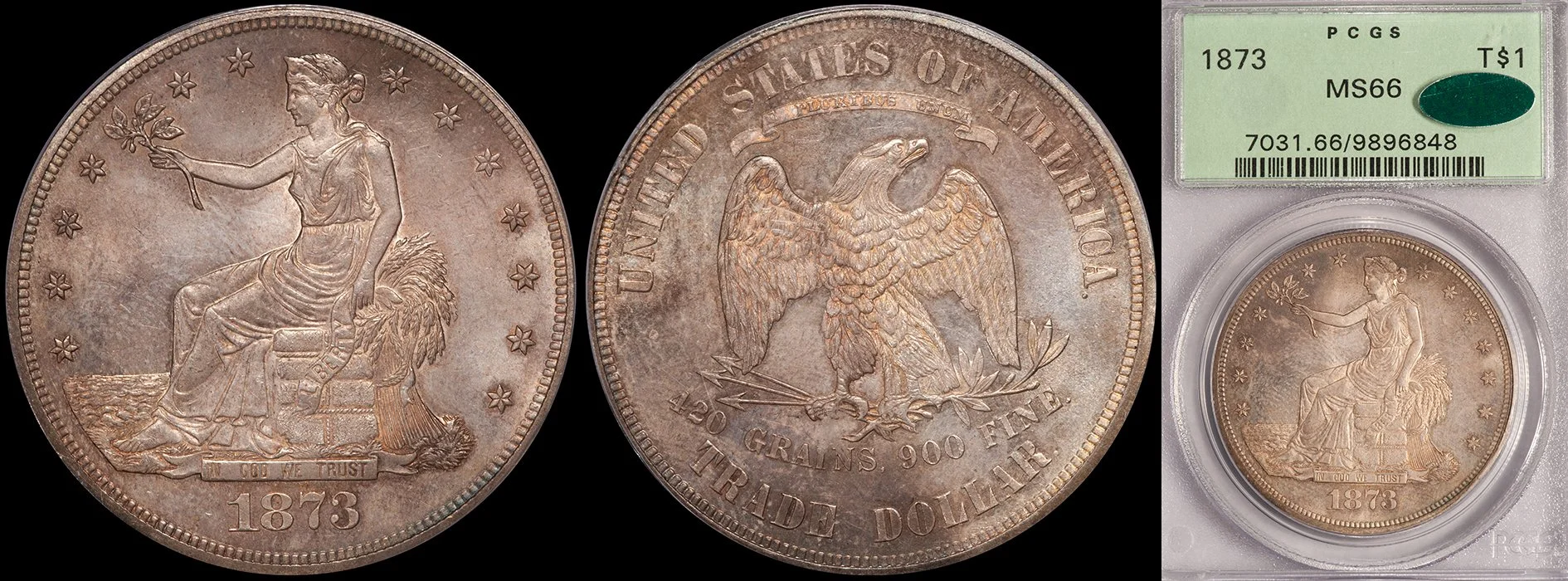
I’ve always thought that Gem Trade Dollars were one of the rarest and most undervalued mid-19th century types.

I personally hate Morgan Dollars so I’m probably not that the best person to ask about “best buys” in this series.

I’m amazed that more people don’t try and assemble Peace Dollar sets. These coins are such great deals compared to Morgans. The series is short, completable and not terribly expensive in Gem. If someone was to write a really good guide to collecting Peace Dollars and a few of the larger retailers actively promoted this series, I think prices could rise dramatically. That said, I doubt this will happen anytime soon.

14. Your Best Buys in the U.S. Commemorative series.

Every time I’ve been asked this question, I always give the same answer: I like Gem examples of the pre-1928 silver half dollars. I don’t look at that many commemoratives but when I do, I find most of the issues like the Maine, Missouri, Alabama, Grant, Vancouver, Pilgrim, etc. to be washed out and “yucky.” I think undipped, lightly toned MS65 and MS66 examples of these early issues are cheap at current levels.

15. Your Best Buys among 20th Century Series coinage.

Superbly toned Proof 1936-1942 coinage seems to have disappeared as most of these coins have been dipped. I’ve always liked coins with lightly toned centers that become deeper in hue towards the edges. In PR66 and PR67, the silver issues from this era are very favorably priced right now.

16. Your Best Buys in any other sector of your choice.

In my primary area of the market (branch mint gold) I’d have to say that nice quality Charlotte gold is a good contrarian play right now. $20,000+ Charlotte coinage is a hard sale but it is inevitable that one or two new deep-pocketed collectors will want to create great sets of these coins in the coming years.

Three Dollar gold pieces were certainly due a correction after the great run they had in 2005 and 2006 but I think the market overcorrected. I like the low mintage dates from the 1880’s (like the 1881, 1883, 1884, 1885 and 1886) in Mint State and nice AU and better examples of the San Francisco issues. A great time to buy coins like this is when all of the “geniuses” who became Instant Experts on Threes last year have now moved on to greener pastures.

Nice New Orleans gold is a terrific value right now. In most cases, you can buy a scarce No Motto half eagle or eagle from this mint at a significant discount in comparison to a more available piece from Charlotte or New Orleans.

As I’ve mentioned about ten times, I really like No Motto Seated coinage in MS64 and better, especially New Orleans pieces.

I think, in general, that in nearly any series, “best buys” are always nice, original coins. It’s become so hard to find pieces that haven’t been messed with. I think down the road that really fresh coins will begin to bring huge premiums over the typical run-of-the-mill junk that you see most of the time.

17. What changes or innovations are needed to make the pricing of coins a better deal for investors? Just as reduced commissions (even the elimination of commissions!), plus much narrower spreads between bids and asks, have dramatically lowered trading costs for stock traders, what can be done to make our market more efficient and a better deal for investors?

The Heritage auction archive is an amazing tool. It enables a collector to see the price performance of nearly any coin over the past few years. If Heritage (or someone else) were to take this idea and include all of the major numismatic auction companies, this would be an incredible resource for collectors and investors. The ability to quickly and accurately track pricing is something that increases a new investor’s confidence level; especially in thinly traded market areas.

The advent of the Internet has increased the amount of transparency in the coin market in the past few years. I think the coin market is far, far more transparent than most any other collectible and, again, that is a good boost for investor confidence.

Something that has long hurt the coin market is that a decent number of neophyte investors are still making their first trades with brokers who are either taking advantage of them or are not providing them with the tools to turn them into long-term market participants. As an industry we still need to shed the last vestiges of the Wild West mentality of the 1970’s and the 1980’s and treat potential new investors with the attitude that the coin market is a great place to place some discretionary income in for the long term.

18. Since PCGS and NGC began, we've seen a general loosening of grading standards. (A) Could standards in the future become stricter, thus reversing the trend of the last 20 years? (B) If yes, what event or events would cause this to take place. If you disagree, please explain why. I doubt very much that either PCGS or NGC is going to admit that standards have changed, let alone reverse them back to where they were in 1986/87. I think it’s more important, at this point, for collectors to keep up on current standards so that they can grade by the standards of 2007 and not by the standards of 1987. Wishing for grading standards to revert to where they were 20 years ago is sort of like someone wishing that you could buy an apartment in Manhattan tomorrow at 1987 prices.

19. What 1, 2, or 3 coins are your favorite "sleepers," coins you know to be much scarcer than generally perceived and, as a result, undervalued. Anything from the 1700's to date, your picks. Please explain why you picked them and tell us their potential.

Here are three coins that I regard as true “sleepers:”

1. 1845-O Quarter Eagle: With only 4,000 struck, this is a very scarce coin in all grades. Any original piece grading EF45 or better is really rare, yet you can still buy a very presentable example for under $10,000. This is the key issue in the New Orleans quarter eagle series, which is short, completable and getting popular.

2. 1847-O Half Eagle: Few non-specialists realize just how rare this date is in nearly any grade. It is the hardest New Orleans half eagle to find and it is nearly impossible to obtain in properly graded AU50 or better. I recently sold a very nice AU55 example of this date for $15,000. If this were a Dahlonega coin of comparable rarity, it would have been worth $25,000++.

3. 1841-O Eagle: I love this issue. It has a low mintage figure (2,500), it is the first No Motto eagle struck at the New Orleans mint and it is nearly impossible to find above EF45. Despite this fact, it is priced at a fraction of the second-tier double eagle rarities from the New Orleans mint (i.e., the 1855-O, 1859-O, 1860-O and 1879-O).

Coin Price Perspectives

If you ask ten knowledgeable people if coins are too cheap or too expensive, you’ll probably get ten different answers. I think certain coins are clearly too expensive but I think others are dirt cheap. Read on for my explanation. Coin prices depend a lot on perspective. I’ve been involved with coins since the 1970’s and in the market as a professional since the early 1980’s. I’ve seen markets go up and go down and watched the cycle repeat itself. As 2007 begins, I think there are certain coins that seem very pricey; primarily due to the fact that they’ve been promoted and that these promotions appear to have run out of steam.

Let me give you an example. Everyone knows that Indian Head quarter eagles have been brilliantly promoted for the last four or five years. During this period of time, the key issue, the 1911-D rose dramatically in price -as it should have. After all, hundreds of new collectors starting working on Indian Head quarter eagle sets and everyone needed a 1911-D.

When the Indian Head quarter eagle market was at its frothiest (in late 2005 to early 2006), an MS63 1911-D would have cost you around $30,000. When the Indian Head quarter eagle series was first being promoted, back in 2001, you could have bought a 1911-D in MS63 for $9,000-10,000. This coin tripled in value in five years and actually became somewhat more available during this time period due to relaxed grading standards. In retrospect, $9,000 for an MS63 1911-D seems pretty cheap while $30,000 for the same coin in MS63 seems pretty pricey. Or is it? If the promotion had continued for another five years, could the 1911-D risen to $50,000 or even $75,000 in MS63? My guess is that, yes, it could have (although I certainly wouldn’t have wanted to buy an MS63 1911-D quarter eagle for $50,000…)

Coin market observers (including, alas, myself) tend to think small and don’t often look at the big picture. The fact is that there is a tremendous amount of wealth in the United States right now and not a lot of places that wealthy individuals feel safe putting some of their excess cash.

If you follow the art market at all, you might have noticed that auction prices for Contemporary Art in the past few years have truly gone through the roof. It is not uncommon for good but not great examples of paintings by relatively good but not great Contemporary painters to sell for well over $1 million. In fact, in the upper echelon of the art world today, $1 million does not buy you very much at all.

We know who is buying many of these paintings. Hedge Fund managers and other successful Wall Street types have targeted Contemporary Art as their “Place To Make A Splash.” And why not when many of these individuals got $5 million, $10 million or even $20 million dollar bonuses this year? When you already own a killer apartment in Manhattan and a great weekend house in The Hamptons, what’s a million dollars here or there on a nice piece of art for the walls?

So what would happen if a small number of these Hedge Fund Superstars got interested in coins? They already have the perfect personality to be coin collectors and many of them probably dabbled with Lincoln Cents and Mercury Dimes when they were kids.

If you are brand new to the coin market and you have this kind of discretionary income, coins seem dirt cheap. Just the other day, I was talking to a client of mine about purchasing a major rarity in an upcoming auction. This is a true museum quality coin and one of the two or three finest known examples of an issue with probably less than a dozen known. To buy this coin, he’ll probably have to spend $125,000 or so. To you and me, that’s a lot of money. But to someone who sees “unspecial” paintings selling at Sotheby’s auction for $2.5 million+ this seems very cheap.

Clearly, these Hedge Fund guys will see their salaries come down to earth someday, possibly soon. But what if, in the meantime, a few of these guys started buying coins? And what if I told you a small but meaningful number of them already are?

The result of this, I suppose, will be an even further bifurcation of the market. The meat and potatoes coins that most of us buy and sell on a routine basis will go up and go down but shouldn’t be affected by Harry Hedge Fund’s foray into coins. But what about coins that are extremely rare or those with great stories or those which are finest known? My guess is that coins like this could get really expensive. Because, if you really think about it, the truly great coins out there actually are dirt cheap when you compare them to other collectibles.

2007 FUN Show Preview

Remember when you were a kid and 6th grade took around two and a half years (or so it seemed) to complete? I guess the best sign of getting older is that your perspective of time changes completely. It literally feels like I was just at the 2006 FUN show a few months. Is it possible that we’re just a week or so away from the 2007 edition? As I’ve written before, FUN is one of my favorite shows. From a psychological standpoint, it feels “new” since it’s the first show of the year. Dealers come to this show more ready to do business than probably any other show. Many dealers have spent the last two or three months trimming their inventories down and divesting themselves of their bad deals. They come to FUN all cashed-up and ready to spend money.

FUN is one of the strongest shows for collectors as well. Unless you live in Hawaii, the chances are that the weather is better in Orlando during January than where you are now. So this tends to be a show that collectors come to with their spouses, significant others and even, on occasion, the entire family. The atmosphere tends to be more relaxed than the ANA show (which I have always thought has a sort of tense undercurrent).

Of course, if the FUN show wasn’t well-run, it might be a lot harder to get excited about it. After all, many people are catching flights on New Year’s Day in order to get there in time to do the pre-show auctions. But unlike other shows that I always hear dealers kvetching about, I never seem to hear anyone complain about FUN being too long or too expensive or in too weird a location.

I think what people like about FUN is its continuity. I’ve been a professional coin dealer since the early 1980’s and I’ve always associated the New Year with the FUN show. I don’t especially like Orlando but I think the Convention Center is better than average (and it is now as big as a small city) and the show is very well-run and professional.

I am a bit concerned by this year’s FUN show being diluted by the size and magnitude of the various and sundry auctions. Until a few years ago, FUN was all about the show itself and the auction(s) surrounding it were secondary. This changed once Heritage started producing $25-50 million dollar FUN sales.

How will the auctions affect the show? I think the biggest affect will be with collectors who might have a budget of, say, $10,000 to spend on coins at FUN but who get carried away at the auctions and spend it all there. I would expect that my retail sales at the show will be down considerably from where they were in the past. I don’t think that the size of the auctions will have all that much affect on wholesale business at FUN. If you have neat coins, dealers are going to want to buy them and many realize that coins on the bourse floor could be a much, much better deal than their counterparts at auctions.

What will be interesting is the impact on dealer cash flow, especially 45 to 60 days from now when auction bills come due. I can think of a number of well-known dealers who already have precarious cash flows. How are they going to pay a $500,000 auction bill with Heritage or Stack’s when a check they write me for $10,000 needs to be held for thirty days? This could be very interesting…

That said, I personally think the 2007 FUN show is going to be very strong. There is no doubt in my mind that people want to buy coins and, despite the fact that the auctions contain a seemingly unlimited number of lots, there really aren’t all that many fresh or very interesting pieces available; at least in the area of pre-1900 United States gold.

In some market areas, we are going to be able to figure out what some very rare coins are really worth. I expect that we’ll see a dip in the Indian Head eagle market and significant strength in rare date Saints. Proof gold is going to be very interesting to monitor, especially Matte Proof issues. I personally think the coins in the auction shouldn’t sell for strong prices given their quality but I’m willing to bet that I’m wrong and that they sell for strong prices to people who don’t know what original examples are supposed to look like.

2007 is going to be a very interesting year in the coin market and I’m guessing that the FUN show should be a good barometer. I hope to see you there!

Can You Determine a Market Trend From One Auction Result?

Can you determine a market trend from one auction result? A few mixed results from a recent coin auction caused a number of clients to call me and ask me this question. My answer(s) were that, in each case, I did not feel that changes in the market could be determined from these results. Let me be more specific. In the November 2006 Heritage sale there was an 1845-O quarter eagle in NGC AU53 offered as Lot 1937. If you’ve read any of my articles on New Orleans quarter eagles, you’ll know that I LOVE this date and almost always try to buy it. But this coin was an exception to the rule.

Although you couldn’t really see them in the Heritage online images, this 1845-O quarter eagle had some really detracting marks on the surfaces. They were the sort of marks that, eight out of ten times, NGC would have no-graded the coin in question for “damage.” Which was sort of a shame, as the coin, with the exception of the marks, was not bad looking. But I decided to pass on the coin as I though the marks made it too hard to sell.

The coin was reserved for somewhere in the $5,000 range which means that it could have been purchased for $5,750 including the 15% buyers charge. In my opinion, $5,750 for an AU53 1845-O quarter eagle is very reasonable. Except in this case.

After the sale, a client called me (one who owns a nice AU58 example of this date, by the way…) and asked me if the fact that this coin didn’t sale indicated a weakness in the market for 1845-O quarter eagles. I told him that I didn’t think so, given the fact that the coin in question was not very nice.

Another lot in the same sale provided another interesting test case. This was an 1879-O double eagle graded AU50 by NGC and it was Lot 2570.

If you follow New Orleans double eagle prices at all, you know that nearly any 1879-O that has been offered at auction in the past four or five years has sold for full Trends or, in many cases, considerably more. But the 1879-O in this sale sold for around 75-80% of Trends. Did this suggest, my client asked, that the market for this date was getting weak and could he finally buy one for a reasonable price?

I had viewed this coin in person and hated it. I thought it had zero eye appeal. It was not only overgraded, in my opinion, but it had some detracting spots as well. Apparently other bidders agreed with me as well as it brought at least $5,000 less than what a nice looking example would have.

Does this weak auction result mean that the market for 1879-O double eagles is tanking? Not in the least. Now, if this trend continues for the next two or three times that an 1879-O is offered, my opinion would change. Especially if any of the future coins that sell cheaply happen to be nice for the grade.

The bottom line is this: I do not think you can make any profound analysis about values decreasing (or increasing) for a specific issue based solely on a single transaction.

The Pinnacle Collection of New Orleans Gold Coinage: An Overview

There haven’t been many truly great collections of New Orleans gold coins formed over the years. This is due to two reasons: a lack of popularity until recent times and the rarity of many of these issues in higher grades. One of the finest collections of New Orleans gold coinage of which I am aware is the Pinnacle Collection which is currently owned by a collector who lives on the West Coast. I have been the primary supplier of coins in this collection and, if you don’t mind a little plug for Douglas Winter Numismatics, I don’t think it would be possible to form a much nicer set than this. Nearly every coin is very high end for the grade and most were selected with the following criteria in mind: originality, excellent overall eye appeal and sharp strikes.

The owner of this collection began assembling it in 2002 and bought the majority of the coins in 2003 and 2004. I was lucky to have been able to purchase a superb collection of New Orleans gold coinage in 2003 of which many pieces went into the Pinnacle Collection. It was clearly a situation that this collector was in the right place at the right time.

The Pinnacle Collection is very nearly complete with the exception of the Liberty Head double eagles. The owner of this collection decided not to focus on this denomination due to the extremely high cost of choice pieces and because he felt that the smaller denomination coins represented better value for the money. His gold dollars, quarter eagles, three dollar gold pieces and half eagle sets are complete while the eagle set lacks just four coins (none of which are especially rare) to be complete.

NOTE: You can view this set on on-line on the PCGS website (www.pcgs.com). Simply go the Set Registry area, search for gold sets and then for New Orleans sets. The collection is listed as the “Crescent City” collection but it is better known to collectors as The Pinnacle Collection. In my new book “Gold Coins of the New Orleans Mint, 1839-1906”, many of these coins are described and photographed as well.

I. GOLD DOLLARS

The six coins in this set have an average grade of 63.66 and are very evenly matched and original. They range in grade from MS62 (the 1855-0) to MS65 (the 1849-O).

One coin in this group that really stands out is the 1850-O. It is graded MS63 by PCGS and is one of just five recorded by PCGS in this grade with two better (both MS64). The 1850-O is the rarest gold dollar from this mint yet it remains an issue which is overlooked by many collectors. This is a coin that would be priced at $15,000-20,000+ if it had a C or a D mintmark but it is still valued at well under $10,000 in this grade.

I also really like the 1849-O gold dollar in this set. It has been graded MS65 by PCGS and is one of just four graded as such by PCGS with none finer. It is historically significant as a first-year-of-issue date and it is, obviously, very rare in Gem. The Pinnacle Collection example is unusually well struck and it exhibits lovely natural rose and orange-gold color.

II. QUARTER EAGLES

The quarter eagle set contains fourteen coins and every piece except one (the 1845-O) grades MS62 or better. The average grade of these coins is a healthy 61.9 and I would have to think it is one of the two or three best sets ever assembled.

My choice for the highlight of this set is probably not a coin that others might take note of: the 1856-O in MS62. Even though this issue is slightly available in lower grades, it is a major rarity in Uncirculated and the Pinnacle Collection’s example is the best piece ever graded by PCGS. It is really a stunning example for the date and grade with great luster, rich orange-gold color and outstanding surfaces. It traces its origin to the Bowers and Merena 6/01 sale where it brought $19,550 in a much slower market than today.

Two other coins in the quarter eagle set that I think are notable are the 1840-O and the 1842-O, both of which have been graded MS62 by PCGS. The former is pedigreed to the David Lawrence Richmond collection sale while the latter was obtained from my firm via private treaty in January, 2005. Both coins are notable for outstanding strikes and are very original with great green-gold color and thick, undisturbed luster.

The three highest graded quarter eagles in the collection are the 1839-O, 1846-O and 1857-O, all of which have been graded MS63 by PCGS. The 1839-O has a population of seven in this grade with five finer (all MS64), the 1846-O has a population of just one in this grade with one better (an MS64) and the 1857-O is one of four in this grade with a single example better (an MS64). Obviously, all New Orleans quarter eagles are rare in MS63 or higher grades and the fact that the Pinnacle Collection contains three different pieces is, in my opinion, quite impressive.

III. THREE DOLLAR GOLD

The Pinnacle Collection contains a PCGS AU55 example of this popular one-year type. It is notable for its excellent strike and originality and it is a much nicer coin than many I have seen graded AU58 by NGC.

IV. HALF EAGLES

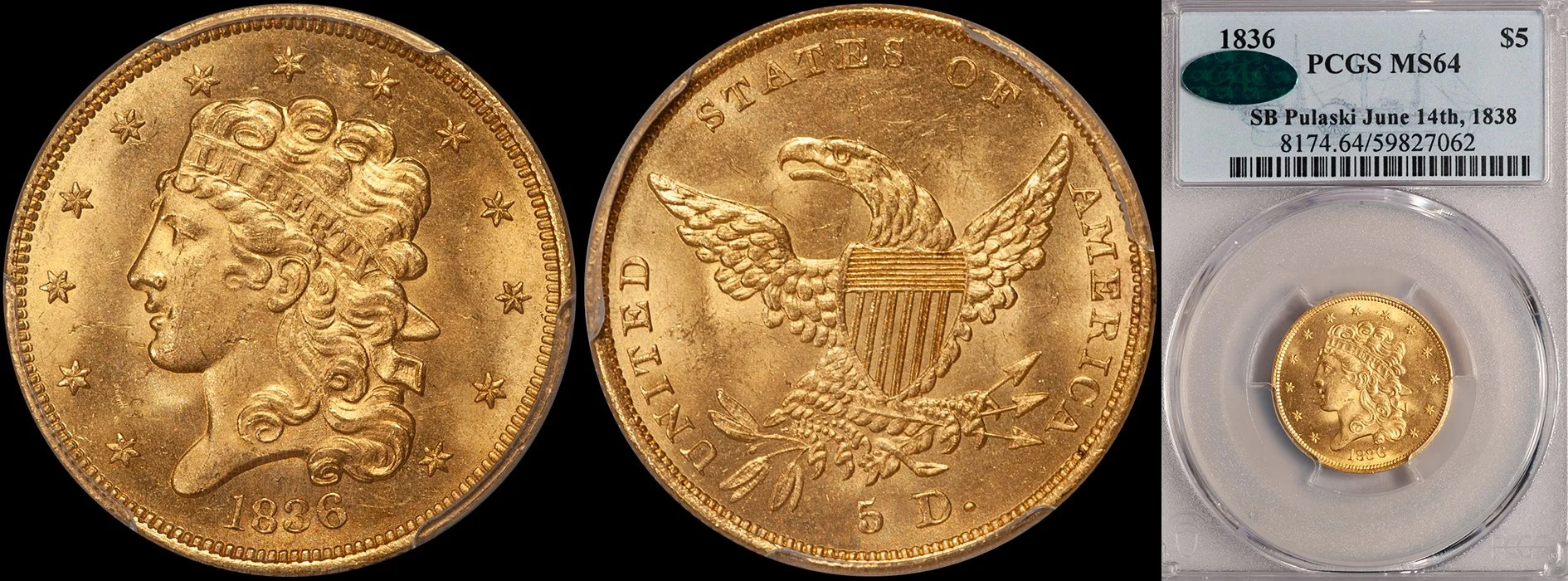
Although the average grade per coin of the half eagles in the Pinnacle Collection is not as high as the quarter eagles, I would have to say this is my favorite set. There are a total of sixteen coins which range in grade from a low of AU55 (the 1843-O Small Letters and the rare 1847-O) to a high of MS63 (the 1840-O Narrow Mill, 1844-O, 1845-O, 1854-O the 1894-O). Of the 16 coins in the set, eleven are Uncirculated and the average grade per coin is 60.68.

It’s really hard for me to pick just one highlight of the half eagles, so I’ll focus on two coins. The first is the incredible PCGS MS63 1840-O Narrow Mill that is pedigreed to the famous Pittman collection. It is an amazing coin that I rank as the finest known for the date. Another highlight coin is the MS63 1845-O that is pedigreed to the Bass collection. It is one of just two known examples of this date in this grade (there are none finer) and it is the epitome of a choice, original coin with superb luster and dramatic rich green-gold coloration.

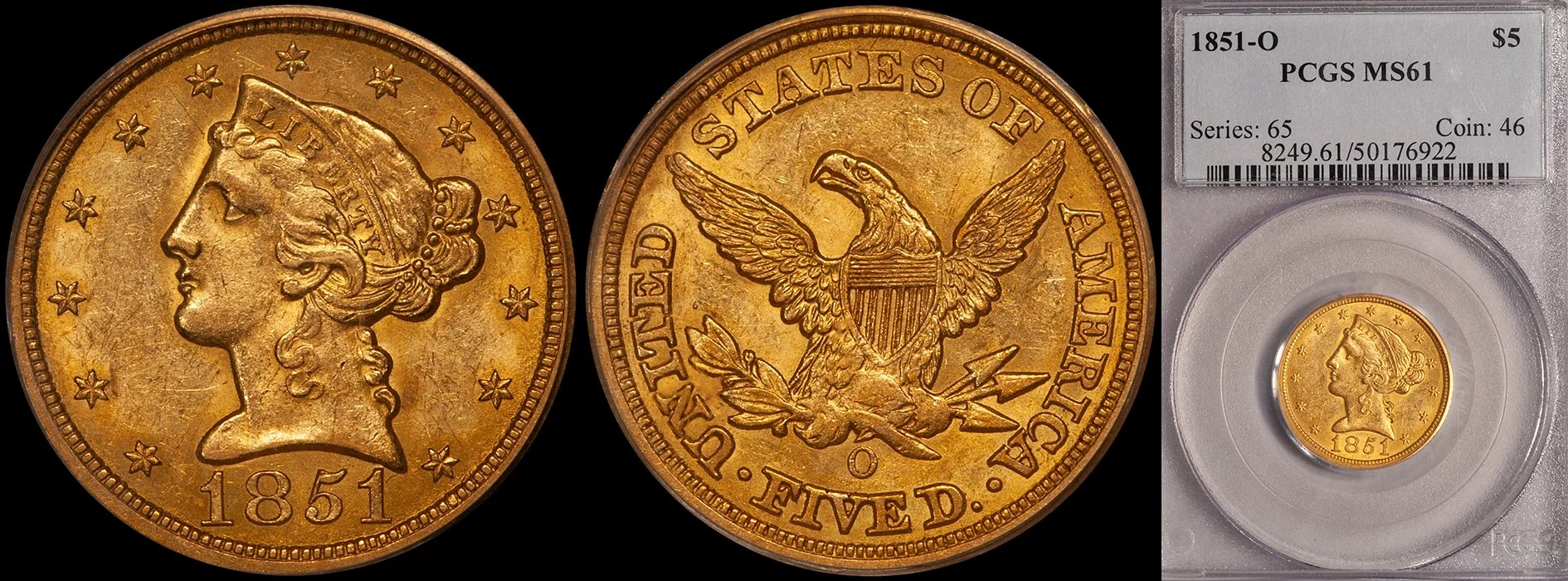
The PCGS MS61 1842-O half eagle in the Pinnacle Collection is one of just three known examples of this date in Uncirculated while the PCGS MS62 1846-O is regarded as the third finest known example of this date. An 1851-O in PCGS MS61 is another extremely rare coin in this grade with just four or five total pieces believed to exist in Uncirculated.

Two final coins are worthy of a quick mention. The 1854-O, graded MS63, is tied with another example as the finest known and it is pedigreed to the Bass collection. The 1894-O in PCGS MS63 is the sole example of this date graded this high by PCGS and it is likely the finest known.

To the best of my knowledge, the only sets of New Orleans half eagles ever assembled that were comparable to the Pinnacle Collection were Ed Milas’ (sold by Stack’s back in 1995) and Charley Tuppen’s (which, as far as I know, is still intact).

V. EAGLES, NO MOTTO

Of the various gold denominations produced at the New Orleans mint, the No Motto eagles, struck from 1841 through 1860, is certainly one of the most difficult to collect. Many of these dates are exceedingly rare in higher grades and a number are essentially unavailable in grades higher than AU55 to AU58. There are a total of 21 issues in this set. This includes two varieties of 1846-O (the Normal date and the so-called “Overdate”) and two 1854-O (the Small Date and the Large Date).

The Pinnacle Collection contains 17 of these 21 No Motto eagles. It is missing the 1842-O, 1844-O, 1847-O and 1855-O. Ironically, with the exception of the 1855-O, these dates are not especially scarce from the standpoint of overall rarity.

The No Motto eagles in this collection range in grade from a low of AU53 to a high of MS61. There are three coins in Uncirculated and the majority grade AU55 and AU58.

The two key issues in the No Motto eagle set are the 1841-O and the 1859-O. These are nicely represented by examples that grade AU55. The former has a PCGS population of just five with none better and the latter shows three in this grade and none higher.

There are number of coins in this set that might be readily overlooked by the non-specialist but which are quite scarce and have very low population figures. As an example, the 1849-O in PCGS AU58 has a population of three in this grade and just two better. The 1850-O in PCGS AU58 is even rarer in this grade with just three recorded in AU58 and a single coin graded higher.

The Pinnacle Collection contains 18 No Motto New Orleans eagles with an average grade of 57.05.

VI. EAGLES, WITH MOTTO

After the New Orleans mint was closed in 1861, it reopened in 1879. With Motto eagles were produced, with interruptions, at this mint until 1906. There are a total of 16 issues in this set. Unlike its No Motto counterpart, this set can be assembled in (mostly) higher grades.

The Pinnacle Collection contains fifteen of the sixteen issues. It is missing the 1880-O but it contains PCGS AU58 examples of the very rare 1879-O and 1883-O. Twelve of the sixteen coins in this set are Uncirculated and these range from a low of MS61 to a high of MS65.

From the standpoint of rarity, the unquestioned highlight of this set is the 1883-O of which just 800 pieces were produced. This collection has a lovely orange-gold AU58 which is one of just three graded by PCGS with none better.

The sleeper coin in this group is the 1881-O in MS61. This date has a PCGS population of just one in MS61 and none finer and it is a rare, underrated issue in Uncirculated.

The highest graded coin in this set (and in the entire Pinnacle Collection) is a 1904-O in PCGS MS65. As one might expect, Gem New Orleans eagles of any date are extremely scarce and this coin has a PCGS population of four in this grade and only one better.

The With Motto eagles in the Pinnacle Collection have an average grade of MS62. Many of the late date pieces (i.e. those struck in 1897 and later) are notable for their beautiful, original color and most are quite high end for the grade.

The Pinnacle Collection is truly one of the finest sets of New Orleans gold coins that has ever been assembled. It contains examples from other great collections such as Norweb, Bass, Pittman and Farouk. The collector who assembled this collection can certainly be proud of his accomplishment, especially given the fact that the bulk of the collection was assembled in just three years.