In April 2006 Heritage will be auctioning the incomparable Duke's Creek Collection of gold dollars, quarter eagles and three dollar gold pieces. I have been asked to write the descriptions of these coins. In the first part of a two-part series, Douglas Winter Numismatics is proud to present the write-ups of these issues. CONDITION CENSUS 1849-D GOLD DOLLAR
1849-D MS64 NGC. Variety 1-B. Similar reverse die state to that seen on the Duke’s Creek: 1001 coin with a number of cracks on the reverse including a prominent one from the rim past the second S in STATES through this letter and down through the base of ATE in this word to the olive leaves at the left end of the wreath. This is the scarcer of the two varieties known.
This is a nicely struck example of a date that is not often found boldly impressed. The obverse shows a group of raised artifacts between the stars at 8:00 and 9:00 while the reverse has a bold date and mintmark. There is a small amount of weakness on the rear curls behind the ear as is typical for this date. The surfaces display some light old hairlines in the fields and we note one tiny nick on the face of Liberty; a few small marks at the center of the reverse do not readily detract. The luster is frosty and above average for the issue while the surfaces are covered with some orange-gold color. There is a band of contrasting color at the obverse border while some splashes of gold on the reverse enhance the appearance. The eye appeal of this coin is very respectable for the grade and this coin’s balanced appearance between the obverse and the reverse is unusual.
The 1849-D is the most common Dahlonega gold dollar both in terms of overall and high grade rarity. There are an estimated three to four dozen known in Uncirculated with most in the MS60 to MS62 range. In properly graded MS63 this issue is quite scarce and it is rare in MS64. We know of approximately three to five pieces that would grade as such by today’s standards. The Duke’s Creek coin is comparable to Green Pond: 1001 which realized $14,950 in our January 2004 sale.
Ex: Duke’s Creek collection and obtained via private treaty from Hancock and Harwell; earlier ex: Heritage 1996 ANA: 8098 (as PCGS MS64) where it sold for $9,625. Listed in Doug Winter’s Condition Census as tied with a small group of other coins as the fourth finest known 1849-D gold dollar.
FINEST KNOWN 1850-D GOLD DOLLAR GRADED MS64 BY NGC 1850-D NGC MS64. Variety 2-C. The only variety of this year. Very early die state with minimal die clashing. Perfect dies.
While coins such as the 1855-D and 1861-D will garner more attention in the, I personally feel that this 1850-D is among the most important gold dollars in the Duke’s Creek collection. It is easily the finest known and it is remarkable for its sharpness of strike and high quality planchet.
The 1850-D is not typically found with a sharp strike but this piece is almost fully defined at the centers and very strong at the borders as well. I can not recall having seen another that showed detail which was comparable to the Duke’s Creek example and this is one of just a handful of pieces known that is not weak on the LLA in DOLLAR.
The surfaces are very clean with a few insignificant ticks seen in the obverse fields and one old, thin scratch that runs down from the ear to the throat. The reverse is nearly perfect and shows just a few light clashmarks as made. In fact, viewed on its own, I would call the reverse at least MS65, if not actually a touch finer. Another feature of this coin that deserves commendation is its blazing, frosty luster. This coin is original and has not been enhanced or “improved” like so many other 1850-D gold dollars. The coloration is a thrilling medium to deep green-gold and orange with some steel-blue tones at the obverse periphery. The color gives this coin a very high eye degree of eye appeal. I consider this coin to be the finest known 1850-D gold dollar by a fairly substantial margin despite the fact that it is tied with another example graded MS64 by NGC.
The 1850-D has long been one of the more underrated Type One gold dollars. It is the fifth rarest of 13 issues from the Dahlonega mint. Of the 8,382 struck there are an estimated 125-150 known with the typical piece grading EF40 or so. Despite the population figures from PCGS and NGC, there are no more than six to eight Mint State pieces known and nearly all are in the MS60 to MS61 range. The Green Pond: 1002 coin was graded MS61 and showed a typical weak strike on the obverse. In all of our years of selling great Dahlonega gold coins at auction, we have never offered an 1850-D gold dollar that graded higher than MS62 and only two at that level.
Ex: Duke’s Creek collection, Hancock and Harwell, Doug Winter.
FINEST KNOWN 1851-D GOLD DOLLAR GRADED MS65 BY NGC AND PEDIGREED TO THE BAREFORD COLLECTION 1851-D NGC MS65. Variety 3-E. All four digits of the date are lightly recut with this showing most clearly below the upright of the first 1. Intermediate die state with some cracks on the reverse. There are two varieties known of which this is the more common; an estimated two-thirds of the 1851-D gold dollars struck employ this die pair.
This is among the more important condition rarities in the Duke’s Creek collection of Dahlonega gold dollars. It has long been regarded as the finest known 1851-D and it has a long pedigree that includes some of the more famous branch mint gold collectors from the past half century. It is also an important enough coin that the late Dahlonega specialist Jack Hancock bought and sold it at least four times (!)
The strike is extremely sharp for the issue with full radial lines noted within the stars. The hair has fully defined curls while the wreath is bold. Both the obverse and reverse show a number of clashmarks with the most prominent seen on the reverse. The surfaces are very clean, as one would expect from a Dahlonega gold dollar that has been accorded an MS65 grade by NGC (none has been graded this high at PCGS either). When the coin is tilted just right, it is possible to see a small cluster of thin hairlines below the bust; there are also a few small ticks in the obverse fields but none of these is deep enough to merit a description. Perhaps the best feature of this coin is its superb frosty luster. The 1851-D tends to have better luster than nearly any other gold dollar from this mint but even by this standard, the Duke’s Creek piece is remarkable. Both the obverse and reverse show light green-gold color with pale yellowish highlights. The overall level of eye appeal is very pleasing and this is truly a handsome coin that deserves to be called a Gem.
This has long been regarded as the finest known 1851-D and it ranks as one of the three or four nicest Dahlonega gold dollars of any date that I have personally seen. It would make a great type coin for the collector seeking a single very high quality Dahlonega gold dollar or it would greatly improve a specialist’s date collection. This is the only 1851-D gold dollar graded MS65 by either service.
Ex: Duke’s Creek collection, Hancock and Harwell, Leon Farmer collection, Hancock and Harwell, Georgia collection, Hancock and Harwell, Stack’s Auction ’84: 1297 ($9,900), Arthur Montgomery collection, Hancock and Harwell, Stack’s Bareford collection (12/78): 15, Hollinbeck 11/47: 1418. Plated in the first edition of Doug Winter’s “Gold Coins of the Dahlonega Mint, 1838-1861.”
THE DUKE’S CREEK-ELIASBERG 1852-D GOLD DOLLAR: THE HIGHEST GRADED BY EITHER SERVICE 1852-D NGC MS63. Variety 4-F. The only variety of this year. Struck from strongly clashed and lapped dies as on all known examples. The diagnostic die scratch on the reverse past the second A in AMERICA is plainly visible.
This is one of the two or three best struck 1852-D gold dollars that I have seen. In spite of the fact that the dies had severely clashed, the details seen at both the obverse and reverse center are extremely sharp with full individually-defined curls seen on the head of Liberty, complete radial lines on the stars and a sharp date. Some slight weakness can be seen on the obverse and reverse denticles but this is the result of an improper collar and not actual weakness of strike. The surfaces show no readily distinguishable abrasions, just a host of clashmarks and roughness in the die as made. There are multiple clashmarks in the left obverse field but this appears to be a reasonably early die state. Under a magnification, some very light hairlines (not from cleaning, by the way) can be seen in the right obverse field and at the center of the reverse. The luster is frosty and far above average for the issue. Most 1852-D gold dollars are worn to the point that little natural luster remains and the higher grade examples that exist usually have a dull, grainy texture. There are splashes of intense orange-gold at the central obverse and around the stars; the reverse shows deeper and somewhat more even color which is a bit lighter in hue near the 1 in the value.
The 1852-D is the sixth rarest Dahlonega gold dollar in terms of its overall rarity and the eighth in high grades. Around 100-125 are known with perhaps seven to nine of these grading Uncirculated by today’s interpretations. Nearly all of these are in the MS60 to MS61 range and a properly graded MS62 is very rare. The present example was described by me in 2003 in the Condition Census of 'Gold Coins of the Dahlonega Mint, 1838-1861" are being the finest known 1852-D gold dollar and it remains so today.
Ex: Duke’s Creek collection, Hancock and Harwell, Leon Farmer collection, Hancock and Harwell, Georgia collection, Hancock and Harwell, Bowers and Ruddy 10/82: 16 ($1,430), Eliasberg collection, John Clapp Jr. and John Clapp Sr. collections, Chapman Brothers 4/1897, M.H. Brown collection. Plated in the first edition of Doug Winter’s “Gold Coins of the Dahlonega Mint, 1838-1861.”
HIGH GRADE 1853-D GOLD DOLLAR 1853-D NGC MS64. Variety 5-G. Easily identifiable by the presence of a die file mark on the obverse from the rim to the base of the star located at 9:00.
This is a very well struck example with a sharp obverse. The hair and stars and fully defined and this is not frequently seen on 1853-D gold dollars. The reverse shows some minor weakness on the 85 in the date but the overall quality of strike is reasonably sharp for the issue.
Under magnification, there are a few very small marks and light hairlines (not from cleaning) that are consistent with the grade assigned by NGC. The reverse is of Gem quality. Both sides exhibit rich frosty luster with a slightly grainy texture. The color is a light green-gold with some pale yellowish hues seen on the high spots. This is a very pleasing example for the grade and it is clearly among the finest known.
The 1853-D is the fourth rarest of the six Type One gold dollars from this mint and the ninth rarest overall of the thirteen issues. Only 6,583 were produced of which 125-150 are known today. This date is most often seen in EF and AU grades. It is very rare in Uncirculated with an estimated six to nine properly graded pieces known. There are a pair of Superb Gems from the Jackson, Tennessee hoard which first came on the market around five or six years ago. One of them, graded MS66 by NGC, is fully Prooflike and it is one of the two best Dahlonega gold dollars of any date that I have ever seen in person.
This piece is listed in the current Condition Census as being tied with a few other pieces as the fifth finest known for the date.
Ex: Duke’s Creek collection, Hancock and Harwell, Leon Farmer collection, Hancock and Harwell, Georgia collection, Hancock and Harwell, Stack’s Auction ’84: 1299 ($14,850), Arthur Montgomery collection, Hancock and Harwell, Paramount Auction ’81: 1332 ($8,200), NASCA 12/76: 2200, McNally collection. This is the plate coin in the first edition of Doug Winter’s book “Gold Coins of the Dahlonega Mint, 1838-1861.”
ONE OF THE FINEST KNOWN 1854-D GOLD DOLLARS 1854-D NGC MS62. Variety 6-H. Obverse and reverse die scratches as seen on all examples.
The obverse is uncommonly sharp for this date with the stars showing strong radial lines detail and the hair nearly full with many of the individual strands visible. The reverse shows a more typical strike with a bit of weakness seen on the LLA in DOLLAR and the 54 in the date. I would still rate this coin as one of the better struck 1854-D gold dollars that I have seen in some time.
The surfaces have some light ticks and hairlines in the fields with the most visible of these present on the obverse. However, nothing can be seen with the naked eye that is deep or detracting. Unlike many pieces, this does not have clashmarks and it appears to be a fairly early die state. The luster is satiny and it is very slightly subdued in appearance; probably because of the depth of the orange-gold coloration which is seen on the obverse and the reverse. Almost every 1854-D shows poor luster and this piece is far above-average in this regard.
The 1854-D gold dollar is an issue which requires a bit of explanation to the non-specialist. It has a number of very distinct mint-made die characteristics. On the obverse there are always raised die scratches around many of the stars. Large, raised die scratches can also be seen on the reverse to the left of the mintmark and on up to the U in UNITED. Many neophytes have mistaken these for damage.
Just 2,935 examples were produced and this is the third rarest Dahlonega gold dollar, trailing only the 1855-D and the 1861-D. Fewer than 100 are known with around two dozen in AU and another dozen or so in Uncirculated. Nearly every Uncirculated coin known to me is in the MS60 to MS61 range and properly graded MS62’s are extremely rare. The Duke’s Creek collection specimen is clearly in the Condition Census and is certainly among the best to have come on the market in some time.
Ex: Duke’s Creek collection, Hancock and Harwell, Leon Farmer collection, Hancock and Harwell, Georgia collection, Hancock and Harwell, possibly ex: Stack’s Bareford (12/78): 26. This is the plate coin in the first edition of Doug Winter’s book “Gold Coins of the Dahlonega Mint, 1838-1861.”
FABULOUS FULL DATE 1855-D GOLD DOLLAR GRADED MS64 BY NGC. THE FINEST KNOWN EXAMPLE OF THE ONLY TYPE TWO ISSUE FROM THIS MINT 1855-D NGC MS64. Variety 7-I. The second 5 in the date is positioned totally below the A in DOLLAR.A very early die state with a remarkable full date and lacking the reverse mintmark seen on later die states. 1855-D gold dollars with a full date are extremely rare and I doubt if more than nine or ten are known. The Duke’s Creek example is the finest of these and its sharpness of strike is easily the best I have seen on any 1855-D.
The 1855-D is the second rarest Dahlonega gold dollar in terms of its overall rarity but it is clearly the rarest in high grades. Of the 1,811 produced there are probably no more than 75-90 pieces known. I know of four that would qualify as Uncirculated by today’s standards. This piece is clearly the finest and it is one of just two Mint State pieces with a full date. A strong case can be made for calling this coin one of the two most desirable Dahlonega gold dollars in existence, along with the Duke’s Creek 1861-D which will be offered for sale in just a few minutes.
As mentioned above, this issue is plagued by weakness of strike. Nearly every known 1855-D shows considerable weakness on the 8 and, sometimes, on the first 5. Sophisticated collectors have long regarded full date examples as very rare and desirable and in the past decade those with very sharp dates have traded at premium prices over those with typical weak dates. The present example has a remarkably bold date. It is almost fully detailed on both the obverse and the reverse despite the fact that there are clashmarks on both the obverse and the reverse. It is ironic—and appropriate—that the finest known 1855-D gold dollar is also the best struck.
The surfaces are clean with just a few very fine hairlines (not from cleaning) in the fields. Under magnification there is some slight roughness as made. The aforementioned clashmarks are most noticeable at Liberty’s forehead and in front of the face; the reverse has some rather extensive and interesting clashmark patterns at the center.
Another amazing thing about this coin’s appearance is its luster. Most 1855-D gold dollars are worn to the point that no luster is visible and on the few higher grade pieces which are known the luster is typically dull and flat. This piece has bright, frosty luster with a texture more like a Philadelphia Type Two gold dollar than one from Dahlonega. The coloration is a light yellow-gold with some greenish tinges.
This is a truly remarkable coin which is certainly a highlight of the Duke’s Creek collection. We have been fortunate to sell many of the Condition Census examples of this date in the past few years. In the Platinum Night session of the January 2006 FUN sale the second finest known 1855-D gold dollar, graded MS64 by NGC, brought $109,250. While that coin was certainly a lovely example, it lacked a full date and, in our opinion is therefore not as desirable as this piece. We expect the Duke’s Creek 1855-D to set a record price for this date.
Ex: Duke’s Creek collection via Hancock and Harwell, Bowers and Merena 10/99: 102 ($92,000), Harry Bass collection, obtained via private treaty from Manfra, Tordella and Brookes in December 1974.
VERY RARE UNCIRCULATED 1856-D GOLD DOLLAR 1856-D NGC MS62. Variety 8-K. This is one of just 1,460 examples produced. All were made from a single pair of dies in May, 1856.
The strike is fairly typical for the issue with the obverse not as well detailed as the reverse. There is some flatness on the hair above the ear and around the face and the U in UNITED is, as always, weak. On the reverse the bases of the 85 in the date are weak and the O in DOLLAR is filled. The detail at the borders is better than usual with most of the denticles fully defined and a good amount of the wreath can be plainly seen with the naked eye.
The surfaces are very clean for the date and grade. There are no very detracting marks visible to the naked eye. With light magnification, a tiny nick in front of Liberty’s nose can be seen. This is not a really important mark and is mentioned mostly for a purpose of future identification.The luster is satiny and somewhat subdued in its texture. This piece shows a good amount of luster for the issue. There are splashes of reddish-gold color on the obverse; the reverse is an intense reddish-gold shade that is most prominent from 4:00 to 11:00 at the border.
This is, overall, a very handsome example of this rare date. The 1856-D is the third rarest Dahlonega gold dollar in terms of overall rarity, trailing only the 1855-D and the 1861-D. In high grades, it is the second rarest issue, trailing only the 1855-D. The PCGS and NGC population reports both include some pieces in the MS60 to MS61 that are, in my opinion, enthusiastically grade. These numbers are also inflated by resubmissions. In my best estimation there are around four to six pieces known. The single best 1856-D gold dollar I have seen is the PCGS MS62 from the Green Pond collection that was sold as Lot 1009 in Heritage’s January 2004 for a remarkable $47,150. The Duke’s Creek collection example is high in the Condition Census and it is likely to be the best piece available to advanced collectors for quite some time.
Ex: Duke’s Creek collection, Hancock and Harwell, Leon Farmer collection.
THE FINEST KNOWN 1857-D GOLD DOLLAR: PEDIGREED TO THE ELIASBERG COLLECTION 1857-D NGC MS62. Variety 9-L. The reverse used for this issue is likely the same as that found on the 1856-D gold dollar. It has a filled O in DOLLAR as well as raised segments on the reverse from 2:00 to 5:00, as struck.
The piece shows an average strike for the issue with some weakness on the hair of Liberty. Around half of the hair shows individual definition with the greatest amount of weakness seen on the curls around the face; the top of the head is sharper than usual. The date is nearly full with some minor weakness on the tops of the 85.
Most every 1857-D gold dollar that I have seen is abraded and has below-average quality surfaces. This piece is quite clean with just a few scattered marks and hairlines in the fields. The reverse center has a few ticks, none of which are deep or worth of specific mention. A small reverse planchet chip at the top of the ride side of the wreath is mint-made and clearly identifies this example. As mentioned above, what looks like small scratches on the reverse border are, in fact, mint-made die scratches which are diagnostic to the issue. The luster is far above average for the issue. Both the obverse and reverse are frosty and this is unusual as many pieces are dull and appear lifeless. There are splashes of reddish-gold coloration that are most prevalent at the edge of the obverse; the reverse has lighter and slightly more even color.
The 1857-D has a mintage of 3,533 and an estimated 120-130 are known. This is a very rare coin in Uncirculated with no more than five to seven properly graded examples known. The Duke’s Creek coin has long been regarded as the finest known and it has a wonderful pedigree to go along with it.
Ex: Duke’s Creek collection, Hancock and Harwell, Leon Farmer collection, Hancock and Harwell, Georgia collection, Hancock and Harwell, Bowers and Ruddy 10/82: 36, Eliasberg collection, John Clapp Jr., John Clapp Sr., B. Max Mehl 11/22, Rawson collection. This is the plate coin in the first edition of Doug Winter’s book “Gold Coins of the Dahlonega Mint, 1838-1861.”
INCREDIBLE NGC MS66 1858-D GOLD DOLLAR: THE FINEST KNOWN AND THE HIGHEST GRADED GOLD DOLLAR IN THIS COLLECTION 1858-D NGC MS66. Variety 10-M. This is the only variety for the year. It is characterized by thick lettering on the obverse with the second S in STATES joined solid. The date is well centered and evenly placed while the mintmark is large and well centered.
There are two Gem 1858-D gold dollars known of which this example is the best. In fact, it is among my personal favorite Dahlonega gold dollars of any date and it has a simply wonderful appearance that will be discussed in greater detail in just a minute.
This coin has a lot going for it and its best attribute is its “freshness.” It has the sort of look that is hard to describe. It has obviously been carefully preserved since it was made and it has thick, frosty luster and superb rich coloration that is almost never seen on a Dahlonega coin, regardless of date or denomination. With the exception of some weakness on the ER in AMERICA, the strike is quite bold for the issue. The tips of the bonnet are sharper than usual while the milling at the obverse border is nearly complete. On the reverse, all of the detail is very strong with a full date, sharp wreath detail and bold milling. There is one very small mint-made flake below the E in UNITED. This is the result to a piece of foreign matter sticking to the die at the time of strike and it is seen on nearly all 1858-D gold dollars. With the exception of this trivial mark, the surfaces are nearly perfect and really “as struck.” The luster is phenomenal. It is ultra-thick in texture with an aura in front of Liberty’s face and behind her head that is reminiscent of that seen on certain frosty Gem Three Dollar gold pieces. The coloration is a subtle orange-gold hue with some greenish tinges on the high spots of the obverse; the reverse is a bit deeper with an area of rich coppery-gold at the center.
From the standpoint of aesthetics, this could well be the best Dahlonega gold coin in the entire sale. It has everything going for it: clean surfaces, great luster and color and that je ne sais quoi which makes certain gold coins special. If you have been seeking a very high grade gold dollar from this mint as a type example, here is a piece that you should give very strong consideration to.
The current auction record for an 1858-D gold dollar was set in February 1999 when we sold the ex: Miller collection coin (then graded MS65 by NGC) for $46,000. Look for this record to be broken when the Duke’s Creek collection is sold.
Ex: Duke’s Creek collection, Hancock and Harwell, Gene Sanders, David Akers session of Auction ’90: 1825 ($33,000), David Akers session of Auction ’89: 1345 ($15,400).
NGC GRADED MS64 1859-D GOLD DOLLAR— ONE OF THE FINEST KNOWN EXAMPLES OF THIS DATE 1859-D NGC MS64. Variety 11-N. Higher date than on the other variety of this year with the 9 under the left foot of the A in DOLLAR. Late die state with unusual clashmarks on the reverse from 7:00 to 8:00. Other clashmarks, which are more typical for this issue, can be seen around the bust and at the central reverse.
This is a very well struck coin for the issue. On the obverse, most of the hair is clearly visible while the border is nicely defined. The reverse has some minor weakness on the 85 in the date and the OLL in DOLLAR while the border is sharp. The surfaces are reasonably clean with a few very faint light scratches visible below the bust; these can only be seen when the coin is tilted into a light source. More noticeable, and serving as clear identification, are a shallow curved lintmark on the lower portion of Liberty’s cheek as well as a small mint-made lamination that is located in the same general area. The luster is frosty and undisturbed while the coloration is a natural light to medium rose-gold with some greenish tinges in the right obverse field. For all intents and purposes this coin is a virtual Gem by today’s standards but it has been slightly net graded on account of the aforementioned lamination on the cheek. It is the second finest 1859-D gold dollar known to me, trailing only the Green Pond: 1012 coin. It is the second finest graded at NGC (exceeded only by a single MS65 coin of which I am not aware) and none have been graded higher than this at PCGS.
The 1859-D is a relatively common issue in higher grade by the standards of Dahlonega gold dollars. There may be as many as twenty known in Uncirculated including a few reasonably choice examples.
Ex: Duke’s Creek collection, Hancock and Harwell, Leon Farmer collection, Superior 1/93: 1272, Heritage 11/92, Dr. Richard Appel, Steve Contursi, Stack’s 10/90: 1010. This is the plate coin in the first edition of Doug Winter’s “Gold Coins of the Dahlonega Mint, 1838-1861.”
THE HIGHEST GRADED 1860-D GOLD DOLLAR: AN NGC MS64 EXAMPLE 1860-D NGC MS64. Variety 12-P. This is the only known die pair for this year. It has an extremely small date and a very large mintmark.
Only 1,566 examples of this date were struck. In the past, the rarity of the 1860-D has been way overstated and it is actually somewhat overrated in terms of its total rarity. But in higher grades it is a very rare coin and it trails only the 1855-D, 1861-D and 1854-D in AU and above. It is an extremely rare coin in Uncirculated with around seven to nine pieces known.
The 1860-D is the worst struck gold dollar from the Dahlonega mint. That said, the Duke’s Creek example is the best struck 1860-D I have ever seen. It has a good amount of detail on the U in UNITED and much sharpness on the periphery of the obverse. Equally strong and also worthy of description is the hair which shows much better definition than on any other 1860-D that I have seen. The date is nearly full and OLLA in DOLLAR lacks all but the slightest amount of weakness. This is truly remarkable for an issue that is usually seen with such a poor strike. There are two light scrapes on the obverse in front of Liberty’s nose and a few small hairlines (not from cleaning) on the surfaces. The reverse has some minor mint-made roughness at the center that appears to be the result of a few small flecks of foreign material on the die at the time of striking. The luster is slightly steely in texture and has a typical “hard” appearance as seen on the other high grade 1860-D gold dollars that are known. As usual it is a bit more pronounced on the obverse than on the reverse. Both sides are covered with rich orange-gold color.
This is the only 1860-D gold dollar to have ever been graded MS64 by either service and it is listed in the current Condition Census as the finest known. It is an extremely important coin and, obviously, one of the highlights of this remarkable collection of Dahlonega gold dollars.
Ex: Duke’s Creek collection, Hancock and Harwell, New York Gold Mart (Ron Karp).
THE FINEST GRADED 1861-D GOLD DOLLAR— AN NGC MS65 AND A HIGHLIGHT OF THE DUKE’S CREEK COLLECTION 1861-D NGC MS65. Variety 12-Q. The only dies of the year. The obverse is the same as on the 1860-D. On the reverse the date is small and positioned somewhat to the left.
The 1861-D is the rarest and most famous gold dollar from this mint. It is also the single most coveted coin from Dahlonega as it is the only regular issue that was produced entirely by the Confederacy. After the Mint was seized in April 1861, between 1,000 and 1,500 examples were struck by the Rebel forces. It is unlikely that more than five to six dozen are known today. Interestingly, more of these exist in high grade than one might expect and there are probably more than a dozen in Uncirculated. This is almost certainly due to the fact that examples were saved as souvenirs.
This issue has a very distinct appearance and this is, in my opinion, part of its charm. It is always found with a weak strike on the obverse and this example is no exception. The UN in UNITED are weak but they are actually more distinctive than usual. The IC in AMERICA is also weak but, again, they appear more fully defined than on nearly any other example of the 1861-D gold dollar that I have seen. There is also some weakness on the left side of the denticles; this is diagnostic to the issue. The reverse is remarkable and has probably the fullest strike I can recall having seen on an 1861-D. The date and mintmark are full while the word DOLLAR is complete except for the O which shows some softness. There are multiple clashmarks which are heaviest near the R in DOLLAR. These clashmarks can also be seen along the portrait on the obverse but they are not as strong. Some of the field near the left side of the portrait is semi-reflective and this is very likely due to someone at the mint attempting to remove the clashmarks The surfaces of this coin are very clean and suggest that this coin has been carefully preserved since it was produced almost 150 years ago. There is one tiny shallow tick in the left obverse field and another shallow, unobtrusive mark on Liberty’s cheek. These serve as excellent identifiers for future pedigree information. The luster that this piece shows is exceptional. It literally “drips” off the surfaces and is far above average for a date that, surprisingly, can be found with good luster. The obverse is graced by rich orange-gold color with some steel highlights at the center and towards the edge; the reverse is slightly lighter with deepening to an olive hue at the border.
In my opinion there are three really great 1861-D gold dollars known: the Ullmer-Pierce coin (graded MS64 by PCGS) which is in an Alabama collection, the Green Pond/Eliasberg coin (graded MS63 by PCGS) which was last sold by Heritage in January 2004 and the Duke’s Creek coin which is being offered today. It would not surprise me to see this coin set an all-time record for a Dahlonega gold coin, given the demand for rare coins with great stories.
Ex: Duke’s Creek collection, Hancock and Harwell, Leon Farmer collection, Stack’s 1/90: 1594 ($31,900), Tony Terranova, Superior 1/89: 274 ($24,200), Dr. Philip Weinstein. This is the plate coin in the first edition of “Gold Coins of the Dahlonega Mint, 1838-1861.”

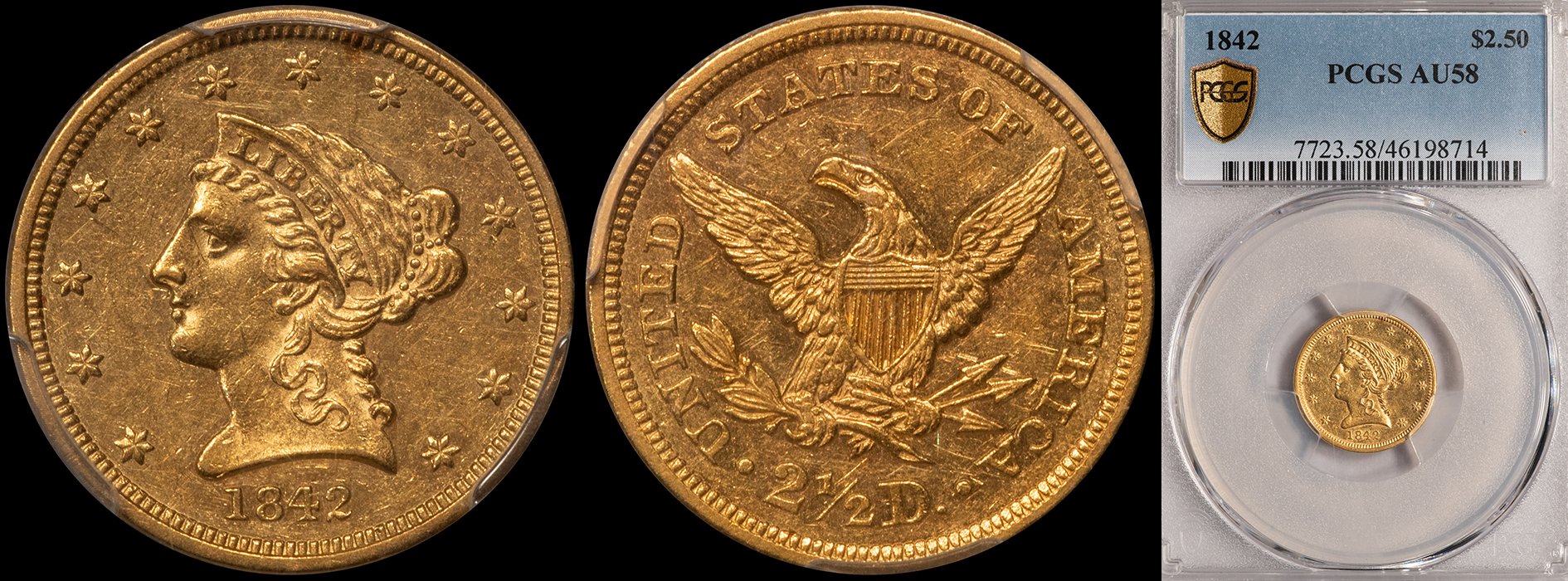
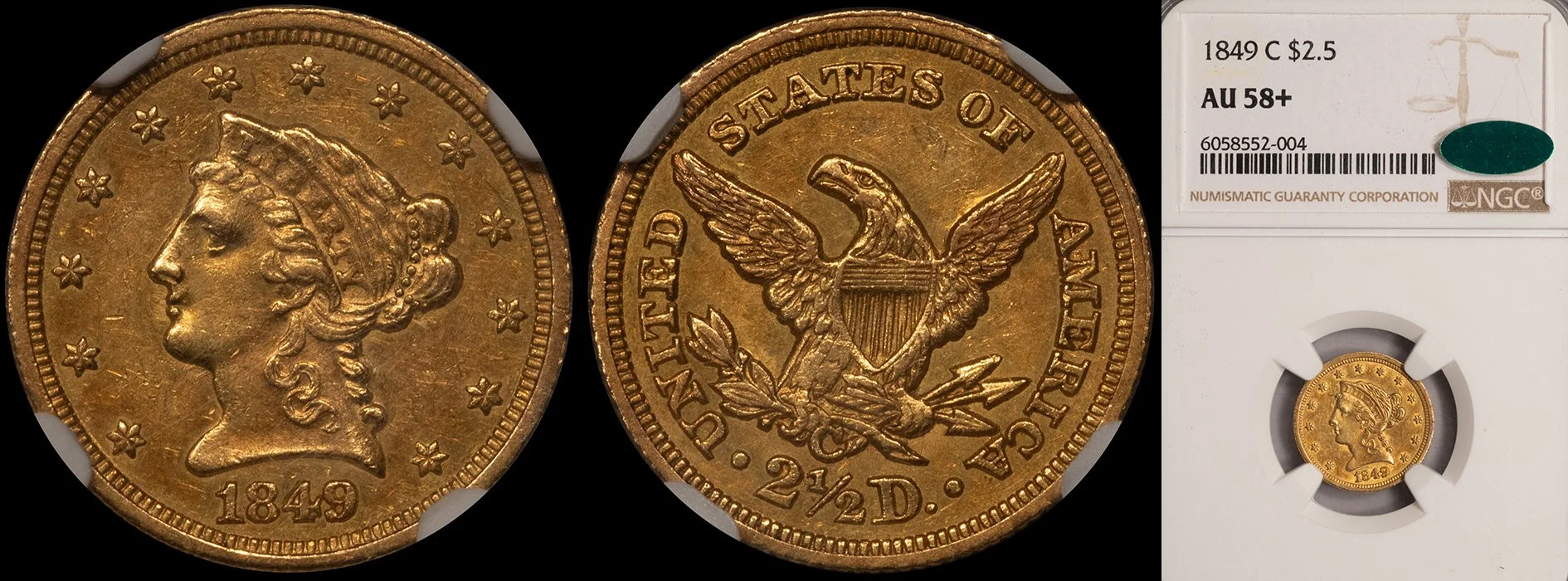
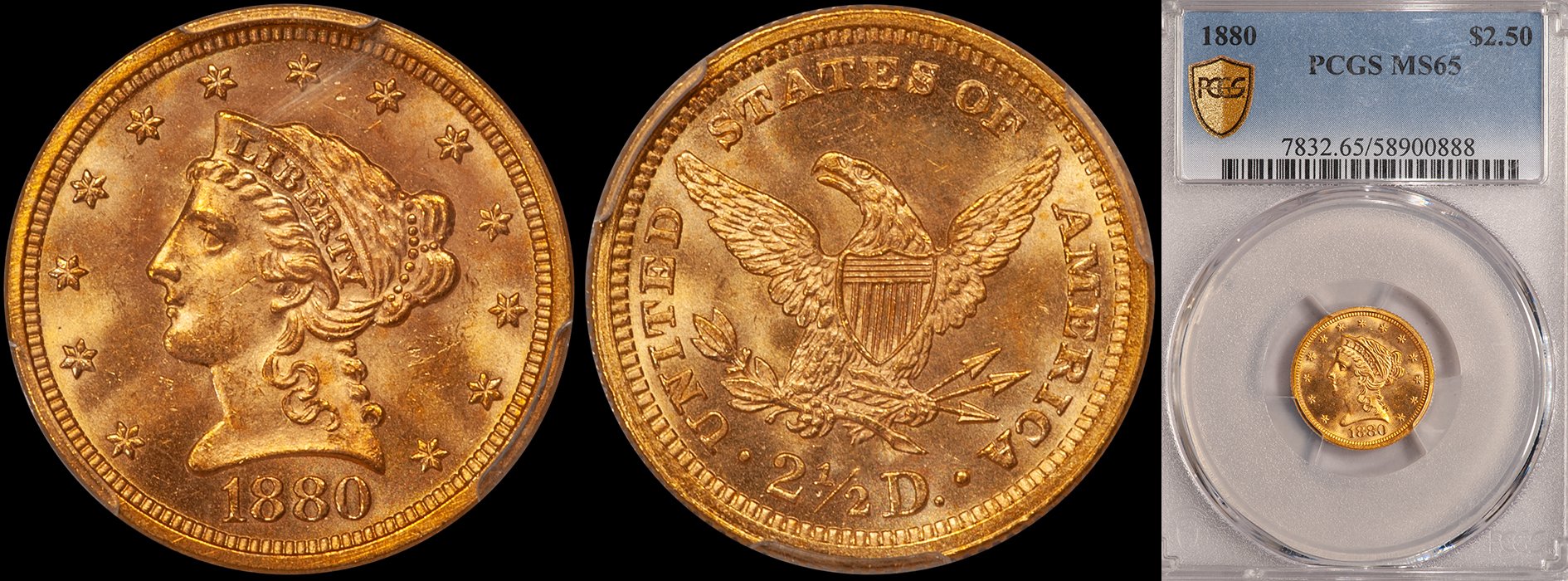
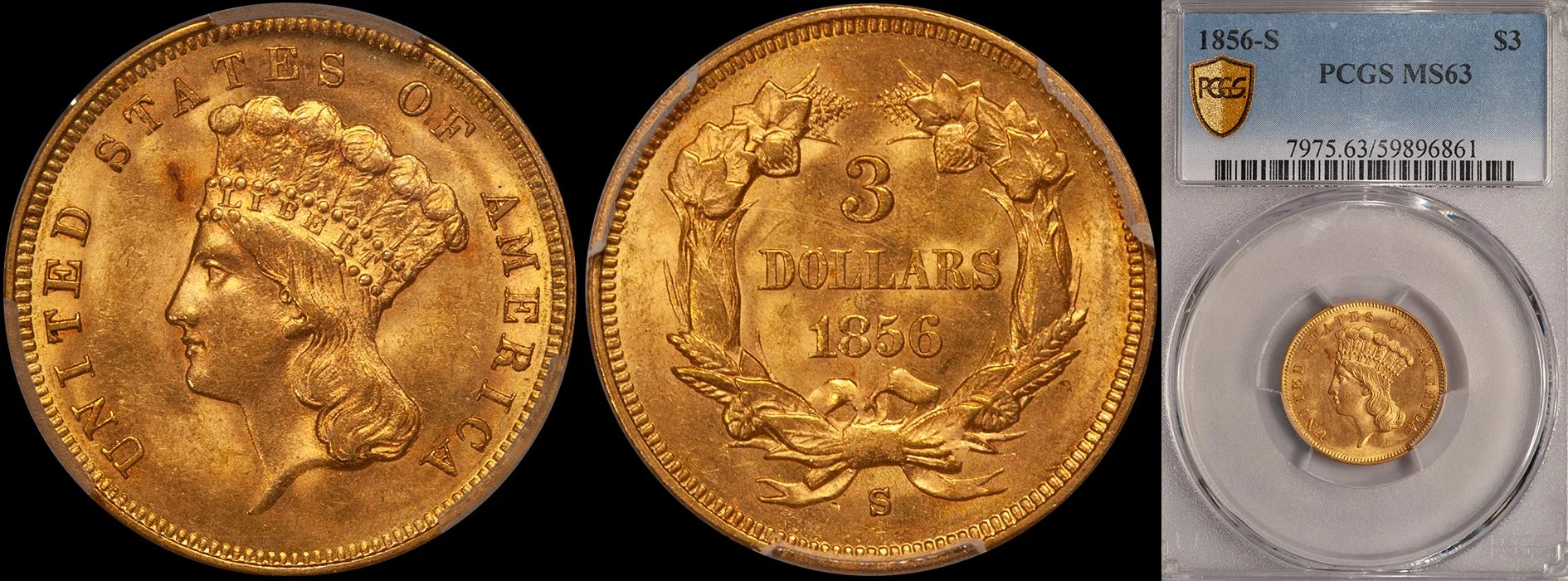
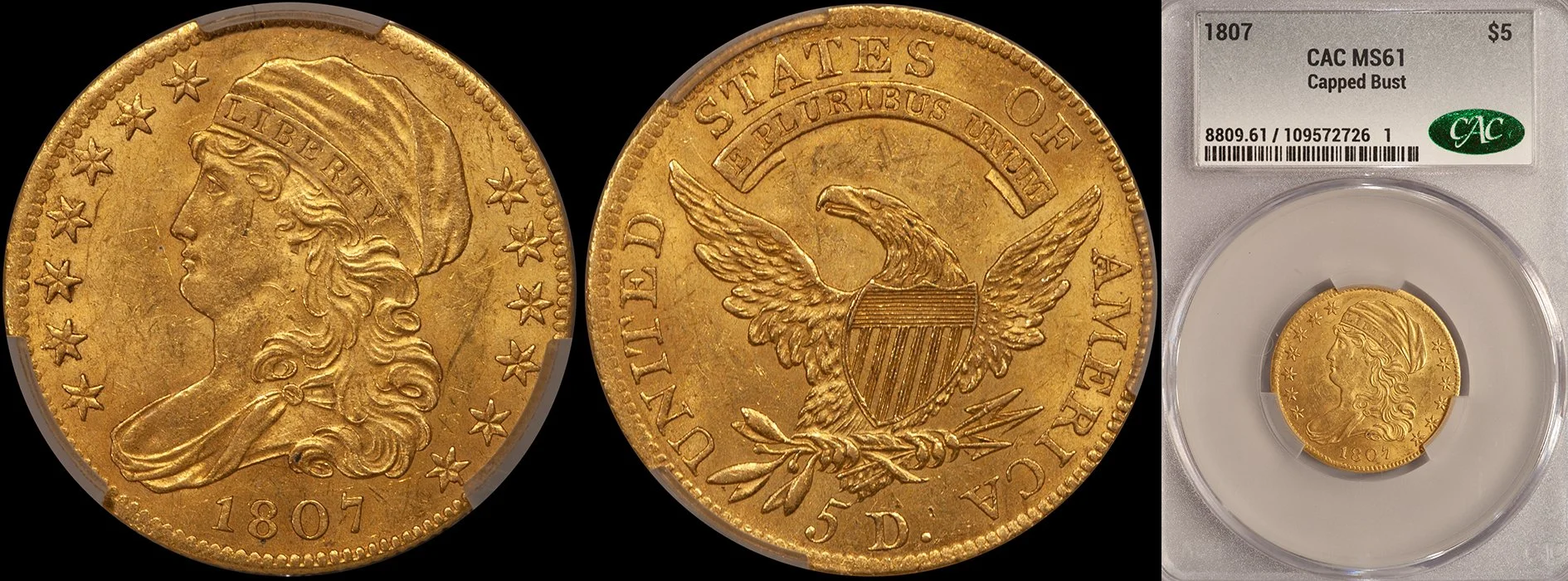
Date…….1849-O
Grade…….PCGS MS63 CAC
PCGS Price Guide.…….……35000
CDN Greysheet/CPG.…..…37500
Population (PCGS).……….….3/0
Population (NGC)……...………1/1
Population (CAC).….....….…..2/0
Serial Number……5414.63/61207008
PCGS Lookup Number.……….5414