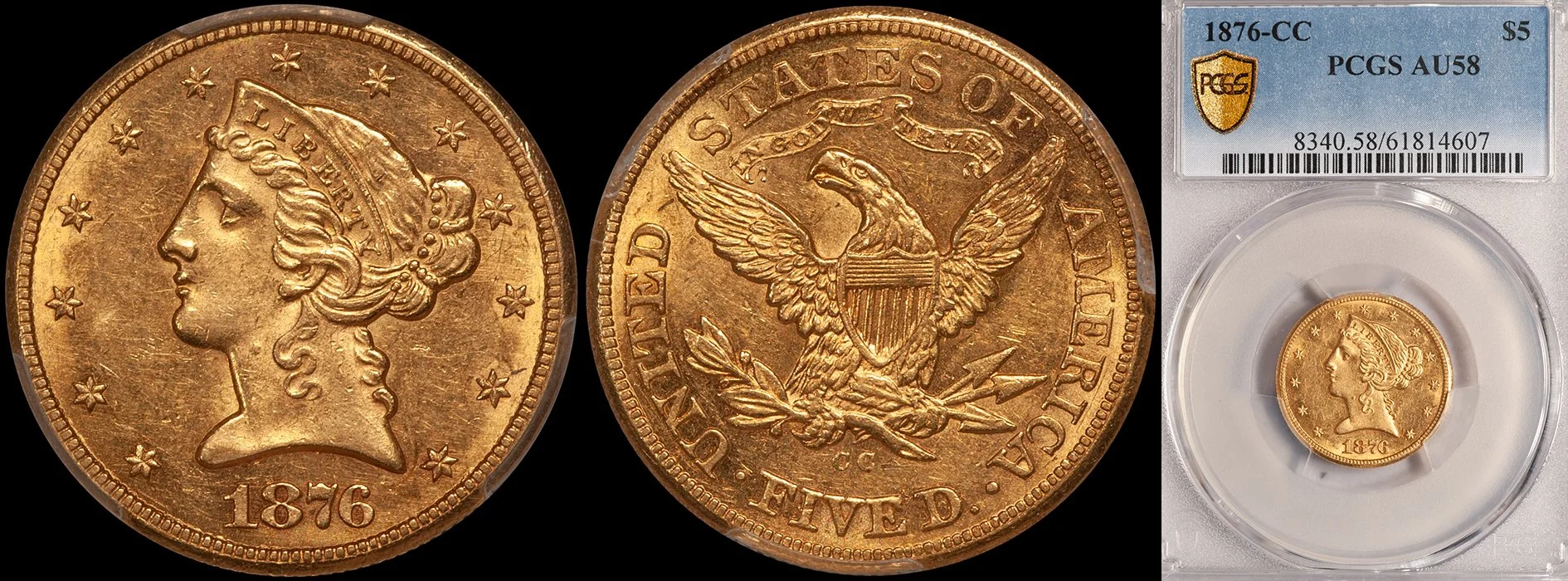
Compromising When Coin Buying: When You Should and When You Shouldn't

Collectors often ask me about my thought process(es) when I make coin purchases. Why do I buy certain coins and pass on others? Why do I stretch for some coins, and make others based solely on a favorable price? These are great questions and I think they are worthy of a blog.

Most coin purchases involve some sort of compromise. Very few coins are “perfect” from an appearance standpoint. A coin may have been cleaned at one time or it may have some weakness of strike or more marks in prominent locations than you would hope for. When should you compromise your standards, and when should you hold fast and true?

A lot of the answers that I would give to these questions depend on what sort of coins you are buying and whether you collect by type or by date. If you are a type collector, it is much easier to, as an example, wait for the perfect AU55 Capped Bust Right Heraldic Eagle ten dollar gold piece than it is to wait for an 1804 eagle in AU55 which is well struck and which has natural color.

Let’s look at some specifics for compromise vs. non-compromise, and use some real world examples.

1. Very Rare Coins Should Be Held to Lower Standards than Common Coins

Intuitively, you would think that the exact opposite should be true in numismatics, but it’s not.

The rarest Dahlonega half eagle is the 1842-D Large Date. It’s the only issue in the series which is genuinely hard to find in EF and higher grades with really good eye appeal. I haven’t handled a truly nice one in years, and I have numerous want lists for this date in nearly any grade. If someone offered me a marginal quality in a 45 holder tomorrow, I would invariably buy it unless it was grossly overpriced or it had some flaw that I just couldn’t get past.

1842-D Large Date $5.00 NGC AU55

The most common Dahlonega half eagle is the 1854-D. It’s kind of a blah issue, but I seldom buy this date unless it is outstanding for the date for one of the following reasons: it's 100% original, it has great color, or it is exceptional eye appeal. In other words, I’m not going to buy an 1854-D (or any other very common Dahlonega half eagle) unless there is something really exceptional about it.

If I hold the 1842-D Large Date to the same standards that I hold the 1854-D to, I’m never going to buy an example. And this is a trap that many collectors fall into.

There are a number of very rare coins that just don’t come nice. A classic example is the 1870-CC double eagle. I’ve seen or owned probably half of the surviving examples and I can’t recall more than two or three that I would regard as “choice.”  The typical example is not only well-worn but it lacks original color and has numerous abrasions. As a buyer who loves original color and tends not to like abrasions, the 1870-CC is problematical for me. Which is why I hold it to an entirely different set of standards than, say, an issue like the 1890-CC double eagle, which I can easily locate with good eye appeal.

2. If You Don't Lower Your Standards on Certain Coins, You'll Never Buy Any

Around a year ago, I began selling coins to a new collector who decided that he wanted to specialize in rare to very rare Liberty Head eagles. His collecting background was with more modern issues such as Walking Liberty half dollars and he was used to big, bright, shiny coins which were just about perfect. I warned him that he would have to use an entirely different set of standards with a coin like an 1860-S eagle; an issue which is not only extremely rare but is one with which rigorous buying standards have to be thrown out the window.

The first two transactions I had with this gentleman were disasters. He returned one very scarce coin (in a PCGS holder and with CAC approval) for having a tiny “scratch” hidden on the reverse, and another rarer one for not being as “dark and dirty” as he thought the photo and description on my website indicated. I don’t have many coins returned due to quality issues, and two have two returned by the same individual in the space of a few weeks…well, let’s just say this doesn’t happen much at DWN.

We spoke on the phone and this is what I learned: since these coins were expensive (high four figures in one case and low five figures in another) he expected them to be superb. I tried to explain to him that what constitutes “superb” in the realm of rare date eagles is entirely different than what constitutes “superb” when looking at MS66 and MS67 late date Walkers. He was using a set of standards that were totally inapplicable to rare date 19th century gold coins that were both conditionally rare and which had very low survival rates. I think we parted friends, but to this day I have never sold him another coin and don’t think he is likely to buy anything from me.

This blog is not meant to be an apology for compromising your standards. In the field of rare date gold collecting there are many coins that you can take a firm stand and not waver from it.

3. When You Want One of Something, You Can Be Fussy

More dated gold collectors are collecting by a type or by “best available neat coin” strategy and wandering from the previous standards of collecting series by date.

Let’s say you’ve decided that you like Charlotte quarter eagles but you want just two examples: a Classic Head and a Liberty Head. You are more limited with the former as there are just two Classic Head issues; the Liberty Head series offers much more flexibility with 18 different issues to choose from.

You’ve saved up and have $3,500 to spend on a really nice quarter eagle. You are someone who really values good strikes and you hate coins which are made on inferior planchets. This automatically eliminates around half to two-thirds of the possible Liberty Head issues from this mint (due to budget constraints, strike problems, or poor method of manufacture) and you can focus on the issues which make sense. The chances are good that the “right” $3,500 coin will show up in a few months; a coin with excellent striking detail, nice surfaces and the original color and surfaces that collectors now crave. It might be a “common” issue such as an 1847-Cl or it might be a scarcer issue such as an 1840-C.

Or you can just buy assorted neat coins in your price range. Let’s say you love dirty, original coins and your price point is $2,500-5,000. It doesn’t theoretically matter if you buy a PCGS AU58 1857-S gold dollar or an NGC AU50 1846-D/D half eaglel as long as the coin has character and its eye appeal “speaks” to you.

4. Be Picky on the Keys (if you collect by date)

I’ve discussed this more than once but most collectors overbuy the common dates in their chosen set(s) and underbuy the keys.

Let me give you an example of the right way to form a set. A very good client of mine has been working on a Dahlonega quarter eagle set for five or six years now. His motivation to begin this set was when I had just bought a great collection of D mint quarter eagles and was breaking them up. It just so happened that the key 1855-D and 1856-D in this collection were wonderful quality for the date: comparatively high grade, nice and original, and well-pedigreed. He realized that by purchasing both coins, he would be off to a great start and that he might not have a chance to purchase such nice examples again.

1854-D $2.50 PCGS AU58 CAC

After buying these two key issues, this collector decided that the other rarities in the set (1840-D, 1841-D, 1842-D, and 1854-D) had to be special coins. And over the course of the next five years, I was able to purchase beautiful AU55 to AU58 examples of each.

As picky as he was on the keys, he was discriminating on the common dates in the set. He bought nice AU examples but resisted the temptation to spend $15,000 on a common 1843-D when he could own a perfectly presentable example for $4,000 and funnel the savings towards another key date, or two to three more nice commons.

5. Be Picky When You Have Options

Let’s say you are a collector for whom strike is a key factor in determining whether or not you buy a coin. On some issues, you are out of luck as all known examples are found with weakness of strike (an example of this would be the 1859-C and 1860-C half eagles). Other issues are found with varieties which are well struck or poorly struck, depending on the die state (examples of this include the 1844-D and 1848-C quarter eagles).

To be a good collector in the area of rare date gold, you have to learn about each issue’s appearance. This is why the books I have written explain factors such as typical strike in great detail.

You are surfing the web and you happen on a nice, crusty 1844-D quarter eagle in a PCGS AU55 holder. It has your “look” and is priced in your wheelhouse, but the strike is very poor. If you know the intricacies of this issue, you know that around 50% of all 1844-D quarter eagles show central weakness. This means that you still have a good chance to find a well-struck example and that you should probably pass on the coin, even if you need it for your date set.

Knowing when to be picky and when to compromise is an important part of the strategies used by sophisticated collectors of all coins; not just dated gold. Do you have any stories to share about being picky or not being picky when you bought a coin? Please share them in the comments section below.

Do you buy rare gold coins?

Do you have coins to sell?

Would you like to have the world’s leading expert help you assemble a set of coins?

Contact me, Doug Winter, directly at (214) 675-9897 or by email at dwn@ont.com.
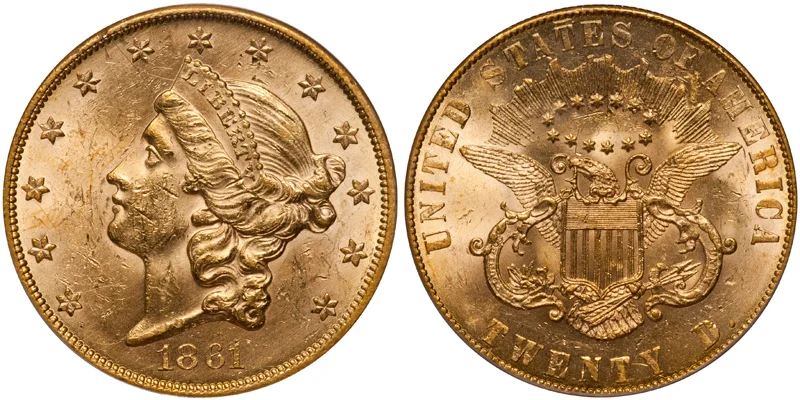
Douglas Winter Numismatics Sets World Record with $1.645 Million Dollar Purchase

Douglas Winter Numismatics Sets World Record with $1.645 Million Dollar Purchase

There are just two 1861 Paquet Reverse double eagles known and this issue is ranked as the fourth rarest regular issue United States coin, after the unique 1870-S half dime and three dollar gold pieces and the 1873-CC No Arrows dime.

Read More

Are 1870-CC Eagles Undervalued in Comparison to their Double Eagle Counterparts?

Without a lot of fanfare, we have seen the dispersal of one of the most amazing collecting of Western branch mint gold coins in the history of numismatics. So far in 2014, the various sales of the Bently/Nob Hill Collection(s) of US Gold Coinage has seen no less than six examples each of the rare 1870-CC eagle and double eagle with the promise of more to come.

The sale of this quantity of 1870-CC eagles and double eagles has made me reconsider the rarity and price structure of both issues. It has not only allowed me to get an excellent idea of exact valuations for both issues in a variety of grades, it has led me to ask an important question: is the 1870-CC eagle undervalued in comparison to its double eagle counterpart?

Before I attempt to answer this question, let’s take a quick look at both issues.

A total of 5,908 1870-CC eagles were struck. This is the rarest Carson City eagle (although the 1879-CC makes a strong claim to the rarest coin in the series) and there are an estimated 50-60 pieces known with most in the VG-VF range.

There were 3,789 1870-CC double eagles struck. It is the rarest CC gold coin of any denomination and I feel that there are 35-45 known in all grades; mostly in the VF-EF range.

Let’s look at the current PCGS population figures for each issue:

$10.00 G-VF : 23; EF: 18; AU: 10; UNC: 0; Total: 51

$20.00 G-VF : 6; EF: 22; AU: 5; UNC: 0; Total: 33

These numbers tell us a few things. First, as expected, the 1870-CC double eagle is around twice as rare as its counterpart the 1870-CC. Interestingly, the eagle is seen more often in lower grades (the average example grades VF) while the average grade for the double eagle is EF. Both issues are extremely rare in properly grade AU and are unknown in anything close to Mint State.

We might make the quick conclusion that based on rarity alone, the 1870-CC double eagle should be worth around 2x what an 1870-CC eagle is worth in VF, EF and AU grades.

Based on the sales of so many 1870-CC eagles and double eagles in 2014, I’d suggest the following valuations for each denomination:

1870-CC $10.00 PCGS EF45

$10.00

  • VF: $25,000-40,000 (depends on grade/grading service)

  • EF40: NGC $40,000-45,000; PCGS $45,000-50,000

  • EF45: NGC $45,000-50,000; PCGS $50,000-55,000

  • AU50: NGC $60,000-65,000; PCGS $70,000-75,000

  • AU55: NGC $125,000-135,000; PCGS $150,000-175,000

1870-CC $20.00 PCGS EF45

$20.00

  • VF: $175,000-225,000 (depends on grade/grading service)

  • EF40: NGC $235,000-250,000; PCGS $250,000-265,000

  • EF45: NGC $260,000-280,000; PCGS $275,000-290,000

  • AU50: NGC $285,000-295,000; PCGS $310,000-330,000

  • AU55: NGC $325,000-350,000; PCGS $400,000-425,000

Assuming that the price structure for the 1870-CC double eagle is “correct” (and I think it is, based on the number of coins which have sold over the last few years), why is the 1870-CC eagle not priced at around half the level of its counterpart?

I think there are a few answers to this. The 1870-CC double eagle is a more famous coin with a lower mintage. It is larger in size and it is part of a set (Carson City double eagles) which ranks as among the most avidly collected in all of upper-echelon American numismatics.

Double eagle rarities have multiple levels of demand, and the 1870-CC is a coin that often sells to a collector or investor who might not be a tried and true specialist.

I think we are beginning to see a strong shift in the eagle market and this denomination is now gaining in popularity and price. CC eagles aren’t as popular (yet) as double eagles, but the metrics for these series is clearly changing.

My conclusion is that the 1870-CC eagle is undervalued. If a nice quality EF45 1870-CC double eagle is worth in the $275,000-295,000 range, an 1870-CC eagle at $50,000-55,000 seems substantially undervalued. Given that the 1870-CC eagle in EF is pretty similar in rarity to the 1870-CC double eagle (see the chart above), it is hard to believe that it is worth only 1/5th as much. I can easily see the 1870-CC eagle in EF and AU grades doubling in price in the next five years; I’m not sure I can say the same for the 1870-CC double eagle.

What are your thoughts about the price and rarity of the 1870-CC eagle and double eagle? I would love for you to comment below.

Do you buy rare gold coins?

Do you have coins to sell?

Would you like to have the world’s leading expert help you assemble a set of coins?

Contact me, Doug Winter, directly at (214) 675-9897 or by email at dwn@ont.com.

Is it Time to Buy Indian Head Half Eagles?

I am generally not a participant in the generic gold market as I tend to favor scarce and rare dates over more common ones. But I like Indian Head half eagles a lot and a recent experience made me ask the question: “is it time to buy Indian Head half eagles?” I bought a nice, fresh deal of Indian Head half eagles about six weeks ago. All were in very old holders and I broke them out and sent them off to grading. My results were excellent and nearly every coin graded MS64 or MS65. As I got ready to cash in on my windfall, I did some price research and was shocked. Unless they stickered at CAC (more on this in a few moments) the levels I was going to have to sell them left me breathless…and not in a good way.

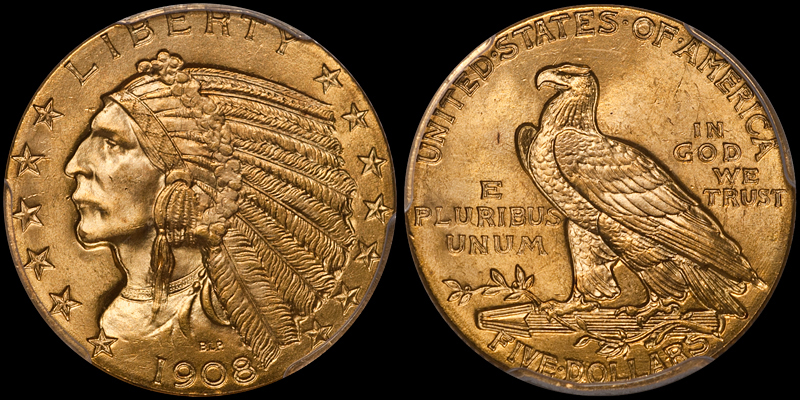
1908 Indian Head $5.00 PCGS MS65 CAC

If you are like me and you don’t really follow the generic market on a day-by-day basis, it can be mystifying to see how cheap most issues have become in the last few years. My non-CAC MS64 Indian head half eagles were worth around $1700 per coin if they were in NGC holders and a bit more in PCGS holders. I was more shocked at how cheap MS65’s have become: around $9,000 for NGC coins and a smidge over $10,000 for PCGS coins. And that’s not to mention the fact that you basically have to twist buyer’s arms to get them to buy any quantity of these even at these cheap, cheap, cheap levels.

Why are Indian Head half eagles so inexpensive in MS64 and MS65? There are a number of answers.

1. Traditional Sellers of Generic Gold Now Sell Other Products

Firms like Blanchard, Swiss America, and Goldline used to sell lots of better quality generic gold coins; items such as MS64 or MS65 Indian Head half eagles. Today, they either sell few generics or if they do, they are focused on those coins with CAC approval. The supply of MS64 and MS65 Indian Head half eagles has stayed consistent as coins are continually found in Europe or upgraded from current holders. The demand has not kept up with the supply, however, and this has resulted in plummeting prices.

1911 $5.00 PCGS MS65 CAC

2. Owners of Generic Gold Don’t Want to Cost Average Their Positions

Let’s say you bought a few nice MS65 Indian Head half eagles for $15,000 each back around 2006-2007. You are clearly not a happy with today’s prices so much lower than when you purchased your coins. But why not by a few more and use cost-averaging to lower your overall price point(s)? This logic makes sense to me, but for most coin investors it is exactly what they do not want to do. They feel “burned” by Indian Head half eagles and probably want nothing more to do with them. This lack of continuity in the generic market, due to poor price performance, has clearly not helped this market.

3. The CAC Effect

One of the primary reasons why CAC was created was to identify those generic gold coins, particularly in series such as Indian Head half eagles, where the perception was that many coins in MS64 and MS65 holders were over-graded or not, at the very least, “solid” for the grade. CAC has proven to be very tough on Indian Head half eagles, and only a small percentage of the MS64 and MS65 coins sent in for approval have received a green sticker. As a result, stickered MS64 and MS65 Indian Head half eagles sell for very strong premiums; in most cases 25-50% over non-stickered coins. The market perception of non-stickered MS64 and MS65 Indian Head half eagles is they are not “good” coins and, as a result, the price gap between non-CAC and CAC stickered generic gold coins is widening. My gut feeling is that non-stickered MS65 Indian Head half eagles could ultimately be worth half as much as their CAC’d counterparts.

4. The Plus Grade Effect on MS64

It is a matter of opinion whether coins graded MS64+ are actually “better” than coins graded MS64, but the market perception is such that plus-graded coins have begun to sell for significant premiums, even in the generic market. If you are a new collector and you are offered a “regular” MS64 Indian Head half eagle for $1,750, or an MS64+ example for $2,250, the chances are good that you will spend the extra $500 and get the “better” coin. This has clearly hurt the market for MS64 Indian Head half eagles, and it is likely that we will see further price separation between MS64 and MS64+ coins.

5. Changing Tastes Amongst Gold Coin Buyers

More than anything else, the generic gold coin market has been hampered by a lack of demand. Past generations of new collectors and investors were introduced to numismatics by the assembling of the basic 11 or 13 coin U.S. gold coin type set. Today, new collectors are more inclined to collect something which is rare. For $10,000, an AU 1864 half eagle (slightly over 4,000 struck and under 75 known in all grades) is a more sensible purchase than an MS65 1909-D half eagle (nearly 3.5 million struck and over 100 graded in MS65 at PCGS alone) in the minds of these new collectors. It will take a large marketing promotion and lots of re-education to get new collectors to re-think this.

1912 $5.00 PCGS MS65 CAC

So what is my conclusion? Is it time to buy Indian Head half eagles in MS64 and MS65? I’d like to say yes, but I think that prices could easily drop another 20-30% on these coins in the next year or two. In my opinion, if levels get down to $1,500 for nice MS64’s and $7,500 for MS65’s, I would jump in the market, likely in a big way. For now, I’d avoid this coin unless you need one for a gold type set or if you are a contrarian with some tolerance for risk.

What’s your take on the Indian Head half eagle series and generic gold in general? I’d love to hear from you and encourage you to add your comment(s) in the section below.


Do you buy rare gold coins?

Do you have coins to sell?

Would you like to have the world’s leading expert help you assemble a set of coins?

Contact me, Doug Winter, directly at (214) 675-9897 or by email at dwn@ont.com.

Your Blogger Swoons at an Auction Announcement

The last few years have been fertile, to say the least, for auction sales involving all-time great collections. We’ve seen the sales of the Newman collection, are seeing the current selling off of the Gene Gardner sets, and have also witnessed the not-as-splashy sales of a number of important general and specialized sets. But none of these sales affected me as much as the announcement of the upcoming sale(s) of the legendary Mac and Brent Pogue collection.

Around a week ago I read a press release stating that the Pogue collection would be sold by Stacks Bowers in a series of auctions “over the next several years.” My reaction? Unprintable in this blog (hint, starts with: Holy) but understandable, given that it is well-known within the dealer community that this is quite probably the greatest collection of American coins ever formed, and that there were no rumors floating around that it might be sold.

After pondering the Pogue Situation for a few hours, I’ve reached a few initial reactions which I’d like to share with you.

1. This Collection is Even Greater than You've Heard

Other than a handful of people, there are not many numismatists that are aware of the complete inventory of this collection, and I am not one of the lucky few. Over the years, I’ve been shown little date runs from the collection (I can remember looking at a phenomenal group of early quarters at Dave Akers’ table at an ANA convention 10-15 years ago that belonged to the Pogues and, at another ANA show maybe 15 years ago a group of Fat Head half eagles which were mind-blowing) and have received tidbits of information from Brent about what he has. But this is truly a once-in-a-generation collection and it is certainly the only collection that I would actually pay to see in person.

2. This Collection is More Valuable than You've Heard

It is nearly impossible to know the value of a collection which you haven’t seen in person and don’t even know for sure what it includes. If I had to give a good guesstimate, I’d say the collection is easily worth $150 million, and it could ultimately be worth $200 million or even more. It contains a coin which is likely to set a record for most valuable United States issue ever sold at auction (the Childs/Pogue PCGS PR68 Original 1804 Dollar) and it contains at least two other coins (the 1822 half eagle and the 1854-S half eagle) that could break the $5 million dollar barrier. There are scads of mid to high six-figure coins in the Pogue collection, and I wouldn’t be surprised if there are a number of other coins which will break the $1 million dollar mark when they are sold at auction.

3. This Collection Will Severely Impact the Very Highest Segment of the Coin Market

If you collect finest known or Condition Census early American gold or silver coinage, the news of this sale impacts you critically. There are going to be countless once-in-a-lifetime opportunities for collectors and you will need to start planning your strategy sooner than later. If you are planning to sell high quality coins in the near future, you have to ask yourself: will the prices I realize for my coins be impacted by Pogue? If you are planning to buy an expensive early American coin, how will prices be impacted by Pogue?

One fallout I see happening is a rush to trade-in certain coins which are nice but which are exceeded in quality by Pogue. Some collectors will trade in coins wisely, others will make poor decisions. Working with a smart, informed dealer is the best way to make your decisions the right ones.

4. The International Factor

For the most part, the impact of foreign buyers in American coin sales has been insignificant. Sure, a few foreign buyers bid in American sales but not enough to have a serious impact. This could change with the Pogue sales.

Stacks Bowers has made strong inroads selling foreign coins via auction in Hong Kong and, if I were them, I’d take the Pogue coins to exhibit in Hong Kong and at least one other location in the Far East before the dates of the sales. There is a better-than-average chance that they will interest at least one or two wealthy Chinese buyers in these great American coins, and I wouldn’t be shocked if a not insignificant amount of the dollar value for some of the sales went to foreign bidders.

Now that I think of it, I’d probably take the coins to London as well and expose them to European and dual national buyers in this important market.

5. The Draw of the New Internet

As we witnessed with the Saddle Ridge Hoard discovery and subsequent sale, the newest incarnation of the internet has forever changed the rare coin market.

When the Eliasberg and Bass sales were sold in the 1980’s and late 1990’s, there was essentially no internet. The Pogue collection is the first truly great American coin auction which will be picked up by world-wide press outlets and which will receive untold amounts of publicity on internet news outlets.

Stacks Bowers has the potential of reaching nearly every wealthy person in nearly every country with relative ease. All it takes is a few Indian men of extreme wealth, Russian oligarchs, Chinese and other far Eastern billionaires, and American hedge fund managers to bring the Pogue collection to a new pool of ultra-wealthy buyers who might not have known about rare American coins. What seemed far-fetched a few years ago seems possible today.

6. "It's 1995-1999 All Over Again"

A smart dealer friend made this comment when looking at the current embarrassment of riches when it comes to auctions. He was referring to the point in time when we had scads of sales of great coins in the mid to late-1990’s: James Stack, Pittman, Childs, Eliasberg (silver), and Bass were all sold within a span of less than a decade. If you were in the market then, you remember how great coins were suddenly everywhere and you’d see coins like Proof 1868 three dollar gold pieces or Proof 1877 half eagles sitting, unsold, in dealers cases; coins which would sell quickly today if available.

The impact of these 1990’s sales was profound. After some temporary weakness in the market, a run of boom years began around 2001/2002 which lasted all the way up to the economic issues of 2008/2009. In part, this boom was fueled by the availability of great coins from these great old collections. After all, you can’t have a bull market in coins if there are no great coins to sell.

And this is what could happen after the Pogue coins sell. The coins which don’t get bought by collectors and which don’t get “black holed” are likely to sit in dealer’s inventories and impact dealer’s cash flow. If, say, the Pogue sales begin in 2015 and conclude by 2017, we might see an oversupply of coins in 2018, 2019 and 2020. This could, in turn, weaken the market.

But, to take another perspective, perhaps the market will be deep enough this time around (due to the amazing amount of global wealth) to absorb the Pogue’s $200+ million without skipping a beat. We shall see…

7. How Will Pogue Impact Me?

At this point you are thinking, “OK enough of the babbling, Winter, how is this sale going to impact me?"

Fair enough.

Not every coin owned by the Pogues is a finest known six figure rarity, so it is likely that if you are a regular DWN client, there are going to be some coins in the sales that interest you, anywhere from casually to obsessively. So let’s operate under the assumption that you might want to consider expanding your coin budget in the next few years.

If you are the typical DWN client who feels comfortable spending $5,000 or $10,000 on a neat American gold coin, the Pogue sales aren’t going to have a huge impact on you. The sale of the finest known 1838-C half eagle (the Pogue collection contains a gorgeous PCGS MS63) isn’t going to impact the value of a nice AU50 example that I sold you in 2010.

I see the sale of this collection as a positive. Coins will become better known across the world thanks to the internet-driven publicity of the Pogue collection and, if it is done as well as I think Stacks Bowers will do it, the number of serious collectors of serious American coins could increase. A lot.

The greatest impact will be on the very top of the market; the 1% if you will. There will be a lot of juggling and jostling to see who has the best 1794 half dollar or the finest 1795 half eagle after the grades of the Pogue coins become better known.

Given the fact that the Pogue collection really came of age after the family bought heavily in the 1982 Eliasberg gold sale, I think the Eliasberg pedigree will become even more important than it is today. When today’s new collectors see how many great Pogue coins are from the Eliasberg sale, the legacy of the Eliasberg pedigree will grow and grow.

I am curious to hear your thoughts about the Pogue sales. Please leave your comments at the end of this blog or write me at dwn@ont.com.


Do you buy rare gold coins?

Do you have coins to sell?

Would you like to have the world’s leading expert help you assemble a set of coins?

Contact me, Doug Winter, directly at (214) 675-9897 or by email at dwn@ont.com.
The Bently Effect

As I have discussed in prior blogs, a paradigm shift has occurred in the rare date gold markets in the last two-three years. Formerly unpopular areas of the market such as San Francisco half eagles and eagles and No Motto Philadelphia eagles (and others) have gone from “cool but hard to sell” to “top of the food chain” in a short period of time. There are a number of reasons why this has happened; some obvious and some not-so-obvious. What I find interesting is that the two collections responsible for this Tipping Point weren’t great old-school holdings like Eliasberg and Bass.

In January 2012, the San Francisco stamp auction firm of Schyler Rumsey sold the Broadus Littlejohn collection of US gold coins. This little-known collection hinted that something was afoot in the rare date gold market. Instead of focusing on traditional bellwether rare date gold items like Charlotte and Dahlonega quarter eagles and half eagles (of which there were extensive date runs in the sale), the strength was in the eagle date run, especially the rare San Francisco coins from the 1860’s and the rare low mintage Philly coins from the 1870’s.

The Littlejohn sale was off the radar for many collectors and dealers, and even though I wrote a detailed analysis about the prices realized, I don’t think its impact was felt at the time.

What most dealers didn’t know (confession: myself included) was that there had been an all-consuming rare date gold buyer way off the grid. The Bently Collection, which focused on Western rarities from San Francisco and Carson City, was being quietly amassed, and it contained quantities which seem borderline unimaginable.

The Bently collection was a strange amalgam of coins ranging from no-grades to Condition Census pieces. Mr. Bently was a voracious consumer of certain issues (as an example, he appears to have had a “thing” for 1870-CC double eagles, and he owned more of them at one time than any other collector in history) and if he liked an issue, he’d buy it in “VG details” or MS65.

Which brings me to the gist of this story: the Bently Effect. How ironic is it that a little-known uber-accumulation of coins is probably more responsible for impacting the rare date gold market than once-in-a-lifetime master collector like Harry Bass? How much of it is the coins themselves, and how much is it the timing of the sale(s)? How much of it is the impact and reach of the internet? How much of it is just pure blind luck and changing trends within the market?

While I have been dazzled by the scope and breadth of the collection, I have been mostly underwhelmed by the coins themselves. For every nice, original coin in the Bently holdings, there are numerous coins that are either damaged or heavily processed. Bently was, I doubt, a bottom feeder and I doubt he was buying solely with price in mind. From what I know about Mr. Bentley, he was an older gentleman who sold his company and decided to enjoy his final years enjoying nice things. His primary supplier was faced with the age-old dilemma with this sort of numismatic supernova: do I sell my super-secret mega customer a few nice coins every week or do I sell him everything I can get my hands on? I would have chosen the former, but some dealers would choose the latter… (And who’s to say that this isn’t the better strategy from a business standpoint?)

A very curious set of circumstances happened while the Bently coins were being accumulated. Carson City double eagles became extremely popular and rose significantly in price; not as a result of Mr. Bently’s purchases but rather as a consequence of new collectors in the market and two large wholesale promotions. That Mr. Bentley had hundreds and hundreds of CC double eagles ranging from common dates in VF to rarities in Uncirculated was understandable given his interest in double eagles and western coins. That his estate came on the market at exactly the perfect time is one of those delightful coincidences that seemed to follow Mr. Bently around; a smaller version, perhaps of his life story.

A sophisticated collector recently asked me an interesting question about this collection; would Bently have been better off buying two or three nice 1875-CC double eagles (say MS62 to MS63) than twenty marginal (EF40 to AU50) examples? Possibly. But for many rare issues in the first three Bently auctions, the appearance of the coins themselves has had little consequence to their prices realized.

If you accept my statement that market areas such as rare San Francisco eagles are currently very hot, and you accept my premise that many buyers of such coins don’t really know the difference between a nice original coin and a processed but commercially acceptable one, you’ll suddenly understand why I have been pretty awed at the prices that a lot of the Bently coins have brought. As a dealer who has lived through decades of malaise for coins like 1860-S half eagles, to suddenly not be able to buy an AU58 after bidding close to $20,000 seems mystifying.

But we live in an era of Instant Numismatic Expertise and any collector can suddenly be armed with the same rarity and price information that an expert collector or dealer has taken years to accumulate. (Of course, accumulating this information and actually being able to make sense of it are two entirely different things…)

Looking back at the remarkable Bass sales of 1999-2001, one thing that instantly hits me is that could just as easily have been conducted by the Chapman Brothers in 1899-1901. I remember that the insanely great Bass II sale in 1999 was essentially carved up by ten or so bidders with no internet and almost no mail bidding. Imagine something like this happening today.

The Bently Effect is a set of circumstances that have come together to create the Perfect Wave in the history of the dated gold market. A market hungry for rare coins like 1864-S half eagles and eagles. A lack of availability of these coins (partly due to the fact that Mr. Bently had bought nearly every available example in the last 5+ years). A shift in taste in the dated gold market with Big and Western suddenly being the new “in” coins. The ability of Heritage to properly catalog, market and sell these coins (Kudos to whoever is managing the Bently collection and resisting the temptation to sell too many duplicate coins at once, as have other ultra-comprehensive sales in the past). And, last but not least, the power of the new Internet-driven market which has forever changed the coin business, in ways in which we still do not (in 2014) totally understand.


Do you buy rare gold coins?

Do you have coins to sell?

Would you like to have the world’s leading expert help you assemble a set of coins?

Contact me, Doug Winter, directly at (214) 675-9897 or by email at dwn@ont.com.

The "Ten Favorite Coins in Ten Weeks" Series: A Look at Some Interesting US Gold Coins

If you are a sports fan, you are probably aware of the wonderful ESPN series 30 for 30. As I watched an episode a few nights ago about the sad demise of the Big East conference, I thought about doing a blog series which looked at 30 of my favorite coins over the course of 30 days. After realizing this was waaaaay over ambitious, I tempered my initial enthusiasm to ten coins in ten weeks.

So here’s the skinny.

Every week I’m going to choose a coin which, after my nearly three decades as a professional dealer, still gives me goosebumps to buy. You’ll be surprised by some of my choices. Some won’t be gold coins but will be nostalgia-based due to my early days in the coin market (hint: I’m still intimidated by those gaping holes for the 1856 and 1877 in my circa 1968-70 Flying Eagle and Indian Head Penny set). Others won’t be rare in the true sense of the word, but will have a design or an historical element which still appeals to me. And yet others won’t be specific dates but rather types (Fat Heads!) which get me hot and bothered to this day.

While this is probably a social media pipe dream, I’d love for this series to be interactive and for you to share with me (and the readers of this series) your thoughts on the coins I select and your own "10 in 10."

Look for this series to begin next week.

I Bought a Modern Coin...and I Liked it.

Those of you who know my numismatic taste knows that it tends to run to coins dated 1890 and earlier, and coins which are truly rare. I have mostly avoided the modern coin market for a variety of reasons but one stands out: I generally don’t like the designs of modern coins (exceptions: the High Relief St. Gaudens and Buffalo revivals), and the thought of collecting them doesn’t personally appeal to me.

Confession time:

I participated in the recent offering of 2014 Baseball Hall of Fame commemorative issues, and did so in the most mercenary way: I bought them, paid extra for NGC and PCGS gimmick labels (early release or something of this ilk) and flopped them as fast as I could get my greedy little hands on them.

When I arrived at the recent Baltimore coin show, I had just barely heard that the new Hall of Fame coins were going to be released in limited quantities. Being a lifetime baseball fan, these coins appealed to me from a historic perspective. Being an art aficionado, the revolutionary new designs of these coins appealed to me as well.

Baseball Half of Fame Commemorative

I didn’t really have time to formulate a game plan, but I knew these coins were going to be winners. I also knew that there would be a decent opportunity to buy them and flip them for a decent profit. I quickly realized that given the limits of how many coins I could buy, and the fact that this would take away from my main reason for being at the show (buying and selling rare 18th and 19th US gold coins), my participation in the Great Baltimore Baseball Coin Flip was going to be modest at best. Still, for Mr. Rare Coin Snob, any sort of participation in the modern market seemed like a blog topic at the very least.

To make a long story short, my wife (who was with me at the show) got on line around 10am, somehow was third in line, and waited until 10:58am when she texted me that the line was starting to move, and to get over to the Mint booth ASAP.

We each bought our full allotment, and quickly ran the coins over to be graded. On the way there, a friend suggested that I split the coins in half to “hedge” my grading. This seemed like a pretty clever idea so while I submitted them to NGC, my wife walked them over to PCGS. A day and a half later we had them back, all in MS/PR69 and 70 holders, and looking pretty spiffy if I may say so.

Since I promised my wife the full profits from this deal as she was the one who patiently waited in line (her impatient husband doesn’t “do” lines very well…) I then asked her how she wanted to sell the coins. I gave her a few options: we could flip them immediately and make a pretty decent profit, we could hold them for a few weeks or months and see how the market for these coins played out, or we could sell them on E-Bay. She chose her own option: she decided to consign them to Great Collections where, even as we speak, they are being offered for sale.

A few quick observations about my foray into moderns:

 1. The U.S. Mint could turn me into a Libertarian.

I don’t often deal with the mint so I didn’t realize I was dealing with such a low-tech operation. When it was time for our orders to be filled, they were both done incorrectly and done without barcodes and scanners. I heard that the fulfillment issues grew worse as the line grew longer.

Some other news that might make me embrace Ron Paul: the Mint ran out of gold coins a few hours into the sale and had no contingency plans to bring more coins in; even though they could have sold hundreds if not thousands. The Mint had no idea that they were going to be so successful, and didn’t even bring stanchions for the long lines which even a Modern Coin Newbie like me knew would inevitably form. The Mint personnel at the show seemed nice and they seemed overwhelmed. Perhaps a little marketing meeting before the sale might have helped…

2. I LOVED the design of the coins.

I had vaguely followed the story about the Baseball HOF coins in the numismatic press and from the printed/online images they looked OK. In person, they were far better. The concave/convex design is unique in American numismatics and it is an impressive feat from a technological standpoint. The design was “different” without being hokey and as a collector, this is a modern coin I might actually want to own. I liked the gold coins the best and I liked them as Proofs better than I did as business strikes.

 3. Modern coins are a PITA

One of the reasons I don’t deal in modern coins is that they are extremely labor intensive. As an example, when I got them graded, I had to remove all the coins from the original packaging; taking care not to destroy the packaging or discarding the COA’s. Yes, I know this sounds very wimpy, but it was time consuming and really kind of a pain. The whole key to buying and selling modern coins is a mastery of logistics. I’m a pretty good coin dealer, but I am crappy at logistics, hence my decision to stick with what I know best.

4. The Mint hit a home run with the Baseball HOF coin.

I couldn’t write a blog about baseball with using this cliché. Just couldn’t. Sorry.


Do you buy rare gold coins?

Do you have coins to sell?

Would you like to have the world’s leading expert with you assembling a set of coins?

Contact me, Doug Winter, directly at (214) 675-9897 or by email at dwn@ont.com.

Ten Buyer's Tips for San Francisco Gold Coin Collectors

If you are a collector of San Francisco gold coins, there are a few buying tips I’d like to offer. These range from pretty basic to pretty savvy, and they can be applied (in some cases) to other series if San Francisco coins are not your particular cup of chai.

1. Don’t Pay Shipwreck Prices for non-Shipwreck Coins

It is an established fact in the market that coins from the major shipwrecks are worth a premium over non-shipwreck coins. This is especially true for S.S. Central America coins with low shipwreck populations. But this information can be misinterpreted and can cause a collector to overpay. Let me give you an example.

Recently, I was offered a decent quality AU58 1855-S double eagle by another dealer. As part of his sales pitch, he mentioned that an example had recently sold for $7,931; thus his coin, priced at $7,500, seemed like a good deal. What he conveniently failed to mention to me was that this auction price was for a coin pedigreed to the S.S. Central America and that the last non-SSCA coin had brought $5,288. Once I mentioned this, his reaction was a simple “oh…I forgot to mention that, huh?”

When you are figuring prices for S mint coins, especially Type One double eagles, the sales records for shipwreck coins have little bearing on non-shipwreck coins and vice versa.

2. Don’t Pay Full Shipwreck Prices for Re-Packaged Coins

The premiums that shipwreck coins sell for are packaging-dependent. In other words, an AU58 1855-S double eagle from the S.S. Central America is worth more (quite a bit more in fact) if it is in an original PCGS gold-foil holder than in an NGC holder. Why? Because in this instance, the coins from the SSCA were originally graded by PCGS, and collectors want them in their original packaging.

Another example: in 2013, three PCGS/CAC MS66 1857-S double eagles in their original gold-foil holders were sold at auction, and they brought $32,900, $32,900, and $33,030. Two NGC MS66 examples sold this year and they realized $17,625. Why? Because the market clearly realizes that these coins were formerly PCGS MS65’s and because they are no longer in their original holders.

3. Premium Quality San Francisco CAC Coins Can Be Worth Significant Premiums

As I have previously discussed, many San Francisco issues do not come nice, and it is likely that their CAC populations will be very low. Let me give you two quick examples.

The 1862-S half eagle is a very scarce date in all grades and it is seldom found choice and original. PCGS has graded 39, and CAC shows a current population of just two coins; an EF40 and an EF45. Now granted that many 1862-S half eagles in PCGS holders have not been sent to CAC, but the fact two only two have been approved (and none above EF45) indicates that this is an issue that is not seen with a nice, natural appearance.

As another example, let’s look at the 1862-S eagle; a date which is nearly as rare as its half eagle counterpart. PCGS has graded 45 examples and CAC shows a current population of just two: an EF45 and an AU55. Again, not all the PCGS coins have been sent to CAC, but my feeling is that the percentage of 1862-S eagles (and half eagles) with CAC approval will remain very small; probably less than 10% of the coins graded.

It seems to me that CAC approved examples of the 1862-S half eagle and eagle should be worth a fairly significant premium above their non-CAC counterparts.

4. How Do You Price Very Rare Date San Francisco Gold?

When it comes to rare/very rare San Francisco gold coinage, most published price guides are of little to no use. Auction prices are far more relevant, and this is how I price such coins. So how do you price a coin in, say, EF45 when the last auction record was in 2008?

Here are some of the factors that I take into consideration when pricing San Francisco gold. First, is the coin fundamentally rare? In the case of the aforementioned 1862-S half eagle and eagle, these are issues which are rare in all grades. Secondly, how nice is the coin which is being offered to me? Is it abraded, not terribly original and softly struck, or is it relatively free of marks, original and well impressed for the issue? If it is the former, an older auction record might have some weight with my pricing. If it is the latter, I know I will have to stretch; maybe considerably.

5. The Two Distinct Groups of San Francisco Gold

As San Francisco gold becomes more popular, we are seeing a distinct bifurcation of the market: the coins made prior to 1879 which tend to be rare in all grades, and the coins made after 1879 which tend to be rare only in high (or very high grades).

I think we will continue to see quite a bit strength in the rarity-driven market as collectors tend to be more interested in coins like 1862-S half eagles in VF than in 1892-S half eagles grading MS64. The market for condition rarities will be more hit or miss. Certain coins, including many of the “top pops” from the Saddle Ridge Hoard, will be eagerly absorbed into collections. Others may prove far harder to sell.

6. Year Sets Will Become Popular

There were six different denominations of gold coinage produced at the San Francisco mint. There were just four years in which all six denominations were made, and one of these includes a unique issue (the 1870-S three dollar). This leaves collectors with three possible choices for six-coin year sets: 1856, 1857, and 1860.

None of these three years contains an impossible rarity, and the first two years could even be completed in Uncirculated grades. The 1860-S is the most difficult set as the half eagle and the eagle are both rare in all grades, and virtually impossible to find above AU55.

I don’t think these sets are The Next Big Thing in coin collecting, but I wouldn’t be surprised if a few savvy collectors attempted to complete at least one year.

7. Learn What Real Color Looks Like

There are numerous high-value San Francisco gold coins in both PCGS and NGC holders which have questionable color. I suggest you learn what original color looks like for the San Francisco issues which are of interest to you. Notice I didn’t suggest you learn how to grade; I think most of you taking the time to read this have other things to do with your few free minutes per day. But I do think it’s important to learn that, as an example, all 1862-S quarter eagles are supposed to have a certain shade of color, and if you see one which isn’t close to this shade, it’s likely been enhanced.

How do you learn what original coins look like? Look at catalogs with old time collections (Bass, Norweb, James Stack, and Eliasberg) and study the hues/patterns of color that these coins had. Go to the ANA Museum in Colorado Springs and study the Bass coins. Carefully study the raregoldcoins.com Coinapedia to see hundreds of pictures of unmolested, original coins.

8. Learn How to Differentiate Strike vs. Wear on Type One and Type Two Double Eagles

Many new collectors of San Francisco gold are thrown off by the difference between strike and wear on Type One and Type double eagles; two of the most popular series from this mint.

As you begin to learn about these coins, you will begin to determine that certain issues are always found with weakness on the hair or on the stars or even at the centers. Learn which issues are struck which way. This is reasonably easy to do as photo archives for higher grade San Francisco double eagles can be found on ha.com or on PCGS Coinfacts.

9. Best Value Grades

I have written before on Best Value Grades. As San Francisco gold coins become more popular and increase in value, I think this is an important point for collectors to consider.

10. Does Size Matter?

So far, the San Francisco gold coin renaissance has been led by large-size coins: eagles and double eagles. Will this increase in popularity carry over to smaller coins?

I can see gold dollars and three dollars from this mint becoming popular due to the possibility of these being collected by series, and the possibility of these sets being completed.

The quarter eagles from this mint I’m not as sure about. The fundamentals of these coins make sense to me. Other than the 1854-S, all the issues are obtainable and many can be purchased in Uncirculated grades for under $5,000. But with the exception of the Civil War issues, these coins have just not yet caught on with collectors.

The “wild card” series is the half eagles. These are already reasonably expensive coins and in the case of the Civil War rarities, and they are more expensive than most any southern branch mint half eagle while (currently) being far less popular. It is hard to call a moderately popular (but indisputably rare) issue like an 1862-S half eagle “undervalued” when it is already a pricey coin. But “value” is relative, especially in the rare date gold market and I think San Francisco half eagles—at least those struck prior to 1878—are destined to become very avidly collected in the next few years.


Do you buy rare gold coins?

Do you have coins to sell?

Would you like to have the world’s leading expert with you assembling a set of coins?

Contact me, Doug Winter, directly at (214) 675-9897 or by email at dwn@ont.com.