Battle of the Civil War Fives: Stack's Bowers Sells the Finest Known 1861-C - and a High Condition Census 1861-D
/On March 10, collectors of high-end Southern branch mint gold were given an opportunity which has occurred just once before, as Stack’s Bowers presented the finest known 1861-C half eagle (graded MS63 by PCGS/CAC) and its Dahlonega counterpart, the 1861-D (also in PCGS/CAC MS63).
In the Legend auction held in December 2020, the exact same two coins were offered as part of the “Big Mo” collection of Civil War era coinage. The published prices realized were $164,500 for the 1861-C and $282,000 for the 1861-D. In reality, neither coin sold as they were reserved by the consignor and “bought back.” I had a good relationship with Monte “Big Mo” Weiner, and I called him after the auction was over and arranged to purchase the two coins at levels slightly lower than the “official” prices realized. I then sold them; one to a collector, and the other to a dealer.
Both coins realized $408,000, which represents a record auction price for each issue. The $408k price for the 1861-C is a record price for any half eagle made at the Charlotte mint. The 1861-D set an auction price record for the date. I am aware of a single private treaty sale for this date at a slightly higher number.
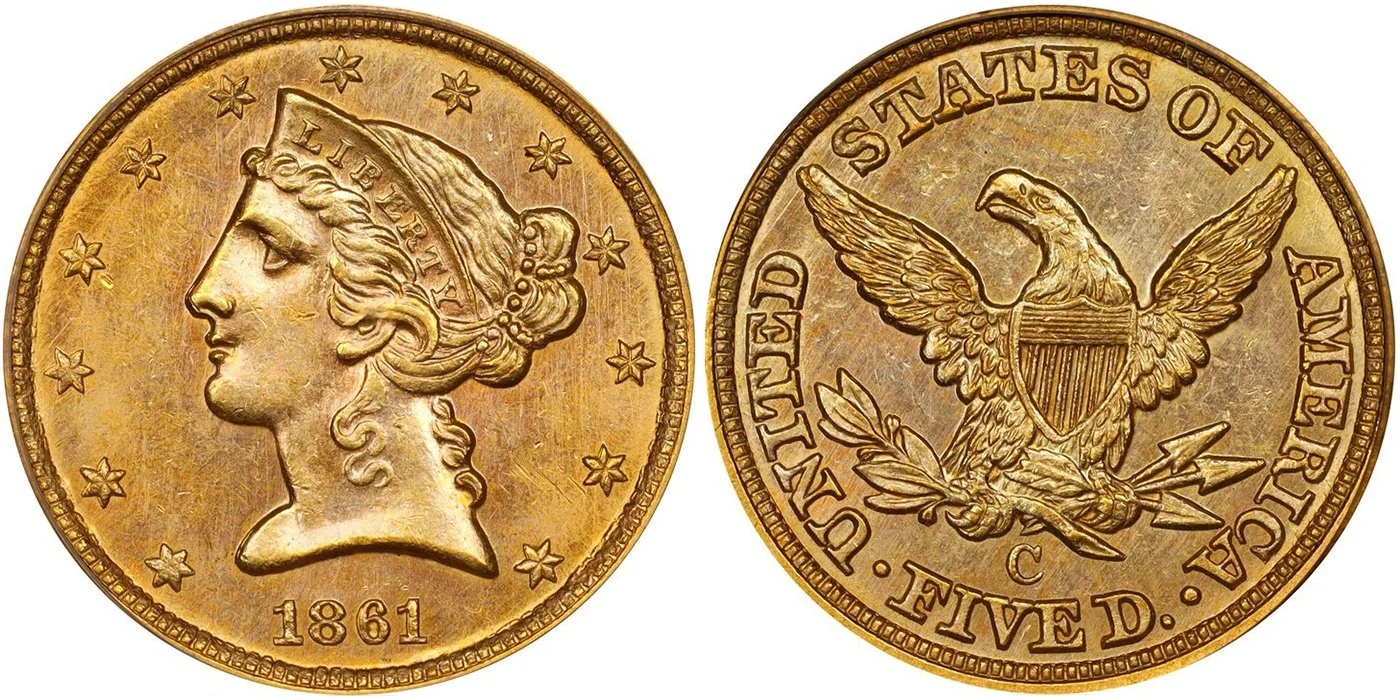
1861-C $5.00 PCGS MS63 CAC, COURTESY OF STACK'S BOWERS
To me, the 1861-C bringing $408k is a bigger surprise than the 1861-D selling for the same amount. Before I explain why, it is important to let you know that I was the underbidder on the 1861-C, and the successful bidder for the 1861-D.
For many years, I have been an advocate of high-grade 1861-C half eagles; especially this specific example. It is by far the finest known and it is the only coin I know of for this date which is 100% unequivocally Uncirculated. I was bidding on it for a collector who needed it to finish a set of Charlotte gold that was already complete with all the coins save for the 1861-C, in MS60 and finer. Prior to the sale, I told him that we should expect the coin to sell for $250,000 to $300,000 hammer. The coin opened at $185,000 and by the time it reached $220,000 it was just me versus the successful bidder. I could tell—by the speed of his bids—that he was going to pay whatever it took to buy the 1861-C. I stretched to $330,000 hammer and was done.
The 1861-D in the Stack’s Bowers sale was a coin that I was certain I was going to buy. I have a new(er) client putting together a type set of D-mint gold, and it only took a soft push from me to convince him that this was the right coin for his set. I told him we would likely have to pay around $350,000 hammer, and I was accurate in my assessment as the coin brought $340,000 (plus the additional 20% buyers fee).
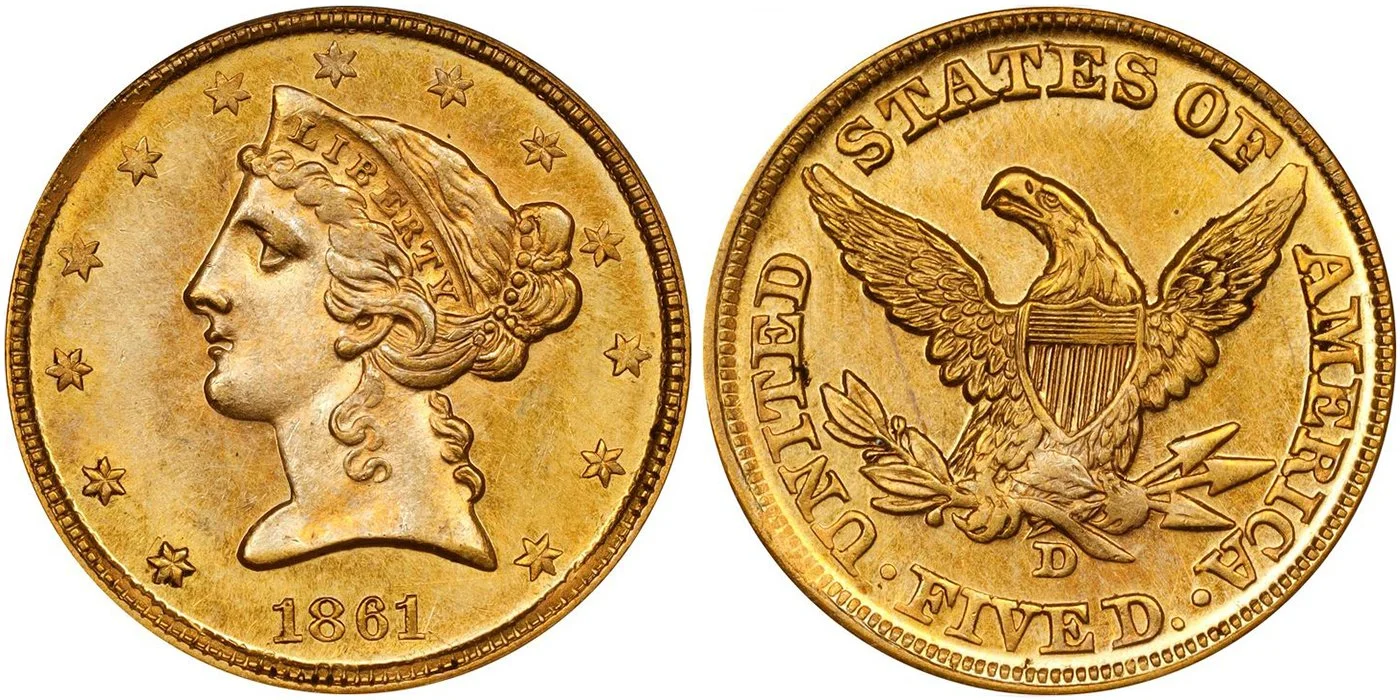
This 1861-D is one of two graded MS63 by PCGS with none finer. It is also one of two in this grade approved by CAC. It has a terrific pedigree going back to 1919 when it was sold to John Clapp. It was then sold to Louis Eliasberg in 1942 when he purchased the entire Clapp estate for $100,000. It then appeared in the 10/1982 sale of the Eliasberg Collection, where it sold for a record price of $33,000. I first handled it in 1999 when I purchased it from Leon Farmer who owned the North Georgia Collection, and I bought it again in the 2008 FUN auction where I paid $207,000.
Why did the 1861-C sell for as much as the 1861-D; a coin it had traditionally trailed price-wise by a considerable amount?
As I don’t know who the buyer was, I can’t say for sure why he was willing to pay seemingly whatever it took to own the coin. If he is assembling a world-class set of Charlotte half eagles, he now owns what is regarded by most Southern gold specialists as the single best Liberty head half eagle from this facility.
Do I think the new owner of the finest known 1861-C $5 overpaid for the coin? When it was offered for sale in early 2023—after it failed to sell in its December 2020 auction appearance—I felt it was an incredibly good value. Three short years later at nearly a 3x multiple, it seems fully priced for the time being but not dramatically so.
An interesting postscript occurred right after the auction ended. Another dealer texted me and asked if I had purchased the 1861-D in the Stack’s Bowers sale. When I told him that I did, he offered to sell me the other PCGS/CAC MS63 1861-D at a 5% discount off what I had just paid for the Eliasberg example. I knew I had to buy this coin, and the decision was made easier after I spoke to the underbidder on the 1861-C who had reached out to me. This meant that I had accomplished a numismatic first by selling both of the PCGS/CAC MS63 examples of the 1861-D half eagle. The speed of this accomplishment—two $400,000 coins within a half hour of each other—makes this accomplishment pretty special for an afternoon that I had set aside to write a blog on the auction itself. Instead, the blog wrote itself.
In summary, I think this was a true win-win. The consignor of the 1861-C and the Eliasberg 1861-D has to be happy with what his coins sold for. The two collectors I sold Condition Census 1861-D half eagles to are both happy. And I’m happy to have sold $800,000 worth of 1861-D half eagles in less than an hour.
Are you in the market for an 1861-D half eagle? Or do you need world-class auction representation? Feel free to contact me by phone (214-675-9897) or email (dwn@ont.com) and see what DWN can do for you.