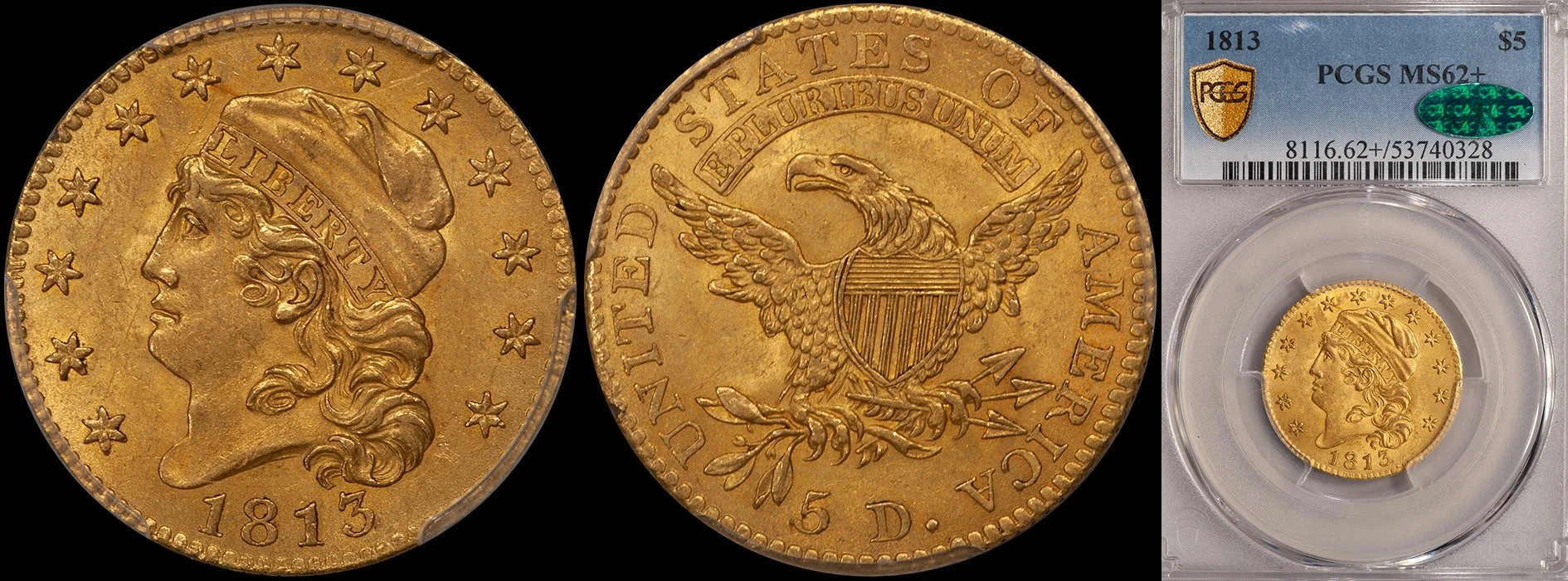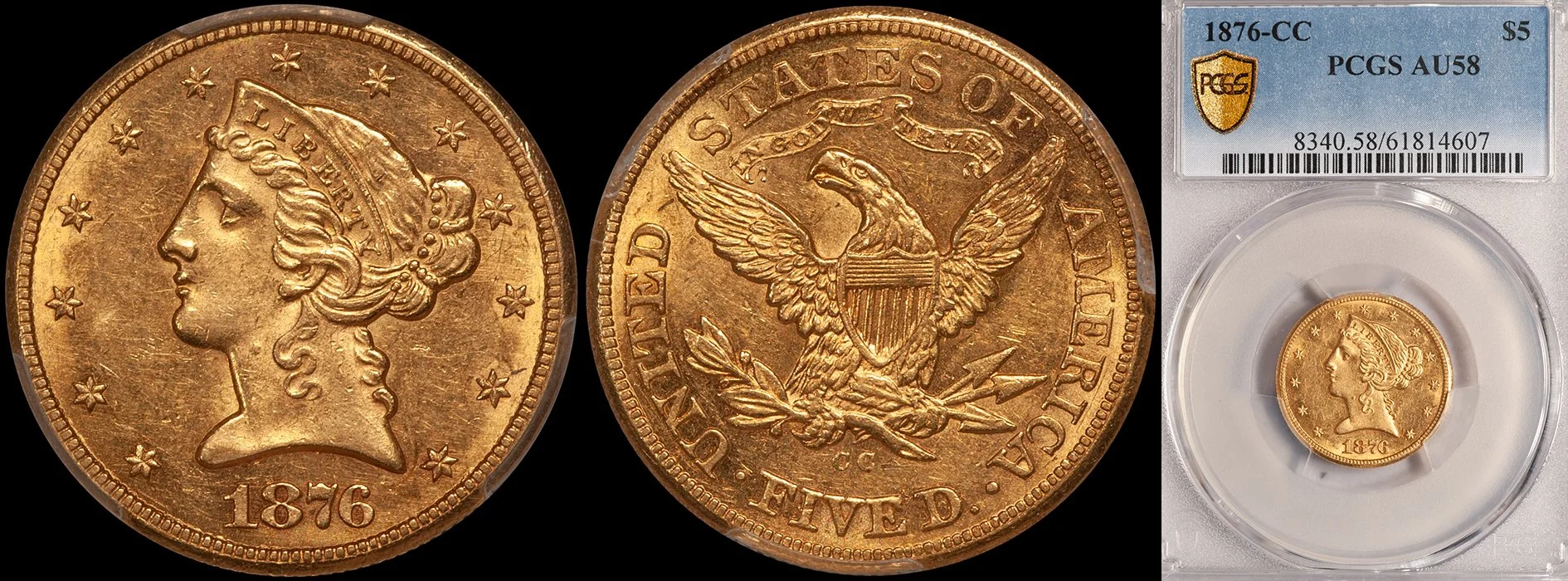
In 2026 and Beyond, is it Even Feasible to Collect Pre-1933 Gold Coins by Date?
/Across virtually every series of pre-1933 US gold there is a chronic shortage of choice, interesting coins. I’m not talking about a series such as Draped Bust quarter eagles which have always been extremely difficult to collect by date. The reality of the coin market in 2026 and beyond is that collecting a series (i.e., Liberty Head eagles from 1838 through 1907) has become nearly impossible, while collecting a sub-series (i.e. Carson City eagles from 1870 through 1893) has become very challenging.
If you are a relatively new collector, you probably have a naïve perspective on coin availability. If you called me on an early April morning in, say, 1998 and asked me if I could assemble an average to somewhat above-average set of Liberty Head eagles in a two year time period, I would have said “sure, I can do that…” If you asked me the same question in 2026 and gave me a five year window, I would likely say “I’d love to work with you on that set, but it will not be completed to my satisfaction within five years.”
It is important to note that this article presupposes that the collector cares about what is coins actually look like. Because if he doesn’t really care, I can complete a decent set of Liberty Head eagles for you—as referenced above—in less than five years.
Let’s look at some of the reasons why a shortage of high quality exists in 2026 and will likely continue for years to come.
1: The coin market is bigger and deeper than most observers assume. If you go to most any coin show held in the US (besides the Summer ANA and Winter FUN), you’ll see tired old dealers hustling tired old coins to tired old buyers. However, there is another parallel market where dynamic dealers—some as young as their mid-teens—sell interesting coins to younger, eager buyers.
Whatnot and Ebay Live (plus Instagram and a few others) have become huge platforms for buying and selling coins. I was in a meeting with a Whatnot executive early this year, and he stated the estimated sales from just rare coins and bullion was projected to be $1,000,000,000 (that’s a billion dollars) in 2026.
I’m going to go out on a limb here and predict that if you are reading this blog on my site, you aren’t a buyer on those platforms and I’ll predict that over half of you don’t even know exactly what Whatnot is or what it does. If you want to see what the short-term future of the rare coin market looks like—for better and for worse—I suggest you download the Whatnot app; you can find it on the Apple App Store where it can be downloaded for free and spend a few hours watching coin business getting done.
2: The number of rare date US gold coins which were destroyed by upgraders is even greater than I feared.
I blame the grading services for this occurrence.
In the early years of third-party grading, US gold coins with original color and surfaces were graded with extremely tight standards. I’ve seen untold numbers of coins graded prior to 2000 which appear hugely undergraded by the accepted standards of 2026.
But a category of dealers made their living by cracking-out coins from their original holders and brightening them. Every time an EF45 Bust Right half eagle was cracked out, made shiny, and morphed into an AU53, the crackout dealer was tacitly endorsed by the services to repeat the process over and over. At one time, there were as many as 75-100 dealers who were full time “crackers.” Let’s assume that at least half of these individuals were actively cracking out and ruining 18th and 19th century US gold.
So, we might have had upwards of 50+ people each cracking out 200+ coins per week. This translates to 10,000+ coins per week in total. Multiply this time 52 for the number of weeks in a year and you are up to 520,000+ coins per year (a number which I feel is waaaaaaay too low). Now multiply this by 20 years of coins being ruined and you are up to 10,400,000+ destroyed coins. When you consider that an estimated 12,500-15,000 Dahlonega gold coins in total exist across all denominations, the fact that a very significant percentage of them have been ruined is not fully understood by most new collectors.
3. Most new collectors are quality-conscious and prefer to add CAC approved coins whenever possible. The problem is that there are just not enough CAC approved coins in most pre-1900 gold types to satisfy increased demand.
Let’s look at an example which I feel will clarify this situation.
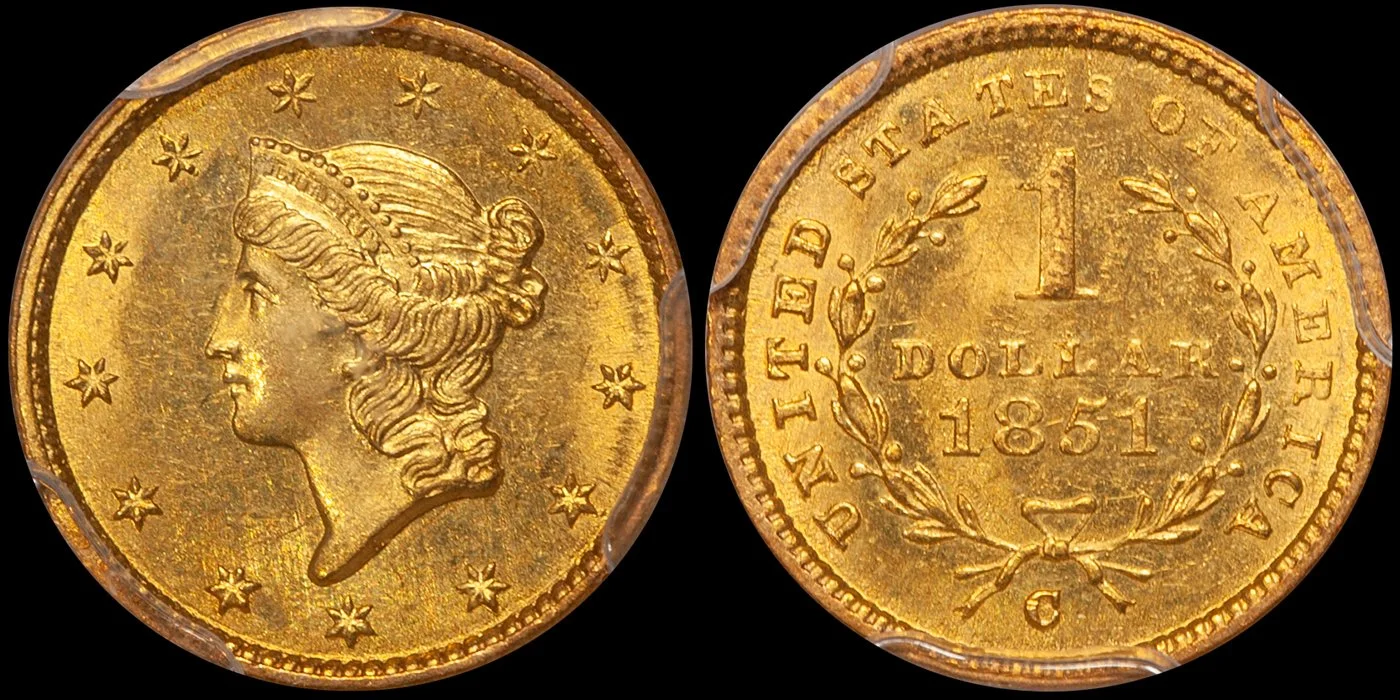
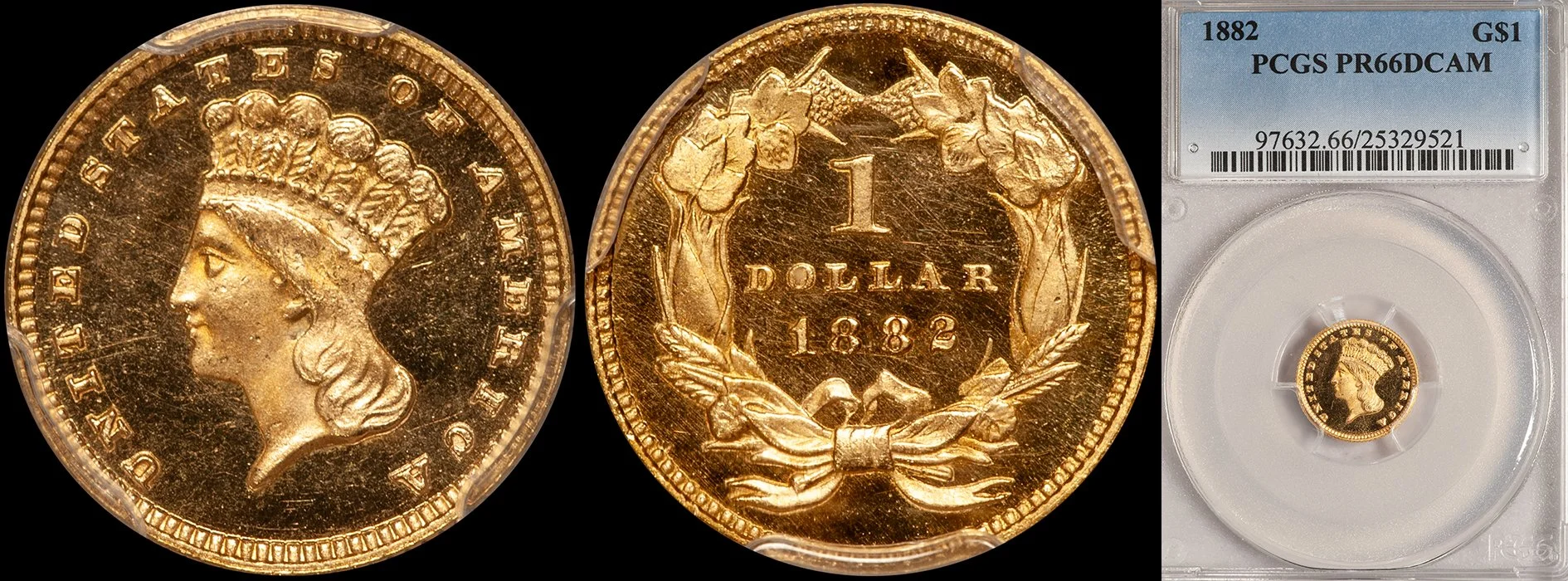
1851-C $1.00 PCGS MS64 CAC
An 1851-C gold dollar is “common” by the standards of Charlotte coinage. It is likely that as many as 750-1000 exist and this date should be readily available. And it was easily located as recently as the early 2020’s, when I would return from any larger show I attended with two or three presentable 1851-C gold dollars as part of my new purchases.
In 2026, I’m lucky to offer a PCGS/CAC 1851-C gold dollar more than two or three times per year. What gives?
Let’s look at the CAC population figures as most of the relevant coins that are considered to be “nice” are approved by CAC.
As of late April 2026, CAC shows a total population of 78 1851-C gold dollars with the lowest coin a VF30 and the highest a pair of MS65’s.
Most collectors would be happy with an AU in their collection. Breaking the numbers down, we see that a total of 57 coins have been approved by CAC. If we figure duplicate submissions along with coins that are CAC approved but which are not especially nice, we are down to an estimated three dozen or so AU 1851-C gold dollars. And with fewer than half of these not held in long-term collections, we are talking about a possible population of acceptable coins dwindling even lower.
This chart shows the total numbers of Charlotte gold dollars graded as well as those in AU and finer, plus some personal survival estimates for each date in DWN quality™ AU and higher:
| DATE | TOTAL APPROVED BY CAC |
TOTAL IN AU/MS |
DW ESTIMATES |
|---|---|---|---|
| 1849-C CW | 18 | 15 | 9-12 |
| 1850-C | 16 | 13 | 8-10 |
| 1851-C | 78 | 57 | 35-40 |
| 1852-C | 29 | 26 | 15-20 |
| 1853-C | 26 | 20 | 13-18 |
| 1855-C | 21 | 11 | 5-8 |
| 1857-C | 12 | 8 | 3-5 |
| 1859-C | 16 | 14 | 7-11 |
If you throw out the numbers for the 1851-C, you have a bunch of really difficult yet surprisingly inexpensive coins. That said, I doubt at double current CDN Bid prices could you assemble a complete eight coin set of C mint dollars in PCGS/CAC AU53 to AU55. I can explain it to you in greater detail by phone but suffice to say, this scenario plays out in nearly every series of pre-1900 US gold.
4. Coins used to be sold with the understanding that hold times were reasonably short; typically three to five years. If you look back at auction records from the 1995-2005 era, you’ll note certain great coins appearing over and over again at auction; typically at descending prices.
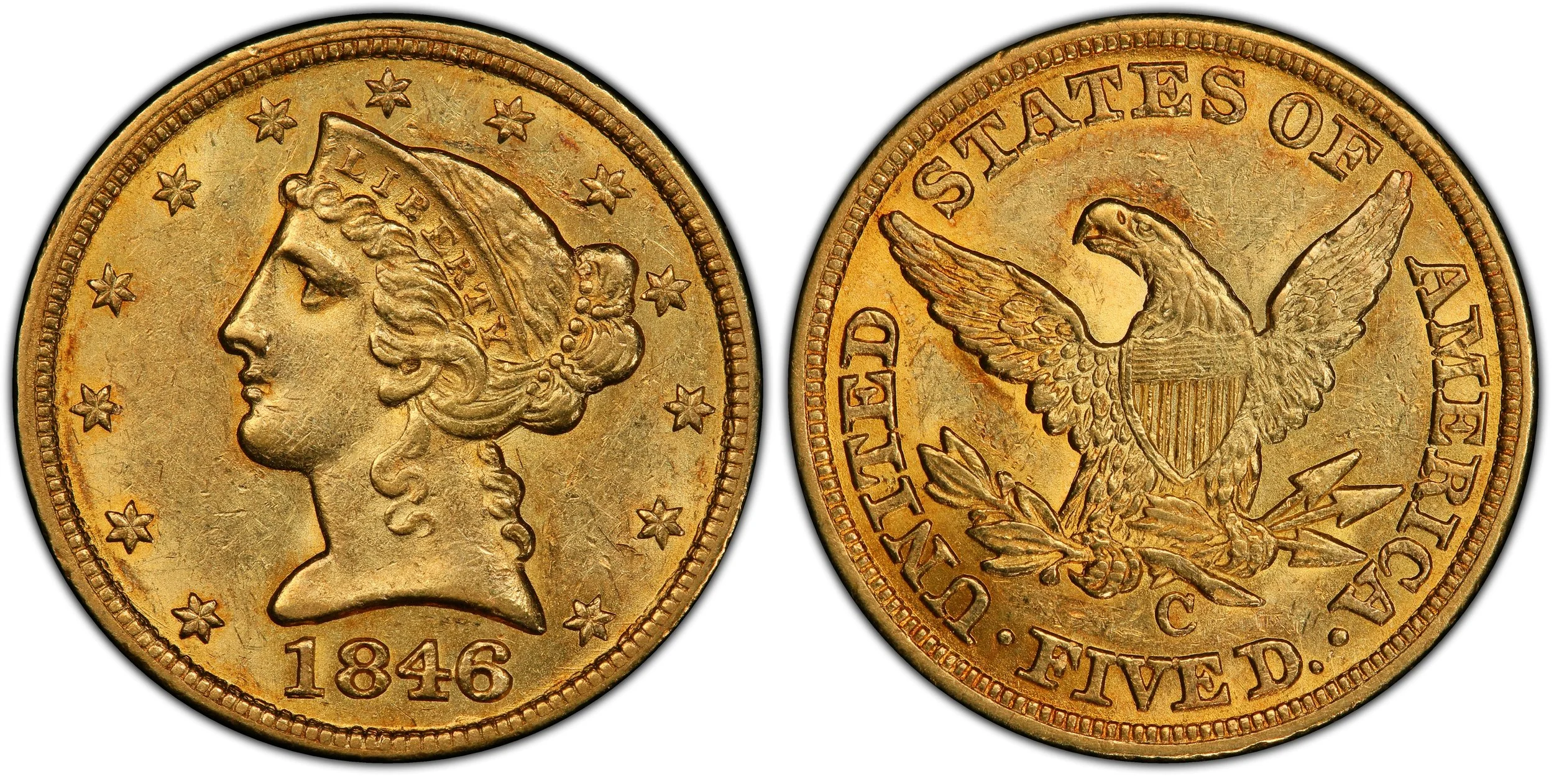
1846-C $5.00 PCGS MS61, courtesy of PCGS
Take, for instance, high-grade Charlotte and Dahlonega half eagles, I’ll select a random date; let’s use an 1846-C Half eagle. There are three nice Uncirculated coins currently known with the best a PCGS MS64 that was previously graded MS62 by PCGS and MS63 by NGC. This coin last sold at auction in May 1995. Then come two PCGS MS62s: one is ex Ashland City Collection and it has sold three times between 2003 and 2021, the other coin in PCGS MS62 is from the Bass Collection and it has sold twice; first in 1999 and again in 2004.
What this means is that collectors have had the chance to bid on a Condition Census 1846-C $5 just twice since 2021: the Ashland City MS62 listed above, and a nice PCGS/CAC MS61 that brought $30,000 as Heritage 2025 FUN: 4773.
5. In many US gold series, the key dates have become almost impossible to locate.
As an example, I recently bought and sold a really crisp and fresh 1842-C Small Date half eagle in PCGS/CAC EF45. In spite of it being aggressively priced (the dealer was smart and knew what he had was very special…) I bought and quickly sold it; although not to a client I expected would take my call to action when I listed the coin on my site.
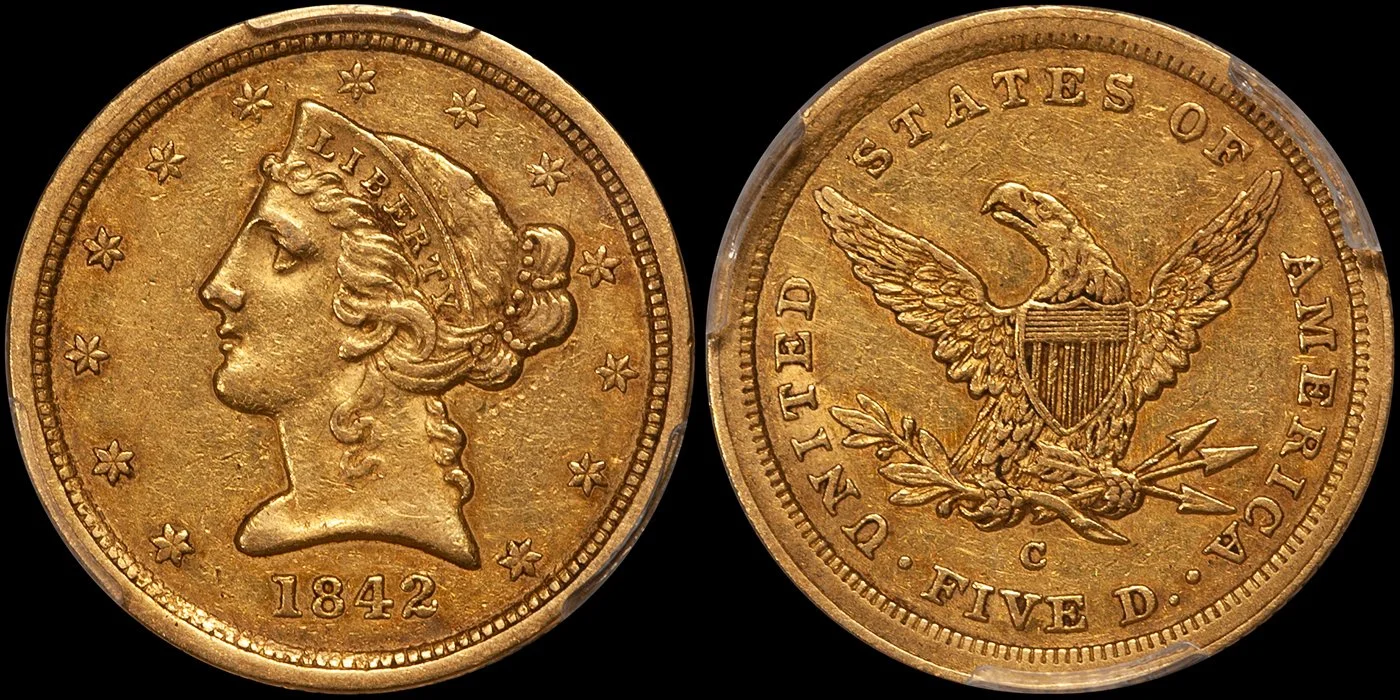
1842-C Small Date $5.00 PCGS EF45 CAC
I went into the DWN Database and looked up my activity with this issue. It had been six years since I handled one (a PCGS/CAC VF25), and in the last decade I had sold just three with none finer than the above-referenced PCGS/CAC 45 coin.
In many other series I see the same pattern.
In the gold dollar series, business strike examples of the key date 1863 and the low-mintage 1875 are seldom available. Within the branch mint gold dollars, there are very few 1855-D, 1856-D, and 1860-D examples available, and the same is true for nice, higher grade 1850-C, 1855-C, and 1857-C dollars.
In early gold, you see a good number of schlocky 1795 Small Eagle half eagles and eagles, but 1796 and 1797 fives and tens are extremely difficult to locate in AU50 and better.
The key date 1854-O and 1856-O double eagles are daunting rarities and with virtually none nice enough for CAC approval, this keeps demand somewhat low. I think there are fewer than seven or eight that are what I would term as “reasonably nice for the issue”
The point I’m hammering home here is that if you can’t find the key issues in your potential series, why even bother to go through the motions.
In conclusion, an old school maximalist approach to set collecting may no longer be viable in 2026 and beyond. I’m still willing to give it a serious and carefully thought-out attempt, and I would be happy to work with you on your quest for completion.
Call Doug Winter today at (214) 675-9897 to discuss your collecting goals.