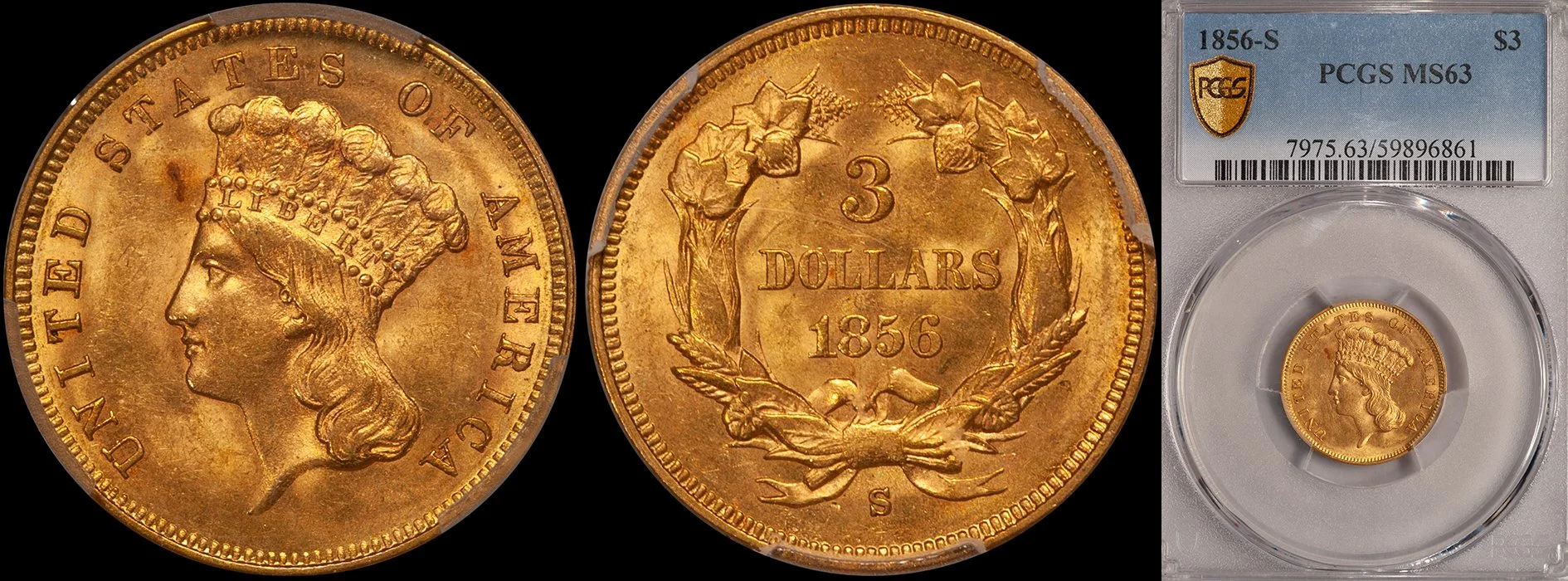
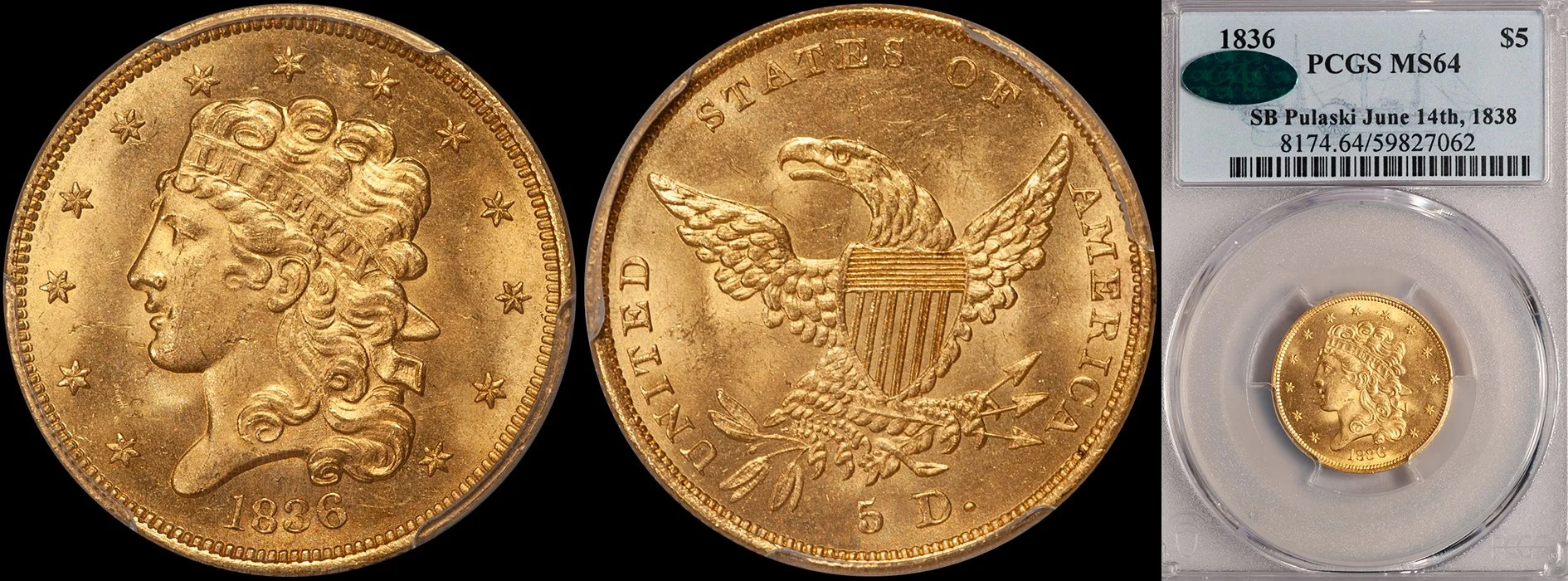
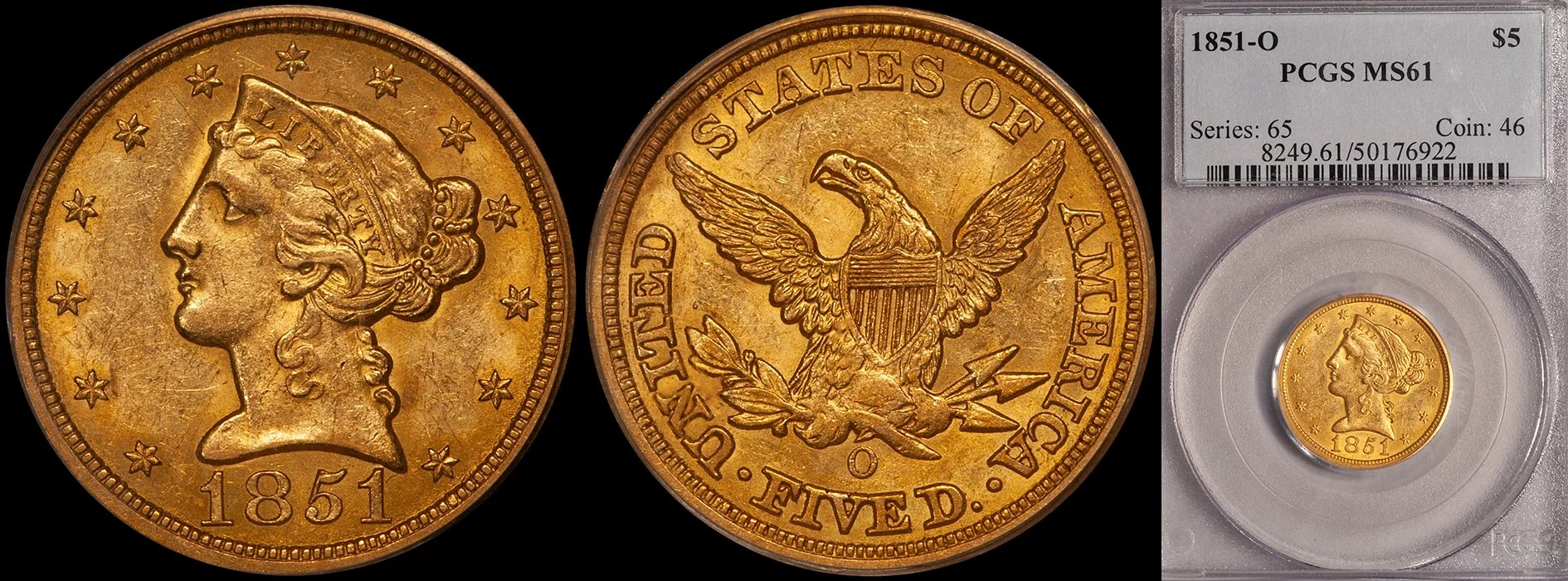
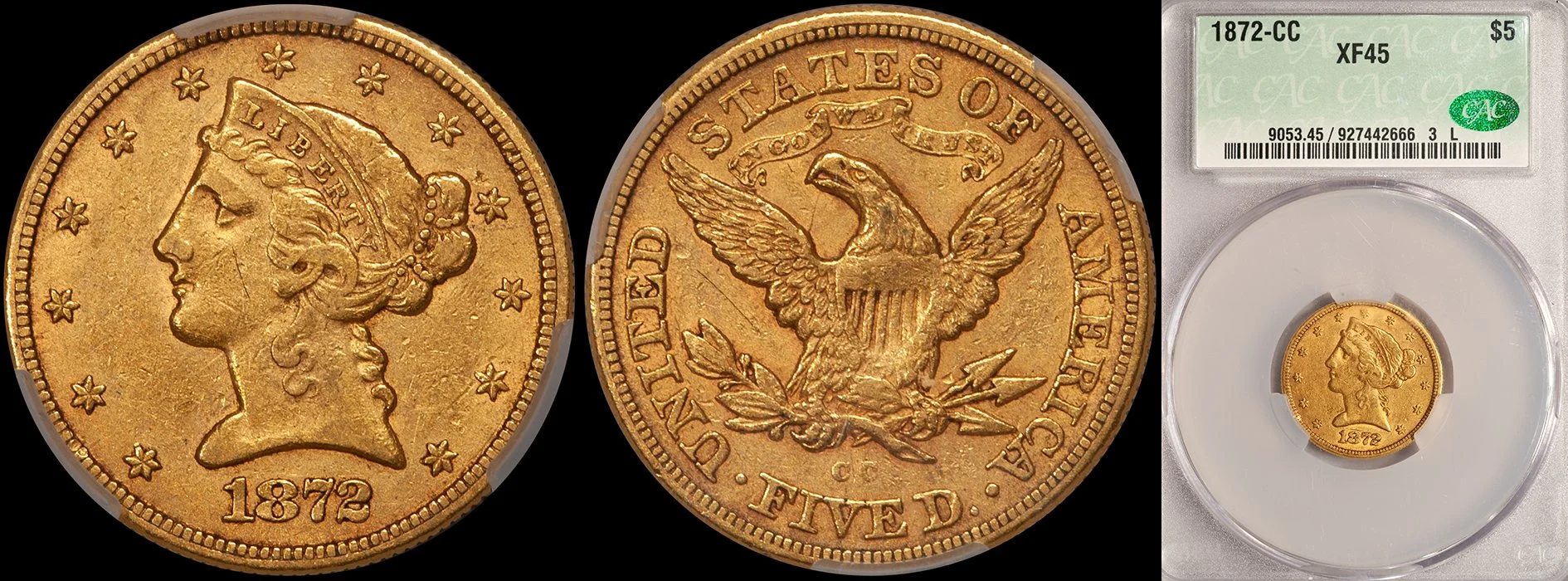
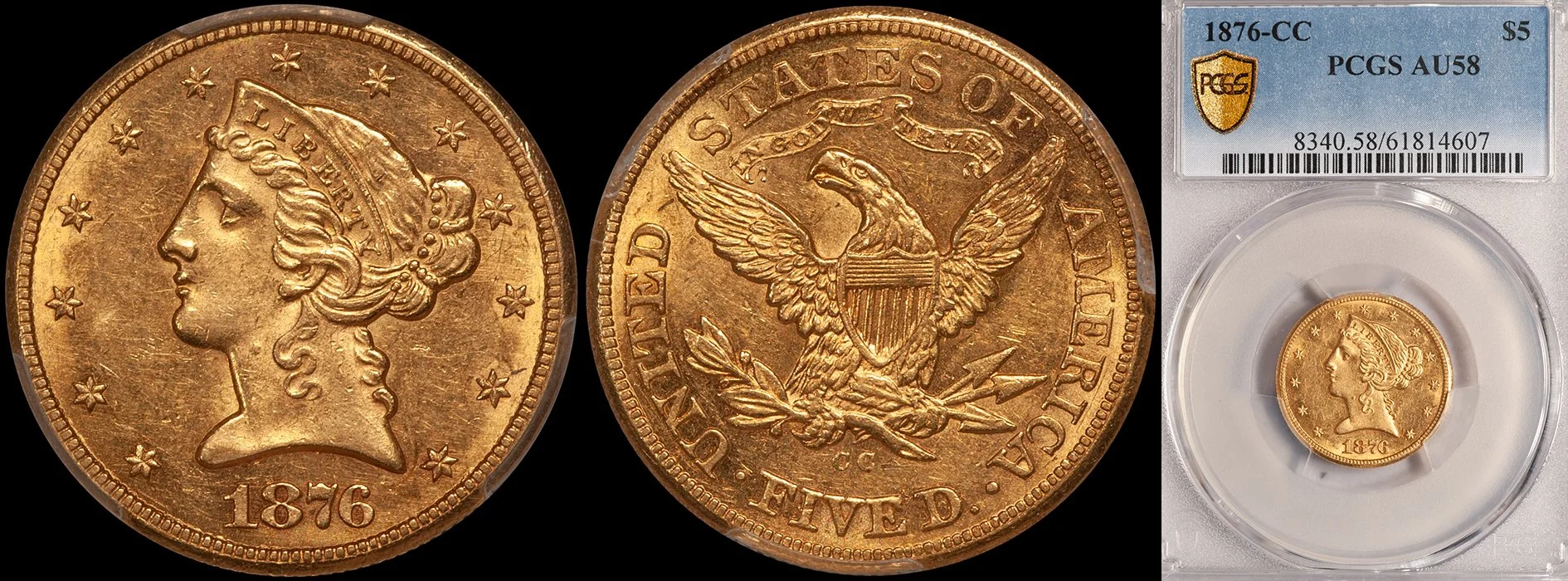
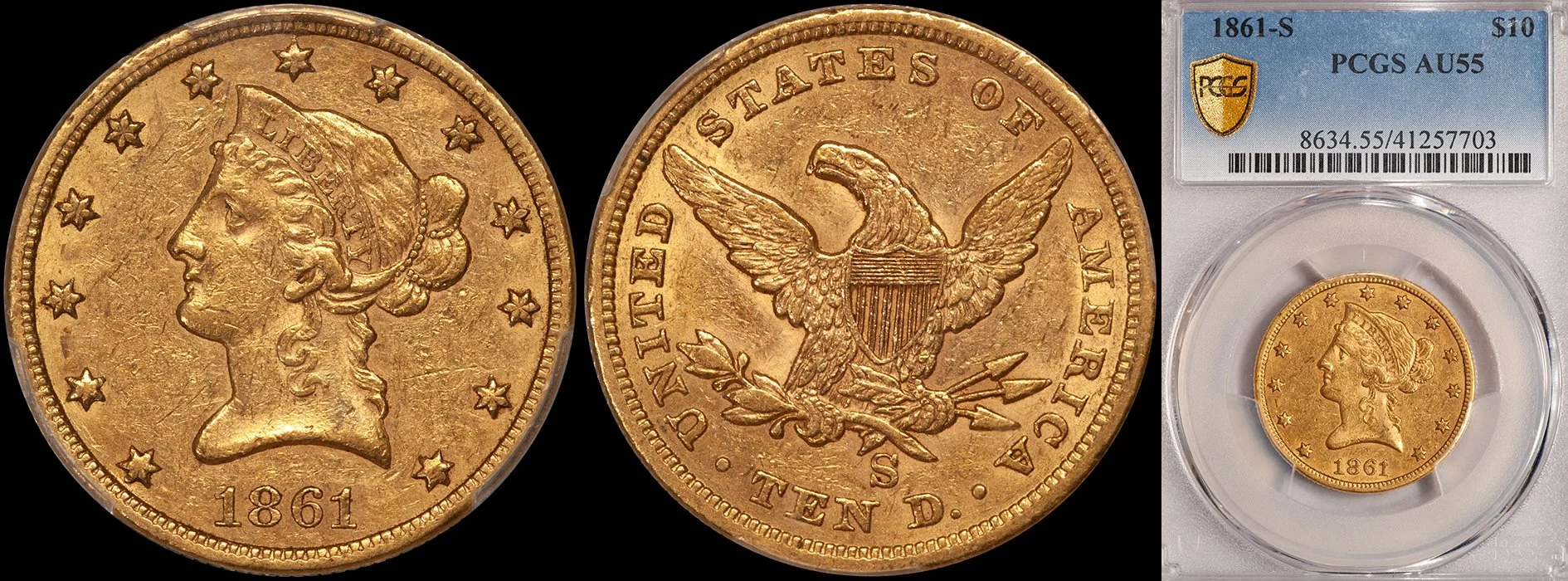
Why Do San Francisco Gold Coins Get No Love?

The City by the Bay gets my vote as by far the nicest city in which the U.S. Mint ever struck coins.

San Francisco is a cultural hotspot with museums galore and a long history of supporting the arts. It relishes its history, isn't afraid of it's somewhat sketchy past, and is home to more upscale, artsy residents per capita than probably anywhere else in the country. It should be a hotspot for collecting and its 19th century gold coinage should be as — or more popular — than its Podunk Western cousin, Carson City, right?

Actually it's not. San Francisco gold gets (relatively) no love from coin collectors. It's not a great coin town and, curiously, there are far fewer collectors for San Francisco gold coins than one would expect. This market is finally beginning to show some legs but it is still far less popular than I think it should be.

Why?

I think there are a lot of reasons. some clear and obvious, some far-fetched and obtuse. Let's look at a few reasons why San Francisco gold coins aren't that popular (yet), what the current trends in the market are and what the future holds for these issues from the Barbary Coast.

1. There Are "Too Many" Issues

San Francisco produced gold coins with virtually no interruptions from 1854 through 1916 and, sporadically in the 1920's and early 1930's. This is the longest production run of any branch mint and only the Philadelphia mint struck more coins during this time period.

Clearly, there are a lot of gold coins struck at the San Francisco and not all of them are "interesting." This is a contrast to the southern mints of Charlotte and Dahlonega which had shorter production runs and from which every coin has some degree of numismatic scarcity and desirability. The pre-1879 San Francisco Liberty Head gold coins tend to be far more interesting than their post-1879 counterparts and, admittedly, these later issues tend to be viewed as a group which sort of just drags on and on.

This plethora of issues tends to intimidate the novice collector. To state, "I'm a collector of San Francisco gold," entails denominations ranging from gold dollars to double eagles and, quite frankly, this is intimidating. It is important for the potential San Francisco collector to immediately become a specialist and focus on either one denomination or a subset (i.e., No Motto half eagles from this mint).

Which brings us to the all-important point number two...

2. There's No Reference Book on San Francisco Gold Coinage

Reference books exist on virtually all the mints that struck U.S. gold coins and specialized books by Bowers, Dannreuther, Akers, Goe and others cover early gold, certain non-southern branch mints. But, to date, there is no single specialized reference work on San Francisco gold.

For years, I've given this project strong consideration but the amount of work it will take to write a San Francisco gold coin book is staggering. And it's a real Catch-22: the market will be jumpstarted by said book but who wants to spend the time, effort and money to undertake this project when it will probably sell 500 copies and go overlooked? It's truly a labor of love and the handful of dealers that I think are qualified to write such a book (myself included) are probably too busy buying and selling coins to pen a 400-500 page opus on SF gold. 

Until a good standard reference book on these coins is published, the market is destined to trail areas such as Carson City, Charlotte, Dahlonega and New Orleans.

3. There's No Marketmaker(s) In This Series

If you want to buy a nice Dahlonega half eagle, there is a small but stable core of suppliers that collectors know where to turn to. Same with Type One double eagles, Proof gold and early gold, to name a few. But who is an iconic marketmarker for San Francisco half eagles; a dealer you know is always going to have a nice date run of Civil War era coins or some Gem semi-scarce issues from the 1880's and 1890's? At this point, there is no one dealer who is "Mr. San Francisco gold."

1861-S Paquet $20.00 NGC AU53

Ironically, there has been some exceptional marketing in one area of the San Francisco coin market: Type One and Type Three double eagles. The former has been the domain of a West Coast firm for over a decade and it began as an off-shoot of the S.S. Central America shipwreck. They had a brainstorm many years ago which proved prescient: you buy a gorgeous 1857-S double eagle in MS64 or MS65 and you get hooked; the next logical step is a date set of Type One double eagles from this mint. That's why coins like the 1854-S, 1861-S Paquet Reverse and the 1866-S No Motto have tripled in value in the last decade.

If this West Coast marketer started to focus on San Francisco gold which complimented its double eagle focus, it might be a huge shot in the arm for these coins. If a collector bought a nice 1857-S double eagle, wouldn't he want to assemble a date set of 1857-S gold? In theory yes but there is one problem. While there are thousands of Gem and Superb 1857-S double eagles available, all the other denominations from this year are rare to very rare in Uncirculated and non-existent in Gem. How do you explain to a new collector that the AU58 1857-S eagle he is being offered to go with his 1857-S double eagle in MS65 is the best available coin for that denomination?

4. Modern Coins Have Hurt the "Unusual Date" San Francisco Market

A coin like an 1864-S eagle is clearly a "rare date" issue with an avid collector base. And a 1901-S eagle is clearly a "generic" issue which is bought and sold like a commodity by investors and investor-collector hybrids. Then there coins like, say, an 1883-S eagle which is not really a rare coin but is clearly not a common generic issue. I sort of jokingly refer to these as "unusual dates."

Before modern coins became popular, "unusual date" San Francisco gold was popular with marketers and it might sell for a 20%, 30% or even a 40+% premium over common dates. The sales pitch was easy to make: here is a coin which is fifty times more rarer than a generic issue for just a 30% premium. It made sense.

But today, most of the firms that would sell these "unusual dates" are focused on moderns where the supply is unlimited and the margin are consistent. And this has not only destroyed the market premium for a coin like an 1883-S eagle in MS62, it has hurt the ability for a coin like the 1883-S to be used an entry portal into the rarer coins from this mint, like the 1864-S eagle.

If a few of the firms which used to sell "unusual date" San Francisco gold would resume their programs, this might be good for the long-term health of the market.

5. One Of The Horses Has To Finish Last In The Race....

If we throw out Denver as a branch mint (because it's my blog, I get to make the rules) that leaves us with five branch mints. One has to be the most popular (I'm going to give that honor to Carson City although I could see a case for Dahlonega and one has to be the least popular. To paraphrase the immortal words of my high school baseball coach, "in a horse race, one of the animals has to finish last."

But if one branch mint has to finish last in a Numismatic Popularity Contest, why San Francisco? With all the newly created wealth in Northern California from nerd-centric professions such as engineering, entrepreneurship, social media, etc. one has to wonder if the time is coming for San Francisco gold coins.

Interestingly, a few of my newer clients are in their 30's, have made a good deal of money from Internet or tech-related businesses and are from the bay Area or Silicon Valley. They are very attracted to SF gold and when they "run the numbers" (as you would expect a Tech Wonk to do) they quickly conclude that these issues seem like great value when compared to southern gold.

So could this be the future of the San Francisco gold market? Hard to say but if these few new collectors are any indication and at least one or two of the problems listed above is addressed, than we may be seeing a strong new market developing right before our very eyes.

Are you interested in San Francisco gold coinage? Would you like to assemble a world-class collection of gold from this mint? Whether you are Mark Zuckerberg or Mark the Dude from Around the Block, I can help! Please feel free to email me directly at dwn@ont.com to discuss your new San Francisco gold collection!


Collecting No Motto New Orleans Half Eagles

If you have a numismatic budget of $2,000-10,000 per coin and you want to explore a series that is reasonably short in duration but long on challenges, I'd strongly suggest No Motto half eagles from New Orleans. Let's take a brief look at this area of collecting and see if it is for you. The New Orleans mint opened in 1838 and began producing silver coins. The first gold issue from this facility was the 1839-O quarter eagle. The next year, coinage of half eagles would begin. Half eagles would be struck, intermittently, until 1857 with a total of twelve issues (thirteen if you count the two varieties of 1843-O). Production did resume in 1892 and three With Motto issues were produced but we are not going to discuss them at this time.

To my way of thinking, No Motto New Orleans half eagles are a great collector-based series for a variety of reasons. These include the following:

*The coins are scarce and undervalued but they are affordable. If you can budget around $5,000 per coin for most of the issues (and $7,500-10,000 for the two keys) you can assemble a really nice group of coins with most of the pieces in the AU grades.

*The coins are well made. Unlike the sometimes poorly produced half eagles from Charlotte and Dahlonega, the New Orleans issues tend to be very well made. If you are a collector who finds strike to be a critical issue, this is going to be an important factor for you.

*There are no unobtainable issues. In both the Charlotte and Dahlonega half eagle series you have at least one very expensive issue (the 1842-C Small Date and the 1861-D). In the New Orleans series, there is nothing that will bust the budget of an average collector.

*There is a great book available on these coins which just happens to have been written by yours truly.

As I mentioned above, there are a total of thirteen different No Motto half eagles from this mint. There are two issues which I would call very scarce to rare, two issues which I would call common to somewhat scarce and nine which are scarce-ish to scarce but which can prove to be challenging if the collector is picky to very picky.

1842-O $5.00 (graded NGC AU55)

The two really challenging No Motto half eagles from New Orleans are the 1842-O and the 1847-O.  The former has a mintage of 16,400 while the latter has a mintage of 12,000. Both have well under 100 known in all grades and both are usually seen in low grades. Despite the rarity of these two issues, they are still relatively affordable..

As an example, a presentable PCGS VF20 1842-O half eagle sold at auction for just $2,300 in Heritage's 8/11 auction. In 2010, two PCGS EF45 examples brought $3,881 and $3,738. While neither of these coins was what I'd call "PQ" for the grade, they represent amazingly good value at less than four thousand dollars for a date which has not been sold at auction in any AU grade since 2004.

1847-O $5.00 (graded NGC MS60)

The 1847-O is even rarer than the 1842-O and it is actually less available in higher grades than the far more pricey 1861-D half eagle.  A nice, wholesome NGC VF35 brought $4,025 in the Heritage 12/11 sale and two PCGS EF examples (one in 40 and the other in 45) sold for $7,475 and $8,052 in Heritage's January and August 2011 auctions. In my opinion, a pleasing original EF or AU example of this date at current levels is a terrific value.

The next category of dates--the ones I called "scarce-ish to scarce" include the 1843-O Small Letters and Large Letters, 1845-O, 1846-O, 1851-O, 1855-O, 1856-O and 1857-O. These can actually be sub-divided into the classes: the dates in the 1840's (scarce-ish) and the dates in the 1850's (scarce).

The 1840's dates are all very affordable in the EF grades. The collector is looking $2,000-3,000, on average for nice quality pieces. In AU grades, the collector is looking at $3,000-6,000 depending on quality.

Here are some very brief comments on each of these dates:

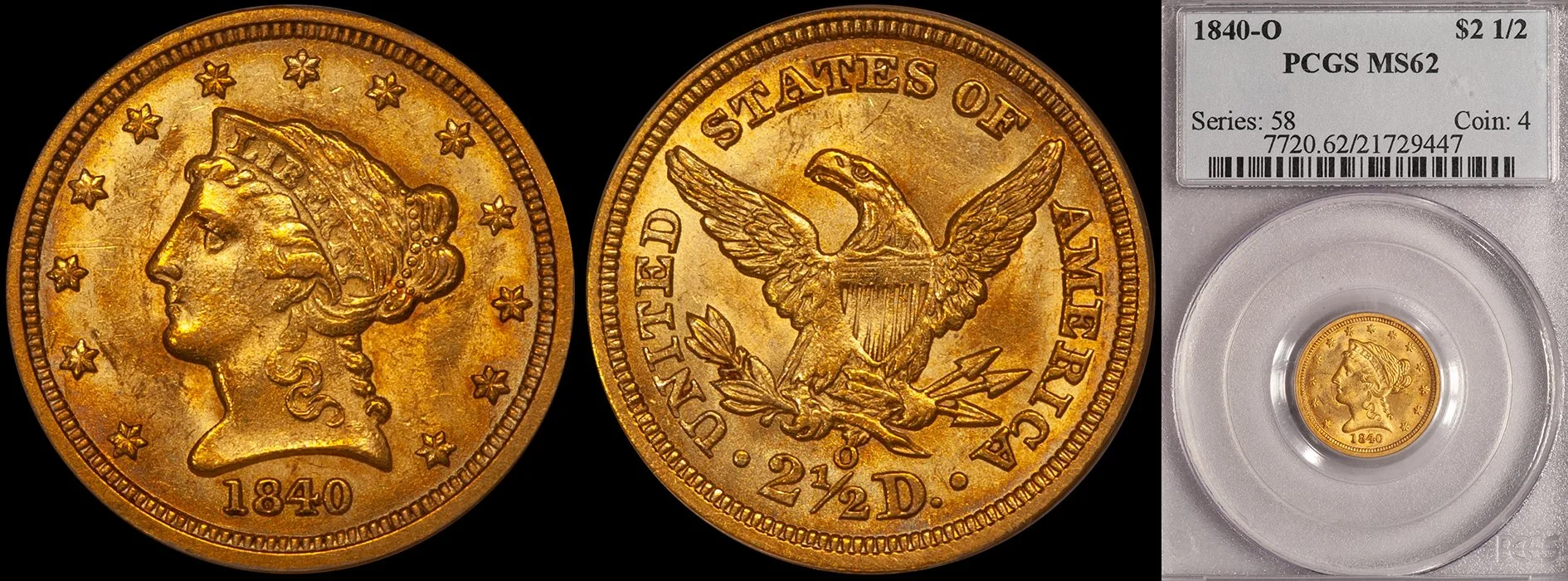
*1840-O:  This is the most common of the three first-year-of-issue half eagles from the southern branch mints. Varieties exist with a narrow mill (common) and a wide mill (rare).

*1843-O Small Letters:  The rarer of the two varieties struck this year. Often seen with weakness at the borders from die lapping. Very hard to locate with original surfaces and color.

*1843-O Large Letters:  The more common of the two. A reasonably available issue in EF; available in the lower AU grades but becomes rare in AU55. Generally well struck with good luster.

*1845-O:  Available in EF grades but harder to find than many more expensive C+D half eagles of this era. Generally well struck but often very abraded. Worth a good premium with natural color.

*1846-O:  Harder to find than the 1845-O but comparable in rarity below AU. For some reason, nice AU coins have become much more difficult to find than in the past. A really tough issue in crisp, wholesome AU55 and AU58.

*1851-O:  Similar in rarity to the 1845-O and 1846-O so included with the 1840's issues. Not quite as well struck as the last two but the luster tends to be good. Often seen dipped and worth a strong premium with natural color.

Given their lower mintage figures, one would expect the 1855-O, 1856-O and 1857-O to be scarcer than their counterparts from the 1840's. All three of these are hard to find and, in my opinion, very undervalued in relation to Charlotte and Dahlonega issues from this era.

These three issues are comparable in rarity but I would rank them in this order: 1855-O, 1857-O and 1856-O.

The 1855-O, 1856-O and 1857-O are hard to find in problem-free, original EF grades but, when available, they can still be had to under $3,000 a coin. As an example, look at the 1855-O. Since 2009, there have been four EF45's sold at auction. Prices for these have ranged from a low of $2,302 to a high of $2,700. In my opinion, that is very reasonable for a coin as rare as this.

The two common date No Motto half eagles from this mint are the 1844-O and the 1854-O. The 1844-O had a mintage over 364,600 and it is reasonably easy to locate in grades up to AU55. The 1854-O had a much lower mintage of 46,000. It is less rare than the 1851-O (which has a mintage of 41,000) and can be found in the EF40-AU50 range. In properly graded AU55 and AU58, it is scarce and undervalued.

My ideal set construction for this series would be as follows:

For the collector with a budget of $2,000-3,000 per coin, I would focus on obtaining EF40 to EF45 examples of the scarce dates and AU50 to AU55 examples of the more available ones. The 1842-O is going to require an outlay of at least $3,000-4,000 for a decent high end VF to EF coin. The 1847-O will be a bit more expensive but it is possible, with some patience and luck, to find one for around $5,000-6,000.

For the collector who has a budget of $5,000-10,000 per coin, I'd look at AU55 to AU58 examples of all the dates with the exception of the 1844-O (where I would stretch for an MS62 at $6,00-7,000) and the 1847-O (where I'd hope I can find a nice AU50 or AU53).

For the collector with a big budget of $10,000+ per coin, the focus would be on Uncirculated coins. The majority of the No Motto issues from New Orleans have fewer than a dozen known in Uncirculated. Two issues, the 1842-O and the 1847-O, are exceedingly rare and might not be available above AU55 to AU58 while the final three (1855-O, 1856-O and 1857-O) are not as impossible but are not exactly slouches.

As I mentioned above, this is a series that I think has a ton going for it. It doesn't have the level of popularity which enshrouds the double eagles but it is easier to collect than the No Motto eagles from this mint and far more interesting than the gold dollars or quarter eagles.

No one--and I mean no one!--has handled more interesting No Motto New Orleans half eagles than I have. If this is a series which you want to collect, you should contact me by email at dwn@ont.com and we can discuss it.

How To Succesfully Negotiate a Trade With Your Coin Dealer

You see a $25,000 coin in a dealer's inventory and you really want it. The problem is you are short of funds and you are the sort of person who has made a promise  to never take on debt to finance his hobby. Do you pass on the coin? Maybe you don't have to. My guess is that if you are a long-time collector you have at least $25,000 worth of coins in your collection that range from" junk" to" stuff" to "I kind of like this but it really doesn't fit into my collection anymore." I'd like to suggest that you can obtain that $25,000 coin by trading miscellaneous coins with the dealer in order to achieve your goal. And if you do the trade the right way, the best possible thing happens: a scenario in which both you and the dealer are happy and walk away thinking "I liked that trade and I'd do it again."

Some dealers don't like to trade and the advice which I give in this article will be for naught. Others--myself included--like to trade, especially if they have the opportunity to shed some older inventory and bring in some interesting new coins without the effort of going to a show.

A trade is mostly likely going to work if you know the dealer already and the dealer knows you. I have a few clients who, it seems, would almost always rather work out a trade than write me a check for a coin and I am happy to oblige them. They understand the dynamics of trading.

In a nutshell, trades only work if both parties feel they are getting good value. I am less likely to trade a great new coin that I just added to my website than one which has been in stock for a few weeks (or months) . Conversely, collectors want to trade for coins which will improve their collections. They are sophisticated enough to understand that not every great coin owned by a specific dealer sells quickly (that's a topic which deserves a blog...) and ultimately they want a collection that contains more neat coins and less "stuff."

The inherent problem with many coin trades is that collectors want one really good coin from a dealer but are not willing to give up anything in return. It's the numismatic equivalent of a baseball trade in which one team is offering a proven star player while the other team offers either unproven young prospects or overpaid, over-the-hill players on their roster. Some sort of compromise has to be made by both parties for a trade to work.

When someone proposes a trade with me, I immediately have to categorize what is being offered by the other party. Some trades are incredibly easy. I have a $10,000 Dahlonega half eagle in stock and my potential trading partner has two $5,000 Dahlonega half eagles. Those kind of deals are a piece of cake and get done very easily.

But trades are usually more complicated than that.

Let's look at the categories in which potential trade coins can fall into. I'll make a few pertinent comments about each.

1.  Coins Purchased From Me Recently

In theory, the coins I should want most are the ones which he has recently sold, right? Actually this is often not the case and the reasons why are not often so obvious. Let's say I had a reasonably memorable coin in stock a few months ago and it comes back in a trade. My worry is that potential customers will recognize it and wonder "hey, there's that MS63 Charlotte quarter eagle...what's it doing back in Doug's stock?" In the case of really obvious coins,  this is something that might keep me from getting a trade done.    

How do I value coins that I sold within, say, the last year which are being offered back to me in trade? I generally work on a 10-15% margin (sometimes less) so if I sold a coin for $5,000, it is likely that my cost was $4,250-4,500. I'm going to want to take that coin back at my original cost so that when I re-offer I can price it once more at around $5,000.

Some dealers do something disingenuous when it comes to taking coins back in trade. Let's say they sold a coin for $5,000 and their cost was $4,500. They will offer to take the coin back at $5,000 (which is technically a $500 loss for them) and make this up on the sell side where they will quietly jack-up the price of another coin from $5,000 to $5,500.

The bottom line is if you use a recently purchased coin as part of a trade, you can expect to get around 80-90% of what you paid for it but only if you are trading it back to the dealer from who you purchased it. If the coin is not from me, I don't feel the obligation to do this.

2. Coins Purchased From Me a Number of Years Ago

What if I get offered a group of coins which I sold back in 2003? The chances are good that the owner is going to be in a profit position but how much of one can become a grey area. Before I get into that, let me tell you how I'd figure them, value-wise.

Typically, if these are "cut and dry" sorts of coins (say like a common date Dahlonega half eagle in PCGS AU55) I'm going to see what the last few auction trades were and offer somewhere in the middle of the range. In other words, if the last three trades were $3,000, $3,300 and $3,600 I am going to figure the coin at around $3,300.

Let's say I get in a bunch of coins in trade and they are in older holders with a possible chance to upgrade. What do you I then? To me, the ethical thing to do in this situation is to let the collector know that there is possibly some extra value in the coins. I might tell him, "I am going to crack this coin out to regrade it. I'll figure it in the trade at $3,300 regardless of what happens but if it upgrades, I will pay you more."

If a dealer sells nice coins, he should be happy to get back a group which he sold years ago and this would be an ideal scenario for a trade.

3.  Coins I Don't Specialize in But Which I Like

As a dealer who specializes in rare United States gold coins from the 18th and 19th century, these are obviously the sort of coin that would interest me most in a trade. But I wouldn't rule out coins that I don't typically deal in. For me to accept non-gold coins in a trade, they have to be either something that I find interesting enough that I would put them on my website (and hope that it sells) or something that I think would sell for a price close to (or over) what I paid for them if I wholesaled them or put them into an auction.

I recently traded a high quality early gold coin for a group of coins which I don't deal in but found interesting. The main reason I made the trade, however, was because I think the collector who proposed the trade has an excellent eye and he understands value very well. I might not have made the exact same trade if it was proposed by someone who I didn't respect ability-wise. But this was a guy who impresses me and I was happy with the coins I received.

There is a limit to what I will take in trade. As an example, a few months ago, someone proposed a trade in which I would ship him a very cool Proof gold coin in exchange for what seemed to be some good quality Buffalo Nickels and Lincoln Cents. Even though it seemed like a reasonably fair trade, I passed. I don't know the Buffalo Nickel and Lincoln Cent markets very well; certainly not well enough to start taking in $5,000 examples in NGC holders. I suggested that he offer these coins to a specialist who would be more interested in them than I would and then use the proceeds to buy my coin.

4.  Coins I Don't Deal in And Don't Like    

Never say never, as the cliche goes, but it is going to be hard me to take in a bunch of off-quality coins that I don't like and I don't specialize in order to make a trade. I guess if I had a few complete duds in stock which I hated and I was desperate to get out of them...the good news, for me, is that I infrequently purchase disastrous coins and when I do, I tend to wash my hands of them as quickly and painlessly as possible by throwing them into auction and washing my hands of them.

Ready for a brief aside?

There is a well-known but frequently cash-strapped dealer who is (in)famous for trading coins. He is the worst trader that I have ever seen and I know a few dealers (myself included) who have totally gotten the better of him when we make trades. My strategy was to take the oldest, most expensive retreads in my inventory (always gold coins) and trade them for lower priced, reasonably fresh non-gold coins which he owned.  He always botched trades by taking in high priced coins at too high a price (I was always able to steer him towards the coins I owned that were the worst values) and exchanging them for less expensive, far more liquid coins.

5.  Bullion

I don't deal in bullion but I stayed at a Holiday Inn last night and can offer a fair trade price for bullion, knowing that I can lay it off at those numbers or even a small profit. Most dealers are happy to take bullion in trade. I suggest that if you offer bullion, you call a few national dealers and get an idea of what they are paying. I should be allowed to make a small amount on your bullion but I should not be allowed to make 10 or 15%. Don't undervalue or overvalue your bullion!

6.  Modern Crap AKA Your Boxes Full of Junque

This is where most collectors have the greatest amount of unrealized potential trade value in their collections. Let me give you an example.

I have been working with a collector for a few years who is trying to pare down his holdings. He wants to own a small number of really good coins but his business is cash intensive and he doesn't always have the available funds to buy good items as they become available. I went to his house a few months ago and he had pulled out literally hundreds of proof sets, rolls of silver coins, sets of low grade pieces and miscellaneous "stuff."

This isn't the sort of material I typically deal in but I like this guy, we've done a lot of business and I had the feeling that his junk was going to add up to a decent chunk of change. By the time I got his coins home, sorted through them, sent the good coins to PCGS and NGC and taken pen to paper, we were up to close to $75,000. That's a lot of "junk" and that, in turn, bought him a few really good coins which he now has stored in one small box instead of in three huge safety deposit boxes.

As a dealer, this isn't the sort of deal I like to do. It is very labor intensive and I still have nightmares about washing my hands every three minutes as I sortd through bag after bag  of circulated Indian Cents and Mercury Dimes looking for key dates. But I was working on 10% and got the collector to promise that I would be able to trade for his good coins when the time came.

Most times I'm not going to trade, say, a Proof Liberty Head double eagle worth $75,000 for a trunk full of modern crap. But if you are a good client and you do most of the work (i.e, you ship me your stuff neatly packaged and reasonably well-organized) I will consider trading my one great coin for your boatload o' crap.

I've probably made the whole trading process seem more complicated than it really is. If you don't have two compatible trade partners, you'll probably never make a deal work.

I'd love to hear your stories about good trades and bad trades. Please comment on them at the end of this article. And if you have coins which you would lke to trade, please feel free to email me at dwn@ont.com

Why Some Coins Sell and Why Some Don't

At a typical coin show, I buy between 25 and 75 new coins. I like every coin  I buy and I always think think that they have something worthwhile about them; something that will find them a new home. The majority of the new purchases  I put on my website sell quickly. But, from time to time, a good coin doesn't sell quickly or even doesn't sell at all. Why?

One of the things that I like about my business is that it is somewhat predictable but not so rote that at this point I don't have to think about it. I am well known as a good source for buying and selling rare United States gold coins but enough quirky things happen to me on a week-by-week basis that it still makes it challenging (and fun) to do what I have done as a full-time profession for my entire adult life.

Why is it that some of the coins that I think are going to sell well on my website do not while others that I worry if they will even get a nibble receive multiple orders within hours of being posted? Here are some thoughts:

1.  The Coin Didn't Image Well

Numismatics has become an extremely visual hobby with the proliferation of coin related websites. As recently as a decade ago, people relied on verbal descriptions. Today, it is all about images. I am lucky that I have one of the best coin photographers in the world working for me and her images are generally top-notch; certainly clear enough to give potential buyers an excellent idea of what the coin will look like in-hand. But even Jenna doesn't nail every image.

There have been a number of times I have gone through the coins on my site and noticed that a good coin that has sat around for a few weeks has an image that isn't quite perfect. Virtually every time the coin has been re-shot, it has sold.

Another thing that I have found is that sometimes NGC or PCGS holders need to be freshened. They might have scratches which appear to be on the coin in an image or they may be "scuffy" from spending too much time going from show to show in double row boxes. Sometimes, a fresh holder will get a coin sold.

2. They Are Too Expensive

I work on a pretty tight mark-up and I think I'm a savvy buyer who is able to buy nice coins at fair market value. But ultimately, it is up to my wholesale and retail buyers to determine if a coin is or isn't fairly priced. Usually my coins sell quickly and this is a validation of my pricing.

What about coins that have sat in my inventory for a month without a single inquiry? Sometimes they don't sell because they are perceived as being too expensive. In most cases, I have to agree with the market and re-price these coins accordingly.

On a number of occasions, I've taken a coin of mine which hasn't sold and put it in an auction where it has brought a good deal more than the price I had it for on my website. I would have to assume these coins were sold to buyers who don't go on my website at all and therefore didn't recognize where the coins were from.

3.  Too Many Other Examples Have Sold

Some esoteric rare coins have a limited amount of demand.

As an example, I recently spoke with a very knowledgeable collector who passed on a coin on another dealer's website which I thought was an excellent value (I tried to buy it and was too late). I asked him why he passed on it and he replied that so many examples of this issue had been available in the last few major auctions that his perception was that it wasn't rare. While I didn't agree with him in this instance, this was still a good point.

Many of the higher end coins that I sell have reasonably limited demand. A New Orleans quarter eagle may be one of only six to eight known in Uncirculated but if all the major players in this area have one, a truly tough coin might take a while to sell. I generally have a good idea which coins have the strongest level of demand but my potential selling scenarios do not always come to pass. And sometimes, I am surprised by who buys a very rare coin; the New Orleans quarter eagle cited above may be purchased by someone who until now has only bought double eagles from me.

4.   The Market For That Coin Is Slow

One of the odd things about a collector-driven market is that it can come to a screeching halt very quickly.

About seven or eight years ago, I quick-started the market for Three Dollar gold pieces. Within six months to a year, prices had risen and the market seemed self-sustaining with a high quality of demand. And poof!--just like that this seemingly strong market came to a screeching halt. Luckily, I was tuned into the market enough to know not to have a huge inventory of Threes and didn't get caught holding to many high-powered pieces when the market crumbled.

I notice the same thing happening from time to time in 2012-2013 although not on this level of magnitude. All of a sudden shipwreck coins are hot as a pistol and as a dealer I have to judge if the quality of demand is good enough that I would stock a $10,000 shipwreck double eagle that was $7,500 last year. This is one reason why I tend to be highly specialized in what I buy and sell. It's hard enough to know the vicissitudes of the market for 18th and 19th century gold coins let alone having to keep track of what Morgan dollars are selling in MS65 and what the premium factor is for PCGS/CAC coins in this series.

My point being...a coin I buy in January because I think it is going to sell might, through some quirk, become less easy to sell in February. That tends to be why I stick with coins that have multiple levels of demand and which are less subject to these shifts in demand.

5.  Sheer Happenstance

I have this conversation at least once a week:

Collector: When did you add that nice 1873-CC eagle to your website? I need that coin! It's nice!

Me: Uh, I've had it up for six weeks. I was really surprised that no one asked about it until now....

My point being, sometimes through weird quirks of fate, a seemingly very easy to sell coin lasts weeks before it sells. Other times, I get four inquiries in a day about a coin I'm worried if it will sell, even though I like it. I'm sure if you asked five coin dealers the same question they would all agree: some coins that should sell quickly don't and for not good explanation.

Why do you think some coins sell and some don't? Add your comments below and let me know. Do you have any questions you'd like to ask about which specific coins sell well for me and which do not? Feel free to email me at dwn@ont.com


What Percentage of Classic Rare United States Coins Have Been Graded by the Services?

     After 25+ years of encapsulating coins and 50+ million submissions, it is clear that PCGS and NGC have had a huge impact on the way we view coin rarity. I have personally learned many things: which coins are rare and which are not; which coins are true condition rarities and how issues within a specific series can be viewed on a comparative basis. This got me to thinking: how many coins within a series need to be graded (on a percentage basis) to make definitive rarity statements? And once this has been determined, what percentage of coins within certain series have already been graded by PCGS and NGC?      To start making trenchant observations about absolute and conditional rarity, I think we have to feel confident that over 50-60% of all known coins in a specific series have been graded. When it comes to expensive (let's say $5,000 and up) gold coins, I think the percentage of all coins graded by PCGS and/or NGC ranges from a low of around 65-70% to a high of close to 90%.

 Let's take a look at a few specific areas and try to guess what percentage of coins have been graded.

     1.  Charlotte and Dahlonega Gold

     The Charlotte and Dahlonega market was reasonably hesitant to embrace third-party grading and this initially made sense, given how erratically these coins were graded by PCGS and NGC during their formative years. But by the end of the 1980's, submitters were more confident and large quantities of these pieces were being encapsulated. And given the high average value of C+D gold, it makes sense that even the low end coins would eventually be sent in for slabbing.

     My guess is that a great majority of Charlotte and Dahlonega gold in all denominations resides in PCGS or NGC holders as of 2013. There are certainly still a few old school collectors who have held out and won't have " those confounded newfangled slabs" in their collections but these are seen less and less as the years pass. And given the fact that there were never many C+D coins in overseas sources, such as European banks, the thought of bags of Dahlonega half eagles lurking in Dortmund seems remote.

     When you look at PCGS and NGC populations figures for C+D mint gold, you have to remember a few things. The first is that these figures are inflated by resubmissions. The second is that they, of course, do not include damaged or cleaned coins which do not qualify for slabbing. Taking these two factors into consideration, I'd still say that the percentage of C+D gold which has been graded by PCGS and NGC is comparatively high; ranging from 75 to 85% of the known examples. In the case of choice, high end pieces (MS60 and above) this might be as high as 90% with the few renegade raw coins being those held by museums such as the ANS and the Smithsonian.

     2.  Proof Gold

     I always felt that one aspect of slabbing which was undervalued was its ability to protect fragile coins. Back in the old days, coins were typically transported to shows loose in 2x2 plastic flips and it would always make me cringe to see a coin like a Gem Proof Liberty Head double eagle in a soft flip. You knew that these coins were collecting hairlines with every trip to Long Beach or New York. Slabs were far safer environments for such coins. Because of this, Proof gold was an early adherent and by the late 1980's/early 1990's many Proof gold coins were already in slabs.

      Then came the Great Proof Gold Era of 1995-2000 when collections such as Childs, Bass and Pittman were sold at auction. In some cases you had very rare issues with ten or so known coins having three different survivors sold in a short period of time. Virtually all of these coins wound up being encapsulated or, in the case of the Bass collection, were sold in PCGS slabs.

     There are still two rich sources of unslabbed Proof gold: the ANS collection and the US Mint collection in the Smithsonian. But other than these two, I doubt if there are more than a handful of gradable Proof gold coins that still lurk in the raw. I'm going to guess that the percentage of pre-1916 proof US gold coins that have been graded by PCGS and NGC are at least 85% and may actually be as high as 90%.

      3. Early Gold

     I can remember auctions full of interesting unslabbed early gold coins as recently as the mid-1990's but these days are long, long gone. Today, virtually all early gold that is capable of being encapsulated is now encased in slabs. There were holdouts in this area of the market who lasted longer than in the two categories mentioned above and for good (and bad) reasons. I can remember dealing with some old time collections as recently as the 1990's who felt that they knew more about early gold than PCGS and NGC did and, in a few cases, they were right. Also, lower grade early gold wasn't as expensive then as it is now and a raw problem-free 1810 half eagle wasn't looked at like a man with two heads might be today.

     The grading services have vastly improved their ability to grade early gold and most of the old time collectors who scoffed at slabs have passed away or are no longer active. Today's generation of early gold collectors and investors would just as soon eat dirt as they would buy any early gold coin unslabbed and they have come to rely on PCGS and NGC to help them grade these complicated issues. As a result, I'd have to estimate that at least 75-85% of all early gold is now encapsulated and I wouldn't be surprised if the actual number is as high as 90%.

    4.  Generic Gold

    When I speak of Generic Gold, I aam refering about coins such as common date With Motto Liberty Head half eagles and common St. Gaudens double eagles. Staggering numbers of these coins exist in the higher circulated grades and the lower Uncirculated grades and many of these have been graded by PCGS and NGC. If you look at population figures for coins like 1901-S eagles in MS62 to MS64 or 1927 Saints in MS62 to MS64, the numbers are pretty impressive.

     But I think there are still very large quantities of these coins that have not been sent in to PCGS and NGC. I know for a fact that there are at least six or seven American firms who import large amounts of United States gold coins from European and other overseas sources every month. While supplies from Europe ebb and flow, the quantities coming over every year are still immense; in the tens of thousands at the very least.

     So while there are hundreds and hundreds of thousands of generics in slabs, I think that the quantity of raw coins remains very large. I'm sort of guessing here but I wouldn't be surprised if the number of slabbed generic coins in slabs is only 50% of the total that have survived.

     5.  Miscellaneous

     As I mentioned above, one of the parameters of slabbing coins is the economics involved. If a coin is worth $400, it is less likely to be slabbed than if it is worth $3,000. But a reasonably interesting $400 coin, like an AU50 1851-O dollar is more likely to be slabbed than an uninteresting $400 gold coin like a common date $2.50 Indian in AU50. Becuase of this fact, I think there are still tens of thousands of cheap American gold coins which have yet to be slabbed although this number is diminishing over time due to the rise in gold prices and the demand for slabbed coins versus raw coins.

     There are still some non-gold series where lots of nice collector-grade coins have not been slabbed due mostly to collector preference. Examples of this include Large Cents, Seated Liberty coinage and Barber coinage in all denominations. This includes significant numbers of problem-free coins in the $100-2,500 price range in grades ranging from AG to AU.  You can still go to coin shows and find interesting raw coins like 1862-S half dollars in nice EF45 or 1874-CC trade dollars in VF30. While I don't see the end of the line--yet--for such coins, I can tell you that more and more are being "made" at PCGS and NGC.

     So what can we conclude from my percentage guesstimates regarding numbers of coins graded at the services?

     The most important conclusions is that, yes, sizable percentages of many United States gold coins have been encapsulated and due to this fact we can make statements about rarity--fundamental, absolute and condition--which really couldn't be made as recently as a decade ago.

     That said, there are still important and impressive individual coins "in the wild" and in  collections that are not widely known which always make me hesitate to make definitive statements along the line of "this is the finest known" or "this is the rarest Liberty Head half eagle in Uncirculated" (and believe me, I make more of these statements than the average coin dealer...) With the recent sale announcement of the Eric Newman collection, this reminded that important new discoveries (or re-discoveries) await us with each passing year.

     I want to know your thoughts on this subject. If you'd like, share them below or email me at dwn@ont.com.

Rosen Report Answers, 2013

Every year, I participate in the Rosen Report in which I (along with an impressive panel of fellow dealers) answer a series of timely and interesting questions which pertain to the rare coin market. This year's version of the report was interesting and I think that you will find my answers to be informative. Please note that all of the questions are as asked by Maurice Rosen; the answers are the exact ones which I gave to him. These answers were published in December 2012 and January 2013. Out of respect for the "freshness" of Mr. Rosen's newsletter, I waited a while to publish them.

1) Much has been said and written about the glut of off-grade and problem slabbed coins (due to sloppy grading, doctoring, and just very low-end coins for the grade). The comparison of those coins in the market versus truly high-quality, eye-appealing coins --the ones we constantly look to buy-- is striking.

 A)   Will we always have this glut?

     I’m guessing that in the 1880’s, the collectors of that era were complaining that there were a lot of not-very-nice coins around so this “complaint” is not new. Also, you have to realize that grading is a continuum. MS63 is actually a series of grades, ranging from 63.0 to 63.9. You never see the 63.7, 63.8 and 63.9 coins because they are being tried and re-tried for higher grades and the 63.5 and 63.6 coins are being sold by retailers like myself, Legend and Pinnacle to our best clients and don’t get offered to the average collector. So what most collectors see is the “dreck”—i.e., the 63.2 and 63.3 coins that just barely made it. It’s no great conspiracy and not at the fault of the services; it’s more the dynamics of the marketplace.

 B)   What would reduce or even eliminate it? And, what needs to be done to achieve that?

 You will never reduce grading mistakes by the services. The coins are being graded by humans and even the best grader gets a few things wrong every day. Multiple this by three graders, all making a few mistakes every day, and at the end of a decade or two of grading you have a few thousand egregious errors. A few things the services can do is 1) be more proactive about cleaning up their mistakes  2) use more outside consultants for esoteric coins that they don’t really understand  3) rotate the graders more frequently  4) shame the blatant doctors of coins by outing them.

 C)   Isn't it true that there's always been a glut of inferior slabbed coins but it is due to our heightened awareness to grading and improved tastes that the situation is magnified?

 I disagree with this. I think the number of dealers and collectors who really, truly know how to grade (like at the level of a Jason Carter or a Ryan Carroll) is always going to be very few, just like only a few athletes are ever going to be able to run like Usain Bolt or hit like Miguel Cabrera. The seeming “glut” of crappy coins is mostly because so few nice, fresh coins are available and the 10-15% of coins in any series that are “A” quality are so amazingly easy to sell right now, most collectors (and many dealers) never see them. Remember: even before third-party grading there were still a lot of schlocky coins in the market.

 2) Is it time to recognize Modern Coins as a more legitimate part of numismatics, therefore worthy of an investor's consideration? Or, do you regard those coins as largely a hustle of sorts, too speculative and over-exploited? And, whether you like Moderns or not, are there any you see that are worth investing in?

            I’m not a big fan of modern coins but I totally understand why people collect them and can understand their appeal, such as it is. I don’t think that modern coins in PR70 or MS70 are worth such big premiums but, then again, I think common date Walkers in MS68 or PR68 are bad deals as well.

            If I had to select an area in the modern coin market to invest in, it would be the Spouse coins. Some of these have very low mintages and if the market for these were created and nurtured by a legitimate modern coin dealership, I think they could see good long-term growth. My main caveats in modern coins are don’t overspend for quality and stay with low mintage issues.

 3) A) Of all worthy slabbable coins (pre-Moderns of sufficient economic value to be submitted) what percentage would you say have been slabbed? Indeed, have the services pretty much penetrated the universe of those coins?

            Not including Morgan Dollars and Saints (which still seem to exist in significant quantities as raw coins), I would say that over 75% of all the worthy coins have been slabbed. In the case of areas such as early gold or Proof gold, the percentage of slab-worthy coins that have been graded at least once by the services may be as high as 90%

  B) If so, what are the implications here?

            I can think of at least two major implications here. The first is that if NGC and PCGS clean up their population figures reasonably well, we can, for the first time, have a pretty good idea of the absolute rarity for many issues. The second implication is that really “fresh” coins (and by this I mean stuff that has never been to the services) are probably even rarer than we think they are. The next time a really great really fresh deal (like the remainder of the Bass collection or Eric Newman’s coins) come on the market, you will see a level of demand for cons like this unseen in numismatic history.

 4) What one series of reasonably moderate cost to complete (say, under $25,000) would you recommend an investor look into? Please explain your selection.

            $25,000 is a pretty limiting amount for working on a set but if this is all that I have to work with, I’m going with Proof 64 Barber Dimes. Let’s see…there are 24 different dates and at an average cost of around $750-1000 per coin (and no key dates with big premiums. That means a set of reasonably scarce coins with good eye appeal could be done well within budget. I would focus on nicely toned coins with cameo designation that were just a hairline or two away from grading higher. And at just a few hundred bucks more for 65’s, you could throw a few Gems into the set.

 5) The premiums for generic U.S. gold coins are coming back slightly from their lows of a year ago. A) Have the dynamics of this market changed so much that it is wishful thinking to expect premiums to expand much more? Why so?

     In the past, there were a number of large marketers who sold generic gold. Now they sell modern coins. The supply of generics has stayed constant but there is a pronounced lack of demand. It’s understandable why the marketers have punted generics from their programs. Other than Saints, most generics just don’t have a really compelling story. Modern coins can be sold in MS69/PR69 and MS70/PR70 grades, they have reasonably attractive designs and they have performed fairly well over the course of the last decade.

 B) If you think premiums can increase a lot, please explain why and what conditions would arise to bring that about. Also, please state which issues here offer the best investment potential.

            Unless the large marketers decide to re-focus on generics, I don’t see this market doing that well. This was always a very heavily manipulated market with periodic “shortages” created by the suppliers and market conditions generated by promotions. If a firm suddenly starts a promotion on, say Indian Head half eagles in MS64 and they need 500 coins, you’ll see prices shoot up. But the way the market is now, there is no real reason for most generics to increase in value. I don’t really care for the “investment potential” of generics but I do buy MS66 Saints for my personal holdings as I like the supply/demand ratio of these coins.

 6) There's talk about the government phasing out the use of coins and paper money as technology provides digital and other forms of payment.

A) How would such a development effect the coin market?

       My first reaction was if coins and paper money are phased out, this will add a flavor of “uniqueness” to our markets as we are suddenly dealing in obsolete products. But as I thought more about this, I thinking phasing out coins and paper money would harm the market(s). Even though no one searches their change for interesting coins anymore like we did as kids, getting a new generation of collectors interested in coins will be a lot harder if they don’t even know what a “coin” or a “bill” is.

 B) Would it open the door to certain oppressive government actions bearing down on the coin market?

     I think any of the (potential) oppressive government actions on coins in the future are going to be based on VAT’s or comprehensive interstate internet taxation.

7) Some folks have the feeling that the U.S. coin market has been so researched and exploited that every stone has been overturned and there are few, if any, areas left with standout potential.

 A) What are your thoughts here?

            If you think about it, the majority of the research on US coins has been focused on a few areas. There are plenty of series that have next to no research. And even areas that have specialized books about them often lack good general information. An example: if you collect bust half dollars, the Overton book is great. But it is solely about die varieties. What if you want basic information about, say, an 1812 half dollar and don’t care about die varieties. No one has ever written a good general collector’s guide to Bust Halves that discusses the rarity of the coins (date by date), how they should look, which coins are the finest known for each year, how to tell Proofs from business strikes, etc.

 B) What area or areas seem relatively unexploited to you?

            A few areas that come to mind are Proof bust silver coins (someone should write a book on these…), San Francisco Liberty Head gold (especially quarter eagles, half eagles and eagles), Philadelphia gold and early gold.

 C) Any favorite issues there?

            Just about any 100% no-questions-asked Proof bust silver or gold coin is a great value. Same goes for many pre-1878 San Francisco quarter eagles and half eagles in EF45 and better with original color and surfaces.

 8) The commem market (silver and gold) has been in the doghouse since the wild highs of 1989.

 A) What will it take to revive it?

            Commemoratives aren’t marketed properly. Sellers always describe coins with comments about how cheap they are relative to 1989. Who cares! That’s not a smart approach. They need to be marketed for their beauty, their relative scarcity and their collectability, not because they are thirty cents on the dollar when compared to 1989. If a large firm like Blanchard suddenly got interested in commems, the coins could increase in value. Perhaps a really good new how-to-collect book might help this series as well.

 B) What specific issues have noteworthy potential?

            I’ve always been fond of the issues from the 1910’s and 1920’s in MS65 and MS66. I also like coins with really nice color but not enough of a “wild” appearance that they bring huge premiums.

 9) Are Morgan and Peace $1s still a great choice for investment gains? Which issues do you like best.

            Scarcer date O mint dollars in MS65. For Peace Dollars, I like nearly any non-Philadelphia issue in MS65 with original surfaces.

 10) CAC coins:   A) Is the market warming more and more to CAC'd coins such that investors should focus almost exclusively on them?

            In my opinion, CAC has made extremely strong inroads into the high end of the coin market. If you look at auction results for CAC, they inevitably bring higher prices. When I have a CAC and non-CAC example of the same issue on my website, the CAC coin inevitably sells first. I don’t agree with the thought that a non-CAC coin is a “bad” coin but I feel that people who are buying coins primarily as an investment are probably better off focusing on CAC material, especially if they are not comfortable with their ability to distinguish an A coin from a B coin.

 B) In what areas do CAC'd coins have the greatest impact?

            The areas that CAC has made the greatest impact are the areas which the grading services are most inconsistent on: common date St. Gaudens double eagles in MS66 and MS67, better date 20th century gold issues in MS65, Proof gold, high end early gold.

 C)  The least impact?

     Collector coins such as colonials, early copper, rare date bust and seated, EF-AU early gold, certain areas of the rare date gold market.

 11) Since 2001, gold has risen 7-fold from the 250's to as high as the 1900's. During these last 12 years the government has largely not changed the climate or rules under which transactions take place, nor taxes on or ownership of gold. Something tells me that the next multi-fold increase in gold's price will see the government taking a much more aggressive and oppressive role in the market. A) What are your thoughts here?

            As state and federal deficits increase, the government is going to have to get more create about producing revenue without raising taxes. I would imagine that large profit-taking in gold, should metal prices rise to, say, $3,000 per ounce, would put these gains on the radar for the government.

 B) How might the rare coin market behave with such heightened presence of the government in the gold market?

            For many collectors, one of the beauties about the coin market is that it remains essentially unregulated. Regulating it certainly won’t be a way to attract more people into the hobby.

 12) What's the one coin that could come onto the market that would cause the biggest splash in and out of the industry? Why so? (Examples: 1873S Seated $1, 1849 $20).

            The currently missing third known example of the 1854-S half eagle would be a pretty big deal for me or the second 1870-S three dollar that was supposedly placed in the mint cornerstone. But I think the coin that would actually cause the biggest splash would be an 1849 $20 that someone could own. That coin would bring a lot of money!!

 13) You have $1 million in fun money. What one coin or series would you buy to hold for the next ten years? Please explain your selection.

            Ah, the old million dollar fun money scenario… My answer would be predicated on what was available for sale at the time this money became available. If, for example, a fresh deal of early gold became available and I could spend the million dollars at an auction (and provide my client with fair value), I’d go in that direction. Or, if there was a great collection of Saints, I’d focus there. The main thing is that I would be looking for outstanding quality coins with great eye appeal and true overall rarity.

 14) Are generics dead? Are there any issues here that offer good value, if not speculative appeal for someone looking to amass a position?

            Generics aren’t necessarily dead but if you invest in them, you better have a way to market them or access to information about who is planning a big promotion. As an example, if a little birdy tells you that a TV shopping network is planning on promoting MS64 Morgans in a big way, then it might make sense to invest in these coins before prices go up. But that seems highly unrealistic for most collectors—even those with good connections

 15) Two investors come to you to assemble a portfolio to hold for the next 5 to 10 years. One has $25,000 to commit, the other $250,000. What would you put into each of their portfolios? Why make those picks?

            a)  $25,000 portfolio:  one each of the following:  Reduced Size Capped Bust Dime (1828-1837) in MS65 with CAC approval (around $10,000), No Motto Seated half Dollar in MS65 with CAC approval (around $7,500), Indian Head half eagle in MS65 with CAC approval (around $12,500). Yes, I realize that adds up to $30,000…

 b) $250,000 portfolio: one each of the following, most or all with CAC approval:  a nice MS65 Red and Brown Matron Head Large cent from the 1820’s or 1830’s, no 1820 (around $10,000), an MS64 Large Size Bust Quarter 1815-1828 (around $15,000), a true Gem MS65 Capped Bust Half Dollar 1807-1836 (around $10,000), an MS64+ No Motto Seated Liberty Silver Dollar, 1840-1865, (around $10,000). That would be a total of around 50k on a group of nice type coins. Combined with the 30k portfolio above, this would be around 80k on type coins

       Three Dollar Gold Piece, 1854-1889, an MS66 example (around $20,000), MS64 Classic Head Half Eagle, 1834-1838 ( around $20,000), No Motto Liberty Head half eagle, 1840-1865 in MS64 (around $15,000), a nice piece of Proof gold in PR64 or PR65 struck before 1900 and withy a mintage of less than 100 (around $35,000) and one really nice MS62 to MS63 Dahlonega quarter eagle or half eagle (around $20,000) That would be a total of around $110k+ on nice gold coins.

            One great $50,000 coin, preferably in gold. Maybe something like a finest known Liberty Head eagle or a rare date Saint (has to be CAC approved) or an important Type One or CC Liberty Head double eagle.

            The remaining 10k on hand selected MS65 Saints, all CAC approved.

   Do you have any comments or further questions about my Rosen Report 2013 answers? If so, please contact me via email at dwn@ont.com

Some Thoughts on Rare Coin Pricing

I have been working on a few coin-related projects lately and one component which has made me stop and collect my thoughts on many occasions involves pricing. And then it hits me: if issues about coin pricing confuse me, how confusing must they seem to new collectors? Here are a few random thoughts about coin pricing.

Try to see if you can answer this question without cheating: what do you think an 1893-S double eagle in PCGS MS65 is worth? Without knowing much about the series, I'm going to predict that your guess is in the mid-to-high four figures; maybe as high as $12,500-15,000. What if I told you this was a $44,063 coin and could prove it?

Which brings us to Thought #1 of this blog: can a market be made by one coin trade? Quick answer: "yes but..."

The 1893-S double eagle, it turns out, is the Poster Child for Numismatic Condition Rarity. It is common as dirt in the lower Uncirculated grades and only marginally scarce in MS63. It is very scarce in MS64 with an estimated value  of $9,000-10,000 (which in and of itself might prove surprising to you for a coin with a population of 40 pieces, just at PCGS...). But it turns out that in MS65, this date is a beast with a current population of just two at PCGS and none finer.

Which is all well and good but how do you price a coin like this when one has never sold? Well, you wait until one does sell which is exactly what happened in Heritage's 10/12 auction, when a PCGS MS65 example brought an impressive $44,063.

I'm not going to make a value judgement about this coin as it isn't my intention to state whether it was a "good deal" or a "bad deal." But  if another piece were to come up for sale, I would have to use the $44,063 figure as a baseline comparison. As long as the population figure (i.e. the supply)  stays low for this issue, we can assume that the demand will remain fairly consistent. For better or worse, this $44,063 is what we are left to work with, even if the underbidder at the Heritage 10/12 suddenly thinks the coin is now worth $20,000.

Here's the thing about coin pricing: in very thinly traded markets (like coins with populations of two and none better) the market price becomes whatever the last trade is. In the case of very rare coins, this makes sense. In the case of a condition rarity in a series which is not typically collected by date, especially in Gem (like our aforementioned 1893-S double eagle) it makes sense but it is harder to embrace.

What about what I call "outlier prices?" Can a pricing structure be based on pricing anomalies?

This is a harder question to answer. Let's use another 1893-S double eagle as an example; this time in MS64. While scarce, enough have appeared at auction over the last few years that we can make some good assumptions.

The last MS64 to sell at auction was a PCGS MS64 with CAC approval which brought $12,925 in Heritage's 1/13 auction. It was a nice coin and one of the few examples of this date in MS64 with CAC approval; even so, the price realized has to be considered an outlier given other comparable coins.

The two previous APR's for the 1893-S in MS64 are $9,975 for a PCGS/CAC coin in Heritage's 2/10 sale and $9,890 for a non-CAC PCGS example in Heritage's 2/09 sale. The non-CAC coin, interestingly, was nicer than the CAC (in my opinion).

Why did the one coin bring nearly $13,000 while the other two brought a shade under $10,000? It could be a number of factors. It is possible that two "crackout" dealers felt that it had a shot to upgrade to MS65 (not likely given its scratch on the face) and they bid the coin up. Or, Type Three double eagles may be a bit stronger now than they were a few years ago (possible but are they nearly 30% higher, in the case of this date?). We'll never know the answer for certain but I don't feel strongly enough about this price to make the bold statement that all other 1894-S double eagles in PCGS MS64 with CAC approval are now worth $13,000. To me, they are still $10,000 coins and this one "outlier" price realized doesn't necessarily mean a new price level has been established.

There are many other scenarios in which an outlier price can be attained.

Let's take a random example: an 1855-S  eagle in AU55. This is a coin which could have a potentially huge range in valuation. And there are many factors why this range could be so dramatic. If it was a "real" AU55 with original surfaces and good eye appeal it could be worth double the amount of a crappy processed example. If it was a nice AU55 with an SS Central America pedigree (in the original holder) it could be worth even more. My point is that we could see dramatic variations in prices if enough examples of this date were sold at auction.

I mentioned that the range on this date could be vast. While a junky, low end "buying it for the plastic" AU55 could be worth $7,000-9,000 in the current market, a choice PCGS AU55 with a CAC sticker could bring as much as $12,500-15,000. And a coin with all the bells and whistles (PCGS/CAC/pedigree/old holder) could bring close to $20,000.

Which brings me to another thought.

Some coins are easy to price. An Iowa half dollar in an MS65 holder is worth around $150. An 1882-S Morgan dollar is a $350 coin (unless it has spectacular multi-colored toning but that's another issue).  Other coins are hard to price and they require value ranges. As I pointed out above, the value range for an 1855-S eagle in AU55 could run from a low of $7,000 to a high of close to $20,000. Same date, same grade, same value, right? In the case of very rare, esoteric coins this is far from the case. There are a ton of factors which influence value and, unfortunately, this is often not reflected in pricing guides.

Would it be possible to create a pricing guide which reflected the fact that there are variations in value for many coins? In the case of 1793-1814 Large Cents such pricing already exists. This pricing assumes that there are at least three variations within each grade; let's call them "A" for nice coins, "B" for average coins and "C" for below average coins. These variations may not matter much for MS65 Iowa half dollars but they matter alot for coins like Chain Cents or 1855-S eagles or even common date Dahlonega half eagles in EF45. I would love to sell multi-tiered pricing for various series and believe that this could be done, albeit with a great deal of effort.

I've written this before but I believe that one thing that holds coins back from literally exploding as an asset class among sophisticated investors is a lack of high quality pricing. Someday, someone is going to realize this and they are going to create a proprietary pricing system (its not hard to do but it is extremely labor intensive and requires input from extremely knowledgable market players and specialists) which will revolutionize numismatics. Until then, many new collectors will have to gamble that the 1855-S eagle which they just paid $15,000 for is a $15,000 1855-S and not a $7,500 1855-S. CAC approval is a start, but dissemination of information is a necessary next step.

A Record-Breaking Dahlonega Quarter Eagle

Lost in the post-sale chatter about the 1794 dollar was a record-breaking Dahlonega coin which became the highest-priced single quarter eagle from this mint ever sold at public auction. Stack’s Bowers was able to do something which no one else has ever done before: elicit a six-figure bid for an 1839-D quarter eagle.

1839-D $2.50 PCGS MS64 CAC, photo courtesy of Stacks Bowers

The coin in question is an 1839-D quarter eagle graded MS64 by PCGS and approved by CAC. It was consigned by the owner of the Stellar collection and it was previously Lot 859 in Stack’s October 1994 sale of the famous James Stack collection where it brought $55,000. Nearly two decades later, it was offered as Lot 13291 in the Rarities Night session of the Stack’s Bowers January 2013 auction where it brought a sizzling $105,750.

The previous auction record for a Dahlonega quarter eagle of any date was $86,250, set by the Goldberg 2/12: 1209 coin; an 1855-D graded MS63 and approved by CAC, which I purchased and later blogged about.

I hadn’t seen this 1839-D in many years, and when I had a chance to view it again in person at the 2013 FUN show, I was suitably impressed. It was coin which had aged well; the color was as wonderful as I had remembered from before and it was very high end for the date and grade. But did I expect it to shatter the record for all Dahlonega quarter eagles? To be honest with you, I didn’t and now, a few days later, I finally understand why this coin was a record-setter.

Before I give some thought as to why it broke a record, I think a little background information about the 1839-D in particular and the D mint quarter eagle series in general is in order.

Of the 20 quarter eagles made at the Dahlonega mint between 1839 and 1859, the 1839-D is only the 13th rarest in terms of the number known in high grades. There are a few hundred known in total from an original mintage figure of 13,674 and as many as 8-11 exist in Uncirculated. I do not consider this to be an especially rare issue but I consider it to be very popular and very fundamentally desirable; two points that I will touch on in more detail in a minute.

Looked at as a series, the Dahlonega quarter eagles are the rarest of the three primary denominations struck at this mint. While there are a few common issues, virtually all Dahlonega quarter eagles are hard to find in AU55 and higher grades and very choice Uncirculated pieces, regardless of date, are very rare. The Dahlonega quarter eagle series doesn’t appear to be “hot” to me and I haven’t seen a flood of new collectors in this market but I have noted a strong level of demand for all very high end Dahlonega coins, regardless of date or denomination, in recent months. Noting this, I’m not surprised that the James Stack/Stellar 1839-D did well.

I don’t know who bought this coin but I wouldn’t be totally shocked if the new owner was a type collector as opposed to a Dahlonega specialist. The 1839-D is a unique issue among Dahlonega quarter eagles in one regard and this is what gives it a far more broad level of appeal than a rarer issue like an 1855-D.

The 1839-D quarter eagle is a first year of issue coin AND it is a one-year type. It is the only quarter eagle from this mint that employs the short-lived Classic Head design and, as a result, it is the only quarter eagle from this mint with the mintmark placed on the obverse. It is one of the few Dahlonega quarters eagles (maybe the only one, in fact) that a collector who wasn’t a specialist would buy and in this regard, it is similar to issues like the 1838-C and 1838-D half eagles.

There are some other interesting facts about this coin which were not discussed in the Stack’s Bowers description. It is regarded as the single finest known 1839-D quarter eagle (despite being tied with one other as the finest graded by PCGS) and it has been graded MS64 since it was first slabbed back in the mid-1990’s unlike so many other high grade Dahlonega quarter eagles which have “gradeflated” over the years. In looking back at my notes from the 1994 Stack sale which the coin first appeared in, I called it a “Gem” back then and I still think it deserves serious consideration today at the MS64+ to MS65 level. There is certainly the possibility it was bought by a dealer who will break it out, send it to NGC and hope for an MS65 grade; if there was ever an 1839-D that deserved consideration at this level, it is the James Stack/Stellar coin.

The new owner of this coin has added a very special 1839-D quarter eagle to his collection The purist in me can think of other Dahlonega quarter eagles which are more “valuable” but I totally understand why this coin is the current record holder. Branch mint collecting has changed dramatically in the last few years and “dates” aren’t always as important as “types.” The 1839-D is a coin which “checks all the boxes” for the new breed of Dahlonega collector and, ultimately, its record breaking sale at the January 2013 Stack’s sale is a great shot-in-the-arm for the Dahlonega market.

Some Thoughts on the $10 Million Dollar 1794 Dollar

Stacks Bowers auctions made numismatic history last night by selling a PCGS SP66 1794 silver dollar for $10,106,875. This amount is by far an auction record for a single coin and it is very significant for many reasons. And it's also time to fess up: I thought the coin would bring considerably less money than it did. Do I think this was a savvy purchase? Yes I do and I find some of the comments that I have read and heard about the sale to be amusing and poorly considered.

I didn't attend the auction in person but I've watched the on-line video of the auction and a potentially controversial moment occured when the sucessful bidder "jumped" the increment from $5.5 million to $8.5 million. It later turned out that this wasn't the result of the agent representing the interests of two collectors (the buyer, who is smart and experienced, was never going to be bidding for multiple clients on this one lot) but it was the decision of the buyer to induce a "shock and awe" response that would make the competition quickly fold.

So, think about this. A few weeks from now, no one is going to remember how the 1794 dollar was jumped from $5.5 million dollars or why it was jumped. There are going to remember what it sold for and that it was the first coin to ever sell for $10 million dollars or more.  And the eventual new owner of the coin, in a few months or years?  I guaranteee you he will care less about how it was jumped, if he knows at all.

Was this a good strategy? Its easy to be a Monday morning quarterback and over-analyze this move. Personally, I wouldn't have done it this way and it is possible that this decision cost the buyer some money. But here's my analysis and why, in the long run, I think that the act of buying the coin was a lot more important than what it actually sold for.

This coin was either going to be a sensational bargain (which is what I expected; something in the $5 million-6 million range was my pre-sale guesstimate) or it was going to be a home run. If it got anywhere close  to the old auction record of $7,590,000 (set by the 1933 double eagle in July 2002) or the private treaty record of $7,850,000 (set by the same 1794 dollar a few years back) it literally had to leapfrog over this amount.

Let's say the coin was stalling at the 7 million dollar mark. If you were serious enough to be player at $7 million, you'd be crazy not to pay $8 million and immediately have the coin set the all-time record. But if you were at $8 million, why not pay $10 million? Yes, I know this sounds odd but hear me out.

When you are talking about really great collectibles items no one remembers what coin or what car or what painting is the second most expensive or the third most expensive. What people want to know is what is THE most expensive? What is the single "greatest" coin? While I do not personally think the 1794 dollar is the single "best" coin there is, it is the best that was available in late 2012/early 2013 and this is a period in which, in its short duration, we are seeing epic prices for the best of the best in all fields.

So put yourself in the buyers position. He is the owner of a firm which specializes in super high end rarities and in order to cement his position as the source for seven (or eight!)  figure coins, he has to buy the 1794 dollar. And he has to pay a record price for it. But as a smart businessman, he knows that $10 million sounds a lot more robust than $8 million or even $9 million. If he wants to catch the attention of a hedge fund multi-billionaire, he is more likely to do it with a coin which is "the first 10 million dollar coin" than one which is the "first 8 million dollar coin."

So what impact is this likely to have on the coin market? Probably none in the near future. But I can see some ripples that will occur sooner than later.

  1. Stack's Bowers gains some strong momentum in the rare coin auction market. As recently as a few months ago, I would have expected Heritage to set the record for the highest priced coin and suddenly Heritage has to be thinking, "maybe we need to step up our game a little bit." Heritage is still the force to be reckoned with in the auction market but clearly, they can't just assume they are going to be getting all the big deals from here on out.

  2. I have always believed that the most valuable American coin is the Childs 1804 silver dollar graded PR68 by PCGS. This coin sold for $4.1 million in August 1999. I am not a great fan of 1804 dollars but I can make an easy case for it being the one coin that someone like Bill Gates would buy if he was going to buy just one coin. The Childs coin is the "best of the best" and I think that its suddenly a $15-20 million dollar coin, maybe even more.

  3. Gem early type is likely to see a shot in the arm from the sale of the 1794 dollar. If you own a nice fine 1796 dime, it isn't suddenly worth 10-20% more. But if you own a Gem 1795 half dollar or a superb 1799 dollar, you can make the case that your coin(s) seem cheap compared to the $10 million dollar 1794 which just sold. I'm thinking that all Gem/Superb early type in all metals just went up at least 10-20%,  if not more.

  4. I was sort of surprised that all the players for the Specimen 1794 dollar were known collectors. Frankly, I thought there was a good chance that the buyer would be someone like the individual who bought the 1933 double eagle in 2002: a mystery man who had never bought another coin and who, it seems, have never again bought a coin. It will be interesting to see who the next owner of the 1794 dollar will be. If someone wants to start a great collection of early silver coins, in anticipation of the upcoming Newman sale(s), what better place to start than with the 1794 dollar?

  5. The next great trophy coin that will hit the market is the famous Walton specimen of the 1913 Nickel which Heritage is offering as part of the Central States sale this spring. Will it eclipse the $10 million dollar mark set by the 1794 dollar? I would guess not as it isn't a Gem coin like the 1794. But I'm thinking it will set a record price for the issue.

  6. You should be seeing a lot of feel-good stories about coin investments in the coming days and weeks and stories about the $10 million dollar 1794. I'm assuming that this story will get picked up by Forbes and by Bloomberg and that a few ultra-wealthy people could possibly have rare coins suddenly appear on their investment radar screens. And if you are reading this, Carlos Slim , I can be reached at dwn@ont.com and am happy to discuss coins with you in English or Spanish!

My most heartfelt congratulations to the new owner of the 1794 dollar. Great purchase, Bruce, and one which puts you in the pantheon of the all-time great collectors. I also would like to congrulate Stacks Bowers and a great job of selling the 1794 dollar, from the cataloging to the marketing to making it through the nerve-wracking days leading up to the sale itself.