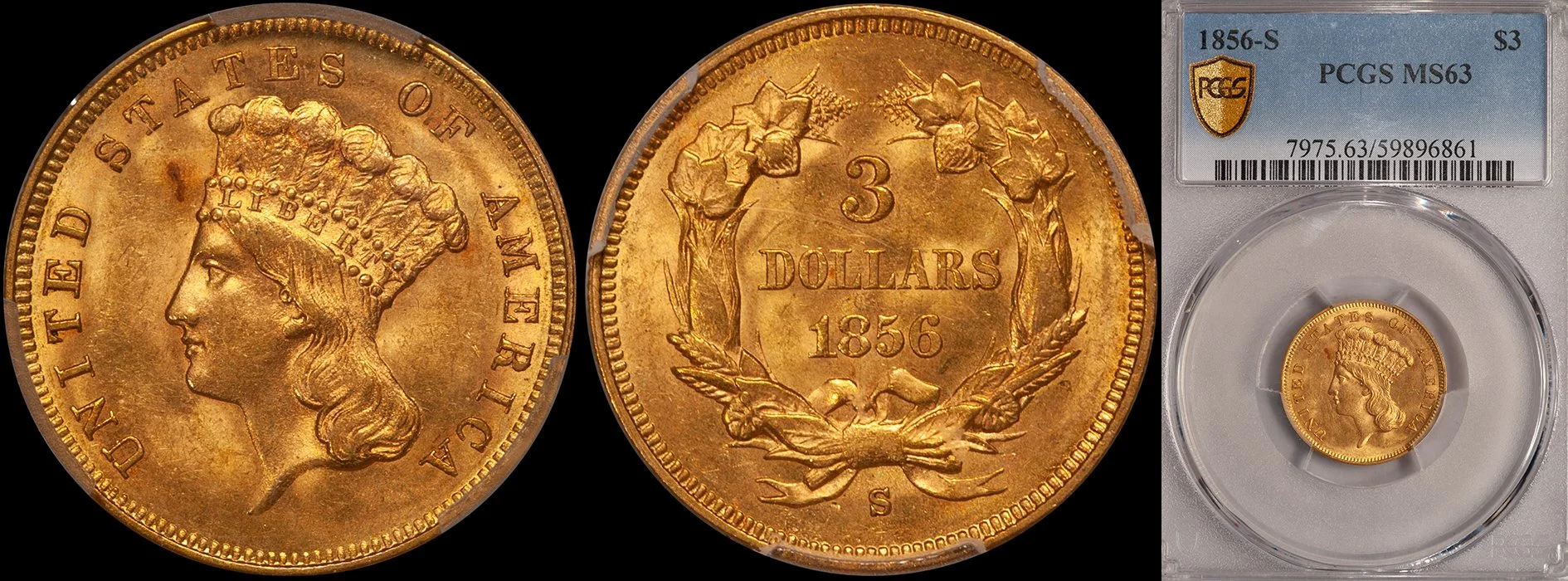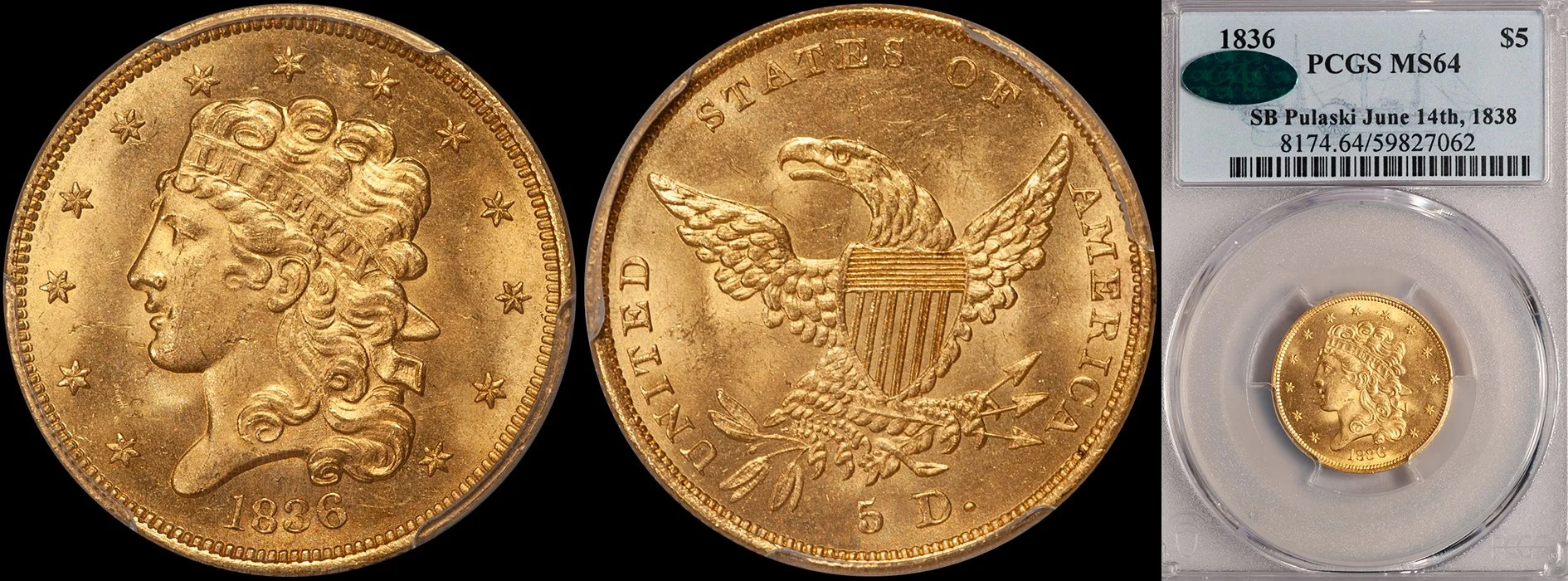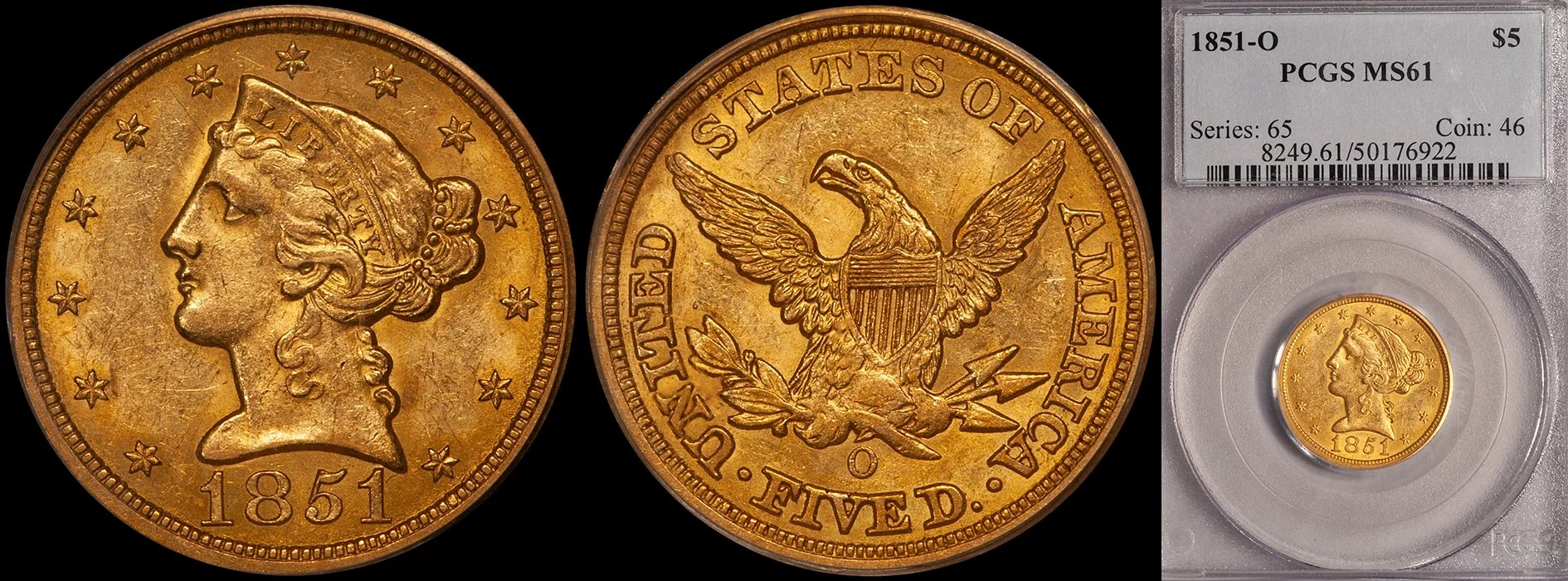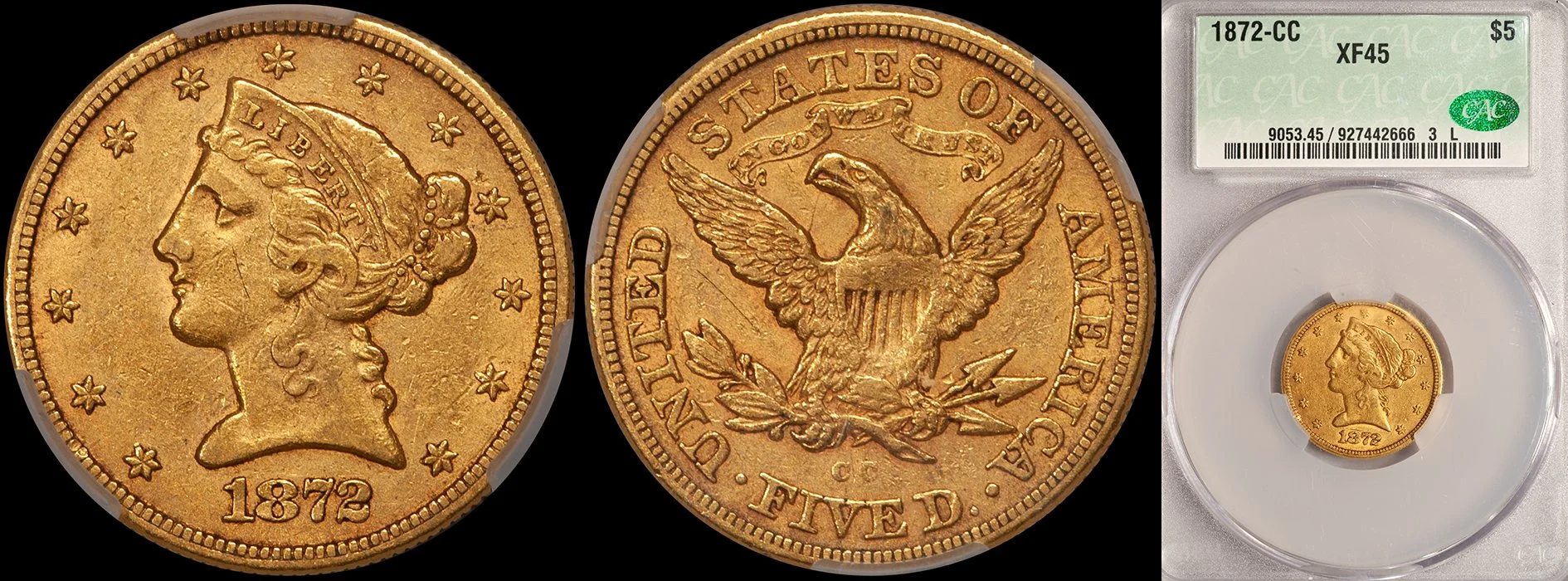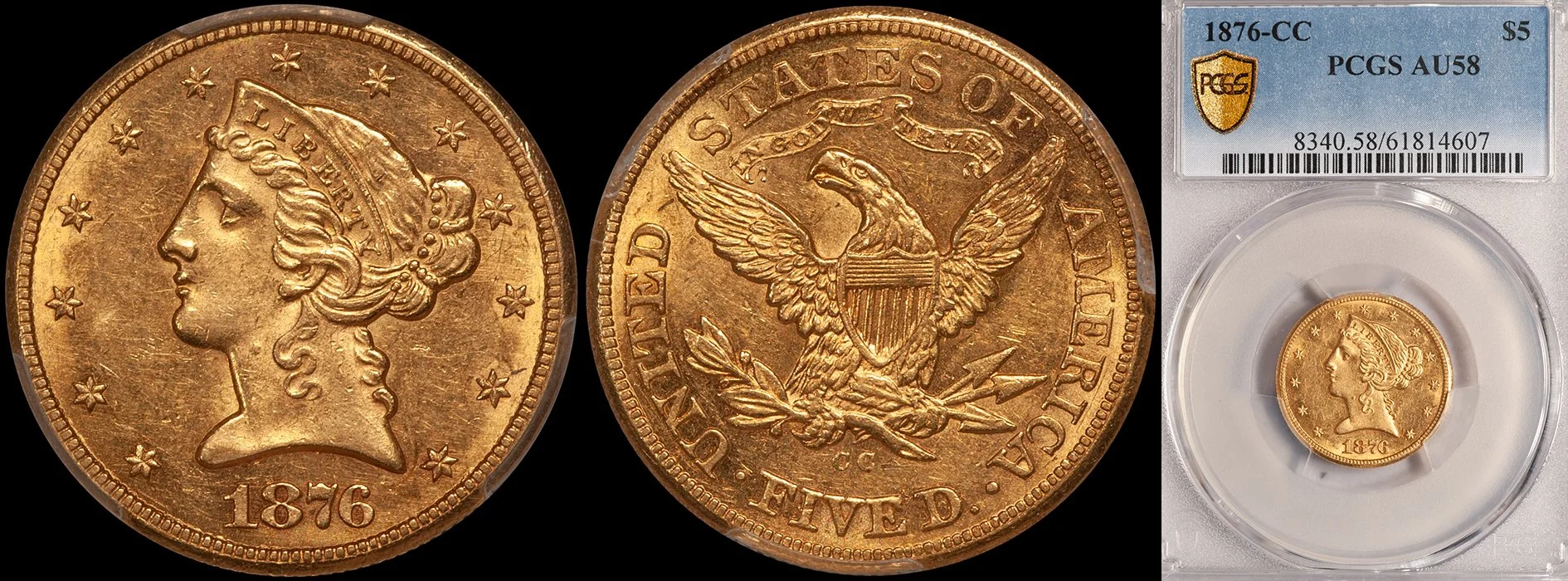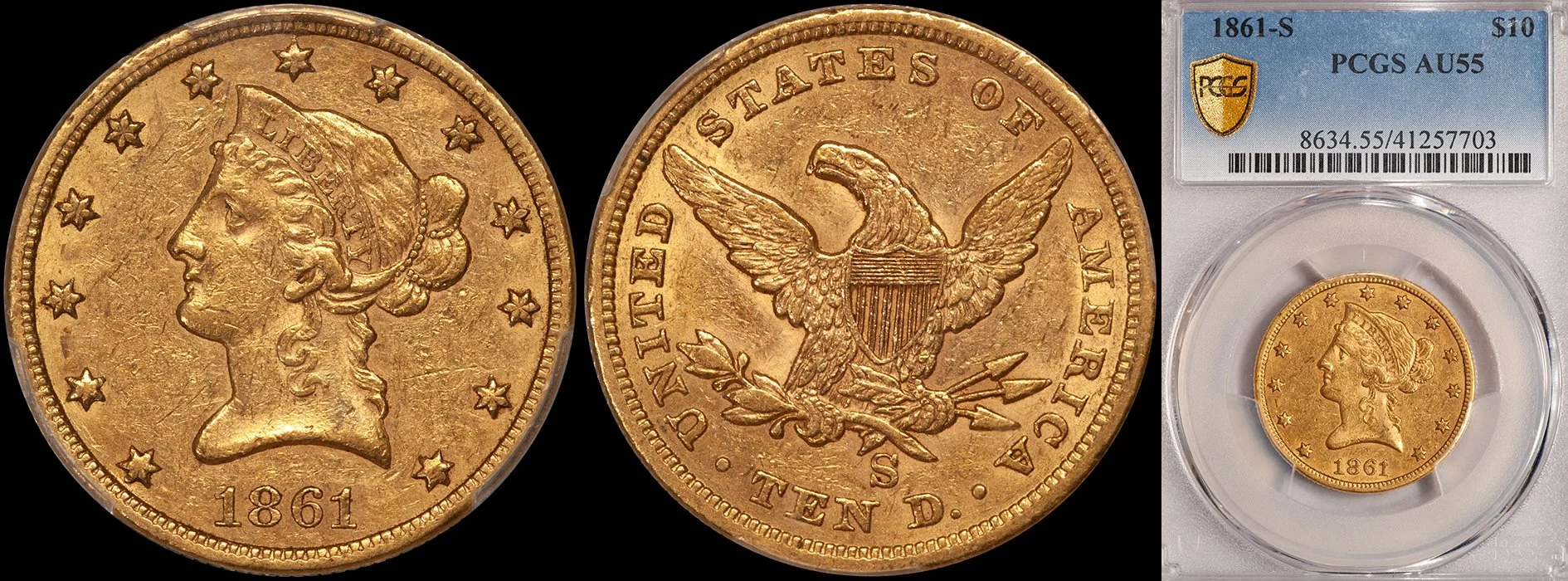
Three Great New Orleans Coins

I’ve heard it said many times that, “All the great coins can only be found at auction.

As my recent experience at the 2013 FUN show in Orlando will prove, this is far from the truth. At this show—and at most other major conventions—I am able to purchase great coins via private treaty from dealers and collectors. Many of these are fresh as the proverbial daisy having either never appeared at auction before or, if they have, many years ago.

As a dealer who specializes in choice and rare 18th and 19th century United States gold coins, I have a special place in my heart for important coins from the Eliasberg sale. Held in October 1982 by Bowers and Ruddy, this was arguably the single greatest collection of gold coins sold in the modern era. Unlike many other great gold sales, the Eliasberg pedigree is synonymous with high quality and, in most cases, when I see a coin is ex: Eliasberg, I get the mental picture of a very high end piece for the date.

On the first day of the FUN show, I got a text message from a dealer who I have known for many years and who I do business with from time to time. He told me to come to his table to look at a group of coins and I went there quickly as I know this dealer isn’t someone who will waste my time with marginal stuff.

When he showed me the small group of coins, my heart skipped a beat as the group contained a number of New Orleans gold coins that I immediate recognized as being from the famous Eliasberg sale. One of these coins was something that I had been chasing since the mid-1990’s. That was the good news. The bad news was that this dealer is one of the very smartest guys in the coin business and he is not exactly known for giving things away. I knew I had to buy these coins; it was just a question of how much would I have to pay.

I’m going to discuss these coins in some detail. Since they are already sold, I’m not going to reveal what I paid for them but I will discuss how I figured values for each.
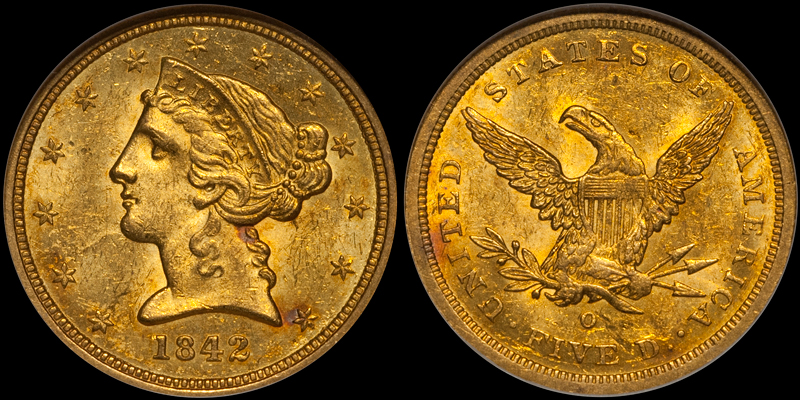
 

1842-O $5.00 NGC MS63 CAC

1842-O Half Eagle, Graded MS63 by NGC/CAC approved

The New Orleans mint produced a total 16 Liberty Head half eagles from 1840 to 1894, in two different designs. The No Motto coins, issued from 1840 to 1857, tend to be scarcer than their counterparts from Charlotte and Dahlonega and nearly all are very rare in Uncirculated.

The 1842-O is the second rarest half eagle from this mint. Of the 16,400 struck there are around five or six dozen known. When available, the typical 1842-O is very well-worn with most in the VF-EF range. In About Uncirculated, the 1842-O half eagle is quite rare with probably less than a dozen properly graded pieces known. But in Uncirculated, this date is of the highest rarity.

There are exactly three 1842-O half eagles known in Uncirculated: an NGC MS63 (the present coin), a PCGS MS61, and an NGC MS60. Remarkably, I have now sold all three of these coins, meaning that there are no longer any Uncirculated pieces available.

Of the three known in Uncirculated, this example is the finest and it has a wonderful pedigree. It was last sold in Stack’s May 1995 auction for $31,900 as part of the famous collection of No Motto half eagles owned by the late dealer Ed Milas. It was earlier in the Eliasberg collection where it brought a whopping $3,850 in October 1982. Eliasberg obtained the coin from the Clapp collection and it was first recorded in the George Earle collection sale of June 1912, conducted by Henry Chapman.

A number of things appealed to me about this coin as I made the decision to purchase it. The first was that I would be able to sell it. I had a specific collector in mind but even if he passed on it, I had enough confidence in the coin to buy it “on spec.” Probably even more important was that I loved the coin when I first saw it two decades ago and I loved it even more when it reappeared. It was still in the same old NGC “fatty” holder in which it appeared in the 1995 Milas sale and, even without having access to that catalog, I knew that it had not been messed with.

As you can see from the photo above, the most remarkable thing about this coin is its color. Both the obverse and reverse have splendid rich orange-gold and coppery color. If you don’t know what “real” color on a gold coin of this era is supposed to look like (and many collectors, I’m afraid, do not…) take a careful look at the toning pattern and the hues on this coin. Note how the color is perfectly blended and how it lays on the surfaces. Note how it doesn’t suddenly become darker exactly where there is a mark (as on coin where color is applied to masks flaws). And note the richness and the “purity” of the color.

Having sold the other two Mint State 1842-O half eagles, I had a good idea of the “base line” value for a high grade 1842-O. Knowing this, I factored in the amazing appearance of the coin, its pedigree and its numismatic significance as the finest known example of a truly rare coin. This was an easy decision for me to make and I doubt that there will be many New Orleans half eagles that I buy in 2013 with more panache than the Eliasberg 1842-O half eagle.

1844-O $5.00 NGC MS64 CAC

1844-O Half Eagle, Graded MS64 by NGC/CAC Approved

By the standards of New Orleans No Motto half eagles, the 1844-O is a “common” coin. It is plentiful in circulated grades and available, from time to time, in the lower Uncirculated grades. There are an estimated two to three dozen in Mint State with most in the MS60 to MS62 range. In MS63 the 1844-O is rare and it is very rare in MS64 with around five or six known to me. There is a single Gem known (graded MS65 by PCGS) and it is ex Bass II: 937 where it sold for a reasonable $34,500. A few years ago, it was re-offered to me by a Midwestern dealer for a six-figure sum.

In my opinion, this NGC MS64 has the best pedigree of any 1844-O half eagle. It was last sold as Lot 457 in Stack’s Milas collection in May 1995 where it brought $20,900. Before this, it was Lot 434 in the October 1982 Eliasberg sale, where it brought $4,620. It was earlier in the Clapp collection and it is not pedigreed prior to be obtained by the Clapp family.

As with the 1842-O half eagle described above, this coin was in the same old NGC “fatty” holder in which it had resided when offered in the May 1995 Milas sale. It was a degree of comfort to me to know that it hadn’t changed in appearance since then.

This coin had a very different look than the 1842-O. Where the first half eagle was all about its color, this 1844-O was more about its blazing mint luster. Unlike some of the high grade 1844-O half eagles which I have handled, this piece was very frosty in texture; most of the others are grainier and present a different appearance. The Milas/Eliasberg 1844-O half eagle had lovely light to medium yellow-gold color and really the only thing keeping it from an MS65 grade was a few small marks in the left obverse field.

While the purchase of the 1842-O half eagle was a no-brainer, I had to think a little bit harder about this coin. I generally don’t care for common dates in uncommon grades. But how often do you see any No Motto half eagle in real MS64, let alone one from New Orleans? So I thought for another two or three seconds…then happily bought the coin.
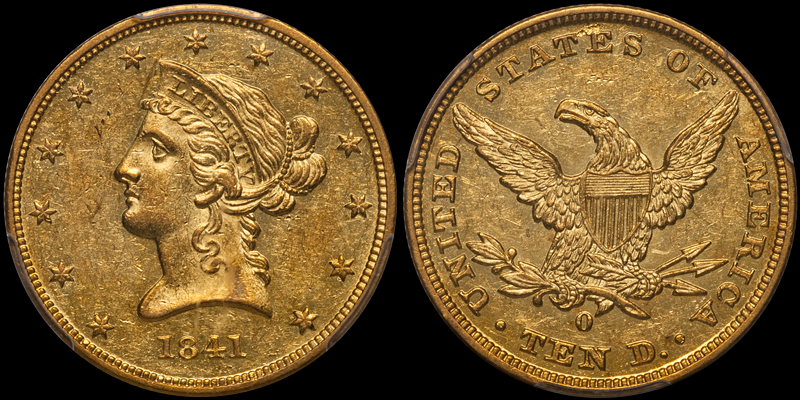
 

1841-O $10.00 PCGS AU58 CAC

1841-O Eagle, Graded AU58 by PCGS/CAC approved

Every dealer and many collectors have coins that are White Whales. If you don’t get that Ahab-ian reference, I mean an elusive coin that you are literally on a quest to buy, even if it takes years to track down. And when it becomes available…Ahab-ian things can and will happen.

While still not that widely known, the 1841-O eagle is among the most numismatically significant gold coins from the New Orleans mint. It is the first eagle struck at this mint and only 2,500 were made. It would remain the largest coin struck at a southern branch mint until 1850, when the double eagle denomination was introduced to New Orleans.

Of the 21 No Motto eagles from New Orleans, the 1841-O is the second rarest in overall rarity with around 60-70 known. This is an issue which was placed immediately into circulation and it saw hard use. When available, an 1841-O is likely to grade VF and a decent-looking EF coin is very scarce. In higher grades, I regard this issue as the single rarest eagle from New Orleans. It is unknown in Uncirculated and I believe that there are only two properly graded AU55 and finer pieces known: a PCGS AU55 in a California collection which I sold in 2007 and the present example. Having now owned both of them, I can pretty boldly pronounce that the PCGS AU58 is clearly the finest known.

If you have ever seen a typical quality 1841-O eagle, you are aware that this date just doesn’t have very good eye appeal. Most are very heavily worn and extensively abraded. More significantly, most have been processed and stripped to the point where they have zero original luster or surfaces. And that fact makes the existence of this choice 1841-O so miraculous.

While it is “only” graded AU58 by PCGS, I feel that this coin is actually Uncirculated as it has no real wear. Because of the fact that it is semi-prooflike, the surfaces appear a bit more abraded than they are in person. When I first saw this coin two decades ago, I thought it was a “baggy Unc” and I still believe this today; probably even more so.

The pedigree of this 1841-O is impressive. It was last sold as Lot 6238 in the Heritage 10/95 auction as part of Warren Miller’s collection (a set of Liberty Head eagles that is still probably the finest ever assembled). It was earlier sold as Lot 934 in Stack’s 10/86 auction and before this it was Lot 665 in the Eliasberg sale where it brought $4,400. Eliasberg bought it as part of the Clapp collection in 1942 and it was earlier purchased from the Massachusetts dealer Elmer Sears in 1920.

Of the three coins, this was the hardest to buy as it was many multiples more expensive than any other example of this date which has ever sold. But it was the coin I wanted the most. So how did I justify paying what I did?

In the last few years, the 1883-O has become the coin du jour of all New Orleans eagles. At least two AU58’s have sold for over $100,000 and this is a coin that is clearly more available in comparably higher grades than the 1841-O. I asked myself: “Self, what coin would you rather have: an AU58 1841-O eagle or an 1883-O eagle?” The answer was almost immediate: the 1841-O is an issue which I think has more upside than the 1883-O and it is an issue that is rarer; despite the very low mintage for the latter. I sucked it up, wrote a check and haven’t looked back since…

So how was your FUN show? Mine was pretty incredible actually. I was able to buy many, many impressive coins there but the three which will stand in my memory are these wonderful New Orleans pieces from the Eliasberg. This is what makes being a coin dealer fun and why I still look forward to major coin shows even after all the years I’ve spent going to them.

For more information on great New Orleans gold coins, Eliasberg pedigree gold coins or cool coins in general, please feel free to contact me by email at dwn@ont.com.

Is the Market for Dahlonega Varieties Starting to Heat Up?

For years, I've been commenting on the die varieties of Dahlonega coins. My take has usually been somewhere along the line of "they are neat and they are fun to collect but I'm not sure that I ever see the market for these coins taking off." From time to to time, I talk to a collector who dabbles in Dahlonega varieties and I've even dealt with one or two who have been pretty hard-core. But, with some exceptions, I've never seen prices for these coins reflect this interest. Until possibly now. I'll be the first to tell you that you can't make a declaration about a market based on one auction but, the recent Heritage 2013 FUN sale had a large and varied collection of Dahlonega half eagles by die variety and there seemed to be a trend towards some of the rarer, more obvious varieties selling for premiums. Let's take a look at a few examples and try to make sense of them.

Lot 7189

Lot 7189 was an 1854-D Medium D in an NGC VF30 holder. It was a nice coin, solid for the grade and original. NGC doesn't designate this variety so my brilliant plan was to break it out and send it to PCGS where it would grade, I hoped, VF30 and be designated as a Medium D. I bid $1,600 for the coin which would have put me into it at $1,880 with the buyer's premium. The coin brought $1,998 . The price was around 10% more than I expected. Certainly not a huge price premium but enough to make me raise an eyebrow.

Lot 7193

The next coins that I found interesting were Lots 7193 and 7194; the former was an 1855-D Large D in NGC AU53 while the latter was an 1855-D Medium D also graded AU53 by NGC. In my experience, the Large D is the scarcer of the two (despite the fact that there were two Large D examples in the sale).

Lot 7194

The first coin, lot 7193, sold for $3,182 while the second, lot 7194, sold for $3,290 which sort of disproves my theory that the market for Dahlonega half eagle varieties might be picking up. I partially attribute this to the fact that the Medium D coins are always weakly struck at the centers which means most collectors don't "get" this variety. Had Lot 7193, the Large D, been more attractive, I'm guessing it might have sold for some sort of premium. Clearly, this market is not yet developed enough that collectors are saying "this is a rare variety and even though the coin is kind of ugly I still need to pay a premium for it."

The two coins which were really interesting to me were Lot 7213 and Lot 7214. Both were 1859-D Large D half eagles. These varieties are designated by PCGS, they have very low populations figures and they are clearly visible to the naked eye; sort of the perfect storm for D mint half eagle varieties, if you will.

Lot 7213

The first 1859-D (Lot 7213) was graded EF40 by PCGS and I thought the coin was extremely nice for the grade; maybe an EF45/AU50 on a good day. I figured it at $2,100, which meant a shade under $2,500 all in. The coin sold for $4,700 with the buyer's premium which I thought was remarkable.

Lot 7214

The second 1859-D (Lot 7214) was graded AU55 by PCGS and I liked the coin even though it had an odd area of light toning directly above the head of Liberty at 12:00. I figured the coin at $3,750 or $4,406 with the fees. The coin wound up selling for $5,875 including the premium.

Were these prices strong? Just as a point of reference, an NGC AU58 1859-D half eagle in the same sale (Lot 7212) sold for $3,819 including the premium. The coin was a bit over-graded, in my opinion, but actually pretty decent and certainly an AU55 all day long.

Now, I don't know who bought the two 1859-D half eagles. They could have been bought by break-out dealers or telemarketers who figured the low PCGS populations meant a potential big score. But assuming they were purchased by variety collectors, I think these prices were extremely significant and they could portend an oncoming wave of interest in varieties.

My guess is that if varieties are to become of interest to collectors, they are going to be just the ones that are designated by PCGS/NGC and the ones that are easily seen with the naked-eye. Will someone care about one of the six varieties of 1848-D half eagle because of the position of the date or the placement of the mintmark? I doubt it. But I think they will care about a coin like the 1848-D/D half eagle which is genuinely rare and which can be appreciated by beginning and advanced collectors alike.

Kudos to Heritage for doing a nice job of cataloging these coins and my hats off to the collector who assembled this variety set, especially the two 1859-D half eagles.

How NOT to Assemble a Great Collection

     While looking through thousands and thousands of coins recently in the 2013 Heritage FUN sale, I took a brief pause and read the preface to the catalog, where collectors are introduced and given the opportunity to write briefly about their collections. Some of these collectors, like John Adams, are incredibly sophisticated and operate within narrow specializations in which they are probably more knowledgeable than all but a tiny handful of dealers. Other collectors are clearly products of the Internet era of coin collecting and they make mistake after mistake. This got me to thinking...how does the mindset of a confirmed I Can Do This By Myself  collector work and why, in my opinion, does it often spell disaster?      In the spirit of these thoughts, let's take a look at how NOT to build a great--or even a good to very good--collection of coins. The spirit of this article may be snarky but I think there a lot of good points that are raised.

     1.  Choose a Complex Series.

     If you are going to collect a series like American Silver Eagles, you can be an I Can Do This Myself type of collector who lives on the plains of Montana, never goes to a coin show and seldom even visits a local brick and mortar coin store. And I wouldn't limit this simplicity factor to modern coins. I think you can build a reasonably complex set like Red and Brown Two Cent Pieces or PR64 to PR65 Barber Dimes going it alone.

     There are series that are complex either because of they way that they were produced (many Colonials as an example) or because they can be "messsed with" or misrepresented so easily (red copper coins or 20th century Proof gold as just two examples). These are not series that lend themselves to rugged individualism and I'm not certain that I've ever seen or heard of a savant who learned the ins and outs of a really complex series totally on his own.

     Despite this, many beginning collectors outsmart themselves and choose a series that is far more complex than they realize. They don't know that the preferred look for Southern gold coins is dark and dirty; not bright and grainy. They never learn that there are different levels of "redness" on Indian Cents and Lincoln Cents and that a red MS65 example of a certain date can be worth anywhere from $2,500 to $7,500.

     So what exactly am I saying here? Do I mean that all beginning collectors should start with PR69 American Silver Eagles and gradually work their way towards Dahlonega half eagles? Absolutely not. What I'm suggesting is that if you do choose a series that is complicated (and I can make the case that virtually all pre-1964 American coins have some degree of mystery that can not be unlocked in a few weeks) you need a mentor and/or a good dealer to work with.

     Or better yet, outsmart yourself and pick a series you don't really understand. You'll be on your way to NOT assembling a great set...

     2.  Go it Alone; Don't Have an Expert Dealer Working With You.

     Some collectors look at dealers as a necessary evil. They don't like dealers, don't trust dealers and work with them because they have to. (I feel the same way about lawyers but the last time I was involved in a legal issue, I was happy to hire a great lawyer and not read "Law for Dummies" and represent myself). This attitude is unfortunate as there are many good dealers.

     I'm a student of coin collectors and the coin market as well as coins themselves and in the modern era of numismatics (let's call this 1945 and onwards) there have been many great collectors but few "mavericks" who have bypassed the typical collector/dealer relationship. Some collectors like John Pittman were able to buy great coins at auction without a dealer's guidannce but even Pittman had a few dealers with who he had a good working relationship. One wonders how Pittman would view the current generation of sight-unseen Internet buyers, especially those who buy sophisticated, expensive coins without a trained set of eyes working with them.

     (If your answer to this is "much of what Pittman bought was sight unseen through mail bids at auctions he never attended" I would agree with this to an extent. Big difference: today, a slight variable in a coin's appearance can equate to tens of thousands of dollars--which was not the case in the 1940's or 1950's. Also, many of the coins sold today have been doctored while during Pittman's heyday, original coins were, more often than not, the norm in the market).

    Well-connected, educated dealers are of little value to collectors who are NOT assembling a great collection.

     3.  Buy Only Online Based On Images

     I've made this point a dozen times in other articles but I think it is tremendously important and it bears repeating. Again. Collections that are built by collectors who buy coins through auction based solely on images are destined to be full of problem coins. Auction sales are sight-unseen and most of the images that I see online are not sufficient to make important decisions, especially on high grade coins. (NOTE: I feel differently about circulated coins as it seems possible to get a clear enough image of an EF or AU piece that I would personally feel OK bidding on it although not necessarily aggressively).

     Buying a coin off a dealer's website is different as you have a return privilege.

     If you do buy sight-unseen at auction, try to at least establish a rapport with a friendly, knowledgable person at the firm and ask his opinion on the coin(s) that interest you.

     Or just buy based on the images since you do NOT want to assemble a great collection...

    4.  Don't Learn What Original Surfaces Look Like.

     If no one ever takes the time to teach you what an original coin looks like, you are not going to have any reference point in determining originality. I was lucky enough to learn about originality back when there were still a decent number of non-processed coins in the marketplace. This is not the case today. To learn this today requires a real effort and real connections in the market.

     I had an interesting conversation about originality the other day with a collector of Proof gold. He told me that when he was  less experienced, he returned a few high grade Proofs because they were "dirty." He was so used to seeing bright, shiny Proof gold that when he finally had a chance to add a few totally original coins he returned them to the dealer who sent them. But this collector was smart enough to ask his mentor why the coins were tarnished and what made them desirable. Then he learned: the "dirty" coins had a nagtural haze and had yet to be dipped. These were the "good" coins he needed to be buying.

     As I looked through the Heritage 2013 sale, I saw gold coin after gold coin that had been stripped including at least two high six-figure collections that didn't contain more than a handful of coins that were original. The owners of these coins never were able to determine what constituted an "original" (or even a semi-original) coin and never had the foresight to ask a knowledgable expert.

     Keep buying bright and shiny coins--they are the cornerstone to NOT assembling a great set!

     5.  Race Through Your Collection.

     I just sold a very significant gold dollar to a collector who has been working on his set for close to two decades. As we concluded the transaction, I commended him for his patience and got to thinking about how the old-school method of slowly assembling a collection has changed along with the way that collectors build sets and acquire individual coins.

     A few days later, as I viewed the Heritage FUN sale, I noticed that a few of the major collections had been assembled in two to five years. And these were not sets that ordinarily could be assembled quickly. Clearly, shortcuts were taken...and they showed.

     Great collections are the result of opportunity. Let me give you an example. A month ago, I began selling a superb collection of gold dollars. I gave first shot to a dedicated, persistent collector who I knew was not only going to buy a number of coins, he was going to appreciate them and (hopefully) sell them back to me a number of years down the road. Here's a collector who was probably expecting to buy two or three coins for his set this year and suddenly he was given the opporunity to buy no less than eight coins that he needed and knew he was unlikely to find again in many years of searching.  Was his purchase of eight coins at one time an example of "racing" through his set? Clearly not; it was, instead, a moment of great opportunity.

     This is an example of "positive opportunity." There are examples of negative opportunity where collectors bury themselves in a mound of problem coins in a short period of time. And there are clearly scenarios where well-meaning collectors have chosen the wrong dealer(s) and proceeded to be bombarded with crappy coins.

      Try to assemble your collection as quickly as possible; that's how NOT to assemble a set!

     6.  Overpay for Mediocre Coins and Underbid for Nice Coins.

     In the aforemtioned Heritage FUN sale, it was interesting to note on coins which pedigrees were given, what the (ex)owner paid for them. It served to reinforce an old belief of mine: misguided collectors tend to pay too much for mediocre coins and they never get to buy really nice coins as they a) either lacks the dealer connections to be offered them or b) won't "pay up" for high end pieces.

     I also note a tendency for this kind of collector to "overbuy" the common dates in a set and "underbuy" the rarities. An example: if you collect New Orleans quarter eagles, the coins you should be stretching on (i.e., buying the absolute best possibe pieces you can afford) are the keys such as the 1845-O and the dates with multiple levels of demand such  as the 1839-O. The dates that you shouldn't overbuy (i.e., buying a common date in an uncommon grade) are the 1843-O Small Date and the 1854-O).

     How can you "overpay" for most of your coins? If you are exclusively an auction buyer, I think that's easy: you can misinterpret the auction prices realized data that firms such as Heritage provide.

     Let's say you are looking at prices for a certain Type One double eagle in AU58 and the last three results are $4,500, $4,650 and $7,750. Another example comes up for sale and you figure "hey, the last coin sold for $7,750, I'm fine paying $6,250 for it." If you do not really analyze the $7,750 sale you might not know that the coin was a) in an old holder and undergraded or b) was from a shipwreck and it brought a strong premium as such. Suddenly, your bid 0f $6,250 is way too high, given that the two pertinent results are actually $4.500 and $4,650.

     Nobody actually makes that mistake, right? Uh, think again. They do. And mistakes such as this are ways that you DON'T build a great collection.

     7.  Sell Your Collection As Soon As You Finish It.

     In this New World of Coin Collecting another collector trait that seems suddenly accepted is to sell your collection literally as soon as it is done. In the red hot market of 2006-2008, you could get away with this and sometimes even have a nice score. But in the current market, I don't think the collector is doing himself a service by blowing out his collection.

     Today's market is all about "fresh coins" and it's easy for a knowledgeable collector with a computer to figure out that the coins you just consigned to auction were all bought out of other auctions in the last two or three years. This will hurt the potential resale of your coins, even if they are above-average coins.

     We were blessed with the longest bull market in numismatic history in the 2000's and collectors who were too new to remember the bear markets of 1980's and 1990's are sometimes not entirely realistic with their financial expectations regarding coins. Generally, it takes a full cycle--or two--for coins to realize their full potential.

     Buy coins quickly and sell coins quickly....exactly how NOT to assemble a great collection.

     To me, the ideal collector uses the concepts of collecting that were in vogue in 1913 and marries them with the technology that is in place in 2013. This is how you assemble a great collection.

Undervalued U.S. Gold Coins in the $1,500-3,500 Range

 An article of mine was recently published by a content partner   and a reader left a comment about how my subject was elitist and  I am only concerned with selling $50,000+ coins. Hey, I LOVE selling $50,000 coins but I probably sell ten times more $1,500-3,500 coins every year than I do big ticket items. So to placate my angry reader, I thought I'd give some brief suggestions. Steven Mlaker, this one's for you!      1.  Type Three San Francisco Gold Dollars, EF45 to AU58

     There are only five San Francisco gold dollars of this type (1857-S, 1858-S, 1859-S, 1860-S and 1870-S) and all are of basically similar rarity. When available, these issues are seen in the EF45 to AU55 range and all can be had for $750 on the low end to $2,500+  for a nice AU58.

     What I like about these issues is that they are all low mintage and all are rare to very rare in Uncirculated. If I had to choose one date as the real "sleeper" it would probably be the 1870-S with a mintage of just 3,000.

     I like the concept of doing an evenly matched set of five coins, all grading AU55 to AU58. It can be done for around $10,000. To make the set a real challenge, make sure every coin is CAC quality with natural color and nice surfaces.

     2.  Properly Graded EF45 Dahlonega Quarter Eagles.

     Of the three main denominations from the Dahlonega mint, the quarter eagle is the hardest to find in choice, original Extremely Fine grades. Despite the rarity of these coins (and they are not easy to find with natural color and surfaces, no matter what the population reports say!) they are still priced in the $2,000-3,000 range.

     There are many dates in this series which are rare and expensive even in EF grades but I can think of at least ten (1843-D, 44-D, 45-D, 46-D, 47-D, 48-D, 49-D, 50-D, 51-D and 57-D) which can be bought for less than $3,000 in presentable grades.

     When buying these coins, look for pieces with deep, rich natural color and surfaces that are not overly abraded. Strike shouldn't be a major concern; if it is try idea #3, below.

    3.  Philadelphia and San Francisco Quarter Eagles, 1865-1876.

     Many of the quarter eagles made from 1865 through 1876 at the Philadelphia and San Francisco mint are scarcer than their southern counterparts at half the price.

     My favorite sleeper dates are the 1867, 1869, 1870, 1870-S, 1872 and 1876. Not a single one of these will cost you more than $2,000-3,000 in nice AU grades and the beauty of these dates is that, when available, they tend to be quite well made and reasonably attractive.

     Are these coins good "investments?" I doubt it, unless you move up the ladder and buy nice Uncirculated pieces (which, as Mr. Mlaker will remind me, is an elitist sentiment...) which seem like very good value to me.

     4.  Nice AU Classic Head Half Eagles.

     With the exception of the 1834 Crosslet 4, none of the Philadelphia half eagles made from 1834 through 1838 are scarce but they are extremely popular and when I have a nice, original AU55 to AU58 on my website, it typically sells within a few hours.

     What's not to like about these coins? They are very old, the design is cool and in the middle to higher AU grades, they look great; if original.

     A five coin 1834-1838 year set in AU55 to AU58 could be assembled for $10,000-15,000. For more of a challenge, you could add some of the major die varieties which are known.

     5.  Philadelphia No Motto Liberty Head Eagles

     After years of neglect, the Liberty Head eagle series became popular in 2008-2009 and, today, it is one of the more in-demand U.S. gold series. But collectors are mainly buying the key low mintage dates or the mintmarked coins and nice AU55 to AU58 Philadelphia coins from the 1840's and 1850's can still be bought in the $1,000-3,000 range.

     If your budget won't go higher than, say, $3,000 per coin, you can still come pretty close to completing a date run from 1840 through 1861.

    Sleepers? How about the 1840,  1842 Small Date, 1845, 1850 Small Date, 1857 and 1859. Collecting suggestions? Stick with coins which grade AU55 or better if possible and look for nice dark green-gold pieces with rich, frosty luster and light, even wear.

     6.  Mid-AU Grade Type One Philadelphia Double Eagles.

     The "play" with these coins is that they contain $1,500+ worth of gold (at current spot) but can be bought, in very presentable grades, for less than double melt. Are they rare? Not really. But they are popular as anything, they are a good "double play" hedge and they don't appear to have been adversely affected by shipwrecks like their San Francisco counterparts.

     I like nearly any 1850's Philadelphia double eagle in AU53 and better as long as it is choice, original and lesss marked thaan usual. The dates I like best are the 1855, 1856, 1857 and 1858 and $3,000 or so will get you a really presentable example of any of these four.

     7.  Early Type Three Double Eagles From San Francisco.

     My logic on these coins is the same as for the Philadelphia double eagles listed above but with one difference. These are "jump grade" coins in which a tiny difference in quality (say MS61 to MS62) can mean thousands of dollars.

     The dates I like are the 1877-S, 1878-S, 1880-S, 1881-S and 1882-S in MS60 to MS61. They aren't tremendously expensive and if you are very patient and very selective you might find an MS61 example of any of these that looks almost identical to an MS62 of the same date; at a greatly reduced price!

     Just so you know I'm not pay lip service to Mr. Mlaker, I have handled numerous examples of nearly every coin on this list during 2012 and will continue to make an active two way market in undervalued sub-$3,500 coins in 2013 and beyond.

     For more information on undervalued U.S. gold coins (in any price range, even over $50,000!) please feel free to call me at 214-675-9897 or email me at dwn@ont.com.

How I Blew My Free Appraisal

One of the oddest things about being a coin dealer are the almost daily phone calls I get from people who demand free information. Typically, these calls are from non-collectors who have found my name on the internet and have chosen me to help them determine the value of the coin they just found in the attic/coin they bought from on Ebay/coin they inherited from their Aunt Marge in Whitefish/etc.

So, what's "odd" about these calls?  It isn't the fact that I get them regularly; all coin dealers do. It's how unbelievably rude most of the callers are and how they feel that just because I'm listed on the internet, that I am obliged to help them.

(As an aside, the last time I tried to call Steve Cohen and ask him for stock picking advice for the upcoming year, I didn't get very far but, hey, maybe it was the way I asked....)

Let me run you through a typical call:

Phone rings.

Me: This is Doug Winter, how can I help you?

Caller: (Doesn't give me his name, just brusquely goes right into the question). I have an 1849 Pacific $5.00 gold piece, what's it worth?

Me: That's an exceedingly rare and often counterfeited coin.

Caller: No, its real gold. It's been in my family for XXX years. (More than 10 but less than 100...)

Me: That's great. Why don't you send me a photo?

Caller: I don't need to send you a photo because its real gold. What's it worth?

Me: *Sigh....* Since you already know what it's worth perhaps you should take it to a dealer who is smarter than me.

Caller hangs up. Calls back thirty seconds later. I don't take the call, recognizing his number on Caller ID. He leaves a message. I listen to it. Its not pretty. After he curses me out, tells me that not only is he never going to do business with me, he's going to "tell everyone on the Internet" not to do business with me. I'm crook. I'm rude. I "blew it" because I missed the chance to buy his coin.

What caused this phone conversation to go so horribly wrong? I'd like to think it was because he was surly, self-absorbed and arrogant, but perhaps the reason was simpler than than this.

I was brought up by Mom who taught me to be polite. I say please and thank you, I hold doors open for women, I help old people cross the street. Maybe I'm old-fashioned but I believe that when you are calling someone you don't know for a potential favor on the phone there is a certain basic etiquette that you follow. Some suggestions for a fruitful call, as follows:

  1. Introduce yourself. Tell me your your name. And not just your first name, unless you are Madonna, Prince or Ichiro. You don't have to tell me your life story but can I at least know who I'm talking to?
  2. Politely tell me the intent of your call. Tell me that you inherited some silver dollars and that you are interested in selling them.
  3. Show me enough respect to do five minutes of background checking on your coin(s). I can't tell you the number of times someone calls me and tells me that they have a coin for sale but they don't know or forgot the date. I haven't yet mastered the art of seeing through your phone (or computer screen) and manually retrieving the date of the coin that you "forgot."
  4. As your family doctor will happily remind you, no professional is obligated to spend five minutes with an anonymous, rude jerk.

OK, I know that I'm sounding like your grandma here but I'm kind of wondering how people suddenly became so rude. I'm guessing it's a function of email and social media where all sorts of formerly face-to-face interactions are now done anonymously. I get the fact that a guy calling me with a coin doesn't want to tell me his name and home address for security reasons. I also get the fact that if I don't treat this guy like he's Mrs. Norweb, he is going to write a review of DWN on Yelp or a message board and tell everyone how rude, insensitive and jerky I am. At some point, the proverbial twain must meet...

So, Mr. Pacific $5.00, I'm sorry I didn't offer you $250,000 sight-unseen for your amazing rarity, even though you wouldn't tell me your name and you already knew that the coin was real. I blew it.

The Second Annual DWN Art Basel "I Was There" Blog

For the second year in a row, I went to the incredible Art Basel show in Miami Beach. For those of you who are not familiar with this show, it has become quite possibly the leading art show in the world and it turns Miami into the Epicenter of the Art World for a week or two every year in early December. This year's edition of the fair was probably better for me than last year's (which I loved) because of the fact that I knew what to expect, was better prepared and was less overwhelmed. As I did last year, I'm going to share with you a couple of thoughts, using my vast experience in attending coin shows as a basis of comparison. 1.  Your money goes a lot (and I mean A LOT) further at a coin show then at a high end art show. Good art (I'm not even going to approach the subject of great art since it is so far out of my league pricewise) is fabulously expensive and it makes good to very good quality coins seem astonishingly cheap. I think my eye is pretty good when it comes to art and nearly every painting I priced at Art Basel was $100,000 and up. These were for artists that I thought I actually had a chance to buy. For great artists that I recognized (like the stunning Mark Rothko that hung, in its fiery orange glory, in the very first booth on the left as you entered the fair...) I didn't have the nerve to even ask what it was priced at. I know these great museum-quality works of art were going to run in the $5 million to $50 million and, tire-kicker that I was, I didn't want to waste the dealer's time.

2.  Coin dealers are much, much more approachable at shows than art dealers are at fairs. Unless you exude wealth or are known by the dealer, you don't get so much as a nod of recognition at Art Basel. At one booth, I was passed onto the most junior member of the firm when I asked the price of a painting. Sigh... (The real laugh here is that after I was told the painting was sold, the 23 year old junior dealer tried to upsell me to a $350,000 painting that was so large I would have had to hire a semi truck to get it to my house in Portland even if I had the 10,000 square foot house it would have required to show it!) I'm as guilty as any coin dealer of pre-judging someone approaching my table at a show but even if you are dressed in cheap jeans or a t-shirt, you are going to get my attention if you are a) polite b) interested in coins and/or c) knowledgeable about the types of coins I specialize in.

3.  Just like at a coin show, a little knowledge goes a long way at an art fair. Quick story: my fiance Irma saw a painting by an American woman artist named Edna Reindel that she loved at a ritzy New York dealer's booth. She was quoted $95,000. If I had that sort of art budget, I would have given it real consideration. That night, we went back to the room and on my computer, I searched for information about Edna. Within thirty seconds, I found an image of the painting. It had just sold, less than three weeks ago, in an auction for $28,500. Let's say you gave your interior designer a budget of $100,000 to buy "something special" at the show. Then let's say she bought this painting for $80,000, marked it up to $90,000 and hung it over your sofa. Looks great in your living room but how are you going to feel when (or if) you learn it just sold for less than 30 clams? Ouch!!

4.  Ethnic profiling is so fun and easy at these shows. The Italians are all wear bright red pants. The Germans have crazy architectural eyeglasses. The Brazilians (men and woman) are gorgeous. The Russians seem desperate. The American woman all have fake boobs and botoxed lips. Have you ever people-watched at Heathrow Airport in London or JFK in New York? Art Basel is ten times better with the added advantage that almost everyone is either rich or an artist. (Or a rich artist...)

5.  The art market for dead artists makes sense. A painting sells at auction for, say, $50,000 and this sets a level for comparable works by the artist. There are variables: is it a major work or a minor work? Was he in the middle of a glorious love affair with his mistress or had he just broken up with her and was clearly depressed? Is the condition nice or is it ratty?  But the market for living artists--especially emerging ones--is so fraught with variables. I saw one drawing at the show that was priced at $65,000 but I thought it was a great deal given the fact that it took the artist eight months to make (!) and it was staggeringly gorgeous and cerebral. Even without any auction comparables, I saw the value. On the other hand, I saw paintings for $100,000, $200,000 and up that I thought were hokey and derivative. Here's a thought: every generation produces maybe a half dozen truly great artists. Isn't it scary that artists are selling for $1 million and up today are almost guaranteed to be afterthoughts in thirty years (see Schnabel, Julian)? Give me a Dahlonega quarter eagle any day; at least I can figure values in that market.

6.  As with coins, freshness is absolutely essential in the high end art market. If you are a rich newbie at Art Basel, it is a virtual certainty you will be offered stale, overpriced secondary market pieces or B quality works by new artists. This is true even if you have a "consultant" who, in all likelihood, has his or her own agenda. It was interesting how often I heard obviously savvy collectors ask a gallerist at Art Basel about the provenance of a work of art or who it had been offered to already. If a painting had appeared at auction in the last few years and it failed to sell...instant kiss of death. Which is not the case, by the way, in the coin market where an auction dud can still attract interest.

7.  The level of passion for art at Art Basel is amazing. Sure, it's a see-and-be-seen atmosphere and more and more of the attendees are there for the parties. But I'm pretty impressed by the fact that in a single night out in Miami Beach, I ate dinner with a group of people ranging in age from around 30 to around 80 from all over the world wearing clothes that ranged from The Gap to Prada talking passionately about art and the art market. The demographic at a coin show tends to be, how shall I say it, a bit "different" and certainly far less diverse.

8.  Because of its proximity to Latin America and South America, the fairs in Miami tend to have a Hispanic orientation that I find fascinating. There is clearly a rapidly emerging upper middle class in countries like Colombia, Brazil, Mexico and Venezuela. Not only were there a number of dealers from these countries, there were a number of collectors at the fairs buying up a storm. This wealth is almost certain to touch the coin market and if I were a betting man (wink, wink...) I would start buying selected high end coins from these four countries.

9.  Art Basel dealers, I feel your "pain."  Up at 9am. Walk or jog on the beach. Interesting clients to schmooze with all day. Brazilian women. Talk about art. See art. Sell art. Eat great food in Miami Beach. Brazilian woman. Stay at Art Deco hotels. Party 'til dawn at exclusive boites. And then there's my life... delayed flights on glamorous domestic carriers, botched reservations at Westins and Sheratons, crappy convention food, hot spots like Long Beach, Baltimore and Rosemont, fascinating conversation about die breaks on early half eagles. Not a Brazilian woman in sight. SIGH....

10. I had a great time at Art Basel 2012 and hope to be back next year. Its a fascinating week and I think it not only makes me a better connoisseur but a better coin dealer. I'm refreshed, excited and ready for the 2013 FUN show in Orlando in a few weeks.


Dual Rarities: Great American Gold Coins

There are coins that are rare because of their grade ("condition rarities") and there are coins that are rare because only a small number survive ("absolute rarities"). Then there are coins that are a whole different category: I call them "dual rarities." These are coins that stand out as having an amazing combination of date rarity and grade rarity. There are not many of these and even fewer exist in the arena of United States gold coinage. In this article, I'm going to choose one coin from each denomination which I think is the ultimate dual rarity. Before I begin, I want to establish three parameters for true dual rarity. These are as follows:

1.  The coin is a rare date. Whether due to low mintage or low survival rate, the coin is not easily available, even in lower grades.

2.  The coin is exceptional well-preserved for the issue. This is based not only on the date but the type. In other words, if the coin is a No Motto half eagle, it is not only exceptional for the date, it is one of the best of the entire type as well.

3.  Nothing close survives. There are coins that are dual rarities but other comparable examples exist for the date or for the type. An example (non-gold) is the 1845-O Dime, ex Eliasberg, graded MS69 by PCGS. It is the best early date Seated Dime known, its a rare date and the next finest known is somewhere in the AU58 to MS61 range. Now that's a dual rarity!

4.  Only business strikes qualify. Proofs, especially near early dates, are very interesting but they were made in limited editions for collectors and we can expect these to have survived. Branch mint proofs or specimen strikes are another story and despite being controversial and slightly esoteric, I'm going to let them qualify. Its my list and I can be the Dual Rarities Czar if I want to. So there...

1.  GOLD DOLLARS

This was a fairly hard denomination to choose a single coin from because there aren't a lot of truly rare gold dollars and the most famous issues (the 1849-C Open Wreath and the 1861-D) don't have a single really memorable survivor. So with some thought, I chose a coin that I actually had in my hands the other day and which was sort of an impetus for this article: the Brand-Akers 1863 gold dollar, graded MS68 by PCGS.

The 1863 is the single rarest Philadelphia gold dollar despite a mintage of 6,200 business strike. There are a number of branch mint gold dollars with lower mintages but they not to be found in supergrades. There are 14 Philadelphia gold dollars with lower mintages than the 1863 but these tend to have been saved in higher grades. A few of the dates have incredible individual coins known (the 1864 in PCGS MS69 quickly comes to mind) but they are not as rare, overall, as the 1863.

The Brand 1863 gold dollar was purchased by famed dealer-collector David Akers as Lot 29 in Part One of the Virgil Brand auction, held by Bowers and Merena in November 1983. It sold for $15,400. Akers kept this coin as part of his personal collection until a few years ago when he sold it via private treaty to a West Coast collector who is forming an incredible, high grade set of gold dollars.

The Brand 1863 dollar is a true "wonder coin" with amazing surfaces that literally drip with luster. When I was looking at it the other day, my first comment (made out loud) was "wow, what a coin! I'd be impressed with this if it was an 1880's date, let alone an 1863."

As I recall, this was Dave Akers' favorite gold dollar and that's saying something given that he a) saw, owned or sold nearly every great gold dollar in existence and b) personally loved gold dollars and collected them with an unbridled passion.

I love this coin for many reasons. First is the fact that it is one of the most aesthetically pleasing gold dollars that I've ever seen and it just happens to be a rarity. Second, it is the finest known by a long shot. I have personally handled an NGC MS66 and currently own a PCGS MS65 but neither of these is even on the same planet as the Brand 1863. Third, it has a great pedigree. Virgil Brand is probably the most underrated coin collector of all time. He has a reputation today of having been a hoarder and he certainly was happier owning ten of something than just one. But as his notebooks show, he put together a wonderful, sophisticated set that was one of the greatest ever. Brand's legacy has been further diluted by the fact that most of his coins were sold privately after his death but even the small fraction that was sold by Bowers and Merena from 1983 to 1985 was worth millions and millions of dollars. It is staggering to think what his complete collection would be worth today.

2.  QUARTER EAGLES

This was an easy, easy choice for me. The most valuable quarter eagle in existence is the Gem 1796 No Stars that sold for $1,725,000 in Heritage's 2008 FUN auction. It's old, beautiful, rare and gorgeous. But it still isn't my ultimate dual rarity quarter eagle. That honor belongs to....the Byron Reed 1864 quarter eagle.

Depending on whether you think the 1841 was struck in non-Proof format or not, the 1864 is either the first or second rares business strike Liberty Head quarter eagle from the Philadelphia mint and the second rarest issue of this design after the 1854-S. There are a few dozen known 1864 business strikes with most in the EF40 to AU50 range. There are exactly three known in Uncirculated which actually makes it more available than the 1865 quarter eagle but (and this is a big but) the 1864 in question is graded MS67 by NGC.

I first saw this coin in the Spink's October 1996 sale where it brought $132,000. I desperately wanted to purchase it and even offered to do it with no commission for my two biggest clients at the time but I had no luck. It was purchased by a West Coast dealer for his client who was, at the time, putting together an absurdly cool type set with as many dual rarities included as possible. It was graded MS67 by NGC many years ago and, by today's standards, I could easily see it in an MS67+ or MS68 holder.

You see great quality 1900-1907 quarter eagles from time to time. Not that long ago, I had a PCGS MS68 common date in stock that was an amazing coin. But it was a common date in an uncommon grade and a coin that I wouldn't have thought twice of buying in MS67. The Byron Reed 1864 is easily the finest quality early date Liberty Head quarter eagle that I've seen. It is nearly perfect with lovely rich yellow-gold color, razor sharp details and that certain "look" that you only find on very, very special coins.

There are so many reasons to love this coin. Its a Civil War rarity that is a big deal even in EF grades. It has amazing eye appeal. Its pedigreed to the famous Byron Reed collection and has been sold at auction only once since Reed acquired it in the 19th century.

This coin is owned, like many of the pieces in this article, by a major collector who understands the importance of it and considers it to be among the best of his many major rarities.

3.  THREE DOLLAR GOLD PIECES

This was a hard denomination to choose. I was leaning towards the Bass collection's 1854-D but this is a raw coin that I have never actually held in my hands (I've just seen it behind display glass) so I don't know if it is as great as I think it is. So, I'm going to cast my vote for a coin that is a bit more esoteric but which is easily the most valuable three dollar gold piece known: the unique branch mint proof 1855-S. This coin was last sold for $1,322,500 (as an NGC PR64 CAM ; it was recently crossed to a PCGS holder at the same grade and designation) in Heritage's 8/11 auction.

When examining any branch mint proof, you have two ask two basic questions: is the coin really a proof and is there a compelling reason why the issue would exist as a proof. In the case of the 1855-S three dollar, the answers are both resoundingly "yes."

I first saw this coin back in the mid-1980's and even then, knowing a fraction of what I know today, I was totally convinced the coin was a proof. It looks just like a Philadelphia proof of this era and, if you didn't flip it over and see the "S" mintmark on the reverse, you'd swear it was made at the Philadelphia mint. And there is a very compelling reason for this coin to exist as it is the first year of issue for three dollar pieces from San Francisco and there are known proofs for the quarter dollar and half dollar of this date.

The grade of this coin is not as absurdly high as most of the other coins on this list but, in the case of Proofs, I don't think this is as important. Proofs are either nice or not nice; there is little aesthetic difference between a PR64 and a PR66. What really matters about the 1855-S is that it is totally unique and it has a multiple level of demand that no other three dollar gold piece, with the possible exception of the 1854-O and 1854-D, possesses. And given the fact that there are no "wonder coin" 1854-O or 1854-D threes currently known, I give the dual rarity prize for this denomination, in a rout, to the Proof 1855-S.

This coin is currently owned by an eastern collector who added it to his set of Proof Three Dollars. It is almost certainly the most comprehensive set of proofs for this denomination ever assembled and quite likely the finest as well.

4.  HALF EAGLES

It took me about two seconds to choose the dual rarity that I felt was the "essence" of this denomination. It's a coin that I have written about in glowing terms more than once and, in my opinion,  it is one of the single greatest 19th century coins of any denomination. The coin is the Bass/Norweb 1864-S half eagle.

First a little background about the issue. The 1864-S is the second rarest half eagle from this mint after the excessively rare 1854-S and it is the third rarest half eagle of this design after the 1854-S and the 1875. There are around two or three dozen 1864-S half eagles and most are in low grades; typically in the VF-EF range. There is nothing even remotely close to Uncirculated for this date...with one exception and, boy, is it ever an exception.

While first attracting attention back in 1956 in Abe Kosoff's "Melish" sale, the 1864-S half eagle really came to light when it was sold as Lot 875 in the Norweb I auction, held by Bowers and Merena in October, 1987. At the sale, Harry Bass, knowing this was a "have to have it" coin, paid a strong $110,000. It was then sold in Bass II, by Bowers and Merena in October 1999, for $178,250. Since that time, it has been off the market and, as far as I know, it is still in a southern collector's set.

Back in 1999, this coin was graded MS65 by PCGS and I thought, even then, that the grade was very conservative. Other than some weakness of strike, I recall the Norweb/Bass 1864-S half eagle being nearly perfect and other than some later date S mint coins of this type, I also remember it being among the best Liberty Head half eagles of any date that I've ever seen. I'd have to think this coin would grade at least MS66 to MS67 today and with barely any other 1864-S half eagles known in grades above AU50.....well, you get the point. Dual Rarity!!!

5.  EAGLES

I'm not ashamed to admit that I have bias towards pre-1900 issues when it comes to all American coins. As you've no doubt noticed in this article, all the coins--so far--have been dated in the 1850's and 1860's. Well, I'm going to go outside my comfort zone with the ten dollar denomination, especially because there is really no single Liberty Head eagle that stands out to me as a classic dual rarity (although the Eliasberg Gem Uncirculated 1850-O would be the closest thing to this...). I'm going to go into the 20th century with this denomination.

In their March 2007 auction, Heritage sold a PCGS MS67 example of the 1920-S eagle for a record-shattering $1,725,000. This coin was not only one of the single best Indian Head eagles of any date that I've ever seen, it was one of the two or three rarest dates in the entire series and clearly the finest known.

The 1920-S eagle is a much different issue than the other dates listed in this article. It is far more available than, say, the 1864-S half eagle and far more available in Uncirculated than all of the other issues that we are discussing. There are a few hundred 1920-S eagles and a few dozen Uncirculated pieces exist, including at least four or five Gems. But you have to approach 20th century coins differently than 19th century coins as the former tends to be more condition rarity in nature while the latter tends to be more absolute rarity. To me, the 1920-S eagle comes closest to being a true dual rarity as it is a comparably tough issue in all grades and is recognized as one of the keys within this popular series.

There's some pretty cool background information about this coin. Steve Duckor purchased it in the June 1979 Stack's auction for $35,000 which was alot of money for him back then and alot of money for an Indian Head eagle. He held it for nearly three decades and his timing was just right as when he sold in in early 2007, the coin market was very strong, the economy was still rolling along and, most importantly, at least three very wealthy collectors needed this specific coin for their set. I was sitting next to Steve when the coin sold and I can still remember the look on his face after it hammered. To say he looked stunned is an understatement.

Today, this coin is in the Bob Simpson collection where it is part of the finest known set of Indian Head eagles. It is now graded MS67+ by PCGS and it remains one of the most amazing coins of any denomination that I have ever seen.

6.  DOUBLE EAGLES

You're probably thinking I'm going to choose the 1933 double eagle, aren't you. But here's why I'm not: besides the fact that the coin isn't theoretically legal to own (at least yet), I have the sneaky suspicion that the group that was "discovered" a few years ago in Philadelphia might not be the only ones known. Just a hunch but...

The coin I chose as my dual rarity double eagle may very well be the most valuable double eagle in existence but it is probably the least well-known single piece of the six that are featured in this article. The coin I've selected is the 1861 Paquet Reverse that was struck in Philadelphia. There are exactly two examples of this issue known to exist. One, graded MS61 by PCGS, sold for $1,610,000 in the Heritage 8/06 auction. The other, graded MS67 by NGC, was last sold at auction in the Norweb III sale (all the back in 11/88) for a then-strong $660,000.

This coin has an interesting back story. It features a one-year redesign by Anthony Paquet that was created in an attempt to improve the quality of strike for this issue. It failed and most of the Philadelphia strikings were melted; the San Francisco pieces of this design were actually released and over 100 are known today, mostly in lower grades.

The one thing that hurts the 1861-P Paquet double eagle is that it is a slightly obscure issue that could be considered a pattern. My argument against this is that it is widely known enough that the vastly inferior MS61 (mentioned above) brought over $1.6 million in a market that was less appreciative of rarities (and double eagles) that what we are seeing in late 2012/early 2013.

And then there is the coin itself. It is an absolutely smashing Gem that would be a great coin even if it were a common date. It is nearly flawless with the sort of naked-eye appearance that most of the other coins on this list all have and what makes it, in my opinion, so special.

I am virtually certain that when this coin does finally sell, it will set a record price for any coin ever produced. It is currently in strong hands but when it does sell, look out for some fireworks in the auction room.

So there you have it: my list of the ultimate dual rarities. Every coin on the list is a great piece for a variety of reasons and every piece is something that a sophisticated, wealthy collector would love to own. These coins combine grade and rarity like no others do.

Buying the Jump Grade

A few recent  coin sales that were made by my firm have given me an idea for a blog that I think is interesting. I've written about this before so I'll try to approach what I think is an important concept from a new perspective. The concept of value is extremely important to me when I buy a coin for my inventory and I try and share this with clients of DWN. In a nutshell, my core belief in coin buying is that, with most coins, there is a point at which you can "overbuy" . There are obvious examples of this and not so obvious ones.

The basis of my concept is what I refer to as the "jump" grade for a coin. The jump grade is the point at which the value spread for a coin becomes out of whack and the higher grade(s) for a coin no longer make sense.

 Let's look at a hypothetical pricing structure for a coin in higher grades:

     MS63:  $2500

     MS64:  $5000

     MS65:  $90000

This seems far-fetched, right? In truth, this is the exact value spread chart for a 1920 St. Gaudens double eagle, an issue that I consider to be the poster child for buying the jump grade which is MS64.

In this case, an MS64 example at $5,000 seems to make alot more sense than an MS65 at $90,000, especially given the fact that the single PCGS MS65 1920 Saint that has ever been graded isn't all that much nicer than a number of the 64's that I've seen or sold. So why would anyone buy a $90,000 version of a coin that can be represented in a set by a nice $5,000 version?

The answer is more complicated than you think. Obviously, part of it is vanity. Very high end collectors demand the finest coins and if a finest known coin jumps nearly 20x in value over the next grade down, that's just the reality of the market. If you are putting together a set of Saints that is competing for the finest in the set registry, the opportunity to add a finest known population one/none better coin (and the huge number of "points" that come with such a coin) is far and few between.

But what about the rest of us; we coin buyers without unlimited funds?

I'd like to share a few of my personal philosophies about value in numismatics.

     1.  Most collectors overbuy common coins and underbuy key coins. This is especially true for gold collectors who focus on 20th century issues. Let me give you an example. If you are collecting high grade Indian Head half eagles by date, why spend $25,000-30,000 on a common date in MS66 when you can buy a perfectly acceptable MS65 for half that amount? I think I'd rather pocket the $12,500-15,000 difference and apply it to a truly rare coin like a 1911-D. Conversely, the same collector who is working on the killer set of Indian half eagles would be foolish to scrimp on a classic issue like a 1929 and buy a "details grade" cleaned example so he could save money.

     2.  Issues with large underlying populations are dangerous purchases. Let me give you an example, along with a chart:

     1879-S Double Eagle

     Grade          PCGS Population          Value Range

     MS61                        225                        4000-5000+

     MS62                         59                          11000-13000+

     MS63                           3                           40000++

This issue actually has not one but two jump grades. For many collectors, the choice will be clear: buy an MS61 because in MS62 the price of this issue jumps almost threefold. An important point to consider is how many of the 225 coins graded MS61 (the actual number factoring in resubmissions is probably still 125-150) could become MS62 someday? Even if the number is just 10-20% percent of the total, that's still potentially as many as 15-30 new MS62 coins. Is the market deep enough to handle that high an influx and still maintain current value levels?

But for collectors with deeper pockets, MS62 is the jump grade for this issue, especially given the fact that they are unlkely to have the chance to buy an MS63 ( considering that the PCGS population is just three  and none have traded at auction since 2006). My personal choice would be a nice MS61 but I would buy a high end MS62 at, say, $15,000 if it were an obvious "just miss" coin.

3.  "Boring" coins deserve "boring" grades in most sets.  To me, a coin like a Dahlonega quarter eagle is interesting. That's why I don't think you can really "overbuy" in this series. There are very, very few D mint quarter eagles graded MS65 (or even MS64) and just about any coin graded as such, unless its horribly overgraded, is worthy of consideration for an advanced Dahlonega specialist.

But a coin like an 1898-S half eagle is boring. There were nearly 1.4 million struck, thousands and thousands exist and most range from nice to very nice. I have a hard time getting excited about a nice 1898-S half eagle; even the direct-from-the-mint to-John Clapp piece, now graded MS68 by PCGS. This coin last sold for $81,600 and I can think of alot of U.S. gold coins at this price point that I'd rather own. The only real "function" that this MS68 example might properly serve is as a type representative in a knock-your-socks off set.

4.  Type collecting looks at jump grades differently than date collecting.  Type collectors just buy one example of a specific design unlike date collectors who buy numerous. So a type collector will look at a jump grade differently. Going back to our earlier example of the Indian Head half eagle, for type purposes an MS66 might make sense and this becomes the jump grade; given that the next grade up (MS67) is likely to cost $70,000 or more.

5. You can throw the book away when it comes to dual rarities.  There are coins that are rare because of their grade and there are coins that are rare because few are known. Then there is the "rarest of the rare." These are coins that I refer to as "dual rarities" because they check boxes on both sides. An example of a dual rarity is a coin like the Byron Reed 1864 quarter eagle, which is graded MS67 by NGC. This is a coin that is not only very rare in any grade, it is an amazing piece from a condition and appearance standpoint.

I'm going to write an article on dual rarities and it should appear in the next few days on my website www.raregoldcoins.com.

Whether you have a coin budget of $1,000 or $1,000,000, you want to get the best value you can every time you make a purchase. Understanding the concept of the jump grade can help you as you mull decisions for your collection.

How to Collect Dahlonega Gold Coins

One of the real pleasures to collecting Dahlonega gold coins is the variety of ways that the collector can pursue his avocation. Collecting these coins can range in levels of intensity from a mild flirtation to a complete obsession. As someone who has an abiding interest in these coins and who has helped many collectors with their purchases, I would like to present some suggestions on the way to collect Dahlonega gold coins. The Introductory Three Coin Set

The most basic way to collect Dahlonega coins is to purchase a single example of the gold dollar, quarter eagle, and half eagle. This makes sense for the collector who is on a limited budget or who is not certain how deep his interest in these coins lies.

A basic three coin Dahlonega set should consist of nice, problem-free coins. It also makes sense to stick to the more common dates. The grade ranges for these coins will probably fall between Extremely Fine-40 and About Uncirculated-55.

1849-D $1.00

The 1849-D is a logical choice for the gold dollar in this set, since it is the most common and the most affordable date in the series. A nice Extremely Fine coin can be purchased for $2,000-3,000, while About Uncirculated examples range from $3,000-5,000, depending on quality.

The best quarter eagles for this set are the 1843-D, 1844-D, 1846-D, or 1848-D. A nice Extremely Fine example of any these dates swill cost $2,000-3,000, while an About Uncirculated costs $3,000-5,000+ (since no Dahlonega quarter eagle can be considered “common” in the higher About Uncirculated grades, the collector of more modest means should stick with a coin in the Extremely Fine-45 to About Uncirculated-50 grade range).

There are a number of dates in the half eagle series which would fit well in this set. These include the 1843-D, 1852-D, 1853-D, and 1854-D. Any of these dates can be purchased in nice Extremely Fine for $2,500-3,000, while an About Uncirculated will be in the $3,000-5,000 range.

An alternative to this set would be to buy all three denominations with the same date. This is feasible for the issues dated 1849-D, 1850-D, and 1851-D. Sets from 1852-D, 1853-D, 1857-D, and 1859-D could also be assembled, but least one coin in each of these sets is a scarcer, somewhat more expensive issue.

The basic three coin set can be further expanded by adding an 1854-D three dollar gold piece. Only 1,120 examples of this date were struck, and 1854 is the only year in which a coin of this denomination was produced in Dahlonega. An acceptable Very Fine example of this popular and rare issue can be purchased for $15,000-20,000, while an Extremely Fine will cost between $20,000 and $30,000+.

The Basic and Expanded Basic Type Sets

A type set of Dahlonega gold coins includes one example of each major type struck at this mint. Such a set includes the following:

  • Type One gold dollar (1849-1854)
  • Type Two gold dollar (1855 only)
  • Type Three gold dollar (1856-1861)
  • Classic Head quarter eagle (1839 only)
  • Liberty Head quarter eagle (1840-1859)
  • Three dollar gold piece (1854 only)
  • Classic Head half eagle (1838 only)
  • Liberty Head, obverse mintmark half eagle (1839 only)
  • Liberty Head, reverse mintmark (1840-1861)

A set such as this makes for an extremely interesting display. The various designs employed in striking these nine major types provide a graphic illustration of the artistic and historic record of the Dahlonega Mint.

Most collectors who assemble a nine piece Dahlonega type set do so in grades that range from Extremely Fine-40 to About Uncirculated-55. It would be virtually impossible to complete this set in Mint State as two of these types – the Type Two gold dollar and the three dollar gold piece – are extremely rare in Uncirculated.

The specific coins included in a Dahlonega type set are generally the more common dates. Some collectors, however, use better dates in order to make their sets more interesting and potentially more valuable.

A nicely matched set of Extremely Fine-40 to Extremely Fine-45 coins will cost approximately $80,000 and $100,000. The two most expensive coins in this set would be the Type Two gold dollar and the three dollar gold piece. Together, these coins would account for at least half of the total cost.

A set with all of the coins grading About Uncirculated-50 to About Uncirculated-55 could be assembled for approximately $125,000-150,00. The cost of this set could be significantly reduced if the Type Two gold dollar and the three dollar gold piece were nice Extremely Fine coins, as opposed to About Uncirculated-50 or better.

This set can be further expanded if the Liberty Head, reverse mintmark half eagle is represented by an example with Small Letters on the reverse (i.e., a coin struck from 1840-1842) and by an example with Large Letters on the reverse (i.e., a coin struck from 1843-1861). The addition of this one extra coin would increase the cost of an Extremely Fine set by approximately $2,500-3,500, and an About Uncirculated set by $5,000-10,000.

Collecting by Denomination

Some collectors feel a certain affinity for a specific denomination. All three of the primary denominations struck at the Dahlonega Mint have their pros and cons.

The size of the gold dollar is a major turn-off to many collectors. It is hard to justify paying thousands – or even tens of thousands – of dollars for a coin that is about the size of an average adult’s thumbnail.

Another negative about the Dahlonega gold dollar series is the fact that many are among the most crudely struck coins ever produced in this country. They are certainly not pretty enough that they can be shown to admiring friends, and their crudeness puzzles most non-specialists.

The very reasons that cause some people to dislike gold dollars are the same reasons that others like them. Like the runt of the litter, they are so small and can be so ugly that this gives them a certain charm. Their crudeness adds to their allure as well. Just like a classic New England folk art portrait from the 18th or early 19th century, a Dahlonega gold dollar paints an accurate picture of the harshness and uncertainty of life in North Georgia in the decade leading up to the Civil War.

Another factor which attracts people to the gold dollar series are the small original mintage figures which many of these coins have. Only one of the thirteen has a mintage of over 10,000 coins, and five have mintages of 3,000 or less.

The Dahlonega gold dollar series is the most expensive of the three denominations to collect on a coin-by-coin basis. A complete set of thirteen coins in nice Extremely Fine grades will cost approximately $100,000+.

Every Dahlonega gold dollar is reasonably available in About Uncirculated grades, and the obstacles to completing such a set are available funds and the level of fussiness that a specific collector has. A complete set in grades ranging from About Uncirculated-50 to About Uncirculated-58 will cost approximately $150,000-200,000+. A complete set in Mint State is a formidable but not impossible challenge if the collector is patient, and  if he works with a knowledgeable specialized dealer who can assist him in locating such rare issues as the 1855-D, 1856-D, 1860-D, and 1861-D.

1861-D $1.00

The Dahlonega quarter eagles are the most challenging of the three denominations. They can also be the most frustrating. Many collectors seek immediate gratification as they build a set. Assembling a high quality, complete set of Dahlonega quarter eagles requires a great deal of patience. A number of dates in this series (such as the 1840-D, 1841-D, 1842-D, and the 1854-D through 1856-D) are quite rare in any grade, and high quality examples are very challenging to locate. This is further compounded by the fact that many are found with crude strikes and poorly-prepared planchets.

The extreme difficulty of putting together a Dahlonega quarter set is what attracts many collectors. They appreciate the fact that they cannot assemble a set merely by making a few phone calls to dealers or attending an auction or two. They believe, correctly, that the best coins to buy are the ones that do not become available with any degree of frequency.

It is a realistic goal to assemble the complete set of twenty quarter eagles in Extremely Fine-40 to Extremely Fine-45 grades. Such a set should cost approximately $125,000-175,000. In About Uncirculated grades, this set becomes very difficult to assemble. A number of dates (such as the 1840-D, 1841-D, 1842-D, 1845-D, 1855-D, and 1856-D) are rare and costly in the upper ranges of About Uncirculated. The cost of such a set is approximately $200,000-300,000+.

The Dahlonega half eagle set is the most popular of the three denominations. One of the reasons is the relatively large size of these coins. Another is the fact that almost every date is fairly easy to obtain in medium grades. And finally, this is the most affordable of the three sets on a coin-by-coin basis.

A complete set of Dahlonega half eagles includes all twenty-four of the dates struck from 1838 through 1861, as well as the 1842-D Large Date and the 1846-D over D mintmark (for a total of twenty-six coins). A set of nice Extremely Fine coins costs approximately $100,000-150,000.

A complete set of half eagles in About Uncirculated is much more challenging. The 1842-D Large Date and the 1861-D are both  rare in any About Uncirculated grade. Other dates, such as the 1840-D, 1846-D Normal Mintmark, and the 1850-D are very scarce, even in the lower About Uncirculated grades, and years may pass before an especially choice piece may become available. A set of Dahlonega half eagles grading About Uncirculated-50 to About Uncirculated-58 costs approximately $200,000-300,000+.

Assembling a Complete Set of Dahlonega Gold

Once people start collecting Dahlonega gold coins, they often get bitten by the bug and decide to assemble a complete set.

A complete set of Dahlonega gold is generally understood to contain the following:

  • Gold Dollars: A total of thirteen issues struck between 1849-1861.
  • Quarter Eagles: A total of twenty issues struck between 1839-1859.
  • Three Dollar Gold Pieces: A total of one issue struck in 1854.
  • Half Eagles: A total of twenty-six issues struck between 1838-1861.

For half eagles,this includes both major varieties struck in 1842 (Large Date and Small Date), and both major varieties struck in 1846 (Normal Mintmark and D Over D Mintmark).

This is a grand total of sixty different issues, covering four different denominations.

Assembling a complete set of Dahlonega gold coins is challenging but very popular. Unlike many other mints, there is no single unobtainable issue that is either prohibitively rare, or essentially unobtainable.

I would make the following suggestions to any new collector who is considering putting together a complete set of Dahlonega gold coins:

1. Be patient. You can complete a set in a few months, but the changes are good that by rushing you will make a number of mistakes. Wait for the “right coin” to come along.

2. Stretch for outstanding coins. Truly choice, high end, Dahlonega gold coins are very hard to locate – regardless of date or denomination. Don’t miss the chance to own an important coin merely because you think the price is a little too much. In the long run, the decision to buy high quality coins will pay for itself.

3. Buy the best you can afford. If you are unable to spend $20,000+ on an About Uncirculated 1842-D Large Date half eagle, then wait until you have the chance to purchase a nice quality $10,000 example in Extremely Fine-45. Figure out a budget for each coin, and try to use this as a basis in making your collecting decisions.

4. Buy the rarest coins first. For each denomination, there are certain Dahlonega gold issues that are extremely hard to find. As an example, the 1840-D and 1856-D are often the last two pieces collectors add to their Dahlonega quarter eagle sets. If the opportunity presents itself, try to purchase these coins before the more common issues – such as the 1843-D or the 1848-D. You should always assume the following when assembling a complete set: your opportunities to purchase truly rare coins will be infrequent, while your opportunities to purchase the relatively common issues should be more frequent.

5. Buy with eye appeal in mind. The overall value of a set of coins is greatly enhanced when the individual pieces have good overall eye appeal. As an example, the finest known collection of Dahlonega gold coins (the Duke's Creek collection) was sold to an investor in 2003 for a figure in excess of four million dollars. Every coin in this set was extremely choice and had lovely, original coloration. This resulted in the collective value of the set being at least 15-20% greater than if the coins had been valued on an individual basis.

The final cost of assembling a complete set of Dahlonega gold coins is within the reach of many collectors. A set which has coins ranging from Extremely Fine-40 to Extremely Fine-45  costs in the area of $300,000-500,000+. A set which consists of coins grading from About Uncirculated-50 to About Uncirculated-58  costs approximately $600,000-800,000+.

As stated above, it would be extremely difficult (but not impossible!) to assemble a complete set of Dahlonega coins in Uncirculated grade. But a few people have managed to complete certain denominations in Uncirculated grade and the famous Duke's Creek set was complete in MS60 and above.

Collecting by Die Variety

Certain types of United States coins, such as large cents struck from 1793 to 1814, and half dollars produced from 1794 to 1836, are avidly collected by die variety. There are very few die variety collectors who focus on gold coins. This could possibly change in the future as more information about these varieties becomes available.

There are already some significant die varieties from the Dahlonega Mint that have made their way into the mainstream. Two examples of these are the 1842-D Large Date half eagle, and the 1846-D Over D Mintmark half eagle.

There are a number of other Dahlonega varieties that have yet to become regarded as essential components of a set. Some are very important and will probably be accepted in the near future. They are as follows:

1. 1843-D Large Mintmark Quarter Eagle: Of the 36,209 quarter eagles struck at the Dahlonega Mint in 1843, only 3,537 used the Large Mintmark which was to be found on coins dates 1844 and later. This is a significant and easy to recognize variety, which is many times rarer than the 1843-D Small Mintmark. PCGS and NGC both recognize this variety.

2. 1846 D Near D Mintmark Quarter Eagle: A small number of 1846-D quarter eagles were struck from a reverse which clearly shows traces of an errant mintmark to the left of the “regular” mintmark. This variety has is recognized by PCGS and NGC and is already included by most advanced Dahlonega collectors in their sets.

     Are you interested in beginning a collection of Dahlonega gold coins? As the wrold's leading expert, I am well-qualified to assist you. Please contact me directly via email at dwn@ont.com.

3. 1841-D Medium D Mintmark Half Eagle: Of the 29,392 half eagles struck at the Dahlonega Mint in 1841, only 4,105 used the Medium Mintmark which had been employed on coins dated 1840-D. This variety is quite rare and easy to recognize. It should sell for a significant premium over the 1841-D Small Mintmark. It is recognized by PCGS and NGC.

4. 1843-D Small Mintmark Half Eagle: This variety uses the same reverse as on the 1842-D Small Date half eagle. It is much scarcer than the 1843-D Large Mintmark, and may someday be recognized as such. This is another variety that PCGS and NGC both recognize.

5. 1848-D Over Low D Mintmark Half Eagle: This variety is similar in origin to the better known 1846-D Over D Mintmark half eagle, except that it is much rarer. On many examples, it is hard to see the first mintmark punch. Coins which clearly show the errant first punch are rare and desirable. This variety has recently been recognized by PCGS and is already included by most advanced Dahlonega collectors in their sets.