
The Battle Born Gold Coins: A Quick Analysis
/The recently concluded Battle Born sale, held by Stack's Bowers at the 2012 Philadelphia ANA convention, was clearly a benchmark for collectors of Carson City coinage. It was probably the finest collection of gold from this mint that has been sold at auction during our lifetime; only the Bass sales of 1999-2000, the Old West sale held in 2006, and the Lang collection in 2003 are comparable. I attended the sale and would like to share some quick impressions of each denomination in the gold section. (NOTE: All of the prices below reflect a 15% buyer's premium and not the 17.5% that was charged to buyers who spent less than $50,000, cumulatively, at the auction). Half Eagles: On a coin-by-coin basis, the half eagles were the strongest individual series in the gold portion of this collection. Fifteen of the nineteen coins were Uncirculated and at least seven or eight were either finest known or tied for finest. But this series is not currently being contested by multiple numbers of wealthy collectors (as are, for example, Carson City Dimes and Carson City eagles). I felt that prices for the half eagles were disappointing at best, and that there were some great values for bidders.

A few coins stood out as great values. The foremost of these was the 1870-CC in PCGS MS61 CAC that sold for $103,500. I expected this coin to bring at least $125,000-150,000 based on the fact the fact that it is possibly unique in Uncirculated and clearly the finest known example of the rarest and most numismatically half eagle from this mint. The 1871-CC, graded MS63 by NGC, sold for $63,250 and I thought this was very cheap as I expected a final price of close to $100,000. The 1873-CC in PCGS MS62 sold for $103,500, and this seems low based on its Heritage 2011 record of $161,000 but I always felt that price was an anomaly. The 1874-CC in PCGS MS62 CAC and the 1875-CC in PCGS MS61 CAC, at $43,125 and $37,375, were both very cheap and I expected them to sell for considerably more.

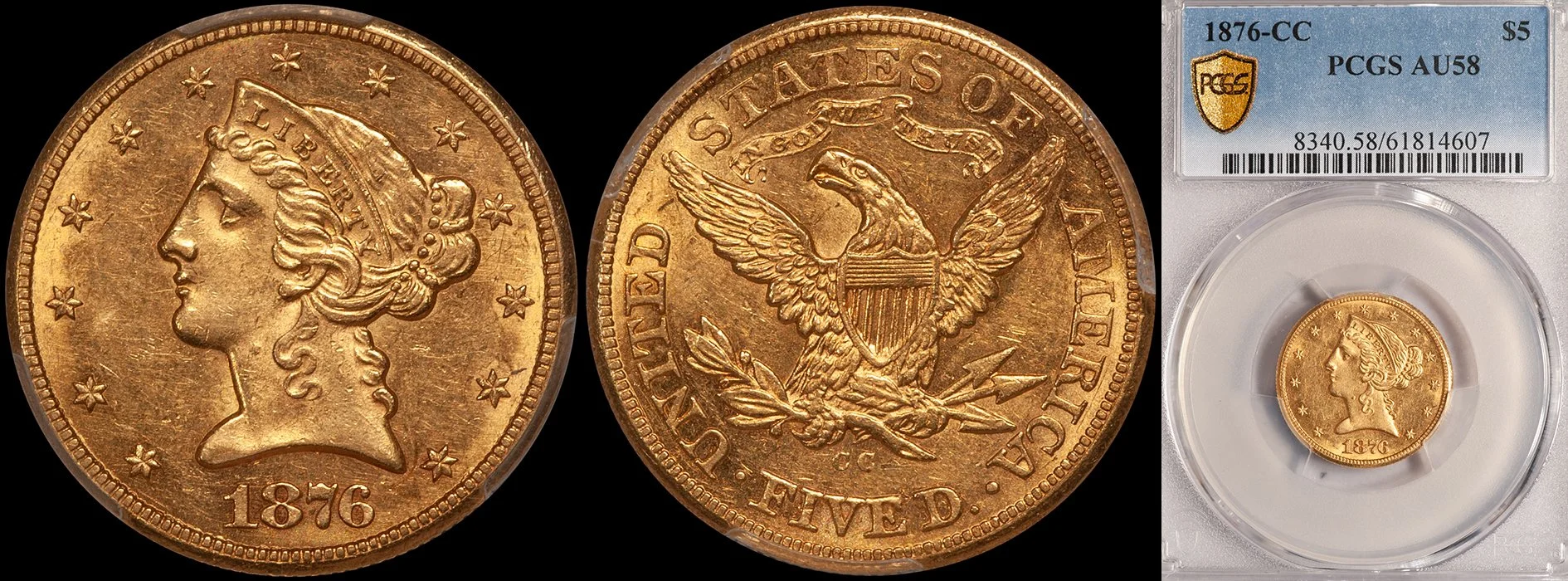
Which brings us to my favorite coin in the sale, the 1876-CC graded MS66 by PCGS and approved by CAC. When I bought this coin in 2003 for $138,000, it was a piece that I really wanted to put away for a decade as I thought it was an amazing coin and the sort of "freak" that could bring a lot of money in a more appreciative market. But I sold it to the owner of the Battle Born collection and it has stayed off the market since then. I bid up to $350,000 for it this time but was left in the dust as it sold for $415,000 plus the buyer's premium, or $477,250. I'm certain that this is a record for any Carson City gold coin at auction and the buyer of the coin is a dealer I greatly respect who will, thankfully, not mess with this wonderful piece or worry about regrading it.
There were a few other half eagles that must have been disappointing for Mr. Born. The 1879-CC, graded MS62 by PCGS and approved by CAC, had sold to the collector for $69,000 in the Heritage 2/11 auction. This time around it brought $37,375. The 1881-CC in NGC MS63+ sold for what was close to the mid-way point of my pre-sale estimate of $40,000-50,000. A coin I really wanted to buy was the glorious PCGS MS65 CAC 1890-CC. I figured this coin would bring around $50,000 and it sold for $46,000 in the sale. Perhaps the biggest bargain, though, was the NGC MS65 1893-CC that sold for $18,400. I didn't especially like the coin, but I estimated that it would bring around $25,000.
Eagles: I expected this to be a strong part of the sale but was curious to see what impact the mixed quality would have on prices. There were some PCGS coins with CAC approval that I thought would do well. There were other coins that I thought were a bit generously graded and which were the sort of pieces that generally need to be priced at some sort of discount to sell to advanced collectors. At this sale, it didn't matter about the holder. As long as the coin had a "CC" on the back, the price was strong.

I disliked the 1870-CC in PCGS AU55 and strongly disagreed with the cataloger who claimed it was the finest known (the Old West: 1341 coin is clearly finer). It sold for $126,500 which in theory seemed like a marginal price but I would have passed at $100,000 if the coin had walked up to my table for sale at a show. The 1871-CC in PCGS MS62+ CAC seems pricey at $126,500 until you realize that it is the finest known and the only true Uncirculated example. One coin that sold for nearly double my pre-sale estimate was the 1874-CC in PCGS MS63. I thought bidders would be scared off by the two big scratches on the obverse (otherwise, it was a Gem...) but two collectors had to have it and the coin sold for a crazy $195,500.
A coin that really surprised me was the 1873-CC in NGC AU58. I really liked the appearance of the coin but graded it AU55 and thought that bidders would also see it as such. Ummm...wrong. It sold for $92,000 which made the nicer PCGS AU55 I sold a few years ago for a lot less seem like a really good deal.
The exact same scenario played out with the 1878-CC in NGC AU58. It was a fresh-looking and very attractive coin but one I know for sure had been upgraded from AU55. It sold for $80,500 which is more than double what I was prepared to pay for it.
Even though it is a common date in Uncirculated, the quality of the 1881-CC (graded MS64 by NGC and approved by CAC) made it special. I paid $74,750 for the coin in the Old West sale and I imagined that it would bring around that much this time; possibly less. It sold for $97,750 which I think is a ginormous amount for the date.

My "sleeper" CC eagle in the sale was the 1882-CC in PCGS MS61 CAC. It is one of only two known in Uncirculated and I liked the coin a lot due to its fresh appearance and lack of rub or wear. It brought $27,600 and I was the underbidder.
The worst value in the sale? I'm sorry to pick on the buyer of this coin--and I don't know who it was--but the NGC MS65 1891-CC at $57,500 was just not a savvy purchase.
Double Eagles: While I sold many of the half eagles and eagles to the collector, I was not involved in much of the assemblage of the double eagle collection. I thought the overall quality was nice. I wasn't fond of the 1870-CC (the previous 1870-CC in the collection, which I sold many years ago, was far nicer) and a few of the more common dates in MS62 and MS63 did nothing for me, but there were some great coins available.
The 1871-CC, graded MS64, is a coin that has bounced around for years and I've never understood why it hasn't been more appreciated. It was a little overgraded in an NGC MS64 holder (I like it more as an MS63) but it is easily the finest known and extremely rare in Uncirculated. It last sold in the Heritage 2008 auction for $414,000 and this time it went very reasonably at $322,000.

One of my favorite coins in the sale was the finest known 1872-CC in PCGS MS62 with CAC approval. I first saw this coin a few years ago in a bid deal at a coin show and it was in an NGC MS62* holder. If I'm not mistaken it sold then for around $100,000. In the Battle Born auction it brought $161,000 which is a very strong, but not unreasonable, price.

My favorite "sleeper" coin in the double eagles was the PCGS MS61 (with CAC approval) 1874-CC that sold for $28,750 in the Heritage October 2010 auction. This is a common date in circulated grades but it is very rare in Uncirculated. I thought the coin was worth around $20,000 back in 2010 and was willing to pay a touch more today. It brought $24,000 and I was the underbidder.
I don't remember the exact price of what I sold the PCGS MS62 1877-CC for in 2002 when it went into the Battle Born collection, but I'm certain it was less than $20,000. It brought $63,250 today. This is a good indication that nice MS62 and better examples of virtually all CC double eagles have performed extremely well during the past decade, often doubling or even tripling in value.
One coin that I sold to the Battle Born collector (in 2003) that I thought went sort of cheaply was the NGC MS61 1878-CC that was bid up to $48,875. I was expecting it to bring over $50,000 as it is a date that is virtually unavailable finer.
If there was one double eagle in the collection that I expected the owner to lose money on it was the 1882-CC graded MS63 (and approved by CAC). Yes, it is a condition rarity (one of just two in this grade with none better and it is the only one in MS63 with a CAC sticker) but I just didn't care for the coin. It wound-up selling for a whopping $80,500. To me, this shows the strength of the CC double eagle market and it tells me that buyers are very anxious to acquire examples that are very low population.
I was really fond of the 1885-CC graded MS62 and approved by CAC. This exact coin had sold for $37,375 in Stack's Bowers 2011 auction and, just a year later, it realized $57,500 which is easily a record price for the date at auction. Why did it bring so much more this time? I'd attribute it to three reasons: the "hotness factor" of the CC double eagle market, the "frenzy factor" of the Battle Born sale and the "comfort factor" of it now having CAC approval.

From a quality standpoint, the 1889-CC in PCGS MS62 with CAC approval was one of my favorite double eagles in the sale. It was really nice for the grade with good color and luster and choice surfaces. I thought it had no chance whatsoever to upgrade but thought it was a textbook example of a "real" MS62 CC double eagle. The last three auction records for this date in this grade were $20,125, $25,300 and $20,700. The coin in this sale brought $27,600.
A few more thoughts on the sale. Kudos are certainly in order for Stack's Bowers who did a great job promoting the sale and certainly proved that they are a formidable competitor to Heritage in the specialized gold coin market. The catalog itself was extremely well done with great information and lovely graphics. I was pleased to see that my name was totally Stalinized out of the pedigrees as I expected it to be. The overall price realized for the collection was just shy of $10 million (including the silver coinage) and I would have to think that the owner was pleased with the results.
How, then, would I rate the overall health of Carson City gold after the most important sale in this in close to a decade? I would, in a nutshell, make the following observations: the half eagle market is fairly weak and this sale would have been a great time to begin a serious collection of ultra-high quality pieces. The eagle market is extremely strong and there is far greater depth in the high end than I expected. I already knew the CC double eagle market was smoking hot, and this sale just confirmed it.
For more information on Carson City gold coinage, please feel free to contact me via email at dwn@ont.com
all images appear courtesy of Stack's Bowers
Date…….1849-O
Grade…….PCGS MS63 CAC
PCGS Price Guide.…….……35000
CDN Greysheet/CPG.…..…37500
Population (PCGS).……….….3/0
Population (NGC)……...………1/1
Population (CAC).….....….…..2/0
Serial Number……5414.63/61207008
PCGS Lookup Number.……….5414