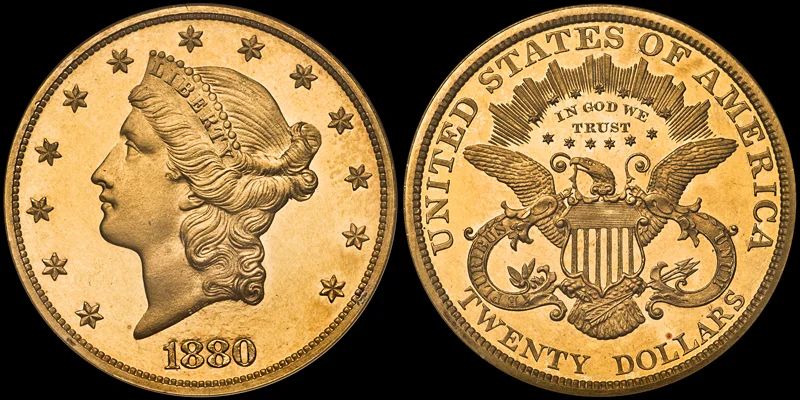
1880 $20.00 NGC PR63

Brilliant Proof Liberty Head gold coinage is almost never seen anymore. Most examples have been dipped and/or conserved in an attempt to generate higher grades from the third-party services and in order to receive Ultra Cameo designations. In the 2011 FUN auction, Heritage sold a number of superb quality Proof gold coins from the Miller collection that were notable for having natural coloration. These coins were purchased in the 1970’s and 1980’s; back when collectors knew what original proof gold looked like and it was appreciated for what it was. This 1880 double eagle was from that sale and collection.

1847-C $2.50 PCGS MS64

The 1847-C is easily the most obtainable Charlotte quarter eagle and there are as many as three to four dozen known in Uncirculated. However, there are no Gems and probably no more than five or six MS64's of which this piece, which has been off the market for a number of years, is probably the second best that I have seen. The quality of strike is amazing with detail that would typically be equated with the Philadelphia mint and the luster is pillowy and full. The color is totally "right" for the issue with intense yellow-gold shades turning slightly to orange at the left obverse border.

1866-S With Motto $20.00 PCGS MS61

The motto IN GOD WE TRUST was added to the double eagle in 1866 but not before 120,000 examples were struck in San Francisco without the motto. This created an interesting transitional issue and the only other time that this occurred in the double eagle denomination is 1907 when both the Liberty Head and St. Gaudens design were made. The 1866-S With Motto double eagle is typically seen in EF40 to AU50 grades. It is scarce in the higher AU grades and rare in Uncirculated with an estimated dozen to dozen-and-a-half known. Almost all grade MS60 to MS61 and I have only seen two pieces higher than this (both in MS62).

Eight Tips on Buying United States Gold Coins

As a specialist in the area of United States gold coins, I often find myself giving "tips" to buyers. Some of these seem pretty obvious to me while others are kind of clever and maybe not so obvious. Here are some of these tips along with a bot of pertinent commentary. 1. If you are a gold coin specialist who is worried about potential hoard coins hurting the value of pieces in your collection, there are a few things you can do as a safeguard. First, stick with coins struck prior to 1890. Most of the gold coins expatriated from overseas appear to be dated from 1890 onwards. Coins struck earlier, especially those before 1878, seem a lot "safer." Second, limit your exposure by not buying very high grade coins. The collectors who owned high grade 1857-S double eagles before the S.S. Central America was discovered got killed afterwards. But if you owned a nice AU example, your downside was limited. Third, you could stick with lower denomination coins. Hoards of gold dollars, quarter eagles and half eagles seem less frequent and dramatic than those with eagles and double eagles. But to those collectors who live in fear of hoards, I'd tell them to get over this and just buy what appeals to you.

2. By the grade before the big price jump. What I mean by this, if you have a choice between an MS64 double eagle priced at $3,500 and an MS65 priced at $25,000 I would always buy the lower priced example, especially if the population is high in the lower grades. As an example, if there are seventy five examples of the $3,500 MS64 with just five better doesn't it seem like that at least a few of the high end 64's could gradeflate to MS65?

3. Nearly every collector who works on a series builds it the wrong way. It seems to me that all collections should have the keys be the best coins in the series while the common dates should be nice but not overblown. Instead, most collections skimp on the keys but overdo it on the commons. Let me give you an example. If you are working on a set of Dahlonega quarter eagles the coins you should "overdo" are the legitimate rarities like the 1854-D, 1855-D and 1856-D. I would stretch on all three and buy the nicest ones I could find. On the other hand, I would be content to purchase nice, original AU55 or AU58 examples of the common dates like the 1843-D, 1844-D and 1847-D and sink maybe $5,000 per coin into these three issues.

4. Always use a 5x glass when you are making a buying decision. Just recently, I bought a Charlotte half eagle at a coin show. It was in an old green label PCGS holder and it looked great to the naked eye. I made an accepted offer and never used a glass to look at it. When I got home and was ready to break the coin out to regrade it I put a glass on the obverse and noticed a deep, detracting scratch that had naturally blended into the surfaces. Yes, you may have great vision and you may be a really macho guy but use a glass whenever possible.

5. Buy coins with good eye appeal. Unless we are talking about an amazingly rare issue like an 1854-S quarter eagle, there is no reason to buy an ugly coin. And I would include damaged coins when I am talking about coins that lack eye appeal. As time goes by, I am noticing that fewer and fewer 18th and 19th century United States gold coins have good eye appeal. By "eye appeal" I mean a coin that is pretty; one that makes you stop in your tracks, look at it carefully and maybe even take a deep sigh. I can pretty much assure you that when you go to sell your coins, the ones with good to great eye appeal are going to be the ones that cause the greatest commotion.

6. First impressions are usually correct. If you get a coin shipped to you by a dealer and your first reaction is "yuck" or "um...I don't really like that" you should pass. Nearly every major mistake that I have ever made as a buyer has been convincing myself that I "liked" a coin when, in fact, I really did not.

7. Price buyers wind up with mediocre collections. Really nice coins with good eye appeal are really hard to buy right now for a number of reasons. If you are a buyer whose is driven by price alone I'm guessing you either buy modern coins or you haven't had much luck lately buying. And if you are a cheap buyer who puts in low bids at auction, I'm guessing the only coins you are buying are the dark, ugly, low-end pieces that those of us who like nice coins wouldn't buy no matter how cheap they are. You aren't going to have fun when you go to sell your coins. But don't take it from me; as an experiment post a few of your "good deals" on a message board to try to sell them to the local dealer....

8. If you are buying coins as an investment and expect to turn them over quickly to make a profit, there are a few things you should know. Rare coins have a fairly sizable entry/exit fee. If you are buying from a typical retailer, you are probably paying at least a 15-20% markup. And when you go to sell your coins, whether it be to a dealer or through auction, you are probably paying in the area of 10-20%. So even if you are buying and selling through good sources, you are talking about values having to go up 25-40% just to break even. That's why I don't personally tout coins as an investment and when someone does ask me about coins in this regard, I stress that they really need to be held at least a full market cycle (or five to eight+ years).

Like these buying tips? Want to read another blog with more tips? Leave a comment at the end of this blog or drop me an email at dwn@ont.com

Some of My Favorite Obscure United States Gold Coins: Part Two

The first part of this article, published at the end of December 2010, discussed some of my favorite little-known United States gold coins in the dollar, quarter eagle and three dollar denominations. In the second and final part of this series, I'm going to look at some of the more interesting half eagles, eagles and double eagles that I have seen or sold over the course of the last two decades as a specialist in United States gold coinage. One quick note. I received some comments about the first part of this series that asked why I didn't include Proofs or 20th century coins. While I like Proof gold, I am not often that impressed with it (there are exceptions, of course...) and a great business strike is a coin that is more likely to stay with me. The same goes for 20th century gold coins. I love the designs and respect the collectors but I can remember more than a handful of Ten Indians or Saints that have left decade-long impressions on my coin psyche.

1. Half Eagles

a) 1838-C, graded MS63 by PCGS. There are a number of Charlotte half eagles that are rarer than the 1838-C. But this is among the more difficult half eagles from this mint to locate in higher grades. In Uncirculated, it is exceedingly rare and this example, which first surfaced in the Stack's 1978 Bareford auction, is the only unequivocally Mint State piece of which I am aware.

I first saw this coin in the October 1989 Superior sale. I badly wanted to buy it but didn't have a client for it at the time. It sold for $48,400 which seemed like a lot of money for an 1838-C half eagle twenty+ years ago. It was purchased by dealer Andy Lustig who was never able to sell it and I think he had it in his stock for close to two years before he gave up and put it into the 8/91 Akers/Rarcoa sale where it went cheaply at $38,500. It was later acquired by Harry Bass via private treaty with yours truly playing a small supporting role. After Bass died, it was sold in October 1999 by Bowers and Merena auctions where it was purchased by the Pogue family for $86,250.

I love this coin for numerous reasons. Its easily the finest known example of the first Charlotte half eagle. Its the only Charlotte half eagle that employs the Classic Head design. Its amazingly choice for the issue. It is one of those coins that every time I think about it I say to myself "why didn't you buy that coin for yourself when it was cheap and only a handful of people appreciated it?"

b) 1847, graded MS66 by PCGS

This was an especially memorable coin for me because I think it was one of the most controversial gold coins I can remember viewing. The coin in question was a staggering 1847 with a virtually perfect obverse and a reverse with the Mother of all Copper Spots. I'm not talking a small copper spot; I'm talking a deep, dark multi-hued stain that covered most of the reverse. I recall sitting in the bar of the Baltimore Marriott hotel the night before the sale began, talking shop with other dealers. Some people loved the coin (I was one of them) but other people absolutely hated it; and this was before the era that all copper spots "had" to be removed in order for a coin to sell!

The coin wound up bringing $110,000 which I though was a staggering price considering the dissent it caused among bidders at the sale. It later graded MS66 at PCGS (I graded it "67 net 66" and figured the spot would lower the grade by a point which it did). Years later it appeared as ANR 11/04: 1804 where it brought $92,000; a poor return for a seven year hold. Seeing it again, I still loved the coin but thought that, for $100,000, I'd prefer a No Motto half eagle with a little less "character."

3. 1864-S, graded MS65 by PCGS. I've written about this coin before. It's among my favorite United States coins ever and its one of those special coins that combine extreme rarity with amazing aesthetics.

The 1864-S is the second rarest collectible Liberty Head half eagle, trailing only the 1875. There are around 25-35 known in all grades but most are well-worn and I know of just two or three in the AU grade range. And then there is this piece, which must have either been saved as an assay coin or somehow put away (on purpose or accidentally) by someone in San Francisco at the time of issue.

You have to see this coin in person to appreciate its beauty. Other than some weakness of strike on the stars it is nearly flawless and probably would grade a point or two higher by today's standards. Harry Bass bought it out of the Norweb I sale in October 1987 and it is originally from Kosoff's Melish collection sale in 1956. It brought $176,000 in 1999 which I thought was a good deal then and which seems amazingly cheap now.

2. Eagles

1) 1839 Type of 1840, graded MS64 by NGC. The span of years from 1995 to 2001 was unique in that a lot of really great old collections were taken to auction and sold. Unless something totally unsuspected happens, I can't imagine we'll ever see another five or six years with so many great coins in so many sales. For me, the Pittman sale was one of the most fun and challenging.

Pittman was like the Super Bowl of coin auctions. All the coins were raw (I doubt we'll ever see a huge sale like this again with raw coins...), the material was as fresh as could be imagined, every major player was involved and the terms were cash and carry, meaning that you had little margin for error.

There were so many great coins in the Pittman sales but this 1839 Type of 1840 eagle is one that I still remember. It sold for $143,000 to Greg Roberts and I was the underbidder. I didn't have a client in mind for the coin and I was actually going to put it away in my own collection. Now graded MS64 by NGC, the coin is staggeringly beautiful with amazing deep yellow-gold color, great surfaces and superb luster. I have always liked the design of this issue and have found it to be a rare coin in AU and higher grades. The Pittman coin appears to be the finest known and there are only three Uncirculated pieces that exist.

2) 1848-O, graded MS66 by PCGS. The James Stack sale, held by Stack's in October 1994, is one of those auctions that don't get mentioned much but it was, in my opinion, one of the premier numismatic events of the 1990's. It was a great collection, put together by a sophisticated collector and there were a number of really wonderful coins.

My favorite coin in the sale was Lot 1298 which was a monumental 1848-O eagle. Later graded MS66 by both NGC and PCGS, this coin is certainly one of the finest No Motto eagles known and it is far and away the finest New Orleans eagle of this type.

The 1848-O eagle was a coin that caused quite a commotion during lot viewing. It was what I call a "pass around" coin, meaning that the dealers viewing the sale on more than one occasion stopped viewing the lots while the coin was passed around from person to person with appropriate comments made at each stop.

At the Stack sale, it brought $154,000 which was a huge, huge price for a New Orleans eagle in 1994. It resurfaced in the 2003 ANA sale and was later seen in the inventory of a California dealer around 2009-2010.

3. 1899-O, graded MS68 by PCGS. One of the really great numismatics accomplishments of the modern era was the group of gold coins put together by Les Fox known as Amazing Gold Rarities. Using Dave Akers as his adviser, in a few short years, Fox gathered a really superb group of coins that he proposed to sell at Sotheby's or Christie's presented as great artworks. Great idea, yes? Except not great enough to get either Sotheby's or Christie's involved and the holdings wound-up in a more conventional Stack's auction held in October, 1988.

There were many great coins in this sale but, for some reason, the one that sticks with me nearly twenty-five years later is the 1899-O eagle that was first sold in the Eliasberg sale and which was obtained by John Clapp directly from the mint at the time of issue.

I haven't seen this coin since 1988 but I remember it being the single most perfect 19th century U.S. gold coin that I'd ever seen. It had virtually perfect surfaces, superb color and sensational frosty luster. It was later graded MS68 by PCGS and I would be curious to see it today and speculate how it would grade by current standards. Just as an FYI, it brought all of $39,600 in October 1988.

3. Double Eagles

a) 1861, graded MS67 by PCGS. The discovery of thousands of high quality Type One double eagles in the S.S. Central America probably had a bigger impact on this specific coin than on any other issue I can think of. For many years this coin was THE Type One double eagle and I still think it is the best single example of this type that is known. But that didn't keep it from becoming an obscurity.

As far as I know, this incredible Gem was first sold at auction in Rarcoa's session of Auction '90 where it brought a remarkable $170,750. A year later, in a much less robust market, it sold for just $68,750 (ouch!) in the Superior May 1991 auction. I seem to recall it bouncing around from dealer-to-dealer until it brought $96,800 as Lot 7947 in Heritage's 1995 ANA sale. The value of this coin increased through the late 1990's and by the turn of the century it was probably worth around what it had brought in Auction '90. But after the onslaught of Gem Type Ones from the SSCA shipwreck its value yo-yo'ed back to its May 1991 level.

I've still never seen a Type One that compares to this coin. Great luster, great color, great surfaces...it was a really spectacular coin and it's something that I would very much like to see again after being off the market for so long.

b) 1891, graded MS64 by NGC. This coin was one of many great double eagles that was sold in the Dallas Bank Collection auction in 2001. This is a sale (and a coin) that offers an extensive backstory for me.

The Dallas Bank collection was owned by Jeff Browning, a Texas oil man who had died young in the 1970's or 1980's. I had known about this collection since I moved to Dallas in 1983 and because of the fact that I never got to see it, despite it residing in a bank less than two miles from my house, it became my numismatic Loch Ness Monster. When it was finally announced that it was going to be sold at auction in New York by Sotheby's and Stack's in October 2001, I was very excited.

The trip to New York for this sale was nerve-wracking as it was my first time on a plane since the 9/11 attacks. I remember lots of soldiers at DFW with machine guns, incredibly tight security and a nervous feeling on the plane that's hard to describe unless you flew yourself at that time. New York was still reeling from the tragedy. There were fliers on the walls searching for missing people and when I went downtown with a fellow coin dealer to see the Trade Towers site, you could still smell the smoke and chemical odor. Chilling...

I thought the coins in the sale didn't all live up to their legend(s) but there were many I liked. The one I liked the most was an amazing 1891 double eagle that was later graded MS64 by NGC. It sold for $80,500. It came on the market again in January 2005 and Heritage sold it, this time in the aforementioned NGC holder, for $155,250.

What are the obscure rarities that stand out to you? I would love to hear from you and can be reached by email at dwn@ont.com or, you can leave a comment at the end of this article.

How to Price AU58 Gold Coins

As a buyer of rare gold coins, nothing makes me happier than seeing choice AU58 pieces with original color and surfaces. I love "Gem Sliders" as these coins tend to have better eye appeal than most MS60 to MS63's and are typically priced at a much lower level. They can be among the best values for savvy collectors but the question that often comes up with these coins is "how much of a premium do they command?" Not all AU58's are similar in quality. In fact, I think there is a huge range of quality and appearance within this grade. There are AU58's that are bright and have clearly been scrubbed. Other AU58's are more original but they are excessively abraded or a bit lackluster. The coins that I call Gem Sliders are ones that probably saw little--if any--circulation and acquired what little wear (or friction) they possess either from collector handling over the years or being transported from location to location. Out of all coins that are graded AU58, I'd say that fewer than 10% are true "sliders" and even fewer of these are what I'd regard as "Gems" for the grade.

The focus of this article is on how to price these Gem Sliders. In some series, such coins are seen from time to time but in most, especially those struck prior to 1880, they are rare enough that pricing can prove to be a challenge.

As I see it, pricing these coins falls into three categories: coins that merit a small premium, coins that merit a moderate premium, and coins that merit a substantial (or even a very substantial) premium.

A Gem Slider 1897-O eagle is a coin that merits a small premium over a less appealing AU58 example. This is so for a variety of reasons. First of all, the 1897-O is not a scarce coin in AU58 nor is it rare in the lower Uncirculated grades. Secondly, of the numerous examples graded AU58, a decent number are original and attractive. Thirdly, there is not a big price jump between AU58's, MS60's, and MS61's for this date. This means that an average quality AU58 might be worth around $800-900 while a truly superb AU58 might only be worth an extra $50 or so.

Gem Sliders that can be acquired for a moderate premium are generally priced at 15-30% over a less choice piece. An example of a coin that might sell for a premium in this range would be an 1851-C gold dollar. The 1851-C is not a rare coin by the standards of Charlotte gold dollars but it is certainly many times more scarce than the 1897-O eagle mentioned above. It is also an issue with a higher overall level demand since it is popular both with date collectors and with type collectors. The premium accorded a Gem Slider is not as great as one might expect for a number of reasons.

The 1851-C is relatively available in the lower Uncirculated grades and MS61 to MS62's sell for a reasonably moderate level in comparison to AU58's. This means that a collector on a limited budget has some options, unlike on an issue where the premium between an AU58 and an MS62 might be too great for him to consider the latter grade. Another thing to consider is the size of the 1851-C gold dollar. On small coins, the "gemminess" of Gem Sliders are not as apparent as on larger coins. This means that the premium tends to be lower.

It should be noted that not all small coins have their premiums held in check by size. An issue like an 1855-D dollar or an 1861-D could command a very strong premium in AU58 because of its rarity, its popularity and its prohibitively high value in Uncirculated grades.

The AU58 Gem Sliders that deserve to sell for a very significant premium are coins that have a number of factors working in their favor. They are typically large-sized coins (although not always; see below), coins that are extremely rare or expensive in Uncirculated and/or coins that are very popular.

To pick a fairly random example of a coin that would sell for a big premium in Gem Slider, let's look at an 1853-O eagle. This is a coin that has a fairly high population in AU58 (especially at NGC) and a scrubby, commercial-quality AU58 might be available for under $4,000. But a very high end, looks-like-an-MS62 Gem Slider is quite rare and could command a price in the $6,000-8,000 range. This sounds like an excessive premium but its not when you consider that there are only two or three properly graded pieces known in Uncirculated and if one were available it might sell for $15,000 or more.

A series that I think deserves high premiums for premium sliders is the Type One double eagle. With very few exceptions, this is a series which becomes exponentially rarer in grades above AU58 and one in which eye appeal is both critical and often lacking.

Again, let's take a random example; this time an 1855 double eagle in AU58. This is an undervalued, under-appreciated date in higher grades but one that is finally becoming recognized for its scarcity. A low-end AU58 example is worth around $4,000. In MS61, this date is worth in the $12,000-15,000 range. So what does that make a gorgeous, mark-free, frosty Gem Slider worth? $6,000? $7,000? Maybe even $8,000?

I can think of many coins where a Gem Slider (or possibly an especially nice AU55) might sell for more than a low end MS61 or even an MS62. An example that comes to mind is a 1796 No Stars quarter eagle. I haven't seen many Gem Sliders of this issue in the last few years but I have seen a number of really unappealing MS61 to MS62's. As a collector, I'd rather spend $200,000+ on a superb AU58 than I would an over-graded, processed MS62. The same scenario holds true on a number of other early gold issues, like 1795 half eagles and eagles, 1808 quarter eagles, etc.

Since the entire concept of Gem Sliders is so rooted in eye appeal which is, in and of itself, a hard concept to get universal agreement on, it would be impossible to publish a Gem Slider Price Guide. One man's $6,000 AU58 Type One double eagle might be another man's $4,000 coin. The addition of the "+" and "*" grades at PCGS and NGC to reward good eye appeal is a beginning of quantification but it is still up to the market to determine what premiums are applied to Gem Sliders.

What Do Original United States Gold Coins Look Like?

Around a year ago, I wrote a blog that discussed original 19th century United States gold coins and used photos of specific coins to illustrate the points I was attempting to make. This was one of the most popular blogs to ever appear on www.raregoldcoins.com and I was pleased to get the positive feedback it generated. At the recent FUN show, I was shown two collections of coins. One consisted of around two dozen Charlotte and Dahlonega coins while the other had around 30 early gold coins. All were graded by PCGS or NGC and in both instances the owner prefaced his show-and-tell by informing me that all the coins were sold to him by dealers who stressed their "originality."

Out of the 50 or so coins I looked at, around five were what I would describe as being "original." This made me realize that most collectors do not understand the concept of originality and that it would be a good time to dust off the old "how to tell originality" blog.

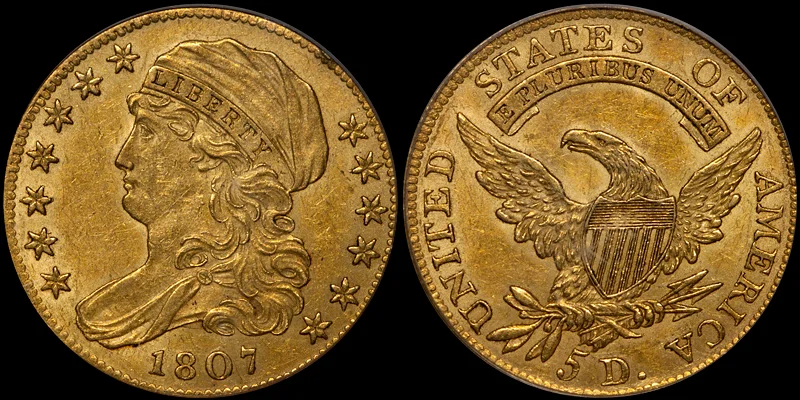
1. 1807 Bust Left $5.00 Graded AU55+ by PCGS

To me, this coin is just about the most perfect piece of lightly circulated early gold that you are likely to find. I think its an AU58 instead of an AU55+ but that's just splitting hairs; what can not be denied is this coin's exceptional color and overall originality.

There are a numbers of factors that make me believe that this piece is original. First is the depth and evenness of its color. Note the "age" of the color and how well it blends. Artificial color looks "newer" and never blends as well as old, mellow natural color. Secondly, note how the underlying luster is still undisturbed and in a perfect cartwheel pattern. This is most clear at the obverse border where there is considerable mint luster at the stars. Thirdly, note the absence of hairlines or other imperfections that might have been caused by a prior cleaning.

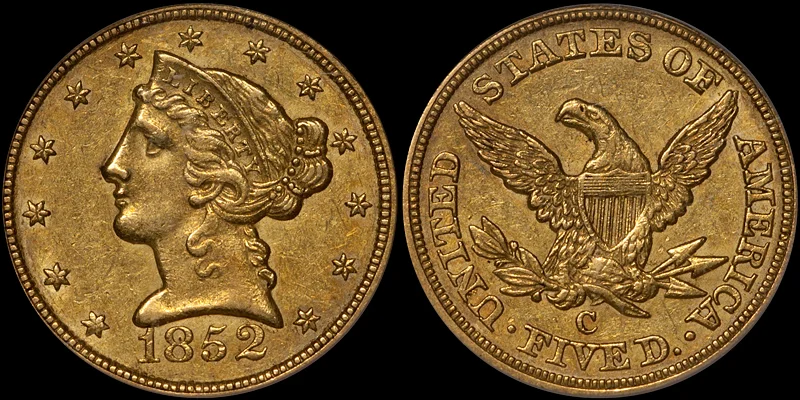
2. 1852-C $5.00 Graded AU53 by PCGS

I almost decided not to use this coin as an example. Its sort of like going to the gym, choosing the biggest lunkhead you can find and then holding him up as an example of a fit guy to a bunch of scrawny non-lifters. Just not fair, right?

The first sign that this coin is very original is the depth of its coloration. Note the very deep and very even hues that can be seen on the obverse and reverse. Coin doctors are never able to reproduce this deep green-gold hue and most artificial toning on gold tends to be more of a bright orange or slightly off-kilter red hue. Another sign of this coin's originality is the fact that the few marks on the surfaces are not shiny or bright. On artificially toned or processed coins, the chemical agents used to color the coins tend to break down over time and there is often discoloration or brightness within the recesses of the marks on the surfaces.

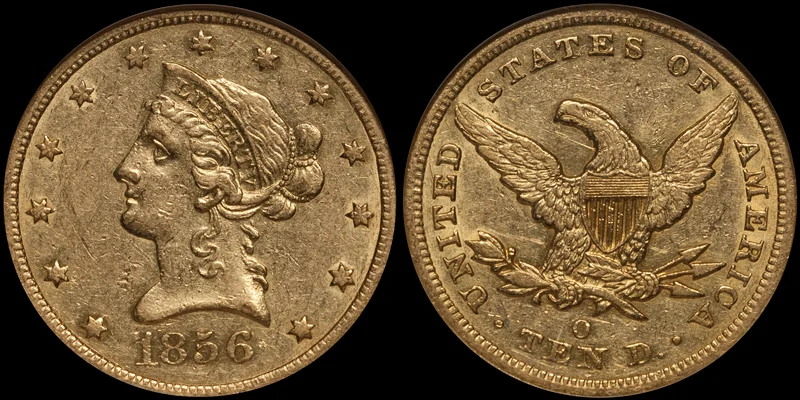
3. 1856-O $10 Graded AU53 by NGC

This attractive coin has a few things that lead me to believe that it is original. The first is its deep, even green-gold color. Note that the hues are consistent on the obverse and reverse. The second is that there is no "filminess" atop the surfaces that might be caused by it having been puttied. The third is the presence of dirt deposits in the protected areas of the obverse and reverse. Note around a number of the stars and within the reverse lettering: there are raised black dirt "chunks" which would quickly dissolve if this coin were dipped in a chemical solution or even put into a soap and water bath to lighten it.

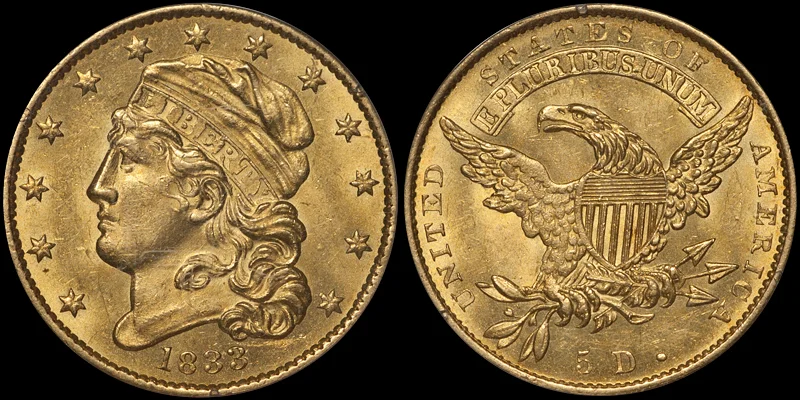
4. 1833 Large Date $5.00 Graded MS63 by PCGS

The common theme so far in with these coins have been their deep, dark original coloration. But what about coins that are lighter in hue and higher in grade? Can a coin that is not dark still be original? In the case of this 1833 half eagle, a coin that I bought and sold at the 2011 FUN show, it certainly can. One of the first things of note about this coin is the fact that it is an old green label PCGS holder. This, of course, doesn't mean it is a guaranteed original coin. But what it does mean is that it was graded at least 15 or so years ago and nothing was placed on the surfaces by a coin doctor as a chemical or substance would have broken-down by now and become visible.

This coin is bright and vibrant but it isn't too bright or too vibrant. I'm not sure this makes sense to a new collector but long-term collectors will immediately realize the difference between a coin that is naturally bright and one that has been brightened. The luster on this coin is completely undisturbed and, as is typical for half eagles from this era, it has a sort of "pillowy" texture. Also, note that the color is a rich light yellow and green-gold. This is characteristic of original Fat Head eagles and this is something that is not seen much, anymore, on the surviving coins from this era.

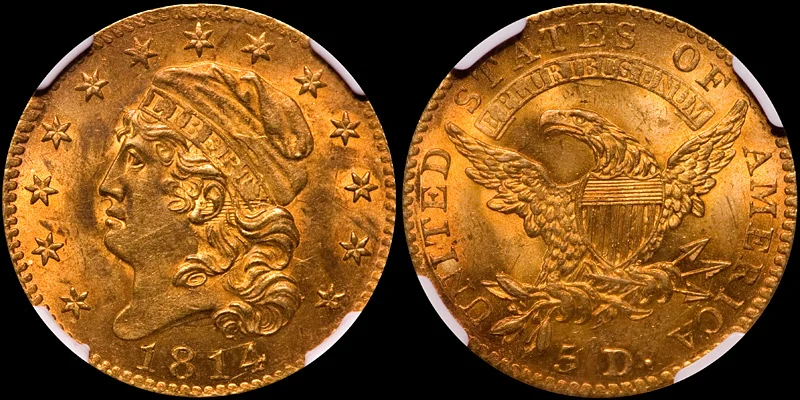
5. 1814/3 $5.00 Graded MS62 by NGC

This is a tricky coin and one that would probably cause the greatest amount of dissent if I showed it to a number of experts. As you can see from the photos, it is very richly toned, in fiery reddish-gold hues. Red is often a color on early gold that has been applied. But in the case of this coin, the hue and intensity of the red is "right" and it has, to the best of my knowledge, never been duplicated by coin doctors. You can also see that the color lies nicely on the surfaces and is variegated with a number of different hues. Artificial color is more monochromatic and does not have the subtle gradations that a natural piece like this displays.

A few other facts about this coin are compelling. First, it is interesting to note that I have handled at least three 1814/3 half eagles in Uncirculated that have had reasonably similar intense reddish-based color. Having seen similar colors on other examples makes me even more certain that the color is genuine. And, the coin is housed in a very old NGC "fatty" holder which means that it was graded nearly two decades ago. If this color wasn't real, it wouldn't look so good after two decades in an NGC holder.

6. 1880 $20.00 Graded PR63 by NGC

Brilliant Proof Liberty Head gold coinage is almost never seen anymore. Most examples have been dipped and/or conserved in an attempt to generate higher grades from the third-party services and in order to receive Ultra Cameo designations.

In the 2011 FUN auction, Heritage sold a number of superb quality Proof gold coins from the Miller collection that were notable for having natural coloration. These coins were purchased in the 1970's and 1980's; back when collectors knew what original proof gold looked like and it was appreciated for what it was. This 1880 double eagle was from that sale and collection.

There are a few things that immediately show this coin is original. As simplistic as this sounds, the first is that it isn't blindingly brilliant. Note, instead, how there is rich copper-orange toning which deepens towards the borders. Also, there is a copper spot on the reverse between the two L's in DOLLARS. Proof gold that has been conserved doesn't have these spots. Finally, there is an even natural "haziness" atop the surfaces that exists on original Proof gold. Note that I did not say "filminess" as in "this coin has been puttied and is now filmy."

Hopefully, this blog has been helpful. There is, of course, no substitute for seeing original coins live and in person but in the absence of doing this, these images and descriptions should be a step in the right direction.

Why I Recommend Numismatic Specialization

When I first started out in the coin business, I assumed I was going to sell everything; Morgan Dollars, Barber Dimes, St. Gaudens double eagles and Charlotte gold, I'd handle it all. But I quickly learned that it would be difficult--and costly--to be an expert in so many areas of the market. I then decided that I'd become really good at just a few things and leave the rest to other people. Nearly three decades later, that's exactly what I've done: I've become a world-class expert in 18th and 19th century U.S. gold. I think my decision to become highly specialized was one of the best things that I've ever done from a career standpoint. And I believe that what I did has practical applications to new and advanced collectors alike.

Becoming a savvy numismatist isn't necessarily a difficult process. But it is an involved one and one that takes a lot of time. If you are like most people, time is one commodity that you do not have an excess of. Given the high value of time in this day and age, I'd suggest that you use the time you spend on numismatics wisely. This is where specialization makes a lot of sense.

I became a specialist in the area of U.S. gold coinage because, as I mentioned above, I realized that the most economically viable approach to numismatics as a career for me was going to be as a specialist. I'd like to share a few thoughts of mine regarding specialization. Its a lot easier to become a competent numismatist who makes good decisions if you are focusing on a narrow range as opposed to a broad range. But I think the concept of specialization is not totally understood. You can be a "broad specialist," a "narrow specialist" or an ultra specialist."

Which one you choose depends on a number of factors including--but not limited to--your budget, your range of interest, availability of coins and opportunity factors. A "broad specialist" is a collector who has a pre-determined focus but not necessarily a constrained one. Let's say, as an example, that you really like crusty original gold coins made prior to the Civil War and have a budget of up to $5,000 per coin. This means that you might purchase coins as diverse as an 1858-S gold dollar in AU58 or an 1846-D half eagle in VF35. Your focus isn't so much a specific series or type as it is a "look." In other words, your collection is focused on attractive, dirty coins. You might not know the relative rarity of an 1858-S gold dollar in AU58 but you know the "look."

A "narrow specialist" is more focused on coins from a specific mint or of a specific denomination. He might buy an 1858-S gold dollar because he is putting together a set of gold dollars or, even more specifically, a subset of San Francisco gold dollars.

I like this sort of specialization because it gives a collector a much more narrow focus or what I would call a "micro focus" as opposed to a "macro focus." If you are assembling a gold dollar set you have around 80 to 90 coins that you ultimately need to purchase and learn about. This is a lot easier than being an indiscriminate buyer of U.S. gold coins with a pool of hundreds--or even thousands--of issues to become familiar with.

A more narrow focus involving gold dollars would be the San Francisco set I mentioned above. There are only six coins to learn about and it wouldn't take much to be accomplished in this area. But I think most collectors aspire to more than being "Mr. San Francisco gold dollar."

Another way to specialize is to collect by die variety. This is a great collecting strategy for certain coins like bust half dollars or large cents but it doesn't apply all that well to U.S. gold.

In my opinion, the ideal way to collect is to have a #1 set and then a secondary set to keep you busy when you can't find coins for set #1. As an example, you could specialize in collecting early half eagles by date and have a secondary collection that is focused on Dahlonega half eagles in perfect, original EF grades.

Becoming a good numismatist is all about knowledge and by not biting off more than you can realistically chew. you stand a chance to be on equal footing with other collectors in your area of specialization. You might not aspire to write the standard reference book on San Francisco gold dollars but wouldn't it be nice to be able to make purchases in this area of the market knowing that you were clued-in about the rarity, price history, appearance and minting history of each issue?

A Quick 2011 FUN Sale Analysis

The 2011 Heritage FUN Sale contained some of the most interesting and freshest coins that have appeared at auction in the last few years. Yes, there were some retreads, some low-end "stuff" and some run-of-the-mill lots, but there were also some really exceptional coins; most of which could be found in Thursday night's Platinum Night session. I'd like to focus on a group of coins from this session that I found exceptional. 1. 1864 Quarter Eagle, NGC PR65 Cameo, CAC Gold Label. Lot 5033. I have seen some pretty incredible Proof quarter eagles over the years but the truly amazing ones, at least from the standpoint of grade, tend to be date 1890 and later. Pre-1880 Proof gold coinage tends to be far, far rarer and really superb pieces, regardless of denomination, are almost never seen.

This 1864 Proof quarter eagle was from the Henry Miller collection and it was easily the best Proof quarter eagle in the sale. I'd even go out on a limb here and say that it was one of the best--if not THE best--early date Proof of this denomination that I've seen. It was in an old PR65 holder but I graded it PR67 DCAM. The coin sold for $80,500 which is a record price for a Proof of this year.

Only 50 Proofs of this year were made and I doubt if more than fifteen or so exist. The best that I had ever seen before the Miller coin was Bass III: 210, graded PR66 by PCGS, that sold for a very reasonable $27,600 back in 2000.

This coin was purchased by an extremely savvy dealer and it will be interesting to see what grade it will be after it is resubmitted for grading. I'd love to think that PCGS or NGC would call it a PR67 DCAM without it having to be conserved.

2. 1823 Half Eagle, NGC MS65 CAC. Lot 5096.. This was a coin that you had to see in person to really appreciate. When I pulled it out of the box during lot showing at Heritage's office in Beverly Hills my reaction was pretty to the point and it rhymed with "moley bit." In a nutshell, this was among the prettiest early gold coins that I've ever seen.

I knew this coin would be one of the most actively bid on lots in the Heritage sale and my guess was that it would wind-up in the collection of a prominent father and son in Dallas who have the best set of early gold assembled in modern times. It was purchased by a Chicago-area dealer for $299,000 bidding as an agent for a collector.

The 1823 is a scarce date in all grades with an estimated 100 or so known. It is typically seen in AU50 to MS61 grades and it is rare in MS62 to MS63. There are a few nice MS64's (there were actually two PCGS examples available at the FUN show) but this is the only Gem. It is from the Bareford collection and it had the sort of unmessed-with appearance that you almost never see anymore on early gold coins.

My opinion is that this coin sold for a ton of money but it was a ton of coin. I'd have to assume it was bought as a type coin and if this is the case, the new owner is getting a Fat Head half eagle that he or she will never have to worry about upgrading.

3. 1838-D Half Eagle PCGS MS63. Lot 5105. This was another fresh coin but, unlike the Miller pieces listed above, it had never been on the market until the 2011 FUN auction. I spoke with the dealer who consigned this coin and he told me that it was part of a small group of coins that had been in a New Hampshire family for many generations and was recently "rediscovered" by the family.

I am a big fan of this issue. It is the first half eagle made at the Dahlonega mint and a popular one-year type that is in demand in all grades. It is scarce in Uncirculated with fewer than a dozen known but most of these grade MS60 to MS61 and are characterized by processed surfaces. The 1838-D in the FUN Sale was only the second coin ever graded MS63 by PCGS and it was one of the two best I'd ever seen. It had lovely natural coloration, choice surfaces and a wonderful overall look that just shouted "originality."

This coin sold to a collector bidding on the floor for $57,500. It broke the previous auction record for the date which was set by a PCGS MS62 that brought $40,250 in the 1999 FUN sale.

4. 1857-O Double Eagle NGC MS62 CAC. Lot 5251 This was my favorite lot in the sale. I knew it was going to be a hard coin to buy but, more than any other coin in the sale, it was a coin that I wanted to own. I spoke with a client of mine who is a seriously collector of New Orleans gold (and Type One double eagles) and he agreed to let my represent him. We decided to bid $125,000.

The coin opened at $100,000 and I found myself bidding against two other dealers. I was able to raise my hand at the $130,000 mark but was outbid by another dealer at $140,000 and then watched another dealer successfully buy it at $150,000. With the buyer's premium the coin brought $172,500.

I can't imagine a New Orleans double eagle with much more eye appeal than this 1857-O (I liked it more than the 1852-O graded MS65 in the sale!). It had superb color, great luster and a really wonderful look that you really had to see in person to appreciate. I graded it MS63+ and am really interested to see what it winds-up grading. I wouldn't be shocked if it was graded MS64.

There are just two choice examples of this date known. The first is a PCGS MS63 that brought $97,750 back in the Bass III sale (May 2000). That was a huge price for an 1857-O double eagle back then but the market has really soared for great Type One double eagle in the ensuing decade and the more I think about it, the more I wished I had bought this coin; even at a level above what it sold for in the FUN Sale.

It was hard to limit myself to just four coins in this auction as there were dozens of really great pieces with great stories to tell. Prices were exceptional for the coins that merited them and this sale offers pretty convincing evidence to me that great coins are back in demand. (But did they ever really ever fall out of favor?)