How the Internet Has Changed the Rare Coin Market

The year was 1995. I can remember my wife Mary telling me that it was really important to establish a presence on the Internet; that it would be the future of the coin business. No way, I thought, people are still going to want to read print ads and receive mailed price lists. The Internet was slow and bulky and you could basically die of old age waiting for each coin image to come up on screen. Sixteen years later, it seems that, as usual, she was right and I was wrong. The Internet has, along with third party grading, changed the coin market like nothing else in history. Why has the Internet been so good for the coin market and what are some of the changes that it has wrought?

The best thing about the Internet for all hobbies has been the dissemination of information. 10 to 15 years ago, if you wanted information about rare coins you had to dig for it. You could open a Redbook and get mintage figures and you could find information about die varieties in various specialized books. But like the man behind the curtain in the Wizard of Oz, in the past, information was strictly controlled. If you were lucky, you were invited into the secret circle and given some of the information you needed. If you didn't know the secret handshake, you were pretty much on your own.

The impact of the Internet can be felt in a numbers of distinct ways. One is the newest phenomenon of the Internet (better known as Internet 3.0): social networking. Back in the pre-web days if you wanted to meet and talk with other collectors, you had to join a local coin club or, if you were lucky and lived in a town with a good coin shop, you met at the bid board on Saturday and talked coins with other interested locals. Now, it is reasonably easy to connect with fellow collectors and share information, buy and sell coins, talk about which dealers are good or bad, etc. I would expect that Facebook will become a much more important platform for coin collectors in the coming year.

As I mentioned above, the Internet has given collectors access to information that was formerly difficult to acquire. Pricing information from auctions is easier to source than ever before. A decade ago, the only place that compiled annual auction data was Krause Publications' annual auction prices realized book(s). These were expensive, not always complete and only provided a one-year window into specific series of coins. Today, sites such as Heritage.com and PCGS.com enable collectors to see 10 or even 20 years of auction results for a specific coin in a specific grade. This is critical information for determining what to pay for a coin or what to price a coin at when you are ready to sell. I would expect that better, more sophisticated coin pricing sites will be introduced in the coming years as well.

As recently as ten years ago, many dealers did not have a website and many of the ones that did featured clunky, slow moving sites. Today, coin websites are considerably more sophisticated and offer much better quality images and descriptions than before. The fact that collectors now feel comfortable enough to buy coins sight-unseen is a result of better technology (hello cable modems!) and it has greatly broadened the size and scope of the market.

One of the biggest changes we have seen in the last decade as a result of the Internet is a restructuring of the auction market. One coin auction firm responded better to technological advances in the last ten years and as a result they have basically decimated their competition. Ten years ago, the vast majority of coins sold at auction were purchased by dealers who were sitting in the room. Today, most lots sell to Internet bidders. Its a little unnerving for a new collector to walk into a coin auction and see it basically empty (with the notable exceptions being the FUN and ANA sales which still attract good crowds or very important specialized collections) but to be told that the auction is in fact a rousing success and that there are hundreds of active bidders participating.

I would expect that we will see similar changes with coin shows in the next ten years. I'm not certain we will have an actual "virtual bourse" but with coin dealers and collectors getting older, travel becoming harder and more expensive, and the number of shows simply too great to be sustainable, I'd think we'll see very different types of shows than what we have now and that they will be far more Internet-based.

How has the rise of the Internet changed the way that I do business? I can think of numerous ways in which it has and there are a few that stand out in particular. I have always sought to purchase pretty, high end coins but now a major consideration for me is if the coin is "photogenic." I might pass on a very dark or somewhat splotchy piece because it won't image well on my website and will be hard to sell as a result. It is very important for me to get my new purchases listed online as soon as I can after I return from a show. Instead of spending the weekend following a show relaxing and decompressing from an intense two or three days of trading coins, I know spend the next few days writing descriptions and having my new coins imaged.

The Internet has improved my cash-flow as it has sped up the amount of time it takes to sell a coin. In the pre-Internet days, I would create price lists and mail them out or put my new coins in print ads. The process would take weeks. Now, I put new coins on my website and often they are sold within hours and shipped within a day to their new owner. By the same token, it's made my concept of what's "fresh" change. I can have a coin on my website for thirty days and if it hasn't sold, it's no longer fresh and I have to rethink the pricing and selling process(es). The Internet has sped up the business cycle in ways which can be great but which can be a little scary as well.

I can foresee some exciting changes to the coin market as a result of the Internet. I would expect that dealer websites will become more interactive in the near future and that there will be more video and customization. If 3-D imaging ever becomes a reality, the inclusion of such images on coin website would be fantastic. I would expect there to be more social networking, more specialized auction sites and, as I mentioned above, more and better access to pricing.

I'd love to hear your input about the Web and its impact on your collecting habits in the past decade.

San Francisco Double Eagles: A Date by Date Analysis Part Two

The second part of this study on San Francisco double eagles deals with the Type Two issues struck from 1866 to 1876. There are no absolute rarities in this series as with the Type One issues but there are a number condition rarities as well as affordable dates that are easy to locate in Extremely Fine and About Uncirculated grades. Let's take a look at each date and focus on the higher grade coins as these tend to be the most interesting Type Two double eagles from this mint.

1866-S With Motto: After a small number of No Motto double eagles were struck in San Francisco in 1866, the change was made to the new With Motto design. The 1866-S With Motto is desirable as a first year of issue date but it is not really rare in terms of overall rarity. It tends to be found in lower grades (EF40 to AU50) and is nearly always seen with heavily abraded surfaces and poor eye appeal. It is scarce in properly graded AU55 to AU58 and rare in Uncirculated with an estimated two to three dozen known. It is extremely rare in MS62 above and none have been graded better than this by PCGS or NGC. The population figures in MS61 seem to be very inflated at both services and a few of the coins that I have seen in MS61 holders are marginal at best for the grade. The current auction record is $39,100 set by Bowers and Merena 7/06: 1667, graded MS62 by PCGS.

1867-S: The 1867-S is a bit more available than the 1866-S With Motto in terms of overall rarity. In Uncirculated it is actually more rare with an estimated 15 or so known. The finest is a single MS63 at NGC; another five or six are known in MS62. This date is typically seen with a flat strike, very "ticky" surfaces and poor luster. Examples with good eye appeal are quite hard to locate and are worth a good premium over typical coins. Properly graded AU55 to AU58 pieces are very scarce and any example that grades above MS61 is extremely rare. The current auction record is $22,425 set all the way back in 2002 by Superior during the ANA auction; this was for a coin graded MS62 that is still the best that I can recall having seen.

1868-S: The 1868-S is the most common Type Two double eagle from San Francisco struck during the 1860's. It is plentiful in grades below AU55 but it is scarce in properly graded AU58 and rare in Uncirculated. I think there are around three dozen known in Uncirculated with most in the MS60 to MS61. Above MS61, the 1868-S is extremely rare. The highest graded is a single MS64 at NGC; the services have combined to grade four in MS62 with just one of these at PCGS. This date comes better struck than the 1866-S and 1867-S and has better luster as well. Like all San Francisco double eagles of this type, it is plagued by excessive surface marks. The natural coloration is often a pleasing rose-gold; others are found with orange-gold or greenish-gold hues. The current auction record was set by Heritage 2006 ANA: 5644, an NGC MS62 that sold for $32,200.

1869-S: The 1869-S is just a touch less available than the 1868-S in circulated grades but it is more available in Uncirculated. There are as many as 50-75 known in Uncirculated with most in the MS60 to MS62 range. This date is extremely rare in MS63 and above although there are a few really nice MS64 pieces known. The population in MS64 is currently eight coins (five at PCGS and three at NGC) but this includes some resubmissions. Interestingly, the NGC population in MS64 declined from nine in November 2009 to its current three and this indicative of the fact that one coin has been resubmitted numerous times in an attempt to make the first MS65 of this date. The 1869-S tends to have better luster than the earlier Type Two SF issues but it is nearly always found with abraded surfaces. The current auction record is held by Heritage 2005 ANA: 10413, graded MS64 by PCGS, which brought $83,375.

1870-S: I regard the 1870-S as one of the real "sleeper" dates in the Type Two SF double eagle series. It is similar in rarity to the 1869-S in EF and mid-range AU grades but it becomes very scarce in properly graded AU58. It is quite rare in Uncirculated with around 40-50 known but nearly all are in the MS60 to MS61 range. In MS62, the 1870-S is extremely rare (I know of only two) and there is just one graded better than this, an MS63 at NGC. This date has decent luster and can be found with an acceptable strike but many of the higher grade pieces have been processed and nice, original coins with decent surfaces are rare. The current auction record is $33,350 which was acheived by Heritage 4/10: 2311. This coin, by the way, was the single best 1870-S double eagle that I have personally seen.

1871-S: In my experience the 1871-S is considerably more common than the 1869-S and 1870-S although the populations figures for the 1871-S are just a bit higher. It is readily available in EF and AU grades and it is much less rare in Uncirculated than the preceding Type Two issues from SF. There are around 75-100 known in Uncirculated and examples in MS60 to MS61 are reasonably priced and available from time to time. In MS62, the 1871-S is rare and it is extremely rare above this. PCGS and NGC have both graded a single example in MS64 while only four are recorded in MS63 (three at NGC and one at PCGS). This date is sometimes seen with semi-prooflike surfaces and it tends to be well struck by the standards of Type Two double eagles. Surface marks and lack of originality are always a problem with the 1871-S. The current auction record is Heritage 1998 ANA: 7856 which brought $32,200. It is graded MS64 by NGC.

1872-S: The 1872-S is generally lumped with the 1871-S but I think it is a harder coin to find in all grades and it is somewhat undervalued. It is a well-made issue with a good strike and nice luster but surface marks tend to be a problem and it is very hard to find choice. The 1872-S is seen from time to time in the lowest Mint State grades but it becomes very scarce in MS62 and it is extremely rare above this. PCGS has graded nothing higher than MS62 (and just four at this level) while NGC shows a single MS63 and MS64 as well as three in MS62. The current auction record is Stack's 9/09: 5570, graded MS62 by PCGS, that brought $12,075.

1873-S Open 3: There are two varieties of double eagle known for the 1873-S. The Open 3 is the rarer of the two. It is usually seen in the AU50 to AU55 range and it is scarce in the lower Uncirculated grades. It is very rare in MS62 and appears to be unknown above this. Most examples are a bit flatly struck and are almost always severely abraded. It is also very hard to find pieces with nice natural color. NGC and PCGS have combined to grade only seven in MS62 and the current auction record is $28,750 set by Heritage 9/09: 1818 (graded MS62 by PCGS) which is, by the way, the only certified MS62 1873-S Open 3 double eagle to have ever been sold at auction.

1873-S Closed 3: This is the more common of the two varieties. I regard it as around three times more common than the Open 3. It is easy to locate in all circulated grades and it is not especially scarce in MS60 to MS61. It becomes scarce in MS62 and it is extremely rare in MS63. The finest graded are a pair of MS63's at PCGS; NGC shows nothing better than a group of fifteen in MS62. The 1873-S Closed 3 is nearly always very heavily abraded. It tends to have better color and luster than its Open 3 counterpart but it is clearly an issue that was handled roughly with many coins transported loosely in bags. The current auction record is Stack's 6/97: 1583 which brought $15,400. I do not know the current location of this coin or what it grades by today's standards.

1874-S: The 1874-S is one of the more common Type Two double eagles from the SF mint but it is less available than the 1875-S and 1876-S. It is well struck and lustrous but most higher grade pieces show numerous marks on the surfaces that limit the grade. It is reasonably available in the lowest Mint State grades but it becomes very scarce in properly graded MS62 and it is quite rare in MS63. The combined PCGS/NGC population for this grade is just seven coins with none better and I do not recall having seen more than two or three in MS63 that I thought were choice. The current auction record is $18,975 for an NGC MS63 sold by Heritage in their 1998 ANA auction as Lot 7861. Remarkably, this is still the only certified MS63 to sell at auction.

1875-S: The 1875-S is the second most available San Francisco Type Two double eagle. It is very common in all circulated grades and plentiful in the MS60 to MS61 range. It is moderately scarce in MS62 and very scarce in properly graded MS63. In MS64 it is extremely rare with a current PCGS/NGC population of just six. There is just a single Gem known and it is a mind-boggling PCGS MS67 (it has been graded as such by NGC as well) that was originally ex Stack's 3/95: 715 where it brought $82,500 as a raw coin. It traded for more than five times this amount last year when it was sold by private treaty. It is the single finest known Type Two double eagle of any date or mint.

1876-S: This is easily the most common San Francisco Type Two double eagle and this makes it perfect for the type collector who is seeking a single high grade issue from this mint. It is very common in the lower Mint State grades and it can be found from time to time in properly graded MS63. It is very scarce in MS64 and extremely rare in Gem. PCGS has graded just one in MS65 while NGC has graded two. The current auction record is held by Heritage 1/10: 2257, graded MS65, that brought $207,000. This is an all-time record for any Type Two double eagle from this mint at auction; at least one coin has brought more via private treaty.

The Type Two double eagles from this mint are a short-lived set that contain no rarities. The set can be assembled in Uncirculated grades although a few of the issues are essentially unavailable above MS61 to MS62. These coins are currently somewhat out of favor and it seems like a good time for the savvy collector to consider working on a nice, evenly matched set of San Francisco Type Two double eagles.

Smart Collecting 101: Is It Ever Right to Buy the Wrong Coin?

In the first installment of Smart Collecting 101 I discussed the "coin churn" and how to avoid it. One reader made a great suggestion for the second topic and I'm going to discuss it at length here. The topic involves buying the "wrong" coin and if there is ever a right time to buy a coin that you clearly know is not optimal for your collection. The brief answer is yes. It depends on what sort of coins that you collect and what your ultimate goals as a coin collector are. Let's look at a few scenarios.

If you are a die variety collector there will probably be a number of instances that you'll be offered a coin that is a major rarity but which is either ugly or damaged or harshly cleaned or maybe even a combination of all three. But you may still have to buy the coin. Let's say you collect die varieties of early quarter eagles. There are a few varieties that are exceedingly rare and might literally be available once per decade; even once in a generation. In this case, if you aspire to have a truly complete collection, you'll buy whatever becomes available for the extreme rarities; even if the coin is damaged. And you'll probably be thrilled just to have the chance.

Let's say that you are a date collector and you are focusing on a series with major rarities in it. If the series that you are pursuing has some incredibly rare issues (say Fat Head half eagles) it certainly wouldn't be "wrong" to purchase a decent looking but cleaned example of a coin that you know might not be available again for years or which may exist in decent condition but which might be ungodly expensive if ever offered. My feeling here is that if you are someone who likes high grade coins you should avoid specializing in a series that has certain issues that almost never come in high grades.

This leads me to another scenario. Let's say you are a person who hates flatly struck coins. You have waited many years to fill a hole in your set and the date in question finally becomes available. The only problem with the coin, and let's say it's fairly decent in terms of overall quality, is that it is flat as a pancake at the centers. What should you do?

I'd suggest that you research the series and learn what percentage of the issue in question comes with this sort of strike. If every known example is weakly struck, then you just need to buy it. If some examples do exist with decent strikes, I'd say that you pass and wait for a sharper example.

There are some issues that are just so rare or so popular that I will compromise my standards and purchase problem coins now and then. As an example, if I saw a decent looking but cleaned 1870-CC eagle for sale I think I'd buy it; as long as it were priced fairly. It's rare, its in demand and its a cool first-year-of-issue. Plus I think its undervalued in comparison to other high profile Carson City issues. But I wouldn't buy most of the other CC eagles with problems. The reasons for this are simple: they would be hard to sell, they aren't in great demand and nice examples are available with enough frequency that the wrong coin makes no sense. I would take this even further with scarce but not overly rare issues. I'd be patient and wait for the exact coin I wanted.

My high degree of standards would also slacken on great rarities (notice I didn't say "expensive coins." I said "great rarities.") I would have no interest in a damaged ex-jewelry Stella but I would consider an 1864-S half eagle or an 1875 eagle if it were cleaned, very well worn or heavily abraded. In fact, these two issues are rare AND undervalued so I would probably not only buy one "wrong" example, I'd buy as many as I could find.

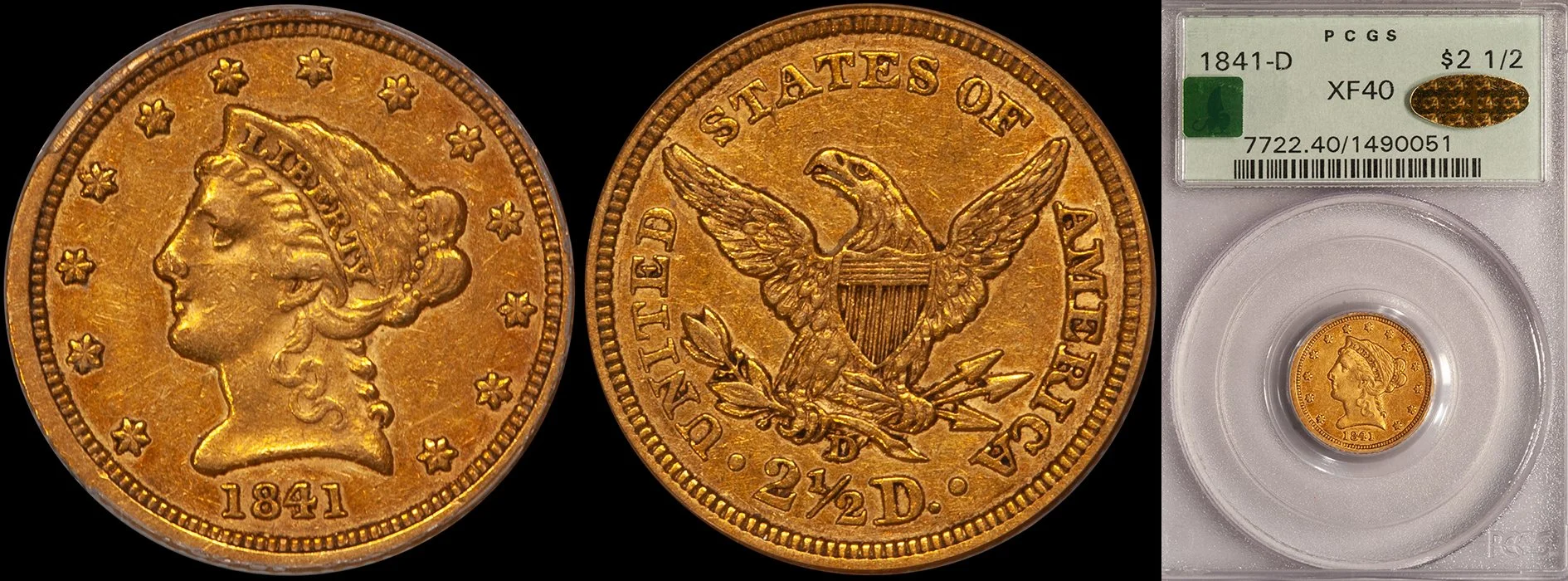
In the case of truly rare coins like the 1841 quarter eagle or the 1854-S quarter eagle, appearance is almost not an issue. Take the case of the 1854-S. There are around a dozen known with three of these actually being "nice." But in this case, "nice" means EF or AU. The others range from very heavily worn (the discovery coin, ex Eliasberg, is a Good 4) to "not as worn but very messed up from scratches or other non-mint damage." You don't get to be fussy with an 1854-S. You see one, you don't hate and you can afford it...you buy it.

Let's say you are one of those collectors who doesn't really have a super narrow focus and your strategy is "best available coin." You don't aspire to finish any series although you might have a preference for San Francisco half eagles or Philadelphia eagles. In such an instance there is really no reason to buy coins that are not right. If a specific issue is too expensive, just pretend it doesn't exist; you aren't completing a set of Liberty Head quarter eagles so don't sweat it if an ugly but rare 1842 Phildelphia becomes available. Sure, it's rare but another will come along and wouldn't you rather pay $8,000 for a really nice example than $3,000 for one that looks like it was gnawed on by numismatic rats?

The "best available" collector may just want to focus on branch mint issues that grade MS60 and above. This might eliminate a host of issues that do not exit in Uncircuated. It might take other issues that are exceedingly rare in Uncircuated and make "compromise coins" very important. Let say there is an issue like the 1859-S half eagle of which just two or three are known In Uncirculated. If the one nice Uncirculated example is sold (which it was, last year, by DWN) this leaves one or two marginal MS60 to MS61 coins in NGC holders that are the best out there. They may not be "new" in the strictest sense but are a good degree better than the coins that exist in AU55 or even AU 58 grades.

In series like the gold coinage from Charlotte, Dahlenega and New Orleans, there are very, very few coins that are rare enough or ones that come ugly enough that a major compromise must be made. The 1849-C Open Wreath dollar is extremely rare with just five known and I would be happy to own one of the two lower grade pieces at the right price. There is really no Dahlonega issue that is so rare that buying the wrong coin might be right although I'd lower my standards on the 1861-D dollar, the 1854-D three dollar and the 1861-D half eagle given their great demand. In the New Orleans eagle series, I would be willing to buy "wrong" examples of the 1841-O and 1883-O because they are relatively inexpensive and because even the "right" coins have eye appeal related problems. Two others that would cause me to compromise would be the 1854-O and 1856-O double eagles. Sure, I'd want my set to contain lovely Choice AU examples and if you have the $1,000,000 to $1,500,000 it will cost to purchase Condition Census or Finest Knowns of this pair than I'd say go for it. If you have budget constraints a lower grade coin or an example that is genuine but cleaned might make sense. But not for the more common 1857-O and 1858-O. Catch my drift?

So, in summary, I'd say that buying the right or the wrong coin is not necessarily set in stone but is, rather, dictated by the collectors needs and circumstances. Just remember that if you buy an expensive problem coin for your set at some point down the road you'll need to convince another collector that he, too, can't wait for the right coin and that he needs to pull the trigger on this "coin with an asterisk."

Smart Collecting 101: Avoiding the Churn

When talking to collectors, I often find myself giving them advice as to what makes a "good collector." I thought it would be interesting to share some of my thoughts and observations in a series of blogs entitled "Smart Collecting 101." These will run, from time to time, over the next few months. One of the mistakes that many collectors make is allowing themselves to be "churned;" either by their dealer/adviser or by themselves. Churning is an expression that means too much buying and selling from an account (or in this case a collection) by a salesperson in order to generate profits for the company and commissions for the broker.

Many of the big marketing firms in the coin business (and some of the better known boutique retail firms) are notorious churners. They will sell a collector a coin and then, a few months later, encourage him to upgrade it.

What many new (and even old) collectors fail to realize is that there are hidden transaction costs involved in any numismatic transaction. Most collectors who deal with the larger marketing firms are paying at least 20% over cost and in many cases more. Now this isn't meant to imply that a 20% or 30% markup is unfair; it's not. But what the collector needs to understand is that the market has to rise at least 20-30% in a short period of time in order to break even on a transaction.

And this fails to take into account another hidden cost: selling. A firm that churns isn't expecting to take back a coin at a price level in which they can break even. Typically, though, they will mask this in a cunning way.

Let's say a dealer sells a coin for $10,000 and his cost is $8,500. And let's say that the current wholesale value for the coin is still around $8,500. What a clever salesperson might do to churn a client is to tell him that his coin is now worth $12,000 or $2,000 over the collector's cost. The salesperson has a coin in stock that represents an upgrade. It's worth $15,000 on a wholesale basis. He charges $19,000. He knows he will lose money on the trade-in but he is selling the new coin for enough of a profit that he is still able to generate a healthy profit. There is nothing really "wrong" with this but what it means is that the collector now has a new $15,000 coin that he is way upside-down on as opposed to an old $10,000 coin that he is only slightly upside down.

Not all churning is the result of sleazy or even "aggressive" dealers. Much of it is self-imposed by collectors.

One of the pieces of advice I try to give to new collectors is that they should "but the right coin the first time." What this means is that instead of impulsively rushing through a set of, say, Dahlonega quarter eagles an then upgrading their mistakes as they go along, they should take their time and buy the coin they will want in their set for the long term the first time.

Of course there are exceptions to this rule. You might have bought a great AU55 1854-D quarter eagle that has pretty natural color and surfaces as well as a great strike. But a few years later, a really superb MS61 becomes available; a coin with an even better strike, a nice pedigree and fantastic coloration. In this case, an upgrade might be a very smart move.

My feeling is that there are clearly times when an upgrade does make sense. Obviously, it is sensible if there is not much of an increase in price. As an example, if you bought a coin in your set for $2,000 and you are able to significantly improve it for $3,000, that's a no-brainer. Or, you might have a coin that you paid $5,000 for a number of years ago that's worth $9,000 today. An upgrade costs you $11,000; you can roll your profit into the new coin and downcost it to $7,000. (Yes, that's how coin dealers think...)

Sometimes, new collectors start a set tentatively and are not ready to spend $10,000 or $20,000 per coin; say on the aforementioned Dahlonega quarter eagles. Their comfort level to begin with is $2,000 or $3,000. This is understandable but my advice in this situation is to not rush headlong into the set. I have seen many great collectors start with small steps and grow into buyers of serious Condition Census-level pieces after they become more sure of themselves and more comfortable with the dealer they are working with.

Even if you are not working on a specific set, you can still get caught-up in the World of Churn. I've talked to a number of collectors over the years who have had their entire "portfolio" changed around by their expert adviser a number of times. And some of the changes that they made were ill-advised to say the least. As an example, I recall talking to a man who had owned some fantastic coins like a Gem Proof Stella, a high grade High Relief and a sensational 1907 Wire Edge eagle. He had bought them at a low point in the coin market, held them for a few years and was in a great long-term position. The salesman at the firm he was working traded him out of these great coins not once but three times over the course of five years and had taken what would have been a small but superb group worth around $1 million and turned it into a bunch of mediocre, overgraded swill that would have been hard to liquidate at half that amount.

I think one of the best signs of a good, reputable dealer is the individual who tells you "no" from time to time. This is a dealer who is interested in a good long-term relationship but will tell you that a coin he has in stock that is a small upgrade over the one you currently own just isn't worth spending a few thousand dollars on. Desperate dealers always say "yes." Stable, dependable dealers sometimes say "no."

In closing, I'd like to ask you, as a collector, for some suggestions about topics for future editions of Smart Collecting 101. What questions do you about collecting that you'd like answered? Feel free to email me at dwn@ont.com with your questions, comments, etc.

A Quick Look at the Current Market for Type One Double Eagles

How's the market doing for Type One double eagles? Good question and one that I feel well-qualified to answer, having been a very active participant in this market for over two decades. We've had a lot of interesting external factors shape the Type One market in the last few years. Naturally, the severe economic conditions of 2007-2009 had a profound influence; especially at the high end of the market. And even if the economy had been strong there's a chance that prices for rarities might have slowed down on their own, given the extreme rise in prices we had seen in the Type One market for the previous five years. It was natural that there would be some profit taking; what I didn't expect was some of the forced sales we saw in 2007 and 2008.

And then there is the X factor in the Type One market: the incredible run-up in gold prices that has seen metal prices top $1,200 per ounce, and the associated pressures on supply that this has brought with it.

All that said, I'm pretty amazed at how strong this segment of the market is right now. In my mind, there is no question that most Type One double eagles valued at less than $5,000 are in greater demand than I can ever remember. I also think that prices are about as strong as I can recall for these coins. If you look at recent auction, nearly all decent quality EF45 to AU58 Type One double eagles are bringing in excess of Trends (more on pricing in a second...) and these coins are typically selling at auction to dealers; not necessarily end-user collectors.

The coins priced at $5,000-20,000 are generally quite strong as well, although not as much so as at the lower price point. The key factors for Type One double eagles in this price range are: eye appeal, eye appeal, eye appeal and the "sexiness" of the date. This is clearly a collector-oriented market and really pretty coins (i.e., those that are not excessively bagmarked, those that are not all bright and shiny and those that are well-made) are in great demand. Average and below-average quality coins still sell; especially if they are useful dates. But they do not bring the premium prices that the nice coins bring.

The real weakness in this market a few years ago was with the expensive coins. As I touched on above the reasons for this were twofold. When the world economy seemed to be melting down, people weren't all that crazy about dropping $50,000 on a coin. And prices had risen so much on many of the key issues that many market participants wondered if certain key issues were still good values at the levels they had risen to.

Before addressing some specific areas in the market, I mentioned earlier about difficulties with pricing. Coin World Trends ability to keep up with this area in the market appears to not be as good as it was before and many Type One issues now sell for over Trends. This is particularly true with less expensive coins in circulated grades.

Let's look at how the coins from each of the three mints are doing.

New Orleans: If you bought good quality New Orleans double eagles at any time before 2005, pat yourself on the back. You are in a profit position and, in some cases, you are in a huge profit position. New Orleans Type One coins remain strong but not as robust as they were in 2005-2007. The dates that I see some weakness in right now are the 1857-O and 1858-O and, to a lesser extent, the 1859-O and 1860-O. The former seem a bit weak due to the fact that a number of coins in the AU grades have been available and these are two of the few Type One issues where supply seems able to keep up with demand. The latter have cooled off as a result of the fact that some truly awful AU coins have sold slightly cheaply at auction. Very nice AU55 and AU58 1859-O and 1860-O double eagles are extremely rare and choice, properly graded examples will bring well in excess of what the schlocky auction pieces have realized. It is interesting to note that few 1854-O and 1856-O double eagles have traded in the last year or two. I heard through the grapevine that an NGC AU55 1854-O traded for over $600,000 between dealers at the recent Long Beach show. If this is true then, it appears, the market for this ultra-rarity is just fine, thank you.

Philadelphia: I'd have to say that the better date Philadelphia Type Ones are the coins du jour in this series right now. The specific coins that seem to be in real demand are the 1854 Small Date, 1855, 1856, 1857 and 1858. Nice AU examples of these five issues are still buy-able at less than $5,000 and offer alot of bang for the Type One buck. The 1850 is as popular as ever due to its first-year status and the common 1851-1853 issues are in real demand in Uncirculated due to the fact that they are still reasonably priced and occasionally available. The two key issues from this mint, the 1854 Large Date and the 1859, have really come into there own in the last year. I personally love the latter issue and think it is still hugely undervalued in all grades from Very Fine to Mint State. If I were a betting man (and as a coin dealer, I obviously qualify as such) I would say that the Civil War issues will be exceptionally active in the next few years, given the 150th anniversary of the beginning of that conflict is in 2011. The 1862 is already an expensive, well-recognized issue and the 1863 is well-known but the 1864 and 1865 are affordable in circulated grades and seem like good values right now.

San Francisco: In all other denominations, the San Francisco coins lag the other branch mints in popularity. This is not the case in the Type One series where the San Francisco coins are quite popular. We can attribute this, of course, to the shipwreck coins which have been a blessing to the market and which have have made many new collectors aware of and interested in other San Francisco double eagles of this era. The post-shipwreck dates (1858-S, 1859-S, 1860-S, 1861-S) are very popular right now and appear to be bringing close to or even above Trends in AU55 and AU58. The few sales records for Uncirculated pieces in the last year have been very strong and they seem to be consistently at levels higher than 2006-2008. Two interesting individual dates to look at quickly are the 1861-S Paquet and the 1866-S No Motto. For many years these were greatly undervalued and I can remember imploring collectors to buy them at $10,000-20,000 in the early part of the 2000's. They soared in price then came down quite a bit in 2007 and 2008. After being unobtainable in Choice AU for many years, there were a lot of over graded, marginal pieces for sale. I've noticed that there are two very distinct markets for these two issues: the market for low-end pieces and the market for choice, CAC-quality pieces.

I believe that we will continue to see a very strong market for Type One double eagles in the coming years. These coins are big, they contain nearly an ounce of gold, they have a great story behind them and there are still a lot of different dates that can be bought for under $5,000 per coin. I am as bullish on Type One double eagles as on any coin in the market right now.

The DWN Online Rare Gold Coinapedia

For many years, it has been my strong belief that the best DWN client is one who is educated. An educated collector is a confident collector and a confident collector is a more active collector. This is one of the reasons that I have tried to share as much of my knowledge about United States gold coins as possible. I’ve written the standard reference books on Charlotte, Carson City, Dahlonega and New Orleans gold as well as hundreds of specialized articles and blogs that can be found on my website www.raregoldcoins.com. With few exceptions, I don’t think there are many other dealers who can make the claim that they are as interested in educating their clients as much as I can.

My current work-in-progress is something that I am especially proud of. I call it the DWN Online Rare Gold Coinapedia and I am proud to officially announce that it is available for collectors to use immediately.

What this online project consists of are hundreds of high-quality images (obverse and reverse) of 18th, 19th and 20th century United States gold coins along with descriptions of each. These descriptions, while taken from write-ups that originally appeared on my website, are informational as opposed to commercial and should provide the new collector with lots of basic facts about the coins they are interested in.

The beauty of this project is that it is totally non-commercial. None of the coins that appear on the on-line encyclopedia are currently for sale. No hype, no sales pressure, just useful facts about coins. And the quality of the images is superb.

At this point in time there are around 300 different images posted. These include the following:

*Over 40 gold dollars

*Over 65 quarter eagles

*Over 15 three dollars

*Over 85 half eagles

*Over 55 eagles

*Over 60 double eagles

And, there are miscellaneous images of coins such as Territorials as well.

As time passes, I will be adding images and descriptions to this resource. I hope to double it in size by the end of 2010. While it will never be totally complete (there are clearly a number of very rare issues that I will not be able to image in the near future) I anticipate that it will become an important, widely used reference in the months to come.

Please visit the DWN Online Rare Gold Coinopedia. Use it often and give me input as to how to make it better and more useful to you. I look forward to hearing your comments.

Which Gold Coins Are Popular and Why: Part One

A question that I am often asked by new collectors is "which gold coins are popular?" I think this is a great question and one certainly deserving of a blog. I'm going to not only answer this question for each denomination, I'm going to give a few reasons why I think certain coins/types are or are not popular. I. Gold Dollars

People tend to be in one of two camps when it comes to gold dollars: they either love them or they hate them. This is mainly due to these coins small size. I am clearly in the "love 'em" camp and have, over the years, handled many finest known and Condition Census pieces.

In my experience, the most popular gold dollars are the Dahlonega issues. Produced from 1849 through 1861, they are very collectible and a number of the issues are quite affordable. The most popular is the 1861-D which, at this point in time, is the single most popular gold dollar of any date. This is clearly due to this coins historic significance.

At one time, the Type Two issues were extremely popular with date collectors. But the values of the 1854 and 1855 Philadelphia issues have dropped considerably in recent years. At the same time, the branch mint issues of this design (1855-O, 1855-C, 1855-D and 1856-S) have become exceedingly popular.

Type Three gold dollars tend to be overlooked but offer the collector a number of very good values. The best known--and most popular--issue is the ultra-low mintage 1875.

II. Quarter Eagles

As a denomination, quarter eagles are fairly popular and they are clearly increasing in popularity each year.

The pre-1834 issues are all rare. They are not as popular as the half eagles and eagles of this era but there are a number of people who specialize in them and they are seldom overlooked when offered for sale. The most popular early dates are the 1796 No Stars and the 1808. Both are one-year types that have low original mintage figures.

The dates in the 1790's are always popular due to their historic significance and their overall rarity. I am personally a big fan of the Capped Head Left type produced from 1821 to 1827. There are only five dates, and these are hard to locate in all grades.

The Classic Head quarter eagles have become quite popular in the last few years and I expect that they will continue to grow in stature as more becomes known about them. The branch mint issues are the most popular. None of these is really rare (except in the upper Mint State grades) and collectors appreciate the unique positioning of the mintmark on the obverse. There are a total of ten Classic Head issues.

The Liberty Head quarter eagle series is popular as it is one of the few 19th century gold series that can actually be completed. There are a few rarities: the 1841, 1854-S and 1863 are all six-figure coins and many of the branch mint issues are very rare in Uncirculated.

In my experience, the most popular Liberty Head quarter eagles are the Dahlonega issues. The rarest is the 1856-D. None are common in higher grades but this series can be completed with time and patience and this makes it popular with specialists.

The San Francisco quarter eagles seem to be the least popular issues of this type; discounting, of course, the very rare 1854-S. I attribute this lack of popularity to the fact that there is no published reference work on San Francisco gold. These coins tend to be relatively available in lower grades but nearly all of the issues from the 1850's, 1860's and the early 1870's are very rare in Uncirculated.

The Indian Head quarter eagle series is probably the most familiar type of quarter eagle due to the availability of these coins. Unlike the 18th century issues, the Indian Head coins are readily available in higher grades.

For a number of years, this series was extremely popular due to an excellent promotional effort by one firm. This firm is no longer focusing as much attention on these coins and prices have dropped.

I personally like the design of the Indian Head quarter eagle and I find fresh, high grade examples to be very cosmetically appealing. But, to be honest, the availability of these coins make them a bit boring to me and I have never really found locating any of the dates to be enough of a challenge to get me interested.

III. Three Dollar Gold

The popularity of this odd denomination tends to ebb and flow. A few years, Threes were very popular with collectors. Today, they are not as popular and appear to be an excellent area for the contrarian.

My guess is that most people would agree with me that the 1854-D is, hands-down, the most popular issue in this series. It is the only Three from this mint and it has a small original mintage of 1,120. It is certainly the only date of this type that seems to have broad appeal outside of the realm of specialists.

The 1875 and 1876 are Proof-only issues that are rare and popular. But many three dollar collectors feel it is OK to exclude these from their set and focus exclusively on circulation strikes.

The ultimate three dollar is the 1870-S which is unique and housed in the ANA money museum in Colorado Springs. When and if this coin becomes available for sale, I would expect it to sell for a strong seven-figure price.

Some of the demand that was created for this denomination a few years ago was artificial as it was generated by telemarketers. I would expect that if a really nice specialized collection of three were to become available, new collectors would come back to this series and you'd see a more "pure" level of demand.

IV. Half Eagles

This denomination has incredible variety and breadth. Some collectors find it overwhelming while others appreciate the challenges afforded by the half eagle.

The early dates (pre-1834) are generally divided into two categories: the semi-affordable and the not-very-affordable. The Small Eagle coins from 1795 to 1798 include few of both. The most popular issue is the 1795 Small Eagle due to its status as the very first half eagle produced. It is can be found without a great effort.

The Heraldic Eagle type of 1795-1807 includes a number of great rarities but many of the issues (especially those struck after 1799) are available and surprisingly affordable. The Capped Bust Left type of 1807-1812 is very collectible and there are no "stopper" issues.

Almost nothing but "stoppers" can be found in the 1813-1829 Capped Head Left issues. The best known issue is the 1822 of which just three are known. Many of the other issues (like the 1815, 1819, 1821, 1825/4 and 1829 Large Date) are extremely rare and almost never offered for sale.

The reduced size Capped Head Left issues of 1829-1834 are also extremely rare, despite relatively high original mintage figures.

For many collectors, the earliest half eagles that they focus on are the Classic Heads of 1834-1838. I really like this series as it is short-lived, nicely designed and a nice bridge between the expensive "old gold" issues and the more ubiquitous Liberty Head coins. The two branch mint Classic Head half eagles (1838-C and 1838-D) are extremely popular but affordable and available in circulated grades.

Liberty Head half eagles are found with two types: the No Motto issues from 1839 through 1866 and the With Motto issues from 1866 to 1907.

No Motto half eagles range from not very popular to very popular. As one might expect, the most popular issues are those from the southern branch mints. The order of popularity seems to be Dahlonega solidly in the lead followed by New Orleans and lagged by Charlotte.

Branch mint No Motto half eagles tend to be seen usually in the Very Fine to Extremely Fine grades. Even the common dates tend to be hard to locate in properly graded About Uncirculated and all are scarce to rare in Uncirculated. I personally believe that there is some excellent value to be had with both the branch mint and Philadelphia No Motto issues, especially in higher grades.

The With Motto half eagles are less popular with collectors with one big exception: the Carson City issues that were produced from 1870 through 1893. The 1870-CC is far and away the most popular Carson City half eagle due to its status as the first year of issue from this mint.

There are a few very rare issues in the No Motto series including the 1875 and the 1887 but these tend to be somewhat overlooked due to the extreme availability of many of the post 1880 Philadelphia and San Francisco dates.

The final half eagle design is the attractive Indian Head made from 1908 to 1929. Despite this coin's beauty, it is probably the least popular of the four "modern" 20th century gold series. I'd say part of this lack of popularity has to do with the rarity of many Indian Head half eagles in high grades. Even the most common Philadelphia dates are scarce in MS64 and above and nearly all of the San Francisco issues are very rare to extremely rare in MS64 and above.

The most popular Indian Head half eagle is the 1909-O. It is well-regarded due to its status as the only Indian Head half eagle from New Orleans.

In part two of this article, we'll look at eagles and double eagles.

The Not-So-Secret Secret 1883-O Eagle

About a month ago, I received an auction catalog from Olivier Chaponniere and Hess-Divo, two well-known Swiss firms located in Geneva and Switzerland, respectively. I often toss these catalogs directly into the recycling bin but thought I'd check this one out; if only because Hess-Divo has the reputation of selling some exceptional ancient and European coins. I went right to the United States gold section and started browsing. A few minutes in, I was startled to see an 1883-O eagle that had been graded AU58 by PCGS. From the photo, the coin looked very fresh and very nice and I was, needless to say, very interested. 1883 O $10.00, image courtesy of Hess-Divo

For those of you that are not familiar with the 1883-O eagle, a little background information is in order. This is the single rarest eagle from New Orleans with an original mintage of only 800. There are around 35-45 known in all grades including a unique Uncirculated piece that I sold around three years ago. There are a total of five graded AU58 at PCGS with none higher. I did a little bit of research on this specific coin and learned that it was new to the PCGS population report and, in all probability, totally fresh to the market.

At this point, I was feeling pretty cocky. After all, it was a European auction and not many American dealers were even going to know about the coin, right?

I started feeling a lot less cocky when I saw these two firms at the Central States show with the American gold coins from the auction on exhibit. My hat goes off to Chaponniere and Hess-Divo. I can't think of many times that European firms have brought American coins to an American show to market them to an American audience. And especially at a non-ANA show; can you imagine the excitement that these Swiss guys must have had regarding four days in Milwaukee? (But that's another story...)

I viewed the coins in person at CSNS and loved the 1883-O. It was fairly baggy but it had nice color, attractive semi-prooflike surfaces and a virtual absence of wear. It was the best 1883-O eagle I had seen in a few years and I felt it was at least the third or fourth finest known; and certainly the only one that was going to be available.

Now I had to determine what to pay for this coin. In regards to the 1883-O eagle, this date is a sort of Numismatic Rare Date Gold Franken-coin. No one cared about this date as recently as a few years ago but I've told collectors for years how rare and desirable it was. Around three years ago, low quality examples started to sell for three or four times more than they had only a few years before this. The last two AU58 examples that I handled were an nice AU58 (ex Pinnacle collection) and a beautiful NGC coin that I sold to a Washington, D.C. collector. I had sold them for less than $40,000 each but figured that in this market that they were going to bring around $60,000. So I bid $55,000 (which translated to $60,000 with the 10% buyers premium).

So how did I do? Not well. The coin sold for an amazing 90,000 Swiss Francs which, according to my on-line currency calculator, is around $78,225. I'm assuming the consignor was even more amazed as the catalogers had estimated the coin to bring 10,000 CHF.

I learned a few valuable lessons from this experience.

The first is, that in this day and age, you could hold a coin auction on the third moon of Saturn and it would still be publicized. The Internet means that the secret auction(s) of yore are now well-attended and the information that is available to collectors regarding pricing makes formerly secret dates not so secret anymore as well.

The second is that good coins will always be found by good collectors. I know the buyer of this coin very well and he was likely to have have bought it no matter where the auction was. The fact that the coins were brought to the CSNS show was amazingly helpful to him and I'm guessing it added at least $20,000 to the bottom line; if not more.

The third is that there are still really cool coins lurking in Europe. You'd think that with American dealers having scoured Switzerland, France, Luxembourg, etc. since the 1950's that there wouldn't be much left anymore. Not true. While coins like this AU58 1883-O eagle don't show up everyday, there are clearly still some eyebrow-raising coins left overseas.

The (Very) High End of the Coin Market Needs Feeding

With less fanfare than in past cycles, the super high end of the art market has suddenly gone ablaze. In the past few months, two iconic works have broken records. On May 4th, Christie’s sold the Picasso painting “Nude, Green Leaves and Bust” for $106.5 million. This painting was owned by the Lasker estate and it was fresh to the market, not having been offered in many decades. I don’t claim to be a Picasso expert (nor have I ever seen this work in person), and my gut tells me that while it was a very nice quality work, it was not considered to be an A+ quality painting, unlike some of the early masterworks painted by Picasso in the early part of the 20th century) that were sold for epic sums last decade.

In February 2010, Sotheby’s garnered considerable attention when they sold Giacometti’s iconic “L’Homme qui Marche I” for $104.3; an all-time record for a sculpture at auction. I personally love Giacometti’s work and though this was an amazing piece of art it was one of five known and it was a challenging, complex sculpture that I think most people just don’t appreciate.

These two sales bring up an interesting question: if a flashy but non-masterpiece Picasso can bring $106.5 million and an iconic but odd sculpture can sell for $104.3 what would fresh, undisputed masterpieces bring in today’s market?

What these two sales have shown is that there is still an incredible amount of wealth in the world and an incredible desire to put this wealth into something tangible like art. This is probably all the more so due to the Greek debt crisis which has impacted European buyers even more than Americans.

These upper market sales have interesting applications to the very high end coin market. Now, obviously, coins don’t sell for $100 million dollars. But there are a number of coins that have brought (or would bring) $1 million or more if they were offered for sale.

It has been a long time since a truly great, truly fresh collection filled with $1 million plus coins came to market. Despite all the amazing coins that have been sold in the last three to five years, just a handful of these were “fresh.”

You’ll notice that I use the expression “fresh” a lot. What exactly does this mean? A coin that has been off the market for ten, 20, 30 or 100 years is “fresh.” This is especially true if it was owned by a specific collector or family and it was not shopped around in the interim. The aforementioned Picasso was fresh to the market as it had hung in the Lasker house since at least the early 1960’s and hadn’t been surreptitiously offered to a few big collectors by sneaky family representatives.

Back in the 1970’s and 1980’s, it was not uncommon for amazing multi-generational family collections to become available. We dealers were spoiled by these collections and almost grew complacent when they were offered. But since the Bass estate was sold in 1999-2000, I can’t think of many “old time” collections that encompassed a broad scope having been sold at public auction.

That’s not to say that some great specialized collections haven’t been made available; both at auction and via private treaty (and don’t let the auction firms fool you into thinking that all the great coins sell at auction. They don’t...) but the very top end of the market hasn’t been tested since the middle of the 2000’s and the amazing top-end results in the art market art exclusive to painting and sculpture.

There are a number of potentially huge buyers waiting in the wings of the coin market if the right coins were to become available. Let’s say, for example, that the coins in the ANA museum (the Bass core collection) became available in 2011. I think you’d see absolutely amazing prices for these coins and I’m not so sure that they would all sell to the usual suspects.

All of a sudden, there seems to be a small “perfect storm” brewing in the world of collectibles. Gold is at an all-time high and I wouldn’t be stunned to see it race past $1,350-1,400 before it cools off as the result of profit taking. The economy is certainly not strong but it has recovered enough that people are spending money again. The wealthy have gotten even wealthier in the last year as a result of a robust stock market but seem uncertain what to do with their profits. The demand for great tangible objects (be they coins, sculptures, paintings, etc.) appears to be quickly rising with very little in the way of supply to satisfy consumers.

What I think this basically means is that if the right collection of coins were to come around in the next year or two, it would completely shatter all existing price records. This would be especially true if this collection met the following parameters: the coins were totally fresh, they were gold, they were interesting, they were well-pedigreed and they were properly marketed. In fact, I think these coins could even bring more than they might have at the peak of the market in 2006 and 2007.