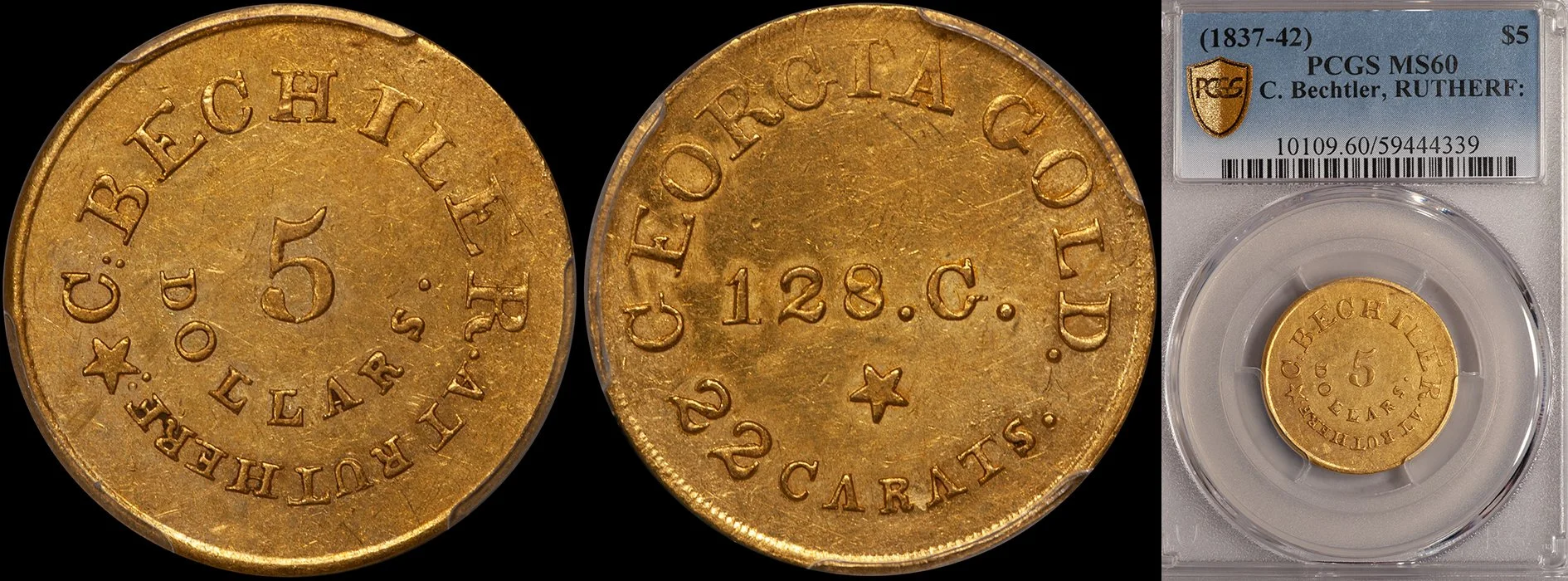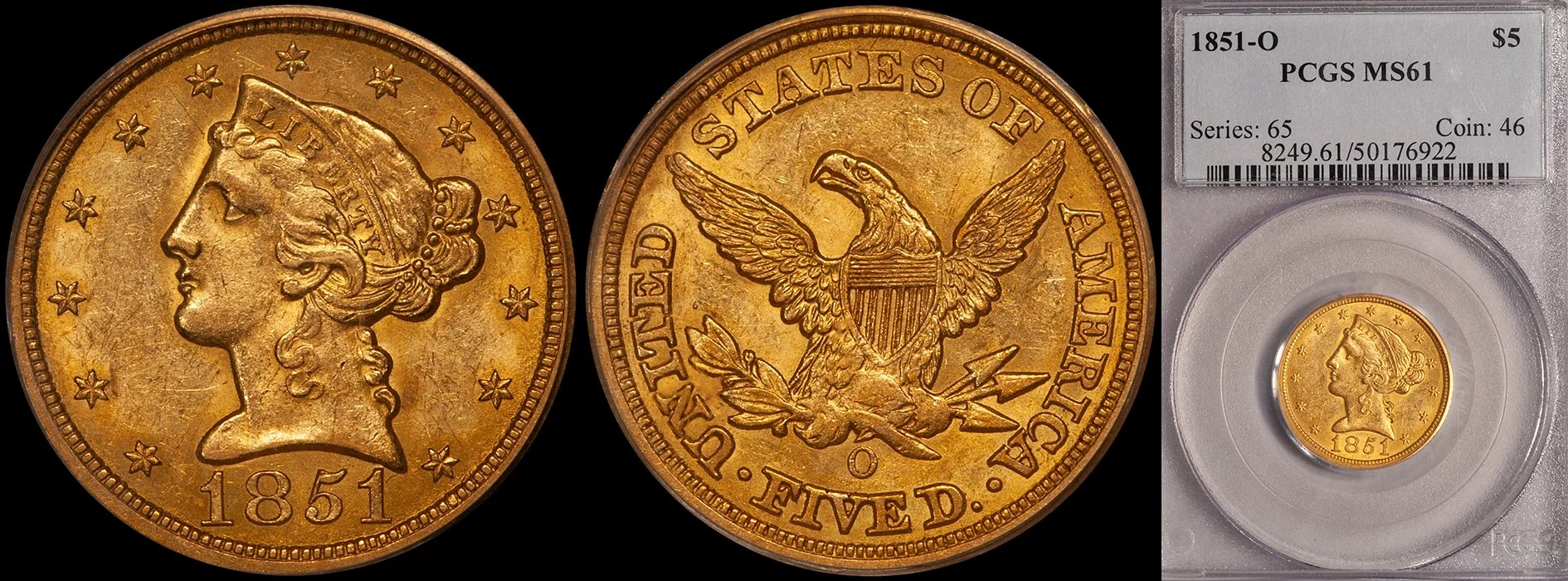
Carson City Double Eagles: An Introduction and Overview

Carson City twenty dollar gold pieces, or double eagles, are the most available gold coins from this mint. Only one date in the series, the 1870-CC, can be called truly rare, although a number of other dates are very rare in high grades. Amassing a complete collection with an example of each date is an enjoyable pursuit. And if you decide not to include the 1870-CC because of its prohibitive cost, don’t despair; many collections do not include this date. A collector of average means can put together a nice set of Carson City double eagles with the average coins in the Extremely Fine and About Uncirculated range. The collector will soon learn that only the 1870-CC presents a great challenge in terms of availability. There are an estimated 40-50 examples known in all grades. This means that no more than four dozen or so complete collections of Carson City double eagles could possibly exist. In comparison, the maximum number of Carson City half eagles that could exist is around five dozen while around three dozen (or a few more) eagle sets from this mint might be formed. In each series, the 1870-CC is clearly the “stopper” or key date.

The completion of an average quality Carson City double eagle set is somewhat easier than a comparable half eagle or eagle set, provided that the collector is willing to accept coins that do not grade Mint State-60 or better. There are just 19 dates required to form a complete set. Carson City double eagles are without a doubt among the most popular United States gold coins. Their large size, combined with their romantic history, makes them irresistible to many collectors. This fervent collector base is most evident when one examines the great popularity of the 1870-CC. This issue has increased dramatically in price and popularity since the last edition of my Carson City gold coins book was published in 2001. As this is being written (2010) there are a few examples actually available to collectors but a few years back it was nearly impossible to locate an 1870-CC double eagle at any price.

As with the other Carson City gold series, it is very challenging to pursue the double eagles in higher grades; in this case About Uncirculated-55 and higher. It becomes even more of a challenge when the collector demands clean, original coins with a minimum of bagmarks and abrasions. As a rule, CC double eagles are less rare in high grades than their half eagle and eagle counterparts (at least the issues from the 1870’s and 1880’s). This means that locating really choice coins is not as difficult as with the half eagles and eagles from the first decade of this mint’s operation.

More than most other Liberty Head double eagles, the Carson City issues have tended to remain popular and increase in value over the course of time; regardless of their bullion value. One of the major reasons for this has to do with the great story behind these coins. CC double eagles are reasonably easy to promote due to their relative availability (especially in lower grades) and their wonderful history. These coins have long proven easy to sell to non-collectors and pure investors. Interestingly, the Japanese were major buyers of Carson City double eagles in the past and this is due to their interest in the legends and history of the Old West. I am aware of several American dealers who sold a number of Carson City double eagles to the Japanese and other Asians.

At the present time it remains impossible to assemble a complete set of Uncirculated Carson City double eagles. At least one of the nineteen dates is unknown in Uncirculated. However, more dates in the double eagle series exist in full Mint State than in the half eagle and eagle series, both of which contain a number of issues that are either unknown or excessively rare in Mint State.

The 1870-CC is unknown above the AU53 to AU55 range while the 1871-CC and 1872-CC has just three to five and five to six, respectively. The 1878-CC and 1879-CC are extremely rare in Uncirculated as well with fewer than ten pieces believed to exist. The 1873-CC and 1891-CC are very rare in Uncirculated and almost unobtainable above the MS60 to MS61 range. The 11874-CC, 1877-CC and 1885-CC are considered to be quite rare in full Uncirculated as well. Conversely, a few Carson City double eagles are very plentiful in Uncirculated. These dates include the 1875-CC, 1890-CC and 1893-CC of which hundreds are known in the MS60 to MS62 range. It should be stressed that well over 90% of all Uncirculated Carson City double eagles are in the MS60 to MS62 range and any date in extremely rare and desirable in properly graded MS63 or above. I have still never seen or heard of a Gem and have only seen one piece (an 1875-CC) that I regarded as being close to MS64.

High grade Carson City double eagles are in very high demand by date collectors and type collectors. I doubt if there are as many as twenty Carson City double eagles that are true MS63 coins by today’s standards. CC double eagles are essentially unknown in high grades because of the rough way in which they were handled and if a Gem is to ever show up it is likely to be an Assay coin or a piece that was given special treatment by a VIP or prominent local family.

There was probably not a single coin collector alive in Nevada at the time these coins were produced. The few MS63 to MS64 coins that do exist were preserved by good fortune or sheer happenstance. Many were stored in the vaults of European, Central American and South American banks after they had been shipped there as payment for international debts. While stored in these banks they were protected from the American gold recall of 1933 and the wholesale meltings that took place during this period. Many of these coins have worked their way back to America since the 1960’s as their numismatic value increased. Despite the fact that literally thousands have been repatriated, more Carson City double eagles are still being found in Europe, Central America and South America.

An examination of the series reveals some interesting rarity trends. Survival statistics depend, to some extent, on the original mintage figures. But they vary widely according to the year of issue.

The rarity trends for CC double eagles do not break down as neatly as they do for the half eagles and eagles from this mint. Unlike these two other denominations, the double eagles do not always get characterized as “rare early dates” and “common late dates.” One of the rarest double eagles is the low mintage 1891-CC while the most common is the 1875-CC. After studying the half eagles and eagles from this mint, I feel that the rarity of the Carson City double eagles are based less on mintages and actual use than on mintage values and subsequent shipment overseas. The collector who studies the rarity tables that I included in my 2001 book on CC gold will note the following very general trend: the lower a coin’s mintage and the older its date, the rarer it tends to be in terms of pieces known today.

The 1870-CC double eagle had the lowest mintage figure of any Carson City double eagle: a scant 3,789 coins. In the entire 57 coin Carson City gold series, only the mintages of the 1877-CC, 1878-CC and 1879-CC eagles were lower. As with the other 1870-CC gold issues, the comparably high survival rate of the double eagle (on a percentage basis) is most probably due to a few pieces being saved as first-year-of-issue keepsakes. The fact that no AU-55 or better specimens exist implies that these coins went directly into circulation and saw active use.

The next rarest dates are the 1871-CC and the 1891-CC. The 1871-CC is rare due to a low original mintage figure (just 17,387 coins) and the fact that this issue saw active commercial use. The 1891-CC is rare more because of the fact that only 5,000 were produced. It is also interesting to note that the similarly dated half eagle and eagle are extremely common by the standards of Carson City gold and can be found with no difficult even in the lower Uncirculated grades.

The next rarest issues are the 1885-CC, 1879-CC and 1878-CC. All three have low mintages and tend not to be found in groups of CC double eagles located in overseas sources.

The 1875-CC, 1876-CC, 1884-CC, 1892-CC and 1893-CC appear to have been saved and then shipped overseas. A decent number of these coins are still being brought back to the United States, including examples in the lower Uncirculated grades. The 1892-CC and 1893-CC, in particular, are less rare in Uncirculated than their comparatively low mintages would suggest.

As with other gold denominations, a general rule is that the older a coin is, the lower the average grade of surviving specimens. This intuitive statement is not nearly as easy to predict in the double eagle denomination. As an example, the 1872-CC is the third rarest Carson City double eagle when it comes to high grade rarity but it is only the eighth rarest in terms of overall rarity. This suggests that this coin was released into circulation and used in commerce; not stored in banks and shipped overseas like the 1892-CC and 1893-CC.

Carson City double eagles served two primary functions. They were meant to circulate but they were also meant as a storehouse of value. The large $20 denomination was the most convenient form in which to coin, transport and trade the large quantities of gold that had recently been mined in Nevada. During the western gold rushes, paper money was viewed with suspicion. This made gold coins an important factor in daily commerce, which quickly became the accepted mode of payment in the Old West. Thus, it is not surprising to learn that Carson City double eagles can be found in comparatively low grades today. These low grade coins (Very Fine and Extremely Fine) are often heavily abraded from years of use in commerce. Conversely, most of the known Uncirculated coins are also heavily marked, the result of loose coins striking against each other while being transported in bags. It is not uncommon to see CC double eagles with no real wear but with such extensive abrasions that they are downgraded in the commercial marketplace to About Uncirculated.

The greatest challenge for the collector of these coins is not finding specific dates but, rather, locating clean problem-free coins. As mentioned above, the typical Carson City double eagle, whether it grades Very Fine-30 or Mint State-61, tends to have negative eye appeal due to excessive marks, scuffing or mint-made spotting. Coins which have truly good eye appeal are quite rare and deserve to sell for a strong premium over average quality specimens. The collector is always urged to “stretch” for exceptional pieces with high quality eye appeal.

Most of the pieces struck from 1870 through 1875 are not sharply impressed. This is most evident in the central portion of the coin where the greatest amount of pressure is needed to raise the metal of the planchet and bring out the details. On the obverse, the weakest area is usually on the hair. On the reverse, this weakness is most often seen on the neck feathers of the eagle, the radial lines in the shield and on E PLURIBUS in the motto. This weakness of strike is often confused with wear. Still, Carson City double eagles of this era tend to be sharper (and easier to grade) than their half eagle and eagle counterparts.

The survival estimates in my new book are based on information current as of 2010. Since the last edition of the book in 2001, a number of new coins have surfaced. This has included some reasonably significant hoards. Populations for Uncirculated have increased due to relaxed grading standards. Some coins that I considered to be About Uncirculated in 2001 and now Mint State.

Due to the sheer number of Carson City half eagles that exist, I have always found it difficult to estimate surviving populations; especially with the more common issues. I anticipate that my current overall population figures will prove to be conservative, just as they were in 2001 (and in 1994 when I wrote the very first Carson City gold book).

To reach these conclusions, I study auction data, population reports, dealer ads and websites as well as my own personal records of sale. In an average year, the number of 1870-CC double eagles might be as low as one or two coins. For other dates, such as the 1871-CC and 1891-CC, the number might be around one per month; possibly less. Obviously, the rarer the date and the higher the grade desired, the harder it will be for the collector to locate an acceptable example. Finest known or Condition Census examples may stay in specific collections for many decades.

As I mentioned earlier, the collector with a budget can form a complete (or near-complete) set of CC double eagles excluding the 1870-CC in the VF and EF grades. A number of the dates in the series can still be found in lower grades for less than $2,500 per coin and they would appear to have very little downside risk at these levels.

The collector with a larger budget is likely to focus on coins grading AU50 and above. With the exception of the 1870-CC, no Carson City double eagle is prohibitively expensive or unobtainable in this range. Such a set could probably be assembled in two years or less.

A connoisseur with a large budget will focus on coin that grade About Uncirculated and Uncirculated. For the 1870-CC, a coin grading EF45 to AU50 will prove satisfactory. The collector of such coins should focus on pieces with minimal marks and original color. Since many of the early issues are so rare in full Mint State, finding even properly graded AU55 to AU58 pieces is very difficult. Given normal market conditions, a collection of this magnitude might be assembled in three to five years.

An even more impressive collection would be one in which all the coins except the 1870-CC were MS60 or finer. Such a collection might take decades to assemble.

Collecting Carson City double eagles is a very enjoyable pursuit and the number of serious collectors currently working on sets will attest to this.
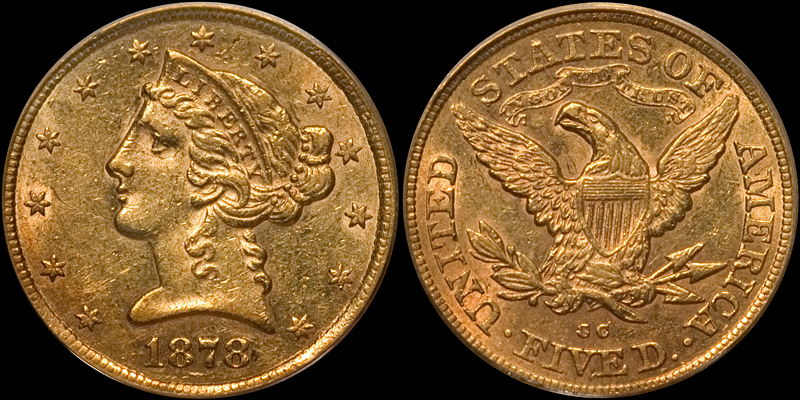
Finally...An Appeciation for San Francisco Gold Coinage (?)

After decades and decades in the dumps, it looks like there are small signs of life in the San Francisco gold coin market. But the activity in this market area is sporadic, to say the least, and is being led by exactly the sort of coins that you wouldn't think would be the pacesetters. There are plenty of overgraded, unappealing high priced San Francisco gold coins on the market right now. You haven't been able to give these away for years. You still can't. San Francisco gold coins that are faux-rarities, uninteresting dates or processed with no eye appeal are impossible to sell.

The coins that are suddenly selling have three things in common:

1. They are genuinely rare dates and most are either from the Civil War era or the years right before the war (i.e., 1858 through 1860).

2. They are well-worn but problem-free coins in the VG to VF grade range. These are true collector coins and this little renaissance of interest is obviously collector-based.

3. They are in PCGS holders. There are a few exceptions to this rule but the people buying these coins seem to want PCGS graded coins. This may be because they are forming Registry Sets.

The denominations that seem to have generated the most interest are half eagles and eagles but from time to time a quarter eagle is included as well.

The recent Heritage Central States auction included a few early, rare San Francisco gold coins that nicely illustrate this new trend. Let's take a quick look at each.

The first was Lot 3476, an 1862-S quarter eagle that was graded F15 by PCGS. This is a rare date in all grades with just 8,000 struck. It sold for $1,092.50 against a Trends value of $550 in F12. Why did it sell for double Trends? The reason is obvious: Trends is way too low for a coin as rare as this. I would have figured it was worth around $700-800 but even at a shade under $1,100 I think its great value.

The second example was an 1859-S half eagle, graded VF25 by PCGS and sold as Lot 3633. It brought $2,323 against a Trends of $1,200 in VF20. I figured it was worth around $1,500-1,750 and actually sold it to the consignor recently for a figure in this range. This coin had a number of things going for it. It was in an old green label holder and it was really nice for the grade. It is a rare, seldom seen issue that is very expensive in higher grades (I sold the second finest known late last year, an NGC MS62, for over $25,000). When you do see EF and AU examples they tend to be pretty yucky quality-wise and at around $2,500 this coin was a fantastic bargain.

The third example was a little bit of a surprise to me: an 1866-S No Motto half eagle in PCGS VF35. Offered as Lot 3636, it brought $3,220 against a Trends of $1,600 in VF20 and $4,250 in EF40. Although this is a numismatically significant date as the final No Motto half eagle from this mint, it is much less rare than the 1859-S and I wasn't really wild about the coin from a quality standpoint. Also interesting was the fact that this date is sometime seen in lower grades, unlike the 1862-S quarter eagle and the 1859-S half eale which are extremely arre in grades below EF40.

Now I know that three auction records do not exactly constitute a full-blown trend but this is not a totally isolated series of incidents. I know that when I have an interesting lower grade San Francisco half eagle or eagle that is affordable and seemingly good value, it typically sells quickly and often well in excess of current published values.

I have noticed that Trends (and Greysheet) values for lower grades (Fine and Very Fine) are way out of whack with reality. Often times, these numbers are years old and have not been changed since gold was priced at below $500 per ounce. Think about it: a coin like an 1862-S quarter eagle in Fine at $550? That just seems like absurdly good value. And coins like this are likely to stay undervalued, at least according to price sheets, due to lower collector activity than silver coins from this era. Enough F12 1862-S Dimes trade that it is possible to have an idea what such a coin is worth. But an 1862-S quarter eagle in this grade? You are talking about a coin with a population of just a few pieces and if two people care about such a coin at any given time, prices at auction can run up quickly.

I'd like to thank Jason Carter of Carter Numismatics in Tulsa OK for suggesting this topic and pointing out this market trend to me.

Overdated United States Gold Coins

One of the most interesting varieties of United States gold coinage is the many overdated issues that exist. Some are very rare and others are common; some are well-known and some are very obscure. But all share a common trait: a high “coolness factor” that makes them desirable with collectors. What are overdates and how can the collector of United States gold coins focus on these issues? An “overdated” coin is one on which two dates are present. A famous example is the 1942/1 dime. An overdate occurs when one of more digits from the current year is punched into an older working die. Overdates are often intentional creations and they may exist for a number of reasons.

In the early years of the US Mint, steel to make dies was scarce and funds were scarcer. The Mint operated on a shoestring budget and if any dies were leftover at the end of the year, there was good reason to reuse them. There are many overdates from the 1790’s and early 1800’s and many were probably caused by economic reasons.

Quality control at the Mint during the early years was often lax and some overdates appear to have been produced by accident. These accidents occurred when an engraver inadvertently employed a date punch that was not consistent with the die he was working on. This appears to be the case with some of the overdated coins produced during the 1830’s and 1840’s.

Let’s look at some of the more interesting overdates that occur on Liberty Head gold coins. We’ll save overdated early U.S. gold coins for another time as the list and scope of these is very comprehensive.

Gold Dollars: There are no gold dollars that were overdated. It is interesting to note that there are very few varieties of note in this entire denomination. The branch mints, where one would have expected an overdate or two to have occurred, never produced one in this denomination.

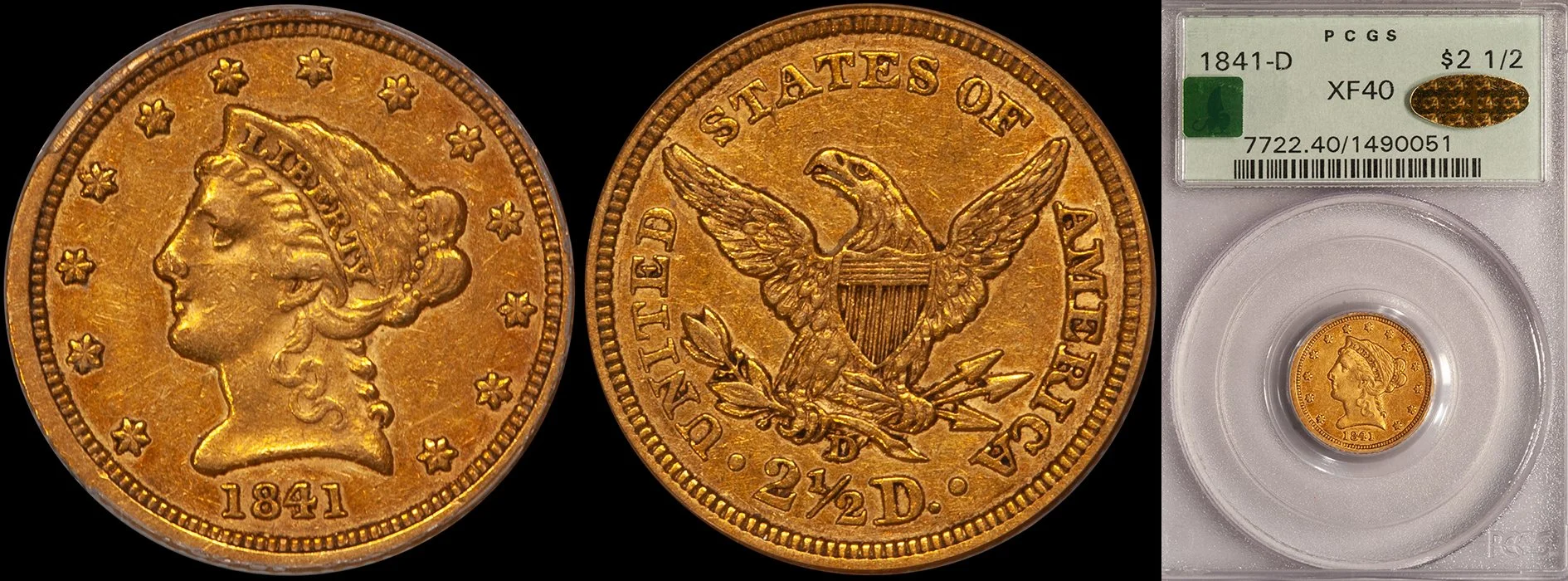
Quarter Eagles: The Philadelphia, Charlotte and Dahlonega issues from 1839 have been called 1839/8 overdates in the past but this is incorrect. The only genuine overdate for the Liberty Head type is the 1862/1. This is a clearly visible overdate that was probably caused by the stress involved with producing gold coinage during the most intense year of the Civil War. It was once believed to be extremely rare but now is only regarded as very scarce. In higher grades, the 1862/1 is very rare. I have personally seen two or three in Uncirculated including a PCGS MS62 that was the best of these.

Three Dollars: You would think that this odd denomination contained an overdate or two but it does not. In fact, there are virtually no significant varieties.

Half Eagles: The pre-1834 issues of this denomination are fertile ground for overdate collectors. The Liberty Head issues are not as interesting when it comes to varieties. There are only two legitimate overdates: the 1881/0 and the 1901/0-S.

The 1881/0 is an overlooked issue that I think is undervalued and quite interesting. There are hundreds known in circulated grades and it is available even in the lower Mint States grades without much effort. It is rare in MS63, very rare in MS64 and may not exist in Gem. A very presentable Uncirculated 1881/0 half eagle can be obtained for less than $2,000.

The 1901/0-S half eagle is probably the most common overdated Liberty Head gold coin of any denomination. A total of 3,648,000 half eagles were coined in San Francisco in 1901 and my guess is that a decent percentage of these were overdated. This variety is common in circulated grades and easily located in grades up to and including MS63. It is scarce in MS64 and rare in MS65 or better. In lower grades it sells for virtually no premium over a common 1901-S and it is a good introduction to the world of overdates coins for the neophyte.

Eagles: The first few “overdate” issues in this series are either controversial or simply wrong. This parade of suspects is led by the 1839/8 Large Letters (Type of 1838). As with the similarly dated quarter eagles, what has been described as an overdate is, in fact, a defect in the die which can be mistaken for an “1839/8.”

For many years, the 1846/5-O was believed to be an overdate but this has been disproven by me and other specialists. Some collectors believe that an 1849/1848 overdate exists but the pieces that I have are not convincing and I don’t think this variety exists. Same goes for the 1857/5; a variety that has been claimed to exist but which I am certain is not a true overdate.

The only legitimate overdate in the entire Liberty Head eagle series is the 1853/2. The variety has received some fanfare over the years but it is still underappreciated; especially given its status as the only true overdate in the series. I estimate that there are around 125-150 known with most in the EF45 to AU50 range. This variety is very rare in properly graded AU55 and above and extremely rare in Uncirculated. I have seen only one Uncirculated example, an MS61 graded by PCGS.

The 1865-S/Inverted 186 has been called an overdate but it is not; it is actually a blundered date caused by mis-entering the first date punch.

Double Eagles: There is only one overdated Liberty Head double eagle: the 1853/2. This is a somewhat controversial issue and it is one that I have seen a few prominent numismatists (including Dave Bowers) state that it is not an overdate but a recut date. I am of the belief that it is an overdate but that some of the pieces that have been designated as “overdates” but PCGS and NGC are later die states that are questionable. The real 1853/2 double eagle has a bold oblong obverse die dot below the foot of the R in LIBERTY. It also shows fairly clearly within the bottom loop of the 3 the straight-lined base of a 2. There are an estimated 200-250 known in all grades and the 1853/2 is quite scarce in the AU range. It is very rare in Uncirculated with probably no more than a half dozen known. I have seen three or four that grade MS61 or slightly better.

Putting together a set of overdated Liberty Head gold coinage would be a fairly easy task. It would consist of only five coins and only one—the 1853/2 double eagle—is expensive in higher grades. The really fun and challenging overdates tend to occur on the pre-1834 issues but as I mentioned above these are often expensive and some are extremely rare.

The 1878-CC Half Eagle

Having just acquired one of the two or three finest known examples of this date (a PCGS AU58 that is illustrated below) I thought it would be interesting to share some information about one of my favorite half eagles from this mint.

The 1878-CC is among the rarest Carson City half eagles, both in terms of overall and high grade rarity. It is not nearly as well known as the 1870-CC and it doesn't have the cult following that the rare and undervalued 1873-CC has. That said, it is still a coin that is very well respected by specialists.

A total of 9,054 were struck. When I wrote the second edition of my book "Gold Coins of the Carson City Mint" back in 2001, I estimated that there were just 60-70 known in all grades. A decade later this estimate seems a bit on the low side and I'd probably revise the total number known up to the area of 75-100.

As of May 2010, PCGS has graded a total of 64 examples in all grades with none in Uncirculated and a total of twenty in About Uncirculated including five each in AU55 and AU58. NGC has a total of 48 in all grades with one in Uncirculated (more on this in a second) and nineteen in AU including five each in AU55 and AU58. My previous estimate of just three to five known in About Uncirculated now seems very low but I believe that the PCGS and NGC populations for AU are significantly inflated by resubmissions. My best guess is that there are around ten or so properly graded AU's known today.

A few years ago, an example graded MS63PL appeared on the NGC population report. I have never seen this coin and am assuming it is a data entry error. If it does actually exist, it is one of the most significant Carson City half eagles in existence and it is a coin that I would really like to view in person.

The finest 1878-CC Carson City half eagles that I have seen are a small number (around three or four) that grade AU58 by today's standards. The all-time auction record for this date is Stack's 5/08: 4235, graded AU58 by PCGS, that brought $63,250.

The 1878-CC half eagle has a very recognizable "look" and it is an issue that can be distinguished from the Philadelphia and San Francisco half eagles dated 1878 with relative ease.

The 1878-CC has a somewhat fuzzy strike unlike the Philadelphia and San Francisco half eagles of this year which are very sharply impressed. This fuzziness is most evident around the borders and the denticles on a number of pieces are not fully formed. A number have significant weakness at 4:00 and 7:00 on the obverse border.

This is a hard issue to find with good luster. One of the things about the PCGS AU58 that is special for this issue is the fact that the luster is frosty and visible. This is clearly not the case on most 1878-CC half eagles which are not lustrous and have been stripped by processing. The coin shown above has some scattered marks in the fields bt these are fewer than usual for the issue.

The PCGS AU58 1878-CC half eagle shown in the photo above will be available for sale in a few weeks along with some other remarkable Condition Census CC half eagles from the same collection. For information on any of these coins please contact me via email at dwn@ont.com.

The Numismatic Double Play

Say the words "double play" and most people think of Jeter to Cano to Texeira. But in the world of gold coins, the concept of the double play has another meaning altogether. Back in the 1980's and the 1990's it was common to see large-sized U.S. gold coins marketed with the "double play" strategy. What this meant was that these coins had two inherent factors that contributed to their price structure: their intrinsic gold value and their numismatic value.

The double play concept became stale over the course of time and marketers moved on to find other way to peddle their product. But I believe that this is an idea with merit and one that should be revisited in today's value-conscious market.

People who buy U.S. gold coins typically fall into two camps: those who are investors and those who are collectors. What if a third category became a factor in the market; an investor-collector hybrid who focused on semi-scarce to scarce issues that sold for relatively small premiums above their basal value(s)?

There are basically two denominations that are perfect for the investor-collector hybrid: the ten dollar gold piece (or "eagle") and the twenty dollar gold piece (or "double eagle"). If you're with me so far, I'm going to suggest that we narrow our focus to two specific issues: the With Motto Liberty Head eagle (produced from 1866 through 1907) and the Type Two Liberty Head double eagle (produced from 1866 through 1876).

Here are some basic facts about these issues. The With Motto Liberty Head eagle weighs 16.718 grams and it contains 90% gold. As I write this article (in mid-April 2010) gold is trading for a touch above $1156 per ounce. The trading levels for eagles are as follows:

MS60: $700 MS62: $740 MS63: $1,210

It doesn't take a numismatic genius to immediately note that MS62 appears to be the best value grade for this type. At just a $40 premium above MS60 coins, you are talking around a 5% increase for what is generally going to be a much nicer coin. So for the sake of convenience, let's stick with the MS62 grade for this denomination.

The "base line" date for Liberty Head with motto eagles is the 1894 as it has the highest PCGS population in Uncirculated and in MS62. There have been 18,116 examples graded by PCGS or which 6,013 are in MS62. These numbers are, of course, swollen by resubmissions but the ratio of around one-third of all 1894's graded being in MS62 seems correct based on my experience.

There are a host of dates that we can compare with the 1894 but, again for the sake of brevity, let's focus on three of them. The first is the 1883. This issue has an original mintage figure of 208,700 (compared to 2,470,735 for the 1894). It isn't a remarkably interesting date but it is extremely rare in higher grades (PCGS has never graded an MS65 and only four have been graded MS64 by this service; in MS62 they have graded 261) and there is a big price jump between MS62 (current Trends is $865) and MS63 (current Trends is $2,500). Given the fact that the 1883 is, in theory, around twenty to thirty times rarer than the base line 1894 in MS62, it seems that its current $100-150 premium in this grade is pretty reasonable.

Let's look at another date, the 1900-S. I have always liked this date and think its a real "sleeper" in higher grades. PCGS has a current population of 31 in MS62 with just 16 better than this including a single coin above MS64. Given this coin's relative scarcity in Uncirculated, you'd figure it would have a pretty decent premium above the 1894, right? In MS62, current Trends is $1,100 (it jumps to a comparatively high $5,650 in MS63) and I have purchased examples in the last year for around $1,000. Now I understand that an MS62 1900-S eagle isn't going to be the Poster Child for U.S. gold coins anytime soon but it seems like awfully good value to me, given that a common, boring old 1894 in MS62 is worth around $750.

How about a date that actually has a degree of collector demand? Let's take a quick look at the 1901-O. It is one of the more available New Orleans eagles in higher grades but it has the appeal of being from a popular southern branch mint. The current PCGS population is 103 in MS62 with 61 better including just a single coin above MS64. I doubt if more than 125-150 properly graded MS62 examples exist yet current Trends is just $865 in MS62 (it jumps to $2,750 in MS63). Given the fact that a 1901-O eagle in MS62 is popular, reasonably scarce in this grade and is probably not a bad looking coin at this grade level, its very small premium above the common 1894 is fairly baffling to me.

What if someone were to promote the 1901-O in MS62? Given the fact that a year's worth of quiet, under-the-radar buying would probably only produce 40-50 coins, it hardly seems worth the effort. That said, it seems like an easy coin to promote up to the $1,250-1,500 level in MS62.

What are some of the MS62 Liberty Head eagles that I would recommend as good double-play issues? Some of the dates I like include the 1879, 1882-S, 1884, 1884-S, 1886, 1890, 1893-O, 1894-O, 1895-O, 1897-O, 1899-O, 1900-S, 1906-O, 1906-S and 1907-S.

The second type of U.S. gold coin that offers double play potential is the Type Two double eagle. But this series is different than the With Motto eagles that we discussed above. Type Two double eagles are more popular with collectors and they tend to be be rare to very rare in Uncirculated grades.

The base line issue for this type is the 1873 Open 3. It has an original mintage figure of over 1,000,000 and a high survival rate with probably more than 10,000 coins known in all grades. PCGS shows a current overall population of 4,027 of which 1,356 have been graded from AU50 to AU58.

The trading levels for AU55 to MS60 1873 Open 3 double eagles are as follows:

AU55: 1400-1500 AU58: 1500-1600 MS60: 1650-1750+

Let's look at two slightly better dates and see if the double play concept makes sense. The first is the 1867. This is a relatively popular issue with collectors that has an original mintage of just over 250,000. PCGS has graded 304 in all grades of which 131 are in the various AU grades and another 24 are in MS60. In grades above MS61 to MS62, the 1867 is extremely scarce, so nice AU's tend to be popular with specialists in the series.

The current Trends levels for the 1867 are $2,000 in AU55, $2,500 in AU58 and $4,000 in MS60. The premium in MS60 is high enough that it is not a good double-play issue. But in AU55, the premium is fairly low over the base line 1873 Open 3. My conclusion is that a nice AU55 to AU58 1867 double eagle in the $2,000-2,250 range is a great value for the double play investor-collector.

The second date is the 1872-S. This is a date that is regarded as semi-common; not quite at the level of the base line of the 1873 Open 3 but certainly nowhere as scarce as such earlier San Francisco issues as the 1866-S, 1867-S, 1869-S or 1870-S.

The mintage figure for the 1872-S is 720,000. The survival rate is quite low as most were melted over the years and I doubt if more than 2,500 pieces exist. PCGS has graded 551 in all grades including 343 in About Uncirculated. To give you an idea of this coin's rarity in higher grades, of the 52 that PCGS has graded in Uncirculated, only four are better than MS61 and none are higher than MS62.

You can buy a nice 1872-S in AU58 for around $2,000-2,250. As I mentioned above the base line for an AU58 Type Two double eagle is in the $1,500-1,600 range.

The Type Two double eagles in AU grades that I feel are good double play issues include the 1867, 1868-S, 1869, 1869-S, 1870-S, 1871, 1871-S, 1872, 1872-S and 1873-S Open 3.

The double play strategy may or may not prove to be fruitful for the hyrbrid investor-collector. But with the premiums for genuinely scarce issues like the ones mentioned above at very low levels (some of the lowest premiums that I can remeber, in fact) I think it is a strategy with minimal downside.

The Best Values in Todays Rare Coin Market

There are many issues that face collectors in the coin market of 2010. A lack of quality coins is driving many collectors to seek new areas of specialization. Both PCGS and NGC have recently added “plus” grades which will no doubt change certain areas of the market as well. More than ever, collectors are gravitating towards areas that offer value. The days of new collectors and uninformed wealthy investors arbitrarily throwing money at plastic rarities are over and we appear to be back to a collector-oriented market. So what are some of the areas in this new market that offer the best value to collectors? I have chosen three price ranges ($1,000-5,000; $5,000-10,000 and $10,000 and up) and included some of the series and/or types that I feel are especially good values. Some are currently popular; some are not. What I have tried to focus on are coins that are actually available in some quantity and issues that I gladly buy to put into my own inventory when they are available.

1. $1,000-5,000

a) Gold Dollars, 1865-1872: The eight year run of gold dollars produced at the Philadelphia mint from 1865 through 1872 doesn’t include any real rarities but nearly all of these coins are scarce and undervalued in MS63 to MS64 grades. Most are priced in the area of $1,500-2,000 in MS63 and $2,000 to $3,000 in MS64 (the 1865 is rarer and more expensive in both grades) and they seem like good value to me. Take the 1872 as an example. Just 3,500 business strikes were made and only a few hundred exist in all grades. In MS64 this coin is worth around $3,000 yet it might take me months to find a decent example in this grade. Yes, gold dollars are small but this is a very collectible series and one with a number of really undervalued issues.

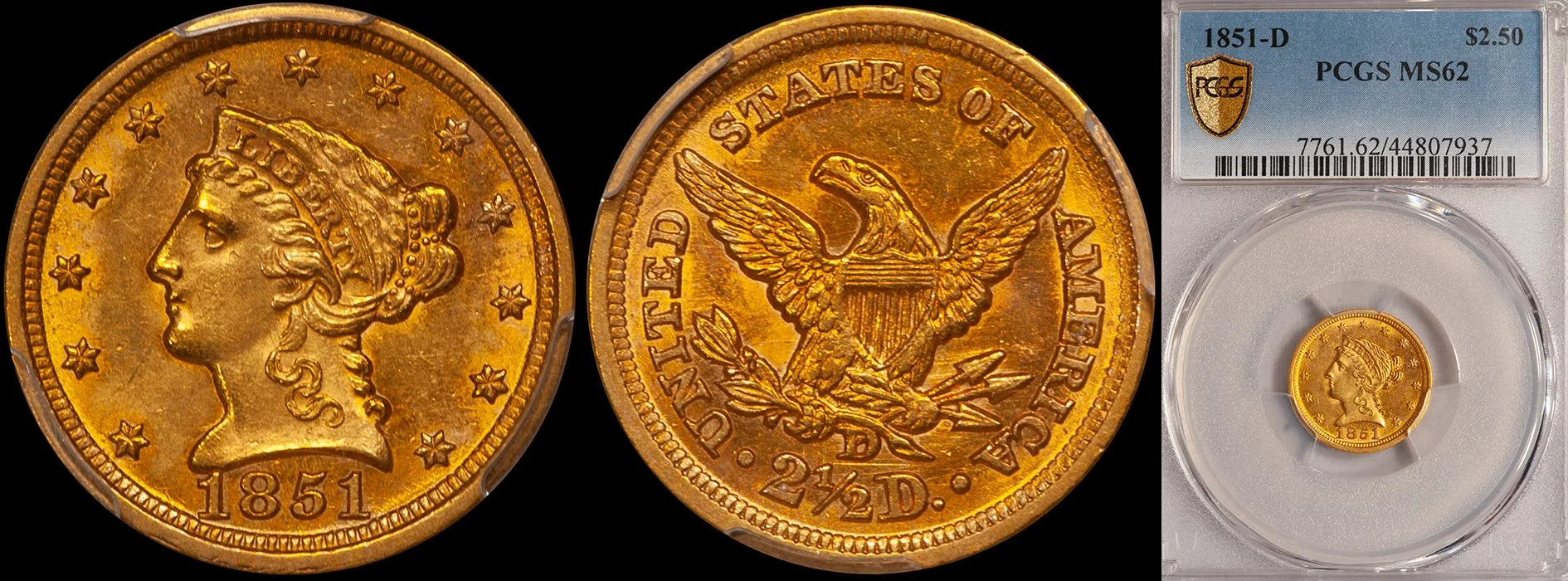
b) Classic Head Quarter Eagles: I’m a big fan of this series in properly graded AU55 to MS62 grades. Note that I stress properly graded as many of the coins that I see are either low end or unappealing due to having been processed. The Philadelphia issues, with the exception of the rare and much undervalued 1839, are affordable in this grade range with pieces valued at $1,750 or so at the lower end and around $5,000 at the higher end. The mintmarked coins are, of course, far more expensive and are not necessarily “good values” although I am an avid buyer of any mintmarked Classic Head quarter eagle in EF40 and better that is choice and original. For collectors at the lower end of this budget range, a nice set of About Uncirculated Classic Head Philadelphia quarter eagles is a fun and challenging endeavor.

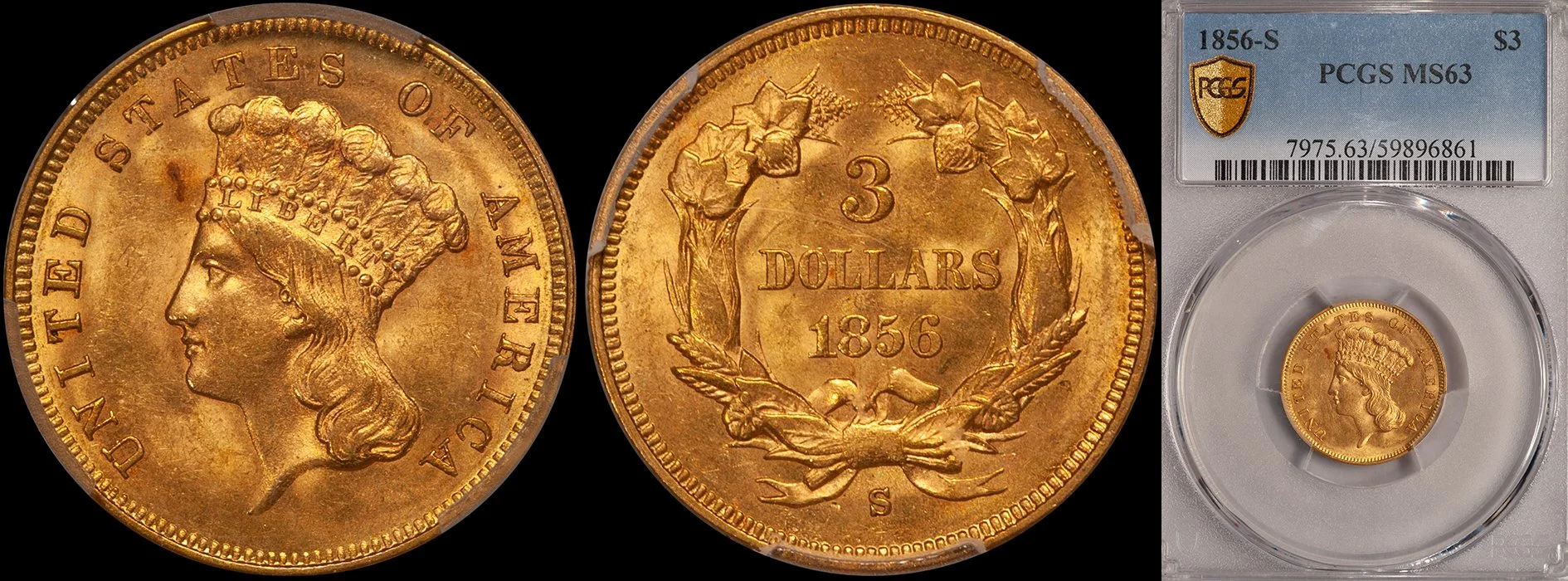
c) Three Dollar Gold Pieces: After a few years of collector and investor popularity, this series has recently gone quiet. I don’t necessarily believe that all three dollar gold pieces are good value. In fact, I feel that some formerly undervalued issues are now marginal value at best (primarily due to the fact that many are grossly overgraded and have absolutely no eye appeal). What I do like about this series is that prices are actually down versus where they were five to seven years ago; which is pretty remarkable when one considers that gold has essentially doubled in price since then. Given the lack of collector interest, a new collector can buy PQ quality three dollar gold pieces for a very small premium right now. There are many coins on the market and with some patience, a really nice partial set of Threes could be assembled. The dates I still regard as undervalued include the 1858, 1862, 1864, 1870-72 and the ultra-low mintage issues from the 1880’s.

d) No Motto Half Eagles and Eagles: In the $1,000-5,000 range there are few areas in the United States gold coin market that offer better value than No Motto half eagles from the Philadelphia mint in the higher About Uncirculated grades. As an example, I frequently sell very nice common date AU58 half eagles from the 1840’s for under $750. That might not seem like a big thing until you consider that an ultra common With Motto half eagle in AU58 is worth $350 or so. In the case of the eagles from this era, many of the common date issues from the 1840’s are still available in nice AU58 for less than $1,500. I love the idea of a large size, visually attractive U.S. gold coin that was made well before the Civil War being highly affordable.

e) Crusty Original Charlotte and Dahlonega Quarter Eagles and Half Eagles in Extremely Fine: It will be very interesting to see what percentage of Charlotte and Dahlonega quarter eagles and half eagles receive a “plus” designation from PCGS and NGC in the coming years. If they are strict with their standards I believe that the number could be as low as 10-15% of the total submissions. As someone who is a strong buyer of nice, affordable branch mint gold I can tell you that choice, original pieces with natural color and surfaces have become exceptionally hard to locate. You can still buy nice Extremely Fine Charlotte and Dahlonega quarter eagles and half eagles in EF40 and EF45 for less than $3,000. I think these are wonderful values given their history and rarity.

2. $5,000-10,000

a) Early Half Eagles in Choice, Original About Uncirculated: Given the fact that early half eagles have doubled in price in the last five to seven years, I’m not certain that calling them “undervalued” is the right term. But even at current levels, I like the values that Bust Right (1795-1807) and Bust Left (1807-1812) half eagles offer in the higher AU grades. These are exceptionally historic issues and they are instantly appealing to virtually any new collector or investor who has the resources to afford them. These individuals might not want to assemble a date set of Bust Left half eagles but at $9,000-11,000+ for a high quality About Uncirculated example it is likely that these will become a centerpiece of any new collection. As with the Extremely Fine C+D coins I mentioned above, it will be interesting to see what percentage of early half eagles are given a plus designation by PCGS and NGC.

b) Affordable Uncirculated Dahlonega Half Eagles: If I had to choose the quintessential Dahlonega gold coin for the new collector, I’d select something like an 1847-D or 1853-D half eagle in properly graded MS61 to MS62. These coins are big, rare, attractive and reasonably priced at less than $10,000. What’s even more interesting about coins like this is that they are priced at essentially the same level as they were in the late 1990’s/early 2000’s. Yes, gradeflation has pushed many AU58 coins into MS61 and MS62 holders. But the popularity of Dahlonega half eagles is as high in 2010 as at any point I can remember. If you can locate a few CAC or “plus quality” Dahlonega half eagles in MS61 to MS62 at today’s levels, I’d suggest that you jump on them.

c) No Motto Half Eagles and Eagles in MS62: MS62 is the “sweet spot” for most No Motto gold. The coins in MS60 to MS61 holder are often questionable as to their “newness” but most MS62 gold from this era tends to have a pretty nice overall appearance. What’s most interesting about this grade is its price point. Take, for example, a common No Motto half eagle like the 1847. In MS62 it can be purchased for around $3,000. In MS63, the same issue is going to run at least $6,000. In the eagle series, the price differences are more extreme. An 1847 eagle in MS62 is a $7,500 coin but in MS63, if available, it could cost $20,000 or more. I believe that more collectors will begin to focus on high quality No Motto gold from the 1840’s and 1850’s in the near future and there are still many issues that a $5,000-10,000 per coin budget can secure a piece that is not that far removed from the Condition Census.

d) Type Two Liberty Head Double Eagles: The Type Two series has sort of fallen through the cracks in recent years. Type One double eagles are remarkably popular with collectors and the Type Three series seems to be an area that is a marketer’s delight right now. That has left the Type Two series as a sort of void. There are two areas in this market that I currently like as good values. The first are the scarcer date Philadelphia issues from 1866 to 1872 in About Uncirculated and above. The second are choice, original common dates in MS62 to MS63. The scarce Philadelphia issues have retained most of their value despite not having promoted in the last few years; imagine what an influx of new collectors might do to prices for these coins. Common dates in MS62 and MS63 are scarce and have dropped quite a bit in price from their highs of a few years ago. At $3,500-4,000 for a choice MS62 and $11,000-13,000 for a nice MS63 I like the value that these offer as type coins.

3. $10,000-25,000

1. Capped Head Quarter Eagles: In this price range, it is hard to beat the Capped Head quarter eagles (produced between 1829 and 1834) for value. All of these issues were produced in limited quantity and even the most “common” date (the 1829) has considerably fewer known than the early half eagles and eagles in this price range. After the market highs of 2006 and 2007, prices on Capped Head quarter eagles have dropped around 15-20% but few pieces have been available at the new lower levels. I especially like choice, original examples that grade between AU55 and MS62. In this grade range you are typically getting an aesthetically appealing coin. A nice About Uncirculated pieces will cost in the mid-teens while an MS62 that is properly graded will run in the low to mid 20’s. The “sleeper” date in this series is the 1833 while the 1832 is tougher than many people realize as well.

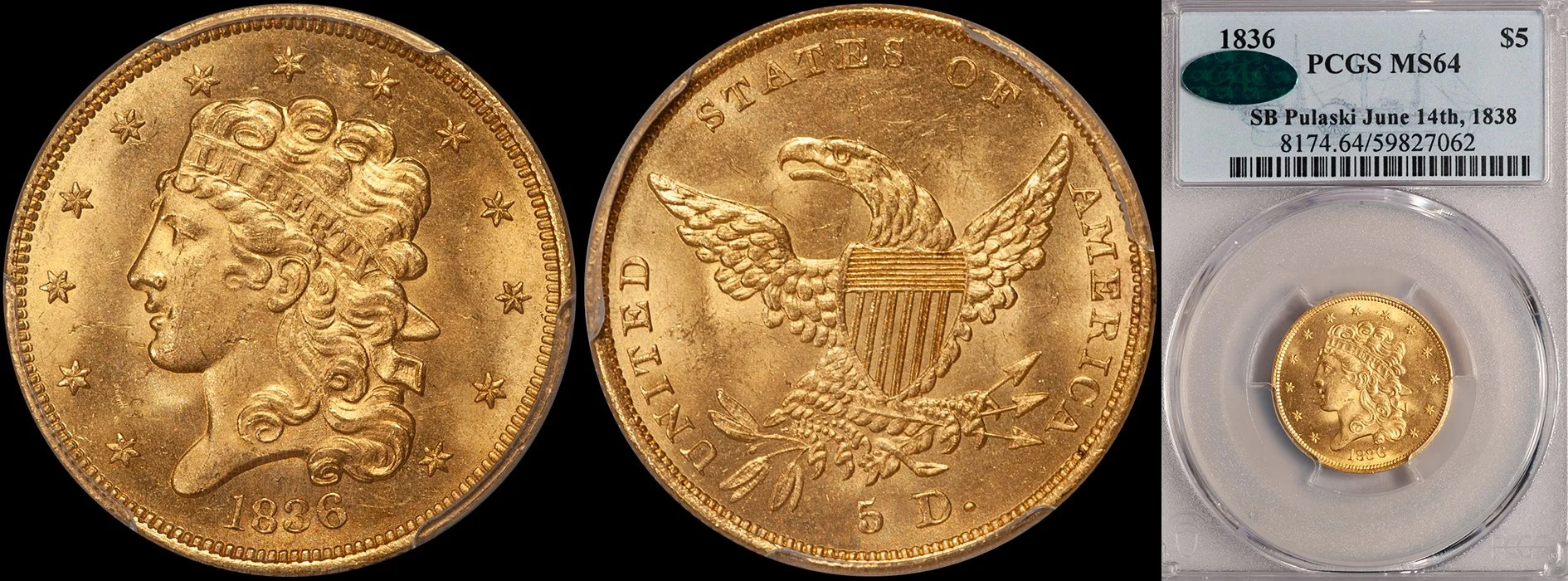
2. Classic Head Half Eagles in MS63 and MS64. I’ve already mentioned Classic Head quarter eagles in the first part of this article. I also like high grade Classic Head half eagles. In MS63 and MS64 this type is scarce and when these coins are nice they typically have great cosmetic appeal with lovely coloration and surfaces. Classic Head half eagles were made from 1834 to 1838. The commonest issues are the 1834 Plain 4 and the 1835. If you’d like an example of this design for type purposes, you are very likely going to buy an 1834 or an 1835 but the 1836 and 1838 are much scarcer and priced at just a 10-20% premium in the MS63 to MS64 range. Current price levels are around $11,000-12,000 for a nice MS63 and $18,000-20,000 for a nice MS64. Considering that a full Gem MS65, if available, will run around $60,000-65,000+, I think these MS63 and MS64 examples offer really good value.

3. Condition Census No Motto Issues: This area is a pretty narrow focus, I admit, but I think some of the best values in the entire coin market are in the $10,000-25,000+ Condition Census quality No Motto issues. This includes half eagles and eagles produced in the 1839-1866 era. I would throw the quarter eagles from this era into the mix as well. If you can find them, very high grade (in this case MS63 and higher) Philadelphia gold coins from the 1840’s and 1850’s seem like the best values in this area. The coins tend to be very well made, very attractive and genuinely rare in this grade. Given the fact that there are not many date collectors of these coins, they need to be viewed more as type issues. But it is hard to argue with their rarity in high grades, especially due to the fact that most smaller denomination Philadelphia gold coins struck prior to the Civil War are unknown in Gem and excessively rare even in MS64.

Some Thoughts on PCGS’ New Secure Plus Program

PCGS recently released the details on their new Secure Plus program. Instead of summarizing it here, I’d suggest that your go to their website and play the video link that will explain their interpretation of the new program. I’d like to share with you some of my thoughts and feelings about it. You can essentially split this new program down the middle and look at it as two distinct facets. To me, the “Secure” aspect is a no-brainer. In a nutshell, PCGS has basically harnessed the technology that will enable them to make a record of all the coins that are submitted to them under this new program. They claim it will end coin doctoring and stop gradeflation in its tracks.

As someone who has been pretty public in his disgust with coin doctoring for many years, I’m glad that PCGS is instituting this program. By the same token, it seems sad to me that a) this had to happen and b) that it took as long as it did. In some areas of the market, there are barely any “original” coins left. PCGS’ step is sort of like making a decision to preserve Bison in 1937: great idea but a little late in coming.

I have always partially attributed coin doctoring, to some degree at least, on PCGS and NGC. If these services had rewarded originality from the beginning and had been really, truly consistent this would have eliminated a lot of the doctoring that has occurred for the last twenty+ years. In the area that I specialize in, United States gold produced from 1795 to 1900, “bright and shiny” has always trumped “dark and crusty.” The irony here is that, finally, dark and crusty is becoming in style. After decades of coins being dipped, dunked, doctored and debilitated (catchy, no?) the coins with character that many people want are exceptionally hard to find.

While PCGS is not really publicizing this, I think the security aspect will be very important in their future efforts to fight counterfeit coins and holders coming in from China. I can’t possibly imagine that some clever guy in Shanghai isn’t already coming up with remarkably good quality early type coins or better date dollars. All it takes is a good distribution system for these to flood the market and by PCGS making it harder for these coins to make it through, that has to be a big positive.

One thing I am a little baffled about is what are we to make of the millions and millions of coins already graded by PCGS? Obviously, the nicest coins are going to be placed into the new Secure Plus holders. But what about the 1% or 2% of the coins that are outright mistakes? What about the coins that people, for whatever reason, decide not to resubmit/regrade? This is going to create a number of secondary markets and it will be certain to cause confusion.

The “Plus” aspect of this new PCGS service is more controversial, in my opinion. What the plus grades will do is to take an area that is already subjective and make them even more so. Now this isn’t necessarily a bad thing. PCGS is essentially decimalizing grading (a subject that I wrote about a number of years ago) and this is something that I believe that very good graders can do. But it puts a lot of pressure on PCGS (and NGC’s) graders to be very consistent and very accurate. Will a PCGS grader who is rushing through a cart full of coins to grade be able to figure whether an early type coin is a 63.8 and follow this coin up with a Saint that he has to determine if it’s a 65.8? It can be done but not easily.

The pricing of Plus coins is going to be very interesting. I’ve written extensively on how broken the price reporting mechanism in the coin market is and how badly it needs to be fixed. So, if we can’t accurately get the value for an MS63 Charlotte half eagle, how are we going to get the value for a 63+? And how consistently graded will the Plus coins be? Will one MS63+ Charlotte half eagle be a 63.7 while another is a 63.9? PCGS expects there to be sight-unseen trading for these coins so I’m hoping they will be graded with enough consistency for this to occur.

Getting back to the pricing issue for a second, it will be very interesting to see how the market values Plus coins in split grades where there is a huge difference in values. As an example, a common date Indian Head half eagle in MS64 is worth around $3,500. An MS65 is worth around $15,000. What does that make a 64+ worth? $4,000? $6,000? 9,000? Until there have been a few hundred Indian Head half eagles graded 64+ by PCGS and they’ve traded I’m not sure that will be a good answer.

It’s been sort of lost in the hype that NGC is working on a plan of their own. I am pleased that NGC is adopting the same plus system that PCGS is. Can you imagine how confusing it would be to have two different grading services using two different grading standards?

I’ve seen a lot of changes in the rare coin market in the last few decades and, for the most part, I’ve been an early adapter to those changes that I liked and believed in. I’m taking a bit of a wait and see approach with PCGS’ new system; mainly because I’d like to see a significant number of newly-graded coins. If I like the system, I will become an enthusiastic convert. But from what I can tell so far, these changes are being done with good intentions and they are destined to have a major impact in 2010 and beyond.

Are Auction Prices Wholesale or Retail?

Until a few years ago, the vast majority of coins that sold at auction were purchased by dealers. It was a safe bet to say that the prices realized at auctions were wholesale and collectors could assume that they would typically pay 10-20% more than what coins were selling for at auction. But this has all changed. One of the key elements to Heritage's rousing success in the coin auction business has been to make sales more collector-friendly. Today, a sizable amount of the coins that sell at auction are going directly to collectors. So, are auction prices now representative of the wholesale or retail markets? The answer is not as easy as you might think...

The answer is actually, as you might have, guessed, "answers." Nothing in the coin market is cut and dry anymore and the new auction market and the prices that coins fetch in an auction conducted in 2010 can have a broad range.

The first thing that has to be analyzed is what coin is being sold. If it's something that's extremely collector-friendly (like a rare date Type One Liberty Head double eagle) the price realized is likely to represent a retail level as it is likely to have been sold to a collector. If it's a widget or a low-end coin that sells cheaply we can assume that a bottom-feeder dealer bought it and the price it brought is clearly at the wholesale level.

The next thing that has to be gauged is the quality of the sale itself. One of the most amazing things about the Bass sales, in my opinion, was the fact that virtually all the coins were bought by dealers. If the Bass sales were to be held today (and conducted by a technologically savvy firm like Heritage) I would venture to guess that over 50% of the coins would be sold for retail as opposed to wholesale prices.

Is the coin in an auction a grading play? (In other words, is it an AU58 in an older holder that would upgrade to MS61 to MS62?) In this case it is a virtual certainty that the coin sold to a dealer. But there is an immediate asterisk that must be applied to the sales price. If the coin is worth $5,000 in AU58 and $13,000 in MS62, it is highly possible that at least two ramblin' gamblin' dealers would pay $10,000-11,000 for the coin. In such an instance, the collector needs to be careful not to assume that just because one AU58 coin sold at auction for $10,000-11,000, the next one(s) will as well.

Auction records are most useful when they occur with some degree of frequency (two or three examples per year) and when any anomalies can be discarded.

Let's say, for example, that a certain Charlotte quarter eagle in AU55 has sold at auction five times since 2007. The prices realized have been $3,500, $3,750, $2,650, $8,000 and $4,000. We can pretty much immediately boot the $8,000 auction record as we can assume that this was a severely under-graded coin with a large spread to the next highest grade(s). We can also boot the $2,650 record as this may have been for an extremely low end coin or it may have been in a "bloodbath" auction that, for a host of reasons, saw very low overall prices in specific areas of the market. This leaves us with three prices: $3,500, $3,750 and $4,000. A quick assumption can now be made that this AU55 Charlotte quarter eagle has a value in the range of $3,500 to $4,000. Another way of looking at this is that the wholesale value might be $3,500 while the retail value might be $4,000.

I have a theory that auction firms give collectors just enough information to do damage to themselves. They provide an archive of auction prices which show what coins have sold for and with a little bit of digging, the collector can determine if the coin sold on the floor, over the phone or to an Internet bidder. But unless someone really follows the market carefully, all of this "information" can do little more than serve as an easy way for the neophyte to make major mistakes. I have long said that hiring an auction representative for 5% is far and away the best value in all of numismatics. This fee (which amount to a whopping $250 on a $5,000 coin) is a small price to pay to have a specialist explain to you why a certain auction record is valid or not valid.

So 700+ words later, I'm back to my basic question: are auction prices wholesale or retail? As you can plainly see, there is no quick answer to this and I urge collectors, new or experienced, not to be lulled into a false sense of security based on what seems like unquestionable information.

America's Forgotten Rarities: The 1842 Quarter Eagle

In the second part of this series on coins that I believe are truly rare but not fully appreciated I am turning my focus on an issue that is very interesting to me: the 1842 quarter eagle. 1842 is, in general, an interesting year for quarter eagles. Four mints produced these coins: Philadelphia, New Orleans, Charlotte and Dahlonega. The mintage figures ranged from a low of 2,823 at Philadelphia to a high of 19,800 at New Orleans. With the exception of the 1842-O, all four are quite scarce in any grade and each is very rare in high grades.

Although it is not the most highly valued quarter eagle dated 1842 (that honor goes to the 1842-D), the 1842 is the rarest, both in terms of overall and high grade rarity. There are an estimated 35-45 known in all grades with most in the Very Fine to Extremely Fine range. I believe that there are six to eight in properly graded About Uncirculated and I think this date is unique in Uncirculated.

The most recent PCGS/NGC population figures show a combined total of fifty graded. This includes two in Uncirculated (more on these in a moment...) and eighteen in About Uncirculated. The population figures are, as usual, inflated, especially the AU coins listed by NGC.

This is generally a well made issue which shows good overall detail at the centers and borders. The luster tends to be semi-reflective but most 1842 quarter eagles are either worn to the point that they show no luster or they have been stripped and display little if any original surface. Most of the pieces I have seen have been abraded and at least a few are either damaged from having been scratched or show evidence of rim filing. The natural coloration is a bright yellow gold.

The finest known 1842 quarter eagle is a piece in a Midwestern collection that has been graded MS62 by PCGS. It first came to the market as Superior 9/99: 1863. I bought it for $31,050 and immediately sold it to a collector in Nevada. A few years later, when I handled the sale of his collection, I placed it privately with the Midwestern collection referenced above.

A few quick words about this PCGS MS62 1842 quarter eagle. I think this is one of the truly great Liberty Head quarter eagles of any date. No, its not a Gem. But it is so head and shoulders better than the next finest piece that it is an unbelievably important coin and certainly one of the less well-known but really significant pieces known from this era. Not to mention the fact that it is choice, original and very attractive as well.

There are two nice AU 1842 quarter eagles that come to mind. The first is ex Bass II: 340 where it was graded AU55 by PCGS and it sold for $13,800. I known that this coin subsequently upgraded to AU58 when it was sent to NGC; I am not aware what its current grade is. The other is ex Pittman II: 1736 where it was conservatively graded "XF" by David Akers. It sold for $12,100 and was later graded AU58 by NGC.

I believe that this date is extremely undervalued. The most recent Trends prices are $3,250 in EF40, $5,000 in EF45, $6,250 in AU50 and $10,000 in AU55. As befits a coin of this rarity in high grades, there is no published valuation over AU55.

A quick check of my records shows that I have handled a whopping three 1842 quarter eagles in the last five years with the most recent being a PCGS EF45 that I sold a few months ago to an advanced collector.

I doubt if this date will ever get the attention it deserves. Its a quarter eagle, its a Philadelphia issue and its too rare to ever promote. That said, the 1842 quarter eagle is a coin that I have great respect for.

1842 $2.50 PCGS EF40