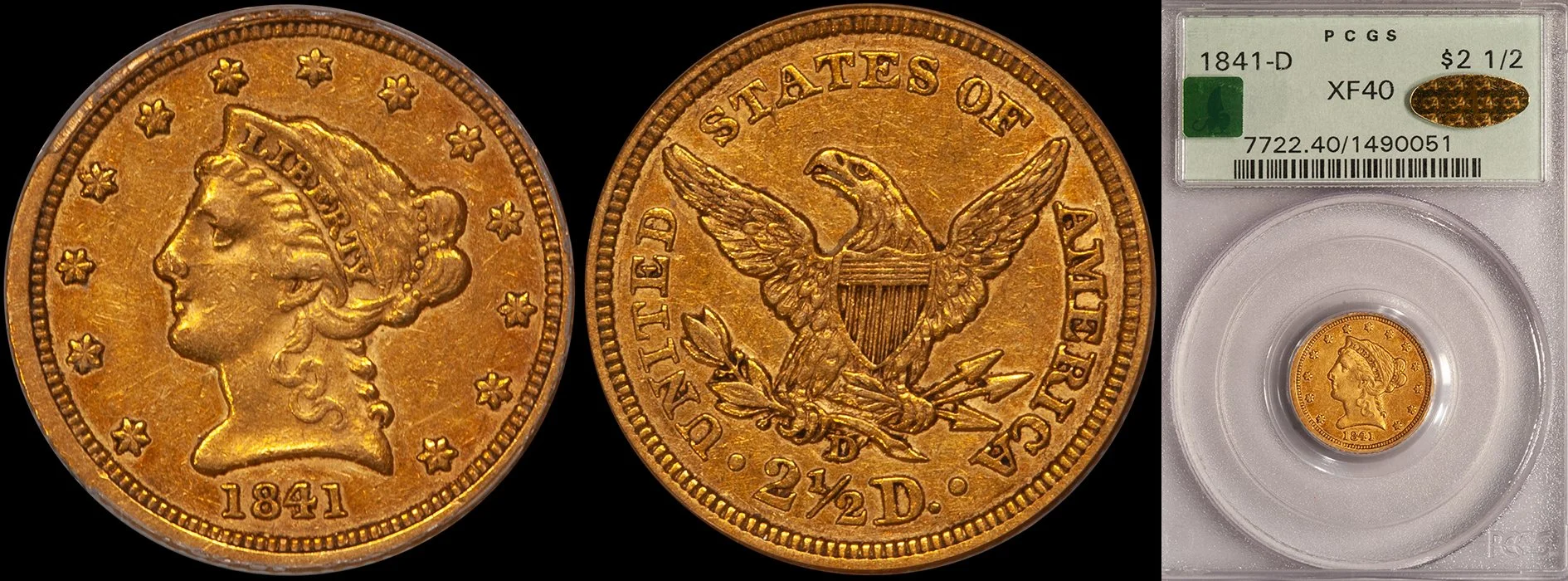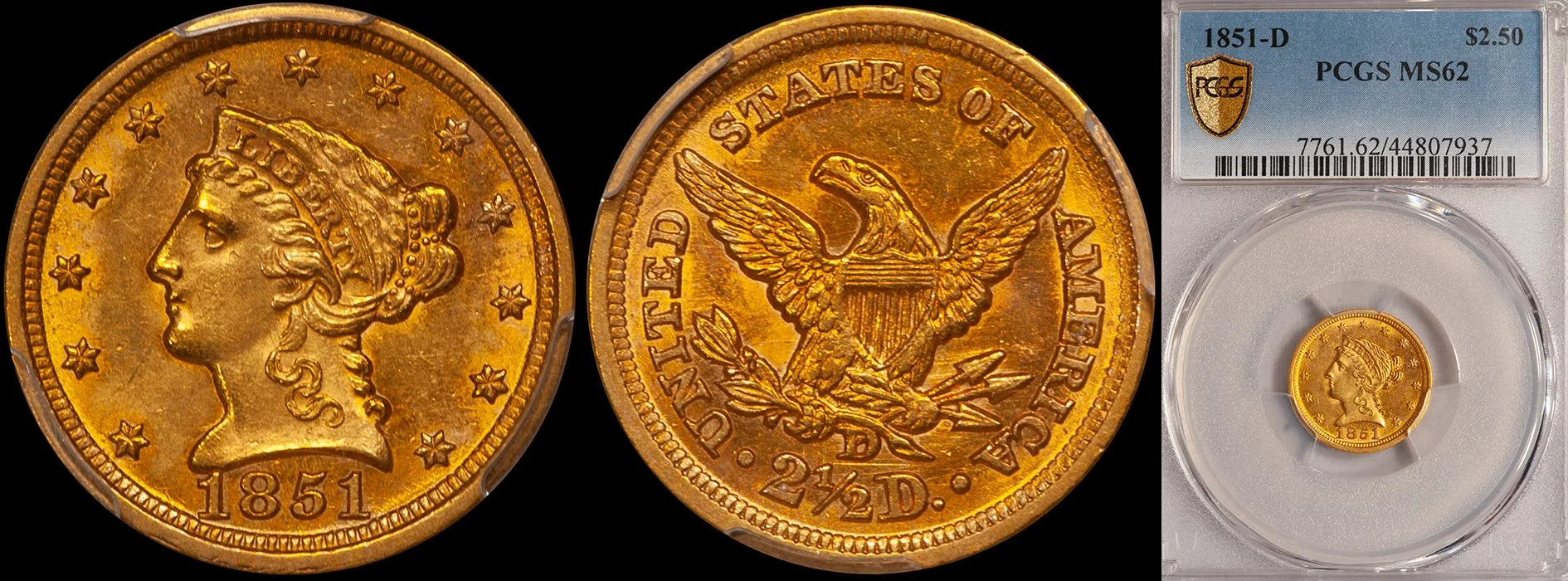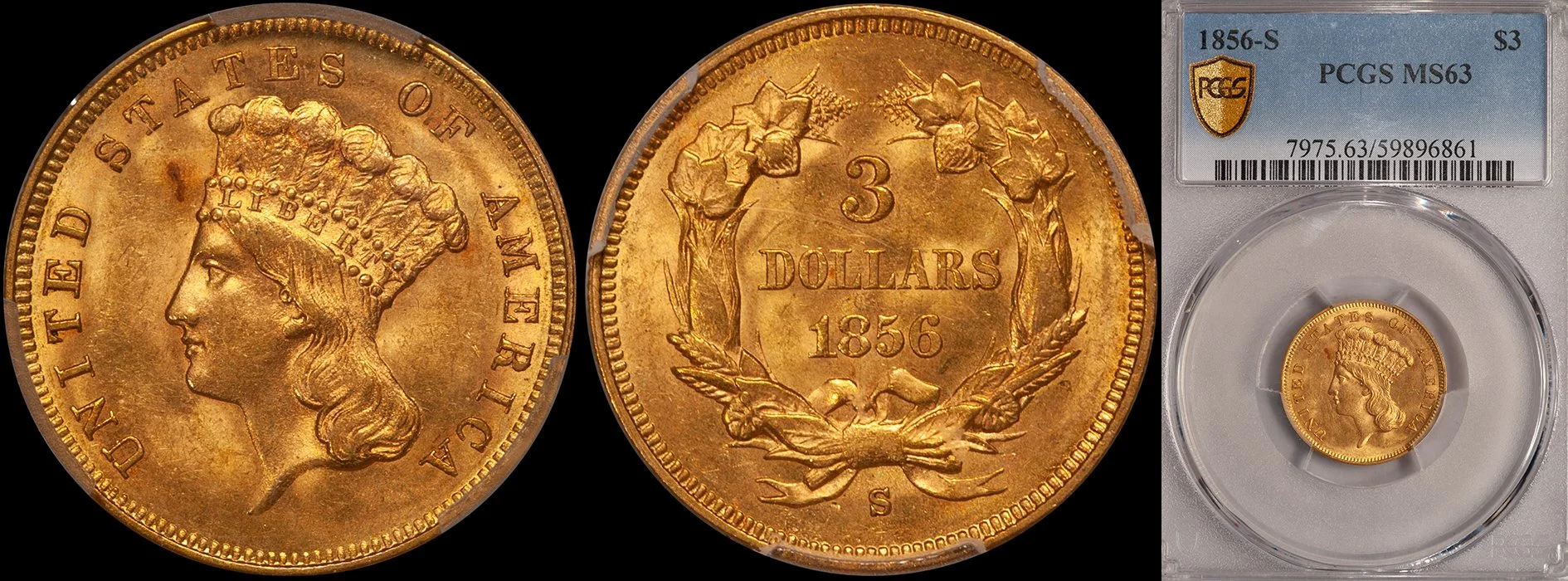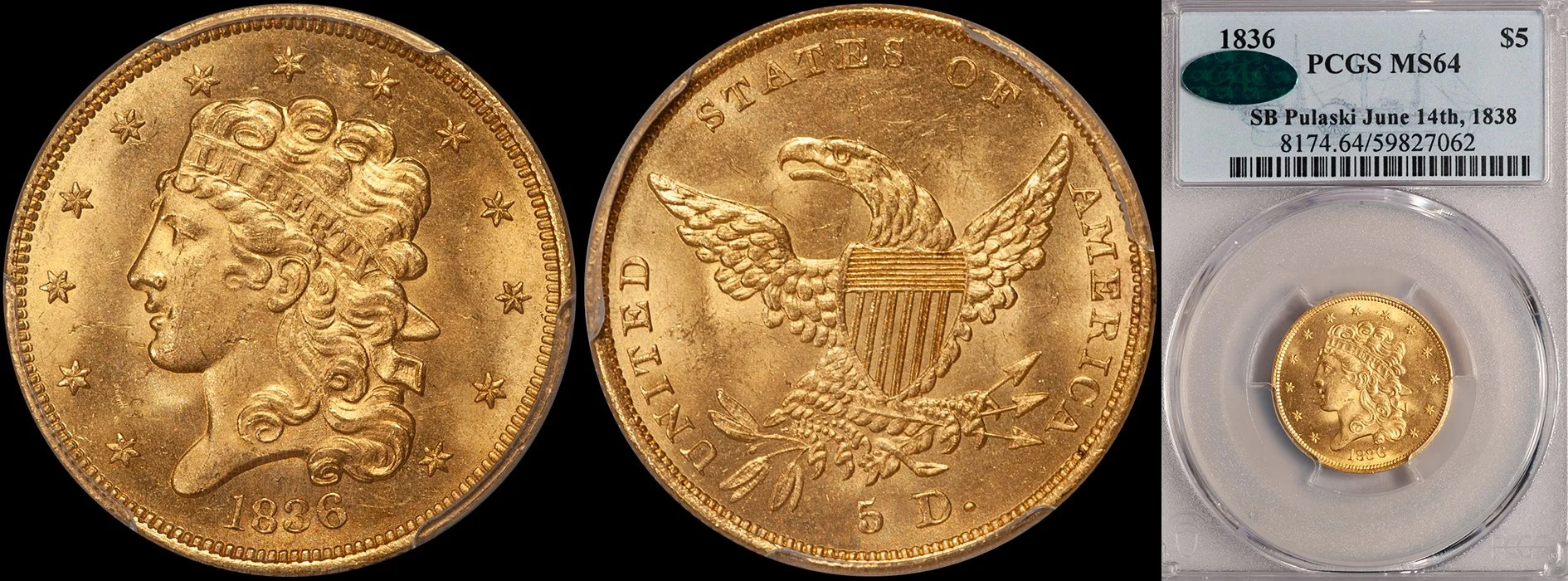
Proof U.S. Gold Coins

Proof Gold Coins - Mintage Figure Variance - While it is difficult to make sweeping generalizations about the survival rate of Proof United States gold coinage, some factors exist that help to determine the rarity of many issues. It is interesting to analyze these factors and apply them to the various denominations. For the most part, Proof gold coins have small mintage figures. With the exception of some of the later date Type Three gold dollars, most issues had fewer than 100 struck and nearly all of the pre-1880 issues have mintages of 50 or less.

As a good rule of thumb, it is a safe assumption that around half of the original mintage figure for a specific issue of Proof gold is known. In other words, if the original mintage of an 1876 gold dollar is 45 coins, it is likely that 20-25 are known today.

What are the factors that exist that make a Proof gold coin more or less common than its mintage figure would suggest? These include the following:

1. External Economic Factors: During hard economic times, Proof gold coins may have been melted or spent. As an example, in the Depression of the 1930’s, Proof eagles and double eagles were spent as they were not worth a significant amount above face value. Other periods of economic hardship that saw a reduction of Proof gold populations include the Civil War and the Reconstruction Era, the Depression of 1873-1878 and the Panic(s) of 1893 and 1907. I believe that this had a very large impact on Proof gold survival rates.

2. Coin Size: This actually works both ways. As mentioned above, during tough economic times, small coins are more apt to survive than large coins. But, a coin as small as a gold dollar is more likely to be “lost” than one as large as a double eagle. Both factors certainly contribute to survival rates of Proof gold.

3. Popularity of the Denomination: Although this is more speculation than fact, I would presume that denominations that have traditionally not been popular with collectors (gold dollars and three dollars) have been more susceptible to loss than more popular denominations such as eagles and double eagles.

4. Hoarding: Certain Proof gold issues were hoarded by contemporary dealers and collectors. This tends to inflate their survival rate. The Proof gold issues most affected by contemporary hoarding include gold dollars and three dollar gold pieces from the 1880’s. It is interesting to note that mintage figures for these two denominations reached record highs during this era; this was a direct result of contemporary speculator demand. 5. Restrikes: Not all Proof gold coins are as rare as their mintage figures would indicate. As an example, PCGS and NGC have combined to grade far more 1875 and 1876 Three Dollar gold pieces than the reported original mintage figures. While the slabbed population is clearly inflated by resubmissions, many collectors are not aware of the fact that the reported original mintage figures of 20 and 45, respectively, does not take into consideration a number of Restrikes that were produced by the U.S. Mint in order to placate collector demand for these two rare issues. Other years with potential Restrikes include 1865 and 1873.

6. Mint Melting/Mint Record Errors: Certain mintage figures for Proof gold coins just seem to make no sense. As an example, the reported mintage for Proof gold dollar and three dollar gold pieces in 1861 is reported to be 349 coins; the highest figure for these two denominations until the 1880’s. It has traditionally been assumed that the Mint was way too optimistic in producing Proofs this year and most were melted at the end of 1861 when they went unsold. I personally would not be surprised if these figures actually represented an error. Another year that has a skewed mintage figure is 1859, the first year of “modernity” for United States Proof gold. The Mint struck 80 examples of all gold denominations, in anticipation of strong demand in the booming new hobby of coin collecting. This proved to be way too optimistic and the vast majority was melted. Another “problem year” is 1910 which has much higher mintages than any other Indian Head design. I believe that the published figures are in error.

Given these six factors, how do they impact the specific denominations of Proof gold coins? My experience with each denomination is as follows:

Gold Dollars: The dates from the 1850’s and 1860’s tend to be very rare in all grades. However, the survival rate of these coins is much higher than expected with the exception of the 1859-1861 dates (whose inflated mintages figures were discussed above under Factor #6). The issues from the 1870’s typically have survival rates of around 50% of the original mintage. The 1880’s Proofs are a real anomaly. From 1884 to 1889, the mintages exceeded 1,000; a huge number of coins by Proof gold standards. But the survival rate is likely between 10 and 20% for each of these. I would ascribe this to numerous coins getting melted in the lean economic years of the early to mid-1890’s.

Quarter Eagles: With the exception of the famous 1841 and 1863 issues, virtually all pre-1870 Proof quarter eagles are extremely rare and most have fewer than ten survivors. The issues from the 1870’s tend to have survival rates of around 50% while the 1880’s and 1890’s seem to be a bit more available in terms of their original mintage. The 1900’s Liberty Head issues have survival rates as high as 75%. Indian Head quarter eagles have an average survival rate of 50% (+/- 10%).

Three Dollars: The issues from the 1850’s are extremely rare in Proof and all have low mintages. The 1860’s and 1870’s issues have average survival rates of around 50% (the exceptions to this are the 1860 and 1861 which had significant meltings) and the 1875 and 1876 (see Factor #5 above). The 1880’s dates mostly have survival rates in the 50-60% range.

Four Dollars: Stellas are really a separate story in and of themselves. Many of the 1879 Flowing Hairs were saved as souvenirs (see Factor #4) and Restrikes exist. The other three issues appear to have survival rates of around 50%.

Half Eagles: With the exception of the 1864 (which had a “whopping” mintage of 50), all No Motto half eagles in Proof are exceedingly rare. The With Motto issues from the 1860’s and 1870’s typically have survival rates of well under 50%; some issues (such as the 1870, 1871, 1874 and 1878) have survival rates that are probably less than 25%. With one or two exceptions, the dates from the 1880’s have also survived with less frequency than one might assume. Most of the 1890’s and 1900’s dates have survival rates of around 50% (+/- 10%). Indian Head half eagles are scarcer on a relative basis than their quarter eagle counterparts and I’d estimate that 30-40% of the original mintage exists.

Eagles: Virtually all No Motto eagles are exceedingly rare in Proof. The With Motto Proofs from the 1860’s and the 1870’s are all very rare and most have fewer than ten survivors. I have always found the Proofs from the 1880’s to be far rarer than most people realize and many of the specific issues (1881, 1883, 1885 and 1889 to name a few) have survival rates of fewer than 25% of the original mintage. The 1890’s are slightly more available (around a third have survived) while the 1900’s dates have survival rates of around 50%. Proof Indian Head eagles, with the exception of the 1908, range from very rare to extremely rare and have typical survival rates of around 25%.

Double Eagles: Only 265 Type One Liberty Head double eagles were made in the Proof format and I would be surprised if more than three to four dozen exist. The Type Two issues are also very rare with a total mintage of only 335 Proofs. They are more available on a relative basis than their Type One counterparts and I think somewhere between a quarter and a third of the original mintage has survived. The Type Three Proofs are the most available Liberty Head double eagles but this is misleading as only a small handful of dates (primarily those dated 1900 to 1907) have survival rates that exceed 30-40%. Proof St. Gaudens double eagles are extremely rare but they have a slightly higher survival rate that one might expect. My best guess is that around one-third of the original mintage exists.

Luster Pros and Cons

Luster - Pros and Cons - Gold coins basically come with three types of luster: satiny, frosty and prooflike. In this blog, I’m going to discuss these three “looks” and the pros/cons of each. I’ll also add an illustration of each look. And away we go... The most common luster seen on United States gold coins, especially those from the 19th century, is frosty in texture. Frosty luster can be extremely attractive. I would describe it to the new collector as having a “hard” look and it is most associated, in my experience, with coins produced at the Philadelphia and San Francisco mints.

1820_5_N62

Frosty luster is considered a “plus” by most collectors. Unfortunately, this sort of luster is becoming harder to find as more and more gold coins are chemically treated. Coins with original frosty luster have what I call a “wagon wheel” effect where the luster flows clockwise and appears to almost radiate out from the center of the coin.

Some of the series that are famous for having above-average frosty luster include the Fat Head quarter eagles and half eagles from the 1820’s and 1830’s, Classic Head gold, No Motto Philadelphia issues and Three Dollar gold pieces.

Another type of luster seen on United States gold coins is satiny in texture. Satiny luster tends to be less attractive than frosty luster but it can be very appealing. I would describe it to the new collector as having a “soft” look and it is often seen on branch mint coins from the 19th century and on San Francisco issues from the 20th century.

For the new collector, satiny luster is more difficult to understand and appreciate than frosty luster. This is due to the fact that it is more subtle in its appearance. As an example, the luster on the coin shown above is excellent in-hand and shows very few breaks in the fields. But most collectors would think this coin has a considerable amount of wear; due to its subtle luster and, obviously, the weakness of strike at the centers.

In my experience, satiny luster is more often seen on New Orleans issues, Civil War era gold and some of the Reconstruction era Philadelphia issues.

The third and final major type of luster is prooflike. When dies are readied for production they are polished and/or rubbed with a cloth in order to make them appear bright and “new.” This polish fades rather quickly and certain issues are almost never seen with mirror-like reflectiveness. As an example, I have seen very few Prooflike coins from Charlotte and Dahlonega and only a handful from New Orleans.

Generally speaking, 19th century gold coins with very low original mintage figures tend to have prooflike surfaces more often than not. As an example, the 1890 quarter eagle pictured above is an issue with a mintage of only 8,720 and it is often found with reflective surfaces. Some of the other types of coins that are sometimes seen with prooflike surfaces include Philadelphia Type Three gold dollars, Philadelphia quarter eagles from the 1870’s and 1880’s, Three Dollar gold pieces and Liberty Head double eagles from the 1890’s.

I personally have mixed emotions about prooflike gold coins. Due to the fact that gold is a soft metal, the surfaces tend to easily pick up marks, nicks and scratches and these tend to be strongly amplified by deep, reflective fields. Unless a Prooflike gold coin is a Gem, it tends to have a “scruffy” appearance and may have compromised eye appeal as a result.

There are two interesting subtypes of prooflike coins that the collector should be aware of. The first are coins that are Deep Mirror Prooflike. These are coins with especially reflective surfaces and a look that can be deceptively similar to that of a Proof. As an example, there are certain gold dollars from the 1880’s that are extremely hard to tell apart from Proofs. Generally speaking, many of the gold coins that are designated as Deep Mirror Prooflike by NGC command strong premiums, especially for issues that are generally seen with frosty or satiny surfaces.

The other subtype is semi-prooflike. A semi-prooflike coin, as one might guess, is a coin that has a blend of mirror-like reflectiveness along with either satiny or frosty luster.

As a gold coin collector becomes more sophisticated and sees more coins, he is likely to see pieces that have a wide variety of luster types. By becoming more familiar with these various types of luster, he will become a better coin buyer and better able to purchase coins that are choice and original.

Long Beach Report

The Long and Short of It - My short (but productive) stay at Long Beach means that my Long Beach report is going to be short (but productive). I didn’t arrive at Long Beach until Thursday afternoon and I was severely jet-lagged after having just returned from Japan. I had originally intended to totally skip Long Beach but a lack of coins meant that I had to try my best to quickly and efficiently restock.

After I landed and cabbed down to Long Beach, I called a few Trusted Suppliers and asked about the show. Their replies were nearly unanimous: it was a bear finding anything of interest and I was certain to be frustrated. My mood, as I headed down the freeway, was not good.

One thing that is good about being at a major show for just over a day is that you don’t have a lot of time to mess around. So as I hit the floor at Long Beach and began to scour I was very focused.

My day at Long Beach turned out to be amazingly productive. I was able to buy over thirty interesting coins; which is about triple the amount that I expected. I sold a few older, expensive coins that I was happy to move out and in the eight seconds that I was actually at my table, I had productive retail sales with new clients.

I spoke with a number of dealers about their Long Beach Experience and got fairly mixed reviews. One dealer told me he had an excellent show and the dealer that I share a table with had one of his more productive shows in some time. Other dealers I talked to told me that they had shows that ranged from fair to poor and most complained about a lack of interesting material (surprise, surprise). I’m not sure why I was lucky and found so many good coins other than the fact that I worked my little fanny off searching for them.

My take on the coin market is that it has clearly slowed down in the last month or so with the exception of very high end items. But there are some areas that remain strong across the board. Decent to nice early gold is in strong demand and choice, interesting Seated Liberty coinage (which I’ve been begging people to buy for about ten years...) is blazing hot.

In the realm of dated gold, I’ve noticed that nice quality Dahlonega gold is virtually impossible to find right now; my current inventory is virtually non-existent. Charlotte seems to be perking up a bit (in anticipation of my new book?) and I noticed a few mid-five figure Charlotte coins selling at Long Beach. Carson City half eagles and eagles are very strong, especially Registry Set quality issues. New Orleans gold continues to be hard to find and with the exception of the odd coin here or there, I have noticed a real shortage of high quality, interesting material since the beginning of the year.

What’s not selling right now? Anything that isn’t regarded as being, at the very least, medium to high quality for the grade. And generic gold....well let’s just say generic gold isn’t exactly a big seller right now.

My guess is that the Baltimore show will be decent but not great. This is the one Baltimore show that many West Coast dealers traditionally miss but the caliber of this show is now such that even the least interesting of the three Baltimore shows is still better than the most typical conventions.

How To Collect Charlotte Gold Coins

There are many ways to collect Charlotte gold. Some people have only a mild interest in these coins and may buy just one or two pieces. Other people are more serious and they have a large number of Charlotte issues in their collection. A small number of Charlotte collectors are obsessives who focus exclusively on these pieces and do not collect anything else. I would like to make some suggestions on how to collect Charlotte gold. In my experience, all of these ideas have merit and none is “better” than the other. It depends on the tastes and budget of an individual collector to determine which one(s) is right for him. I. THE INTRODUCTIORY THREE COIN SET

The most basic way to collect Charlotte gold is to purchase a single example of the gold dollar, quarter eagle and half eagle denominations. This is a very good way to collect for the individual who has a limited budget or who is not certain how deep his interest lies in Charlotte gold.

A basic three coin set of Charlotte gold should consist of nice, problem-free pieces. It would make sense to focus on the more common dates although some collectors might prefer to include some scarcer issues. The grade range for these coins is likely to fall in the Extremely Fine-40 to About Uncirculated-58 range.

The 1851-C is the most logical choice for the gold dollar in this set as it is the most common and affordable date. A pleasing Extremely Fine can be obtained for $1,500 or so. About Uncirculated pieces range from $1,750 to $3,500 depending on quality.

The optimum quarter eagle for this set is the 1847-C as it is the most common date of this denomination from Charlotte by a large margin. A nice Extremely Fine example costs around $2,000 while About Uncirculated coins range from $2,500 to $4,000. It is possible to upgrade to a much scarcer date without paying a substantial premium. As an example, the 1843-C Large Date sells for around the same price in Extremely Fine as does the 1847-C but it is much harder to locate.

In About Uncirculated, the 1847-C used to be much less expensive than all other Charlotte quarter eagles but the price spread has diminished in the last few years. This, in my opinion, makes dates such as the 1843-C Large Date, 1848-C and 1858-C very interesting alternatives, especially in the lower range of the About Uncirculated grades.

There are many dates in the half eagle series that would work well in this type set. These include the 1849-C, 1852-C, 1853-C and 1858-C. Any of these can be purchased in nice Extremely Fine for around $2,500 while About Uncirculated coins are priced in the $3,000-6,000 range.

An alternative to the standard three coin set would be to purchase the same date for all three denominations. This is feasible for issues dated 1849-C, 1850-C, 1851-C and 1852-C. A set from 1855 could also be assembled but the gold dollar and the quarter eagle from this year are quite expensive in higher grades.

II. THE BASIC AND EXPANDED TYPE SETS

A type set of Charlotte gold coins includes one example of each major type struck at this mint. Such a set includes the following:

  • Type One gold dollar (1849-1853)
  • Type Two gold dollar (1855 only)
  • Type Three gold dollar (1857 and 1859)
  • Classic Head quarter eagle (1838-39)
  • Liberty Head quarter eagle (1840-1860)
  • Classic Head half eagle (1838 only)
  • Liberty Head, obverse mintmark half eagle (1839 only)
  • Liberty Head, reverse mintmark half eagle (1840-1861)

A total of eight types were struck at the Charlotte mint. This includes three that were struck only in one year. A complete eight piece type set is an excellent display item. The various designs used in striking these coins provide a graphic illustration of the artistic and historic record of the Charlotte mint.

Most collectors who assemble an eight piece Charlotte type set do so in grades ranging from Extremely Fine-40 to About Uncirculated-58. This set could be completed in Uncirculated but it would be very difficult to do given the rarity of the 1838-C Classic Head half eagle in Mint State.

The coins that are included in a Charlotte type set are generally the more common dates. Some collectors use better dates in order to make their sets more interesting and potentially more valuable. I would strongly recommend that the collector include at least a few better dates.

A nicely matched Extremely Fine set should cost approximately $25,000-30,000. The most expensive coins in the set are the 1838-C half eagle, the 1839-C half eagle and the 1855-C gold dollar.

A set that consists of all eight coins in About Uncirculated-50 to About Uncirculated-58 can be assembled for approximately $50,000-100,000+. The cost could be significantly reduced if the Type Two gold dollar and the 1838-C and 1839-C half eagles were nice Extremely Fine coins as opposed to About Uncirculated-50 or better.

III. COLLECTING BY DENOMINATION

Each of the three denominations struck at the Charlotte mint are popular with collectors. For various reasons, some of which will be discussed below, some collectors feel an affinity towards a specific denomination.

Collectors generally love or hate the gold dollar. The small size of this coin (13 or 15mm. depending on the type) sharply divides the collecting community. Some collectors find it hard to fathom paying thousands or even tens of thousands of dollars to pay for a coin that is the size of an average adult’s thumbnail. Another negative factor about Charlotte gold dollars is the crudeness with which they were struck. If you are not a specialist it may be tough to “get” a coin that is this crude.

The reasons that cause some people to dislike gold dollars are the same reasons that other people like them. Their crudeness has an odd allure and their small size gives them a distinct charm.

Collectors also like gold dollars because of their low mintage figures. With the exception of the 1851-C, each issue from Charlotte has an original mintage figure of 14,000 or less. Four of the eight have mintages lower than 10,000.

On a coin by coin basis the Charlotte gold dollar series is relatively affordable. A set of eight coins in Extremely Fine should be completable for approximately $20,000. Every Charlotte gold dollar can be found in About Uncirculated grades without great difficulty. The only obstacles to completing a set in this range are available funds and the level of fussiness that a collector brings to the set. Figure on spending $35,000-40,000+ for a mid-range About Uncirculated set and double this amount for a very high end About Uncirculated set.

A complete set in Uncirculated could be assembled but it would be difficult due to the rarity of the 1855-C and 1857-C. Assuming that these two issues are available, a complete set in Mint State-60 to Mint State-63 could be assembled for $100,000-150,000+.

The Charlotte quarter eagles are the most challenging of the three denominations. Assembling a set of these requires patience and dedication. Many are very rare in higher grades. Others have peculiarities of strike that make it hard to find pieces with good eye appeal. The rarest Charlotte quarter eagles are the 1842-C, 1843-C Small Date, 1846-C and 1855-C. These are hard to find in all grades and rare in properly graded About Uncirculated.

There are a total of twenty issues in the Charlotte quarter eagle set. This includes two varieties from 1843: the Small Date and the Large Date. No quarter eagles were produced at this mint in 1845, 1853, 1857 and 1859.

It is a realistic goal to complete this set in Extremely Fine grades. The cost of such a set would be in the area of $55,000-65,000. In About Uncirculated this set is still realistically completable but assembling an attractive, well-matched set requires time and patience. It is not unrealistic to set aside a budget of as much as $250,000 for a world-class About Uncirculated set for choice, high end coins with original surfaces. Completing a set of Charlotte quarter eagles in Uncirculated is possible but exceptionally difficult. There are a number of issues such as the 1839-C, 1842-C, 1848-C, 1849-C and 1856-C that have extremely few truly Mint State pieces known to exist.

A complete set of Charlotte half eagles consists of twenty-four coins. This includes two varieties struck in 1842 (the Small Date and the Large Date) and none in 1845.

The half eagles are the most popular denomination from this mint. One of the reasons for this has to do with the relatively large size of these coins. Another has to do with the fact that every issue except for one (the rare 1842-C Small Date) is reasonably easy to obtain in the higher circulated grades.

A set of nice Extremely Fine Charlotte half eagles should cost in the neighborhood of $100,000-125,000 with a good chunk of this set aside for the 1842-C Small Date. A complete set in About Uncirculated is challenging but less difficult than for the quarter eagles. A set of well-matched, original Charlotte half eagles in About Uncirculated would require a budget of approximately $200,000-250,000+. Completing a set in Uncirculated is very difficult but not impossible. The stoppers in this set include the 1838-C, 1840-C, 1842-C Small Date, 1846-C and 1854-C.

IV. ASSEMBLING A COMPLETE SET OF CHARLOTTE GOLD

Some collectors get hooked on Charlotte gold and decide to assemble a complete set. A complete set of Charlotte gold is generally understood to contain the following:

  • Gold Dollars: A total of nine issues struck between 1849 and 1859. One of these, the 1849-C Open Wreath, is excessively rare with just four or five known to exist. Because of its rarity, it is not included in most sets but it is still regarded as an important member of the Charlotte series.
  • Quarter Eagles: A total of twenty issues produced between 1838 and 1860.
  • Half Eagles: A total of twenty-four issues struck between 1838 and 1861.

The final cost of assembling a complete set of Charlotte coinage (minus the excessively rare 1849-C Open Wreath gold dollar) is within the reach of many collectors. A set that focuses on nice Extremely Fine coins would cost approximately $200,000. A set that consists of nice About Uncirculated coins would cost anywhere from $600,000 up to $800,000+.

Due to new discoveries and relaxed grading standards it is now possible for a collector to assemble a complete set of Charlotte coins in Uncirculated grades.

To the best of my knowledge, no collector has assembled a totally complete set of Charlotte gold in Uncirculated. I know of at least two or three collectors who have assembled the complete set (including the extremely rare 1849-C Open Wreath gold dollar) but none of these have contained Uncirculated examples of this variety.

The finest collections ever assembled of Charlotte coins include the Stanley Elrod collection (sold privately in 1994 and now, unfortunately, split into numerous parts), the Paul Dingler collection (which included the only known complete set of Mint State Charlotte quarter eagles and half eagles; it was purchased by Heritage Coin Galleries and myself a few years ago) and the William Miller collection (sold by Heritage at auction in 1999).

Collecting 'Transitional' Coins

Throughout the history of gold coin production in the United States there have been a number of instances where two different designs were produced simultaneously, or at least within the same year. I call these “transitional” coins and I think they would make for a very interesting collecting focus for the gold coin specialist.In the gold dollar denomination, the most obvious transitional issue occurred in 1854 when both the Type I and the Type II issues were produced. Both of these are relatively common although the Type Two becomes scarce in the higher grades and rare in MS64 or better. In 1856 two designs were produced: the Type Two and the Type Three. Since the Type Two was only made in San Francisco this year and there are no 1856-S Type Three gold dollars this isn’t a transitional issue in the sense of the 1854. There are some very interesting transitional issues in the quarter eagle denomination. In 1796 both No Stars and With Stars designs were produced. Both of these are rare in all grades and because of price constraints they would be considered one of the stoppers of a transitional set. The next transitional issue occurred in 1834 when both the Capped Bust and the Classic Head quarter eagles were struck at the Philadelphia mint. The former is an extremely rare coin in all grades while the latter is common in grades up to and including MS63.

More transitional issues exist in the early half eagles than in virtually all other denominations combined. The reason for these transitional issues tends to be different than, say, for the 1854 Type One and Type Two dollar when the design was changed to facilitate improved striking.

There are two types of half eagle dated 1795: the Small Eagle reverse and the Large Eagle reverse. The former was actually produced in 1795 and it is relatively common. The latter was struck in either 1797 or early 1798 using a backdated obverse die. Only 1,000 or so 1795 Large Eagle half eagles were made and this clearly would be one of the stoppers to a transitional set.

A similar circumstance exists with 1797 half eagles. Small Eagle reverse coins from this year are known with both fifteen and sixteen stars on the obverse. These are very rare but not impossible to locate. There are also 1797/5 half eagles with the Large Eagle reverse. These are extremely rare and include two die varieties that are presently unique and housed in the Smithsonian.

Another transitional year occurs in 1798. A small number of half eagles (probably no more than 400-500) were made using the Small Eagle reverse. This is a very rare coin today with only seven or eight examples known. The more common 1798 half eagles have the Large Eagle reverse. These are moderately scarce in terms of overall rarity but they can certainly be found with much greater ease than their Small Eagle counterparts from this year.

Yet another transitional year for half eagles occurred in 1807. This is a direct result of a design change. The first issues struck this year had the Heraldic Eagle reverse while the latter issue employed the new Capped Bust obverse and John Reich’s new reverse. Both of these issues are relatively common in all grades up to MS63.

1834 saw another design change in the half eagle denomination and the transitional collector has two issues to focus on: the rare Capped Bust (or “Fat Head”) and the more common Classic Head. The Capped Head is found with two varieties (the Plain 4 and the Crosslet 4) as is the Classic Head. Interestingly, on both design types the Crosslet 4 is significantly rarer.

The next transitional half eagle occurs in 1866 when the San Francisco mint produced coins with and without the motto IN GOD WE TRUST on the reverse. Despite having a much lower mintage, the No Motto coin is actually comparable in overall rarity to the With Motto issue. Both are very rare in the higher AU grades and virtually non-existent in Uncirculated.

The final transitional issue in the half eagle denomination occurred in 1908 when the design changed from the old Liberty Head to Bela Lyon Pratt’s new Indian Head design. Both of these issues are very common and the transitional collector with a virtually unlimited budget could aim as high as MS66.

In the early eagles there is only a single transitional year: 1797. The first 1797 eagles used the Small Eagle reverse. Only 3,615 were struck and around five to six dozen are known. This issue is typically seen in circulated grades and it becomes extremely rare in anything approaching Mint State.

Later in the year, the new Heraldic Eagle design was first used on this denomination. Slightly over 10,000 examples were produced and this is a relatively available coin, although it is very rare in grades above MS61 to MS62.

One of my favorite pair of transitional eagles are the two types of 1839. The first, also known as the Type of 1838, is easily distinguished by Liberty’s neck being very curved and ending over the right side of the final star. It is the more common of the two and while relatively available in most circulated grades, it is very scarce in AU55 and better and rare in Uncirculated. The second variety is known as the Type of 1840. On this issue, Liberty’s neck is less curved and it ends well before the final star. It is very scarce in all grades and rare in AU.

In 1866, the San Francisco mint was not informed of the changeover to the With Motto reverse until they had struck 8,500 pieces with no motto. The 1866-S No Motto eagle is a rare coin in all grades today. The With Motto variety is also rare although it is a bit more obtainable in the AU grade range. Both are unknown in Uncirculated.

1907 saw a changeover from the Liberty head design to the new Indian Head design. The transitional collector has some difficult decisions about which coins to include in his collection as three major variations of the Indian Head eagle from 1907 exist: the rare Wire Edge, the very rare Rolled Edge and the common No Motto.

In 1908 there are no less than two transitional Indian Head eagles. The Philadelphia and Denver mints both struck No Motto and With Motto coins. Luckily for transitional collectors, all four of these are relatively common except in Gem Uncirculated. The 1908-D No Motto is the rarest of the four and this issue is extremely rare in properly graded MS65.

The United States twenty dollar gold coinage contains more interesting transitional coins for the specialist. The first of these is the 1866-S No Motto and With Motto. The former is a very scarce coin in all grades and it remains unknown in Uncirculated. The latter is fairly common in circulated grades and scarce in Uncirculated with nearly all of the two to three dozen known in Uncirculated grading MS60 to MS61.

The termination of the Liberty Head design in 1907 meant that an interesting group of transitional coins from this year are available. The 1907 Liberty Head issues were produced at the Philadelphia, Denver and San Francisco mints and all three are common in grades up to MS63. The 1907-S is very rare and underrated in Gem Uncirculated.

Augustus St. Gaudens’ redesign of the double eagle was introduced in 1907. Most transitional collections would include one High Relief from this year as well as a 1907 No Motto. Both issues are readily available in Uncirculated grades and the latter is abundant even in MS65 to MS66.

To assemble a complete set of the various Transitional coins that I discussed above would be an amazing accomplishment, given the rarity and prohibitive cost of many of the issues. That said, I think this would be a great set that would be a fun challenge for the collector who is up to it.

12 Undervalued United States Gold Coin Collecting Areas Priced Below $2,500

Sure, every gold coin collector would love to have an unlimited budget. But few do. Is it possible to be an individual of average or slightly above-average means and still be a collector of U.S. gold? I contend that the answer is a resounding "yes" and I'd like to suggest a dozen collecting areas that are priced at $2,500 or less. My basic parameters are that each is undervalued, interesting to collect and they can be found with some patience. Instead of focusing on specific issues (which, for the collector, can be like finding a needle in a haystack) I'm going to be a bit more general and focus on small groups or subsets of coins. Not every date within this group may be of interest to the collector (or fall within the parameters of affordability that we have established) but enough will qualify to make them worthy of serious consideration.

Read More

The Dilemma of the Placeholder

If you collect a set (or sets) and are competing in the Set Registry, the chances are good that you’ve struggled with the Dilemma of the Placeholder. Let’s examine the Pros and Cons of buying a placeholder coin and try to decide whether this is a smart collecting strategy or not. First off, let’s define what a “placeholder coin” is. I view a placeholder coin as one that you buy as a stop gap. As an example, say that you are assembling a set of Indian Head eagles. One of the few dates that you are missing is a 1911-D. One comes up for sale at auction in a grade lower than what you really want. You decide to buy it anyway because of the fact that it a) fills a gaping hole in your set and b) gives you a sufficient number of Registry Set points that you move up a notch and pass Collector X. Was this is a smart purchase or not?

Let’s look at the pros of buying a placeholder coin. The first is the measure of satisfaction that filling a really nagging hole can give. There is nothing more frustrating for our hypothetical collector than seeing a big ol’ ugly blank every time he looks at his set inventory - especially if he has a nice date run before and after the missing coin. Coin collecting is a very emotional hobby and the Karmic Value of filling a hole is hard to put a value on.

Another pro is the fact that a placeholder coin might grow in appeal on the owner. I’m going to assume that as a collector you are smart enough to not buy something truly hideous and to at least hold out for a moderately attractive placeholder. You might learn that your placeholder is actually so rare that it represents the only coin that you are likely to have a shot to buy.

For some collectors a placeholder coin represents a practical decision. Let’s say for example that you are assembling a gold type set from the 19th and 20th centuries and that you don’t have the ability to spend $100,000+ on a nice 1808 quarter eagle. In this case, a decent looking coin in, say, an NCS holder with EF sharpness but with signs of an old cleaning at $40,000-50,000 might be a savvy purchase; especially given the fact that an uncleaned 1808 quarter eagle in this price range might take years and years to locate.

For every pro there is a con, so now let’s look at the cons of buying placeholder coins. To my way of thinking, the biggest con about a placeholder coin is the fact that you know you are going to have to replace it. Unless the market goes up in your series, you are probably going to lose money on it when you sell it. Let’s say, for example, that Collector Z buys the mythical 1911-D eagle we discussed above. He purchases one for $10,500 that’s decent but not really a great looking coin due to the presence of some marks on the obverse. A year later he finds the right coin and it’s going to cost him $27,500. Unless Collector Z has a buyback or “trade up” agreement with the dealer he bought it from he’s probably going to take a 10-15% hit on the coin. Let’s say he’s sells it at auction and nets $9,250; a loss of $1,250. This brings the actual cost of his new coin to $28,750.

Another con about collectors buying placeholder coins is that it teaches them bad collecting habits. I’m a big believer in buying the right coin the first time. I’ve seen some collectors “self-churn” themselves as they buy a 1911-D eagle first in MS61, then upgrade to an MS62 then upgrade to an MS63 and so on. As I just mentioned above, there are transaction costs that will hit you in the wallet every time you upgrade. It also flies in the face of something that I try to teach new collectors: be patient and wait for the right coin. The Coin Gods like to play games with impatient collectors and I can’t tell you the number of times I’ve seen a collector settle on an inferior coin only to have the absolutely perfect coin come along a week, a month or a year later.

So, the bottom line: placeholder coins, yes or no? I’d say in the majority of cases “no”. The exception would be if you are buying something that is so readily liquid and has a tight enough buy/sell spread (a coin like a $50 Pan-Pac Round) that even a short-term hold isn’t likely to have negative impact on its value.