2008 Central States Show Review

In my last blog, I predicted that the Central States show in Rosemont would be active. How did the show turn out and what are my current impressions of the market? Read on for all the answers...and more. After a lack of shows for over a month I knew that there would be a strong demand for nice coins and I was right. Every dealer I spoke to at the beginning of the show told me that they literally had to be three places at once to get a shot at the fresh coins that were available. For someone like myself who does coin shows without assistants, partners, lackeys or go-fers it can be very frustrating to try and buy coins, view auction lots, answer emails, make phone calls and more - often all at once. I can’t ever remember a time when I’ve had to work harder to buy!

I arrived in Chicago on Tuesday and began buying literally as soon as my plane touched the ground. Wednesday was PNG Day which meant that only a limited number of the table holders could set up. I got to wear some spiffy clothes and I got to focus exclusively on wholesale business which, for better or worse, is what shows are really about right now (I’ll explain a little bit more about this statement in a second).

There were a few very interesting deals that broke at the show. I was able to buy some nice early gold coins from an outstanding collection of pre-1834 gold that a West Coast dealer was selling. This was the sort of deal that usually sells at auction (all the coins were in old holders and many were significantly undergraded) and I believe that virtually the entire deal sold to the first three or four people who viewed it. I also heard about a neat collection of Bust Quarters by die variety that sold (I was able to buy a few leftovers from the dealers who handled it) and I was impressed that the collector who owned it didn’t place it in auction.

After lots of running around, I was able to assess what I had purchased and I was pretty impressed. I thought this Central States was the best buying show that I have had since last year’s ANA and I was able to purchase over fifty new coins and I spent north of $1 million in a few hours of frenzied buying. I have already listed many of my new purchases for sale on my website and some of the highlights are as follows:

  • A choice 1861-C $5.00 in PCGS AU58
  • A nice group of New Orleans eagles ranging in price from under $1,000 to over $10,000
  • A superb 1799 half eagle in NGC MS61
  • An 1812 half eagle in PCGS MS64
  • The Garrett 1886 $3.00 in NGC PR63CAM

I was also able to buy a couple of excessively rare coins (that I can’t mention here) for long-term clients whose want lists I have. I admit that I’m not as great at working want lists as I should be (again, this goes back to not having enough help at coin shows) but I will say this: if I know that you are looking for a special coin and we have a good relationship, the chances are a lot better that you will get a shot at this coin than if I have no idea what you are looking for (or who you are).

Thursday was a day that began with me focusing on selling some of the older coins that I had in inventory. I took a group of twenty or so coins around in a box, showed them to three dealers and sold 85% of the group with relatively effort; in many cases for the same amount of money that I had been quoting collectors on my website. My take on selling? It was very easy if you had nice coins.

I thought that the retail aspect of this year’s CSNS show was pretty disappointing. Granted, I didn’t have a great table location and I was away from the table 75% of the time as I was out buying coins. But it seemed that there wasn’t a great “retail buzz” and I only met a few new potential clients.

As I mentioned above, I am noticing that coin shows are more and more about buying and wholesale business. In a market like this when it is hard to buy and easy to sell, a coin show is a brutally competitive environment for specialist dealers. I don’t have the luxury of the mega-dealer who just sits at this table and wades through boxes of other dealer’s coins. And I don’t have the desire to spend four or five days at a show like I did a few years ago. Shows are now extremely intense two or three day affairs for me and I find it hard to spare fifteen minutes out of my limited time to schmooze with a collector who wants to view a coin. I would much rather sell coins to collectors from the saner environment of my office where I do actually have the time to discuss things. The one exception is at the larger shows like ANA and FUN where I am committed to staying for the entire week and don’t have to do four things at once for two days.

I’m sure you’re wondering what was hot at the show and I’m sure that my answer won’t surprise you. There were a number of dealers looking for early gold and Proof gold, particularly coins that were choice or rare. I sold a number of interesting double eagles at the show and that market seems as robust as ever (with the exception of generic Saints which you can’t give away right now..) I also noticed a renewed interest in Three Dollar gold pieces and I was surprised to sell a few Charlotte coins that had been languishing in my inventory for a while. The areas of the market that seemed slow included generic gold, commemorative gold and nearly anything that is ugly or has been recycled through thirty dealers in the past year.

Interestingly, there are no more shows for close to a month and most dealers will be staying at home until Long Beach at the end of May and Baltimore at the start of June. It will be interesting to see how this lull in the action affects the market.

2008 Central States Show Preview

The 69th annual Central States Numismatic Society convention will be held in Rosemont, Illinois next week. What’s the buzz surrounding this show and are coin dealers excited about attending it? I regard the Central States show as one of the better coin conventions of the year. It’s not quite at the Summer ANA or FUN levels in terms of attendance or importance but I’d rank it up in the second tier along with the Baltimore shows, Long Beach and one or two others. Most dealers I know like this show and approach it with a good degree of enthusiasm.

I think this will be a good CSNS show for a variety of reasons. The first is the location. Chicago is traditionally a good coin show town and the convenience factor of Rosemont (which is about five minutes from O’Hare airport by cab) makes this a much better venue than some of the more recent Central States shows. Secondly, most coin dealers have not been to a major show since Baltimore in early March. Being home for over a month means that there will be a good deal of pent-up demand for coins. The third reason is that the coin market remains strong and this includes a better precious metals market than at any Central States show since the early 1980’s.

I go to coin shows primarily to buy and, as usual, I’m hoping that I can uncover a few interesting coins on the bourse floor at Central States. I’ve spoken with many of my suppliers and while no one is holding a collection of Carson City eagles in first generation PCGS holders for me, I think a few neat items may come out of the woodwork.

What will be in strong demand at this year’s Central States? I’m sure you’ll be absolutely shocked to hear me say this but most coin dealers at Central States are going to be scouring the bourse floor looking for nice coins. If you were to walk into the show with a group of choice, fresh, attractive coins and price them “right”, the chances are good that you would sell most—if not all—of your coins within an hour.

To be more specific, I think some of the areas that will experience strong demand include Proof gold, early gold, 19th century type coins and anything that is genuinely rare.

In my opinion, the CSNS auctions are interesting but they lack the impressive array of gold coins that have been included in past sales. I am quite interested to see Heritage sell the David Quellar specimen of the 1804 dollar. This exact coin last sold for $475,000 in 1993 and my best guess is that it will bring about ten times this amount today. If you are attending the show in person I’d strongly recommend that you watch the sale of the 1804 dollar but given the fact that the actual buyer is likely to not be in attendance I can’t vouch for how “exciting” the sale will be.

After Central States is over, there are no other major shows until Long Beach at the end of May; another reason why dealers are excited about Central States and hopeful that they will be able to spend some coin in Rosemont.

Bass Collection Dirty Little Secret

If you ask ten United States gold coin experts what the most important pedigrees are, you are certain to have the Bass collection mentioned nearly every time. Clearly, the Bass collection was among the greatest collections of United States gold ever assembled. But I’ve learned a dirty little secret about some of the Bass coins that I’d like to share with you. Harry Bass was a pretty compulsive buyer and many of his coins came from the major auctions of the 1960’s and 1970’s. When these coins were shipped to Harry, they were enclosed in the clear plastic "flips" that were popular during this era. What we now know is that these flips were made with polyvinylchloride (or PVC) which is an oil-based chemical that imparts a residue on coins.

I don’t know this for a fact but I believe that many of the Bass coins were stored in PVC flips for many years; in some cases as long as two or even three decades. During this period, a lot of PVC "grime" got onto the surfaces of the Bass coins.

So how can you tell if a Bass coin has PVC grime on it? Generally, gold coins with this residue develop a sort of cloudy whitish film that seems to become thicker with the passing of time.

The coins that appear to have the most noticeable residue are in PCGS holders and have "original" Bass pedigrees. If a Bass coin was removed from its original holder but resubmitted later to PCGS (in an attempt to upgrade it) it was still given a Bass pedigree but to distinguish it, it was designated as "Bass" on the insert by PCGS. Coins that are in their original "first generation" Bass holder have a pedigree on the insert that states "Harry W. Bass Collection." There are also NGC coins that have Bass pedigrees. These were in the Bass collection but were cracked out of their original holders. Ironically, I have never seen an NGC Bass gold coin with any PVC grime on its surfaces.

How serious of a problem is this PVC? I am not a chemist and would defer the chemistry-related issues inherent to this question to someone else. From what I do know about gold, it is a very inert metal and one that is far more forgiving than, say, silver or copper. If the Bass collection had been copper coins and they had been stored in PVC flips for years, I think the coins would have been at considerable risk. Being gold coins, I think they were at far less risk. I’m not certain if the residue from these plastic flips did any long term damage but in the instances that I have seen coins on which the residue was removed, the underlying surfaces seemed just fine.

For me, the biggest problem with these coins is aesthetics. Some of the Bass coins in their original holders that I have seen with this PVC grime simply aren’t very attractive. If you purchased coins from the Bass sales in 1999-2000 and you haven’t inspected them recently, I’d suggest you take a quick peek and see how they look.

How to Price Very Rare Coins

If you collect very rare or finest known coins, figuring out what to pay for an item that you need for your collection can be difficult. Here is a real-life example of how I came up with what I believe to be an accurate value for a one-of-a-kind coin. The coin that we are going to use as our Coin Pricing Lab Experiment is the Finest Known 1860-C half eagle; an item that my firm recently handled.

Read More

Eliasberg 1842-C Large Date

Most collectors (and dealers) have never seen a Gem Uncirculated Charlotte half eagle. I recently had the pleasure of handling one of the finest known Charlotte half eagles of any date—the Eliasberg 1842-C Large Date—and thought it would be interesting to readers of this blog. This 1842-C Large Date half eagle has been graded MS65 by NGC. It is one of just a small handful of Charlotte half eagles of any date that have ever been graded MS65 (or better) by the services. In fact, as of March 2008, PCGS had only graded a single Charlotte half eagle in MS65 (1847-C) while NGC had graded four individual coins including this one in MS65 (the others are an 1846-C, 1852-C, 1855-C and 1857-C) plus a single coin in MS66 (1849-C).

Before we discuss the specifics of this coin, let’s look at some of the background about the date. The 1842-C Large Date has an original mintage of 23,589. An estimated 90-110 are known including as many as seven to nine in Uncirculated. The present coin is, obviously, the finest. There are also two graded MS64 by NGC and a pair graded MS63 by PCGS. I rank the 1842-C Large Date as the fifth rarest of 24 Charlotte half eagles in overall rarity and the seventh rarest in high grades.

This particular coin has a long and illustrious pedigree. It last appeared at public auction in Stack’s 1995 Milas Collection sale where it brought $44,000 in an NGC MS64 holder. Prior to being in the Milas collection, it was Lot 421 in the October 1982 Eliasberg sale where it brought $17,600. It has been acquired by Eliasberg from the Clapp collection in 1942 and before this it was sold to John Clapp, Sr. by the dealer Elmer Sears in 1920.

The first question any smart collector should ask about this coin is "is it really an MS65?" Despite the fact that it once resided in an MS64 holder (albeit way back in 1995...) I would resoundingly say "yes, it is unquestionably a Gem by today’s standards."

1842-C $5.00 NGC65

When you look at the photo of this coin, there are a few things that immediately stand out. The first is this coin’s exceptional luster. Yes, I realize that you can not accurately capture the true essence of luster in an image but on a coin like this-that is literally dripping with original mint luster-you can get a pretty decent idea of it. The second thing that is apparent is this coin’s amazing color. Both the obverse and the reverse have fabulous intense yellow gold hues that are accentuated by the full, unbroken frost. Even from an image, you can detect that this coin is original and has never been dipped or "improved."

Some collectors might look at this coin and say that it can’t possibly grade MS65 because it has marks visible in the obverse fields. I would respond to this as follows. First, the current standards of the MS65 grade do not imply that such a coin is perfect. An MS65 will show some light, unobtrusive marks; primarily in the most open part(s) of a coin design. Secondly, some allowance must be made for the fact that this is a branch mint coin from the 1840’s. Sophisticated graders of coins realize that you can’t take the standards of a Philadelphia half eagle from, say, the 1890’s and apply it to a Charlotte coin from 1842. But that said, I honestly believe that even if this exact coin was a common Liberty Head half eagle it would still be assigned an MS65 grade.

The most important thing about grading a coin like this is to consider its overall eye appeal. This 1842-C Large Date half eagle is absolutely beautiful with great detail, superb luster, splendid color and very nice surfaces. These individual factors make it far too nice to assign an MS64 grade to it. Another way of looking at this coin is to ask the question, "would I sell this in an MS64 holder?" If an exact twin of this coin came up to my table at a coin show in an MS64 holder (and it was priced like an MS64) I would write a check in about five seconds and have it cracked out and ready for regrading in about fifteen seconds. And if it didn’t grade MS65 right away, I would continue to try to get this grade.

In my opinion, the Eliasberg 1842-C Large Date is among the best No Motto half eagles of any date that I have seen in many years and it is certainly among the best half dozen half eagles known from this mint. Even a Jaded Dealer such as me gets a tingle out of coins like these and I’m sure it will be a long time before I handle another Gem Charlotte half eagle.

Gaping Holes in Gold Coin Literature

A few years ago, I wrote a blog about coin books that needed to be written for United States gold coin collectors. A few of what I considered to be the gaping holes in gold coin literature have been filled but others remain. Here, again, are some of my “dream books” and the reasons why I think they would be important. 1. A Collector’s Guide to Classic Head gold coinage. It’s been rumored for years that John McCloskey was going to be producing a book on this subject and I have seen references to his die variety numbering system as far back as the Bass II catalog from 1999. But there is still no collector’s guide to this series.

I personally think that Classic Head gold coinage is one of the most collector-friendly series. The quarter eagles and half eagles from 1834 to 1838 have a charming design, are very short-lived and lack the extreme rarities (and ultra-expensive issues) found in the Liberty Head series. And, as Dr. McCloskey has shown, there are a number of extremely interesting naked-eye varieties.

A few of the topics that I’d really liked to see covered in a future Classic Head book would include die characteristics of Proofs (it can be extremely difficult to tell a true Proof from a Prooflike business strike), a detailed history behind the establishment and abolishment of this design (this period in American coinage history remains under-researched and not well understood), a detailed explanation as to why these coins tend to show poor strikes and a date-by-date analysis as to the rarity and collectability of the Classic Head quarter eagles and half eagles.

This wouldn’t be a very long book (I’m guessing 125-150 pages tops) and it probably wouldn’t be a best-seller but it would stimulate what I think is one of the most interesting United States gold coin series.

2. An Encyclopedia of Proof Gold Coinage. The knowledge that most collectors have about Proof gold is sketchy at best. The Breen Encyclopedia and the Akers books contain population estimates about many Proof gold issues but the numbers are typically at odds with each other.

Here’s what I’d like the definitive book on Proof gold to contain. First, I’d like pictures of all the known Proof issues. Secondly, I’d like diagnostic criteria for all proof gold coins. Thirdly, I’d like Condition Census information (where possible). Fourth, I’d like an explanation of the manufacturing process of Proof gold and some detailed information on things like why Three Dollar gold pieces tend to show intense orange-peel texture or why certain issues come with heavy cameo contrast and others do not and to mention, once and for all, accurate information on the Matte Proof manufacturing process.

The problem with such a book is that it would be very expensive to produce (especially with attractive pictures) and I can’t imagine more than a few hundred copies would ever be sold.

3. A high quality “coffee table” book about collecting United States gold coins by type. This topic has sort of been covered by the Garrett/Guth gold coin book and the new book on gold coin collecting by type written by Jeff Ambio. What I’d like to see is a book that takes the design and the scope of the former and weds it with the depth and clarity of the latter.

As more and more new collectors decide to focus on gold coin collecting by type, I think the importance of producing a well-written, easy to use and superbly illustrated book on every major United States gold type becomes more and more critical.

I’d like this book to have information about the how’s and why’s of type collecting, suggestions of what dates work best for type collecting, etc. I’d also like to see really good color photos of every major design type.

This is a book that I can actually see selling quite a few copies and I could imagine the format being spun-off to encompass silver and copper as well.

4. A book on San Francisco gold coinage. If you think about it, there is no real reason for San Francisco gold being less popular than the Southern branch mints other than the fact that there is (currently) no standard reference available to collectors. It has been proven, time and time again, that previously unpopular areas of the market invariably get a shot in the arm when a good book is published.

The reason that I have never written a book about San Francisco gold coins isn’t that I don’t care about the subject; I actually like San Francisco gold quite a lot. My biggest drawback has always been the fact that there are an awful lot of individual issues from this mint and that many of the post-1880 coins just aren’t all that interesting.

If I could ever find the right person to help me with this project, I would consider getting involved.

5. An in-depth collector’s guide to early gold coinage. The recent Dannreuther book on early gold is a fantastic reference for advanced collectors and for collectors who are focused on die varieties. But it lacks basic information for newer collectors that I’d like to see in a book on early gold coinage.

I’d like to see this book in a similar format to the one that I use for branch mint gold, with information about strike, surfaces, luster, color and eye appeal for each issue as well as important die characteristics, rudimentary die variety information, auction price information, a roster of finest known coins, etc.

And I know exactly the right person to write this book. So if you are reading this blog, Paul Nugget, write the book on early gold that could be your legacy and prove to everyone (other than me who already knows it...) that you are the world’s greatest expert on early gold!

1857-S Gold Dollar

One of my favorite under-the-radar U.S. gold issues is the 1857-S gold dollar. This is a coin that is really hard to find yet nice examples can still be purchased for less than $2,000. Read on for some “need to know” information about this interesting issue.

San Francisco only produced gold dollars for a total of seven years. The 1856-S is probably the best known of these issues due to its being a popular one-year type but, ironically, it is probably the most common gold dollar from this mint. The 1870-S is the rarest of these in terms of its overall availability but it is actually more obtainable in Uncirculated than generally realized. The dates that are the hardest to locate in higher grades are the 1857-S, 1858-S and 1859-S and it is my belief that the 1857-S may be the toughest of the three.

A total of 10,000 1857-S gold dollars were struck of which I would estimate that 150-200 are known. This date is seldom found below EF40; this is due to the fact that the small size of the gold dollar did not make it a coin that could easily circulate for many years and subsequently become heavily worn. Most of the survivors are in the EF45 to AU55 range. The 1857-S becomes scarce in properly graded AU55 to AU58 and it is quite rare in Uncirculated.

As of March 2008, PCGS has graded seven 1857-S’s in Uncirculated including one in MS64, two each in MS63 and MS62 and another two in MS61. NGC has graded sixteen in Uncirculated with one each in MS64 and MS63, two in MS62, nine in MS61 and one in MS60. I believe the NGC figures are inflated by resubmissions and I also believe that the NGC MS64 and PCGS MS64 are the same coin. In my best estimation, there are around ten to fifteen truly Uncirculated 1857-S gold dollars with most of these in the MS60 to MS62 range. I know of only two really choice pieces:

      -Bowers and Merena Bass II: 121 (10/99) @ $16,100. This coin was graded MS63 by PCGS in the Bass sale and I believe it may be in an MS64 holder today.

      -David Akers Pittman I: 880 (10/97) @ $13,200. I purchased this coin in the Pittman sale and it graded MS62 at PCGS; I believe that this coin is in an MS63 holder today.

The 1857-S is generally a well struck date, as are all of the San Francisco gold dollars. There are some pieces known that show weakness on the curls below LIB in LIBERTY and the date can occasionally show light weakness on the tops of the 85.

The quality of the surfaces for this issue tends to be somewhat below average. I have seen a number with mint-made lintmarks and others that show die deterioration at the NI in UNITED and/or the C in AMERICA that weakened these areas.

The luster is most often satiny with a slightly grainy texture. A few are known with semi-prooflike luster but this tends to be on circulated coins with abrasions, resulting in sub-standard eye appeal.

The natural coloration ranges from rose-gold to orange-gold and I have seen some 1857-S gold dollars with very attractive color. As one might expect, such coins are becoming harder and harder to find as more are being dipped and/or brightened.

As I mentioned above, I feel that this is a considerably undervalued coin. In fact, I think all of the Type Three gold dollars from this mint are great value in comparison to Charlotte and Dahlonega gold dollars. As an example, I recently sold a nice PCGS AU55 1857-S gold dollar (the coin imaged above) for less than $2,000; the same price level I would have gotten for a far more common 1851-C in a lower grade.

Uncirculated examples of this date are remarkable good value in my opinion. An MS61 is likely to trade in the $5,000-6,000 range while an MS62 would bring around $7,000-8,000 if available. Again, in comparison to the more popular C & D mint gold dollars of this era, the 1857-S seems like really good value to me.

MPF For St. Gaudens Double Eagles

One of the consequences of the soaring gold market is the evaporation of the Market Premium Factor (or "MPF") for certain semi-scarce dates in the St. Gaudens double eagle series. This scenario presents the savvy collector with what appears to be an interesting short-term opportunity. The term Market Premium Factor was invented, as far as I can tell, by my friend the newsletter writer/publisher Maurice Rosen. It refers to the premium that a better date coin sells for versus a common date. If a common date in a series is worth $1,000 and a slightly better date sells for $1,200 it has an MPF or 20%.

In the wake of the Great Saint Malaise, some dates that were formerly accorded market premium factors of 10-30% are suddenly selling for generic prices or just a bit more. There are a number of reasons why the generic double eagle market is currently as weak as it has been in recent memory. With gold blasting through the $1,000 mark, the gold content of a $20 Lib. or a Saint is enough that it becomes a sizable outlay of cash for the typical collector or investor; especially if being purchased in bulk quantities. Many new collectors and investors who are purchasing gold are buying modern U.S. mint products and eschewing older American gold. And many of the large-scale marketers who sold vast quantities of $20’s in the past are turning their focus to areas of the market where the profit margins are greater. These are the coins that, it seems to me, are good value right now.

Let me give you some examples of semi-better date Saints that are selling for the same price as generics but which are a lot scarcer (and, by the way, just in case you think I happen to have a double row box of these sitting in the back of my safe, I don’t...)

The 1910 is a date that I’ve always thought was pretty tough to find in properly graded MS64 and it is genuinely scarce in MS65. According to the most recent PCGS population figures, there are 1,057 graded in MS64 and 158 in MS65. Compare this to the common 1924 that has a current population of 60,451 in MS64 with 38,752 in MS65. In theory, the 1910 is 57 times scarcer in MS64 than the 1924. I’m not saying that the 1910 should sell for an enormous premium over the 1924. But in stronger markets, I can remember getting a decent premium for this date in grades as low as MS62.

Some of the other semi-better dates that have had good MPF’s in the past but which are currently selling for generic price levels (or close to generic levels) include the 1907 No Motto, 1908-D No Motto (in MS63 and below), 1909-S, 1910-D, 1912 and 1913 (in the lower Uncirculated grades) and 1920 (again, in MS63 and below).

Before you run out and buy a bunch of these, I have a caveat for you. One of the reasons that the MPF has evaporated many Saints is because of loose grading. I’m guessing that if you can find CAC approved 1910 double eagles in MS64, they ARE going to sell for a premium; as well they should. If you look at the price structure for many of the more common Saints graded between MS61 and MS64 you’ll note very small price spreads. One of the major reasons for this is that there is often very little difference in quality between these grades (!).

That said, I still like the idea of buying a group of 1910 Saints in PCGS MS64 for common date prices if you have the opportunity. At these levels, you have very little downside other than the price of gold dropping and with the current state of the United States economy I don’t foresee this happening anytime soon.

2008 Baltimore & Phoenix Show Reviews

Two weeks. Two shows. Too much? Read on for a quick overview of the recent Baltimore and Phoenix coin conventions.

I love the Baltimore show. Unlike some conventions that feel like they are in a death spiral, you can clearly sense that this show is fresh, healthy and on the upswing. And this year’s first edition was excellent.

The only negative about this show, at least for me, is the epic day-long schlep that entails getting to Baltimore from Portland. If anyone reading this would like to exchange trips on their private jet for U.S. gold coins please feel free to propose a trade immediately.

I spent two full working days in Baltimore. The first, a Thursday, was essentially a wholesale-only day. As you will probably guess, the usual “it was hard to buy and easy to sell” mantra held to form. Except that this time it was exceedingly hard to buy and really easy to sell. Every dealer I chatted with, even those with reputations for exaggeration confirmed this. In the world of nice, interesting coins it’s as dry as the Mojave on the bourse floor!

My second day, a Friday, was more of a retail day. From the opening of the show until the end of the day I had a constant stream of serious buyers at my table. Most walked away with a new purchase or two and most seemed very enthusiastic about the show.

If I had to make one negative comment about this Baltimore show it would be that, while full of the usual Cast of Collecting Characters, there didn’t seem to be many new faces. I’m guessing that this can be attributed to the fact that many of the new breed of upscale collectors do not attend shows and acquire coins primarily through auctions or via the Web from dealers such as me.

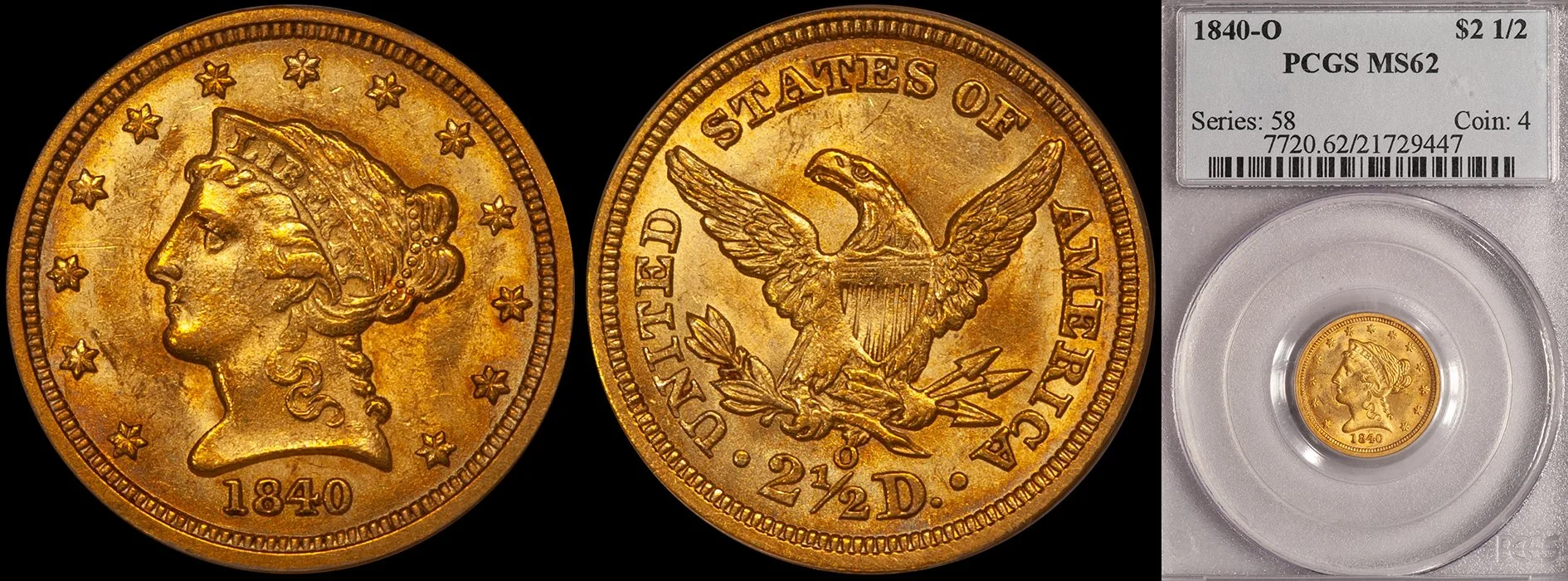
The Bowers and Merena sale conducted at Baltimore had some nice gold pieces and prices for the most part seemed to be quite strong. My two favorite gold lots were a really fresh 1840-O quarter eagle in an old green label PCGS MS62 holder that sold for $20,700 and a seemingly way undergraded 1843-O Large Date quarter eagle graded MS61 that brought a robust $17,940.

What was hot at the show? Early gold and Proof gold were in great demand, particularly nice quality material. I noted a lot of demand for interesting, choice items in the $1,500-7,500 range but even in bad markets coins like this is always easy to sell. Without a doubt the weakest area of the market was low end generic gold. In fact, price premiums are so low on coins like AU55 to MS61 common date $20 Liberty gold that there is a strong possibility that people will start melting these soon.

After what seemed like 45 minutes at home I turned around and went to Phoenix to attend the Spring ANA. Note to ANA Officials: great choice of venue but bad choice of dates. If you want more dealer enthusiasm for this show in the future DO NOT hold it the next week after Baltimore.

Because of the fact that most major dealers had recently attended Long Beach and Baltimore, the Phoenix show had many no-shows from the East Coast. Not only was there little enthusiasm, there were almost no fresh coins. Which meant that I wasn’t able to buy much and which meant that I had minimal enthusiasm.

I wound-up leaving the show early due to a combination of boredom, fatigue and the fact that I am preparing to fly out of town to pick-up a nice collection that I just bought. This collection has nice runs of Carson City double eagles, New Orleans eagles and Three Dollar gold and I expect to begin listing these coins on my website within a week or so.

There are no other coin shows of note between now and the Central States show in mid-April so I expect that demand for nice coins will be extremely high within a month and that the result will be an exceptionally good show in Chicago.