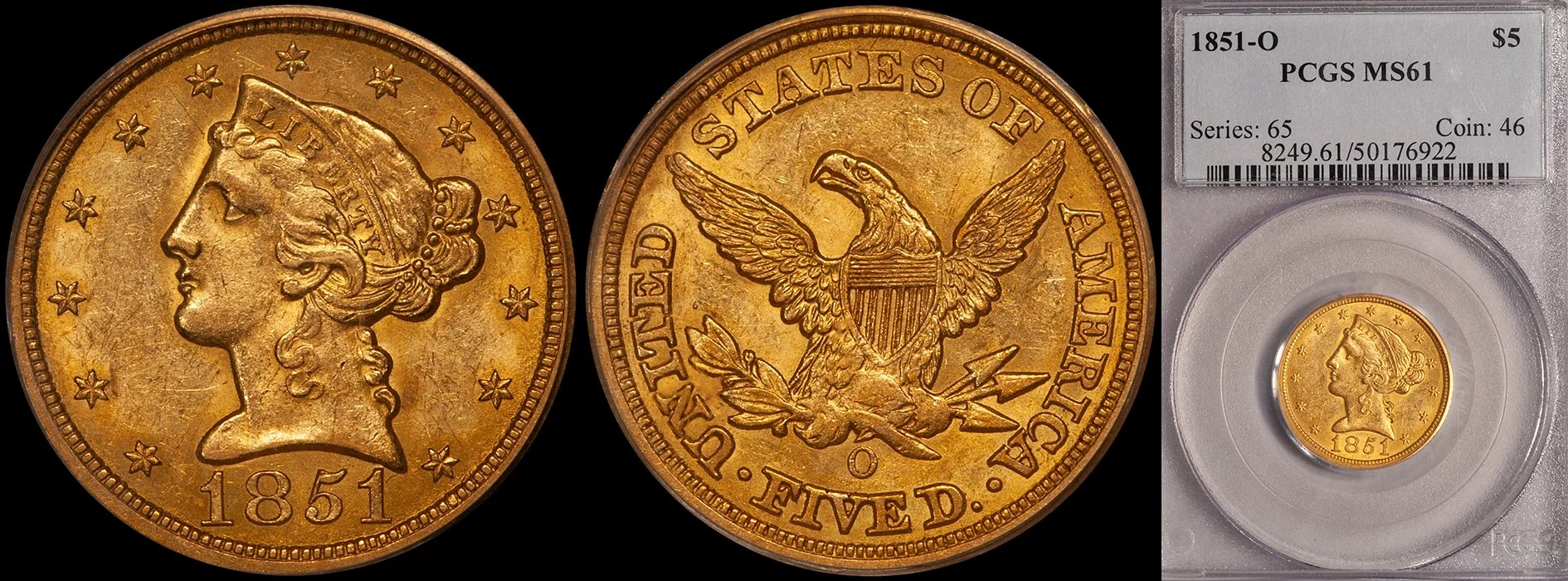
Attack of the 1839-C Quarter Eagles!

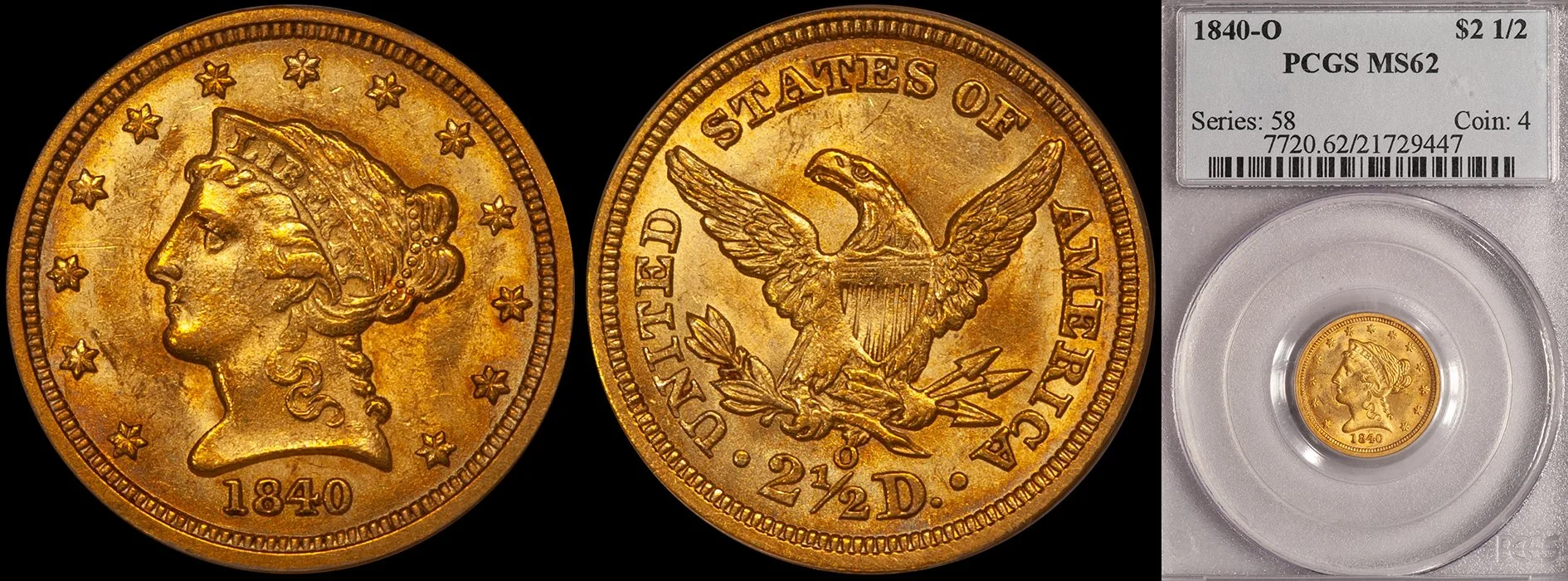
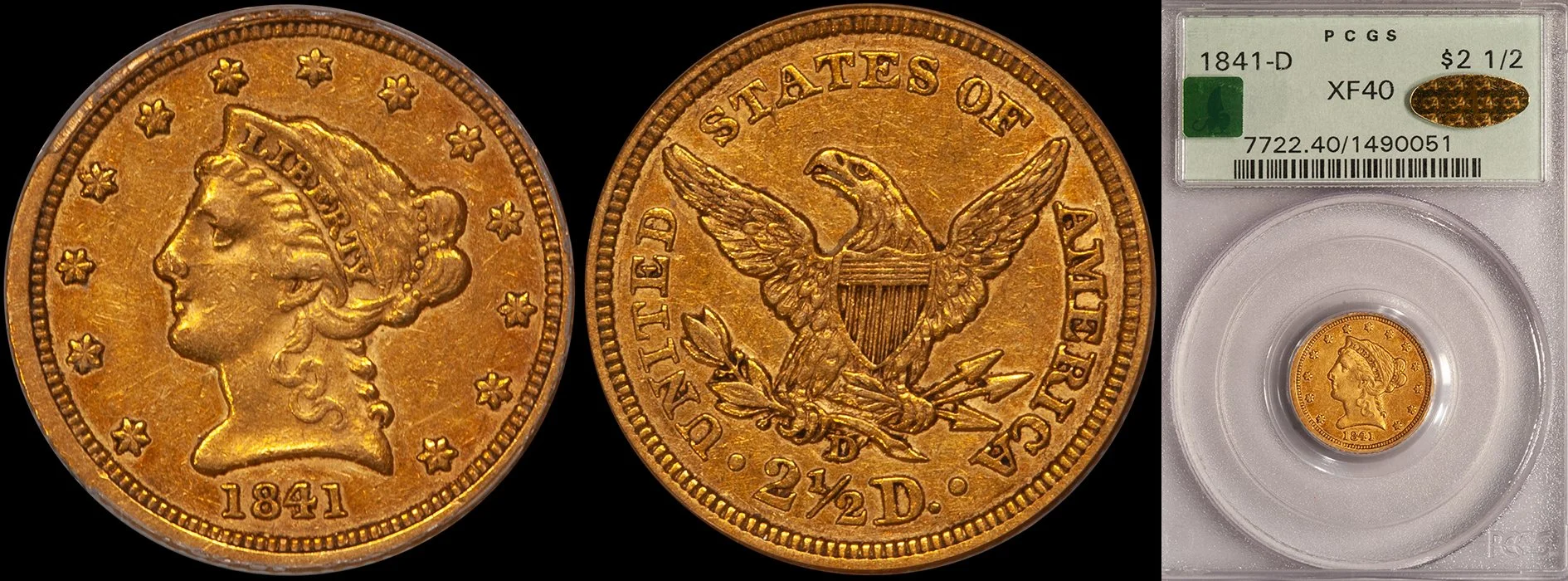
At the Heritage 2008 FUN sale it was the Attack of the 1839-C Quarter Eagles as there were no less than a dozen (!) examples of this popular Classic Head issue available for sale. How did these coins do and what nuggets o’ information can be gleaned from the auction results? The 1839-C quarter eagles in question ranged in grade from a low of PCGS VF30 to a high of NGC MS61 and included ten coins in NGC holders, one in a PCGS holder and one orphan in an ANACS net AU50 holder that had been cleaned.

Two interesting things can be determined right away from the statement made in the paragraph above. The first is that 1839-C quarter eagles are pretty difficult to define as “rare” if eleven examples appear in one sale (although if you read the rest of this blog I contend that a certain type of 1839-C quarter eagle is, in fact, quite rare...) and that secondly, NGC seems to have the market cornered on this date. I’ll let you draw your own conclusions about this (cue raised brow...)

One last thing before we analyze. If I were a consignor I’m not sure I’d be thrilled that my 1839-C had to share the spotlight with eleven of its cousins. But, to Heritage’s everlasting credit, these giant auctions continually prove to me that there are enough people looking at the coins that quality typically trumps quantity.

An interesting place to begin is with Lots 3809 and 3810. The former was in an old green label holder and was called VF30 by PCGS (I graded it AU50 or thereabouts but noted in my catalog that it had been cleaned at one time) while the latter was in an NGC 45 holder and was, in my opinion, pretty marginal for the grade. The PCGS VF30 coin sold for $4887.50 while the NGC EF45 brought $4,600. This result wasn’t really a surprise but it doesn’t point out that when someone analyzes the Heritage auction archives they should assume that the 1839-C quarter eagle that they own in VF30 is worth $4,887.50.

The next pair to compare are the two examples graded AU53 by NGC, Lots 3812 and 3813. The result of these coins was interesting to say the least. The former sold for $20,700 while the latter brought $5,750. How is it possible for two coins graded the same by NGC to bring such a gigantic difference? The coin that sold for $20,700 was gorgeous. It was in an old “fatty holder,” had lovely original color and I thought it was a very solid AU58. As nice as the coin was, I was pretty surprised it sold for essentially MS60 to MS61 money. The other AU53 in the sale? It wasn’t very nice and the fact that it had to compete against the Lovely Lot 3812 couldn’t have helped.

No less than four NGC AU58’s were in the sale and every one of them brought $12,650. With Trends at $18,000, this seems a little bit cheap, no? Well actually I think the numbers were pretty right on when you consider that all four of the coins were not exactly high end for the grade. I was a bit surprised that Lot 3085 sold for the same as Lot 3082-3084. Lot 3085 was what I call on “OOG” coin. This acronym stands for “original overgraded.” Which means that although I didn’t think the coin passed the Winter Test as an AU58, it did at least have natural color and a decent overall appearance for the issue. Had this been the only 1839-C in AU58 in the sale perhaps it might have brought an extra 5-10%.

Neither the MS60 or MS61 examples in the auction sold. I didn’t think either one was very nice and both were reserved too high; never a great combination.

Remember earlier in this blog when I mentioned that despite there being twelve examples in the sale, a certain type of 1839-C quarter eagle was still rare? I think the fact that only one of these twelve coins had original coloration and was high end for the issue says something important. Most 1839-C quarter eagles have been cleaned or processed at one time and the one-in-twelve ratio for originality seems accurate in my experience.

So what did I learn about this issue as the result of The Attack of the 1839-C Quarter Eagles? Well, for one I learned that NGC AU58 examples are worth $12,650. I also learned that nice, original coins still bring great prices even when “lost” in huge sales and when competing against multiples examples of the same date. And I learned that if I had a nice 1839-C quarter eagle in an old holder, I would resist temptation and sell it “as is.”

1804 Eagle

One of my favorite early United States gold coins is the 1804 eagle. I was recently able to purchase a nice PCGS AU55 example in the Heritage 2008 FUN auction (it’s already been placed in a specialist’s collection) and as I was preparing to ship the coin to its new owner it got me to thinking more about this interesting issue. The 1804 eagle has a reported mintage figure of 3,757 but it is believed that as many as 1,000-1,250 of these were dated 1803 so the actual number of eagles produced with this date may be more in the area of 2,500-2,750.

I believe that there are an estimated 65-75 or so known. This includes around 45-55 pieces in the VF-EF range, 10-15 or so that grade AU and maybe another half dozen that are properly graded as Uncirculated. The finest two that I am aware of are a pair of MS63’s. One of these is an NGC MS63 owned by the Pogue Family while the other is the MS63 (last seen in an NGC holder but it may now be in a PCGS holder) from the Pittman collection that was last sold as ANR 6/05: 1016. The specimen in the ANA Museum (from the Bass core holdings) is also outstanding for the issue and would probably grade MS62 to MS63 by today’s standards.

In comparing the rarity of the 1804 to the other dates in the early Eagles, it is clearly rarer than the 1795, 1797 Heraldic Eagle, 1800, 1801 and 1803. I think it is comparable to the 1796 (perhaps it is very slightly scarcer) but it is clearly less rare than the 1797 Small Eagle and both varieties of 1798.

All examples with the exception of a small number of Proofs (more on these below) are instantly recognizable by having a Crosslet 4 in the date.

Most 1804 eagles are very softly struck at the center of the obverse. This is usually best seen with considerable weakness on the face of Liberty (most specifically Liberty’s chin, lips and the tip of her nose) as well as odd ridges in the obverse fields that resemble swelling of the dies. The example which is shown below is much better struck than usual for the date and the Bass core collection example (which is illustrated in the Bass/Dannreuther early gold book on page 528) is perhaps the most fully struck piece I have ever seen.

More than most other early Eagles, this issue is exceptionally hard to locate with nice coloration and original surfaces. Most 1804 eagles that I have seen have been cleaned and processed and display virtually no originality. In addition, the aforementioned weak central obverse strike makes locating pieces with good eye appeal extremely challenging.

An extremely small number of Proof 1804 eagles were produced around 1834-1835 for use in diplomatic presentation sets. The Proof 1804 Eagles have a Plain 4 and were struck in a close collar as opposed to the coins struck in 1804 which were produced using an open collar. An NGC Proof-65 example of this issue recently sold for a record price of $5 million. It will be curious to see if this price has an effect on values of business strike 1804 eagles, as the sale of the 1933 double eagle raised the price levels on 1933 eagles after the former was sold for a record price a few years back.

After the mint struck eagles in 1804, this denomination was discontinued until 1838.

Despite some strong price increases in recent years, the 1804 remains an excellent value when compared to the more popular and better known eagles from the 18th century. I was very excited to have the chance to handle the PCGS AU55 shown above and hope that I am able to purchase other examples of this date in the near future.

2008 FUN Show Recap

After the dust settles from a major coin show and a major auction, there are always a number of things that can be learned. I learned a lot from the 2008 FUN show and, more specifically, from the Heritage FUN auction.

1. If someone is wealthy and they really want a coin, price no longer appears to be an object. Case in point: the 1805 quarter that was sold as Lot 2775 in the Platinum Night 2008 session. It was graded MS66 by NGC and it brought an absolutely incredible $402,500. What is even more incredible is the fact that this exact coin sold for $74,750 one year ago (almost to the day) in Heritage’s 2007 Platinum Night session. With the click of a mouse, even the most inexperienced collector could have determined this, thanks to Heritage’s unparalleled degree of transparency. Clearly the coin market is strong right now but a nearly-six times increase in the price of a neat but not world-class coin? Gulp. And you want to know something even more amazing about this sale? The two collectors battling it out for the 1805 quarter were bidding on line and, in all probability, never saw the coin in person or had an independent dealer look at it for them. In fact, they may not have even had a bidding strategy other than: “I want this coin and must have it no matter what it sells for.” And this was just one of many prices in this sale that I regard as absolutely amazing.

2. The last time that coins sold for numbers like this at auction may well have been at the 1979 and 1980 Garrett sales. There is one HUGE difference between those numbers and today’s seemingly crazy auction prices. In 1979 and 1980 the end users for most of the six and seven figure coins that were selling at auction were dealers. Today it is virtually all collectors. That makes me think that the coin market of 2008 is a lot healthier than the admittedly twisted market of 1979 and 1980.

3. Heritage has created a model that rich new collectors trust and that they obviously find entertaining to use. Collectors can bid live on their computers even if they are in a hotel room in Kuala Lampur and they know the reserve and/or opening bid level for every coin in the auction. Unlike at most other coin auctions, these collectors know they aren’t going to get jerked around at a Heritage sale and that’s why we are seeing something unparalleled in numismatic history beginning to emerge in 2007 and 2008: exceedingly wealthy people who will never set foot in a coin show and whose identity will never be known to more than a small group of industry insiders are quietly dominating the high end of the market like never before.

4. Previously dormant areas of the market can turn around very quickly. As an example, Proof silver coins from the 1840’s and the 1850’s were extremely tough sales for many years. In fact, I can remember dark, overgraded coins from the Starr sale in 1992 languishing in the market for at least five to eight years and some of the less attractive coins from the Pittman sales taking years to find homes. Out of the blue, these early Proofs are now selling for huge prices. In the Platinum Night session, a group of four very rare Proof quarters (1841, 1844, 1845 and 1850) brought a remarkable $1,322,500 including $460,000 for the 1850 in NGC PR68. Before the auction I would have guessed that these four coins would have brought in the area of $750,000 collectively. From what I hear, there are now two or three deep-pocketed collectors who have suddenly started to put together date sets of business strike and Proof Seated coins. That fact, plus the availability of some very rare and really exceptional issues in the FUN sale created a Perfect Storm scenario and ignited a formerly-dead series. Which formerly dead series will be next?

5. In the area of branch mint gold, it was interesting to see the very strong performance of many issues. The strongest prices realized were for the key date or one-year type issues that have been in great demand for the last few years. In the gold dollar series, a very nice PCGS AU58 1855-D sold for $37,375 (Trends for this issue in this grade is $35,000). The fact that this piece was choice, original and well struck helped propel it to what has to be a record price for an 1855-D dollar in this grade. There were some very attractive 1861-D half eagles in the sale and this is an issue that has shown great demand in the last few years but very few pieces have been available. A PCGS AU58 sold for $43,125 (Trends is just $35,000) and a spectacular PCGS MS63 brought $207,000 which is a record auction price for any Dahlonega gold coin.

6. When I was discussing the “how to” details about the Carolina Circle collection with its owner, one of the most important decisions to make was whether to regrade the pieces that had been slabbed years ago or to leave them as is. Given how hard it is to find a fresh deal these days, I made the decision to keep them in their original holders. Was my choice right? At this early point, it’s hard to say with certainty as you can rest assured that virtually every one of the old holder coins will be broken out of the original holder and sent to PCGS or NGC to be regraded. But given the prices that many of these coins brought, I’d have to say that people are going to have to hit some pretty major Grading Home Runs. Here are just a few examples. An 1841-C $5.00 in an old PCGS AU53 holder sold for $13,800. With AU58 Trends at $12,000 this means the coin will have to grade at least MS61 to be a decent deal. An 1846-C in PCGS AU53 brought $12,650. With AU58 Trends at $14,000 this coin will need to grade at least AU58 and even at that level the dealer who purchased it won’t make any money. A very attractive PCGS AU50 1851-C sold for $12,650 which is considerably more than AU58 Trends. To be even a marginal deal for the buyer this coin will have to grade at least MS60 to MS61. One final half eagle of interest was a lovely PCGS AU58 that brought a rousing $17,250. With MS62 Trends at $15,000 this coin will have to grade at least MS63 to be a good deal. From AU58 to MS63 seems pretty optimistic to me...

7. The appearance of CAC coins in the FUN sale was of great interest to many market observers, myself included. I am planning to write an in-depth analysis of their performance in my next blog but the early results seem pretty strong with premiums ranging from a low of 10% to a high of well over 50%.

2008 Crystal Ball Survey - Part One

For the last few years, I have been asked by Maurice Rosen, publisher of the excellent Rosen Numismatic Advisory newsletter, to be a contributor to his annual Crystal Ball survey. This feature, which generally has the participation of a half dozen or so very knowledgeable dealers, is an excellent way for me to analyze the coin market and the questions asked by Maurice are diverse and interesting. Here are my answers to the 2008/2009 RNA Crystal Ball Survey. Please note that due to the length of this article it will appear in two parts. 1. What's your outlook for the coin market in 2008/2009?

I think the market will be mostly strong in 2008 although I think we will see continued bifurcation as we have the last few years. By this I mean I think there will be great strength at the absolute upper end of the market and we will also see good demand for interesting lower priced coins but the middle market will continue to be weak; possibly more so than in 2007. I foresee some weakness in the economy in 2008 and I would imagine that because of the housing slowdown we will see fewer people throwing sizable amount of disposable income at things like coins. Really good coins, though, are going to do awfully well in the coming years. There just aren’t many of them around.

2. What areas of the market look to be the best performers in 2008/2009? Please state your reasons.

I think type coins will be a very strong performer in 2008, especially Seated and Barber coins in MS64 to MS67 and PR64 to PR67. Coins like this have been too cheap for too long and people have finally gotten wise to this. Early coins have gotten too expensive for most people (in higher grades) and the grading standards tend to be pretty atrocious in this area. I think a number of collectors are realizing that a smart place to be is in the Seated and Barber arena. You can still buy really nice coins that are 100+ years old for less than $5,000.

I expect that rarities and trophy coins will be extremely strong this year. I find it amazing that an 1804 $10 sold for $5 million dollars recently and I’ve got to think that $1 million dollar sales are going to be reasonably routine in 2008 and 2009.

I would expect that Proof Gold will do nicely in 2008 as will better date $5 Indians and $10 Indians.

In rare date and early gold, I think anything that is choice and original will be in demand this year. I am already noticing a large price spread between crusty coins and scrubbed coins and I think this will continue as originality becomes more and more in vogue in 2008. Here’s my advice for collectors and investors in 2008, 2009 and beyond. Buy coins that are interesting and which have good aesthetic appeal.  

3. What areas look to be the weakest? Again, please state why.

I would expect that silver commemoratives are going to stay very weak in 2008 unless some large marketing firm decides to promote them. They seem like great values right now but there are just too many of the little buggers around and unless you can count on selling thousands and thousands of coins, you can’t control the promotion.

I would have to think we will see some weakness in Registry Set coins that are perceived to be overvalued.

I also think that, with the exception of gold dollars, small-sized coins are not going to do well. As collectors get older and older, few people are able to see coins like Three Cent silvers and half dimes.

This is going to sound a little bit general but coins that are ugly are going to do poorly in 2008. No matter what the plastic says, if a coin is off quality, it will be hard to sell.

4. Since the 2001 lows, coin prices by some averages are up 20-50% but gold is up about 200%.

A) Have your clients expressed concerns about this?

How could they not express concern? While some areas of the market have done fabulously since 2001 (early type, early gold, rarities) many other areas have been extremely flat. In some cases, truly rare coins in relatively popular series are actually down in value since 2001, especially if you take out the gradeflation factor(s).

B) What do you tell them?

The truth. Which is, in my opinion, that as much as I love coins and the coin market in general, there are some problems that need to be cleaned up. These include accurate price reporting and the need for greater consistency among the grading services.

C) How do you see coins and gold performing from here on?

I think we’ll see gold break through the $1000 barrier but I’m not really sure where the short-term and medium-term caps are going to be. Perhaps $1250-1500-- after that, who really knows? I think price performance in the coin market is going to be selective. As I mentioned above, the market is becoming more and more bifurcated. I think there are going to be fewer collectors in the future but there will be more extremely rich people dabbling. If you buy the right coins and hold them long enough, you should do well. If you buy so-so or average quality coins you won’t do as well. Investors should learn to think like collectors and buy the sort of collector-quality coins (and, no, the expression “collector quality” does not mean 1901-S quarters in Fine) that have traditionally appreciated well over the course of time.

5. The U.S. Mint is the biggest coin dealer. Are they helping or hurting the coin market? Please explain in detail.

I can’t possibly imagine that it’s helping the coin market that hundreds and hundreds of millions of dollars are being spent on modern products that might (or might not...) be spent on rare coins. At least the Mint is now far more receptive to collectors than in the past and they seem to have extended the olive branch to the collecting community after years and years of disliking us.  

6. Coin grading has come a long way since PCGS started in 1986. A) What further advances are needed? B) How would they impact the market?

I’ve spoken with clients of mine who are involved in hedge funds or private equity groups and most of them won’t do a coin deal because the numbers are just too small. These guys are looking at doing $250 million+ deals (in many cases more than this) and a little $25 million to $50 million coin deal is just too small for them. That said, there is always the chance that a hedge fund guy who loves coins might do a fund as sort of a lark. But every time we’ve seen large funds in the coin market, the results have not been good.

If a fund were to be established, it needs to be run by someone like John Albanese who is very smart and very ethical. I assume that a fund run by someone like John would focus on really rare coins like Proof gold, early type (silver and gold), classic rarities and popular individual issues like High Reliefs, Pan-Pac Octagonal and Round $50’s, etc. This is essentially what the Ohio Fund was focusing on and I think they did a very good job in terms of buying coins and focusing on specific market areas.

7. A) How do you feel about the concept of "seals of approval" on graded coins?

I wish they weren’t needed but I think at this point in time they are a good idea—provided, of course, that the people involved with them are doing it for the right reasons.

B) What will the effects be of such slab labeling?

I think we are already seeing an effect. At least one of the services has become considerably more conservative in their grading in the past six to nine months.

8.Coin auctions: A) What's your best advice to consignors?

1. Don’t assume that auctions are always the best way to sell all coins.

2. Learn which firms sell which types of coins for the most money. As an example, I use one auction firm exclusively for any very low population 20th century coin I own as they get much better prices for these coins than anyone else. Conversely, I use another firm exclusively for more “sophisticated” coins as they do a better job describing them and their audience seems to be a bit more dialed in to these sorts of coins.

3. Don’t choose an auction firm solely based on their consignment rate. You get what you pay for.

4. The best times of the year to sell coins at auction are at FUN in January and at the ANA in July or August.

5. Hire an advisor to help you decide how to best market and sell your collection even if you think you know what you are doing. If you do it totally on your own the chances are good that you will leave money on the table.

B) What's your best advice to bidders?

1. Hire a well-qualified representative to bid for you at auction. It is the best 5% you will ever spend.

2. Never bid sight unseen on any coin at auction worth more than $1,000. And, no, you can’t accurately grade a coin based on images!

3. If you attend an auction in person, come prepared. Know what you what to bid on, what you want to spend and how much you are willing to stretch on any coin.

4. Sometimes the best auctions are the ones you don’t buy out of but which you learn from.  

9. Two sophisticated investors come to you to provide them a portfolio for a 5 to 10 year hold, one investing $25,000, the other $250,000.

A) How would you construct the portfolios?

$25,000 portfolio, as follows:

1. Stars Obverse Liberty Seated Dime, PCGS or NGC MS66, cost $4,000-5,000+. I think this has the potential to be a $7,500 coin.

2. No Motto Liberty Seated Quarter, PCGS or NGC MS65, cost $5,000-7,000+. If possible I would try to find a coin dated in the 1840’s and pay a premium of 20-40% for it. This could easily become a $10,000++ coin.

3. Barber Half Dollar, PCGS MS66, cost $4,000-5,000. I can see this coin becoming worth $7,500-10,000.

4. Liberty Quarter Eagle, PCGS or NGC PR65 Cameo, cost $12,500-15,000. I think this has the potential to become a $20,000 coin.

For the silver coins, I would try to buy very pretty originally toned pieces and for the Proof gold coin I’d try to find a coin that was not over-conserved.

$250,000 portfolio as follows:

1. A neat early copper coin, such as a 1793 half cent in AU or a nice Wreath cent or a pretty 1794 Cent with a good pedigree. I would avoid a Chain Cent as I think these are currently overpriced. I’d spend around $25,000 on this coin and I think it has the potential to double in the next five years.

2. A cool $25,000 early silver coin. It might be a really nice AU 1795 half dollar or a very pretty early dollar (preferably a 1796, 1797 or 1798).

3. A Large Size Bust Quarter in PCGS or NGC MS65. I’d be very selective when buying this coin and would hold out for a coin that had great original color, minimal friction on Liberty’s cheek and a good strike. I’d be willing to spend up to $25,000 on the right coin. This type could be worth $35,000-45,000 in a really hot market.

4. A great looking piece of early gold in the $25,000-35,000 range. I might look for a nice MS63 to MS64 Capped Bust Right half eagle or a Fat Head half eagle (1813, 1814, 1818 or 1820) in MS63. Again, I’d be ultra-selective and avoid a piece that has been processed. Although early gold has gone up a lot in price in the last five years, nice coins still have upside potential.

5. A small group (four to six coins) of Colonials priced in the $2,500-5,000 per coin range. I would use an expert in this area to be my guide and would shoot for coins that he thought were accurately graded and really attractive for the issue. This is a $10,000-20,000 investment that could double in the next decade.

6. A really neat New Orleans half eagle or eagle from the 1840’s worth $20,000-25,000 would be my next purchase. Having focused a significant amount of attention on these coins in the last few years, I know how incredibly rare they are and I think they are still wildly undervalued.

7. I’d finish the portfolio off with one or more of the following: a great piece of Proof gold from the 19th century, preferably in PR65 or higher and preferably with an original mintage figure of less than 50 coins; a few great No Motto Liberty Seated silver coins, preferably No Motto mintmarked coins in MS63 to MS65 with pleasing original color and a few neat collector coins—things like perfect EF Carson City half dollars or lovely original AU Bust halves. All of these areas still seem like good values to me and have excellent upside.

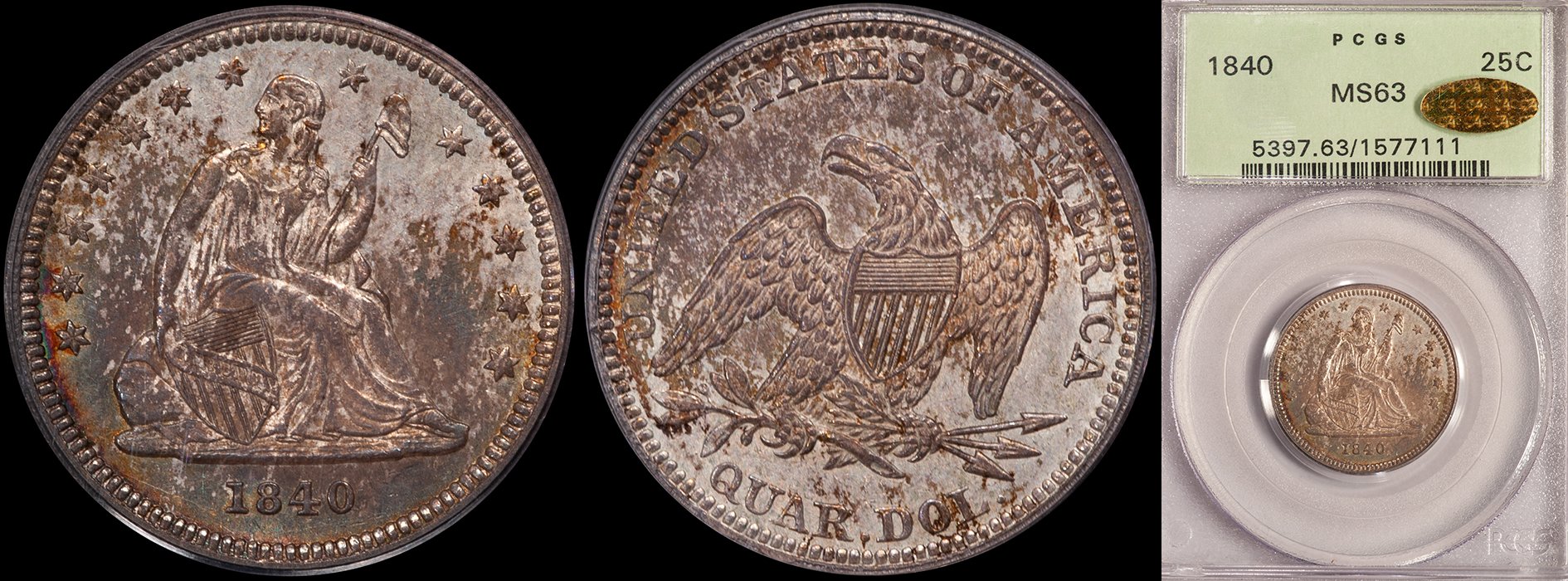
Liberty Head Half Eagle Series

Think you know the Liberty Head half eagle series pretty well? OK, then here is a test. Everyone (well, almost everyone...) knows that the extremely rare 1854-S is the rarest single issue in this long-lived series. But what is the rarest collectible date ? The answer and some interesting analysis can be found below. So have you given some thought to this question? If you answered the 1864-S, pat yourself on the back and give yourself a Gold Star because you know your Liberty half eagles! (For those of you who are about to complain and say, “Hey, Doug, how about the 1875?” my answer is that while this date is the rarest as a business strike, there are also Proofs known and the total number of 1875 half eagles is probably narrowly more than the 1864-S).

With a mintage of just 3,888 you have to figure that this is a rare coin. But there are other dates in the series with lower mintage figures, including the 1865, 1869, 1872, 1875, 1876 and 1877. As a rule Philadelphia coins were saved with greater frequency than those from the branch mints and almost no one saved any 1864-S half eagles. My best estimate is that no more than twelve to fifteen pieces are known.

As of January 2008, PCGS had graded just thirteen 1864-S half eagles including three in Extremely Fine, three in About Uncirculated and one in Uncirculated (more about this coin later) while NGC had graded ten with four in EF and three in AU.

In the last decade or so, I have personally seen a very small number of 1864-S half eagles in any grade. The last one I can recall selling at auction was a PCGS EF45 that Superior sold in May 2006 for $22,425 while an NGC EF45 brought $31,050 in David Lawrence’s July 2004 auction. Back in 2000, the Bass III coin, graded AU53 by PCGS, sold for an incredibly reasonable $23,000 and, at the time, that was one of the two best examples I had ever seen. I have also seen an NGC AU58 in the inventory of an East Coast dealer.

There is one 1864-S half eagle known that is so much better than any other survivor that it deserves special mention. I first saw this coin in October 1987 when it sold in the Norweb collection auction. The Norwebs had, in turn, purchased it in 1956 out of Abe Kosoff’s Melish sale.

This coin is in a PCGS MS65 holder but this doesn’t begin to tell the whole story about how incredible it is. The coin is essentially perfect and could easily grade MS66 or even MS67. Its only “fault” is the fact that isn’t all that well struck with some weakness visible on a few of the stars on the obverse and on portions of the upper obverse and corresponding reverse. It is by a large margin the nicest San Francisco half eagle from this era that I have ever seen and when I saw it again at the Bass sale back in 1999 I wrote the following in my catalog “world’s coolest San Francisco gold coin.”

As I was figuring my bids for this sale, the 1864-S kept popping into my mind. I badly wanted to buy this coin for myself or, at the very least, persuade one of my clients to put it away for a few years so I would have access to it when the market for coins like this would be stronger.

The coin opened for $60,000 and I bid up to $120,000 but I got cold feet and dropped out. It wound up selling for $160,000 to a Southern collector who, to the best of my knowledge, to this only owns one San Francisco gold coin—this 1864-S half eagle. And that is a hell of a San Francisco gold coin collection.

What would this 1864-S half eagle sell for today? I thought it would bring as much as $250,000 back in 1999 and had it been in a sale other than Bass II (which had FAR too many great coins for its own good...) it might have. Today, I figure it would bring at least twice this and maybe more.

Despite the obvious rarity of this coin, I think the 1864-S half eagle is still extremely undervalued. The current Trends value for an EF40 is just $14,250 in EF40 and $45,000 in AU50 with no prices listed for higher grades.

The 1864-S half eagle remains one of my favorite 19th century United States gold coins and I am confident that its true rarity will be fully appreciated in the near future.

Winter's Law of Numismatics

I was recently having a conversation with a long-time client about coin investing and our discussion turned to one of Winter’s Laws of Numismatics. Which basically says that the typical coin investor almost never makes money while the typical collector, often in spite of himself, tends to do just fine from a financial standpoint. At DWN, I tend to regard “investing” with a raised eyebrow. If someone who I do not know calls me up out of the blue and starts talking about coin investment, I give him a lecture which basically states that coins are not good investments and that if he insists on looking at coins strictly as investments, he probably should be dealing with XYZ Coins instead of my firm.

But this isn’t totally true. Coins CAN be a good investment. Let’s say that as a knowledgeable collector you went to the Pittman sale in 1997 and spent $50,000 on some nice lots. The chances are pretty good that you would have done just fine from a financial standpoint.

Before we go further, I suggest you re-read the last paragraph. Notice that I said if you had “gone to the Pittman sale in 1997.” This presumes at least three important points. First, that you knew enough about the coin market that you (or an advisor) were able to determine that the Pittman sale contained good coins. Second, you were able to hold on to your coins for a long period of time (hard to believe that the Pittman sale was ten years ago, isn’t it?). And thirdly that you were able to select nice enough coins for them to be “investment quality.”

The trouble with coin investing is that virtually all coin investors buy the wrong coins from the wrong people at the wrong point in time.

When I look at the typical “rare coin portfolio,” I am usually struck by a few things. The coins tend to be very common and very boring; things like common date Walkers in MS66 or common Saints in MS65. Coins like this will never be good investments because they are too common. The second thing I am struck by is that the coins in these portfolios (the very word “portfolio”, when it comes to coins, makes me cringe...) are invariably overpriced. Even coins like MS66 common date Walkers or MS65 common date Saints which have a well-known buy/sell spreads tend to be dramatically overvalued in these portfolios. Another thing I notice is that these common coins are usually bought at exactly the wrong time; usually when a common series is in the midst of a promotion.

Getting back to the point I was making earlier, collectors often make excellent investment decisions even though, many times, they don’t really know they are making them. The smartest things collectors can do are to buy coins that are pretty, coins that are rare and coins that are in demand. An investor is not likely to know which coins qualify as such and the “advisor” that he speaking to likely does not know either.

So as an investor, what can you do to improve the chances that you will actually make some money? My answer is simple: learn to think like a collector. Learn something about the coin market. Realize that coin collecting involves a lot more than checking “past performance” charts and analyzing statistics.

State of the New Orleans Gold Coin Market

I was discussing the State of the New Orleans Gold Coin Market yesterday with a collector and he pointed out something very interesting to me. In the calendar year of 2007, there were probably fewer important high grade New Orleans eagles sold than any other gold denomination from this mint. This got me thinking and the more I looked into this statement, the more I realized that it was true. 2007 began with a bang for New Orleans eagle collectors when Stack’s sold the Morgan collection. Included in this collection were coins such as the only Uncirculated example of the 1879-O (an NGC MS61 that I purchased as an agent for a California collector for a record $52,900) and the third finest known 1880-O (also graded MS61 by NGC; I purchased this for the same collector for $16,100).

After the strength of this sale, I expected the proverbial flood gates to open and a number of important, high grade New Orleans eagles to become available.

Shortly thereafter, I was able to offer the magnificent Pinnacle Collection of New Orleans gold which contained a number of Condition Census pieces in all denominations. With the exception of double eagles which were never a focus of the original owner, the eagles in this collection were probably the weakest denomination, at least from the standpoint of grade. There were some truly lovely eagles in this collection but unlike the quarter eagles and half eagles (which were virtually all MS60 and better and which included numerous coins high in the Condition Census) the eagles were mostly nice, original AU55 and AU58 coins.

After this flurry of activity in January, the New Orleans eagle market was very dry until Heritage offered a small but interesting group of pieces in the ANA sale. Of particular note were the second finest 1882-O (a PCGS MS63) that sold for a record $37,375, one of the finest known 1897-O (a PCGS MS64 that realized $14,950)and the third finest known 1899-O (an NGC MS64 that went for a reasonable $12,663). Another important piece in this sale was a very high end PCGS MS63 1892-O that sold for a record-setting $10,350.

And then...nothing. The year ended with virtually no important New Orleans eagles appearing at auction and this trend appears to be continuing into 2008. Having just reviewed the FUN offerings from Bowers and Merena, Heritage and Stack’s I noticed a virtual absence of any significant New Orleans eagles.

So where are all the coins and why are they not coming up for sale? These are good questions and while I do not have definitive answers, there are a few reasons that I suspect are the root cause.

The first is pretty obvious. Many New Orleans eagles (especially the No Motto issues) are very rare in high grades. When you are talking about a coin like an 1842-O eagle in properly graded Uncirculated, you are looking at an issue with maybe three or four known. Coins that are this rare do not trade with a great degree of frequency.

Especially when we look at reason number two. The New Orleans eagle market is still in its infancy in terms of development and the “players” in this market tend to be buyers at this point as opposed to sellers. This means that many of the really cool pieces that exist are in tightly-held collections and are not likely to be sold at any time soon.

Another not-so-obvious reason is what I call the “spillover effect.” New Orleans eagles have a number of specialized collectors and these individuals are often competing with Liberty Head eagle specialists when important coins come up for sale. I know of at least three collectors who are working on completing high grade sets of Liberty Head eagles. This means that if, for example, a high grade 1846-O eagle were to become available, the New Orleans eagle specialists would be duking it out with the Liberty Head eagle specialists (not to mention the generalists who like interesting coins) creating an unusual amount of competition.

One other reason for the lack of available coins has to do with poor price reporting. I would contend that a coin like the aforementioned high grade 1846-O eagle is worth a lot more today than it was in, say, 2003. But Trends and CDN Bid levels are essentially the same as they were five years ago. Since this very rare coin shows no “paper profit,” what motivation would its owner have to sell it unless he needed money? Until Trends and Bid show accurate values for coins such as high grade 1846-O eagles, the people who own them have no real motivation to sell.

There were a few other interesting New Orleans eagles that sold privately in 2007. I sold Condition Census examples of dates such as 1843-O, 1849-O, 1859-O, 1881-O, 1883-O, 1894-O and 1904-O. I would assume that some other pieces were sold by dealers who specialize in rare gold coins as well.

It will be interesting to see if these market conditions continue for New Orleans eagles in 2008 and beyond. I see a strong new level of demand for this denomination and expect some deep-pocketed new collectors to focus their attention on New Orleans eagles. I just wonder if they will be able to find enough coins to satisfy their hunger.

Charlotte Half Eagle Rarity

As I’ve been working on the updated third edition of my Charlotte book, I’ve had the chance to make some interesting observations regarding the rarity of Charlotte half eagles. The overall rarity of most Charlotte half eagles has changed. In nearly every instance, this has meant an increase in the total number known for a specific issue. As an example, I estimated in the second edition that 70-80 examples of the 1840-C half eagle existed. My revised estimate, in the third edition, is 80-100.

The increased populations are a result of a number of factors. After nearly twenty years of grading Charlotte coins, the PCGS and NGC populations represent significantly large percentages of the known total for every specific issue. So, these population figures carry more weight with me than they did ten years ago (and, yes, I have figured regrades/resubmissions prominently as a factor of total populations from both services).

I believe that my second edition estimates were also a bit on the low side when it comes to lower grade coins. While I knew of nearly every high grade 1840-C half eagle that exists (now or when the last edition was written) I tended to underestimate the low grade coins. My new estimates try to take into account these pieces.

There are changes in the population estimates for EF and AU half eagles because, let’s face it, the EF45 of ten years ago is, in most cases, an AU50 (or higher) today. I’ve tried to factor in gradeflation into my estimates and I tend to discount some of the slabbed AU50 or MS60/61 coins as, in my opinion, they do not meet my personal grading standards.

One thing my updated research has reinforced is that really choice Charlotte half eagles (MS63 and better) remain genuinely rare. While many of the coins listed in the Condition Census of my second book have changed owners and, in many cases, holders, they remain coins with pedigrees that I am able to trace back to the 1990’s or earlier. I’ve also noticed that the grading services have done a good job (most of the time) at holding the line on higher grading Charlotte half eagles. While a few MS63’s have become MS64’s or MS64’s have become MS65’s, many of the coins that were grading MS64 or MS65 back in the mid-to-late 1990’s have remained consistently graded.

The Bass sales, held from 1999 to 2001, had a huge impact on the third edition of the book. Many of the coins that I speculated about in the first two editions but were unaware of their location/grades were in the Bass collection. They now appear in the third edition; complete with accurate pedigrees and current grades.

What are a few other things that I have learned about Charlotte half eagles that will be reflected in the new third edition of the book?

* I’ve learned that some of the die variety information for issues such as the 1849-C, 1850-C, 1853-C and 1854-C was wrong and it has been corrected.

* I’ve learned the value of good pictures and the crappy old black and white images that appeared in the first two editions will be replaced by useful color plates.

* I’ve learned that people generally liked the format and design of my second edition of the New Orleans gold book that I published last year and so this format will be adapted to the upcoming Charlotte book.

* Finally, I’ve learned that Charlotte coinage for me is like the numismatic equivalent of “home cooking” and when I’m feeling cranky or burned-out, nothing is more numismatically soothing than a dose of Charlotte half eagles.

The 1854-S Type One Double Eagle

One of the more interesting and most misunderstood Type One double eagles is the 1854-S. This is an issue whose seemingly high population of Uncirculated coins belies the fact that it is actually extremely rare in higher grades. Read on for some more information about this interesting issue. The 1854-S double eagle is a historically significant coin as it is the first double eagle produced at the new San Francisco mint. Unlike the quarter eagle and half eagle of this year, it is a relatively obtainable coin as one would expect from its original mintage of 141,168. PCGS has graded a total of 148 while NGC has graded a total of 158. In my book “An Insider’s Guide to Collecting Type I Double Eagles” I suggested a total population of 325-425+. I believe that this figure remains accurate.

What is especially interesting about this date, however, is its population in Uncirculated. Looking at the PCGS and NGC populations, one might think that the 1854-S is only moderately scarce. After all, PCGS has seen 52 in all grades of Mint State while NGC has recorded 68.

But the population reports fail to explain an important fact about the 1854-S double eagle: virtually every coin in a PCGS or NGC Uncirculated holder has matte-like surfaces as a result of exposure to seawater.

Seawater Uncirculated 1854-S double eagles come from no less than three sources:

The wreck of the Yankee Blade which sank off the coast of Santa Barbara in October 1854. It is believed that somewhere between 100 and “a few hundred” coins with Uncirculated sharpness were recovered.

The wreck of the S.S. Central America which sank in 1857. It is believed that 20 or so 1854-S double eagles were salvaged from this ship and this includes some with Uncirculated sharpness.

The wreck of the S.S. Republic which sank in 1865. There were eight 1854-S double eagles salvaged from this ship including five that were graded by NGC and three which were “no grades” due to problems. Seawater Uncirculated 1854-S have a matte-like surface texture due to exposure to the oceanic environment in which they rested for over a century. But there are also a few other interesting tell-tale signs that they show.

As mentioned above, the majority of the seawater 1854-S double eagles are from the Yankee Blade shipwreck. These coins (as well as the ones that I have seen from the S.S. Central America) have die cracks on the obverse and the reverse which are easily identifiable. On the obverse, there is a crack to the left of the 5 that runs from the rim to the truncation and which branches off to the right over the 4. Another crack begins at the left side of the coronet and runs up to the space between stars six and seven. The reverse shows a large crack from the first T in STATES out into the field below the UN in UNITED. I have never seen a seawater 1854-S double eagle in any grade that did not have these cracks.

What’s interesting about the non-seawater coins is that they do not show any of the cracks described above.

There are some other minor diagnostic differences between the seawater and non-seawater coins as well. On the former the 54 in the date are very close and the top of the mintmark is firmly embedded in the tail feathers. On the latter, the 54 appears to be less close and the mintmark is a bit lower.

I first learned about the rarity of high grade 1854-S double eagles with original surfaces around fifteen years ago and have searched for Uncirculated pieces for many years. The finest that I have ever seen is a piece that was recently sold as Lot 61779 in Heritage’s November 2007 sale where it brought $21,850; it had earlier been in the Bass collection and it sold for $10,925 when offered as Bass III: 781 in May 2000. The only other example I can recall having seen with claims to an Uncirculated grade was Heritage 1/05: 9473 ($5,175). This coin was in an old holder and it might grade MS60 or better by today’s standards. It is now owned by a collector in Connecticut.

So where are all of the high grade 1854-S double eagles without seawater surfaces? My guess is that a considerable number were melted. This seems more likely when one takes into account the fact that the vast majority of the 325-425+ pieces known lack original surfaces. My best estimate is that only 25-50 are (currently) known from non-shipwreck sources. It is my opinion that these should command a strong premium over seawater coins in all grades.