State of the Market Report: New Orleans Eagles

A few weeks ago I did a State of the Market Report on New Orleans gold. In that report, I barely touched on Eagles from this mint. Afterwards, I received a number of perturbed emails from readers who wanted to know my thoughts about New Orleans eagles. I hear you loud and clear Unhappy Nawlins Eagle Collectors and this blog’s for you. I’ve written a number of times that I regard New Orleans eagles as the “next best thing” for collectors who can’t afford high quality examples of New Orleans double eagles. But I think this is short-changing what is truly a collectible and very interesting series in its own right.

New Orleans eagles can be neatly divided into two distinct groups: the No Motto series (1841-1860) and the With Motto series (1879-1906). There are twenty–one issues in the former group, sixteen in the latter.

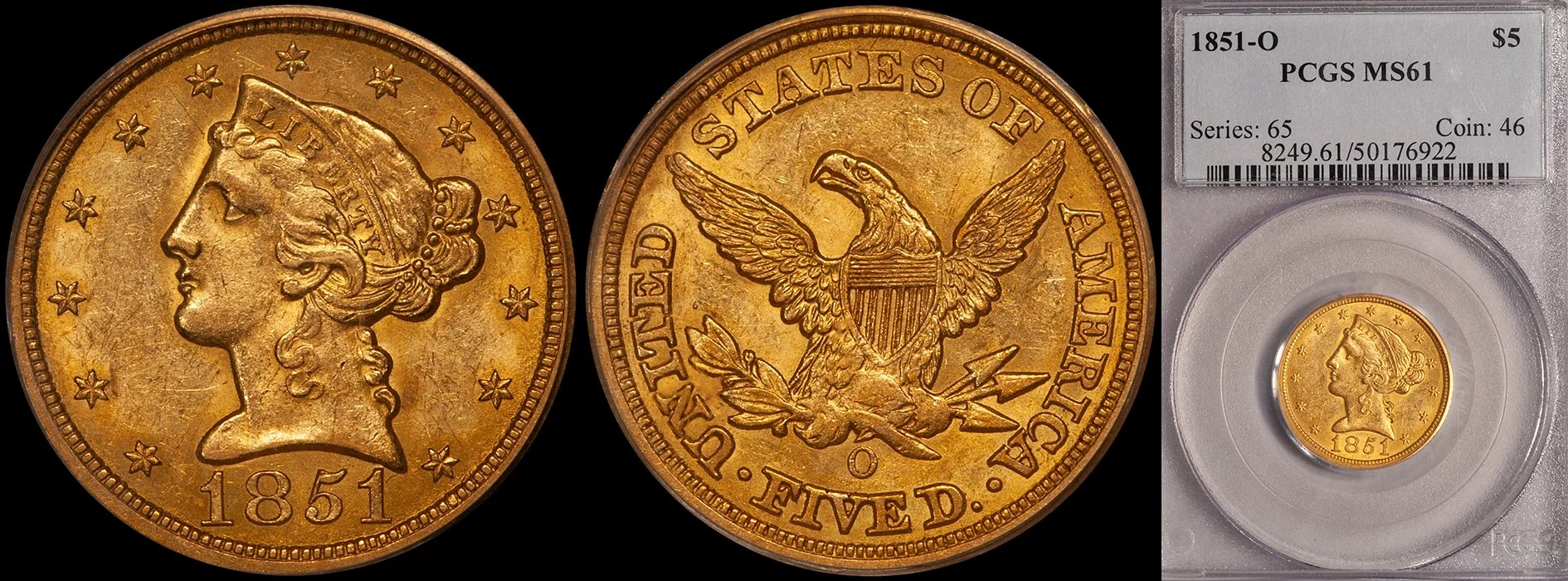
The No Motto series has become extremely popular in the last two years. Collectors have learned that even the common dates (such as the 1847-O and the 1851-O) are, in reality, very scarce to rare in the higher circulated grades and genuinely rare in Uncirculated. Something that I find remarkable is the lack of Uncirculated No Motto eagles that have been available in the last two years. The one exception to this was the coins from the S.S. Republic but the “cream” of this deal was quickly sold and virtually none of the important No Motto eagles from this source have ever re-appeared for sale.

There have been a few very important No Motto eagles sold in the last year or two. The finest known 1843-O, graded MS64 by NGC, brought nearly $60,000 when it was auctioned by Bowers & Merena in 2006 and Heritage sold what I feel may have been the finest known 1857-O (graded AU58 by PCGS but better than this in my opinion) in their October 2006 auction for a touch over $40,000. But for the most part, it has been remarkable how few important No Motto New Orleans eagles have been available since the release of my book on New Orleans gold in the fall of 2006.

My experience in buying No Motto New Orleans eagles at coin shows hasn’t been much different in the last year or two. I have been able to acquire a couple of very interesting coins but, overall, the pickings have been very slim. I see a few dates (1843-O, 1844-O, 1847-O and 1851-O) in AU55 to AU58 but these coins are usually scrubbed and very low end for the grade. The key dates have become exceedingly hard to locate. I’ve owned two 1841-O and two 1859-O eagles in the past year and I am certain I could have sold each of these coins to a long list of eager collectors.

The demand for the keys in the No Motto series is quite high but so is the demand for the second-tier issues such as the 1849-O, 1852-O, 1855-O, 1856-O and 1857-O. Around two months ago, I listed a nice PCGS AU53 example of the 1852-O on my website and within a day I had received seven orders for it. The same would probably be true if I were to list a coin such as a nice EF45 1849-O or an AU55 1856-O. These coins are really scarce and there is clearly a strong demand for them.

The With Motto New Orleans eagles have also increased dramatically in popularity in the last few years. Unlike their No Motto counterparts, there have actually been a number of significant pieces that have been available in the last year or two. In the Stack’s January 2007 auction, I purchased the finest known 1879-O (graded MS61 by NGC) for a client for $52,900 and a Condition Census 1880-O (graded MS61 by NGC) for $16,100. In the 2007 ANA auction, one of the two finest known examples of the 1882-O (graded MS63 by PCGS) sold for $37,375 and in the same auction, a PCGS MS63 1892-O brought $10,350 which is a record price for this issue.

One thing I’ve noticed about the With Motto New Orleans eagles is that higher grade examples of the common dates (1901-O, 1903-O and 1904-O) are not nearly as available as they once were. I used to buy nice PCGS MS63 and NGC MS63 1903-O eagles at nearly every major show I attended. Today, these are still available but not with any degree of regularity. Plus, the few I do see tend to be lower quality pieces that look as if they were recently upgraded from MS62 holders.

My favorite With Motto New Orleans eagle is still the 1883-O. After years and years of being neglected, people are finally recognizing the true rarity of this issue. For some reason, Trends is still far behind on this date and the few examples that I have purchased or know of trading between knowledgeable sources have brought far in excess of published price levels. I fully expect values to continue to rise for this date and would strongly suggest acquiring one posthaste if you are specializing in this series (if you can find one that is...)

My overall perspective on both No Motto and With Motto New Orleans eagles is that they have become very popular and that the demand for the rare dates and high grade examples of the more common issues has soared in the last few years. Collectors are quickly learning that a seemingly mundane coin like an 1845-O in AU55 is actually quite scarce if it is attractive and original. At the high end of the market, there is intense competition for finest known and Condition Census pieces. This is also the case with the key issues from this mint.

What Should I Collect?

Every few days I get asked the question “what should I collect?” I’d like to make some suggestions based on three different budget levels. A quick word on coin budgets before we delve into specifics. As a collector you should not overspend on coins. Buy within the parameters that make you comfortable. Spending $750 on a gold coin doesn’t make you any less of a collector than spending $75,000. I find that many collectors, as they grow more comfortable with their comprehension of the market, find it easier to shift from one budget level up to the next. As always, learn about what interests you as specialized knowledge in numismatics is invaluable. I. Low Budget ($1,000 per coin and below)

Gold coin collecting was not really designed for lower budget collectors. That said, there are plenty of interesting areas to collect in this price range. Here are three suggestions that I find interesting.

a) Common to Slightly Scarcer Date St. Gaudens Double Eagles in MS63 to MS64

This is a perfect area for the individual who is more of an investor than a collector and who would like to put together a nice “position” in the semi-numismatic market. There is something like 25 different dates of St. Gaudens double eagles available in grades up to and including MS64 for less than $1,000. None of these are rare and this is a collection that can be assembled reasonably quickly. This is also a collection that is perfect for the collector or investor who does not want to interact with coin dealers. I would have no problem telling a new collector that he would be perfectly safe buying these coins from a reputable Ebay seller or at auction. The only suggestions I would make is that all of the coins should be PCGS or NGC graded and either the Greysheet or recent auction price records should be consulted when deciding how much to spend on each coin.

b) Philadelphia Type Three Gold Dollars

With the exception of the 1863 and the rare 1875, nearly all of the 34 Type Three gold dollars produced at the Philadelphia mint can be obtained in Uncirculated grades for under $1,000. In the case of the common dates from the 1880’s, the collector can buy coins in grades as high in MS63 well within his allotted budget. The scarcer Civil War dates will probably have to be purchased in the AU55 to MS62 range and the 1873 Closed 3 will either require a stretching of the budget or a lower grade example. Some people will not be attracted to Gold Dollars because of their relatively small size. But I think this is an interesting series for a number of reasons. I like the design, the mintages are comparatively low and the level of production on most of the Philadelphia issues of this type is quite high. In my opinion, these coins seem like great value.

c) No Motto Philadelphia Gold

I recently wrote a blog about how I had “seen the light” regarding No Motto half eagles and eagles struck at the Philadelphia mint. There are numerous dates from the 1840’s and the 1850’s that are available to collectors with a budget of $1,000 or less per coin. In the half eagle series, virtually every date struck between 1843 and 1861 can be found in nice AU for under $1,000. Eagles from this era are rarer but there are still a number of dates that can be purchased in the EF45 to AU55 for less than $1,000. I haven’t mentioned the Philadelphia quarter eagles from this era but they are also extremely affordable.

Something that might make for an interesting challenge would be to select a specific date and to assemble a denomination set. As an example, a collector might decide to put together a set of 1855 Philadelphia coinage. There were a total of six denominations produced in this year and none of these are especially rare in circulated grades—or expensive.

I can, off the top of my head, think of a few other interesting areas in this price range. Examples include lower grade New Orleans quarter eagles, Indian Head quarter eagles (discounting the key 1911-D), lower grade Classic Head quarter eagles and half eagles and nearly all of the With Motto half eagles and eagles struck at the Philadelphia and San Francisco mints between 1880 and 1907.

II. Medium Budget ($1,000-5,000 per coin)

If you are able to afford coins in the medium budget range, your selection becomes considerable larger and more interesting. Here are some suggestions:

a) Charlotte and Dahlonega Quarter Eagles and Half Eagles with Original Color and Surfaces

This collection is a little more “conceptual” than the others listed in this section. It wouldn’t be a complete set and it might have three examples of, say, an 1846-D quarter eagle and none of another common date such as an 1843-D. It would focus on coins in the EF40 to AU55 grade range with most of the coins costing between $2,000 and $5,000.

As I have mentioned in many other articles, even the most common Charlotte and Dahlonega quarter eagles and half eagles are very scarce to rare with natural deep coloration and no signs of recent cleaning or processing. There may be 200-300 examples known of a certain issue but probably no more than 5-10% would be what I referred to as “original” in appearance. That’s what makes this set challenging and interesting.

To work on a set like this, the collector will need to learn what an original Charlotte or Dahlonega coin looks like; which may not be an easy feat, considering how few examples are available at auctions or coin shows these days.

b) Year Set of Liberty Head Eagles

Despite the fact that it contains many rarities, the long-lived Liberty Head eagle series has many affordable issues as well. It is possible to assemble a virtually complete year set of Liberty Head eagles if you have a budget of $1,000-5,000 per coin.

Here’s the catch: certain years in which this series was produced contain major rarities. As an example, the 1875 Philadelphia eagle is an incredibly rare coin with fewer than ten business strikes known. But the 1875-CC is more affordable and with some patience, a presentable VF can be obtained for $4,000-5,000. There are some years that are going to prove to be very hard for the Liberty Head eagle collector on a medium budget. These include the 1838 and the1863-1865. But if the collector is willing to accept a VF example of a few dates (or to stretch his budget for a few pieces) he should be able to put together a very nice set.

This is probably the most numismatic and most formidable project discussed in this price range. Given the fact that Liberty Head eagles were produced from 1838 to 1907 you are looking at a set with 70 coins; including a number which, in spite of relatively low catalog values, do not trade with regularity. I would expect that this project would take a number of years to complete and a commitment of at least $150,000-250,000+ to do it properly.

c) Scarce and Undervalued New Orleans Gold Coinage

The gist of this collecting strategy is to obtain a number of different undervalued New Orleans gold coins in the $1,000-5,000 range. It would not mean assembling any sort of complete set. I look at this strategy as something akin to an NFL team deciding to “draft the best available athlete,” even if they are already stocked at that player’s position.

My personal belief is that the best values in New Orleans gold coinage are in the half eagle and eagle denomination. If you have a budget in the $1,000-5,000 area, you are not going to be able to buy Finest Known or Condition Census coins but you will be able to obtain very presentable examples of some truly scarce and undervalued issues.

Some of the issues which fall under these parameters are as follows:

Half Eagles: 1843-O Small Letters, 1846-O, 1851-O, 1855-O, 1856-O, 1857-O and 1892-O.

Eagles: 1846-O, 1848-O, 1849-O, 1850-O, 1852-O, 1855-O, 1856-O, 1857-O, 1880-O, 1881-O, 1882-O, 1897-O and 1899-O.

There are certainly a number of other areas that collectors with a medium budget can explore. I would suggest New Orleans quarter eagles, Three Dollar gold pieces and Philadelphia Type One double eagles for starters and I can think of many more interesting possibilities.

III. High Budget ($5,000 and up per coin)

When a collector is able to afford $5,000 or more per coin, he has an almost unlimited number of potential collections. It is difficult to limit my list to three suggestions.

a) Bust Right Half Eagles, 1798-1807

This type actually dates back to 1795 but the first three (1795, 1796 and 1797) are expensive pieces that many collectors might not feel comfortable including in this set. The remaining nine issues (no half eagles were produced in 1801) are all relatively obtainable in grades ranging from Extremely Fine to MS62.

There are some variations that could make this set more challenging than just running out to a few big auctions and buying as many of these coins as possible. The first would be to use eye appeal and originality as a factor. In my experience, many of the early half eagles from this era have been cleaned or dipped and locating choice, original examples of many of the dates is extremely difficult. Secondly, this set could be expanded to include the different varieties listed in the Redbook. As an example, there is an 1804 half eagle with a Small 8 as well as the unusual Small 8 over Large 8 variety. The only year which this would really pinch the pocketbook would be for the 1798 where there are at least three major varieties known including the Large 8 14 Stars which is rare and fairly expensive.

b) Carson City Half Eagles or Eagles

I have always thought that Carson City half eagles and eagles are excellent sets for the collector with a higher coin budget. Both of these denominations were produced for just 19 years between 1870 and 1893. Neither denomination contains an impossibly rare or expensive issue or significant varieties which add to the complexity or cost of the core set.

Both denominations can be neatly categorized by the three decades in which they were produced. The issues from the 1870’s are generally seen well worn and even the more available dates are rare in properly graded AU and extremely rare in Uncirculated. The 1880’s issues are more readily available in circulated grades but tend to be very rare in Uncirculated. The 1890’s issues are, for the most part, fairly common in lower grades, sometimes available in the lower Uncirculated grades and rare to very rare in MS63 or better.

Nicely matched Carson City half eagle and eagle sets are very popular with collectors and I believe that these are two of the few sets that might actually be worth more as a well-matched unit than as an amalgamation of miscellaneous coins.

c) Bust Left Quarter Eagles, 1821-1834

This third and final suggestion is a personal favorite of mine. After a thirteen year hiatus, the quarter eagle denomination was resurrected in 1821, employing the John Reich Capped Head Left design. These coins were struck in 1821 and 1824-1827. In 1829, the design was modified and the diameter was reduced. The modified early quarter eagles were then struck from 1829-1834. In all, there are a total of eleven coins that form the complete series. Only one (the 1834) is very rare but even that issue is affordable when compared to the major rarities in the half eagle series of this era.

The 1821-1827 issues are generally seen in the AU50 to MS62 grade range while the 1829-1834 tend to be found in the AU55 to MS63 range. These coins did not see as much circulation as the quarter eagles produced prior to 1808 and many were melted.

For someone with a coin budget that can handle $15,000 or more per purchase, this is a great area to specialize in. The coins are rare but they are not so impossible that the set is essentially incompletable. They are also very good value when compared to the larger-sized early gold denominations.

There are innumerable other areas that collectors with a high budget can focus on. If you like large coins, focus on Type Two Liberty Head double eagles. If you prefer smaller coins, the Liberty Head quarter eagle series is very challenging but it contains a host of overlooked and undervalued issues.

The Market for New Orleans Gold

In many respects, I was one of the primary creators of the market for New Orleans gold. As recently as two or three years ago, I was one of the few dealers who maintained a good inventory of choice and rare gold from New Orleans and was certainly giving this market a bigger “push” than my compatriots. So how has the market fared for New Orleans gold in the last few years? Without a great deal of fanfare, I’d have to say that I did a very good job of helping to jumpstart this market. In some ways, it was maybe too good of a job. By this, I mean that I now have a lot of competition on the wholesale side of the market when interesting New Orleans gold becomes available at a show or at auction. The days that I could negotiate for these coins using the strategy that “no one else cares about this O Mint gold coin so you better sell it to me at my number” are long gone. If I pass on a neat coin, there are three or four other dealers in the wings waiting to swoop.

This is probably both good and bad for collectors as well. If you listened to my pleas to buy New Orleans gold a few years ago, you were probably able to purchase some coins at levels that could not be duplicated today. The bad news, though, is a sudden lack of availability.

If you look at what’s been available at major auctions this year in the area of important New Orleans gold, it’s been pretty slim pickings. There were some important half eagles and eagles in the January Stack’s sale and Heritage has sold its share of Condition Census pieces but impatient collectors have probably found 2007 to be a trying year.

I made a strong effort to purchase New Orleans gold at the recent 2007 ANA show in Milwaukee and came home with little to show for my efforts. What’s really frustrating is that I could have sold about ten times the number of New Orleans gold coins that I bought.

Unless I overlooked some hidden stashes of New Orleans gold, the only items that seemed to be available at the show were either common issues such as 1851-O eagles in grades up to and including AU55 or low-end Uncirculated examples of such uninspiring dates as 1893-O half eagles.

Another thing I noted is that price reporting for New Orleans gold is really out of whack right now. Neat coins tend to bring considerably more than CDN Bid or Trends. Examples? In the recent Heritage ANA sale, an 1882-O eagle in PCGS MS63 brought nearly $38,000. CDN Bid is $14,250. In Bowers and Merena’s pre-ANA sale, a PCGS AU55 1854-O double eagle realized nearly $500,000. Trends is $350,000 in this grade.

Prices are also too low for less spectacular New Orleans coins than these two. Examples? I would be very happy to buy multiples examples of eagles such as the 1849-O, 1852-O, 1855-O, 1856-O and 1857-O in EF40 and EF45 at levels near their current Trends valuations.

Would an increase in values bring some good New Orleans coins out of the woodwork? It might shake a few coins out but I’m guessing that the answer is a resounding “no.” I think the reason for this is that there really aren’t many old-time specialized collections of New Orleans gold that were being formed five, ten or twenty years ago. If someone was collecting branch mint gold in years past, the chances were pretty good that they were focused on Carson City, Charlotte or Dahlonega and they ignored New Orleans issues.

What do I see as future Trends for New Orleans gold coins? Let’s take a quick look at each denomination.

Gold Dollars are becoming more and more popular and the upcoming Dave Bowers book on this denomination is certain to create new collectors. Given the brevity of the New Orleans series, I think we’ll see more collectors putting together sets. I personally like the idea of buying Finest Known or Condition Census examples of any date as well as nice, solid examples of the key 1850-O and 1852-O.

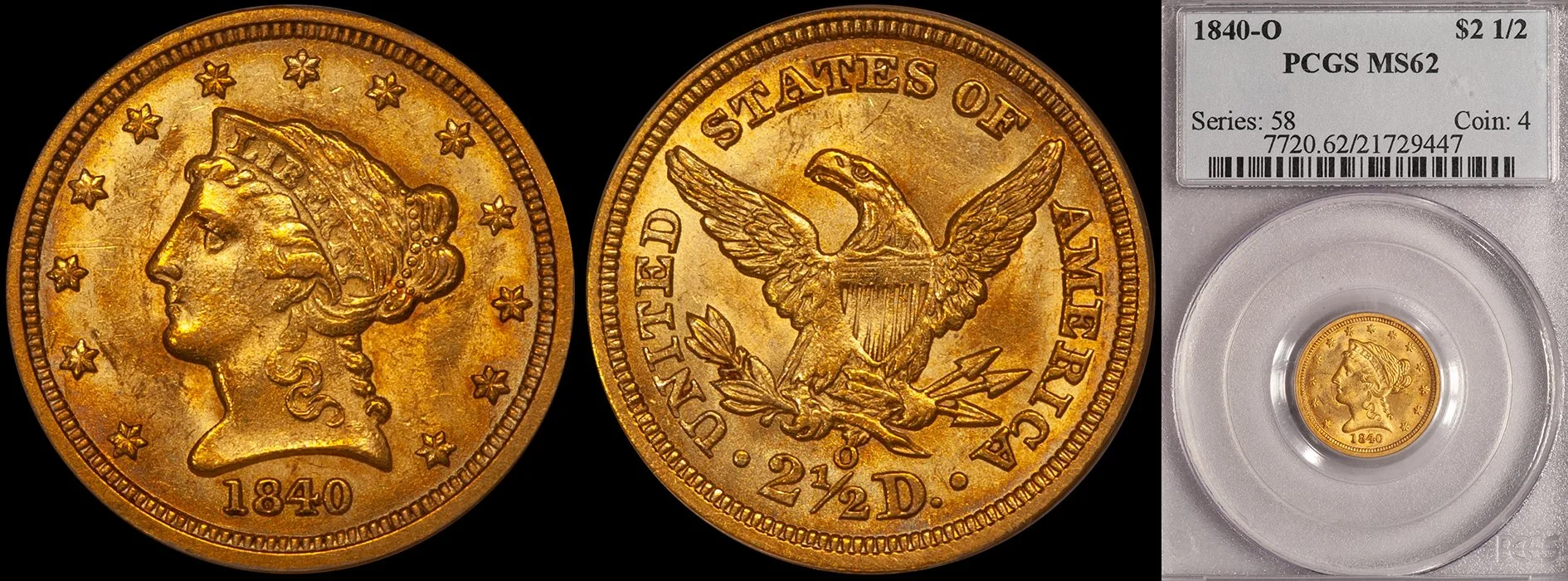
The New Orleans quarter eagle series is seeing some increases in popularity. Collectors are probably misled by inflated populations of Uncirculated and About Uncirculated coins. This is a series that $2,000-4,000 per coin still goes a long way. At the ANA I sold a gorgeous 1852-O in NGC AU58 to a collector for $2,000. I think you’d be hard-pressed to find better value in this series than coins like this. I still like the value level of the key 1845-O in EF and AU grades and also like issues such as the 1847-O, 1850-O, 1851-O and 1852-O in accurately graded MS61 and MS62.

1854-O Three Dollar Gold Pieces seem to be all over the place and most of the coins I see are poorly struck and vastly overgraded. That said, I will still buy an AU50 and better piece I see that I truly like. At the Milwaukee ANA I passed on a really nice NGC MS62 at $52,500 that quickly sold to the next person who saw it (I made a mistake and should have bought it...) In Stack’s pre-ANA Milwaukee auction, an NGC MS63, which is the single highest graded 1854-O $3.00, brought a record $115,000.

It’s become very difficult to find interesting New Orleans half eagles. I handled just one really significant piece at the ANA (an 1842-O in NGC AU58 which I sold almost immediately to a collector) and can’t recall any exciting examples in any of the pre-ANA or ANA sales. My guess is that there are a number of collectors actively working on New Orleans half eagle sets and that the demand for interesting coins far exceeds the supply. I strongly suggest buying nice examples of any of the key issues (1842-O, 1847-O, 1855-O, 1856-O and 1857-O) and I like nearly any choice, original No Motto piece from this mint graded EF40 or better.

For the last few years, I was literally begging people to buy significant New Orleans eagles. It appears that at least a few people listened to me as there now appears to be a number of people building No Motto and With Motto date sets. I still strongly recommend just about any better date No Motto coin and just about any common date With Motto in MS63 and higher grades.

Last but not least: the double eagles from this mint. I’m pretty conflicted at this point in time about New Orleans Twenties. As someone who repeatedly touted what a great value these coins were as recently as a few years ago, I’m happy that I was able to help drive this market upwards. But I wonder how much further it can go. As I mentioned above, an 1854-O in PCGS AU55 just brought close to a half million bucks at auction. That’s a whole lot of money for a fairly esoteric coin. I guess what it boils down to is the number of collectors who are putting together sets of these coins. If there are many very wealthy collectors assembling sets of New Orleans double eagles than I guess I can see basal values for the 1854-O and the 1856-O staying at their currently sky-high levels. But if there aren’t more collectors waiting in the wings to fill these holes in their sets than I wonder what the levels will be like in a few years. One last caveat: if you are working on such a set you absolutely positively need to be working with a knowledgeable dealer. At these kinds of prices, you don’t want to be making many mistakes.

2007 Milwaukee ANA Show Review

I went to this summer’s ANA Convention expecting a good but not great show. I left the show having had one of my better ANA’s in many years and I think most other dealers can honestly say the same. On the DWN grading scale, I’d have to give the 2007 ANA a solid A-. I decided not to do any of the pre-show activity. In my opinion, doing the extra three or four days leaves me too tired during the regular ANA week and this isn’t fair to my customers who are anxious to meet with me. Plus, to be perfectly honest, I just don’t have the unlimited energy I had when I was in my 30’s and could work for days at a time at an ANA level of intensity.

I arrived on Monday and attended the pre-PNG set-up for a few hours. My major goal for the week was to buy and I had decided to focus my energy on the bourse floor as opposed to the Heritage auction where I knew prices on the DWN-caliber material would be extremely high.

PNG day was Tuesday. I generally hate PNG day. It starts absurdly early (8 a.m.) and seeing other dealers in suits scares me. Plus I find this to be a generally lackluster day with little of interest going on. This year’s edition started slowly but it seemed to really pick-up steam after a few hours and by the end of the day, things were very active. I literally ran from table to table searching for interesting coins and was able to buy a number of really neat items. I had hoped to find at least one interesting deal and was disappointed that this didn’t really pan out but I was very pleased with what I did find; albeit one or two items at a time.

Wednesday was a little bit of a let down. There was not a very good turn-out as far as collectors went, so I continued to do quite a bit of wholesale business. I can’t recall a show where it was easier to sell nice coins than at this year’s ANA. And here’s something surprising: a number of formerly “dead” areas of the market are suddenly coming to life. There were numerous dealers looking for type coins, especially items like Proof-64 and better Liberty Seated silver, scarcer date Liberty Seated and Barber coins and even such perennially overlooked items as Liberty Nickels and Three Cent silvers.

What else was hot? Everyone (and I do mean everyone) was looking for coins that were either very pretty, very rare or very interesting. And early coins (i.e. those dated prior to 1835) were in huge demand. I bought and sold a number of interesting early gold coins; mostly in the $7,500 to $15,000 range.

Thursday was the best—and longest—day of the show. I started answering emails at 6:30 a.m. and didn’t finish until I left the Heritage Platinum Night sale at close to 11 p.m. I stayed busy the entire day meeting with clients, preparing coins for submission to PCGS/NGC, buying coins from other dealers, figuring bids, etc. I typically had two to four people at my table all day and I could definitely sense a real buzz in the room and from what I could tell, most other dealers were quite busy as well.

So what were some of the more interesting items that I bought and was able to bring home? A few include the following:

    An incredible original 1865 Proof set in an original presentation box, graded PR65 to PR67

    A glorious 1795 half dollar in NGC AU55

    A choice 1802 half dollar in PCGS EF45

    An Uncirculated 1861-D gold dollar (which is currently being graded at PCGS)

    An 1832 quarter eagle in choice original PCGS AU55

    A superb original 1844-C quarter eagle in PCGS MS61

    A select group of Carson City gold coinage

Some choice Liberty Head double eagles including a nice PCGS MS60 1861-S

One of the more interesting things that happened at the show involved a Midwestern investor/collector who brought a number of rare coins with him for sale. He placed his coins on display on Wednesday and there was a complete feeding frenzy as numerous dealers in upper-end coins descended on him. He sold well over $5 million in coins in two days including a number of very rare double eagles, choice early gold and a great group of choice early dollars. I was intrigued that this individual decided to forego the auction route and it didn’t seem to hurt him any as he got excellent prices for his coins.

Speaking of auctions, the Stack’s, Bowers & Merena and Heritage sales were all very strong. I attended only the Platinum Night session at Heritage and was amazed at the strength of the prices. I expect great coins to bring strong money at these sales but what surprises me these days is what the mediocre material sells for. As recently as two years ago, I could buy “product” at a Heritage sale and flip it to other dealers for a 15% profit the next day. Now, these same coins bring more than what I would sell them for. Clearly, auction prices now represent the new retail price levels for most series and I am convinced that, at least for me, I’d rather try my luck buying on the bourse floor.

My book “Gold Coins of the New Orleans Mint” was given an award for “Extraordinary Merit” in the field of United States coin books by the Numismatic Literary Guild. I wasn’t able to receive my award in person (I was too busy working!) but had it in my case for the majority of the show.

All in all, it was a tiring but very rewarding ANA. I think the strength of this show will carry over into the late summer/early fall months and we will continue to see a good market for the immediate future.

2007 Milwaukee ANA Show Forecast

Needless to say, the upcoming ANA Convention in Milwaukee is a major topic of conversation among dealers and collectors this week. How do I think this show will turn out and what are some of the trends I expect to see? Read on for some of my thoughts. 1. My gut feeling is that this will be a good but not great ANA show; probably something like a B or maybe even a B+ on the grading scale. I think part of the reason it won’t be a screaming success is the simple fact that the market is good right now but not as great as it’s been during the last few ANA shows. The second reason is the location. I know at least a few serious collectors who are not attending because the thought of a few days in Milwaukee isn’t as enticing as going on vacation somewhere exotic. And, of course, some people need to stay home and make enough money to pay for the new coins they will be buying after the show is over.

2. I can just about guarantee that every post-ANA market report you read is going to include a complaint about the lack of available material. I tend to approach major coin shows with a realistic approach these days. If I’m really lucky and all the stars align just right, I’ll be able to buy some really nice coins. If things don’t work out that well, I will buy a decent number of nice coins but not as many as I could have used. The bottom line is that nice coins are very hard to buy and even the number one show of the year isn’t necessarily going to pry them out of the strong hands they tend to be in these days.

3. The auctions are going to be strong. I spent a few hours yesterday looking through the Heritage sale on-line and compared the current bids to the numbers that I am willing to pay. My impression is that while a few interesting coins will sell semi-reasonably, many of the best lots in the sale are going to sell for exceptionally strong prices.

4. It will be interesting to see if certain dealers will be buying coins specifically in anticipation of the upcoming CAC launch. My guess is that the only dealers who will be able to create any significant positions are those with excellent cash flow. Most dealers do not have enough extra cash lying around that they can put away substantial numbers of coins for six months to a year in anticipation of a market swing. Plus you need to remember one thing about most dealers: we like the action of buying and selling and we need a continual supply of coins to sell in order for our businesses to be a success.

5. In terms of what will be in demand at the show, I think it’s safe to say that nice early gold will be actively sought and that most of the available pieces will be subpar for the grade. Better date 20th century gold will be active, especially in the Indian Head eagle series. I think the demand for branch mint gold will be pretty series-specific. By this, I mean the participants in this market will be on the lookout for better dates (such as 1861-D gold dollars and half eagles) or choice, original pieces in the $2,000-7,500 price range. New Orleans gold should continue its increased level of demand and I wouldn’t be surprised if Three Dollar gold pieces show greater activity than earlier in the year. Any coin that is extremely rare and which has a high “coolness factor” will be extremely easy to sell (hopefully I can buy a few coins like this!). But this, of course, is no surprise.

The Availability of Original Southern Branch Mint Gold Coins - Part One

Need to get the rest of the article from Mary. In a recent blog (July 30, 2007) I discussed my criteria for what constitutes "originality." Using this criteria, how available are Charlotte, Dahlonega and New Orleans gold coins? In the first of what may be a multi-part series of articles, I’m going to look at C, D and O mint gold dollars and discuss their availability with original surfaces and color.

What Constitutes Originality?

The term “original” gets thrown around a lot these days. I should know; I probably use (and overuse) this term as much as anyone. But as much as this term is used, I think there is considerable confusion and disagreement over what original actually means. As it applies to 18th and 19th century United States gold, the concept of originality fits just a small percentage of actual coins. Unless you can trace a complete history of a coin, it is essentially impossible to state with certainty that it is truly original—i.e., it has never been cleaned or in anyway enhanced.

So what exactly do I think constitutes originality? I think it’s easier to explain what “isn’t original” than what “is original.”

A coin that is original has the right color for the issue. On rare gold coins, a give-away that a coin has “bad” color is when it is a bright orange or intense reddish-gold hue. This bad color tends to be artificially applied and it is generally done in an attempt to hide hairlines or surface problems. Original color tends to be a medium to deep green-gold or rose-gold hue. In all of the books that I’ve written, I’ve mentioned the color(s) that I’ve observed on specific gold issues. I highly suggest that you read these books when you are making a purchasing decision.

An original coin has surfaces that lack obtrusive hairlines. When a coin is cleaned, it tends to show hairlines. But here’s where a sticky subject comes up: what about a coin that was cleaned 75 or even 100 years ago and which has now naturally retoned in deep hues atop these hairlines. Is it original? Strictly speaking, no. Is it desirable? If the coloration is attractive and the hairlines are not too dense, absolutely. One has to operate under the assumption that virtually all 18th and 19th century United States gold coins have been cleaned at one time and light, unobtrusive hairlines can’t be considered as a detriment when calling a coin “original.”

An original coin also has luster that has not been significantly impaired (assuming, of course, that it does not have enough wear that the luster has been lost). When a coin is cleaned or processed, the luster is changed. Non-impaired luster has a circular or “cartwheel” pattern. When it is disturbed, the luster no longer rotates in a circular pattern. It becomes irregular and it appears to “jump” as opposed to spinning.

A coin that is original also does not have any sort of putty or “gunk” that has been applied to the surfaces in an attempt to hide imperfections. This can usually be determined by the presence of dull or whitish areas that can be seen when a coin is viewed in a good light source.

In summary, a coin that is original is none of the following:

    It has not been recolored.

    It is not unduly bright or shiny.

    It does not have an abundance of hairlines, especially on both sides.

It does not have any foreign substances on the surfaces that were applied in an attempt to hide imperfections.

Given the fact that so few coins meet these stringent criteria, can the collector who favors original coins actually ever expect to find anything for his collection? I would say that the answer is yes.

There are still a decent number of coins that are either original or which have an “original appearance.” (Perhaps this last term is actually more accurate, given the fact that no one can state with absolute certainty that a 150 year old coin has or hasn’t been completely untouched in its long and winding road through numismatics and/or commerce).

Coins that have a good provenance tend to have an original appearance more often that coins that just happen to show up on Ebay. I think we can state with relative certainty that collectors like Mrs. Norweb and Louis Eliasberg were not sitting at home doctoring their gold coins.

Is original always best? That’s an interesting subjective question. There are gold coins with coloration that I refer to as “Euro” which have very dark hues caused by years and years of sitting undisturbed in bags in European vaults. This color is clearly natural but it can be pretty ugly; even to a purist like me who loves coloration on coins. In the case of a coin with dark Euro-grime on it, I could certainly see washing it in soap and water to remove the top layer of dirt. Once this is done, is the coin technically “original?” Or has it been processed? A smart dealer I know once told me that if a coin has been processed in a solution that isn’t lethal to humans upon drinking it is still natural. As you can see, this becomes a matter of semantics that is very difficult to answer.

The bottom line is that there IS clearly a “look” that coins that are perceived to be original do have. This look is appealing to sophisticated collectors and dealers and few coins display it.

The 1838 Eagle

One of my absolute favorite United States gold coins is the 1838 eagle. Here are some impressions I’d like to share about this fascinating issue. The ten dollar gold denomination was abolished in 1805, along with the silver dollar denomination. I’ve read in various coin books that the reason for this was “extensive melting by bullion dealers.” I’m a bit skeptical about this as a reason and would personally think that for Eagles, the reason had to do more with a lack of demand and/or available gold bullion.

After a thirty-four year hiatus, the eagle denomination was resurrected in 1838 and the task of designing the new coin fell to Christian Gobrecht. The new design featured a bust of Liberty facing left on the obverse and an eagle on the reverse. Liberty’s neck on the 1838 eagles is distinctly curved and the back of the neck ends in a curious, abrupt triangle. Another identifying factor is strands of hair over the ear which are swept-back in appearance and which cover much of the ear. The portrait is positioned quite a bit differently than on other Liberty head eagles. On the 1838 (and some of the 1839), the tip of the coronet is placed below the outside of the sixth star while the back of the neck is below the outside of the thirteenth star. On the later issues, the tip of the coronet is placed between the fifth and sixth stars while the back of the neck is located past the inside of the thirteenth star.

In 1838, only 7,200 eagles were struck. I estimate that 50-75 are known today and break these down as follows:

    Very Fine and below................15-25

    Extremely Fine.....................23-31

    About Uncirculated.................10-15

    Uncirculated........................2-4

Most examples of this date grade VF30 to EF40 and show clear evidence of considerable circulation. The surfaces are generally very heavily abraded with clusters of marks seen most often in the left obverse field. This issue has better luster than one might expect and higher grade pieces are sometimes quite reflective. Most show enough wear, however, that the luster is considerably impaired. The natural coloration tends to be a medium to deep greenish-gold hue. I have not seen many examples that have original color as most have been dipped or cleaned at one time. The strike tends to be reasonably sharp with good overall detail at the centers; some examples have weakness on the radial lines of the stars.

The 1838 eagle is scarce in all grades and it becomes truly rare in properly graded AU50 or better. Most AU examples are in the low end of this range and a solid AU55 to AU58 is very rare and extremely desirable. I have personally seen only a handful of nice examples in the last few years, the best of which is a PCGS MS63 that sold for $63,250 in the April 2002 Heritage auction.

There are also three Proofs known. One is in the Smithsonian and it grades PR63, one is in a private collection (ex: Cardinal Spellman) and is graded PR65 by PCGS and the final example is also graded PR65 by PCGS and is ex: Pittman. This coin last sold for $550,000 in 1998 and it would sell for considerably more than this if made available.

Pricing for the 1838 eagle is currently very inaccurate. Coin World Trends shows values for this date at $2,900 in EF40, $4,025 in EF-45, $6,250 in AU50 and $11,000 in AU55. If you can purchase a problem-free 1838 eagle in these grades for prices anywhere near these levels, you’ve found yourself an incredible bargain. I’ve noticed that in the last few years, lower and medium grade examples that have been offered for sale at auction have brought levels far, far greater than Trends.

So what is it exactly about this issue that I found so intriguing? I can think of a number of reasons. It is a first-year-of-issue coin and the first Eagle to be struck after the denomination was resurrected after a three-and-a-half decade hiatus. It is a low mintage coin that is scarce in all grades and very rare in higher grades. It is a unique and very different design that was used on this denomination for just two years. And last but not least, it is exceptionally undervalued at current price levels.

State of the Market: Carson City Gold Coins

For our next State of the Market Report, we’re going to take a look at Carson City gold coinage. How have the half eagles, eagles and double eagles from this ultra-popular western branch mint fared in the past few years? I. Overview

The number of serious Carson City gold coin collectors appears to have increased in the last few years. At the same time, at least three major collections have been sold (Old West, “Morgan” and the Washington D.C. collection that I sold privately in 2006). This has meant that some fantastic quality individual coins have been available with some record prices having been achieved. This has been slightly tempered by the fact that a group of significantly overgraded Carson City half eagles (and eagles) have been offered for sale at a number of auctions beginning in 2005. Until the bulk of these are removed from the market, Carson City gold in general will remain highly bifurcated and marked by huge value differences in similarly graded issues. This is truly a market where one AU55 1876-CC half eagle can be worth $17,500 while another can be worth $12,500.

II. Half Eagles

Of the three Carson City gold denominations, I would say that half eagles are probably the least popular right now. Prices for many Carson City half eagles have stayed fairly flat—or even dropped—in the last few years. There are certainly exceptions: choice, high grade examples of nearly any pre-1890 date are strong and even lower grade examples of the key issues (such as the 1870-CC, 1873-CC and 1878-CC) are in great demand in the VG to VF range. With coins that are priced at $20,000 and up, collectors are very fussy and will not generally purchase a coin which they or their trusted advisor(s) do not feel lives up to its stated grade.

I think that the market for Carson City half eagles will remain spotty over the next few years. My gut feeling is that exceptional coins will continue to do quite well and that many of the key issues from the 1870’s will see across the board demand. In my opinion, the most underrated Carson City half eagles right now are the 1877-CC, 1878-CC and the 1881-CC.

III. Eagles

Spectacular Carson City eagles have brought spectacular prices during the last few years. As an example, the finest known 1870-CC, graded AU55 by PCGS, sold for $115,000 in ANR’s August 2006 auction while a PCGS MS64 example of the more common 1890-CC was bid to $80,500 in Heritage June 2006 sale. But results for mediocre or low-end Carson City eagles have been quite soft in the past few years. This is mostly attributable to a group of overgraded, low-end coins (mostly valued in the $15,000-35,000 range) which an investor has had mixed success selling at auction during the last two years. I personally know of at least four or five collectors of high quality Carson City eagles and they are all looking for essentially the same type of coins right now: choice and original with good eye appeal.

I feel that once the last of the inferior quality Carson City eagles mentioned above are finally sold, the market for these coins will heat up. For collectors who enjoy a challenge (and who have an appropriate budget) this is a great series to collect. In my opinion, the most undervalued dates in this series are the 1870-CC, 1873-CC, 1877-CC and the 1883-CC.

IV. Double Eagles

If you had asked me a few years ago if Carson City double eagles were overvalued I would have probably said yes. If you ask me the same question today I would still probably say yes but with less reservation than in the past. When compared to half eagles and eagles from this mint, Carson City double eagles appear to be overvalued. But (and this is a big, big “but”) the double eagles from this mint have a sexiness factor that is greater than nearly any other series of United States coin. Let’s face it: even if you don’t really care about coins, it is pretty hard to resist the allure of a big, attractive gold piece that saw duty in the most romantic era in the history of this country. And because of this fact, Carson City double eagles will always be very, very popular.

My biggest complaint about this series is that while prices have shot up in the past few years, grading standards have decreased. I often see coins like 1871-CC double eagles in AU50 holders that a few years ago would have graded EF45; or even EF40. Given the fact the Trends for an AU50 1871-CC is now $40,000, I have a hard time spending this kind of money on an example for my inventory which has tons of bagmarks and/or a near-absence of luster. The same goes for dates like the 1872-CC, 1873-CC, 1878-CC and 1879-CC. These are now $10,000++ coins in AU50 and higher grades and if a new collector is going to be spending this kind of money on these dates, I would hope he is getting a nice quality coin.

That said, I think there is still some value to be had in this series. I will continue to buy nearly any attractive, original AU55 to MS61 Carson City double eagle I can find for under $5,000. I also like very choice and reasonably original examples of the key dates but, as I said above, I usually pass on examples that I think have inferior eye appeal.