1875-CC $20.00 NGC AU58 CAC

You don't often see Carson City double eagles that are nearly free of marks and this coin is just that: a piece that probably never saw circulation and somehow avoided the throw-it-in-a-bag fate that met so many of these coins when they were shipped. Both sides have thick, frosty luster with nice rose and green-gold color. A few small grease stains on the obverse are mint-made and do not detract.
1879 $20.00 PCGS MS62

After many years of not handling an example of this date in MS62, this is the second I have had in around a month. The last one, graded by PCGS and approved by CAC, sold quickly and received multiple orders. This example is comparable with nice surfaces, good luster and pleasing natural green-gold, rose and orange color. As a date, the 1879 is seldom seen above MS62 and there is a huge price jump to the next grade as an accurately graded PCGS MS63 is worth in the area of $17,500. If I were doing a date set of Type Three $20 Libs, I would stick with a nice MS62 and use the $10,000+ I saved towards more coins!

1882-CC $20.00 NGC MS60

This coin has a really outstanding "look" with naturally bright and very frosty surfaces that are splashed with golden-orange color which deepens towards the borders. The obverse has some marks in the fields while the reverse is choice and grades at least an MS61 to MS62 on its own. As a date, the 1882-CC is considerably scarcer in high grades than generally known. When seen in Uncirculated, it typically grades MS60 to MS61 and is riddled with marks; I haven't seen one better than MS62 in years. Only one MS60 has appeared at auction in the last three years (a PCGS coin) and this is the first I have handled in some time.

1864-S $10.00 PCGS VF30 CAC

With the exception of the 1875, the 1864-S is the rarest Liberty Head eagle. There are fewer than two dozen known and years can go by without the advanced collector having an opportunity to acquire an example. This fresh piece, which was just graded by PCGS after being off the market for decades, is a "gem" for the grade despite being "only" a VF30. Detail-wise, it is close to being a full EF and I think PCGS was conservative due to the weakness of strike on the eagle's neck feathers which is diagnostic for the date. The color is lovely with deep russet shades which change to iridescence at the date and the left stars; the reverse has a natural ring of concentric color at the border. This coin has the look of a piece that might have been stored in a leather pouch and the surfaces are incredibly clean for the issue. In the recent "secret" Rumsey auction held in February, a vastly inferior PCGS VF30 with signs of cleaning and a large reverse scratch sold for $34,500 with the buyer's premium. This piece is far, far nicer and it represents a fantastic opportunity for the advanced collector to obtain one of the rarest gold coins ever produced at the San Francisco mint.

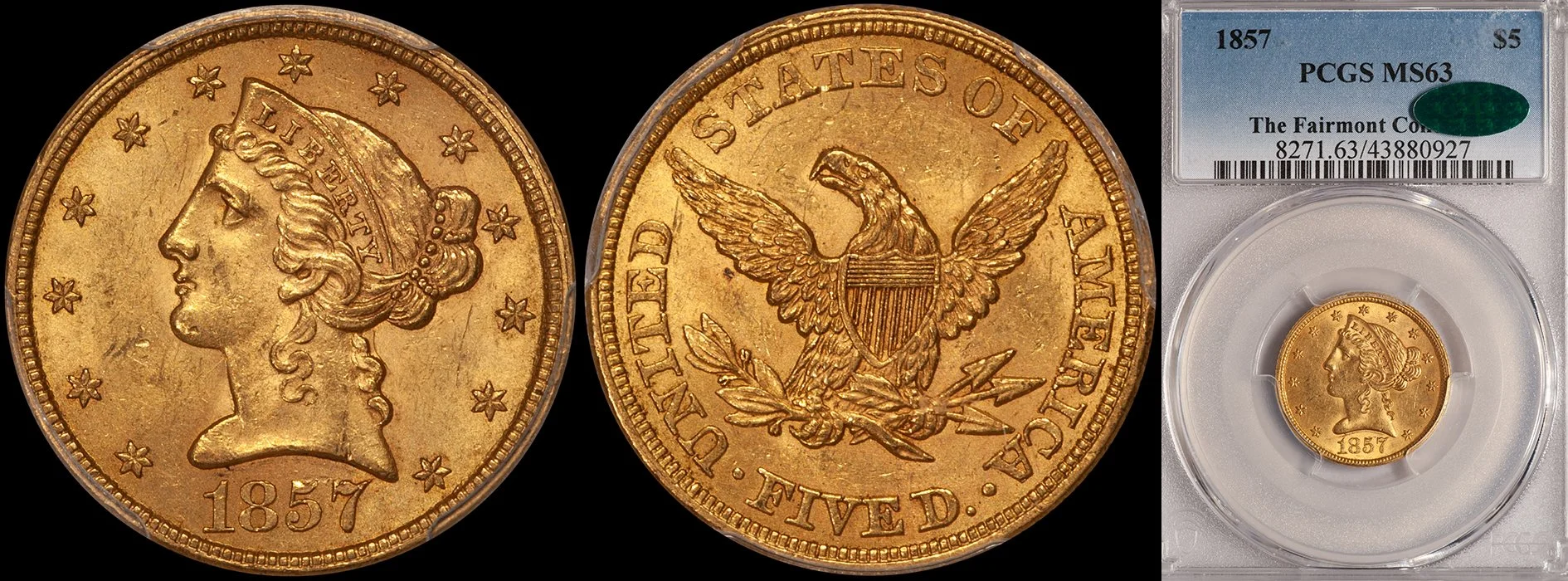
1802/1 $5.00 NGC VF35 CAC

Early gold tended not to circulate extensively and, as a result, it is very hard to find coins like Bust Right half eagles in grades below EF45. This piece shows a decent amount of wear but it is surprisingly original and free of problems. In fact, the detail is suggestive of an EF40 to EF45 coin but it appears that NGC deducted some points on the grading scale due to some old marks clustered in the obverse fields. Both sides are well-detailed and show nice old green-gold color which is contrasted by flashes of reddish-gold and sunset orange. I doubt that are many more early half eagles in this grade range that are pleasing enough to merit a CAC sticker and this is essentially the best available quality in today market at less than $7,500. If you have been looking for a coin of this sort, I'd urge you to give me a call ASAP as it could be some time before I find another!

1893-O $5.00 PCGS MS62

The 1893-O is the most available of the three With Motto Liberty Head half eagles produced at this mint. It is common in circulated grades and not especially hard to find in MS60 to MS61. Properly graded, lightly abraded MS62's are scarce and this date is rare above this level. This example is solid for the grade with natural medium yellow-gold color, no marks of note and good overall detail.

1861-S $20.00 PCGS AU58

Due to a lack of coins being found in shipwrecks, the 1861-S Normal Reverse is the hardest San Francisco double eagle from the Civil War to find in higher grades. In fact, it is very rare in full MInt State and this AU58 "slider" is about as nice an example as what is generally available for the issue. This piece has just a slight amount of wear seen on the high spots and some minor luster breaks in the obverse fields. There two or three small blackish areas of discoloration on the obverse where the copper used to alloy the gold in the planchet was not alloyed properly.

1807 Bust Right $5.00 PCGS MS62

BD-5, High R-6.. In 1807, two varieties of half eagle were struck: the old Capped Right and the new Bust Left. Of the two, the former is scarcer, especially in higher grades. This is a delightful example for the date with a really "fresh" appearance that suggests an MS63 grade, Both sides show lovely rich yellow-gold and reddish-orange colors and this piece has never been dipped or processed unlike so much early gold. The strike is very slightly weak at the centers as is common for this die variety and there are a few minor mint-made adjustment marks on the obverse rim from 3:00 to 5:00. There are no less than five die cracks seen on the obverse including a few terminal state ones; clearly the dies for this varirty were about to break apart as this coin was made. Although I am not asking a rarity premium for it, BD-5 is believed to have only twenty or so pieces known and most are in lower grades. A wonderful type coin for the collector who insists on freshness with his early gold purchases and a date that is undervalued in this grade and with this degree of eye apopeal.