1824 $5.00 NGC MS60 CAC

BD-1, High R-5. A total of just 30-40 examples are known for this date. As with most of the half eagles from the 1820's, this issue was almost completed eradicated by melting. The 1824 is at least twice as rare as the 1823 and comparable in rarity to the 1826. I regard it as just a hair rarer than the 1827. As with nearly all the dates from this era, the 1824 saw very little circulation and many of the survivors grade MS63 to MS65. The present example has no real wear but it does show some cabinet friction on the high spots and light, scattered marks on the surfaces including a small dig below the second S in PLURIBUS on the motto. The color is a pale green-gold and the luster is satiny in texture. I don't generally like coins graded MS60 but this piece has very good eye appeal and it is clearly nicer than what you'd expect to see in an AU58 holder. As one might guess, there has never been an MS60 example of the 1824 half eagle sold at auction. The last piece to sell was a superb PCGS MS63 that I bought out of the 2012 FUN sale (as Lot 4675) where it brought $126,500. In the same auction, a nice PCGS AU58+ example of the 1827 (a date that I personally think is just a tiny bit more available than the 1824) sold for $54,625; it is now on another dealer's website priced at $65,000. Fat Head half eagles from the 1820's and 1830's are finally being recognized for their extreme rarity and it may be years before the collector has another chance to purchase an 1824 in any grade.
1823 $5.00 PCGS AU55

BD-1, High Rarity-4. There are probably no more than 100 or so known for this date and it is considerably harder to find than the 1818 and 1820, its two rivals in the Fat Head series when it comes to overall rarity and price. This piece is lightly circulated but its slightly weak strike makes it appear a bit more worn than it actually is. The fields are quite reflective as is typical for the issue and there are a few minor marks noted including some in the left obverse field that seem to be the result of handling. There have been no AU55 examples of the 1823 half eagle thaat have appeared at auction since February 2002 and in October 2011, an NGC AU58 example with CAC approval brought $20,700. After the recent sale of the Jacobson collection of Fat Head half eagles, these coins are finally realizing the attention that they deserve.

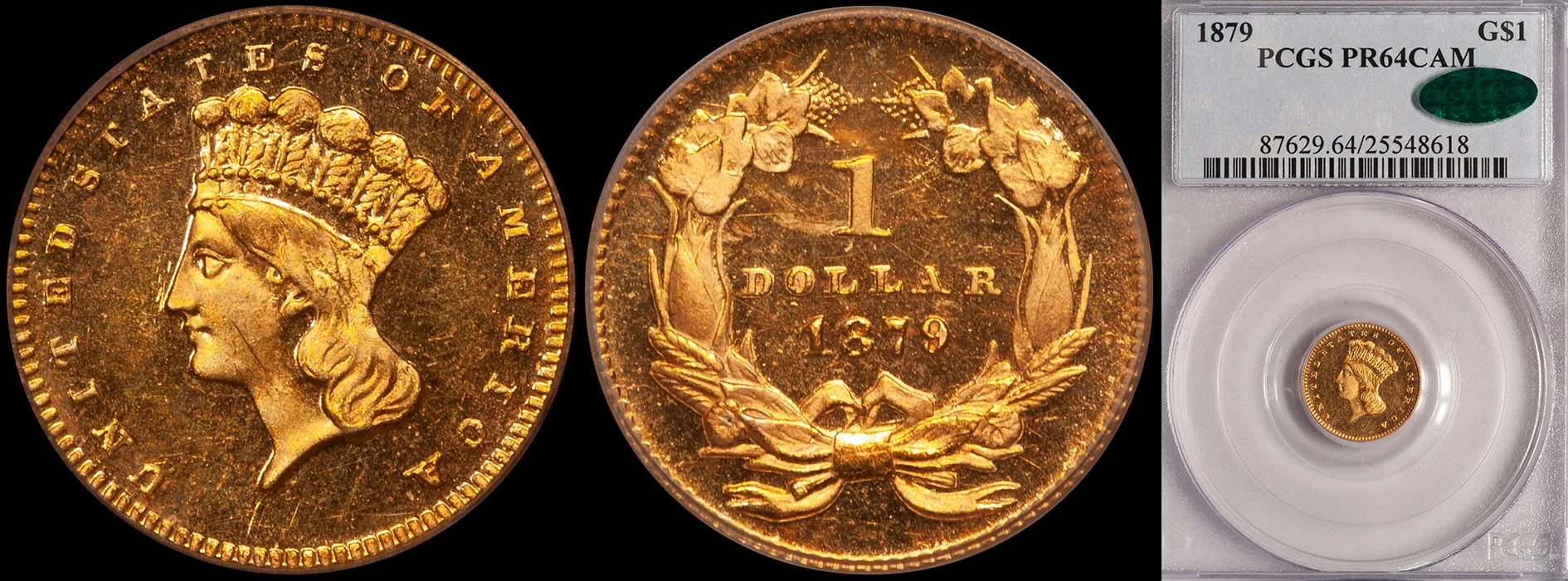
1859-D $1.00 PCGS AU55 CAC

Old Green Label holder. By today's standards, I grade this coin a solid AU58. While showing a typical strike with some weakness at this center, there is little else that is "typical" about this coin. It shows attractive deep, even green-gold color on the obverse and reverse with a good deal of underlying luster. Some dirt can be seen within the lettering on the obverse and the surfaces are very clean with no major abrasions or mint-made defects notable to the naked eye. While probably the most available Dahlonega gold dollar of the Type Three design, it is never easy to locte an affordable example of this date with original surfaces and good overall eye appeal.

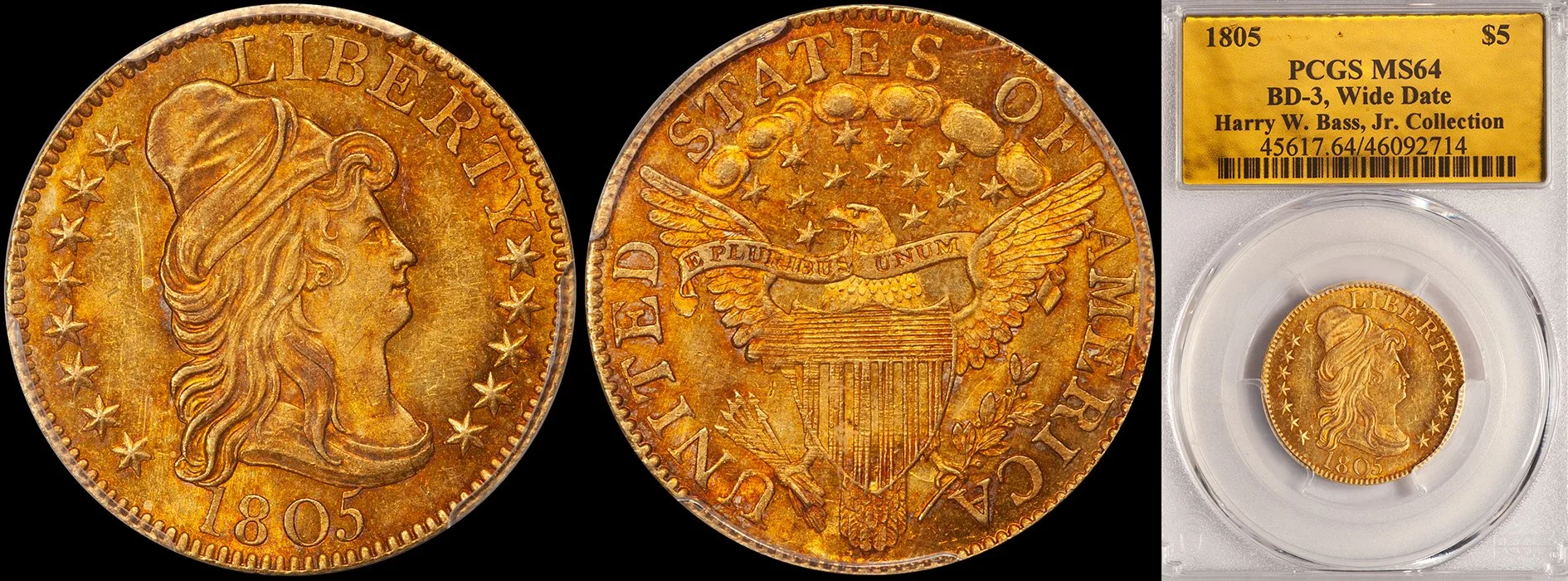
1813 $5.00 PCGS MS64

BD-1, Rarity-2. The 1813 is the single most available date of the Capped Head Left large planchet half eagle type that was produced from 1813 through 1829. But "common" is a relative word and the 1813 is still a hard coin to locate with fewer than 1,000 extent in all grades. As one might expect, this issue becomes rarer as the grading scale is ascended and in MS64 it is a truly scarce coin with Gems being very rare to extremely rare. This specific coin is among the best 1813 half eagles that have come onto the market in many years. It has superb deep green-gold and yellowish colors atop very clean and very frosty surfaces. If you are familar with this issue you know that strike can be a problem and this piece is nicely detailed with just the slightest amount of weakness on the rims as typically seen. One ultra-fine obverse hairline narrowly removes this coin from the Gem level and a $100,000+ price tag. The last APR for an MS64 is Heritage 10/11: 4875 (graded by NGC) that sold for $46,000 while the last MS65 is Heritage 8/11: 7539 (also graded by NGC) that sold for a reasonable $92,000. If you are a collector who is putting together a meaningful type set of early gold and you are lookig for a high quality example of this important issue, give this 1813 half eagle some serious consideration.

1801 $10.00 NGC AU58 CAC

BD-2, Rarity 2. Early die state with no cracks or clashing noted. I really like being able to offer Heraldic Eagle ten dollar gold pieces for sale on my website but the problem with these beautiful coins is that nearly all the ones that I see these days are washed-out, free of any color and grossly overgraded. That's why I was so happy to obtain this coin. It is solid for the grade with very nice surfaces, a significant amount of original skin and pleasing medium coppery-rose color which is a bit more intense on the obverse border than anywhere else. The surfaces are extremely clean with the exception of a very small grease stain on the obverse near star two and a tiny old mark on Liberty's cheek. There are probably around 750-1000 examples of this date known to exist and you can find an 1801 in grades up to an including MS63 to MS64. But for most collectors, a nice AU55 to AU58 is perfect as it displays the loveliness of this design but it is still within reason from a price standpoint. Very low end AU58 examples of this type trade on a wholesale level in the $19,000-21,000 range. The last auction trade for an NGC AU58 1801 eagle with CAC approval that I am aware of is Heritage 2010 ANA: 3543 which brought $23,000. CAC has approved fifteen examples of this date in AU58 with another 28 higher than this.

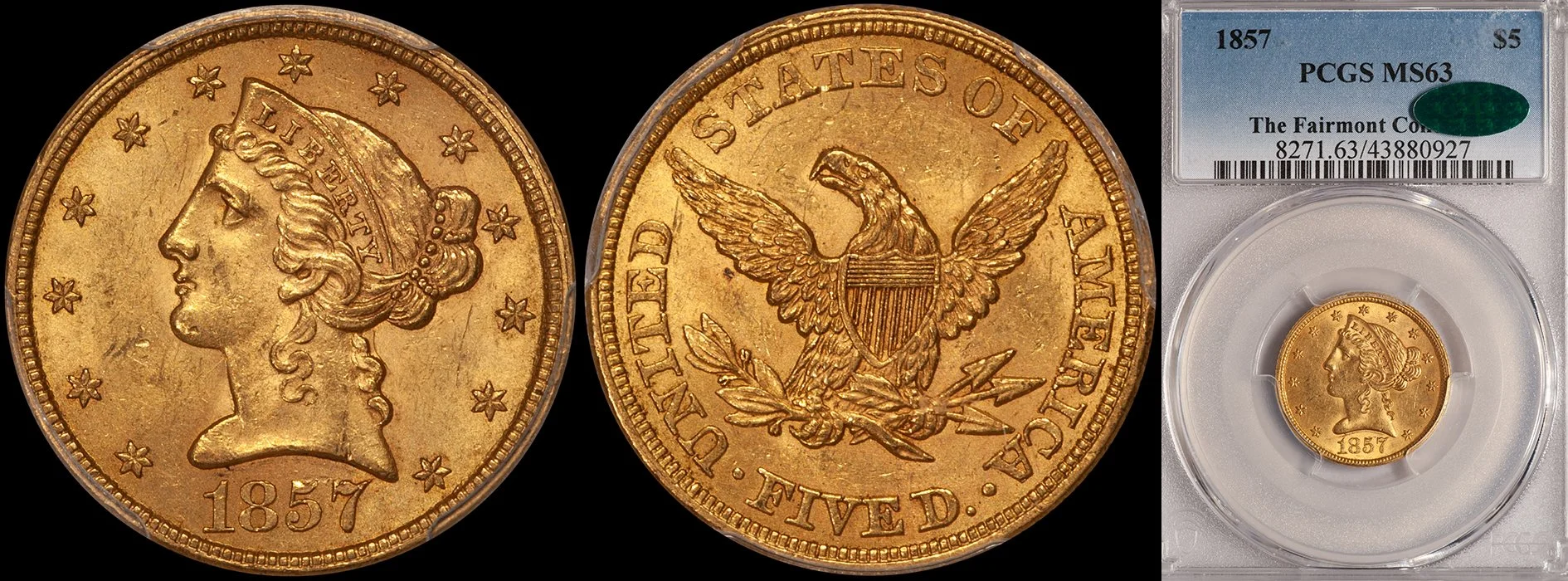
1807 Bust Right $5.00 PCGS MS63 CAC, OGH

Bust Right variety. BD-1, High R-4. Small Reverse stars; the only one of the six half eagles struck this year with this reverse and a distinct naked-eye variety as such. Old Green Holder. A stunning, semi-prooflike example with deep natural yellow gold color seen over the partially reflective fields. Well struck and well made with no significant abrasions or mint-made planchet issues; nicely detailed at the centers and borders with most of the fine design elements showing nearly full clarity. This piece is housed in an old holder and it was last graded at least two decades ago. Unlike so many Bust Right half eagles in MS63 holders, it hasn't been dipped or enhanced and it has really exceptional overall eye appeal. While common in the lowest Uncirculated grades, the 1807 Bust Right becomes rare in properly graded MS63 and it is extremely rare above this with just five finer at PCGS (four in MS64 and a single MS65). The last MS63 to trade at auction was an NGC coin (Heritage 1/12: 4855) which was not CAC approved and which was not high end for the grade; it brought $21,850. You have to go all the way back to the Superior 1/06 sale to find a PCGS MS63 at auction; that coin brought $20,700. Given the fact that the present example is PCGS graded graded, CAC approved and in an old green label holder (quite a triumverate!), I think it is worth at least a 20% premium above the above-referenced NGC example. As of 1/12, only three 1807 Bust Right half eagles graded MS63 have been approved by CAC with two finer than this. A great example for an advanced type set or date run of early half eagles.

1843-O Large Date $2.50 NGC AU58

Large Date variety. The rarer of the two varieties of quarter eagle produced at the New Orleans mint during this year, the 1843-O Large Date is the second scarcest issue in the series after the 1845-O and the third scarcest in Uncirculated after the 1845-O and the 1842-O. This fresh, wholesome example has great color with a rich natural yellow-gold hue visible on both the obverse and reverse. It is likely that this piece never actually entered circulation but it does have some abrasions scattered in the fields and on the neck and lower cheek of Liberty. The NGC population figures for this date in AU58 is much inflated by regrades and it is likely that no more than seven to eight exist which are as nice as this lustrous "slider."

1854-S $1.00 PCGS AU55

Old Green Label Holder. By today's standards I think this coin is right in the middle of the "line" between an AU55 and an AU58. The 1854-S is the first gold dollar struck at the new San Francisco mint and this makes it a very significant coin from a numismatic perspective. This lustrous example is sharply struck and very lustrous. It shows some minor areas of mint-made roughness on both the obverse and reverse which is understandable when one considers that this is the San Francisco mint's first attempt at striking the challenging Type One design. A small mark on the face appears to be the result of contact from another coin many years ago. It is not easy to find this date in the higher AU grades with good eye appeal and this is a nice coin for the date and grade. In my opinion, a very undervalued issue, given its historic importance.

1862 $10.00 NGC AU53 CAC

As recently as a few years ago, the true rarity of this Civil War eagle was not really known outside of the Liberty Head eagle specialist community but this changed when a PCGS AU58 example sold for $25,300 in the Stack's 8/10 auction. There were 10,960 struck but most 1862 eagles were melted and the number known today is likely no more than 100-125 in all grades. I have never seen or heard of an Uncirculated piece and this date is very rare in the higher AU grades. Most of the coins in AU holders are heavily abraded and have been dipped and this clean, natural-looking coin has the best eye appeal of an 1862 eagle that I have seen in years; including the aforementioned PCGS A58. It has a good deal of luster below medium natural green-gold color and there are not many marks of note on the surfaces. A small area of natural toning surrounding the eagle's head and upper wings serves as ready identification. CAC has approved three 1862 eagles in AU53 and three better.