The "Warehouse" Theory of Coin Investment

As anyone who knows me will be quick to point out, I do not generally sell rare coins as an investment. Stocks and bonds are an investment; rare coins, in my opinion, are a collectible that have the potential to appreciate in price if a purchase is approached with the mindset of an intelligent collector. But lately, I have come to realize that there probably is a good way to make money buying coins with a short-term focus. This approach is what I call the "warehouse" theory.

The gist of this theory is simple. There are certain coins that are always in demand. For example, whether the coin market is good or bad, everyone wants a Stella or a Chain Cent. What if you owned a few nice examples of these ultra-popular coins and the market had to come to you instead of the usual you-go-to-the market scenario?

Here's a classic example of the warehouse theory in action. One of the most popular branch mint gold coins is the 1854-D Three Dollar gold piece. In the higher About Uncirculated grades this is an expensive but continually in-demand issue.

For a variety of reasons, an uncommonly high number of AU-55 and AU-58 1854-D Three Dollar gold pieces were available in late 1999 and early 2000. In fact, enough were available (in this case approximately six or seven pieces), that prices "overcorrected" for this issue and fell 20%. An NGC AU-58 1854-D Three Dollar gold piece, which had once been worth $35,000-$40,000 wholesale, was now only worth $28,500-$31,500 in the wholesale market.

It was my opinion that at the new price levels these 1854-D Three Dollar gold pieces were great values. The ideal strategy was to buy every piece that was available at the cheapest price, hold them and wait for their level of demand to return. And when it did return, there would be no coins available--with the exception of the pieces I had put away.

My solution was to call a client of mine and explain the situation. While he is primarily a long-term collector, he saw the interesting situation that these coins presented. So he gave me the go ahead to purchase all the coins I could find. Within thirty days I had bought four 1854-D Three Dollar gold pieces in AU-58 at an average cost of $29,000.

Four or five months later, I started getting phone calls from other dealers searching for high grade 1854-D Three Dollar gold pieces. Some were aware that I had bought a few; others called me due to my reputation as someone who either owns important Dahlonega coins or knows where they are at. I was able to sell all of the coins I had purchased in the $31,000-$33,000 range.

Here are some suggestions about how to approach this theory:

1. Select coins with a traditionally high level of demand

There are certain coins that have been popular for many decades and will continue to be popular. There are a number of reasons for the popularity of these coins: first-year-of-issue status, low mintage figure, historic significance or attractive design. Examples of gold coins that fit into this category include: 1855-C and 1855-D gold dollars, 1861-D gold dollars, 1796 No Stars quarter eagles, 1808 quarter eagles, 1854-D and 1854-O three dollar gold pieces, Stellas, 1795 half eagles, etc.

2. Avoid popular but overly available coins

A warehouser might consider "putting back" a few High Reliefs. While there is no denying the great popularity of this issue, they are too easy to locate. Since anyone who ever wants a High Relief can find one with no problems, having a stash of a half dozen pieces will not create a ripple of excitement in the market.

3. Work with a dealer who specializes in what you are warehousing

In order for a warehouse investment to work, it is important to choose a dealer who has good connections; both on the buying and selling end. Let's say that you have decided to warehouse 1893-S Morgan Dollars in Mint State-63. Unless your dealer is a specialist in this area and knows which collectors are looking for these coins, he serves no real purpose. On the other hand, if he has a strong collector base, the chances are excellent that he will receive regular phone calls from collectors and other dealers who are looking for nice 1893-S dollars.

4. Keep it quiet

With the exception of you and your dealer, you should refrain from telling anyone else about your plans.

5. Have a plan and stick to it

If you have decided to warehouse three examples of an expensive, rare coin, don't let your dealer talk you into more. And establish sell levels before you buy any coins. Let the dealer know that you want to make X% of money on each coin. But don't be greedy and miss out on a potential sale of an expensive coin because you want to make an extra $500.

My 12 Favorite United States Gold Coins

About a year ago, I chanced upon a few coin dealers sitting in a hotel lobby bar after a long day at a convention. When coin dealers gather in small groups, their conversation often turns to--surprise, surprise--coins. The conversation this evening was an interesting one: what were their very favorite United States coins. I recently remembered this late night conversation and thought it would be an interesting topic for an article. What I've decided to do is list my personal twelve favorite United States gold coins. These are not necessarily coins that I've owned or sold. The one major parameter here was that I had to have seen them in person. (And they had to be coins that I "fell in love with" and found them very interesting; as well as very rare). While none of these are currently for sale, these are the sort of coins I would love to have in my own coin collection--that is, if I had a personal coin collection and if I had very deep pockets.

Please note that because of my orientation towards mid-to-late 19th century issues, this list does not include any early gold or 20th century pieces. I could easily have constructed a list of twelve issues from each of these areas; and I may do so in a future article.

So here it is--my "Dream Team" of United States gold coins (listed in denomination and date order):

1. The North Georgia Collection 1849-C Open Wreath Gold Dollar, PCGS Graded About Uncirculated-58

The first coin is a little bit self-serving as it represents the single most expensive coin that I have ever owned and sold. The 1849-C Open Wreath gold dollar is one of the great rarities in all of United States numismatics. There are only four known and this particular piece is the finest of these. It is also the discovery coin and it has a very interesting pedigree dating back to the 1920's. It is an extremely attractive, totally original coin with lovely deep green-gold coloration and choice surfaces. It was sold to a private collector by Blanchard & Co. in 1999 and this lucky individual now owns what I regard as the single most important United States gold dollar in existence as well as the single valuable Charlotte gold coin. (By the way, the listing of a second AU-58 1849-C Open Wreath Gold Dollar in the PCGS Population Report is a clerical error. There is only one known in this grade.)

2. The Miles-Ullmer Collection 1861-D Gold Dollar, PCGS MS-64

I have always been totally enamored with this issue. It is the only coin that can unequivocally be attributed to the Confederate States of America. In April 1861, the branch mint at Dahlonega was seized by the Confederacy and approximately 1500-2500 gold dollars were produced. The 1861-D is a very scarce coin although it is slightly more available in high grades than is sometimes acknowledged. The finest known 1861-D gold dollar is the present example. It is currently owned by an Alabama collector and it has also been in such famous collections as George Elliott, Arthur Montgomery, Theodore Ullmer, R.L. Miles and Grant Pierce. It is a superb, well struck piece with great color and surfaces.It was recently graded Mint State-64 by PCGS and it is the highest graded 1861-D from any service. It is clearly the finest known example of this rare, popular and historic Dahlonega issue.

3. The Elrod Collection 1842-C Quarter Eagle, PCGS Mint State-65

I can remember the first time I saw this coin in the early 1980's. I had never seen an 1842-C quarter eagle that graded higher than About Uncirculated-50 (by that era's standards). And here, looking like it had been preserved in a vacuum chamber for 140 years, was a superb gem piece. This coin has a dual significance, in my opinion. Not only is it the finest known 1842-C quarter eagle, it is the finest known Charlotte quarter eagle of any date that I have seen or heard of. The fact that this is a very rare issue as well as the finest known for the type makes it an extremely special coin. After being owned by Stanley Elrod, the noted Charlotte specialist, it bounced around in a few collections until 1999, when it was purchased by a Georgia collector who specializes in truly great coins.

4. The Brand Collection 1845-O $2.50, PCGS Mint State-63

The 1845-O quarter eagle is one of the great unsung rarities among the 19th century U.S. gold issues. Only 4,000 were struck and high grade survivors are extremely hard to locate. There are around a dozen known in About Uncirculated, including a small number of reasonably choice pieces. But there is one 1845-O quarter eagle that really stands out: the Virgil Brand collection that was last offered for sale as part of the Ronald Brown collection of New Orleans coinage which was featured in the Heritage 1999 ANA sale. This coin was purchased by Brown in the 1987 ANA sale and it first surfaced in the Bowers and Merena October 1983 Brand I auction. Today, the coin is in a PCGS Mint State-63 holder and it is characterized by exceptional color and luster. This is probably the least valuable coin on this list but it is one of my favorites due to its undisputed status as the finest known example of the rarest New Orleans quarter eagle.

5. The Byron Reed Collection 1864 Quarter Eagle, NGC Mint State-67

Philadelphia quarter eagles include some of the great 19th century American gold rarities. Issues such as the 1841 and 1863 are famous and highly priced. But the 1864 is a rarity that gets almost no publicity. Only 2,824 circulation strikes were produced and around 25 to 35 of these exist today. I had only seen one or two 1864 quarter eagles that could be called About Uncirculated before this incredible coin appeared for sale in the October 1996 auction that contained holdings from the Byron Reed collection. This coin had been off the market for over a century and it was literally perfect. It was probably the best pre-1880 quarter eagle I had ever seen and the fact that it was such a rare issue made it especially noteworthy to me. It is now owned by a Western collector who buys extremely high grade examples of very rare dates.

6. The Unique Mint State 1854-D Three Dollar Gold Piece, PCGS Mint State-62

The 1854-D Three Dollar Gold Piece is one of those issues that has strong demand from a number of sources. Three Dollar gold specialists like it as it is one of the true rarities of this denomination. Dahlonega collectors prize the 1854-D as the only date of this denomination produced at the Georgia branch mint while Three Dollar gold piece specialists have long viewed it as a key date within their series of choice. This particular coin was originally in the personal collection of Wayte Raymond and it was in the superb set of Three Dollar gold piece offered in RARCOA's session of Auction 81. This coin was later owned by George Elliott and it was eventually graded Mint State-61 by PCGS, sold by Superior (for a very reasonable $72,600) in their January 1996 auction and finally brokered by Texas dealer Larry Hanks to a collector. It is now in a PCGS Mint State-62 holder and it remains the only unquestionably Mint State 1854-D three dollar gold piece that I have ever seen.

7. The Norweb/Bass Collection 1864-S Half Eagle, PCGS Mint State-65

Even if you don't care about San Francisco gold coinage or Liberty Head half eagles, you have to love the concept of this coin: a superb gem example of a date that is very rare in all grades. There are approximately 25-35 1864-S half eagles known. These mostly include coins grading Very Fine to Extremely Fine. This incredible coin first surfaced in the Melish sale held by Abe Kosoff in 1956. It was purchased by the Norweb family at that sale for less than $100 and was later purchased by Harry Bass in the 1987 Norweb I sale for $110,000. In October 1999, a Georgia collector bought it for $184,000. With the exception of some weakness of strike, this coin is nearly perfect and its combination of rarity and appearance makes it a no-brainer to qualify for this list.

8. The Nevada Collection 1870-CC Half Eagle, PCGS Mint State-61

All three gold issues that were produced at the Carson City mint in 1870 ($5.00, $10.00 and $20.00) are regarded as major rarities. The 1870-CC half eagle is the only one of these three that is sometimes available in higher grades and there are actually three that have been graded Uncirculated by the two major services. The finest of these is a PCGS Mint State-61 that is owned by a prominent Nevada collector. It has an interesting history. It was supposedly discovered in the Carson City area in the mid-1990's when an old office was being cleaned out and this coin was found hiding behind the shelves of a safe or a cabinet. Evidently, it had fallen some 120+ years ago and remained there, untouched, until its rediscovery. This coin's untouched, "dirty" surfaces make its story appear true. It is one of the few Carson City half eagles from the 1870's known in Mint State and its fresh appearance (plus its significance as a rare issue in all grades) make it one of my very favorite U.S. Gold coins.

9. The Pittman Collection 1839 Head of 1840 Eagle, NGC Mint State-64

Two distinct design types exist for 1839 eagles. Of these, the 1839 Head of 1840 is the rarer. In fact, this issue is nearly as rare as the celebrated 1838 eagle; especially in higher grades. There were a number of truly fabulous coins in the Pittman sales and one of my favorites was Lot 1912 in the May 1998 session: a superb, original 1839 Head of 1840 that was later graded Mint State-64 by PCGS. This coin had sensational color and remarkably thick, undisturbed mint luster. I liked this coin so much that I bid over $100,000 to buy it for my inventory (without having a client in mind for it) and it eventually brought $143,000. It is in a private West Coast collection where it is valued both as a rare date and as a significant type coin. It is probably the one coin that would cause most debate among gold specialists when analyzing my picks for this list but I steadfastly believe it is one of the premier United States gold coins.

10. 1874-CC Eagle, NGC Mint State-64

This remarkable coin was supposedly bought over the counter by a small Pennsylvania dealer in the mid-1990's and it eventually was purchased by a New York dealer. It was included in the Heritage Warren Miller sale of Liberty Head eagles, conducted by Heritage Numismatic Auctions in October 1995 (but was not part of the Miller collection). It did not sell at this auction but was later purchased privately by a Carson City specialist. This coin is the finest single Carson City eagle of any date that I have seen. Interestingly, there is one other very nice 1874-CC eagle known: the Bass-Eliasberg coin which is slated to be sold at auction by Bowers and Merena in November 2001. It is my belief that these two coins were probably obtained by members of the Assay Commission in Philadelphia as souvenirs.

11. The Eagle Collection 1856-O Double Eagle, NGC Mint State-63

In a series replete with great rarities, the 1856-O double eagle stands close to--if not at the--pinnacle. It is a very rare coin in all grades with approximately twenty to twenty five known. Most of these are very well worn and until the appearance of this remarkable coin, in the late 1970's, the finest 1856-O had been in the mid-range of About Uncirculated. This coin is not only the finest known example of this rare date, it is, in the opinion of many experts (myself included) some sort of specimen issue or presentation piece. It first sold in the early 1980's for a reported $300,000+ and reappeared in the January 1995 Superior sale where it sold to a dealer for $203,500. It is now the undisputed highlight of the Eagle Collection, a complete set of Liberty Head double eagles.

12. The Ed "The Hawk" Shapiro 1871-CC Double Eagle, NGC Mint State-63

The late Ed Shapiro was a New York dealer who quietly brought a number of high quality rare United States gold coins onto the market. One of his greatest finds was a superb 1871-CC that is not only the finest known example but one of the best Carson City double eagles of any date. This coin was last sold at public auction as Lot 977 in David Akers' session of Auction 88, where it brought $46,200. It is worth considerably more than this today. It is so different in appearance from the typical beat-up, dull 1871-CC that one can only assume that it was either an Assay piece that was saved or it somehow got "lost" in Carson City in 1871 and was somehow rediscovered. This wonderful Double Eagle was graded Mint State-63 by NGC in 1999 and it resides in a private collection.

Selecting The Right Coin Dealer

A successful relationship with the right coin dealer is an essential component in the enjoyment of coin collecting. The collector who chooses to "go it alone" may be setting himself up for some serious problems, even if he is well-connected and knowledgeable. A client (and friend) of mine recently coined a phrase that I feel succinctly describes the ideal relationship between the collector and dealer: the "dealer-partner." The relationship between a dealer such as myself and my clients is mutually enhancing. I sell my nicest coins to my best customers and, in turn, will hopefully be able to reacquire these coins in the future. My clients buy nice coins at fair prices, acquire important insider information and market insights and, literally, put bread on my table.

When deciding on the "right" dealer, I would suggest that you think carefully about the following:

1. How much does the dealer know about the area that you wish to specialize in?

If a collector called and told me he wished to put together a set of Lincoln Cents, I'd probably recommend that he choose someone else. I think I have a great eye and I probably know more about Lincoln Cents than most collectors. But I'm not what I'd call an expert in this area. On the other hand, if a collector called me and said he wanted to put together a set of Charlotte gold coins, I could state with honesty that there is probably no better dealer to work with than me. The collector needs to choose a dealer who really knows an area. That's one reason why I have always respected specialized dealers and it's why, some twenty years ago, I made the decision to be one.

2. What are the dealer's credentials within the numismatic community?

It can be hard to determine how well respected a dealer is within the numismatic community, given the fact that many dealers are not quick to compliment their competition. If I were a collector, I'd want my dealer to have the following qualifications.

First and foremost, I'd want him to be a member of the Professional Numismatist Guild (PNG). There are fewer than 500 dealers worldwide in the PNG and it is the only significant numismatic organization that doesn't admit everyone who applies.

Secondly, I'd look for a dealer who is stable. If he has worked for three firms in five years, that's a red flag.

Thirdly, I'd want to deal with an individual who was a proven expert. Has he written books or articles? Is he a contributor to the Redbook or other pricing guides? Do experts respect his opinions? A dealer who is universally respected and who has the credentials to back up this respect is a good person to do business with.

3. Does the dealer go to coin shows and auctions?

Unless a dealer attends shows and auctions, he will be "behind the curve" when it comes to knowing current market conditions. Dealers who get second hand information and pass it onto to their clients are not nearly as helpful as dealers who are out doing battle on the frontlines of coin shows and auctions.

4. Does the dealer actually enjoy working with collectors?

Some of the most knowledgeable dealers are primarily wholesalers who do not have the personality or available time to work with collectors. These are not going to be good people to work with due to their inaccessibility and lack of enthusiasm. But don't totally rule out one of these wholesale specialists as their knowledge tends to be far greater than the "typical" retailer.

5. Does the dealer own his inventory or broker it?

I have nothing against the concept of brokering coins. In fact, there are times when I wish I could take the considerable amount of money I have tied up in my inventory, place it in a money market account, collect interest and sell other people's coins. But I am a firm believer in putting my money where my mouth is. Every coin that is in my inventory has first been sold to a very strict set of eyes: mine. People who are coin brokers have often never seen the coins that they are selling. In addition, since they do not have their own money and/or time invested in the coins, they tend to be less concerned with their appearance.

6. Will you have too much competition for the coins the dealer buys?

Let's say that you are a Charlotte quarter eagle collector who wants to put together a world-class set. You should ask a potential dealer if there are other existing collectors in this dealer's base who collect the same coins. Will there be situations when the dealer will have to make hard decisions about which collector gets which coin? If so, how will the dealer make these decision? As a rule, truly choice and/or rare coins are scarcer than the collectors who want them. Will you be able to get first shot at the coins that mean the most to you?

7. Does the dealer make a two way market?

The best coin dealers are those who make strong two way markets in the areas they specialize in. They will be anxious to repurchase the coins they have sold you and will tend to be stronger buyers than non-specialists. It's easy to find dealers who only want to sell you coins. It's much harder to find dealers who want to buy them from you.

8. Does the dealer offer "post-sale service?"

Good coin dealers don't disassociate themselves from a collector after they've made a sale. Services that many dealers offer include giving advice on when to buy, sell or hold, upgrading coins or crossing them from one service's holder to another, letting you know if someone else is interested in a coin you own and getting you a discounted seller's commission should you decide to place your coins in an auction.

9. Is the dealer someone you like and trust?

This is an especially important question, in my opinion. If you are going to spend a lot of money with someone, you had better trust them. And if you are going to have a mutually beneficial long-term relationship, you'd better like them. If a certain dealer "gives you the willies" every time you speak to him, then you probably shouldn't consider giving him your business; no knowledgeable or well-connected he is. Conversely, if you really like someone and they give you a warm, fuzzy glow when you speak with them, they might be a better dealer for you than someone who is more knowledgeable and better connected.

In summary, you should ask the following questions to any dealer that you are thinking of doing a significant amount of business with:

    Do you really know the series that I collect? How long have you been in business? How many years have you been at your current address? Do you attend shows and auctions? Have you written articles or books about coins? Do you belong to the PNG? Are you a retail or wholesale dealer? Do you own your inventory or broker other peoples coins? How many other important collections have you built? Will you be as anxious to buy my coins as you are to sell them to me? What will you do for me after you've sold me coins? What can you do to earn my trust?

The following are red flags that might make you think twice about doing business with a dealer:

    He has worked for numerous companies in a short period of time He has been in the coin business for a shorter period of time than you've been a collector (nearly all of the really great coin dealers have been in the coin business since they were teenagers) He goes to fewer than three to five coins shows per year He has never bought and sold coins in the series that you collect He has no inventory of his own His level of knowledge does not seem much greater than your own

The Gold Coinage of The San Francisco Mint: Part One

PART ONE: GOLD DOLLARS, QUARTER EAGLES and THREE DOLLAR GOLD PIECES Gold coins were struck at the San Francisco mint from 1854 through 1930. During this 76 year period, gold dollars, quarter eagles, three dollar gold pieces, half eagles, eagles, and double eagles were produced.

Traditionally, the popularity of San Francisco issues has trailed the other branch mints. But with the discovery and recent sales of the Brother Jonathan and S.S. Central America shipwreck hoards, both of which contained large amounts of choice, high grade San Francisco coins, this mint seems poised to gain many new collectors.

The following analysis will give a brief overview of the gold dollars, quarter eagles and Three Dollar Gold Pieces produced at the San Francisco mint. In future articles, the five dollar through twenty dollar issues will be studied.

I. Gold Dollars

A total of seven gold dollar issues were produced at the San Francisco mint. Surprisingly, these seven issues encompass all three major types of gold dollar. This is an easy set to assemble in any grade up to and including the higher range of About Uncirculated. All San Francisco gold dollars are quite scarce in Uncirculated.

1854-S: A popular coin due to its status as a first-year-of-issue and a one-year type. Generally seen very well struck and with good luster. Slightly scarce in circulated grades although not all that difficult to locate in the higher AU grades. Around 40-50 are known in Uncirculated with most in the Mint State-60 to Mint State-62 range. The best I've seen was the Pittman gem (later graded MS-65 by PCGS) that sold for $33,000 in October 1997.

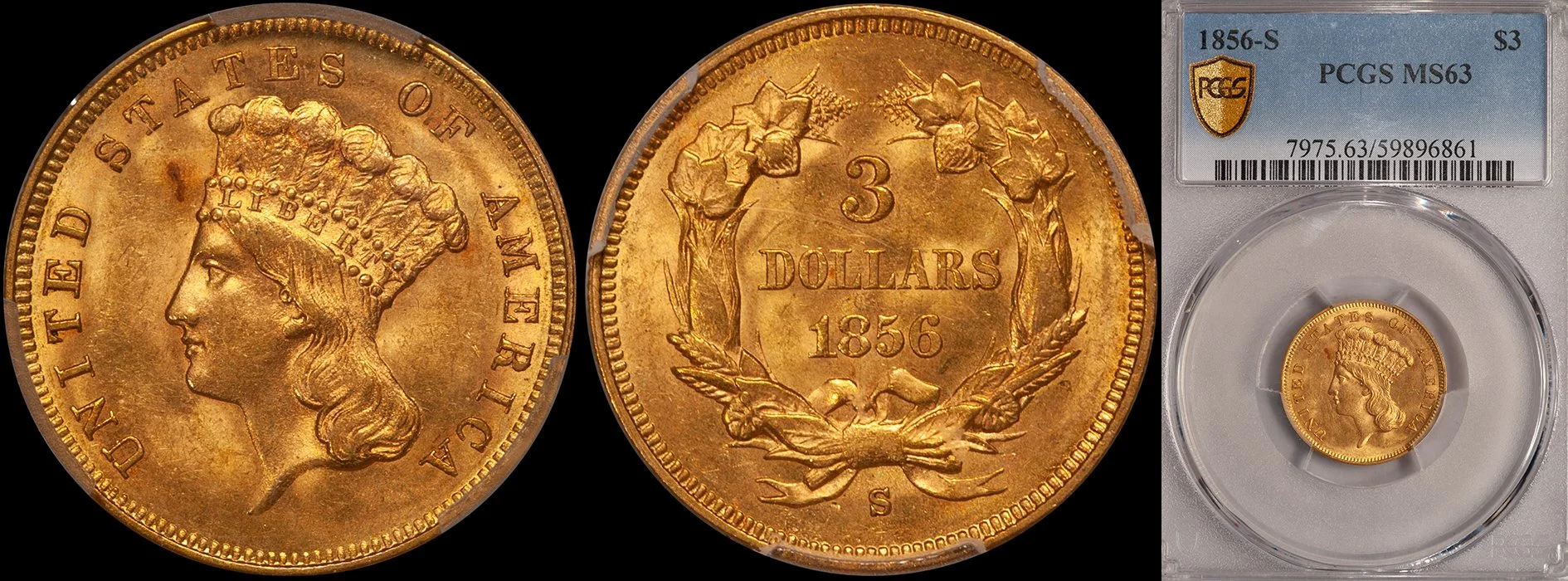
1856-S: This is the only Type Two issue from this mint and the only Type Two dollar dated 1856 from any mint. It is much more common than the Charlotte and Dahlonega Type Two issues but it is currently scarcer than the 1855-O. There are around 15-20 known in Uncirculated although the number could swell considerably if any were found along with the other coins in the S.S. Central America holdings.

1857-S: Only 10,000 were struck and approximately 125-150 are currently known. This issue is usually seen well worn with Very Fine to Extremely Fine being typical. It is scarce in low-end AU, rare in the higher range of this grade and very rare in Uncirculated. Most are seen with somewhat soft strikes, poor luster and with mint-made planchet problems. Examples may exist in the S.S. Central America treasure. The best I've seen was the PCGS MS-63 that brought $16,100 in the October 1999 Bass II sale.

1858-S: Same mintage as the 1857-S and very similar in terms of its overall and high grade rarity. Unlike the 1857-S, this date's rarity in high grades is not jeopardized by the S.S. Central America. There are around 10-12 known in Uncirculated including one gem in a PCGS MS-65 holder. Usually seen well worn with poor luster and heavily marked and/or hairlined surfaces. Very undervalued in Uncirculated; a nice Mint State-61 to Mint State-62, when available, will cost $5,000-7,000.

1859-S: Just a bit less rare than the 1857-S and 1858-S in terms of overall rarity but comparable in Uncirculated with around a dozen known. This date is generally a bit better struck and is found with better color and surfaces than the 1857-S and 1858-S. It is most often seen in Extremely Fine grades and it becomes rare in properly graded About Uncirculated-55. In Uncirculated, the 1859-S is much harder to locate than the heralded 1859-D. The best I've seen was a choice PCGS MS-63 in the 3/98 Bowers and Merena sale that brought $14,300.

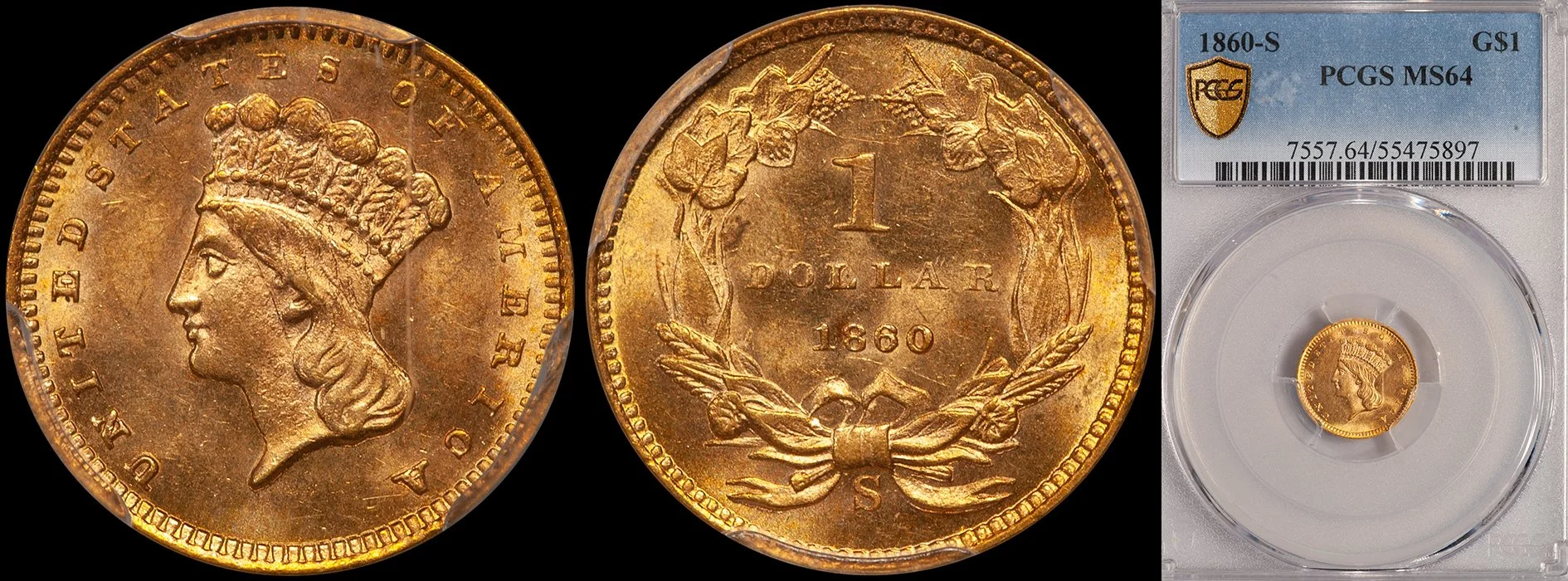
1860-S: The most available of the 1857-S to 1860-S date run but still a very tough issue in all grades with maybe 175-225 known. In Uncirculated, the 1860-S is more available than the 1857-S through 1859-S but it is still a scarce issue with around two dozen known. I recently sold the finest known, a PCGS MS-64, to a Northern California collector. Generally seen with an acceptable strike but often on poor planchets and with little--if any--originality remaining.

1870-S: Only 3,000 were struck, making this the lowest mintage gold dollar from San Francisco. Less rare than its tiny mintage figure would suggest but still a very scarce coin in all grades. Usually seen in About Uncirculated-50 to Mint State-62 grades, suggesting that this issue saw little actual circulation. There are probably 25-30 known in Mint State including three or four gems. Usually well struck and semi-prooflike with rose or orange-gold color.

II. Quarter Eagles

A total of twenty-three quarter eagles were produced at the San Francisco mint between 1854 and 1879. This includes one of the great 19th century American gold rarities: the 1854-S. The rest of the dates range from very scarce to common and this set can easily be completed (excepting the 1854-S) in Extremely Fine to About Uncirculated grades for a very reasonable sum.

1854-S: Only 246 examples were struck and approximately a dozen are known today. Nearly all of these are very well worn and the finest known by a considerable margin is the PCGS AU-50 that brought $135,700 in the October 1999 Bass II sale. This is one of the great American rarities yet it remains curiously overlooked and undervalued in comparison to other issues. Obviously, this is the stopper in any San Francisco quarter eagle set.

1856-S: The mintage figure for this issue is a more robust 72,120. There are currently 115-135 known but it is probable that many are included in the S.S. Central America treasure. There are currently fifteen to twenty known in Uncirculated including a gem PCGS MS-65 that realized $23,000 in the Bass II sale.

1857-S: This is another currently scarce issue that is destined to become far more available as more coins from the S.S. Central America are brought into the numismatic market. In the June 2000 Sotheby's sale of S.S. Central America coins, there was a magnificent, virtually perfect 1857-S quarter eagle and one would have to think there are others waiting to be offered to eager collectors.

1859-S: After a one-year hiatus, coinage of San Francisco quarter eagles resumed. This is a very scarce issue in all grades with around 85-95 pieces known. It is usually in Fine to Very Fine grades and it becomes scarce in Extremely Fine and rare in About Uncirculated. Approximately five to seven are known in Uncirculated with the best of these a PCGS MS-64 that brought $23,100 in the 1996 Bowers and Merena Rarities sale. In high grades, this is an extremely undervalued date.

1860-S: This is the most available of the early 1860's quarter eagles from San Francisco but it is still a scarce coin with around 125-135 known. Mostly seen in Very Fine to Extremely Fine and with soft strikes, poor luster and heavily abraded surfaces. A bit more available in Uncirculated than sometimes acknowledged with as many as 10-12 extant but still an extremely undervalued issue in any Mint State grade. A PCGS MS-63 brought $8,625 in the Bass II sale and this was the finest 1860-S I can recall having seen.

1861-S: Similar in overall rarity to the 1860-S but much scarcer in high grades and an extremely rare date in Uncirculated with just three to five known; the finest of which is a NGC MS-62 that I sold to a Kansas collector in the Spring of 2000. Often seen with mint-made planchet striations and weakness of strike on the eagle's right leg; very hard to find with original color and good luster.

1862-S: This date gets my vote as the rarest collectible San Francisco quarter eagle. There are approximately 70-80 known with most of these grading Extremely Fine-45 or lower. I know of two or three real Uncirculated examples and the finest of these was the PCGS MS-62 that brought $21,275 in the October 1999 Bass II sale. Usually found well struck and in rich yellow gold but often cleaned and with impaired luster.

1863-S: The second rarest collectible San Francisco quarter eagle but more available in high grade than the 1862-S. A few are seen with weakness on the bun of the hair. Of the three to five that exist in Uncirculated, there are two gems known: Eliasberg: 198 and Mid American 5/92: 41 (now in a PCGS MS-64 holder)

1865-S: An extremely underrated date that is much scarcer than its original mintage figure of 23,376 would suggest. Around 90-100 are known with most grading EF-45 or lower. A rare coin in AU and a very rare one in Mint State with maybe six to eight known. The finest known is a PCGS MS-64 but the best I've seen in years is the PCGS MS-62 that brought $6,900 in the Bass II sale. Most have weak strikes, especially at the center of the reverse. At current price levels, one of the best values of any Liberty Head quarter eagle.

1866-S: One of the more common dates from the 1860's but still a major rarity in Uncirculated and almost never seen in the higher AU grades. Of the 200 or so known, most are very well worn, weakly struck and show inferior luster. The Bass II coin, graded MS-61 is the only Uncirculated piece to sell at auction in years; I sold the Eliasberg coin, graded MS-62, to an eastern collector in 1999. Another very undervalued date in higher grades.

1867-S: Most seen have a very weak strike at the central reverse. Around 165-175 are known with most grading Very Fine to Extremely Fine. Scarce in AU and very rare in Uncirculated with approximately 10 known. The Bass II coin, graded MS-63, was sold by me to a Kansas collector in 2000 and a PCGS MS-64 is included in the 2000 ANA sale.

1868-S: Comparable in terms of its overall and high grade rarity to the 1867-S. Most are Extremely Fine-40 to About Uncirculated-55 with decent luster but softness of strike. There are a pair of PCGS MS-64's known; the other known Mint State coins are in the 60 to 61 range. An extremely undervalued coin in high grades.

1869-S: The most common San Francisco quarter eagle from the 1860's and by far the most available in high grades. There are approximately 15-20 known in Uncirculated including at least one truly superb piece graded MS-66 by PCGS (which was included in the Bowers and Merena 2000 ANA sale). Usually seen with a somewhat sunken appearance on the obverse but with excellent luster.

1870-S: One of the more underrated San Francisco quarter eagles and a favorite "sleeper" issue of mine. Approximately 110-120 exist but this date becomes extremely scarce in the middle ranges of AU and it is very rare in Mint State with probably no more than ten known. Despite the true rarity of this coin, a very presentable MS-60 to MS-61 is valued at only $3,500-4,500. The Bass II coin, graded MS-62 by PCGS, sold for a strong $10,925.

1871-S: The relative availability of the 1871-S in Uncirculated suggests that a small hoard existed at one time. There are as many as two dozen examples known in Mint State including at least three to five gems. This is a well produced issue with very good luster and color; most show weakness on the eagle's right leg. The attractiveness and relative affordability of high grade specimens make this a good type coin for the collector seeking a single superior quality quarter eagle from this mint.

1872-S: A touch scarcer overall than the 1871-S but far rarer in high grades. There are around 165-185 known with perhaps two dozen in About Uncirculated and another six to eight in Uncirculated. Not as well struck as the 1871-S but generally seen with pleasing rose and orange-gold color. This is another issue that is genuinely undervalued in high grades.

1873-S: One of the more available issues from this decade but not an easy coin to locate in choice, original AU-55 or better and genuinely rare in Uncirculated with approximately twelve to fifteen known. The best I've seen is a PCGS MS-64 that bounced around a number of auctions in 1993 and 1994 before it found a home in a private collection.

1875-S: Very similar to the 1873-S in terms of its overall and high grade rarity. There are approximately 200-225 known with most of these in the Extremely Fine-40 to About Uncirculated-55 range. This is a very underrated issue in Uncirculated with around twelve to fifteen known. The finest known is a PCGS MS-65 in a private collection. Often seen with weakness of strike at the centers and, especially, on the eagle's right leg.

1876-S: A more available coin than its tiny mintage figure of 5,000 would suggest. Often seen in the middle grades of About Uncirculated and with a similar appearance, suggesting a small hoard may have existed. Always seen with a raised mint-made diagonal bar on the throat of Liberty. There are around twelve to fifteen known in Uncirculated and the best I have seen was the PCGS MS-63 Bass II coin that realized $8,912 in October 1999.

1877-S: The second most common San Francisco quarter eagle and fairly similar in terms of overall and high grade rarity despite a considerably lower mintage of 35,400. Easily located in any circulated grade and not especially rare in the lower Uncirculated grades but surprisingly scarce in Mint State-63 and very rare above this. I have only seen one or two gems.

1878-S: The most common San Francisco quarter eagle by a huge margin, as one might deduce from its comparably high mintage figure of 178,000. Common in all grades up to and including Mint State-61 but much harder to find in MS-62 and MS-63 than generally realized and actually a very rare coin in MS-64 and above.

1879-S: The last quarter eagle struck at this mint and an issue that is considerably scarcer than generally regarded. In fact, many people still view the 1879-S as a common date but it is actually hard to locate in all grades and it is very rare in Mint State with around 12-15 known. Often seen semi-prooflike and with deep reddish-gold color. An exceptional value at current price levels.

III. Three Dollar Gold Pieces

Three dollar gold pieces were produced at the San Francisco mint from 1855 through 1857, in 1860, and again in 1870. The undisputed highlight of this quintet is the 1870-S which is unique and regarded as one of the great rarities of American numismatics. The other issues are all fairly scarce overall and they become quite rare in any grade approaching Mint State.

1855-S: Only 6,600 were struck and this is the rarest collectible Three Dollar gold piece from San Francisco. Approximately 115-125 are known with most in the Very Fine to Extremely Fine range. Quite rare in the lower AU grades, very rare in AU-55 or better and extremely rare in Uncirculated with just three to five known. The Pittman II coin, which was later graded MS-63 by NGC, sold for $35,750 in May 1998 and it is the best business strike I've seen. There are a small number of Branch Mint proofs known, unquestionably struck to commemorate the introduction of this issue to the San Francisco mint.

1856-S: Far and away the most available San Francisco Three Dollar issue with as many as 350-400 known from the original mintage of 34,500. Easy to find in lower grades and only marginally scarce in nice About Uncirculated but very rare in full Mint State with perhaps a dozen known. The two best I've seen are the PCGS MS-64 that brought $34,500 in the October 1999 Bass II sale and an NGC MS-64 that sold for $35,650 in Heritage's 1998 FUN sale. Varieties exist with small and medium mintmarks.

1857-S: Approximately 200-225 are known and this date is relatively common in lower grades. It becomes very scarce in properly graded AU-50, very rare in the higher AU grades and it is exceedingly rare in Uncirculated; moreso, in fact, than either the 1855-S or 1856-S. The PCGS MS-63 in a private collection is the only truly Uncirculated piece I know of; maybe two or three others exist.

1860-S: 7,000 were struck and this underrated date is actually very close in terms of overall rarity to the better-known (and more expensive) 1855-S. It is almost never seen better than AU-55 and it is extremely hard to find pieces that have not been cleaned. The only unequivocally Uncirculated piece I've ever seen was the PCGS MS-62 in the Bass II sale that sold for $19,550; awfully good value when one considers this date could well be unique in Uncirculated!

1870-S: This issue is one of the true enigmas of American numismatics. Like the similarly dated half dime, the 1870-S three dollar gold piece is unique. The only known example is well worn and actually has initials scratched into the obverse fields (!). Nonetheless, this did not stop Harry Bass from paying $687,500 for this coin when it was sold as part of the Eliasberg collection in 1982. Today, it would probably bring $2 to 3 million dollars at auction. The Harry Bass Foundation, who currently owns this coin, plans to loan it to the American Numismatic Association museum collection later this year and, by early 2001, it should be on view in Colorado Springs.

Ten Ways To Improve Your Coin Collection

No one intentionally sets out to create a mediocre coin collection. But many collectors--new and old--make a number of basic mistakes that trap them into a cycle of mediocrity. Here are some suggestions that will make your collection better--and make you a better collector in the process.

    Have Your Collection Assessed by an Impartial Expert Upgrade Your Key Coins Take Advantage of Down Markets When Buying Do Whatever it Takes to Become an Expert Have Your Coins Regraded Learn to be Patient Develop a "Hook" for Your Collection Form a "Fun" Collection Share Your Collection With Others Improve Your Numismatic Library

1. Have Your Collection Assessed by an Impartial Expert

Although the dealer you buy coins from may be an expert, he is not impartial. I strongly suggest that after you've begun a set, find a knowledgeable, legitimate expert who can look at your coins and give you an objective second opinion. When he views your coins, don't tell him who you bought them from. Instead, get an opinion as to the coin's quality, fair market value, eye appeal and its suitability in your set.

2. Upgrade Your Key Coins

In any set, the rarest coins should be the highest quality ones. For example, the rarest Dahlonega half eagles are the 1842-D Large Date and the 1861-D while the most common are the 1853-D and the 1854-D. An intelligent collection of Dahlonega half eagles would have very high quality examples of the two rarest issues and decent but unspectacular examples of the two most common ones. Rare coins are always better price performers than common ones and your big dollar purchases should always be choice examples of truly rare coins; not common coins in high grade.

3. Take Advantage of Down Markets When Buying

When the market is soft, you should buy coins; not when prices are increasing sharply. The old cliche "buy low, sell high" is particularly applicable to the rare coin market. There is a proven history of coin price cycles and if you learn how to time your purchases properly, you can buy nice coins at 20-50% discounts off of past market highs. Surprisingly, this generally applies to truly rare coins as well as common issues.

4. Do Whatever It Takes To Become An Expert

The more you learn about the coins you collect, the better your collection will be. Attend coin shows and significant auctions. Read as much as you can. Go to a class at the American Numismatic Association's Summer Conference. There are many experts in the coin business who would be happy to share information with you. It is up to the collector to find these people and take advantage of their generosity.

5. Have Your Coins Regraded

Grading is subjective and standards change. If you purchased nice quality coins in the early to mid-1990's, there is an excellent chance that they will upgrade. Have a dealer you trust examine your coins and give you a second opinion as to their current grade. You might have a considerable amount of added value sitting in your safety deposit box.

As an example, in the past year, I have worked with three different collectors who I sold a number of very high quality coins to between 1992 and 1996. I had close to a 50% success rate in upgrading their coins and added at least $100,000 in value to each set through a few thousand dollars worth of resubmissions to PCGS and NGC.

6. Learn To Be Patient

Truly great collections, like those formed by Louis Eliasberg, Sr. or John J. Pittman were formed over the course of fifty years. When you rush to assemble a collection, the chances are great that you will make mistakes. If you are putting together a date set or a type set, buy the right coin the first time so you don't have to continually upgrade. If you like coins with a certain "look," wait for the right coin to come along. With very few exceptions, the right coin will become available sooner or later. But when that truly special piece does become available, don't be bashful. Collectors like Eliasberg and Pittman paid what were then considered to be "insane" prices for extraordinary coins. When these coins were sold many years later, they once again brought crazy prices--but this time in modern dollars.

7. Develop a "Hook" For Your Collection

A popular song becomes a hit because it has a "hook." A hook is an especially catchy melody that literally "hooks" the listener and makes him remember the song. Great coin collections have hooks as well. A numismatic hook might be coins with great color or a detailed, specialized assemblage or coins from a certain era. When you go to sell your collection, a random group of average quality coins will create no interest. A collection that has a great hook will create much more interest and sell for a hefty premium over a mundane assemblage.

8. Form a "Fun" Collection

If you are buying expensive, high end coins, you have to make some stressful decisions. One way to reduce this stress level is to put together a cheap, "fun" set. As an example, one of my biggest clients (who regularly purchases $25,000+ coins) has a secondary collection of Civil War tokens. He's never spent more than $500 on a token but has put together a really great and interesting set. I take the edge off buying and selling expensive U.S. gold coins by purchasing superbly toned high grade Washington Quarters. A fun collection is especially useful when your primary collection is nearly complete and many months--if not years--may go by between opportunities to fill those last few holes.

9. Share Your Collection With Others

A good friend of mine, who has a superb collection of Minnesota national bank notes, recently exhibited his collection at a major coin convention. It was the first time I'd ever seen him really have fun with his notes and I think it was a wonderful ego boost for him to bask in the glow his collection received. Another friend of mine, who specializes in Proof bust coinage, is busy compiling interesting information about these under-researched pieces and hopes to write the ultimate guide to them. The Scrooge McDucks of the coin collecting world have no fun and they are missing out on the best aspect of collecting: the fraternization.

10. Improve Your Numismatic Library

There is no substitute for knowledge in numismatics. You should make a goal to add at least one book or catalog to your coin library every month. Become a regular customer of numismatic literature dealers and ask them which books and catalogs are essential to your library. After you've purchased the essentials, buy the slightly less important books. Later, buy the esoteric books. Read as many of them as you can. I regard myself as a pretty knowledgeable numismatist but I am continually learning new information from old auction catalogs or obscure reference books.

What To Collect: Suggestions For The New Collector

For the new collector, one of the most difficult--and important--decisions he faces is what to collect. There are a number of factors that shape any eventual decision. These include price, practicality, availability of coins and aesthetics or personal taste. Nearly every collector, whether he is a seasoned veteran or brand new, has budget considerations. A collector's budget will quickly help shape the focus of his eventual collection. If you have a budget of approximately $10,000 per year to spend on coins, I would suggest dividing this amount into five or six purchases; or one every other month. This means that you can purchase interesting coins in the $1,500-$2,000 range and buy them often enough to maintain a high level of interest.

If your collecting budget is relatively small, you should establish your collecting goals accordingly. A budget of $500-$1,000 per coin is too low to collect early gold (i.e., issues struck prior to 1834) or Proof gold. But, as we will see below, there are other areas that $500-$1,000 will go quite far and this is where a collector with this budget should be focused.

Even if you have an unlimited budget, your collecting goals must be realistic. Let's say you have decided to put together a set of Liberty Head double eagles but only wish to purchase gem quality coins. This is not a realistic set, based on the fact that many pre-1880 issues do not exist in these grades and some don't even exist in the lower Mint State range. Being inflexible towards this goal would mean that this collector would soon hit a roadblock and he would be unable to add to his set.

Coin collecting budgets can basically be divided into three sizes: modest, average and above-average. For the sake of convenience, let's say that a modest budget is $500-$1,000 per coin, an average budget is $1,500-$3,000 per coin and an above-average budget is $5000-$10,000+ per coin. What are some of the best choices for interesting sets within these budgets?

I. $500-$1,000 per coin. Best Choice: A Set of Type Three San Francisco Double Eagles

The San Francisco mint struck double eagles from 1877 to 1885 and from 1887 through 1907. In all, there are thirty issues in this set.

The beauty of the San Francisco Type Three double eagle set is that nearly every coin can be obtained in Mint State-62 and Mint State-63 grades for under $1,000. The key issues of the set are the 1878-S, 1879-S, 1880-S and 1881-S and they can be obtained in MS-60 to MS-61 for below $1,000.

If the collector budgets an average of $750 per coin (figuring that he will spend $500-$600 on the common coins and $800-$900 on the scarcer pieces), he can count on spending approximately $22,500. With an approximately yearly budget of $7,500-$10,000, this set can be completed in two to three years.

I like this set for a number of reasons. The coins all have very limited downside risk as they have an intrinsic value of close to $250. San Francisco double eagles from this era tend to have very nice color and show good detail. And, at current price levels, many of these coins seem to be very good value.

OTHER CHOICES: Philadelphia gold dollars, 1849-1889, in Mint State-60 to Mint State-63. Philadelphia quarter eagles, 1880-1907, in Mint State-60 to Mint State-63. Classic Head quarter eagles and half eagles, 1834-1838, in Extremely Fine-45 to About Uncirculated-55.

II. $1,500-$3,000 per coin. Best Choice: A Set of New Orleans Quarter Eagles

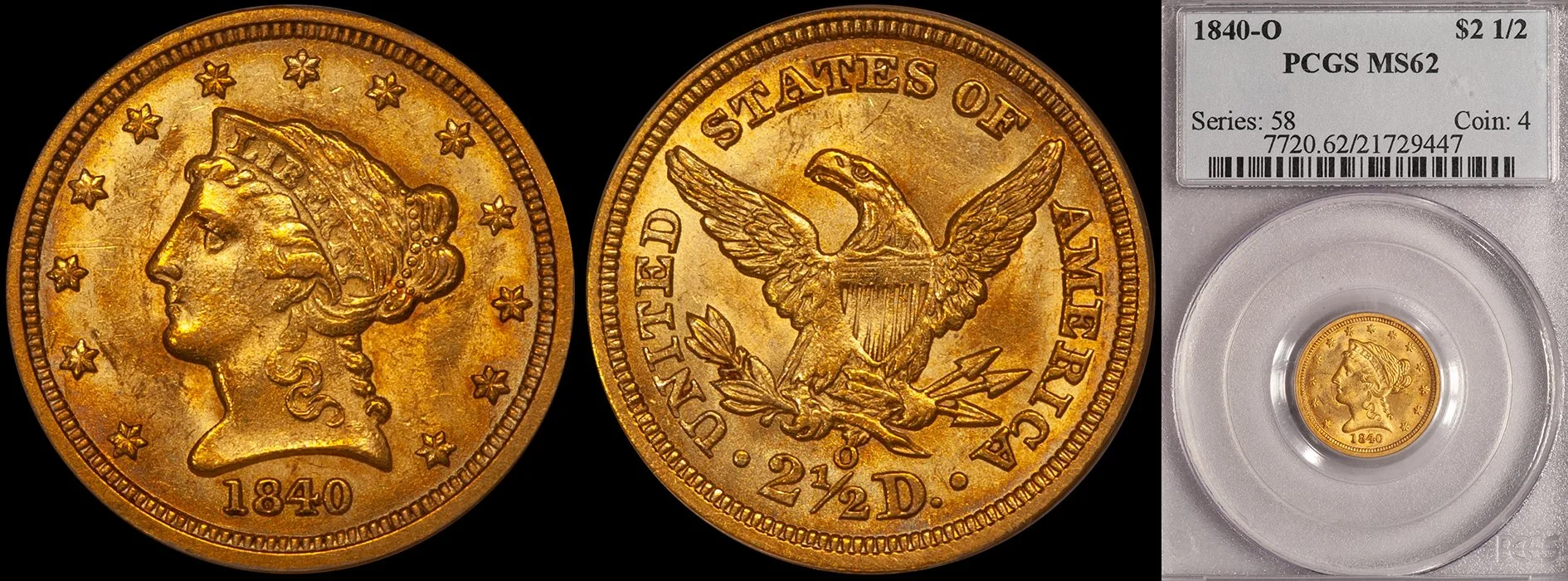
The New Orleans mint struck quarter eagles from 1840 to 1843, 1845 to 1847, 1850 to 1852, 1854 and again in 1856-57. There are a total of thirteen issues, including the Large Date and Small Date 1843-O.

This is a set that I have liked for years and have recommended it to many new collectors. The coins are, for the most part, very undervalued in comparison to Charlotte and Dahlonega quarter eagles of this era. Unlike the other branch mint quarter eagles, the New Orleans set is short and completable.

The most expensive coin in this set is the 1845-O. This is a rare and very undervalued issue with an original mintage figure of only 4,000. Despite this coin's obvious rarity, a nice Extremely Fine-45 coin can be purchased in the $2,000-$3,000 range; still within the financial parameters of this set.

Using a $1,500-$3,000 budget per coin for this set, the most practical grade for each of the thirteen issues is still surprisingly high. This means that, when complete, this will be a good looking group with most of the coins in a grade range that is far above average for the date.

I would recommend building this set using the following grades. Along with these grades are approximate price range for nice quality pieces in PCGS or NGC holders.

1840-O: AU-55, $2000-$2500 1850-O: AU-55, $1750-$2000 1842-O: AU-53, $2000-$2250 1851-O: AU-55, $1900-$2250 1843-O Sm. Date: MS-61, $1750-$2000 1852-O: AU-58, $2100-$2400 1843-O Lg. Date: AU-53, $1750-$2250 1854-O: MS-61, $1500-$1750 1845-O: EF-45, $2000-$3000 1856-O: AU-55, $2400-$2700 1846-O: AU-55, $1250-$1500 1857-O: AU-58, $2000-$2250

To upgrade the 1845-O quarter eagle to AU-50 (which I think is a good idea, as it is the rarest coin in the set), the collector would be looking at spending $4,000-$4,500.

The price range for a complete set of New Orleans quarter eagles, as described above, is $22,500-$27,500. Assuming that a collector with a budget of $1,500-$3,000 per coin had an annual budget in the $15,000-$25,000 range, it would take between one and two years to complete the set.

OTHER CHOICES: New Orleans gold dollars, in About Uncirculated-58 to Mint State-63. Three dollar gold piece date set, in About Uncirculated-55 to Mint State-62. Philadelphia no motto eagles, 1840-1860 (no 1858), in About Uncirculated-50 to About Uncirculated-58.

III. $5,000-$10,000 per coin. Best Choice: A Set of Dahlonega Half Eagles

For this last category, I wavered between a set of Charlotte or Dahlonega half eagles. I decided to select the latter since there are no overly expensive or "impossible" coins.

Dahlonega Half eagles are a challenging set but they have some major advantages over their gold dollar and quarter eagles series. The gold dollars, while relatively short-lived, contain at least two dates that are too expensive for this price range (1855-D and 1861-D). The quarter eagle set not only has a number of rare and expensive dates but it has others that, in our required $5,000-$10,000 price range will have to be compromised in terms of quality. The half eagle set makes the most sense. The coins are large and attractive, scarce but available and well within the proper price parameter.

I would recommend building this set using the following grades. Along with these grades are approximate price range for nice quality pieces in PCGS or NGC holders.

1838-D, AU-53: $6000-$8000 1850-D, AU-55: $6000-$7000 1839-D, AU-55: $6000-$8000 1851-D, AU-55: $6000-$7000 1840-D, AU-55: $5500-$7500 1852-D, AU-55: $3500-$4500 1841-D, AU-58: $6500-$8500 1853-D, MS-61: $5000-$7000 1842-D Sm. Date, AU-58: $5500-$7500 1854-D, AU-55: $3000-$4000 1842-D Lg. Date, EF-45: $6000-$8000 1855-D, AU-55: $4000-$5000 1843-D, AU-58: $4000-$6000 1856-D, AU-55: $4000-$5000 1844-D, AU-58: $5500-$7500 1857-D, AU-55: $5500-$6500 1845-D, AU-58: $5000-$7000 1858-D, AU-58: $4500-$5500 1846-D, AU-58: $4500-$5500 1859-D, AU-55: $4000-$5000 1847-D, MS-61: $6500-$7500 1860-D, AU-55: $4000-$5000 1848-D, AU-55: $4000-$5000 1861-D, EF-45: $7000-$9000 1849-D, AU-55: $4250-$5250

To upgrade the key 1861-D to an AU-50, the collector would be looking at an additional $5,000 to $7,500. This would be a sensible outlay, given that this is the single most important coin in the set. The 1842-D Large Date could either be eliminated (using the assumption that the date 1842 is already represented by the more common Small Date variety) or it could be upgraded to an AU-50 for an additional $5,000 or so.

The total cost for the Dahlonega half eagle set in the grades listed above would be approximately $125,000-$165,000. Assuming that a collector with a budget of $5,000-$10,000 per coin had an annual budget of approximately $40,000-$50,000, this set could be assembled in two to three years.

OTHER CHOICES: Charlotte half eagles, in About Uncirculated-50 to About Uncirculated-58. New Orleans half eagles, in About Uncirculated-50 to Mint State-62. San Francisco Type One and Type Two double eagles, About Uncirculated-50 to Mint State-61.

With a bit of study and some realistic evaluation of financial considerations, there are numerous interesting gold coin sets that can be put together.

How Rare Are Rare Date Coins?

In the past few years, there seems to have been an explosion in the availability of rare date United States gold coins. Many issues that were considered very rare a few years ago now seem almost commonplace. Is this actually the case--or is this perception totally incorrect? The correct answer lies somewhere in the middle. A number of interrelated events have occurred during the past few years which have significantly altered the traditional relationship between supply and demand that has dictated the rare date gold market for the better part of three decades. All of these events are important and each needs to be analyzed individually to make any "big picture" conclusions in regards to this market.

I. Rising Prices Have Brought Many Coins Onto The Market

Ten to fifteen years ago, the prices for many better date United States gold coins were extremely low. It was possible to purchase outstanding pieces in the $500-$2000 range. Today, many of these same coins are worth five to ten times (or even more) their original purchase price. Many collectors have decided to take their profits. After all, it's hard to pay $7,000 for another AU-50 1840-C half eagle when the AU-50 you bought fifteen years ago was priced at $750.

II. Grading Standards Have Changed Considerably In The Past Few Years

Population explosions seem to be greater for high grade gold coins than for low and middle grade pieces. There is a good reason for this. The grading standards of the late 1980's and the early 1990's have loosened considerably. The very same coin that PCGS or NGC graded Extremely Fine-45 in 1989 is almost certainly an About Uncirculated-53 to About Uncirculated-55 today. And many of 1989's AU-55 and AU-58 coins are today's Mint State-60, Mint State-61, Mint State-62 or even Mint State-63 pieces. The result of this "gradeflation" is that many dates that once appeared to be very rare in high grade now seem much more readily available. The truth of the matter, however, is that many of these Uncirculated coins are the exact same pieces that were considered About Uncirculated a decade ago.

III. A Number Of Exceptional Hoards Have Come Onto The Market

The last ten years have seen some amazing groups of gold coins enter the market. Some, like the Brother Jonathan hoard of 1861-1865 San Francisco double eagles and the S.S. Central America hoard of 1857-S double eagles and territorial issues, are well known. Others, like the group of Uncirculated 1856-D half eagles discovered in South Carolina a few years back or numerous groups of key date eagles and double eagles found in Europe or other overseas locations, are not as well known. All of these have made certain formerly rare issues much more available in high grades than in the past.

IV. The Market Is Now Dominated By Investors

Until recently, issues such as Charlotte and Dahlonega gold were strictly collector-oriented. Investors were led to believe that these coins were "bad investments" because they were not available in Mint State-65 or because they were "too esoteric." After years of bad performance by investor series such as silver commemoratives or modern type, the same investment gurus who had badmouthed Charlotte and Dahlonega gold coins were now jumping on the bandwagon. The result was a major disturbance in the supply/demand ratio for such coins.

The most immediate result was a quick run-up of prices. Suddenly, a lot more people wanted high quality Charlotte and Dahlonega coins. Many of the Condition Census quality pieces that had previously been owned by serious collectors were now in the hands of investors. This became a negative factor for the short and medium range health of the Charlotte and Dahlonega market.

Collectors are great for markets because they tend to hold their coins for a long period of time. In order for Charlotte and Dahlonega prices to have risen in an orderly fashion, as they did through the 1970's and the 1980's, the coins had to appear to be rare (i.e., the demand had to outstrip the supply). One of the reasons why it has become so hard to find nice medium grade (i.e., Very Fine-35 to Extremely Fine-45) Charlotte and Dahlonega coins is that these are "collector grades" and the people who own these coins hold them for ten to fifteen years.

Investors are bad coin owners because they tend to sell very quickly. They will buy a high grade piece and sell it six months to a year later. This creates a situation where supply suddenly outstrips demand. Even more hazardous is the fact that the perception of rarity for these coins becomes altered. Coins that were once believed to be rare were now trading on a regular basis. While it might have been the same two examples of a specific date that traded over and over, the casual observer was now led to believe that a supposedly rare issue was more available than he had been led to believe.

The fallout from this has been very interesting. As this article is being written, I find that the demand for affordable, lower grade (i.e., Very Fine and Extremely Fine) Charlotte and Dahlonega gold coins, as well as most other branch mint issues, is extremely high. But coins like this are very hard to find as they tend to be in the hands of serious, long-term collectors who do not wish to sell them. I now find myself in the curious position that when someone calls me looking for a $1,500 version of a certain Charlotte or Dahlonega issue, I have to tell him that I do not have this coin but I do have a $10,000 version. The market now seems to be saturated with hard-to-sell expensive coins while the demand is for inexpensive coins.

V. Too Much Information Leads To Disinformation

In the 1970's and 1980's there was very little easily accessible information about United States gold coins. Today, there is an incredible amount of information. For the sophisticated collector or dealer, this data is a godsend. For the neophyte, this information can be confusing or even misleading.

As an example, let's look at the PCGS and NGC population reports. These monthly publications, which list the number of coins graded by each service, have become widely-recognized sources of information. According to the most recent reports (May 2000 for PCGS and April 2000 for NGC), there have been 21 1859-D gold dollars graded in Mint State by PCGS and another 16 have been graded by NGC for a total of 37 coins.

In my 1997 book "Gold Coins of the Dahlonega Mint, 1838-1861" I estimated that 10-12 Uncirculated examples of this date were known. Was my estimate that wrong or is there something misleading about the PCGS and NGC data?

What many people don't realize about the population reports is that the numbers are often greatly swollen by resubmissions. The "21" Mint State 1859-D gold dollars recorded by PCGS might actually be no more than ten or so separate coins. When you also realize the fact that many of the coins graded Mint State-60 or Mint State-61 by this service could just have easily been called About Uncirculated-58, then my original estimate of 10-12 truly Mint State 1859-D gold dollars seems a lot more accurate.

Another type of information that can easily be misinterpreted by neophytes is auction records. Many collectors make purchases based on the fact the a certain coin has or hasn't appeared a certain numbers of times at auction over the course of a few years.

I keep a meticulous database of Condition Census, rarity levels, and frequency of appearance for branch mint gold coins. I can cite numerous rare coins that have appeared in as many as five or six auctions over the course of one year. This is compounded by the fact that this exact coin may have appeared first as a PCGS AU-58, then as an NGC MS-61, then as a PCGS MS-61 and finally as a NGC MS-62. Same coin, four different holders. If you do not carefully track these appearances and study the plates in the auction catalogs (or view the coins in person), you can make some incorrect assumptions about the rarity of rare date U.S. gold coins.

VI. A New Type of Dealer Starts Buying Dated Gold

Until recently, the number of dealers who were serious buyers of rare date U.S. gold coins was fairly small. They tended to be knowledgeable purists who bought coins for collectors. They were stable in their business endeavors and didn't look at every coin as an upgrade or "breakout" opportunity.

This all began to change as price levels increased and value spreads widened. Suddenly, a date might be worth $1,500 in Extremely Fine-45 and $7,500 in About Uncirculated-50. The possibility of upgrading a coin from this proved to be extremely tempting; especially after grading standards became more loose.

The rare date gold market was then invaded by "crackout" dealers who would buy a wide range of coins in a wide range of grades. This type of dealer thinks nothing about submitting a coin five, ten or even fifteen times before he gets it into the "right" holder. If this dealer does not keep very careful track of the PCGS or NGC inserts from each of his submissions, the possibility of some--or all--of them becoming lost is great. I can cite numerous examples where the PCGS or NGC population for a truly rare coin is now totally out-of-kilter because one dealer submitted a coin ten times then either lost the inserts or is holding onto them for some reason.

VII. A Case Study: The 1840-C Half Eagle

To prove--or disprove--my thesis, I thought it would be interesting to look at a specific rare date gold issue and analyze its rarity. A good example is the 1840-C half eagle. This was a coin that I once believed was very rare in all grades and I would become excited whenever I had the opportunity to purchase an example. Today, I still think this is a scarce issue but I no longer seem to care about 1840-C half eagles when they are offered to me.

When my book "Charlotte Mint Gold Coins: 1838-1861" was published by Bowers and Merena in 1987, I estimated that 55-60 1840-C half eagles were known with just four or five of these in AU and none in Mint State. In 1999, I published a revised edition of this book and suggested that there were eight to ten known in AU and another one or two in Mint State. The May 2000 PCGS Population Report shows sixteen 1840-C half eagles having been graded in all AU grades and one coin in Mint State while the May 2000 NGC Census Report shows another sixteen in AU and three in Mint State. Has the 1840-C half eagle really become this much more available in the last decade and a half?

The answer is multi-faceted and somewhat complicated. I was clearly too conservative in my 1987 estimates; both in terms of this date's overall and high grade rarity. My 1999 estimates are more realistic but still probably on the low side. However, the PCGS and NGC population figures for this date are ridiculously inflated. The actual number of true About Uncirculated 1840-C half eagles is more likely in the area of a dozen pieces. There are three true Mint State coins that I know of and I was not aware of any of these in 1987 and two of them in 1999. The third is a coin that only recently "came out of the woodwork."

I believe that the following conclusions can be reached in regard to this date:

    The PCGS and NGC population figures are inflated due to resubmissions. Many of the coins graded AU-50 and AU-53 by PCGS and NGC are coins that would have been graded Extremely Fine in the 1980's and early 1990's. A few very high grade pieces came on the market (the finest known Pittman coin, graded MS-64 by NGC and the PCGS MS-62 Milas coin which first surfaced in the 1994 James Stack sale). Both of these coins had been off the market since the 1940's and I had no idea that they existed until they reappeared. Price levels for this date have risen to the point that few collectors can afford to buy high grade 1840-C half eagles. Thus, this is now an "investor coin" in high grades and, as a result, the overgraded high grade pieces that exist tend to bounce between dealers and in and out of auctions.

Are rare date gold coins not as rare as we have been led to believe? In some cases, the answer is yes but in most cases I feel that a combination of factors have conspired to distort the true rarity of these issues. Hopefully, the next generation of collectors will be able to make sense of this increasingly confusing jumble of data.

The Ten Coolest United States Coins

About five years ago, a dealer who specialized in ultra-expensive United States coins had an advertising campaign that said, basically, your entire coin collection should be able to fit into a single PCGS/NGC coin storage box. Such a box holds exactly twenty coins. This was obviously an elitist sentiment and it was generally derided as being pretentious. But I thought it had some merit. In numismatics, quality is always a surer bet than quantity (although a large quantity of great quality is best of all...)

I recently got a phone call from a wealthy new collector who asked me to draft a very interesting proposal for him. He was interested in collecting coins but he had very little spare time available to devote to learning about them. So he asked me to come up with a list of ten coins that, in my opinion, were the most significant United States issues.

As I got to thinking about this list of coins, I drew up the following parameters:

    The coins had to be very historic. Their historic significance had to be easily understood, even by someone who didn't know much about U.S. History or coinage. They had to be coins that were always in demand, in good markets and bad. They had to have multiple levels of demand. In other words, they had to be considered desirable by a number of different groups of collectors. They had to be attractive in terms of their design. They had to be rare, but not so rare that they commanded an inordinate date premium.

This collector gave me some other parameters to consider as well. While wealthy, he did not have unlimited funds; nor did he like coins enough that he wanted to put an inordinate amount of his net worth into his collection. This collection would not consist of the "finest known" or the "best" of anything. Rather, it would consist of ten attractive, original, above-average quality examples of the ten most interesting and readily liquid United States coins. In essence, this collection would be themed as the "coolest coins ever struck in the United States," if you will.

Here is the list that I prepared for this collector, along with why I thought each coin should be in this small but special collection.

1. 1776 Continental Dollar

This is not a regular issue coin but, rather, a proposed or speculative issue. Varieties are known in silver, pewter and brass and with different spellings of the word CURRENCY. For this set, I would suggest a pewter piece with the spelling "CURENCY" and the lack of the designers initials (represented on this coin as "EG FECIT," which is believed to signify that the design was by Elisha Gallaudet).

It is probable that these coins did circulate in colonial America and that they did have a recognized value. This fact makes them a legitimate candidate for the first "dollar" struck in this country as well as the largest coin, in terms of size, issued prior to the establishment of the United States. The magical date 1776 makes them even more desirable, in my opinion. And, finally, the charming design on the reverse (featuring thirteen interlinked rings with the name of each colony and symbolizing unity) is believed to have been suggested by Benjamin Franklin.

For this set, I would opt for a very slightly worn piece; perhaps in the About Uncirculated-55 to 58 range. I like the idea that the coin saw some light circulation during the colonial era but would want it to be lustrous and well struck. Such a coin would cost $7,500-$10,000; making it an exceptional value for such an incredibly historic issue.

2. 1792 Half Disme

After obtaining its independence from Great Britain, one of the first legislative acts that the United States considered was the establishment of its own coinage. The first experiments were conducted in 1792. Most of the initial United States mint issues are extremely rare today. The most available is the 1792 Half Disme (the spelling of the word "Dime" was not changed until the beginning of the 19th century).

The story behind this coin is very interesting. George Washington was actively involved in its production and legend has it that he contributed his family's personal silverware for use in the striking of these coins.

Approximately 1,500 pieces were made and survivors are a bit more plentiful than generally realized. This is an extremely significant coin as it is the first United States issued struck by mint personnel in any quantity for use in circulation.

For this set, I would look for a nice About Uncirculated coin with original coloration and nice surfaces. The current value of such a coin is approximately $10,000-$15,000.

3. 1793 Chain Cent

The first two denominations to be struck by the United States mint were the half cent and the cent. Coinage for both began in 1793. Three designs are known for 1793 cents. The first, and most appealing in my opinion, is the Chain Cent.

A total of 36,103 1793 Chain cents were produced. The very first of these are easily identified by having the abbreviation AMERI. (for AMERICA) in the reverse legend. In my opinion, these are by far the most desirable of the major varieties and it is believed that around 7,000 were produced.

Chain Cents are often found very well worn and generally come with the obverse much weaker than the reverse. For this set, I would select a nice brown Extremely Fine to About Uncirculated piece. I would be very careful in making my selection and would look for a piece with good eye appeal, an above average strike and nice surfaces. Coins like this are rare and in great demand and I would expect to pay well in excess of current published values. An Extremely Fine coin is currently valued in the $20,000-$30,000 range while an About Uncirculated coin is worth $35,000-$45,000+.

4. 1794 Silver Dollar

The silver dollar was among the first coins authorized by the United States government. It is hard to think of a more significant coin for the fledgling United States than the dollar as it was the largest circulating coin at the time, both in terms of its size and its value.

This was a very difficult coin for the new mint to strike as they did not own equipment for coins larger than a half dollar. In addition, most 1794 dollars were struck from improperly aligned dies, making the date, the left stars, and the words UNITED STATES appear very weak.

Of the 1,758 pieces believed to have been struck, around 125 are known today. For this set, I would look for a nice, evenly worn Extremely Fine with as sharp a strike as possible. In particular, I would look for a coin with a well-defined date and reasonably sharp stars. This is another issue that is in great demand and nice coins always bring much more than published values. I would expect to pay between $75,000 and $90,000 for the right piece.

5. 1795 Eagle

The eagle, or ten dollar piece, was the highest denomination American coin until the twenty dollar gold piece was authorized in 1849. The essence of this coin is very easy to state in a few words: it is the first year of issue of the most important early gold type.

Only 5,583 1795 eagles were struck. There are a few hundred pieces known and this includes more high grade pieces than one might expect. The 1796 eagle is a much rarer coin and it is very undervalued in relation to the 1795. But I would much rather have the 1795 due to its significance.

For this set, I would choose a nice About Uncirculated example with clean surfaces, no significant adjustment marks, original color and a sharp strike. Such a coin, when available, would probably cost in the area of $30,000-$35,000.

6. 1836 Gobrecht Dollar

After a three decade hiatus, the silver dollar was resurrected in 1836. Its design was considered one of the most important projects undertaken by the new Mint Engraver Christian Gobrecht. From 1836 to 1839, he prepared a number of designs; which are among the most attractive coins ever struck in the United States in my opinion. My personal favorite is the so-called 1836 "original" with the engraver's name on the obverse and the reverse with stars above and below the eagle.

1,000 of these were struck as Proofs at the end of 1836. They were made for circulation and can be distinguished from those struck in 1837 (but dated 1836) by the orientation of the eagle on the reverse. They are generally found with some degree of wear and, for some reason, uncleaned pieces generally have extremely deep toning.

For this set, I would select a Proof-62 to Proof-63 example with attractive coloration, minimal detracting hairlines and good overall eye appeal. I would expect such a coin to cost in the area of $15,000-$20,000.

7. 1850 Double Eagle

The first regular issue double eagles are dated 1850; examples were struck at both the Philadelphia and New Orleans mints. Although the Philadelphia issue is much more available than its branch mint counterpart, I have long felt that the 1850 double eagle was one of the most important United States coins. In a nutshell, it is the first collectible Double Eagle and the twenty dollar gold piece is the largest and most popular United States gold coin.

1,117,261 1850 double eagles were struck and this is not an especially scarce issue in circulated grades. There are around 40-60 known in Uncirculated with most of these in the MS-60 to MS-61 range. This date is often found with an especially sharp strike, nice coloration and very good eye appeal.

For this set, I would select a Mint State-61 example that was original, lustrous and minimally abraded. The cost of this coin would be in the area of $6,000-$9,000; making it among the best values in this collection.

8. 1861-D Gold Dollar

The 1861-D gold dollar is the only coin that can be positively proven to having been struck by the Confederacy. After the branch mint at Dahlonega was seized in April 1861, a small number (1,000-2,000) were produced. Unlike such issues as the 1861-C half eagle and the 1861-O double eagle, which had mintage figures that include Federal and Confederate strikings, every single 1861-D gold dollar is a Confederate striking. This makes these coins, in my opinion, among the most historic issues available to collectors.

There are approximately 75-100 examples known with the typical specimen grading About Uncirculated. This issue is generally found with a poor strike and some planchet irregularities.

The 1861-D gold dollar I would choose for this set would be a very high end About Uncirculated-58 with as good a strike and as clean surfaces as possible. The cost for such a coin would be in the range of $17,500-$20,000.

9. 1879 Flowing Hair Stella

The four dollar "Stella" (so named because of the prominent star on the reverse) was a result of discussions regarding international trade coinage during the 1870's. A very limited number were made, with two different designs, during 1879 and 1880. The most available of these is the 1879 Flowing Hair.

The official mintage figure for the 1879 Flowing Hair Stella is 425 coins, although it is possible that a few more were produced. Approximately half of the original mintage survives today, in grades ranging from Very Good to Gem Proof.

My choice of Stella for this set would be a Proof-63. I would try to look for a coin with nice original surfaces, pleasing color and minimal hairlines or marks. A coin of this quality would cost in the area of $50,000-$55,000.

10. 1907 High Relief Double Eagle

Theodore Roosevelt believed that United States coinage designs had, by the early 1900's, become stale and out of touch. He was particularly eager to redesign the four United States gold denominations. For the eagle and double eagle he hired the prominent sculptor Augustus St. Gaudens.

St. Gaudens' battle with the entrenched Mint personnel is well known as is their subterfuge of his spectacular original design. The "High Relief" that most collectors are familiar with today is a severely watered-down version of his incredible "Ultra High Relief" design. Nevertheless, the 1907 High Relief is still widely regarded as the most beautiful American gold coin.

11,250 examples of this design were struck and the survival rate is uncommonly high. Despite this coin's relative availability, it is still a highly priced coin. But it is priced relative to its extreme popularity and, in my opinion, it is an essential member of this ten coin set.

The High Relief that I would include would be a high end MS-64. The cost of such a coin would range from $14,000 to $17,000.

Conclusion

The total cost for this set, with each of the coins in the grade ranges described above, would be approximately $250,000-$350,000. It would probably take a number of years to complete this set, especially if the collector is very particular in regard to the quality of each piece.

It is my opinion that this would be a great set of coins to assemble. There are certainly other American coins that can also be considered "cool," but these are the ones that I find most appealing.

Carson City Eagles: An Introduction and Overview

The Carson City ten-dollar gold piece or eagle series is the most difficult of the three gold denominations struck by this mint to collect. It contains the single rarest gold coin ever struck by this mint: the 1870-CC eagle, which is even rarer than its more celebrated and far more expensive counterpart, the 1870-CC double eagle. The completion of a Carson City eagle set is a very formidable task. Since only 35-45 1870-CC eagles are estimated to exist, only this number of complete sets of Carson City eagles can be formed. In comparison, 50-60 Carson City half eagle and 40-50 Carson City double eagles sets can be formed. As with the half eagle and double eagle series, completion of a set of the Carson City eagles is difficult but certainly realistic. There are only 19 dates in this series. Unlike the Philadelphia eagle series, the Carson City coinage is short yet, simultaneously, formidable. There are no impossibly rare or prohibitively expensive coins which make finishing a set impossible. Thus, it is a reasonable expectation to finish a Carson City eagle set, given enough time, money, and patience.

If a collector desires more of a challenge, he need only set his sights on higher grade coins. The Carson City eagles are generally rarer in higher grades (in this case About Uncirculated-50 or above) than their half eagle counterparts.

While Carson City eagles have never been touted as an investment vehicle, they have, in fact, shown excellent price appreciation over the past few decades. Values have risen steadily in the past decade despite a large price drop in the levels for common, "generic" coins. The western migration of the American people, along with a related increase of interest in western history and art, has caused Carson City coinage to be in demand among an increasing number of avid, well-heeled collectors and investors. The romance of the Old West along with the rarity of the Carson City eagles has made this a very popular series. These coins are also in demand by general collectors and type collectors.

Regardless of one's time and resources, a complete set of Carson City eagles in Uncirculated grades could never be assembled. Seven or eight of the 19 dates are currently unknown in full Mint State and there are many more dates in the eagle series that do not exist in Mint State than there are in the half eagle or double eagle series.

A partial Uncirculated set is just as daunting. The two most common issues from the 1870's, the 1871-CC and the 1874-CC, are exceedingly rare in Uncirculated. A half dozen or fewer Mint State 1880-CC, 1882-CC, 1883-CC, 1884-CC and 1893-CC eagles are known and nearly all of the Uncirculated pieces which exist for these dates are either in tightly-held collections or grade no better than Mint State-60. Even the second most obtainable Carson City eagle in Uncirculated, the 1892-CC, is a reasonably rare coin and the only issue that can be located in Uncirculated with any degree of regularity is the 1891-CC.

Choice Mint State (MS-63 and MS-64) Carson City eagles are very rare with probably no more than two dozen of all dates combined in existence. Gem Mint State (MS-65) Carson City eagles are essentially unobtainable. From the entire decade of the 1870's, only one MS-64 Carson City eagle (an 1874-CC) is known. Choice examples from the 1880's are currently unknown. The majority of the choice and gem pieces available are from the 1890's, specifically from 1891.

As with the other gold coin denominations from this mint, the rarity of the Carson City issues in high grades has to do with the fact that there were no coin collectors in Nevada who attempted to save these coins at the time they were struck. The few Mint State pieces that do exist have either survived by good luck or sheer coincidence. They may have been hidden in a bank vault for many years (as were some very high grade Carson City eagles purchased at the beginning of the 20th century by John Clapp, Sr. and later sold by his son to Louis Eliasberg, Sr. in 1942) or they were sent to Europe or South American banks as foreign trade payments. The coins that went overseas or that were found by collectors before the Depression were spared the cruel fate of being melted in the 1930's. Some of the other surviving Uncirculated pieces may have been assay coins that were shipped to Philadelphia and never destroyed after they were weighed and examined.

A careful look at the Carson City eagle series reveals some very interesting trends. Survival statistics depend, to some extent, on the original quantity minted and vary according to the era in which they were struck. In general (with the sole exception being the 1882-CC), the rarest coins in the series are the ones minted from 1870 through 1879. The 1882-CC is rarer than the most available date from the 1870's, the 1870's, the 1874-CC. The Carson City eagles produced in 1880, 1883-84 and 1893 are the next rarest. The 1881-CC is the most common date from the 1880's. The 1890 and the 1892 issues are considerably more difficult to locate than the 1891-CC which is by far the most readily available Carson City eagle.

The coins minted during the heyday of the Comstock Lode (1870-1879) have survived roughly--although not strictly--in proportion to their original mintage figures. I estimate that between two percent and as little as one half of one percent of each year's original production of eagles has survived. In general, the older the coin, the lower the average surviving grade and the fewer the high grade specimens that are known. This is intuitive reasoning as much as anything. The longer a coin remains in circulation, the more likely it is to become heavily worn or destroyed. Thus, the rarest Carson City eagle (the 1870-CC) is the oldest, despite the fact that this issue has only the sixth lowest mintage figure in the series.

The 1879-CC is the next rarest coin in the series and it has the lowest mintage figure of any Carson City gold coin with just 1,762 pieces produced. I estimate that around 40 to 50 of these survive. This makes it only a bit less rare than the more famous and far more expensive 1870-CC double eagle. Given the fact that it has such a low mintage, the 1879-CC eagle is actually a bit more available than one might assume. This issue has an estimated survival population of between 2.5% and 3% which is far and away the highest survival percentage of any pre-1890 Carson City eagle. This strongly suggests that there was a hoard of this date at one time.

The third rarest Carson City eagle is the 1878-CC. This date has the second lowest mintage figure--3,244 coins. I estimate that between 45 and 55 pieces exist. The survival percentage of this issue is higher than average and its rarity is primarily attributable to its very small original mintage. Interestingly, all of the 1877-1879 Carson City eagles have higher survival percentages than the rest of the coins in this series. This suggests that the hoard of 1879-CC eagles that was described above may have also included pieces dated 1877-CC and 1878-CC.

The 1872-CC is just a bit more available than the 1878-CC with an estimated 50-60 pieces known. This date has the fifth lowest mintage figure of all Carson City eagles with 4,600 pieces struck. However, as the 1872-CC is one of the earliest dates in this series, it had more time to acquire wear in circulation and/or to be destroyed. This has made the 1872-CC eagle rare both in terms of total numbers known and the average grade of its surviving population.

The 1873-CC and the 1877-CC eagles are similar to the 1872-CC in terms of the total numbers known. Each of these has an estimated surviving population of 50-60 coins. The mintage figures for these issues are fairly similar with 4,543 for the former and 3,332 for the latter. The comparable mintage figures for these two dates and the fact that they were struck just four years apart probably best explains why they are so similar in terms of their overall rarity.

A relatively high proportion of the surviving 1877-CC eagles grade Extremely Fine or higher. Of the 50-60 pieces believed to exist in all grades, twenty five to thirty one of these grade Extremely Fine or above. This is a disproportionately high percentage of high grade pieces when compared to the other dates from the 1870's. Interestingly, the same scenario is true in regards to the 1877-CC half eagle. This strongly suggests that there was, at one time, a small hoard of 1877-CC half eagles and eagles which included coins in the Extremely Fine to About Uncirculated.

The 1875-CC has one of the lowest survival rates of the 1870's dates and a much lower rate than the 1876-1879 issues. There has never been an explanation for this but my research has uncovered a fact that may provide an answer. It is possible that a quantity of newly minted 1875-CC eagles were damaged while stored in banks, shops or saloons during the great fire that ravaged Virginia City, Nevada in October, 1875.

The second most available Carson City eagle from the 1870's is the 1871-CC. Of the 8,805 that were originally struck, approximately 80-90 survive. With the exception of the 1874-CC, the 1871-CC has the highest mintage figure of any of the 1870's Carson City eagles. However, its rarity is maintained by its status as a very early date and its subsequent high rate of heavily worn and/or destroyed coins.

The most common Carson City eagle from the 1870's is the 1874-CC. Its mintage figure of 16,767 is more than double that of any other Carson City eagle struck during this decade. Much of this production was sent to Eastern states to meet a severe coin shortage. Despite its comparatively high mintage figure, the 1874-CC actually has one of the lowest survival rates of any Carson City eagle from this decade. This explains why this issue is still scarce despite its comparatively high mintage figure. It should also be noted that the 1874-CC half eagle also has a low survival percentage. It is likely that a similar fate befell both of these issues and destroyed an abnormally high percentage of the original mintage.

The 1882-CC is the only post-1880 Carson City mint that can be termed as scarce in any grade. An estimated 130-140 survive from the original mintage figure of 6,764. It has a relatively high survival percentage since it is a later date and, possibly, because a small hoard existed at one time.

The 1880-CC, 1883-CC, 1884-CC, and 1893-CC eagles are similar in regards to their original mintage figures and their estimated survival figures. The mintages for these four issues were 11,190, 12,000, 9,925 and 14,000 respectively. I estimate that between 125 and 175 of each issue have survived. Despite a slightly higher mintage figure and its later date of issuance, the 1893-CC may actually be the rarest of these four coins. The 1881-CC is the most common Carson City eagle struck prior to 1890. There are as many as 300 coins surviving from the original mintage figure of 24,015. This comparably high mintage figure accurately predicts that this date would be the most available from the 1880's.

The 1890-CC and the 1892-CC eagles are relatively close in rarity. The former has an estimated 350-400 known while the latter has approximately 400-450. These figures are interesting as the mintage figures for these two (17,500 for the 1890-CC and 40,000 for the 1892-CC) are so dissimilar. I noted in the overview on Carson City half eagles that fewer high grade 1892-CC half eagles have survived than of the other high mintage dates of the 1890's. The same is true with 1892-CC eagles. I cannot offer an exact reason for this curious anomaly. It does seem likely that many of the 1892-CC half eagles and eagles at some time underwent a similar destructive fate. Perhaps a large quantity of coins was not released and was later melted.

The 1891-CC eagle is by far the most common date of this series, as clearly suggested by its large mintage of 103,732 coins.

Carson City gold coins were struck for use in circulation. During the western gold and silver rushes, paper money was suspect. Thus, gold and silver coins were the accepted method of payment and saw very active commercial use. It is not surprising to find that those Carson City gold coins that did survive show extensive wear and heavily marked surfaces from their years in circulation.

It remains very curious that more higher grade Carson City eagles, especially from the 1870's, did not survive. Every eagle struck during this decade is now very rare in About Uncirculated and either unknown or excessively rare in Mint State. Why is this so, especially when quantities (albeit small ones) of eagles from Philadelphia and San Francisco from the 1870's are known in these higher grades?

One of the most likely reasons is the fact that, in the 1870's, ten dollars was so much money that only a tiny handful of people could even think of saving an eagle as a collectible item. But, conversely, there were some very wealthy people in the West at that time. Some of these newly made millionaires appreciated art and were collectors in their own right. So why didn't even a single one of these people decide to keep a newly-minted Carson City eagle from each year as a momento? It is even more surprising that no one bothered to save a new 1870-CC eagle as a first-year-of-issue souvenir, especially when one considers that a number of 1870-CC silver dollars were saved in this fashion.

The few Mint State Carson City eagles which do exist are invariably less choice than comparable Carson City half eagles. There is a sensible explanation for this. Eagles are larger than half eagles and they weigh more. When they come into contact with each other during transfer and storage, they cause larger marks. These coins were thrown loose into bags after they were struck and little care was given to them. This is precisely why they are so rare in high grades. And, Carson City double eagles are even more difficult to find in high grades since they are the heaviest of the three gold denominations produced at the Carson City mint.

For the collector, locating attractive Carson City eagles in higher grades (I.e., Extremely Fine and better) is very challenging. The typical coin, especially for the 1870-1879 dates, grades Very Fine or so and is characterized by excessive bagmarks and poor overall eye appeal.

The rarest Carson City eagle in Extremely Fine or higher is the 1870-CC with an estimated population of 11-13 coins. I estimate that only 12-15 1873-CC eagles are known in Extremely Fine or higher, making this the second rarest Carson City eagle in this grade range. Only 13-15 of the 1872-CC eagle are known to exist in Extremely Fine or higher. The 1875-CC and the 1878-CC have estimated population of 17-20 and 17-21 coins, respectively, in Extremely Fine or higher grades. The extreme condition rarity of these issues is a combination of their status as early dates and their very low original mintage figures.

The next rarity tier for higher grade Carson City eagles is led by the 1879-CC with an estimated 20-25 coins known in Extremely Fine or higher grades. Even though this issue is the second rarest Carson City eagle in terms of its overall rarity, it is more obtainable in higher grades than generally believed. This means that while this date does not appear for sale very often, when it does come up for sale, the average piece is likely to be in a higher grade than for such dates as the 1870-CC, 1872-CC, 1873-CC and 1875-CC.

As one would expect as mintage figures increase for these coins and the dates of issuance become more recent, the rarity of higher grade pieces diminishes. The two highest mintage dates of the 1870's are the 1871-CC and the 1874-CC and these are, not surprisingly, the two most available Carson City eagles of this era in higher grades. I estimate that there are between 32 and 37 1871-CC eagles known in Extremely Fine and above and between 44 and 61 of the 1874-CC.

Despite its very low mintage, the 1877-CC is more common in Extremely Fine than other Carson City eagles of this era. There are an estimated 19-22 known in Extremely Fine. However, this date is very rare in About Uncirculated, and it compares favorably to issues such as the 1872-CC, 1873-CC, 1875-CC, 1876-CC and 1878-CC in this very high grade range.

Like the similarly dated half eagle, the 1874-CC eagle is the most available issue from the 1870's both in terms of overall rarity and availability in high grade. In the overview on half eagles earlier in this book, I proposed a hypothesis which, I feel, explains this. The 1874-CC does have the highest mintage figure of any Carson City half eagle from the 1870's. But being an early date, one would guess that it would be less available in higher grades than it actually is. I feel that many 1874-CC eagles were shipped to the east coast to meet a need for circulating coins. It is very conceivable that a decent-sized group of 1874-CC eagles stayed in an eastern bank where they sat for many years and were later melted.

The 1882-CC eagle is a rare coin in terms of the total number of specimens that are known to exist. But it, too, is a bit less rare in high grades than one might assume. I estimate that 89-97 are known in Extremely Fine or above with approximately three dozen in About Uncirculated and just one or two in Uncirculated. For some reason, this date has an odd distribution of specimens known. One would expect there to be more lower grade and fewer higher grade 1882-CC eagle than there actually are.

The 1880-CC, 1883-CC, 1884-CC, and 1893-CC are fairly similar in terms of their high grade rarity. The 1880-CC is the most available of these issues in About Uncirculated while the 1880-CC and the 1884-CC are the most available in About Uncirculated. Taken as a group, all of these issues are reasonably available in Extremely Fine, scarce to very scarce in About Uncirculated and very rare in Uncirculated.

The 1881-CC is the most common Carson City eagle struck prior to 1890. The number of Uncirculated pieces has swelled in recent years, due to the discovery of a moderate-sized hoard in the late 1990's. The 1881-CC is now actually slightly overvalued in higher grades, based on its availability in About Uncirculated and Uncirculated.

The 1892-CC, on the other hand, is an underrated coin. This is due to its higher mintage and its late date of issuance. The 1892-CC is almost comparable to the 1881-CC in terms of the number believed to exist in About Uncirculated to Uncirculated but it is priced considerably lower.

The existing Carson City eagles from the 1880's and the 1890's are found in considerably higher grades than those struck in the 1870's. This may be the result of the diminishing use of gold coins as the 19th century drew to a close and also because the older coins were in circulation for ten to twenty years longer. By the 1880's, mintages of Carson City eagles had increased and a greater percentage of these coins were sent overseas to banks for debt payment. The existence of such a large number of 1891-CC eagles in higher grades is clear evidence that the coins of this era served a much different function than did the coins produced two decades earlier. These coins exist in higher grade today mainly because they were sent overseas and avoided the melting pot. There is no telling how many Carson City eagles from the 1870's and the 1880's were melted in the 1930's.

I estimate that more than 50% of all remaining Carson City eagles, regardless of date, are from the 1890's. This implies that these four issues have more surviving specimens than the other fifteen years combined. Approximately 90% of all existing Carson City eagles are from the 1890's. Furthermore, I estimate that around 75% of all the existing About Uncirculated Carson City eagles are from this four year period. The 1891-CC eagle is more plentiful than the other three dates from the 1890's combined. Approximately 90% of all the Uncirculated Carson City eagles which exist are from this one date. In fact, the only other date which is available with even the slightest degree of regularity is the 1890-CC, of which maybe five dozen are known.

Many of the early issues are weakly struck. This weakness of strike is most noticeable in the central portions of the coin, where the most pressure is needed to raise the metal of the planchet to give definition to the design. On the obverse, these softly struck coins often display considerable flatness on the neck of Liberty and brow as well as on the top and the rear of her hair. On the reverse, the weakness of strike is usually obvious on the neck feathers of the eagle, the central portion of the shield and the talons. This weakness of strike is often erroneously described as wear. Because of this, the Carson City eagles from the 1870's are often incorrectly graded; even by professional grading services.

The 1870-CC is often found with weakness of strike on Liberty's neck and the eagle's neck feathers. The 1871-CC is typically found with a reasonably sharp strike. The 1872-CC is usually seen with a very soft obverse and the 1873-CC is another issue that is often found flatly detailed. The 1874-CC shows a better overall strike. The 1875-CC, like its similarly dated half eagle counterpart, is probably the worst struck date in the entire series. The 1876-CC eagle is often weak at the centers while the 1877-CC tends to be found with a better quality of strike. The 1878-CC and the 1879-CC are both frequently seen with noticeable weakness at the centers.. The issues from 1880 to 1893 are generally better struck although it is not uncommon to find pieces with some weakness at the centers.

The survival estimates given in this book are based on current knowledge as of 2000. As time passes, it is inevitable that more coins will surfaces from previously unknown collections, hoards or accumulations. This will lead to even more accurate survival estimates and Condition Census listings. In some cases, future revisions may show that fewer examples of a particular issue are known than is currently estimated. In addition, today's grading standards will change the grades of some coins currently assumed to be a certain grade. Depending on the coin, certain pieces could lower or rise, considerably affecting the Condition Census.

My review of auctions, price lists and known private treaty sales should provide the reader of this book with some idea of how difficult it is to complete a collection of Carson City eagles. The rare 1870-1879 issues tend, on average, to reach the market at the rate of 0-3 pieces per year. For the rarest dates, it is not uncommon for a year or two to pass without a single decent quality coin being available. And often times the only coins that are available are rejects from someone's collection; pieces that are well-worn, extensively abraded and visually unappealing. Carson City eagles, like all rare coins, may experience both droughts and gluts of specimens. In some years, a rare date may come onto the market as many as seven or eight different times while in other years, this same date may be completely unavailable. As a rule, the rarer the date, the less frequently available it is. A good percentage of the Condition census or above-average Carson City eagles are tightly held by private individuals, families or institutions and are essentially not for sale at any price.

A nice quality Carson City eagle collection will probably take a minimum of one to three years to complete. This is a series that requires a fairly substantial budget but it can be completed by someone of slightly above-average means if this person is patient and willing to purchase Very Fine examples of the truly rare dates, Extremely Fine examples of the scarce dates and About Uncirculated examples of the more common dates.

The collector with a large budget is probably going to be more inclined to purchase Extremely Fine examples of the rare dates, About Uncirculated examples of the scarce dates and Uncirculated examples of the common dates.

The true connoisseur with a nearly unlimited budget and a great deal of patience can put together a set which contains About Uncirculated examples of the rare issues, Choice About Uncirculated to Uncirculated examples of the scarce issues and Choice Uncirculated examples of the common issues.