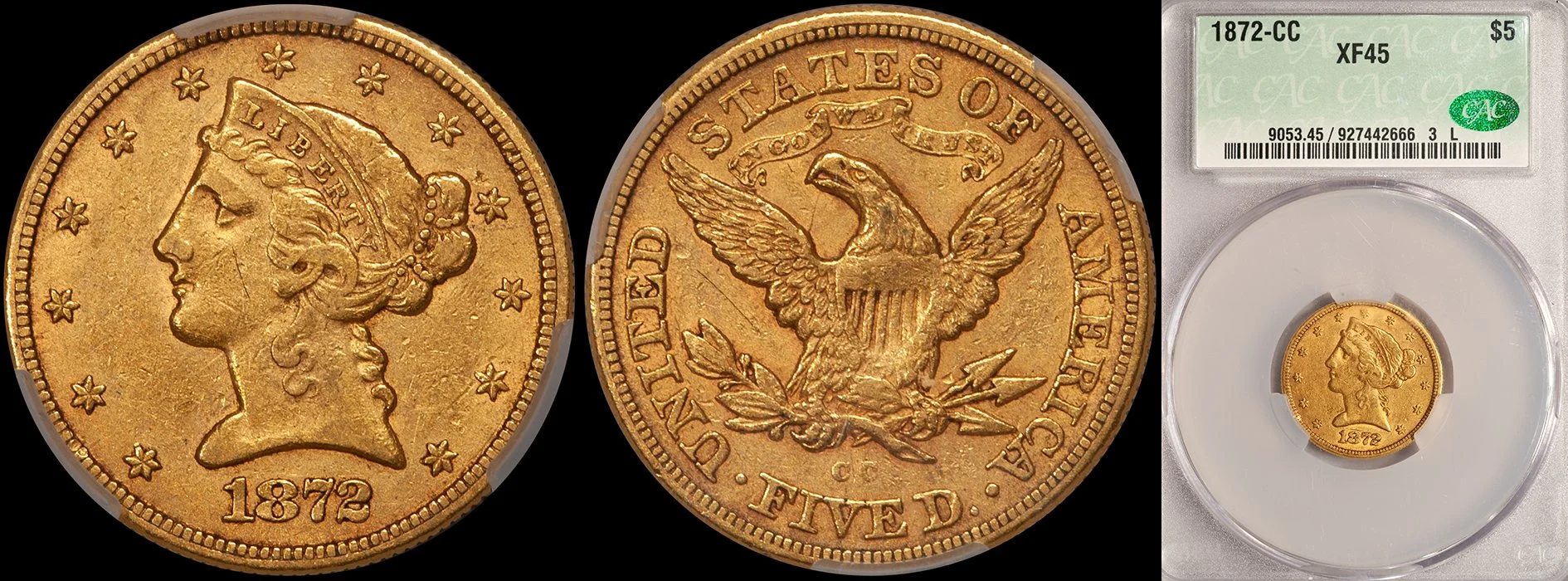
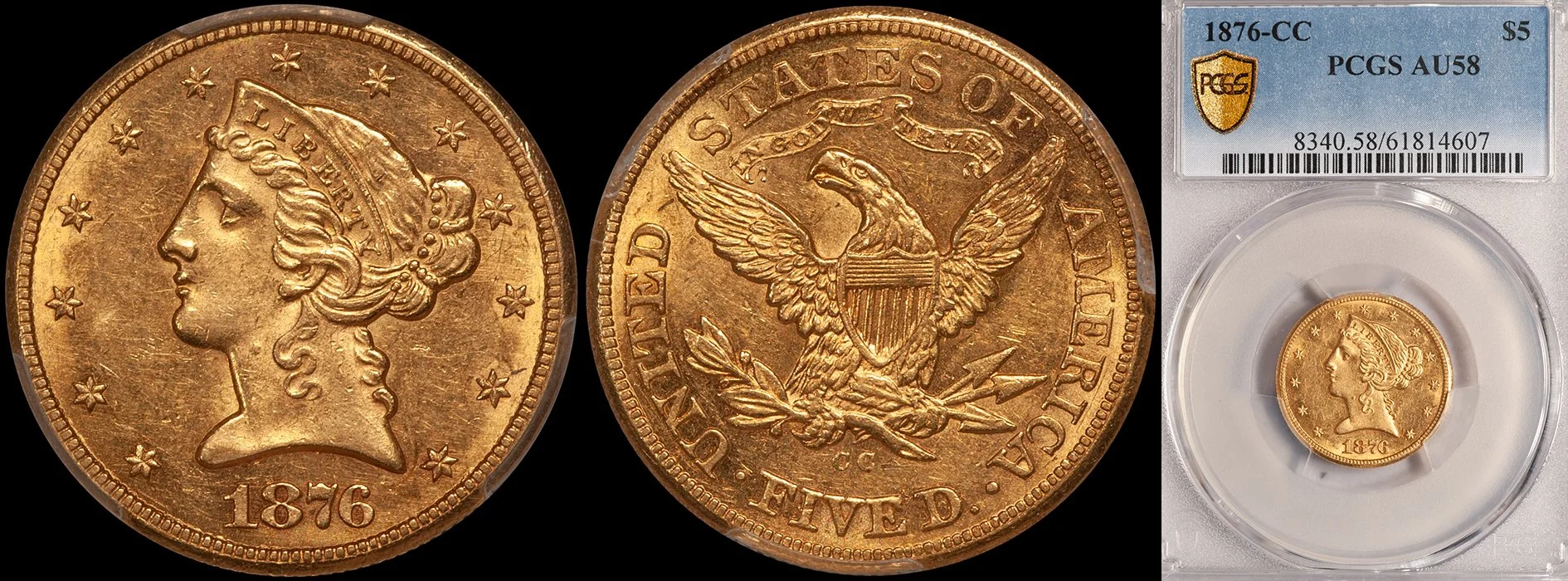
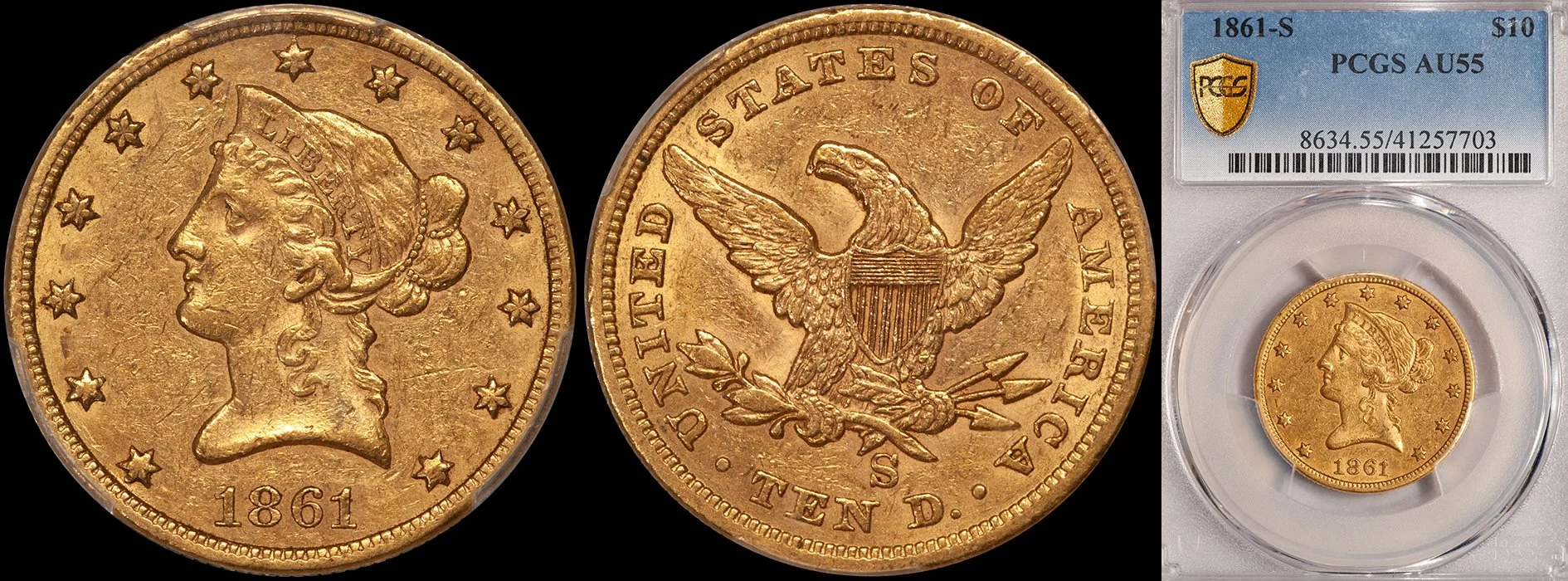
1852-C $5.00 PCGS AU50 CAC

A textbook example for the grade with good detail, outstanding peripheral orange-gold color and a decent amount of remaining luster. The 1852-C is among the more common Charlotte half eagles which make this a perfect date for type purposes. Some light marks in the left obverse field do not detract.

CAC has approved three in this grade with twelve finer.

1876 $5.00 NGC AU55 CAC

With a mintage of just 1,432 coins, the 1876 half eagle is a very scarce issue in all grades. What is interesting about this date is its grade distribution. When available, the 1876 either tends to come very worn and very ugly or very nice (MS62 to MS65). It is sometimes available in high grades due to a small group of five or six pieces that was found a few years ago and, in fact, a nice PCGS MS62+ from this source just sold at the Stack's Bowers 2012 ANA auction for $16,450. The present example has a look that is seldom found on circulated 1876 half eagles: one that is totally original with deep natural green-gold and rose hues on the obverse and the reverse. The surfaces are very clean with just a few tiny scattered marks; a tiny obverse rim bump at 11:00 is barely visible. After years of neglect, coins such as this are becoming appreciated for their rarity and the 1876 is among the rarer half eagles ever produced at the Philadelphia mint.

This is currently the only 1876 half eagle in any grade that has been approved by CAC.

1844 $5.00 NGC MS61 CAC

This totally "new" example is very well struck with nice frosty luster and pleasing natural medium to deep greenish-gold color which is "right" for this date. A few ticks in the fields limit the grade but this piece is choice and fresh. The 1844 half eagle is very common in all circulated grades but it is relatively hard to locate in properly graded MS60 to MS61, scarce in MS62 and rare in full MS63 and better. I still believe that No Motto Philadelphia half eagles from the 1840's are a sort of Final Frontier of American gold coins and they offer the collector a tremendous amount of value.

CAC has approved just one example of this date in this grade with two finer.

1842-O $5.00 NGC AU55

The true rarity of this date is not widely known but it is the second hardest New Orleans half eagle to locate both in terms of overall and high grade rarity. There are well under 100 known from the original mintage of 16,400 and unlike dates like the 1840-O, 1843-O Small and Large Letters and 1845-O, it is virtually non-existent in higher grades. There are exactly three known in Uncirculated (all placed in private collections) and probably another ten to twelve properly graded AU pieces. The present example is one of the few 1842-O half eagles that I have ever seen with fully original color and both sides show a handsome deep, rich green-gold hue. There are a few minor marks in the fields including a small cut between the final star and the back of the neck but this date is known for its rough surfaces and this piece is much more choice than usual in that regard. There has been exactly one auction record for an AU55 for this date in the last decade: the ANR 3/04: 1398 coin (graded by NGC) that brought $8,625 in a market that was far less appreciative of rare New Orleans gold coinage. This coin is a great combination of rarity and beauty and I think it is a great value at less than $10,000.

1835 $5.00 NGC AU58 CAC

The 1835 is many times scarcer than the 1834 Plain 4 although it sells for just a small premium. This very choice example is fully original with choice surfaces, a good strike and pleasing russet color that becomes iridescent as the surfaces are tilted towards a light source. I was able to acquire a few very nice CAC-approved Classic Head half eagles at the Philly ANA show and these are far, far nicer than usual for the grade.

CAC has approved fourteen in this grade with just four higher than this.

1834 Plain 4 $5.00 PCGS AU58 CAC

Classic Head variety. If you are a collector with a $2,500-5,000 per coin budget and you like "old gold," it is a natural to look at Classic Head quarter eagles and half eagles. And there are few coins more appealing than a "gem slider" Classic Head half eagle, especially with the look of this piece. Both the obverse and reverse have glorious natural fiery reddish-gold color with the obverse more intense in hue than the reverse. There is no real wear; just some friction and bag handling in the fields on both sides. You'd have to spend at least double the asking price of this coin to find one that was nicer and even than it might not have this coin's wonderful overall eye appeal.

CAC has approved twenty-four in this grade with another nineteen finer.

1807 $2.50 PCGS EF40

BD-1, R-3. The Draped Bust Right variety of quarter eagle was produced from 1796 through 1807 and it is noted for being amongst the rarest of all early gold issues. The 1807 is by far the most available date of the type but even this issue is not easily found and when available, examples tend to be in the AU and lower Uncirculated grades. There is a high amount of demand for affordable middle grade quarter eagles of this design but they are seldom available as this issue just didn't circulate to wear down to the VF-EF grades. There has been just one PCGS EF40 example of the 1807 sold at auction since 2004 and this was recent (Heritage 9/11: 4201 at $13,800). The present coin is problem-free and while it shows wear, this is even and gentle. In fact, the surfaces of this coin are cleaner than usual for the type and date with nice medium green-gold and orange colors, in slightly different hues, seen on the obverse and reverse. I have handled a few reasonably priced 1807 quarter eagles this year and all of them have sold quickly.

Ten Things I'm Looking Forward to Doing/Seeing at the Philly ANA

The annual Summer ANA show is a highlight on any collector's or dealer's calendar. This is my 30th in a row to attend and I am very much looking forward to the show, especially as it appears to be the last ANA that will be held on the east coast for many years. Here's a list of at least ten things that I'm excited about doing and seeing next week in Philadelphia: 1. Having a Mystery Guest Sighting: Without fail, every year at ANA always brings out at least one "mystery guest." Typically, it's a dealer who left the market and have been unseen for years or it's a collector who I haven't seen since the late 1980's who has decided to wander in because he heard that the ANA show was close to his house. I wonder who it will be this year?

2. Attending the Battle Born Sale. I'm very interested in this sale for a number of reasons. I sold many of the coins to the owner and am curious to see how they do at auction. I am excited to go "head to head" with the sharpest rare date gold buyers in the business as we compete to buy coins for clients and for stock. In the not so distant past, it wasn't uncommon to have big specialized sales like this that all the big players attended in person. I'm hoping that during this sale I'm able to see who I am bidding against, and it will go a long way to answering my questions about the State of the Market for Carson City coinage.

3. Having Something Great Walk Up to My Table: Every dealer hopes this will happen at an ANA show: a well-dressed man walks up to the table with a run of 19th century proof sets that he wants to sell for his elderly parents or a little old lady walks up with an original roll of Saints. These things DO happen from time to time and the fact that we are in Philadelphia, the cradle of American numismatics, bodes well for something exciting walking into the show. So if you are reading this blog, great-grandson of James Longacre, please come to tables 805-807 first and ask for me by name!

4. Wearing Nice Clothes in the 95 Degree/100 % Humidity Philly Summer As excited as I am to spend a week in Philadelphia, I'm going to miss the nearly perfect summer we've had so far in the Northwest. It's been under 80 degrees nearly every day here and I haven't had the air conditioner on once. While I'd like to attend the ANA show in my typical Portland Summer Uniform of polo shirt, shorts and sneakers, I feel this wouldn't be appropriate and will, instead, be suited-up every day. Sigh...

5. Viewing the ANA Exhibits. One of my favorite things to do at the show every year is to take thirty minutes off and go view the competitive and non-competitive exhibits. I still am eager to learn about areas of numismatics I know little about, and to see great U.S. coins that I haven't viewed before. It is always fun for me to do this and I always learn which dealers are true coin weenies when I get a text(s) during the show telling me "you have to see (such and such) coin at the Smithsonian or ANS exhibit."

6. Going to The Barnes Museum. Is it wrong for me to admit that I'm actually more excited to see this art museum than I am to attend the coin show? If you have a teeny iota of interest in great 19th and 20th century art, you need to go.

7. Eating Breakfast and Lunch Every Day at Reading Market. Two words: Amish Breakfast. And I can already taste the Italian sammies I'll be chowing down on every day. Sure beats typical coin show food! (Let's not even begin to talk about Philly cheese steaks, South Philly noodles and gravy, the Belgian mussels and frites place I went to the last time I was in Philly, cheap and good Chinese food, etc. etc.)

8. Restocking My Depleted Inventory. Back in the day, I would save coins for the ANA show because June and July were typically dead months. Now, with the internet 24/7/365 having taken over all retail businesses, I typically go to ANA with very few fresh coins due to the fact that there is essentially no summer break for the coin market any more. I had an atypically busy July and am now in dire need to buy coins. As are, I would assume, most other dealers. That fact, combined with strong metals prices and a great east coast location, lead me to think that this year's show will be a very good to excellent one.

9. Experiencing the ANA Buzz. To use a sports metaphor, the ANA is the Super Bowl of coin shows. It's a whole lot more exciting for a dealer to be at the ANA for a week than its is to spend three days trapped in the purgatory of a slow regional show where you've realized within thirty minutes that there is nothing to buy but your airline wants $1,000+ to change to an earlier flight. (Note to self: continue to pay the change fees and chalk it up to mental health benefits...). Even though I've been doing this show for 30 years and it has becoming a bit of grind, it is still exciting for me every day to walk in, see the hundreds and hundreds of tables and wondering what will happen, good or bad, on this particular day.

10. Leaving the Show. As I hinted above, the ANA is a lot of work, especially when you are doing the majority of the buying/selling/bidding/schmoozing/running around/answering calls/scheduling...let's just say I stay busy pretty much every minute of the day from 8am until 10pm (or later on some of the big auction nights). I like the action and I love the up-side, but it is very tiring and I have to tell you that when my plane lands in Portland, I might be doing the Pope-kissing-the tarmac routine. Except for the fact that the Saturday, Sunday, and Monday after the show are all 12+ hour days...

See you in Philadelphia!