1850-D $2.50 PCGS MS60 CAC

While not as widely regarded as its 1851-D and 1852-D quarter eagle counterparts, the 1850-D is a scarce issue in its own right, especially in higher grades. When I wrote the first edition of my Dahlonega book, I was aware of just one or two Uncirculated coins. Through the miracles of gradeflation, a few new Uncirculated coins have been "discovered" but I doubt if more than three to five Mint State coins are known with none finer than MS62. Although this coin is "only" an MS60, it has phenomenal eye appeal for the issue with lovely deep even honey-gold and greenish colors seen on the obverse and reverse. The strike is far above average for the issue with just minor weakness at the centers and, for the grade, there is less friction than one might expect. The best 1850-D quarter eagle that I am aware of is a PCGS MS62 that is ex Heritage 3/11: 4637 where it brought $27,600. Every other properly graded Uncirculated example of this date is off the market in a tightly-held collection, making this lovely example an important opportunity for the advanced Dahlonega gold collector.

10 Ways to Become a Better Collector

As a dealer who works with collectors who range in experience from total beginners to full-on experts, I have a fairly good idea what separates the masters from the wanna-bes. Experience, obviously, is part of the equation; but some of the best collectors I have ever seen are fairly new to the game and their skill is largely intuitive. Here are some suggestions and observations I'd like to share with you that might just make you a better collector. 1. Don't Spread Yourself Too Thin: I've seen this happen many times before: a newbie gets bitten hard by the coin bug and becomes a collector of everything. You can't fault a bright eyed and bushy tailed collector for being overly enthusiastic, but this is certain to be a pocketbook drain, and it is likely to result in a confused mess of a collection. It's likely that your first choice (or choices) of what you collect will change over time but try to reign in your "I must have it all" sentiments and replace them with a little more control. If you can't stand the down time between purchases, choose a secondary collection that is inexpensive (paper money, tokens, circulated Liberty Seated silver) to fulfill your compulsion to make a purchase.

2. Become A Student Of Your Series: The collectors who impress me the most are the ones who have become specialized in a certain series and who have studied it to the point that they are as knowledgeable about it as possible. This study can take many forms. Some collectors are interested in the history of the coins they collect, while others are more interested in rarity and availability of coins. A collector might select a series to specialize in where there is little written and become the author of a book or a web-based guide. My take on studying a series is that for every hour you put into this, your reward is many times the effort.

3. Establish A Good Relationship With At Least One Or Two Dealers: I don't think I've ever seen a really great collection that wasn't the result of a joint effort between a collector and a dealer. If you collect something like Dahlonega half eagles in crusty About Uncirculated grades, or varieties of Type One Liberty Head double eagles, you just aren't going to have access to enough good coins unless you have a solid relationship with a dealer. Sure, you can find most of the coins that you need on E-Bay, or bidding sight-unseen at a Heritage sale, but my guess is that when you are done you are going to have a set of coins with more problems in it as good pieces. If you collect something like modern coins you don't really need a dealer; this is as close to be a self-service area as there is in numismatics. But if you are a new collector who thinks he can build a complex set without some help...

4. If You Are An Investor, Think Like A Collector: One of the oldest Doug Winter cliches: numismatic investors almost never make money but good collector often makes money in spite of themselves. Think about this for a second: coin investors inevitably buy the wrong coins at the wrong time from the wrong people. Typically, they buy high and sell low. Collectors, on the other hand, buy coins because they love them, hold them for a long period and often see a fairly good return on their "investment" even though they weren't buying to make money. If you are someone buying coins who has no interest in them...stop immediately. Sell what you have and switch to bullion. You'll save yourself a headache or three when its time to liquidate.

5. Buy With Eye Appeal In Mind: Unless you are a specialist who has to buy a certain coin because it is so rare that he can't pass on it, never buy coins that aren't good looking. There are relatively few exceptions to this rule. I would still buy an ugly 1864-S half eagle as this is an in-demand issue that seldom is found at all, let alone with good eye appeal. But if we're talking an issue like an 1864-S double eagle (a reasonably available coin that can be found with good eye appeal if the collector is patient) it is a huge mistake to jump at a coin that is just so-so. This harkens back to #2 listed above: by learning about the coins you collect, you'll learn which can be found nice and which are almost never seen with good eye appeal. Here's a word to the wise: ugly coins are hard to sell unless they are very rare and even then, prepare to steel yourself to a lot of "that's ugly but..." comments.

6. Pay Up For Quality: Another numismatic cliche: "good coins aren't cheap and cheap coins aren't good." In this day and age, it is certainly possible to get fair value when you buy a coin. But with a real shortage of good to great coins in the market right now, it is very unlikely that you are going to be able to buy good coins at auction with low-ball bids or from cash-strapped dealers who have to sell the best pieces they have to pay the bills. The laws of supply and demand have become pretty simple in the coin market in the last five or so years. For every really nice coin, there tends to be multiple buyers. If you aren't willing to step up to the plate, you will not only miss out on them, you probably won't be offered any. I'm not implying that you grossly overpay for coins. Just consider your opportunity costs and consider if your stretch at the time of purchase will be rewarded when its time to sell.

7. Trust Your Instincts: Nearly every numismatic mistake I've made has been the result of not trusting my first instinct. If you have to force yourself to like a coin, it is probably not the right coin for you. If, after doing your research, you think a coin is well overpriced, don't buy it (you might make an exception for that choice 1864-S half eagle you've been looking for since 1998...). Another instinct to trust has to do with a potential dealer. If the guy offering you coins over the phone makes the little hairs on the back of your neck stand up, don't deal with him.

8. Learn How To Price The Series You Collect: Most new collectors either dramatically under-price or overprice coins they are offered. With the online auction prices realized archives that PCGS, NGC and Heritage offer, there is no excuse for most collectors to not have a decent idea of how to price frequently traded coins. Really rare coins, like our friend the 1864-S half eagle, are a different matter and this topic has been discussed by me in previous blogs; read them to see what my thoughts are on this topic.

9. Be Patient! Let me give you a true-life example that illustrates why patience is a numismatic virtue. I met a collector about a year ago who was wanting to collect early gold. I sold him a coin or two and he was hooked. He sent me coins to sell for him to raise money for another purchase. He was self-admittedly impatient and was used to collecting coins that could be found with relative ease. It took me over six months to find him the "right" coin but when I did, it was a total home run; a coin that exceeded his expectations and made him realize that his patience had been more than rewarded. If you want to collect really rare and/or really nice coins, you have to be patient, especially in this market.

10. Don't Bother Learning To Grade: When I had kidney stones two months ago, I didn't take a crash course in how to become a urologist, I just went to the best available doctor and was treated. And it isn't likely that you are ever going to have the time to really learn how to grade; certainly not to the point that you can tell an MS62 from an MS63. But, you can learn how to determine if a coin has real color, if the surfaces are original, if it is well-struck for the issue, if it is new or not new, etc. I used to think it was a good idea to tell collectors to learn to grade and now I realize that it is naive. You can learn to grade to a point but, mainly, learn how to choose coins that are in the top 5-10% for the grade.

If some of these suggestions hit home a little bit hard, don't fret. This blog wasn't written with any specific people in mind and these are mistakes that I have seen made by beginners and sophisticated collectors alike. If you can follow a few of these from time to time, you are likely to enjoy rare coin collecting more and to become a better long-term numismatist.

1839-D $5.00 PCGS AU55 CAC

Variety 1, mintmark above the 3 in the date. The popular one-year type 1839-D is, along with the 1838-D and the 1861-D, the only half eagle from this mint with multiple levels of demand. By this, I mean that it is sought not only by Dahlonega specialists but by gold type collectors (and collectors of "neat coins") as well. This has pushed values up considerably for this issue in the last five or so years but I believe that there is more than enough demand to justify these new levels; not to mention a very limited supply of examples in any grade. I just sold a lovely PCGS AU58 1839-D half eagle a few weeks back and had many inquiries about that coin; the present piece is just about as choice. It shows natural medium yellow and greenish-gold colors at the centers framed by bands of reddish-gold at the rims with this color a bit stronger on the reverse. There is a good deal of luster for the grade and the detail is mostly sharp with just a touch of softness seen on the hair above the ear on the obverse. The last PCGS AU55 to trade at auction was ex Heritage 4/11: 5385 which brought $13,225. In my opinion, the current example is more original and more appealing for the grade. An important coin which is destined to reside in a connoisseur's set of Dahlonega half eagles.

This is one of two AU55 examples approved by CAC with one better. A total of six have been approved by CAC for the date.

Assembling a Year Set of Civil War Gold Coins, Part Four: 1865

In the fourth and final part of this series about the gold coinage from the Civil War era, we now focus on 1865, the final year of the conflict. Viewed as a whole, 1865 is an interesting coinage year although there are not as many extreme rarities as in 1863 or 1864. That said, 1865 remains a challenging year for the collector of United States gold, as the following article will show.

1865 $1.00 PCGS MS67 CAC

1865 Gold Dollar: The 1865 is second only to the 1863 in terms of overall rarity in the Civil War gold dollar series. But it is more available in higher grades with a surprising number of Gem and Superb Gem examples known. The finest I have seen is a PCGS MS68 sold as Heritage 3/08: 1356 for $34,500. There are at least two or three others that grade MS67 and a decent number of MS66's. Original examples show good frosty luster and rich yellow and green-gold coloration. Most are struck from clashed dies yet are well detailed overall. This date is not often available in the more affordable collector grades and when a nice AU55-MS62 does come up for sale it brings well over current published price levels. For a high quality set, the grades to focus on are MS65 to MS66.

1865 $2.50 NGC AU58

1865 Quarter Eagle: The final quarter eagle of the rare three year run from 1863 to 1865, this issue has an original mintage of only 1,520 plus 25 Proofs. It is not as rare as the 1864 quarter eagle but it is a very difficult coin to find with few than three dozen known in all grades. The 1865 is unique in Uncirculated with a single MS63 graded at PCGS. The next best available coins are a small group of AU58's, which are currently valued in the $20,000-25,000 range depending on quality. This is a nearly impossible coin to find with original color and surfaces and it is actually a bit more difficult to find with good eye appeal than the more acclaimed 1864. For a high quality Civil War set, finding a choice AU55 to AU58 would be an impressive accomplishment.

1865-S $2.50 NGC AU58

1865-S Quarter Eagle: Due to its relatively high mintage figure of 23,376 (and its relative availability in higher grades), the 1865-S quarter eagle is not a highly regarded issue. It is actually extremely rare in Uncirculated with just two or three known including a wonderful PCGS MS64 that sold for $20,700 as Bass IV: 218 in 2000. Most are seen in the EF45-AU55 range with a decent strike but scuffy surfaces and stripped color. Uncleaned examples are rare and tend to show soft frosty luster below rose and orange-gold hues. Most collectors will search for a choice AU58 for their sets but the more stalwart collectors of Civil War gold coinage might hold out for an Uncirculated example; a PCGS MS62 sold for less than $10,000 in a recent Stack's Bowers auction.

1865 $3.00 PCGS AU50

1865 Three Dollars: This low mintage date (just 1,140 business strikes made) is by far the scarcest Civil War era Three Dollar issue. Of the 100 or so known, most are in the AU55 to MS61 range. The finest I am aware of is ANR 5/05: 628, graded MS67* by NGC, which brought a record-setting $57,500. This is a well-produced coin that is generally better struck than the earlier Civil War dates and which lacks the vertical striations seen on many of these dates. The luster tends to be satiny or semi-prooflike and the natural coloration is often a rich orange-gold hue. For most Civil War collections, a coin in the MS62 to MS64 range will be the best fit.

1865 $5.00 NGC PR65CAM

1865 Half Eagle: The mintage for the 1865 half eagle is tiny with just 1,270 business strikes and another 25 Proofs. I have only seen one business strike example that I felt was Uncirculated (an NGC MS61 that was last sold as Lot 530 in Stack's Milas auction of 1995 for $18,700) and one or two properly graded AU58's. The NGC population figure of five in Uncirculated includes at least one Proof that has been mistakenly called a business strike and some duplicate submissions. Most 1865 half eagles are prooflike and heavily abraded. Pieces generally are seen in the EF45-AU55 range but seldom have good eye appeal and almost never show natural coloration. Despite this date's obvious rarity, it remains very undervalued with AU examples still selling below $10,000. For most Civil War collectors, a nice, properly graded AU55 to AU58 would be a good purchase for their set.

1865-S $5.00 NGC AU55

1865-S Half Eagle: This date is, by far, the most available San Francisco half eagle from the Civil War era. There were 27,612 struck and a few hundred are known with most showing a good degree of wear from use in local commerce. The typical example is an abraded EF40 to AU50. The finest known, by a large margin, is a PCGS MS64 from the S.S. Brother Johnathan which originally sold for $48,300 in May 1999; it has been sold twice at auction since then and was last offered as ANR 1/04: 480 where it brought $43,700. There are one or two others that have claims to Uncirculated but the 1865-S is very rare in properly graded AU55 to AU58. The few known with original color show nice rose and green-gold hues. This is a issue that should be obtainable in the medium About Uncirculated grades and such a coin, when available, will not be that expensive.

1865 $10.00 NGC AU53

1865 Eagle: The mintage figure for this issue is 3,985 business strikes with an additional 25 Proofs made for collectors. There are an estimated 50-75 known in all grades with most showing a considerable amount of circulation. The 1865 eagle is unique in Uncirculated (a PCGS MS63 which I have never seen) and it is very rare in properly graded AU55 to AU58. Most seen are VF and EF coins with heavy abrasions and impaired reflective surfaces. This is a well-produced issue but it saw heavy circulation and, as a result, problem-free, original coins are extremely rare. In my opinion, this is a very undervalued date as presentable examples can still be obtained for under $10,000. For most collectors, an AU55 example of this issue would be an excellent addition to their Civil War set.

1865-S $10.00 NGC AU58

1865-S Normal Date Eagle: There are two varieties of 1865-S eagle known. The first, which has a Normal Date, is the rarer with an estimated three dozen or so known. The total mintage of this date is 16,700 and it is possible that around 5,000 to 7,000 were struck with the Normal Date obverse. This variety is usually seen with bright surfaces, multiple bagmarks and a sunken appearance which is especially prominent at the reverse center. I have never seen or heard of an Uncirculated 1865-S Normal Date eagle and am aware of just two or three with claims to the AU55 to AU58 range. While not an inexpensive coin, I think it is still undervalued given the fact that it is among the ten rarest issues in the entire Liberty Head eagle series. An advanced Civil War collection with a nice mid-to-high level AU will have a coin that is not likely to ever be improved.

1865-S Inverted Date $10.00 PCGS AU50

1865-S Inverted Date Eagle: There are few United States gold coins with a higher "cool factor" than this variety. The 186 in the date was originally punched upside down and was then corrected. This can be seen with the naked eye and it is a variety that is not seen on more than a handful of other United States issues. While more available than its Normal Date counterpart in terms of overall rarity, the Inverted Date is rarer in high grades. It is extremely rare in AU with no more than three or four known and it is exceedingly rare in Uncirculated with exactly two known. The finest is a PCGS MS64 that is originally from the Brother Jonathan hoard. It sold for $115,000 in 1999 and when it was resold by Bowers and Merena in their 8/01 auction it brought only $81,650; the second finest is an NGC MS62 from the S.S. Republic that is now owned by a western specialist. This is an issue that is generally seen with a very flat strike at the centers and heavy wear which impairs the luster. Most are in the VF-EF range and have been dipped as well as showing excessive abrasions. A nice AU example of this fascinating variety would make a great addition to a Civil War set.

1865 $20.00 NGC AU58

1865 Double Eagle: This is the second most available Civil War double eagle from this mint but it is still many times scarcer than the common 1861. The 1865 double eagle is reasonably easy to find in all circulated grades although nice AU55 to AU58 examples with choice surfaces and natural color are harder to find than their population at PCGS and NGC would suggest. Until the discovery of the S. S. Republic shipwreck, this date was unknown in the higher Uncirculated grades. This hoard included a number of MS64 and MS65 examples and there are currently (as of 6/12) 23 graded MS65 by NGC. These high grade 1865 double eagles are gorgeous coins with great luster and surfaces and they would make a great addition to a Civil War set. For collectors who are more inclined to own a coin with natural surfaces, the best available quality will be in the MS61 to MS62 range.

1865-S $20.00 NGC MS63, S.S. Brother Jonathan

1865-S Double Eagle: Slightly over one million double eagles were struck at the San Francisco mint in 1865 and this is the most common single gold issue produced during this year. The 1865-S is easy to locate in all circulated grades and choice, original AU55 to AU58 examples are still available without a huge effort--or premium. This date was, at one time, very rare in Uncirculated but close to five hundred examples were located when the S.S. Brother Jonathan was salvaged. Today, it is possible to find an 1865-S in grades up to an including MS65. These coins typically show more of a matte-like surface than other shipwreck double eagles from this era but it is possible to find a nice, attractive coin with some patience. For most Civil War collectors an MS64 to MS65 example of the 1865-S double eagle with a shipwreck provenance will be a perfect coin for their collection.

So, there you have it: a four part guide to the Civil War era gold issues from the United States. This is clearly one of the most fascinating--and challenging--sets that a collector can tackle. Due to the rarity and high cost of many coins, the Civil War set is not for everyone. But for the collector with a deep pocketbook and a considerable amount of patience, I can think of few other sets that offer the potential rewards that this one does.

For more information regarding Civil War gold coins, please feel free to contact me via email at dwn@ont.com.

Some of the images above appear courtesy of Heritage.

20 Popular 19th Century US Gold Coins Priced Below $10,000

There are dozens of United States gold coins that are accorded a high degree of value for various reasons: first-year-of-issue, low mintage figures, beautiful design, strong collector appeal, etc. These are not always the "rarest" coins in a series and when the value-conscious collector looks at the numbers they don't always make sense. But coins like the ones listed below are great additions to any collection. Let's look at a list of 20 gold coins from the 19th century priced below $10,000 that would be welcome in any collection. 1. 1849-D Gold Dollar: The first gold dollar from this mint and an affordable, well-made issue. An easy coin to obtain in the $2,500-5,000 range.

2. 1855-O Gold Dollar: The only Type Two gold dollar from New Orleans and the final issue of this denomination from this mint. $3,000-5,000 will buy you a nice piece.

3. 1875 Gold Dollar: Just 400 business strikes were made, yet this issue is affordable.

4. 1838-C Quarter Eagle: The first quarter eagle from Charlotte and a popular two year type. Becoming harder to locate for less than $7,500 but be patient and you'll find one.

5. 1839-D Quarter Eagle: The mate to the 1838-C and an issue that is both first-year-of-type and a one -year emission. Another coin that is becoming hard to find at under $10,000 but not impossible.

6. 1845-O Quarter Eagle: Only 4,000 were struck and this is by far the scarcest quarter eagle from this mint. Still available for less than $10,000 but getting more expensive every year.

7. 1875 Quarter Eagle: If you own the dollar, why not the quarter eagle? Another super-low mintage issue; just 400 struck. Decent pieces can be had for $7,500-10,000.

8. 1854-O Three Dollars: A first-year issue and a one-year type in one affordable package. $5,000-7,500 will buy you a very pleasing example.

9. 1881 Three Dollars: Just 500 business strikes were made and this is a scarce coin in all grades. This date always sells quickly for me. $7,500 will buy you a nice one.

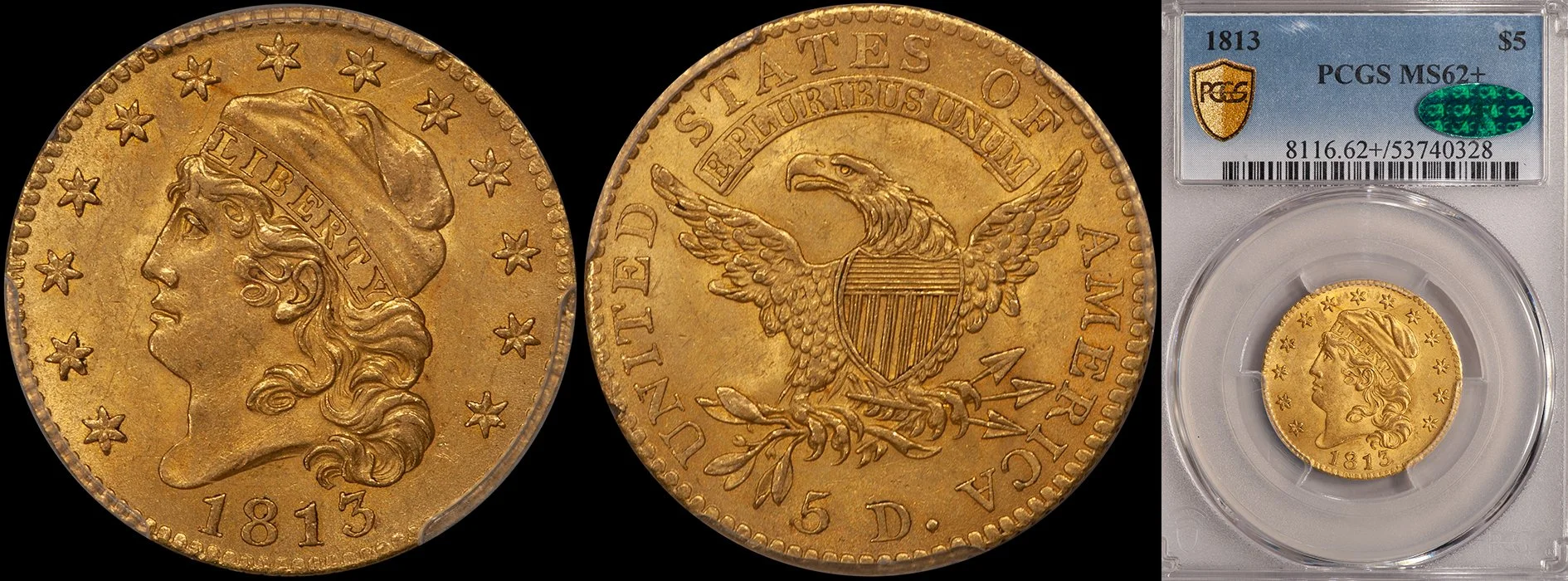
10. 1813 Half Eagle: One of the more common coins on this list but its the most affordable example of the legendary Fat Head type. Nice pieces can still be hard for less than $10,000.

11. 1838-C/1838-D Half Eagles: Both are first year issues and one-year types. Both are very popular and becoming increasingly hard to find at under $10,000. These have great appeal beyond branch mint specialists.

12. 1839-C/1839-D Half Eagles: Two more one-year types. Neither are really rare (except in high grades) but they are well-made, oh-so-popular and can still be purchased in the $5,000-10,000 range. A four coin set that had the 1838-C, 1838-D, 1839-C and 1839-D half eagles would be a great addition to a collection.

13. 1861-C Half Eagle: Final year of issue, possible Civil War issuance and cheap...what's not to love about the 1861-C half eagle? I just sold a nice EF40 for a shade over $5,000 and received multiple orders for it on my site.

14. 1870-CC Half Eagle: You can't buy a really nice example of this date for less than $10,000 anymore but if you stretch a bit you'll own a true piece of history. By a large margin, this is the most affordable first-year CC gold coin.

15. 1838 Eagle: This is another formerly affordable coin whose levels have shot up in the last five years. It's scarce in all grades (only 7,200 were made) and it is the first Liberty Head eagle.

16. 1854-S Eagle: The first San Francisco eagle and a true Gold Rush artifact. Very affordable with very nice pieces still available for around $5,000.

17. 1857-S SSCA Double Eagle: I thought twice about adding this to the list but how can you not love a coin with this much history and cosmetic appeal? MS63's at $9,000 or so seem like fair value right now.

18. 1874-CC Eagle: To me, the thought of owning a Carson City eagle from the early 1870's is pretty exciting and the 1874-CC is the most common. Nice coins can be had for $6,000-8,000.

19. 1861 Double Eagle: An affordable Civil War double eagle that is well made and available. A great starter coin for the collector and always an easy coin to sell. You can buy nice examples for $3,000-5,000 and up.

20. Carson City Double Eagle: I didn't mention a specific date as I am viewing this as a type purchase. What could be more popular than a big, pretty coin like this? You can still purchase an excellent example for $4,000-7,000.

So what coins did I leave off the list that you have in your collection and which do you agree with? Email me at dwn@ont.com and let me know!

1839-D $5.00 PCGS AU58

Variety 1. Mintmark directly over the top of the 3 in the date. This is the rarer of the two known varieties. Along with the 1838-D, the 1839-D is an important issue amongst Dahlonega half eagles as it is a one year type coin. The 1839-D is actually rarer than the 1838-D both in terms of overall and grade rarity. There are an estimated 200-225 known with as many as four dozen grading AU by today's standards. However, the great majority are in the AU50 to AU53 range and choice pieces are very rare. Only four to six are known in Uncirculated and the PCGS population of just three coins in AU58 should give a clear indication as to this coin's rarity in this grade. The present example is a highly lustrous slider with virtually no rub seen on the obverse and excellent overall detail for the issue. Both sides show some medium yellow-gold color and there are only a few light, scattered abrasions visible in the fields. The last APR for a PCGS AU58 1839-D half eagle was in May 2007 when Heritage sold a piece for $16,100; prior to this you have to go all the way back to October 1999 when the Bass II coin was sold for a reasonable $11,500.

1848-C $2.50 NGC EF40 CAC

Sharply struck for the date with none of the central weakness seen on many examples and nicely toned with rich reddish-gold and pale blue colors on the obverse and reverse. A visually pleasing coin and an affordable Charlotte quarter eagle that is perfect either for the new date collector or the type collector seeking a single affordable issue