1864 $5.00 PCGS AU53

The rarity of the 1862-1865 Philadelphia half eagles has been misunderstood for decades. Despite low mintages and no real reason why any should have survived, these coins have traditionally been overlooked in favor of less rare branch mint issues. But the word is finally out on the 1864 half eagle and I, for one, think this coin's sudden appreciation with collectors is long overdue. Only 4,170 business strikes were made and I doubt if more than 60-80 are known in all grades. This date becomes very rare in properly graded AU50 and above and the last PCGS 53 to sell at auction was in May 2000. A PCGS 55 just sold for $9,200 in the last Heritage auction (9/11, lot 4316). This lightly toned example has splashes of tangerine-gold color on the obverse and reverse and is nicely detailed. There are a few marks on the obverse including a series of three small abrasions ( a reeding mark?) from the chin and a light mark or two on the cheek. A nice example of this Civil War rarity.

1798 Large 8, 13 Star Reverse $5.00 PCGS AU58 CAC

BD-4, High Rarity-4. This variety is easily recognized by the reverse cuds at ES in STATES and O in OF. There have actually been a fairly decent number of 1798 half eagles on the market in the last few months and with the exception of a few, I have been largely unimpressed. Most had been dipped at one time and most were liberally abraded. I like this coin because it is very original and because it is clean. I think it compares favorably to other 1798 half eagles that I've seen in MS61 holders and it would not look out of place in such a slab. The color of this coin is exceptional with splendid rich orange-gold that deepens to red at the left obverse and throughout much of the reverse. There is a slight amount of friction on the high spots and a number of adjustment marks (mint-made, of course) on the reverse that form a criss-cross pattern within the shield and the inner parts of the wings. As is typical of this variety, the centers are not as sharp as the borders and I have seen similar adjustment marks on a number of 1798 BD-4 half eagles. The originality and eye appeal of this coin make it very special and this is a wonderful piece of 18th century American gold.

1855-O $10.00 NGC EF45 CAC

With a mintage of just 18,000, the 1855-O is a scarce date in all grades. It is tied with the 1856-O as the fifth rarest No Motto eagle from New Orleans and it is really hard to find in choice, original EF. This example was sold by me to a collector around a year ago and he traded it back to me to acquire a nice PCGS AU50 1855-O eagle. It has lovely medium green-gold color that is accentuated by splashes of reddish-gold at the obverse periphery. In addition to showing nice color, this piece has very clean surfaces with just a few inconsequential marks scattered about the fields. There is a small rectangular planchet flaw on the reverse below the beak that is mint-made. An affordable but truly scarce coin that is a great value for the eagle collector.

Grade Distribution of 19th Century Branch Mint Gold Coins

For many 19th century gold issues, it is as important to know the grade distribution as it is the overall rate of survival. In this blog, let's look at grade distribution; namely how the surviving examples of a specific issue are distributed along the lines of grade. It is natural to believe that for the typical mid-19th century issue grade distribution, if plotted on a graph, would resemble a bell curve. If, say, 100 examples of a specific issue are known, it is likely that few survivors would be in very low grades (i.e. VF and below) and few would be in high grades (i.e., Mint State), with most clustered in the middle grades (i.e., EF and AU). To some extent this is true but there are a number of scenarios that can make the grade distribution skew more towards the low end or the high end.

Grade distribution can cluster towards the low end for a number of reasons. One has to do with the need for coins in a particular geographic region. The gold coins from Carson City were eagerly received by citizens of the western states from 1870 through 1874 due to a pressing need. As an example, nearly every known 1873-CC half eagle and eagle grade Extremely Fine or below, indicating that these were issues that saw considerable use in circulation.

There are other issues that tend to be found in lower grades due to heavy use in circulation. These include the Charlotte and Dahlonega quarter eagles and half eagles from the first few years that these mints were open (1838 to around 1843), San Francisco half eagles and eagles from the late 1850's through the mid-1860's and New Orleans half eagles and eagles from the mid to late 1850's.

You will note that all of the issues that I have mentioned so far tend to be medium to larger sized; they don't include gold dollars, quarter eagles and double eagles. For various reasons, these denominations do not necessarily show the same grade distribution pattern as do their larger-sized counterparts from the same era.

Grade distribution tends to be a size-related phenomenon. Because of their size, Double Eagles did not to circulate as much as half eagles or eagles and because of their intrinsic value they were melted to a greater extent in later years. With the exception of certain rare dates like the 1854-O and 1856-O, most double eagles of the Type One design are seldom found in grades below EF.

The same is true with gold dollars. Because of their small size, the likelihood of a gold dollar circulating all the way down to the VF grade range is improbable.

Let's go back to two issues I mentioned above and look at their grade distribution.

The 1873-CC half eagle is an issue that saw heavy circulation in the local economy and, as a result, is typically seen in low grades. PCGS has graded a total of 65 examples of which only 7 (or a shade over 10%) grade above AU50.

Now compare this to the 1893-CC half eagle, a more common issue but one that saw very little circulation in the local economy. PCGS has graded a total of 364 in all grades of which a whopping 283 (or over 80%) grade AU50 or better.

This situation also exists for the 1873-CC eagle. PCGS has graded a total of 52 of which just 14 are considered high grade coins (i.e., AU50 and above). Compare this to the 1881-CC eagle, an issue that saw little local circulaton and is now often repatriated in groups from Europe. This date has a a total population at PCGS of 264 with 137 of them, or more than 50%, in high grades.

Certain rare date 19th century gold coins have a grade distribution that makes sense because of very low original mintage figures. As an example, well-known rarities such as the 1864 quarter eagle, 1875 half eagle and eagle and 1883-O eagle are very rare in higher grade because they have tiny original mintage figures. The likelihood of a coin surviving in higher grades with an original mintage of 100 or 200 (the 1875 eagle and half eagle, respectively) is, obviously, very slim.

But mintage figures alone do not act as a predictor of a coin's rarity. There are certain later 19th century issues, such as the Three Dollar gold pieces from the 1880's, that have very low mintage figures but high survival rates. These issues were saved by collectors, dealers and speculators when they were struck and not only do they exist in far greater percentages than their counterparts from the 1860's and early 1870's, but in higher average grades as well.

What about low mintage issues that are more available in high grades than expected due to hoards? A good example of this is the 1857-D quarter eagle. With a mintage of just 2,364 you would expect this to be a rare coin in all grades. Most Dahlonega quarter eagles have a survival rate of around 3% of the original mintage. This is not the case with the 1857-D.

According to the most recent PCGS population figures, a total of 67 have been graded. Of these, no less than 57 have been graded AU or higher. How can we explain this anomaly?

If you are a student of Dahlonega quarter eagles, you are aware of the fact that most 1857-D quarter eagles (at least the ones that are original) have a similar look: softly struck, very frosty and toned in a rich yellow-gold hue. This similarity in appearance suggests that a hoard of 1857-D quarter eagles existed at one time and has been dispersed.

The grade distribution of an issue can change quickly due to hoards. A great example is the 1857-S double eagle. At one time, this issue was typically seen in EF and AU grades and was actually quite scarce in Uncirculated. But after thousands of high grade examples were located in the S.S. Central America treasure, the grade distribution of this date changed radically. Now, the 1857-S double eagle is seen more often in higher grades than it is in lower grades. The result of this was a radical compression of value. In MS62 or MS63, this date is only worth around three times more than it is in AU55 to AU58. Prior to the discovery of thousands of Uncirculated examples, this ratio was more like ten to one.

I believe that it is important for the student of United States gold coinage to study the grade distribution. By learning how rare a specific coin is in higher grades, the collector can identify the best values in the area(s) in which he collects. Because of third-party grading certification data, this is better possible than ever before.

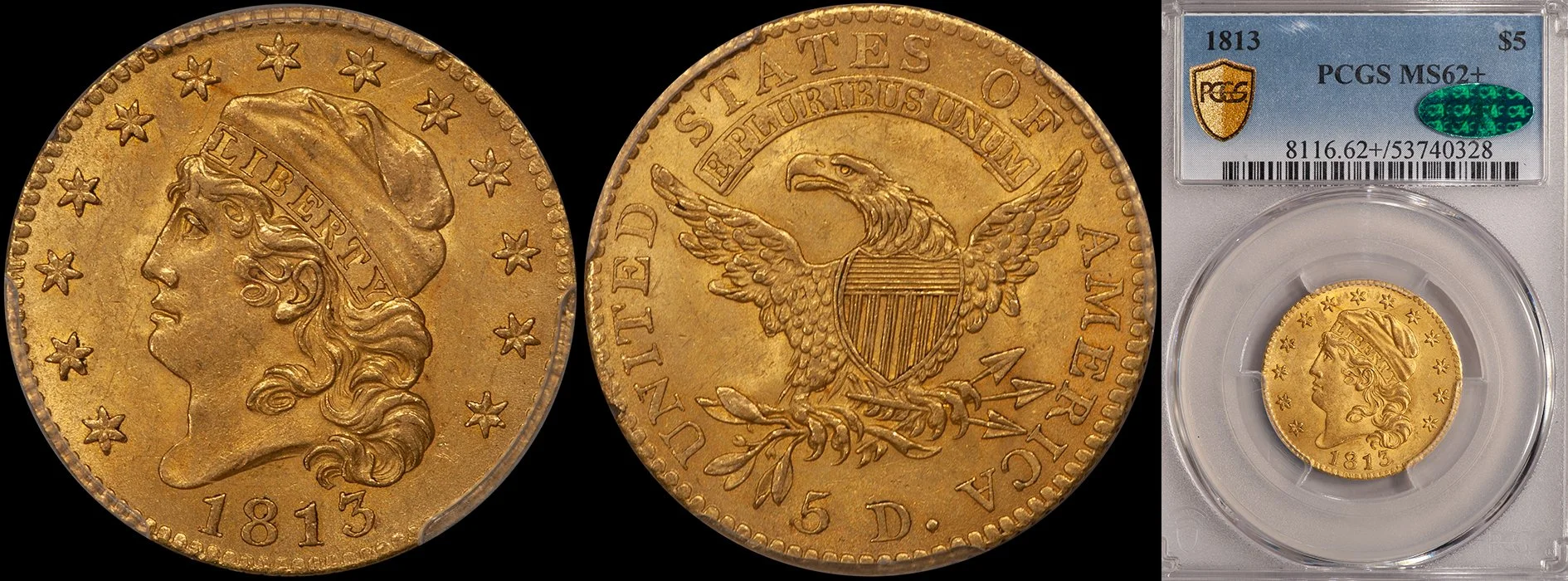
1813 $5.00 PCGS MS63 CAC

BD-2. R-4. The Capped Head Left, Large Diameter type, struck from 1813 through 1829, contains some of the rarest gold issues ever produced by the United States mint. Only the 1813 is somewhat readily available in the lower Uncirculated grades and this makes it the ideal date for use in a type set of U.S. gold. This example is original and choice for the grade with very nice intense lemon-gold color on both sides. The strike is typical for the date with some softness on the border beads but good overall detail at the centers. There is some light marking in the obverse and reverse fields that limits the grade but the freshness and eye appeal of this coin make it as nice a Fat Head half eagle as you are likely to find in this grade and price range. The next grade up (in a PCGS holder and with a CAC sticker) will cost you over $55,000 if you can even find one!

CAC has given approval to ten examples in this grade and seven higher than this.

1860-S $20.00 PCGS EF45 CAC

Original and solid for the grade with even medium green-gold hues seen on the obverse and the reverse. A few small reeding marks can be seen on the obverse with one at the truncation and another inside of the first star. This date is not easily found with better color and surfaces than what is seen on this pleasing, affordable example.

1842 Large Date $10.00 NGC AU58

Large Date variety. There are two varieties of eagles produced at the Philadelphia mint in 1842: the Small Date and the Large Date. The former is the scarcer of the two but the Large Date is more challenging to locate than its mintage figure of 62,884 would suggest. This date is usually seen in the EF40 to AU50 grade range and it becomes very scarce in properly graded AU55 to AU58. In Uncirculated, it is a really rare coin and it is an issue that I have not handled in Mint State since the early 1990's. This fresh example shows no real wear but does display some abrasions from having been transported in a bag. The color is a lovely fiery orange-gold hue with some contrasting reddish shades about the devices. There have been no AU58 1842 Large Date eagles sold at auction since 2008 and the last MS60 (a PCGS coin) sold for $10,925 in the Heritage 3/09 sale despite its funky orange coloration. There are many great opportunities for the value-conscious collector in the Liberty Head eagle market and these early dates from Philadelphia offer some of the best value out there.

1855-O $20.00 PCGS EF45 CAC

Here's yet another reason why I love being a coin dealer: after a couple of years of not handling an example of this very rare double eagle, I have now bought two in less than than three weeks. I just sold the Pittman 1855-O (also graded EF45 and approved by CAC) and am now pleased to offer what I believe to be the single nicest piece that I have ever seen in an EF45 holder. This is a very original 1855-O with superb deep color on the obverse and reverse. Both sides are a rich green-gold with pronounced reddish shadings at the right obverse border and across nearly all of the reverse periphery. The surfaces are choice and exceptionally clean for the issue with no marks of note except for a tiny shallow mint-made planchet flake to the left of the 1 in the date. Interestingly, the Pittman coin that I just sold also had an obverse flake; this time below the 55 in the date. This example has really marvelous overall eye appeal and I doubt if you could find a piece with a better appearance in today's market. As I said when describing the Pittman coin, the 1855-O is the rarest collectible New Orleans double eagle and I think it is considerably undervalued in relation to issues such as the 1859-O, 1860-O and 1879-O.

1842-O $10.00 NGC AU53 CAC

Coinage of the eagle denomination at the New Orleans mint didn't begin until 1841 and given the fact that the first year of issue is rare and expensive, for most collectors the 1842-O is the first available issue. The 1842-O has a mintage of 27,400 and it is only marginally scarce in lower grades but it becomes very scarce in properly graded AU53 and higher. Nearly all the examples that I see graded AU53 to AU55 are heavily abraded and show no originality. This example is a nice exception to the rule(s) as it is very clean and shows nice deep green-gold color with underlying flashes of reddish-gold at the date and borders. The strike is very sharp with just a bit of weakness on the curl above the ear and the fields are smooth. This piece has really good eye appeal for the date. Scarce and attractive.