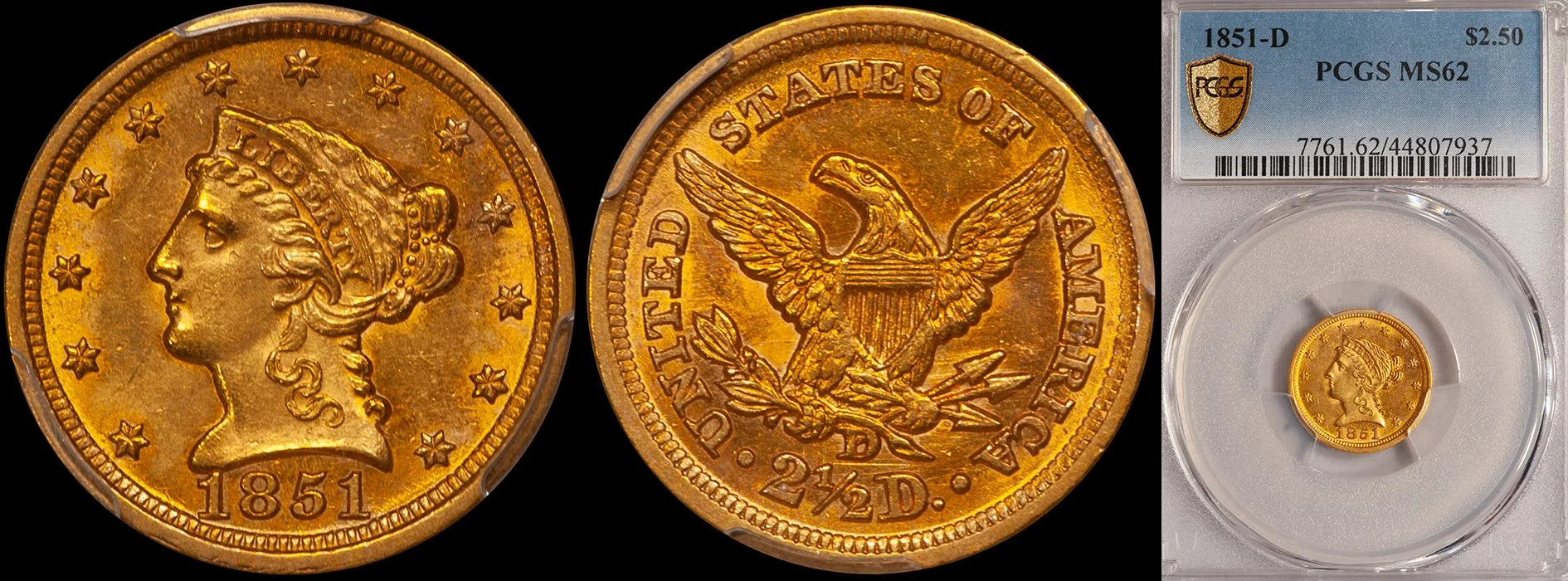
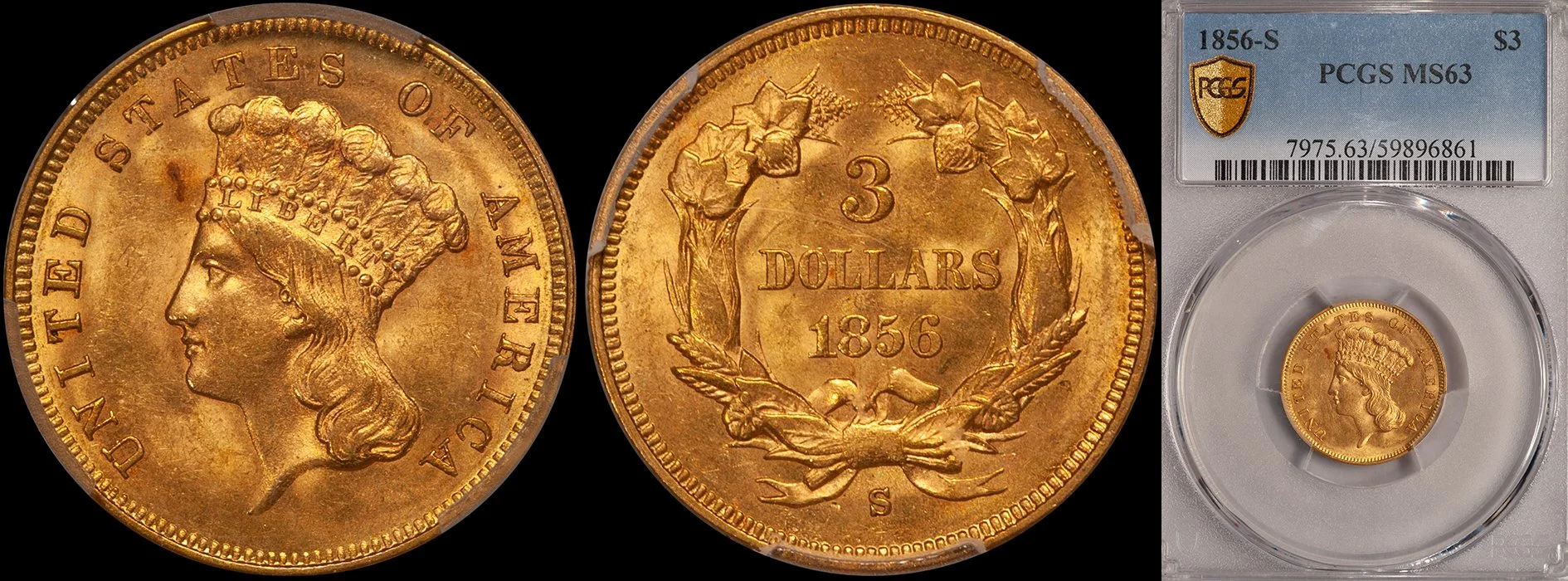
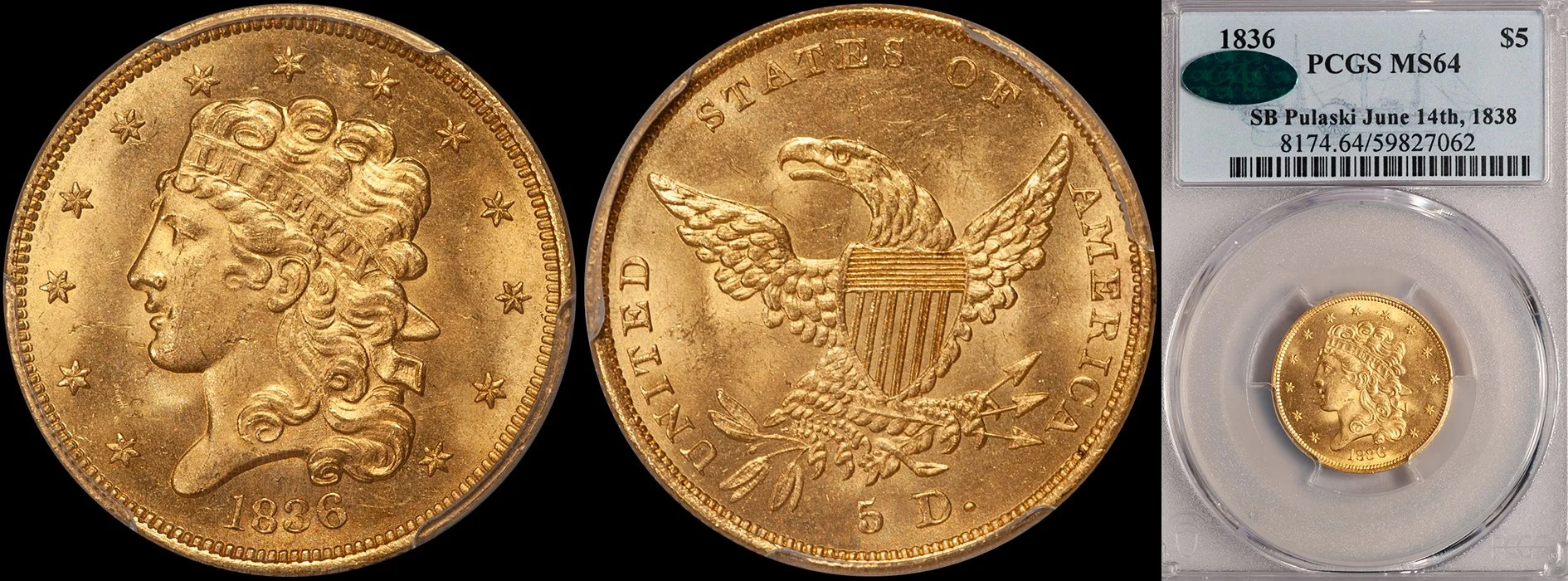
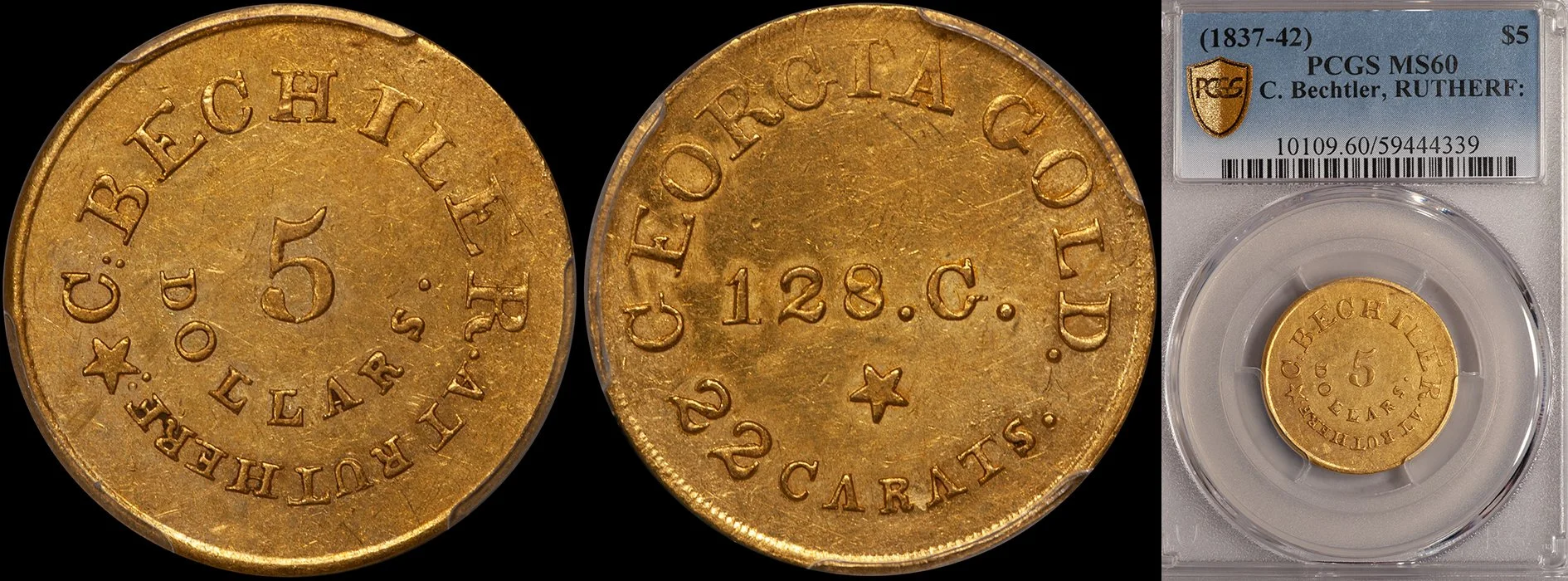
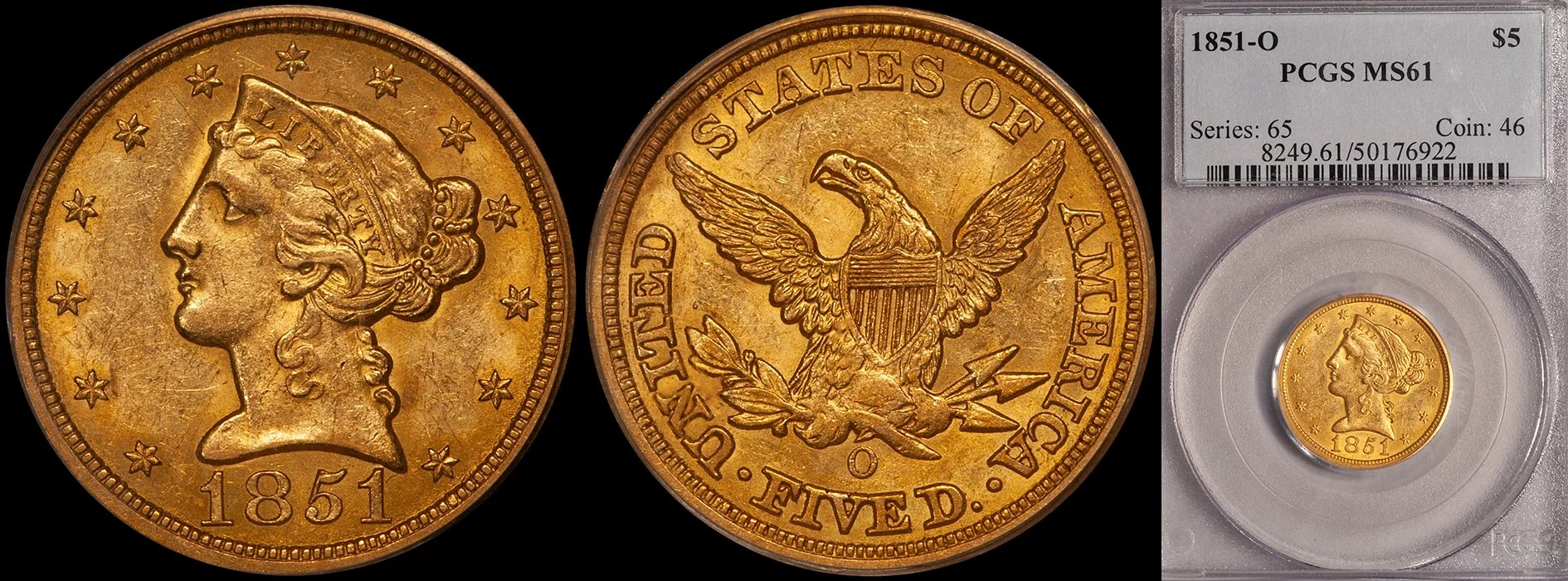
The 1823 Half Eagle

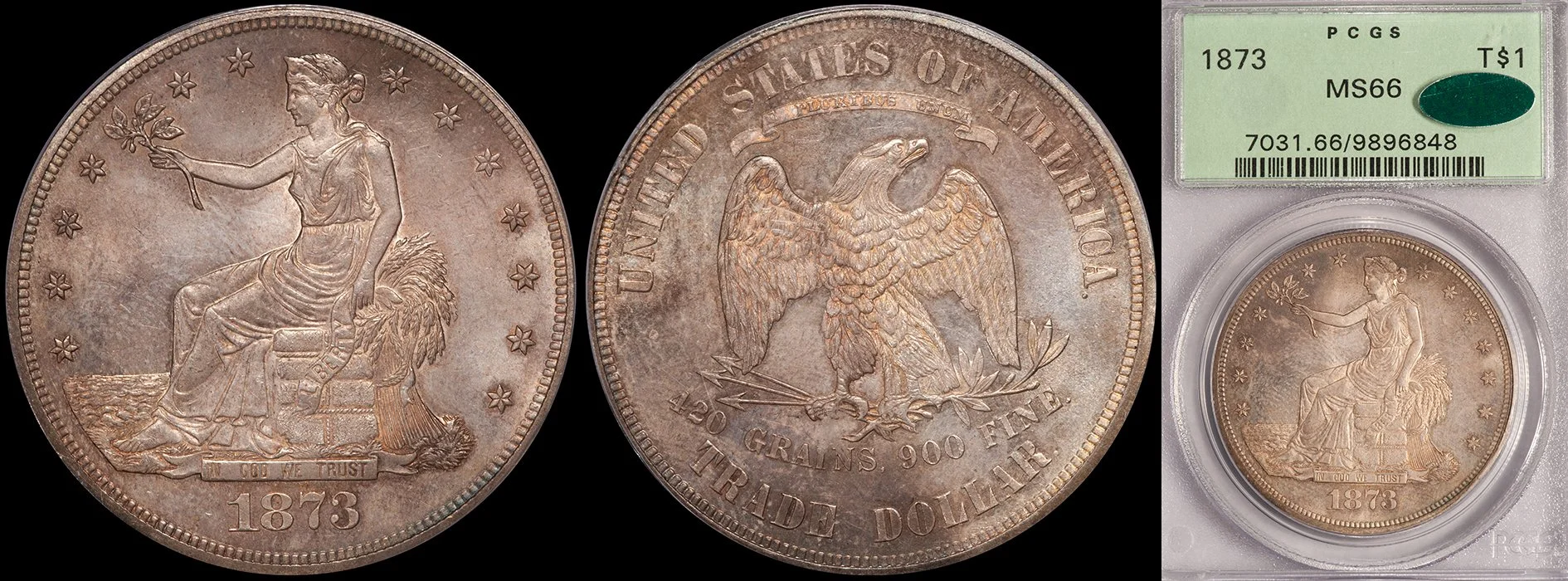
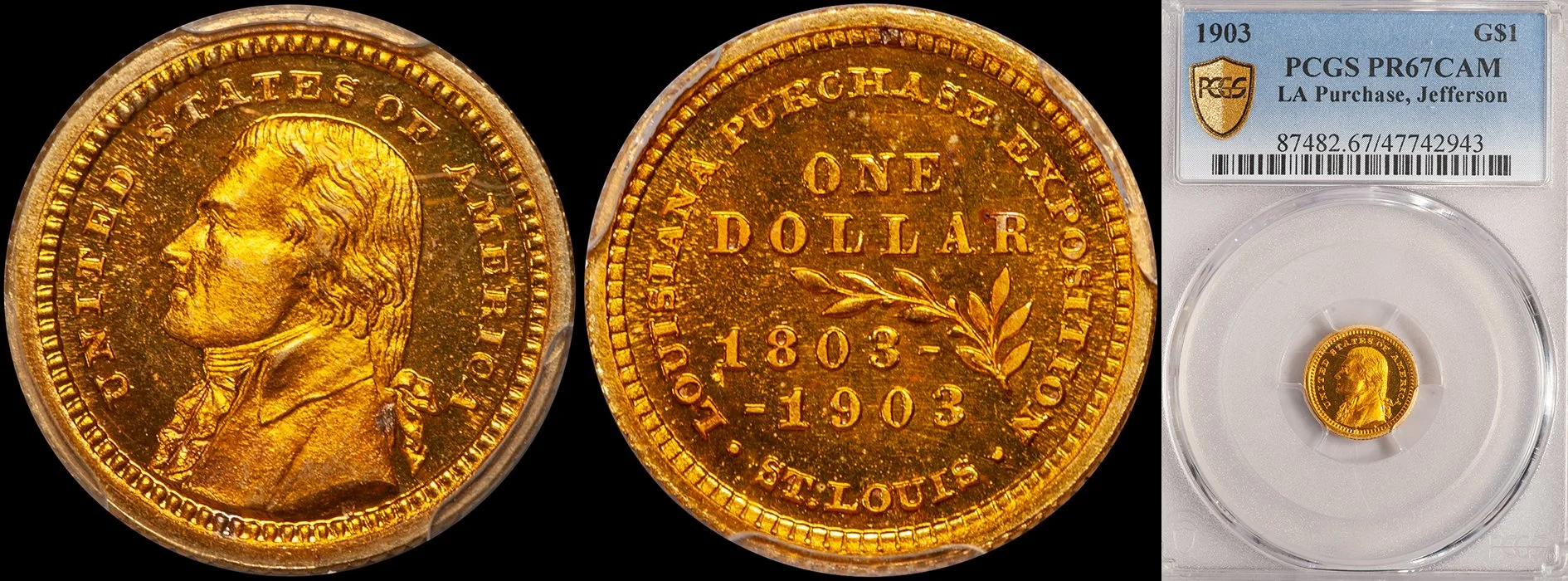
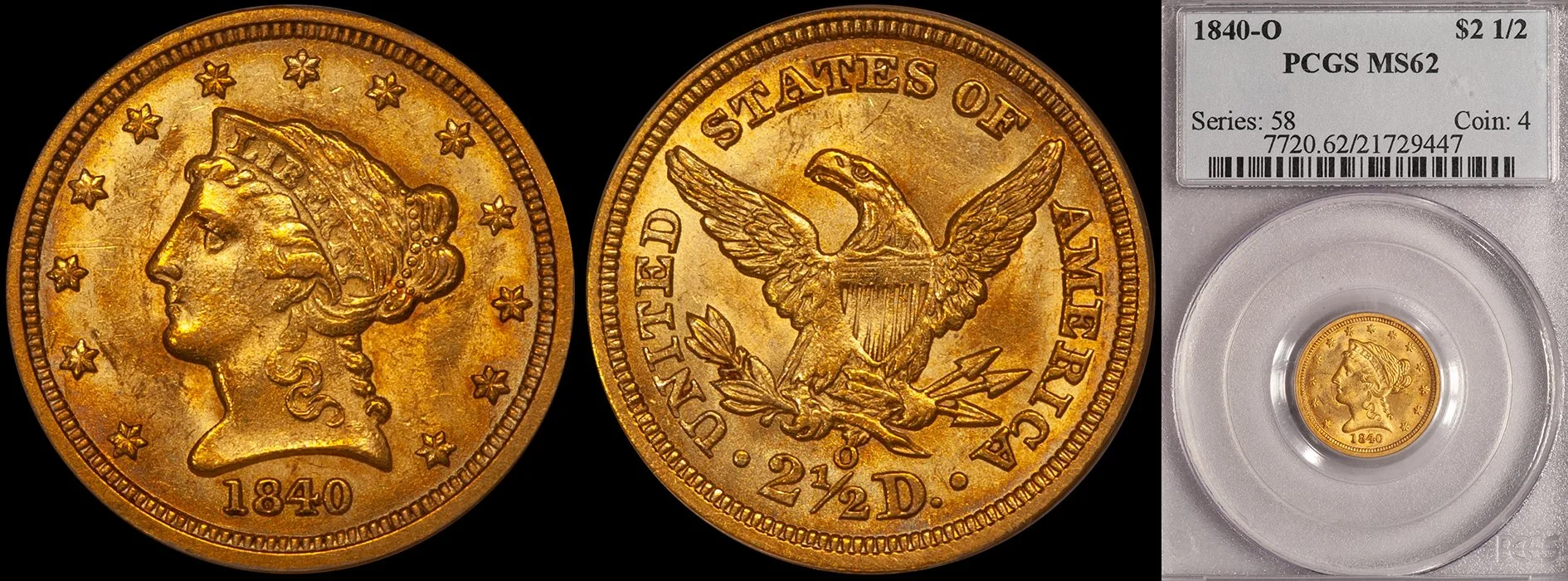
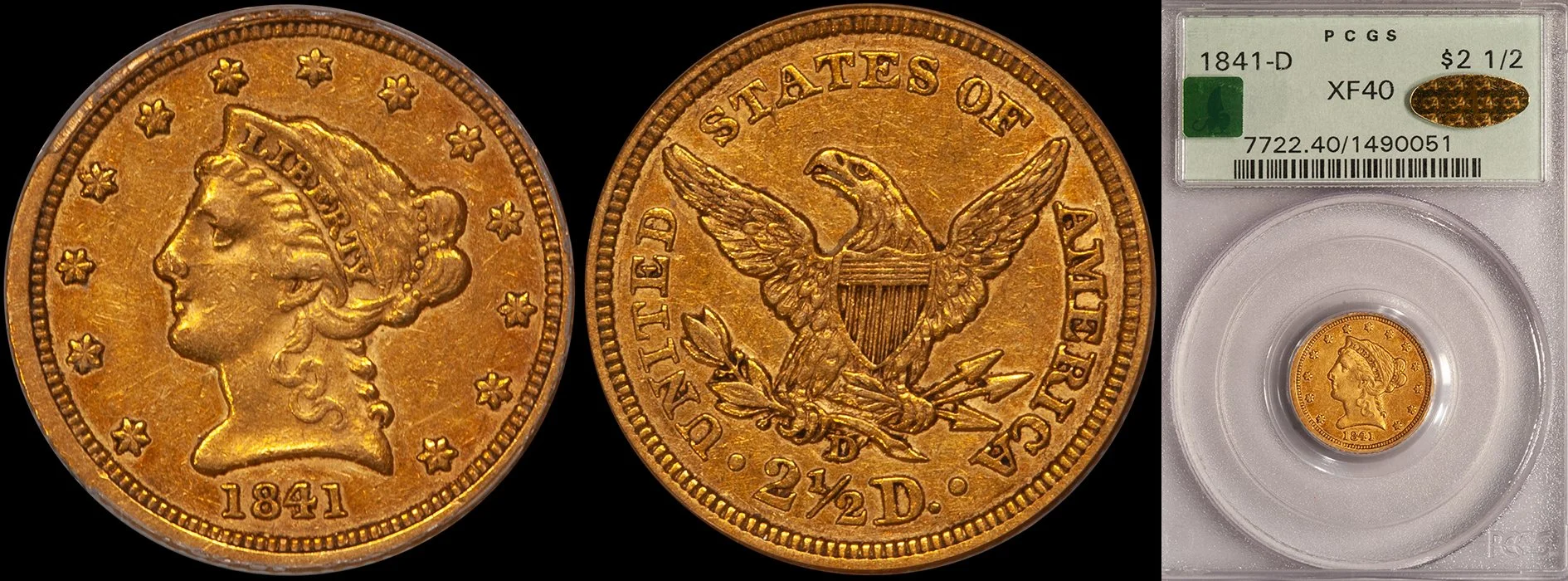
As a specialist in rare United States gold coins, there are few series that I find more interested than the Capped Head half eagles produced from 1813 through 1834. I recently purchased (and quickly sold) a PCGS graded AU53 1823 half eagle. This date, by the standards of the type, is no big deal. But the more I researched the 1823, the more I realized that it is an underrated and enigmatic issue.

The so-called Fat Head series is typically divided into segments: dates that are obtainable (1813, 1814, 1818 and 1820) and those that range from virtually unobtainable to impossible. What's interesting about the 1823 is that it is really the only issue of this type that is clearly rare but which is not an extreme rarity. Let's take a more in-depth peek at this issue.

The 1823 has the lowest recorded mintage of any half eagle made between 1821 and 1834 with only 14,485 having been struck. There are an estimated 70-90 known and nearly all of these are in the AU58 to MS62 range. As with nearly all half eagles from the 1820's, the 1823 saw very little in the way of actual circulation and virtually all of the mintage was melted in 1834 when the weight of gold coins was lowered.

It should be pointed out that mintage figures of half eagles from the 1820's are probably highly inaccurate. I feel that many of the coins struck in 1820 were actually dated 1821, 1822 and 1823. At some point, it may be possible to breakdown these mintages more accurately but it is not currently possible.

There are a few very choice 1823 half eagles known. The finest that I am aware of is the one in the Bass core collection which is ex Norweb I: 774. It sold to Harry Bass for $52,800 all the way back in 1987 which is still an uaction record for this date (!) I grade the coin MS64+ to MS65 and it has superb original luster and color. The second best that I have seen is James Stack: 1069 that sold in October 1994 for $35,200. I grade this coin MS64 or better by today's standards.

NGC has graded one example of this date in MS65 (the Stack coin?) as well as one in MS64. PCGS has never graded an MS65 but does show five in MS64. My hunch is that this number is slightly inflated by resubmissions.

As with all half eagles from the 1820's, the 1823 is a well-produced issue. It is typically fairly sharply struck although I have seen examples that are weak on the curls above Liberty's eyes and a few of the stars lacked their radial lines. High grade 1823's show splendid rich, frosty luster and original uncleaned pieces have lovely rich orange-gold color.

One of the more curious facts about the 1823 half eagle is its current pricing structure. The most recent Coin Values has a value of $13,500 for this issue in AU50 (which seems about right) and a value of $14,500 in AU55. It is hard to imagine that the value of an AU55 would only be $1,000 than an AU50 but I'm assuming that part of this has to do with the fact that so few AU 1823's are known that a small jump in grade doesn't equate to a large jump in value. Right?

Every series has a date or two that fall through the cracks and in the fabulous Fat Head fives from the 1820's and 1830's it seems that the 1823 is (currently) getting the short end of the proverbial stick. This date does not sell for an especially large premium over dates like the 1813, 1814, 1818 and 1820 but it is many times scarcer. Obviously, few people collect Fat Head fives by date so prices for this series are not as carefully scrutinized as Indian Head quarter eagles. That said, it seems to me that the 1823 is a very undervalued issue and it is a coin that I look forward to owning more of in the future.

Value Compression in the Rare Date Gold Market

The recent Coin World “Coin Values” (or Trends as we long-time dealers call it) features a number of price reductions in the various Liberty Head gold series. This has caused some interesting pricing anomalies that have major ramifications for collectors of rare date gold coins. The grade range that appears to be severely affected by the Trends revisions is AU50 to AU58. This makes sense as this is the grade range that, in my opinion, has been most severely compromised by the grading services over the years. I think this especially true for the AU55 and AU58 grades; a range that includes many coins that are marginal quality at best.

A number of factors caused these values to be reduced by the Trends editor(s). One is, of course, auction prices. As I have stated a number of times in the past, one of the biggest problems with coin pricing is the fact that one bad apple can literally spoil the whole bunch. Let me give you an example. Let’s say that Trends in AU58 for a specific Charlotte quarter eagle was $9,000 in AU58. Then let’s say that a really, really low end example in an AU58 holder sells at auction for $4,000. Does this mean that the price of this issue should suddenly be cut in half?

I would argue that it shouldn’t. But I would also argue that a compression of values for rare date gold is inevitable.

Value compression is not without precedent. Two of the most famous examples that I can think of are the Iowa half dollar (worth $85 in XF and $100 in MS65) and the Roanoke half dollar (worth $160 in XF and $180 in MS64). The reason why values become compressed for a specific coin is that the market believes that a premium is unmerited. In the case of the Roanoke half dollar, the reason is obvious: because of the cluttered design, an AU58 Roanoke looks essentially no different from an MS64. For better or worse, this is what has happened with certain branch mint gold coins due to erratic grading standards.

Let me give you an example. The more sophisticated segment of the rare date gold market believes that a choice, original coin graded EF45 is preferable to a bright, shiny processed AU53. Because of this, it tends to place a value premium on the nice 45 coin. The same collector who is willing to spend, say $2,500 on a Choice EF would probably pass on a crappy AU53 example of the same date at $3,000; even though the higher graded example is seemingly the “better deal.”

There are now at least three distinct segments of the rare date gold market. There are the serious hard-core collectors with some budget constraints who will spend $1,500-3,500 on a coin without flinching. This segment of the market is as strong as ever; maybe even more so than in the 2004-2006 Boom Years. The next segment is the casual uninformed investor, the deal-seeker or the “world-is-coming-to-an-end-so-I need-to-own-gold” buyer. They are the likely buyers of the not-so-nice coins that might range from slightly overgraded to blatantly overgraded. This segment of the market is extremely weak right now. The third segment of the market is the high budget connoisseur who is searching for coins that are in or near the Condition Census for the issue; maybe even the finest known. This segment of the market is clearly not as strong as it was a few years ago but if the right coin comes along, these buyers will pay strong prices.

With the existence of these three segments what has happened is that the market has become stronger at the lower end, much weaker at the middle end and slightly weaker but still capable of a wallop on the higher end. As a result, a coin that is worth $2,000 in EF45 and $10,000 in MS60 might only be worth $3,000-4,000 in schlocky AU53. And it might be a hard sale for a dealer even at this compressed level.

Now, here’s where the interesting play comes in for the savvy buyer. I think some nice quality AU53 and AU55 coins are going to get dragged down along with the schlock. Let’s say that you are able to buy a nice Charlotte or Dahlonega quarter eagle in properly graded AU53 for $2,750-3,250 (when a nice EF45 is worth $2,250-2,500). In this case, paying the extra 20% or so for a coin that is demonstrably better is an excellent value. If the collector learns which AU53 quarter eagles are nice for the grade, they are getting coins that are more cosmetically appealing than a nice EF45 and a compressed value that makes plenty of sense to me.

The "Deal Shopping" Mentality and Rare Coin Prices

I had an interesting experience at the Long Beach show that I thought was worth sharing. A new-to-the-market collector/investor came up to my table and asked to see my “best coins.” I was happy to share them with him and pulled out a gorgeous 1802 quarter eagle in PCGS AU58 and a lovely 1798/7 eagle in PCGS AU55. After some back-and-forth negotiating, I could see this deal was not going to get done. The reasons why it didn’t are what I want to briefly discuss. Now let me say in advance that the individual that I was dealing with is younger than I am, better looking than I am, smarter than I am and without a doubt much, much richer than I am. He’s someone whose family has had tremendous success investing in other areas and he is a recent convert to the rare coin market. But I think he’s approaching coins from a totally wrong perspective.

This guy likes deals. And he likes sexy, interesting coins. In other words, he wants to buy the best coins that I (or other dealers) have but he wants to buy them at levels that are unqualified, unquestionable “deals.” Good market or bad market, I don’t see this happening.

One thing that I have learned as a dealer in the last few years is that really good coins are really hard to find. Most of the great old-time collections have been dispersed and you just don’t see many “old time Gems” any more. Any when you do, like in the instance of the recent Naftzger Collection of late date Large Cents, the pent-up demand for the fresh, superb coins is so strong that they sell for crazy prices.

The investor I mentioned comes from a real estate background and he is, no doubt, used to panic sellers who have a nice piece of property but who are in over their heads and have to bail. Quickly. This doesn’t really seem to happen much anymore in the coin market. The speculators who bought the “deals” in the last Bull Market are the guys who bought the overgraded, overrated “stuff” that, in retrospect, maybe wasn’t such a good deal after all. The guys who bought the great coins and paid up for them aren’t selling. They aren’t selling because they don’t have to and because they know that what they have can’t be easily replaced. The "stuff" is what you tend to see, over and over, in auctions.

In the coin market, price buyers invariably wind-up with the worst possible coins for the grade. As I have mentioned before, there are coins with huge variations of value within a specific grade. For example, there are MS65 1795 half eagles that I think are worth well over $500,000 And there are MS65 1795 half eagles that I wouldn’t pay $350,000 for. The guys who “like the deals” are always going to wind up with the substandard coin. No ands, ifs or buts. It always works out this way.

That’s not to say that there aren’t good values in the coin market. I can think of dozens and dozens of coins that are undervalued in relation to their rarity and level of demand. I think that’s what the deal-hunters don’t understand. The real deals in numismatics come with knowledge of coins, not buying something for 10% less than Greysheet Bid. The Greysheet is never going to teach you that, as an example, an 1864-S eagle is a sensational value at double current published levels.

I realize that this sounds like a self-serving dealer blog justifying the “need” to stick a high price tag on nice coins. It’s not meant to be that but I can understand that interpretation. I just was sorry to see a potentially great customer pass on two incredible coins for his collection because they weren’t “deals.”

My Expectations For The Coming Long Beach Show

I first thought about writing this last week and when the question of “what are my expectations for the September Long Beach show?” popped into my mind, the immediate answer was short and sweet: “Expectations? I have no expectations.” But that was before gold made its inexorable sprint towards $1,000. Suddenly, the no-go coin show might grow some legs.

Do I think that $1,000 gold is going to bring a stampede of buyers into the show? Possibly but this answer has a big asterisk. And this asterisk is as follows: there will probably be a larger than average crowd at Long Beach but that vast majority of these people will be browsers, tire-kickers and lookie-loos. Will some of these newbies (or resurrected buyers) come prepared to spend? Possibly but I would assume that the typical man-off-the-street at Long Beach is looking to buy a Saint or two and not a piece of Proof gold or even—gasp!—a Dahlonega half eagle.

The most noticeable effect of gold’s sudden spike will be felt on the wholesale level.

Many collectors don’t realize this but gold prices have been driving the wholesale coin market for quite a few years. The reasons are simple. Many of the biggest players in the wholesale rare coin market are also big players in the generic gold market. They have clients who are marketers and these marketers sell a lot of coins like MS65 Saints and MS63 Indian Head eagles. When the gold market is hot, orders for these generic coins skyrocket. The position of generics that the wholesale dealers own suddenly increase in value and cash flows improve accordingly. And fat, rich, happy coin dealers tend to buy more rare coins.

The retail segment of the market tends not to realize that dealers, in some ways, are the biggest coin weenies of them all. Every dealer has a list of dates or types that he/she is a sucker for and they will buy these coins purely on “spec” just because they like the coin. As an example, I am willing to support the market for a coin like an 1861-D gold dollar not because I necessarily have it pre-sold but because I like the story behind the issue enough that I want to own nice examples of this issue when they become available. But in a generics-on-steroids market like what we are in right now, dealers who typically might pass on an 1861-D dollar could have interest in this coin.

The serious, hard-core collectors that attend every Long Beach show are probably not going to feel a lot of difference between this show and any of the past ten editions. As usual, they will see a lot of “stuff” in dealer’s cases and very few neat or fresh coins will be available. When they go up to the larger dealer’s tables they might not get the undivided attention they got in the past because many of these dealers will be busy doing generic gold deals. And I predict that at least five collectors will storm away from the concession stand because they are outraged at paying $4 for a small bottle of tepid designer water.

For gold collectors, the pre-show and Long Beach auctions don’t have a ton of interesting material available. Now, if I were a Large Cent collector the coming week would be Penny Nirvana as Goldberg is auctioning two of the greatest Cent collections of all time: the Dan Holmes set of early dates and the Ted Naftzger late dates. I expect that prices in these sales will range from strong to absurd and with good reason: these are two simply amazing groups of Cents.

Most dealers I’ve talked to in the last few weeks say that their rare coin business has been pretty slow since ANA. I would attribute this more to the end of the summer/adjusting-to-get-the kids-back-in-school-time period than a slowdown in the market or the economy. While I don’t think the coin market has totally “recovered” from the slump of earlier in the year, I do think that the next few months will be strong(ish) especially if gold continues to increase in value. And I’m thinking that 2010 could be a very, very good year. But more on that in another blog....

Collecting $10 Liberty Head Gold Coins

If you have deep pockets and lots of patience, assembling a set of $10 Liberty Head gold is one of the greatest challenges in all of U.S. numismatics. Even if you are lucky as far as locating the rarities in this series, you are looking at a $1-3 million commitment of funds and a time frame that should last at least three to six years; if not more. I once asked a $10 Lib specialist how he came to choose his set. To paraphrase his answer, he replied something along these lines: “gold dollars were too small, quarter eagles were too monotonous, three dollars and five dollars were incompletable (due to the 1870-S three and the 1854-S five) and double eagles were overpriced. That left the ten lib series...”

It’s hard to argue with brilliant logic like that. And there are a few more points to add. First, the coins are underpriced. As an example, there are a slew of issues that are really cheap (right now) when compared to coins like $10 Indians or Saints or even Liberty Head double eagles. The second is that these coins are big and contain nearly half an ounce of gold. So every time you buy a “boring” common later date issue you are still accumulating a nice chunk of this precious metal. Thirdly, you don’t (currently) have a huge number of collectors competing against you which means that if a rare undervalued coin comes up for sale, you just might be able to buy it very reasonably.

If I were a collector just beginning this series there are a few things that I would do right away.

The first is choosing a great dealer to work with you. Yes, this is a self-serving comment and yes I think I’m the right man for the job. That said, this is a long, complicated series that involves a lot of coin knowledge and good decision making. You can’t assemble a good set of $10 Libs with a mediocre dealer guiding you and you surely can’t do it on your own.

Secondly, I would set parameters for my set even before I began. I would draft a list that included every date in the series and make a decision what grade range I’d want for each date. The most common mistake that collectors make is that they overspend on the common issues and underspend on the keys. I would avoid paying big premiums for uninteresting dates in very high grades but I would make it a point to make the real rarities in the set as nice as possible.

As you can probably guess, I’d also stress learning what a choice, original $10 Lib looks like and sticking with that “look” throughout your set. It’s amazing how rare many of these coins are with choice, original surfaces. Let me give you an example. Take a seemingly uninteresting date like the 1868. PCGS has graded 116 as of September 2009 but only forty-one are in AU50 or better. Let assume that out of these forty-one there are a bunch of resubmissions and the actual number is around 25-30 distinct coins. Most are going to be dipped, heavily abraded unnatural examples that barely make the grade. I’m guessing that there are fewer than ten 1868 eagles known that would qualify as “choice and original” and which would be high enough grade-wise for an important set of $10 Libs. So, this seemingly mundane issue suddenly becomes a challenge to find. And this holds true for many dates throughout the series.

The complaint I hear from some collectors about the $10 Lib series is that it’s “too long.” Here’s a point to consider. It’s no more “long” than the Lincoln Cent series and I haven’t heard too many collectors complaining about Lincolns being uncollectable due to length. And this isn’t even beginning to consider all of the new die varieties that have crept into the Lincoln Cent set and are now “required” to make a set competitive in the Registry.

I’ve also heard collectors state that this series is “too hard” to collect. I actually don’t think this is true at all. If you want to assemble a complete set in Uncirculated, yes it is too hard (in fact, it’s impossible...). But if you want to do a set in VF-EF grades or even in AU and Mint State grades it is completable.

What are the stoppers to this set? The rarest $10 Lib is the 1875 which has as few as 6-8 business strikes known. In the last two decades I’ve only handled a single example and I am aware of a whopping three pieces having traded since the late 1980’s. The 1864-S is another very rare coin but it does come around a bit more frequently than the 1875. After this, there are dates like the 1844, 1863, 1873, 1876 and 1877 that are really rare but which are certainly attainable.

I was discussing the $10 Lib series with another dealer the other day and we came up with an interesting conclusion. If one serious collector started a set each year for the next five year, the entire supply/demand demand ratio of this series would be dramatically changed. And if a good book about the series were to be published in the next few years...well, all bets could be off.

The Ten Rarest Three Dollar Gold Pieces

In my continuing series that has focused on the ten rarest coins in each denomination of United States gold coin struck from the late 1830’s to the early 1900’s, I’ve nearly reached the end of the road. The last major denomination to discuss is the enigmatic Three Dollar gold piece. This denomination was produced from 1854 to 1889. For more details and history behind the series I suggest that you read the book the Q. David Bowers and I wrote in 2005. It is available through Stack’s and fine numismatic booksellers everywhere.

The ten rarest Three Dollar gold pieces are as follows: 1. 1870-S

2. 1875 (Proof only)

3. 1876 (Proof only)

4. 1873

5. 1877

6. 1865

7. 1884

8. 1881

9. 1854-D

10. 1858

1870-S: The 1870-S is the only unique regular issue U.S. gold coin. The sole example resides in the Harry Bass core collection that is currently housed in the ANA Museum in Colorado Springs. Bass purchased it for $687,500 at the Eliasberg sale in 1982. It had been acquired by private treaty from Stack’s in January 1946 for $11,500. The coin is not visually impressive when you see it in person. It has the details of Extremely Fine/About Uncirculated but it was once used as a watch fob by the former Chief Coiner of the San Francisco mint. It has the numbers “893” scratched on the reverse above the wreath tips at 12:00. Nonetheless, it remains one of the two most desirable regular issue United States gold coins, along with the 1822 half eagle. What would this coin bring if sold in the near future? That’s a hard question to answer. There are not many collectors that specialize in this series and the coin itself, as I mentioned above, is not destined to win any beauty contests. That said, it’s unique and it’s a legitimate regular issue with no mystery or controversy trailing it. I’d set the over/under line at $5 million and probably take the over...if I were a betting man.

1875: This date has been a celebrated rarity for well over a century and it is the first United States coin to eclipse the $100,000 mark at public auction, all the way back in 1972. The mintage is traditionally said to be 20 pieces, all in a Proof format. We can deduce with certainty that more than this were made to satisfy contemporary demand. Today, there are between two and three dozen known. Ironically, the 1875 is among the least rare Three Dollar proofs from this era, in relation to the total numbers known. But the fact that business strikes do not exist make it a very rare issue from the standpoint of overall availability. Gems continue to sell in the $175,000-250,000+ range and the level of demand for the 1875 continues to be as strong as ever.

1876: The 1876 is the second Proof-only date in the three dollar series. Like the 1875, its reported original mintage (45 coins in this case) does not include examples that were made later in the year for collectors. I believe that as many as 50-60 are known and it is possible that the original mintage may have been as high as 75-100. The 1876 is actually one of the most common dates of this entire type as far as Proofs go but, as with the 1875, there are no business strikes known which make it very rare from the standpoint of total numbers extant. Proofs are usually seen in the PR63 to PR64 range and Gems are rare with probably no more than a dozen or so known. There are auction records for this date in the high five figures as recently as a year or two ago.

1873: The 1873 Three Dollar exists with two significant varieties. The first is the Closed 3 which was struck as both a business strike and a Proof. The exact mintage of business strikes is not known but it is estimated to be in the area of 750-1000 pieces. There are around 75-100 known in all grades with most seen in the EF40 to AU50 range. In Uncirculated, the 1873 Closed 3 is very rare with six to eight known. The highest graded are a small number of MS64’s but I can’t recall having seen one that I felt was better than MS63. Proofs of this variety exist and these are extremely rare with just half a dozen or so known. There are also Proof 1873 Three Dollars with an Open 3. The estimated mintage is 40-50 (despite a Mint report of just 25 being produced) with fewer than 20 believed to exist. Business strike 1873 Closed 3 Three Dollar gold pieces are usually seen with semi-prooflike or nearly fully prooflike surfaces and most show extensive vertical die striations in the fields.

1877: Until fairly recently, this was a secret date in the Three Dollar series whose true rarity was known mainly by specialists. It has become better known and with good reason. There were a total of 1,468 business strikes produced of which an estimated 75-100 exist today. Most are in the EF45 to AU55 range and this date is very rare in Uncirculated with fewer than ten accounted for. I have personally seen five or six that I regard as properly graded Uncirculated coins and nearly all are in the MS61 to MS62 range. The best 1877 Three Dollar that I am aware of is Bass II: 696, graded MS64 by PCGS, that sold for a very reasonable $30,800 back in October 1999. This date is almost always seen with fully prooflike surfaces but it is reasonably easy to distinguish business strikes from Proofs based on their “look.” The surfaces are usually “ticky” with numerous small abrasions in the fields. Even though prices have risen quite a bit for this date in recent years, attractive, original pieces are rare and remain a good value.

1865: This is one of the more popular dates in the Three Dollar series due to its status as a Civil War issue and its very low mintage of 1,140 business strikes. Unlike the 1861-1864 issues, it was not saved or hoarded and my best estimate is that only 85-115 exist today. It is comparable in rarity to the 1877 in higher grades with maybe a dozen (at most) known in properly graded Uncirculated. Unlike the 1877, there are a few Gems. The finest is an NGC MS67* that was sold in the Jewell Collection by ANR in March 2005 for $57,500. PCGS has graded two in MS66 with one in the Great Lakes collection. The 1865 is generally found with prooflike fields and the few that remain with original color are characterized by attractive rose, green and orange-gold hues. As with the 1877, prices have risen appreciably in the last decade but choice, original examples remain good values at current levels.

1884: Many non-specialists think that the 1881 is the rarest business strike Three Dollar from the 1880’s but this is incorrect. The honor actually belongs to the 1884 which is a rarer coin than the 1881 in spite of a higher mintage. There were a total of 1,000 business strikes made in 1884 and around 90-120 are known today. Interestingly, the 1884 is an issue that is all but unknown in circulated grades. To wit, the current PCGS population is 82 of which just 12 (or under 15%) are in circulated grades. It is probable those most were never released by the Mint and were later melted. Because of poor handling, there are not many Gems. The typical 1884 grades MS62 to MS64. There are fewer than ten in Gem. The highest graded pieces include three in MS67 recorded by NGC and two in MS66 seen by PCGS. Heritage recently sold an NGC MS67 for $43,125 but the finest I am aware of is the PCGS MS66 in the Great Lakes collection. This date is typically found with good eye appeal. Most are prooflike but there are a number of frosty pieces as well. The color is typically a light to medium yellow-gold.

1881: The 1881 Three Dollar is a scarce by virtue of its tiny original mintage of just 500. Other dates from this era have very low mintage figures as well but the 1881 was not saved as carefully by contemporary collectors or hoarders and an estimated 100-150 exist today. The typical 1881 saw a small amount of circulation and grades in the AU50 to AU55 range. In Uncirculated, the 1881 is extremely scarce with around two dozen known. The finest known by a significant margin is a PCGS MS66 in the Great Lakes collection. I have never seen another Gem. There are an estimated four or five known in MS64 and around ten in MS63. As one might expect, all business strikes of this date are found with nearly fully prooflike fields. Business strikes are not hard to distinguish from Proofs. The former have no space between the top ends of the wreath on the reverse while the latter have space. I personally like this date very much and feel that its low mintage figure will continue to ensure its popularity.

1854-D: At first I wasn’t even going to put this date on the list but then I said “hey, wait a minute, a Top Ten list for Three Dollars and no 1854-D? Are you kidding me?” So, here it is, even though it technically might not be rare enough to make the list. The 1854-D is certainly one of the most popular Three Dollar gold pieces and it is, of course, the only coin of this denomination from Dahlonega. Just 1,120 were struck of which around 125-150 are known. This issue circulated more than one might expect and most are in the EF40 to AU50 range. Properly graded AU’s are very scarce and this issue is extremely rare in Uncirculated with only three or four extant. The finest is a PCGS MS62 in the Great Lakes collection. In addition to being numismatically unique, the 1854-D has a very readily identifiable “look.” Most are flatly struck on the obverse denticles from 7:00 to 3:00 and are weak on the reverse border from 3:00 to 8:00. The 1854-D may not be the best value on this Top Ten list but it is probably the most liquid issue in the series and it is a coin that most collectors of U.S. gold would love to own at some point in time.

1858: The 1858 narrowly edges out the 1867 for the final spot in this Top Ten list. It is the scarcest pre-Civil War Three Dollar gold piece. There were just 2,133 business strikes made of which an estimated 125-150 exist. This date is typically seen in the EF40 to AU53 range and properly graded higher end AU’s are quite scarce. In Uncirculated, the 1858 is a very rare and much underrated issue. The finest known is a stunning PCGS MS65 in the Great Lakes collection. I have personally seen two others that I grade MS64 and another three or four that grade MS63. In all, I believe that there are no more than ten or so that grade Mint State by my standards. Higher grade 1858’s have nice luster and color and good overall eye appeal. The usual circulated piece offered in today’s market has been dipped and shows numerous surfaces abrasions. It is possible to purchase an appealing 1858 for less than $5,000 and this seems like really good value to me.

So there you have it. Another month, another Top Ten list. Hopefully these lists have provided you, the gold coin specialist, with some good reference information and maybe even some motivation to begin a new collection.

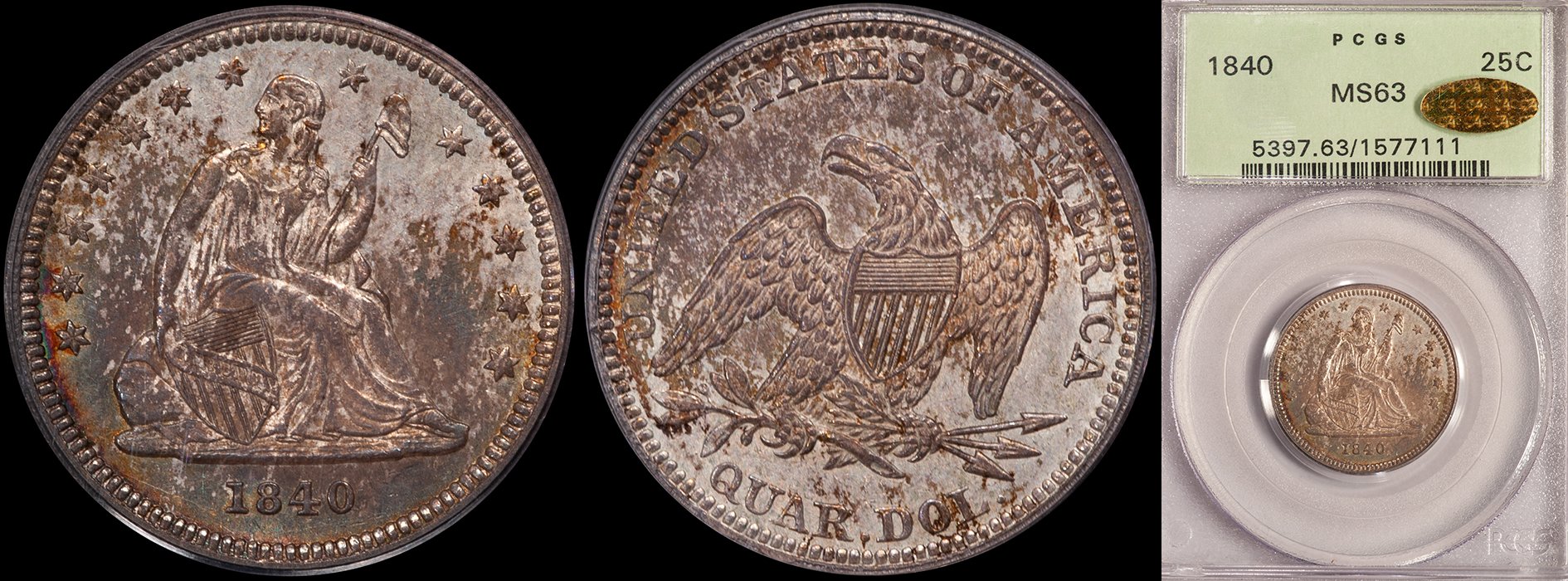
Assembling a "Back-Up" Coin Collection

I’ve recently had a few collectors ask me a similar question; one that has given me some pause to think. Basically, these are people whose main collecting focus is an expensive, very challenging series. Due to lack of availability (of funds), their purchases may be very infrequent. But they still love coins and the thrill of the hunt. What, they’ve asked me, can they play with as their “back-up” set? The parameters that they’ve given me for this back-up set have been pretty consistent. They want a group of coins that are fun to collect, reasonably affordable, interesting but not wildly esoteric and different enough that they won’t compete against their primary set(s). Most importantly, they don’t want their back-up set to grow so expensive that it depletes funds from their primary set.

My answer(s) has typically been based on the needs and wants of the collector. I’d like to share a few suggestions that I have given focusing on the ideas that appear to have been popular as opposed to ideas of mine that have gone over like the proverbial lead balloon.

1. Dahlonega half eagles in EF and lower AU grades. With the exception of two dates (the 1842-D Large Date and the 1861-D), the Dahlonega half eagle set does not include any major rarities or extremely expensive coins. Every issue can be purchased in the EF-AU range for $5,000 or less and there are no “stoppers” that will prove frustrating for the collector. The series is reasonably short (just 26 coins) and the coins themselves are highly collectible. One of the best things about this series is that if a collector gets tired of these coins after buying just a few, he will have little downside risk. I’d say the key to collecting a set of Dahlonega half eagles is to be patient and to wait for choice, original coins.

2. No Motto Philadelphia Eagles. This is a set that the collector might not want to actually form a date set but it is a great area to dabble in. There are lots of very interesting coins that are priced in the $1,000-3,000 and what’s important to remember is that, generically, just about any still-round ten dollar gold piece from this era is worth in the area of $700. If you become seriously interested in this series, you can pursue the rarities which include the 1844, 1858, 1863 and 1865. If you’d rather just dabble, buy coins like the nice AU50 1857 eagle I just sold off my website for less than $2,000 (it was a great value, in my opinion).

3. A date set of gold dollars. I might be stretching on this one but I think a set that one example of every year in which the gold dollar denomination was produced (1849 to 1889) would be pretty interesting. I suggest this as a date set given the relatively high cost of issues such as the 1855-D, 1856-D and 1861-D. In a date set, these can be replaced by inexpensive issues from Philadelphia. A date set of gold dollar could be assembled in Uncirculated grades for a pretty reasonable sum and they only two challenging years would be the 1863 and the 1875. And, yes, I know these coins are small and not necessarily for everyone.

4. Coins with Low Mintage Figures. If you scan through a copy of the Redbook, you’ll be stunned to see how many United States gold coins from the 19th century have original mintage figures of 5,000 or less. You’ll be even more stunned to learn how many of these rare, low mintage issues can be purchased in very presentable grades for less than $5,000. No, you won’t be able to be ultra-low mintage issues in very popular series like Type One or Type Three double eagles. But there are literally dozens of gold dollars, quarter eagles, threes, half eagles and even a few eagles with stupidly low mintages that are highly affordable. And you don’t have to worry about forming a “set”; just buy what you like and look for the issues that seem most undervalued.

5. Related Numismatic Literature. Assembling a collection of books and catalogs related to your primary collection might be a fun adjunct project. Let’s say you collect early gold. Wouldn’t it be interesting to have a library that featured all books about early gold going back to the 19th century (admittedly there are not many...) and all important catalogs that featured early gold collections? Work closely with one of the major numismatic book dealers and have him help you come up with a list of, say, the 100 Greatest Sales of US gold coins.

Instead of waiting months or even years between your “big” purchases, think small(er) and create a secondary set that will keep you busy during the dry spells that all collectors face. It will make you a better collector and it will make you appreciate numismatics as a hobby even more than you already do!

How I Stopped Worrying and Learned to Like the PCGS Genuine Holder

If you've followed my blogs in the past few years you know that I'm a Coin Purtist. I tend to be particularly pure when it comes to "no grade" coins. Loosely defined, a "no grade" is a coin with a problem (or problems) that preclude it from getting into a regular PCGS or NGC holder. This can range from harsh cleaning to scratches to rim damage to a hole.

Until two weeks ago I had never (as in not one single time...ever) had a coin on my website that was not in a regular PCGS, NGC or ANACS holder. But I made an exception to this Winter Rule when I bought an 1864-S half eagle in a PCGS Genuine holder at the recent Los Angeles ANA show.

The coin I bought had clearly been around the block (a few times...) It had been mounted in a soldered bezel and when it was removed it lost detail at the borders. The surfaces had some roughness and the coin had probably been recolored at one time to make it look more original. That said, I still liked this coin alot.

Why? Because it had one thing going for it: extreme rarity. Many people don't know this, but the 1864-S half eagle is the second rarest Liberty Head half eagle after the 1875 and there are as few as 20-30 pieces known in all grades. This is clearly an issue that does not become available very often. To put it in perspective, it is rarer than an 1870-CC double eagle and not much less rare than the celebrated 1854-O and 1856-O double eagles.

But here's the kicker. I sold this 1864-S half eagle for just a touch over $5,000. To me, this seemed like remarkable value. And I wasn't the only person who felt this way. Three collectors ordered the coin within two days of it appearing on my website RareGoldCoins.com.

So am I going to become a regular player in the PCGS Genuine market? I seriously doubt it. But I am going to be more attentive to affordable examples of extremely rare coins like the 1864-S half eagle. Would I buy an 1864 Philadelphia half eagle that was damaged? Absolutely not. But the next time I see a major rarity in the Liberty Head gold series that is fairly priced yet extremely rare, I will give some serious thought to adding it to my inventory.

When Auction Records Don't Tell the Whole Story

I’ve discussed how using previous auction records can be an extremely valuable asset in determining the current value of a coin. But there are instances when previous records can be misleading and they can keep a collector from making an intelligent buying (or selling) decision. When I recently attended the Heritage pre-ANA Platinum Night Sale, I was bidding both for my own account and for a number of clients. One of the coins that a client of mine had a strong interest in was an 1855-D quarter eagle graded AU55 by PCGS. The coin was pedigreed to the North Georgia collection and it had been off the market since its last auction appearance all the way back in January 1999. This could easily be confirmed three ways: it was in an older style PCGS holder, there were no auction records for this specific coin in the last decade and the consignor had been actively buying key date quarter eagles during the 1999-2000 era and it was likely that he had purchased it back then.

The next step for me was to view the coin in person and I travelled to Dallas a few weeks before the sale to look at the lots. I liked the 1855-D quite a bit. It had attractive medium to deep reddish-gold color, a nice planchet and I thought it was a high end example of a date that is seldom found with good eye appeal. I called the client the next day and reported the good news.

We then needed to determine the coin’s value. My first reaction was to go to Heritage’s auction archives and look to see what the last couple of PCGS AU55 examples had brought. Here’s what I discovered:

In February 2009, a PCGS AU55 had sold for $12,650. The only other relevant record for a PCGS AU55 was in June 2007 when an example brought $14,375. Trends for this date in AU55 is $27,500 which I told the client I thought was on the high side but I also mentioned that I thought the prior two auction prices seemed very low.

My next step was to go back to the two Heritage sales that the 1855-D quarter eagles had appeared and read my viewing notes. I first went to the February 2009 catalog. According to my notes, I thought that the 1855-D in that sale was “recolored with a large obverse flaw at 12:00.” Given the fact that I had scratched a large “X” through the photo and wrote “YUCK” next to it, I assumed I wasn’t crazy about the coin. Then, I checked the June 2007 sale. Voila! It was the same coin and my reaction was equally as harsh.

Just for grins, I also checked the Heritage January 2006 catalog where there was another 1855-D quarter eagle in PCGS AU55. This one had sold for $18,975 and, guess what, it was the same coin. So not only had this coin dropped in price from close to $19,000 to just over $12,000 it also meant that the PCGS population of nine coins in this grade was probably inflated as well.

My client was interested in this information but he was even more interested in what I told him next. According to my notes, the North Georgia coin had brought $32,200 all the way back in 1999. Even more interesting was the fact that this coin was graded the same ten years ago, meaning that it hadn’t magically gradeflated from, say, an AU50 to an AU55 as have so many branch mint gold coins.

As I stated earlier, the crux of the issue was what to pay for this coin. Based solely on the auction records cited above, I would have stated in the $13,000-16,000 range. But as I just explained, these records were misleading because they all represented one coin and this specific coin is probably the world’s worst PCGS AU55 1855-D quarter eagle.

In the end, we wound-up purchasing the coin for $23,000. Compared to the $12,650 that the last 1855-D quarter eagle in PCGS AU55 this seems like a high price. But I don’t think it is. What the auction records didn’t explain was that the 1855-D is an extremely rare coin in properly graded AU55, it is essentially unavailable any finer (PCGS has graded just three above AU55) and a high end coin with great eye appeal for the issue and a good pedigree is worth a premium to a serious collector.

My client hasn’t seen this coin yet (I just shipped it yesterday and he should be looking at it about the time I finish this blog) but assuming he likes it as much as I do, the moral of the story is don’t let previous auction prices keep you from making intelligent numismatic decisions. I give this collector alot of credit for being smart enough to figure much of this out on his own without me having to hold his hand through every step of the process. A good collector gets a great coin to add to his impressive collection. Sometimes, things work out for the best...