
1855-C Quarter Eagle NGC MS65 Bass
/The combination of its MS65 grade and Bass pedigree makes this the finest known example of this rare issue. DWN has bought and sold more finest known Charlotte coins than any other dealer.
Learn about buying, selling and collecting rare U.S. gold coins with Douglas Winter Numismatics and read related articles on this blog.
The combination of its MS65 grade and Bass pedigree makes this the finest known example of this rare issue. DWN has bought and sold more finest known Charlotte coins than any other dealer.
Pedigreed to the Eliasberg collection and one of the more exceptional coins that DWN has handled on account of its eye appeal. Needless to say, this is the finest known.
Literally 'as struck' with impeccable surfaces and great eye appeal. DWN handles magnificent Proof type coins from the 19th century and has sold many exceptional examples.
In my last blog, I wrote about a Gem 1855-C half eagle that I was fortunate to recently handle. A number of readers asked me about some of the other Gem half eagles from this mint and I thought it would be interesting to take a look at each of these. There are a total of eight Charlotte half eagles that have been graded MS65 or better by either PCGS or NGC (or by both services in some cases). Many are very famous coins within the Charlotte gold collecting community. A few are not quite as famous and are not given the full "props" that the others have received in the past. Let's take a quick peek at each of the eight Gem Charlotte half eagles.
1842-C Large Date Graded MS65 by NGC, ex Milas/Eliasberg. This coin has a pedigree dating back to 1920 when John Clapp Jr. purchased it from Elmer Sears. It was later in the Eliasberg collection and it brought $17,600 (a comparably high price) when it was sold at auction in 1982. The coin was later owned by Chicago dealer Ed Milas and was offered in the Stack's May 1995 sale of his superb collection of No Motto half eagles. It is now owned by a North Carolina collector and it has been off the market for close to a decade.
1846-C Graded NS65 by NGC, ex Elrod/Eliasberg. This is one of my all-time favorite Charlotte half eagles. It was purchased by John Clapp Sr. out of the David Wilson sale conducted by S.H. Chapman in March 1907. It was later owned by Louis Eliasberg and it brought a reasonable $13,200 in October 1982. The famous specialist Stanley Elrod then owned the coin and I bought it in the late 1980's/early 1990's when the Elrod collection was being dispersed. I then sold the coin to Paul Dingler and bought it back in 2005. It is now owned by a West Coast collector. Funny story: when I was selling this coin to Paul Dingler, I had a hard time convincing him that this coin was as great as I believed. It turned out that Paul was color-blind and the dark, crusty color that this coin exhibited (at the time) was hard for him to appreciate. He did take my word for it and this 1846-C half eagle became a centerpiece of his fantastic collection.
1847-C Graded MS65 by PCGS, ex: Pittman/Farouk. As far as I know, this is one of only two of the Elite Eight that is currently in a PCGS holder. It has a wonderful pedigree that goes back to the Col. Green collection and it was later in the King Farouk and John Pittman sales. I first saw the coin in the Akers 10/97 Pittman Part One auction where it brought $44,000. It was last sold as Heritage 4/02: 6986 where it brought $47,150. I do not know the current location of this impressive Gem.
1849-C Graded MS66 by NGC. This coin was discovered by Avena Numismatics back around 1997 and was first offered for sale as Bowers and Merena 8/98: 330 where it did not meet its reserve. It finally found a home after appearing in the Bowers and Merena 3/04 auction realizing $70,150. It is clearly the finest known 1849-C half eagle. I am not aware of the current location of this coin.
1852-C Graded MS65 by NGC, ex: Silvertowne Hoard. In 1984 or 1985, a group of five remarkable 1852-C half eagles from a family in Southern Indiana was sold to Silvertowne Numismatics. One of the five (I'm not certain which) was later graded MS65 by NGC after having been graded MS64 by PCGS. Interestingly, the second part of this hoard came on the market in December 2007 when a Florida firm offered them for sale. The 1852-C half eagles from this hoard are notable for their superb original color, great luster and high overall level of eye appeal.
1855-C Graded MS65 by NGC, ex: Elrod. Having just written extensively about this coin, I'd prefer not to be reptetitive and suggest you read my blog dated April 8, 2009 for more information.
1857-C Graded MS65 by NGC, ex Elrod. This coin is from the famous Elrod collection and it was first sold at auction in February 1999 as part of the Heritage William Miller auction where it failed to meet its reserve. It reappeared as Heritage 1/03: 4797, in an NGC MS64 holder, where it sold for $33,350. I saw this coin within the last year in a dealer's inventory.
1859-C Graded MS66 by PCGS, ex Milas/Eliasberg. While not widely-known outside of the specialist community, this incredible coin gets my vote for the single finest Charlotte half eagle in existence. It was purchased by John Clapp, Sr. in 1910 from Elmer Sears and was later in the Eliasberg collection. It sold for just $8,800 in October 1982 and this cheap price can be attributed to the relative unsophistication of the branch mint market at that time. After appearing in a number of auctions in the mid-1980's it wound-up in Ed Milas' set of Gem No Motto half eagles where it sold for $104,500. I haven't seen this coin for many years but I remember it being superb and hope that it has retained its superb original color and luster.
It is remarkable to think that only eight Gem Charlotte half eagles exist, considering that close to 900,000 pieces were struck between 1838 and 1861. The collectors who own any of the Elite Eight have coins that, in my opinion, are truly worthy of the overused designation "world-class."
In my February 25, 2009 blog I wrote about (and showed pictures of) the fabulous Bass 1855-C quarter eagle in NGC MS65. I recently handled the Big Brother of this coin, the Elrod 1855-C half eagle also graded MS65 by NGC and I thought I’d share some information and images of this amazing coin. First, a little background. The Elrod 1855-C half eagle has been off the market for close to a decade and has been in the collection of a North Carolina businessman. I can trace the pedigree of this coin back to at least the mid-1970’s when it was obtained by the pioneering collector Stanley Elrod of Matthews, N.C. After trading hands a few times, it was obtained by William Miller, a collector from Michigan. It remained in the Miller collection until it was sold as Lot 6284 in the Heritage February 1999 auction. At this sale, it realized $67,725 which remains a record for the date. The new owner of this coin is an anonymous specialist who is working on one of the finest collections of Charlotte gold ever assembled.

The 1855-C half eagle is the twelfth rarest of twenty-four half eagles struck at the Charlotte mint and it is the eleventh rarest in high grades. I estimate that between 175 and 225 are known with just four or five in Uncirculated. The Elrod coin is, of course, the finest. The other two notable 1855-C half eagles are the Bass/Garrett coin (graded MS63 by PCGS) and the Milas coin (graded MS64 by NGC). Only one die variety is known but there are three die states. The first has a perfect reverse. The second has a light crack joining the base of the letters in FIVE and D. The third, which is rare and distinctive, has a full cud below these letters. The Elrod coin is Die State I.
What makes this coin an unabashed Gem? I personally believe that the two best things about the Elrod 1855-C half eagle is its coloration and its fresh, almost glowing appearance. The coin has amazing rich, frosty luster that is accentuated by sensational medium to deep orange-gold and maize color. The surfaces are almost entirely free of marks with the exception of some mint-made roughness in the planchet which is as struck.
How rare are Charlotte half eagles in Gem Uncirculated? I am aware of eight distinct half eagles from this mint that are regarded within the specialist community as Gems. They are as follows:
1. 1842-C Large Date graded MS65 by NGC
2. 1846-C graded MS65 by NGC (ex: Eliasberg)
3. 1847-C graded MS65 by PCGS (ex: Pittman)
4. 1849-C graded MS66 by NGC
5. 1852-C graded MS65 by NGC
6. 1855-C graded MS65 by NGC (ex: Elrod)
7. 1857-C graded MS65 by NGC (ex: Elrod)
8. 1859-C graded MS66 by PCGS (ex: Milas)
If I had to choose one of the coins above as the single finest known Charlotte half eagle, it would be the Milas 1859-C. But that’s another story that we’ll cover in a future blog. As far as I know the sale of the Elrod 1855-C is the first Gem Charlotte half eagle to occur in a number of years. The other Gem half eagles from this mint are off the market in tightly-held collections and may not be available for quite some time in the future.
Douglas Winter Numismatics (DWN) specializes in choice and rare branch mint gold and handles many finest known and Condition Census pieces from these mints. For more information regarding the Elrod 1855-C half eagle or any other gold coins from the branch mints, please contact Doug Winter at dwn@ont.com.
Since the publication of my book “The Insider’s Guide to Collecting Type 1 Double Eagles” in 2002, this has been one of the strongest and most avidly collected areas in the entire U.S. coin market. I think this is the case for three reasons:
1. Size: New collectors can relate to big, attractive coins and Type One double eagles are exactly the sort of coins that are easy for dealers to sell (and for collectors to buy).
2. Shipwrecks: The discovery of the S.S. Central America and S.S. Republic shipwrecks added a tremendous shot in the arm to this market. Many collectors were first attracted to Type One double eagles by the shipwreck coins but found the series interesting enough that they decided to collect more extensively.
3. Story: There is an incredible amount of history inherent in the Type One series. The 1850-1865 era is pivotal in the story of the United States and this has also attracted many collectors to the Type One series.
I am personally very attracted to the Philadelphia Type One issues. These issues do not get the publicity that the branch mint coins do and, as a result, they remain undervalued. Here is a date-by-date analysis for beginning collectors that, hopefully, will be useful.
1850: This issue is in heavy demand due to its status as a first-year-of-issue. I used to think it was undervalued but now I think it is fully priced, especially in the AU55 to MS62 range. There are as many as 3,000+ known with 50-100 in Uncirculated. There are actually two Gems graded MS65 and another half dozen or so that I grade MS63 to MS64. The current record price was set by Heritage 1/07: 3698, graded MS65 by NGC, which brought a healthy $161,000. Collectors should be patient when looking for an 1850 as there are some very pleasing pieces available.
1851: Over two million were struck but this date is a bit more difficult to locate than most people realize, especially in higher grades. There are an estimated 100-150 known in Uncirculated. I have never seen or heard of a Gem but have known of two or three that grade MS64. Most 1851 double eagles are grainy in appearance with very “choppy” surfaces. However, there are a number of frosty, lightly abraded coins known and the collector would do well to wait for such a piece to appear.
1852: The 1852 is similar in rarity to the 1851 except that it is a bit more available in Uncirculated. Nearly every known example is very heavily abraded and many have inferior grainy luster. Some lightly abraded, frosty pieces are known and I feel that these are desirable and worth a premium. There is a single example in MS65 (graded by NGC) but I have never seen an 1852 that I regarded as a Gem. I have, however, seen at least four or five very nice MS64’s. This date is an excellent choice for novice collectors as it tends to be well-made and affordable.
1853: The 1853 is similar in rarity to the 1851 and 1852 even though it has a lower mintage. I estimate that there are 1750-2250 known but most are in circulated grades and the 1853 is much scarcer in Uncirculated than the 1851 and 1852. I think there are around 30-40 known in Uncirculated and most are in the MS60 to MS62 range. The best I have seen is the NGC MS64 (which I now believe is in an MS65 holder) that was sold in the Superior 5/05 auction for $66,700.
There is also an 1853/2 overdate that is controversial but accepted as such by both PCGS and NGC. It is clearly identifiable by a small raised die dot below the R in LIBERTY. This variety is generally seen in EF and AU grades and from the standpoint of availability it is the rarest Philadelphia double eagle of this type. It is the second rarest in Uncirculated, trailing only the 1859. I am aware of less than a half dozen in Uncirculated and all are in the MS60 to MS62 range.
1854: The 1854 is not a really scarce date in lower grades but it remains scarce and undervalued in AU58 and above. There are an estimated 25-50 in Uncirculated including an MS64 and MS65 at PCGS. The record price for an 1854 is $96,600 which was set by Bowers and Merena 9/08: 831, graded MS64 by NGC. Finding examples with good luster and decent surfaces is very difficult as most are somewhat dull and very heavily abraded.
There are a number of interesting varieties for the year but the most widely collected is the 1854 Large Date. This issue is rare in all grades and it is very rare in Uncirculated. For more information about this variety, refer to the blog I wrote about Type One varieties dated March 30, 2009.
1855: I am a big fan of this date and it is an issue that I have always believed was rarer than its original mintage would suggest. There are around 1,000 known but just 15-20 qualify as Uncirculated. The best I have seen was a PCGS MS63 (later upgraded to MS64) that was ex: ANR 8/06: 1607. It brought $69,000 and was purchased by a well-known Midwestern collector. The 1855 is really hard to find with good eye appeal as most have been cleaned or dipped and exhibit severe abrasions. Pieces that show good luster, original color and minimal marks are very scarce and typically bring strong premiums over the usual “schlock” offered for sale.
1856: This is another sleeper date that I have been writing about for many years. There are an estimated 500-600+ known with most in the VF to EF range. Any 1856 double eagle that grades AU55 or better is very scarce and this date is quite rare in Uncirculated with just 15-25 accounted for. I have only seen one or two that I graded MS63 and another half dozen or so that I thought graded MS62. An auction record was set by Bowers and Merena 1/08: 584, an NGC MS63 example that was bid up to $27,600. Most 1856 double eagles are very heavily scuffed and the vast majority have unoriginal coloration. Finding an example with good eye appeal is quite a challenge and even though price levels have risen quite a bit for the 1856 in the last few years, I think nice pieces are still vastly underpriced.
1857: For many years, the 1857 was regarded as a common date and lumped with the 1851-1853 issues. We now know that this is not true and my best estimate is that only 900-1200+ are known. The 1857 is more available in higher grades than the 1855 and 1856 with as many as 30-50 known. I have seen two that grade MS64 and another two or three in MS63. Many 1857 double eagles show a below average strike and most have poor luster and very heavily bagmarked surfaces. It has become very hard to locate a piece with original color as well. In my opinion, the 1857 remains undervalued, especially in AU55 and higher grades.
1858: With a mintage figure that is less than half that of the 1857, one would expect the 1858 to be a much scarcer date. These two issues are similar in terms of overall rarity but the 1858 is scarcer in high grades. There are just twenty to thirty known in Uncirculated and I have never seen a piece that graded higher than MS63. Eye appeal is a real problem for the 1858 double eagle and the typical example is somewhat softly struck, subdued in appearance and heavily bagmarked. The price of this date in AU and above has risen in the last few years but I feel the 1858 double eagle is still an excellent value as it possible to purchase a very presentable example for less than $5,000.
1859: When my Type One book was published, I stated that the 1859 was the fourth rarest Type One double eagle from the Philadelphia mint. Because of the aforementioned shipwrecks and other hoards, I now think that the 1859 could well be the rarest Type One from this mint. And if it isn’t the rarest, it is certainly the hardest issue to locate with good eye appeal in higher grades. Virtually every 1859 double eagle I have seen is very heavily abraded and these marks are often in prime focal points such as the left obverse field or on the face of Liberty. While the strike tends to be good, the level of eye appeal is nearly always well below average. I believe that there are around 200-250 known including five to seven in Uncirculated. I have only seen one in MS62 and another three in MS61.
1860: The 1860 is a date that is actually a bit more available than one might expect considering its mintage of 577,670. There are an estimated 2,000 known including as many as 100 in Uncirculated. PCGS has graded one in MS65 and NGC graded the finest of the S.S. Republic coins MS65 as well. This is generally a well-produced year and there are still some examples around that have nice color and good luster. The 1860 tends to come with fewer bagmarks than some of the issues from the mid-to-late 1850’s and the collector should be able to find a pleasing piece if he is patient.
1861: Until the discovery of the S.S. Central America treasure, the 1861 was easily the most common Type One double eagle. Today, it is the second most available after the 1857-S. There are at least 4,000-5,000 known and the actual number could be even higher. This is an easy issue to locate in higher grades with coins in MS61, MS62 and even MS63 sometimes available. As such, it makes a good type coin for the collector who prefers a Type One double eagle that is not from a shipwreck. The finest known is an amazing PCGS MS67 that brought $181,500 all the way back in October 1989 when it was sold at auction. I still regard that coin as the single best business strike regular issue Type One double eagle that I have seen.
1862: For many years, the 1862 was a sleeper date that had attained virtual cult status among the small number of people who collected Type One double eagles. Today, its rarity is better known and its value has increased accordingly. I regard it, along with the 1859, as one of the two hardest Philadelphia issues of this type to find although it is more available in higher grades than its counterpart. This is another date for which eye appeal is a problem. Many 1862 double eagles have very heavily abraded surfaces and the luster is sometimes impaired as a result. There are around a dozen or so known in Uncirculated. This includes a solitary NGC MS64 and a combined four in MS63 between PCGS and NGC. The 1862 remains an extremely challenging issue to locate in all grades and it should prove to be one of the tougher holes to fill in any Type One set.
1863: Until the discovery of a number of higher grade examples in the S.S. Republic treasure, high grade examples of the 1863 were extremely rare. Today there are around three dozen known in Uncirculated including one in MS64 and four in MS63. The eye appeal of this date tends to be significantly better than that seen on the 1862. The 1863 is reasonably well struck and original examples show very nice coloration. Many have been cleaned at one time and I have seen more “no grade” examples of this date than nearly any other Type One double eagle from the Civil War era. The coins from the shipwreck have a very unique (and cosmetically appealing) appearance that makes them easy to distinguish from non-shipwreck coins. They tend to have somewhat grainy luster and lack the extensive marks found on most 1863 double eagles.
1864: There are many more 1864 double eagles known today than back when I produced my Type One book. The majority of the new high grade 1864’s are from the S.S. Republic shipwreck which contained at least seventeen Uncirculated examples. Most were in the MS60 to MS62 range and the 1864 remains extremely rare in MS63 or better. Non-shipwreck examples tend to be a bit scuffy in appearance and have frosty luster. From time to time, original pieces are offered for sale and they tend to show attractive deep green-gold or orange hues. In my opinion, the 1864 remains a scarce and undervalued date that does not receive the attention that the (now) better known 1862 and 1863 are showered with.
1865: Close to three hundred Uncirculated 1865 double eagles were found on the S.S. Republic. Obviously, the rarity profile of this date has changed dramatically in recent years and the 1865 has gone from being very rare in higher grade to reasonably common. Some of the coins from the shipwreck were quite spectacular and the best pieces include one in MS66 and no less than two dozen in MS65.
What exactly is it about the Philadelphia Type One issues that appeals most to me? I would have to say that it is value. Unlike smaller denomination coins from this era, there is enough demand for double eagles that there are not many absurdly undervalued issues. But that said, there are a number of Philadelphia double eagles from the 1850’s that can be obtained in decidedly above average condition (in most cases AU55 to AU58) for well under $5,000. I also like the fact that the Philadelphia issues are completable by the collector of average means (unlike the New Orleans coins of this era which have become the playground of wealthy collectors). If I were going to focus on Type Ones, I would work on a set of nicely-matched AU55 to AU58 coins with choice original color and surfaces.
For more information about Type One double eagles, please feel free to contact me via email at dwn@ont.com.
Why are some coins clearly undervalued? I could answer this question existentially and say “because some have to be.” But the answer to this question is worth a little more exploration. Here are some things to consider about the valuations of coins. First and foremost, many of the areas of the rare coin market are thinly traded. In some cases, published prices for coins are speculative due to no examples having ever traded or they represent older price levels that have not been updated in many years. There are times when I am trying to figure what to bid for a very special rare coin at auction and I’m not sure I can scientifically pinpoint the exact price level. This can even be the case with coins that aren’t all that special but which haven’t traded in a long enough period of time to make their current value baffling.
Coin values are predicated by a supply and demand ratio. I have used this scenario enough times that it is now a semi-cliché but consider the following. If there are ten examples known of a certain coin but only three people care, it has an oversupply and its value is probably not very high despite its rarity. But if the same coin has thirty avid collectors than it will probably have a strong level of value.
This supply vs. demand situation is why some truly rare coins remain undervalued. As an example, look at a coin like the 1867 quarter eagle. Only 3,200 were struck and the most recent PCGS population figures show that just twenty-four have been graded. Despite this fact, the current value in AU55 is a whopping $1,500 or so. Shouldn’t this be a $3,000 or even a $5,000 coin? In theory, yes it should. But practical experience dictates that the level of demand for 1867 quarter eagles, which is virtually non-existent, keeps the price low. Advocates of the 1867 quarter eagle will counter with the argument “well, if this were an Indian quarter eagle with a population of twenty-four in all grades, it would be worth 10x in AU55.” In theory, this argument has merit. My counter-argument would be that the Indian Quarter Eagle series is many times more popular with collectors and that this is essentially an apples to oranges comparison.
The coin market is clearly becoming more and more researched-based as time goes by but I think the entire pricing system we have is antiquated. Let’s get back to the point I made in the second paragraph, about the market having thinly traded areas. These infrequently traded series are often compounded by a lack of good pricing information. I am always impressed by collector-dominated series like early Large Cents or Bust half dollars that have databases of pricing information available to collectors. The rare gold coin market doesn’t have this (yet) and I think it would be a real shot in the arm if someone were able to produce a price guide that helped dealers and collectors accurately determine values.
What I’d like to see even more is for an appearance-specific price guide to exist for these coins. Collectors of early Large Cents classify coins by three categories: choice, average and “scudzy.” Let’s say collectors are offered a certain die variety of 1796 Large Cent. A choice coin may be worth $5,000, an average coin $3,500 and a very low-end coin might only be worth $2,000. I’m not certain that these variations would be as extreme for, say, an 1854-C quarter eagle in slabbed AU55 but I do personally think a nice coin for the grade is already worth considerably more than an ugly one.
Getting back to my original point: why are certain coins undervalued? As I stated earlier, the major reason for this is that they are just not that popular. Another reason--one that is harder to give an explanation to--is that in any long series, it is inevitable that a percentage of the coins are “sleepers.” I previously mentioned that the lack of accurate pricing information in the market means that it is always going to be inevitable that a number of coins fall through the cracks. The value of being a specialist is that you will learn what coins are the sleepers before they become more widely known.
After I left what was, for me, a very productive Baltimore coin show, I was sitting in a restaurant at BWI airport, eating a crab cake. As I was finishing up, a dealer who I don’t know that well but who I respect for his knowledge and his connections came up and asked if he could join me before our respective flights left. As you can no doubt guess, our conversation almost immediately turned to the market. As this dealer was quick to point out, as far as gold coins go, we are currently in one of the more confusing market segments that either of us could remember. He made a comment that I thought was really profound. He said something along the lines of “the market is so strange right now, that if I had a fresh deal of Saints or $20 Libs it would probably get other dealers more excited than if I had a group of fresh Proof gold coins.”
At first, I thought this comment was sort of odd. But the more I thought about, the more it made sense. The market is so oriented right now towards generics and “stuff” that many dealers have all but overlooked rare coins. And I think this presents a few really interesting opportunities for buyers who have some extra cash.
Generic gold is on fire for a number of reasons. The “guns and gold” crowd is buying gold because they have a fundamental distrust of the dollar and don’t like the direction that the U.S. economy is headed. Investors are buying American Eagles and other issues to put into their IRA’s in the hope that this year’s contribution outperforms last year’s stock purchase. And large-scale telemarketers are selling the heck out of double eagles to new buyers who have left more traditional investments and like the idea of owning some physical gold.
As is always the case when an area of the coin market gets hot, other areas are forgotten. When you go to a coin show now, it is very interesting to observe what some of the very savvy major buyers are doing. I know of at least two very smart, A-level dealers who have virtually stopped buying anything numismatic and are focusing almost exclusively on ten dollar and twenty dollar gold pieces. As I mentioned above, I think this has created some great opportunities for more numismatically-oriented dealers like me and for serious collectors.
One opportunity for rare coin buyers right now is for PQ coins. With so many traditional buyers of PQ rare gold coins focused on generics I have noticed that many really nice coins are bringing almost no premium over many really schlocky coins. This is especially the case with Charlotte and Dahlonega gold. At the Baltimore show I was able to purchase a few exceptional PQ coins for literally no more than a 5% premium over the usual crappy dipped-n-stripped stuff that I saw all over the bourse floor and in the auctions.
Another opportunity right now for a more select group of buyers is expensive coins. Most dealers (myself included...) are having a hard time selling coins priced at $10,000 and up. If you follow my website you will probably note that while, as recently as last year, I might have had ten or even twenty coins priced at $10,000 or more, right now I have very few.
If you have the money and you are a collector of five and six figure coins, I think you call the shots. Unlike in 2006 or 2007 when dealers had an easy time selling big coins, dealers are far more aware today of the difficulty inherent in selling these coins. My guess is that if your favorite dealer has a $15,000 coin in stock that you’ve had your eye on since December he’s probably more willing to sell it for $13,000 now than he was a few months ago. (And if he’s not, this is a good sign that your favorite dealer may be doing something else besides selling coins in the near future).
As I mentioned before “real coins” are currently out-of-favor with many dealers and some collectors as well. What does this mean for the serious collector? It may not translate to saving money on the coins you want (although it is likely that this is true). More likely, it means that you will actually get a chance to buy some of those hard-to-find issues that might have been causing you grief in years past. Let me give you an example. At the Baltimore show, I was able to get second shot at a group of interesting double eagles. The dealer who got first shot would have ordinarily bought every coin as they were interesting, not unreasonably priced and pretty choice. Instead, he passed on about half the coins and I bought everything that was left over. Why did he pass? My guess is that some of the coins were above the price level that he is currently selling well and that much of his focus is on generics as opposed to rare coins.
There is one other opportunity for collectors right now that I think deserves a quick discussion and that is selling some of the generics that everyone seems so focused on right now. If you bought Saints or Libs more than a year ago you are probably in a good profit position right now. Let’s say you have a bunch of MS65 Saints that your average cost is $1,200 and you can sell them today for around $2,000. It seems like a smart move to me to sell your position at an $800 per coin profit (not a shabby rate of return for a one-year investment during an economic meltdown...) and use the profits to buy a rare coin or two that you have your eye on.
In my opinion, Type One double eagles have become popular enough with collectors that it is time for some of the more interesting varieties in this series to come into their own. I am beginning to notice that these varieties are growing in popularity and that prices are beginning to appreciate as well. What are the most significant varieties in the series, how rare are they and what sort of price premium do they merit? 1852/1852 Double Date: This variety is one of the most obvious double dates that I have seen on a United States gold coin. It can easily be detected with the naked eye due to the heaviness of the date. The original date was punched slightly too high and then corrected with a second full punch placed slightly below.
In the last three years I have looked at over one hundred 1852 double eagles and fewer than ten have been of this variety. Nearly all have been in lower grades (EF45 and below) and I do not believe that I have ever seen an 1852 double date double eagle in Uncirculated.
This variety is recognized by NGC but it is not currently recognized by PCGS. I think it should sell for a 25-50% premium over a normal date 1852 and the premium in AU55 and higher grades should be even more than this.
1854 Large Date: This variety uses a date logotype from the silver dollar. The same anomaly occurs on 1854-O eagles. The 1854 Large Date is easy to recognize as the date is significantly larger than on the Small Date. I have spoken with collectors who have been confused by these varieties and I think it might be a bit easier to think of the Small Date as a Medium Date. In addition, remember that on the Large Date the 1 in the date in the date nearly touches the truncation; on the Small Date it is distant.
This variety has become widely accepted with collectors in the last five years and it is recognized by both PCGS and NGC. Prices have risen considerably and a nice AU now sells for close to $10,000 when available. The finest that I am aware of was the NGC MS64 sold by Heritage as Lot 2010 in their 2007 ANA auction. It brought an impressive $80,500.
It is still possible to cherrypick this variety despite its relative popularity. I have seen at least five or six in older NGC or PCGS holders without designations.
1858-O Blundered Die: This is probably the least well known of the varieties listed in this article but it is among the more visually impressive. Under magnification it is possible to see another 8 protruding from the bottom of the left part of the lowest curl into the field below. One of the reasons that people do not know about this variety is that it was not well-described by Breen when he mentioned it on page 565 in his Encyclopedia. Another reason is that yours truly has not done a good job publicizing this variety in his New Orleans books and his Type One book.
To view a nice blow-up image of the 1858-O Blundered Die double eagle, I suggest going onto Heritage’s website and looking at the close-up that provided for the example they sold as 12/08: 2256.
There are probably fewer than ten 1858-O Blundered Die double eagles known and the Heritage cataloger was able to account for just four. The finest appears to be Heritage 12/04: 6843, graded MS61 by NGC.
This variety is very high on the coolness scale of Type One double eagle varieties but the rarity and current high price of the 1858-O make it the least likely of the varieties that I’ve mentioned so far to begin to sell for a premium. It is not currently designated by either PCGS or NGC.
1859-S Double LIBERTY. This variety has been known for at least a few decades but it remains reasonably unheralded. It is among my favorite Type One varieties and it is very easy to see with light magnification. The final five letters in the word LIBERY show pronounced doubling.
NGC designates this variety while PCGS does not. The current NGC population includes five coins (the finest of which grades MS60) and another six from the S.S. Republic.
I have personally looked at close to two hundred 1859-S double eagles and I’ve seen around five or six with the double LIBERTY. I think this variety is very impressive visually and it should command a significant premium in all grades. I would suggest around 50% in EF40 to AU55 grades and as much as a 100% premium in AU58. It is hard to figure what this coin is worth in Uncirculated given its rarity.
San Francisco Mintmark Variations: The final group of Type One varieties is less likely to catch on with collectors given the fact that these varieties are not as impressive. This could change if either NGC or PCGS were to start designating them but even if this were to happen, I doubt if they will catch fire collectors.
The 1857-S is known with a Medium S mintmark and with a Large S. The latter is much scarcer.
The 1863-S is known with a Medium S mintmark and a Small mintmark.
It is possible that other mintmark varieties will be discovered as time progresses.
As I’ve mentioned in other blogs, collecting gold coins by variety remains a reasonably obscure area of focus for most numismatists. But I could really see some of these Type One varieties becoming readily accepted in the coming years (as the 1854 Large Date already has) and their values rising accordingly.
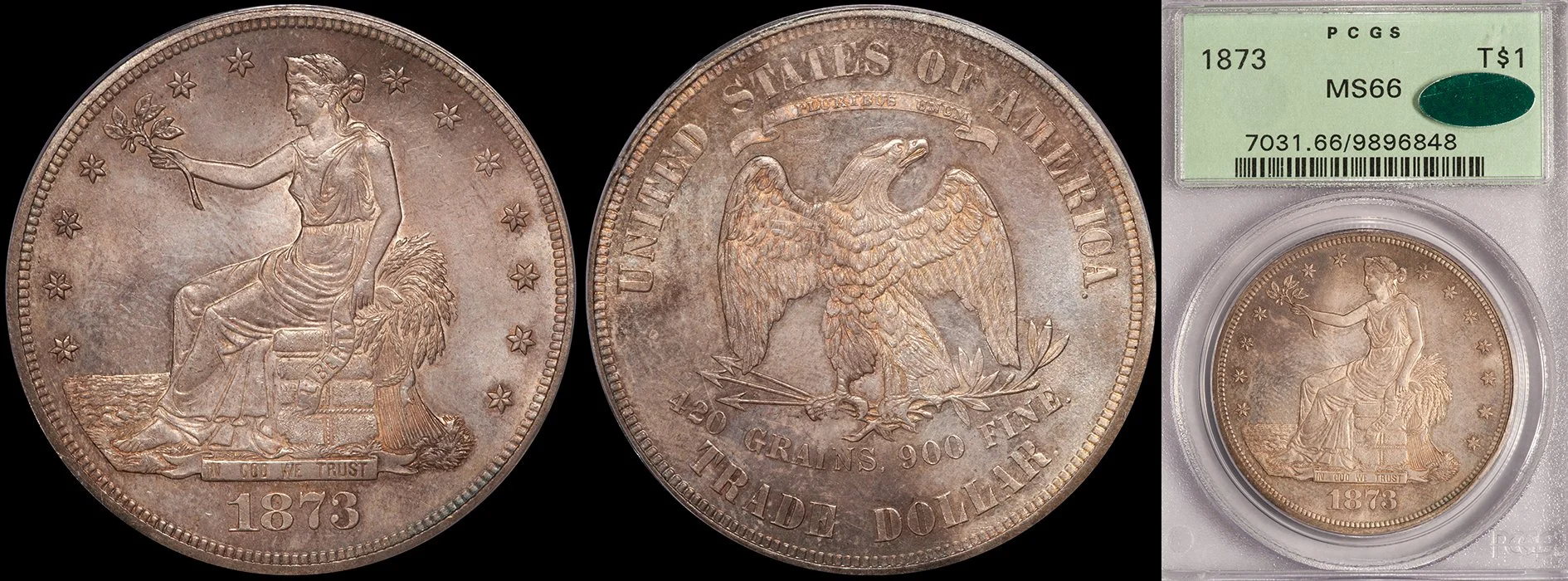
Date…….1873 T$1
Grade…….PCGS MS66 CAC
PCGS Price Guide.…….……70000
CDN Greysheet/CPG.…..…55000
Population (PCGS).……….…5/1
Population (NGC)….…………1/0
Population (CAC).….....….…..1/1
Serial Number……7031.66/9896848
PCGS Lookup Number.……….7031
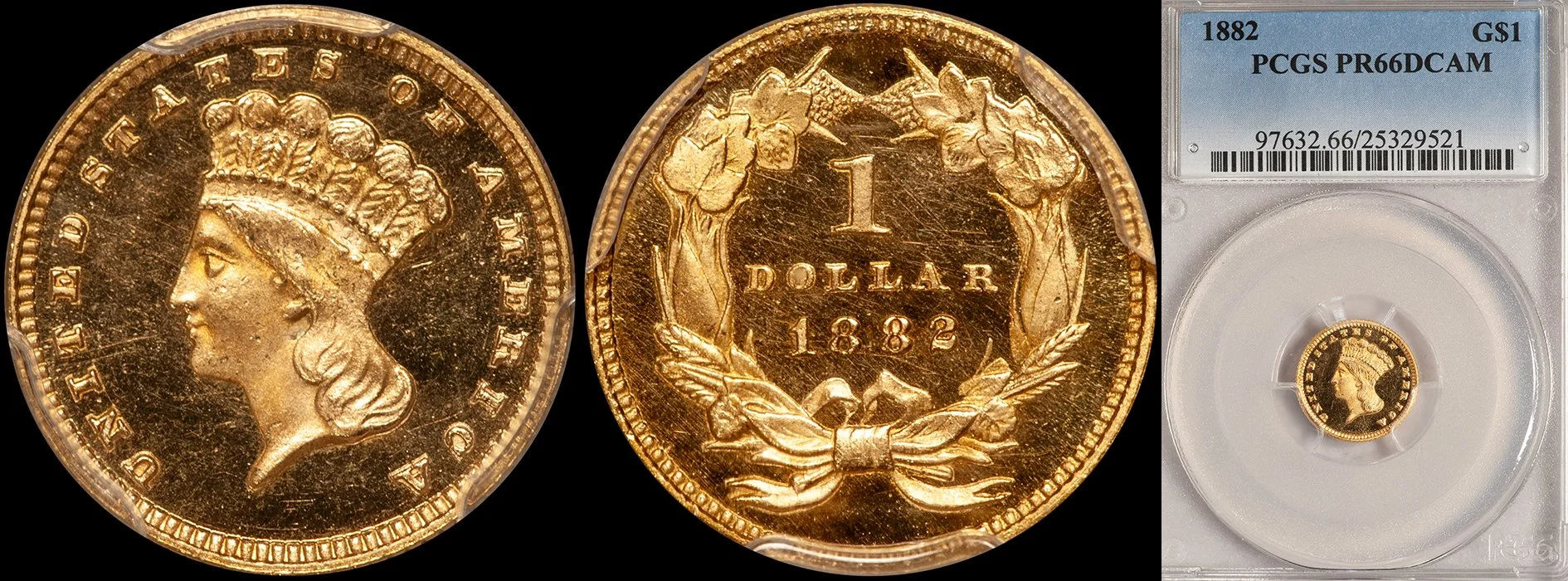
Date…….1882
Grade.…….PCGS PR66DCAM
PCGS Price Guide..……..…20500
Population (PCGS).…………4/1
Population (NGC).…….…….4/0
Serial Number……97632.66/25329521
PCGS Lookup Number.….97632
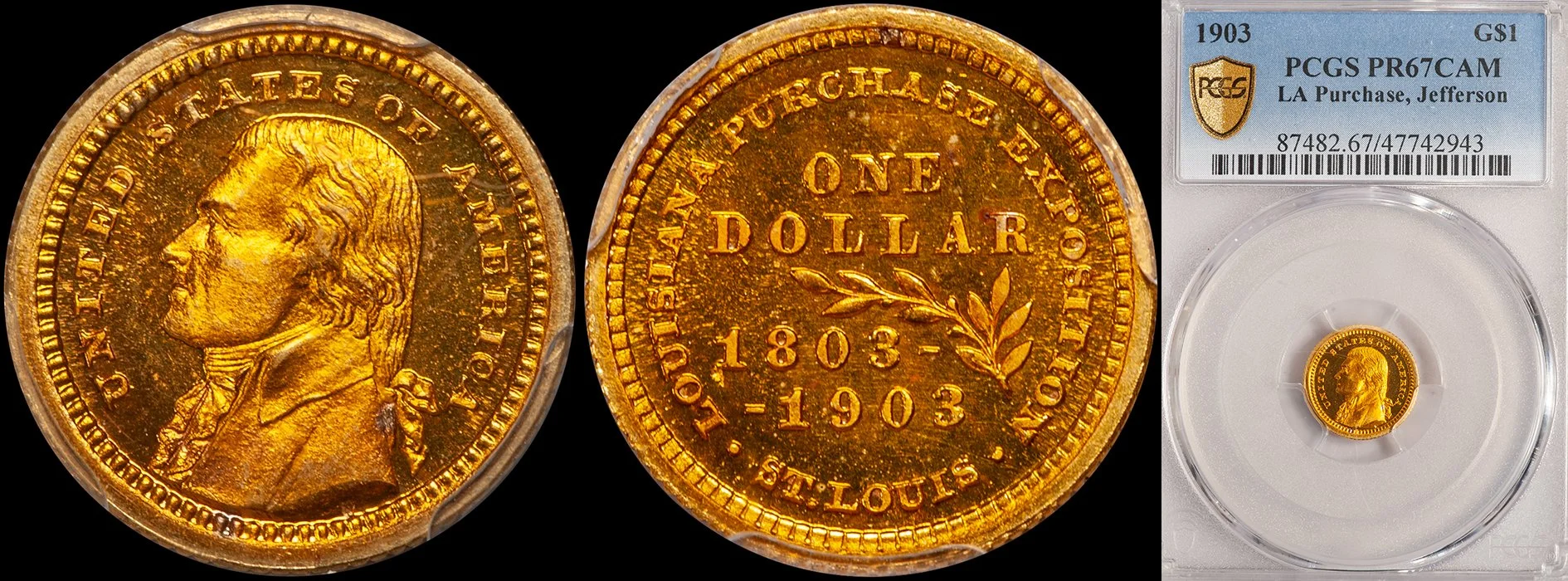
Date…….1903 LA Purchase, Jefferson
Grade…….PCGS PR67CAM
PCGS Price Guide.…….……42500
Population (PCGS).……….…2/0
Population (NGC)…..…..……0/1
Serial Number……87482.67/47742943
PCGS Lookup Number.…….87482
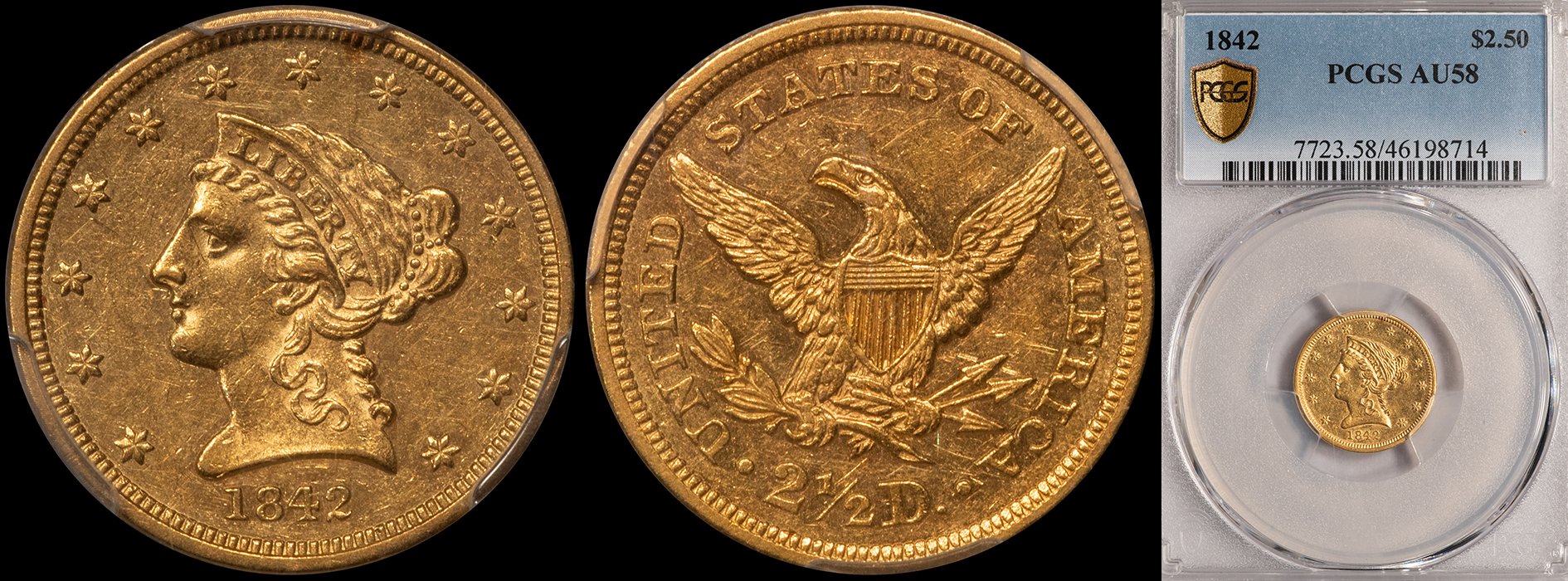
Date…….1842
Grade…….PCGS AU58
PCGS Price Guide.…….……25000
Population (PCGS).……….….…3/3
Population (NGC).……...…….…4/1
Serial Number……7723.58/46198714
PCGS Lookup Number.…….7723
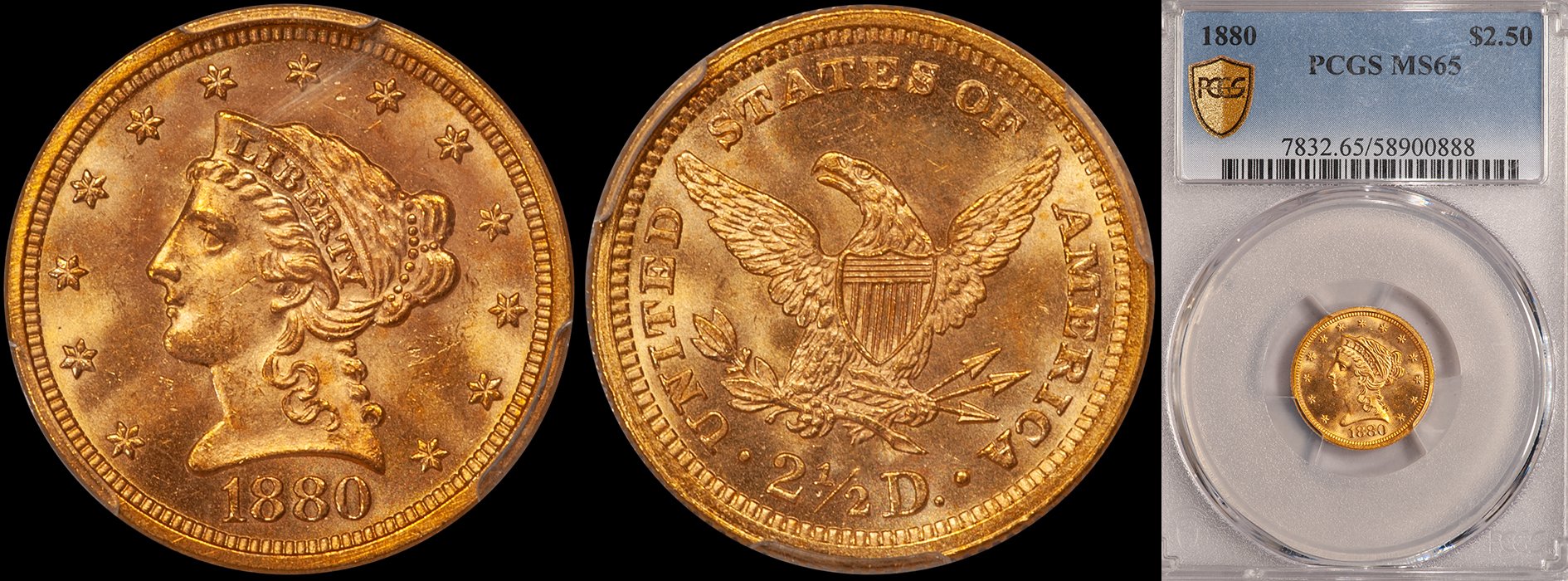
Date…….1880
Grade…….PCGS MS65
PCGS Price Guide.…….……23500
Population (PCGS).………….…7/1
Population (NGC)….……..……3/1
Serial Number……7832.65/58900888
PCGS Lookup Number…….7832
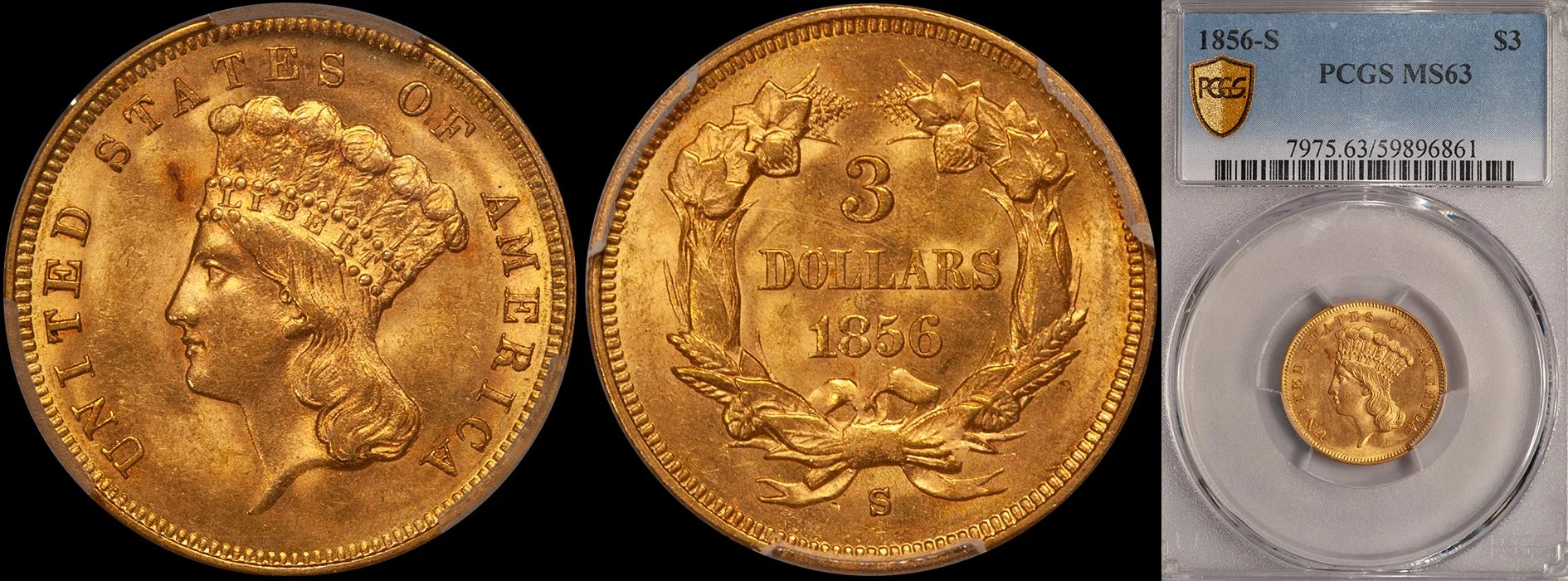
Date…….1856-S
Grade……PCGS MS63
PCGS Price Guide.….….……70000
Population (PCGS)……………5/3
Population (NGC)….….………7/1
Serial Number……….7975.63/59896861
PCGS Lookup Number…….7975
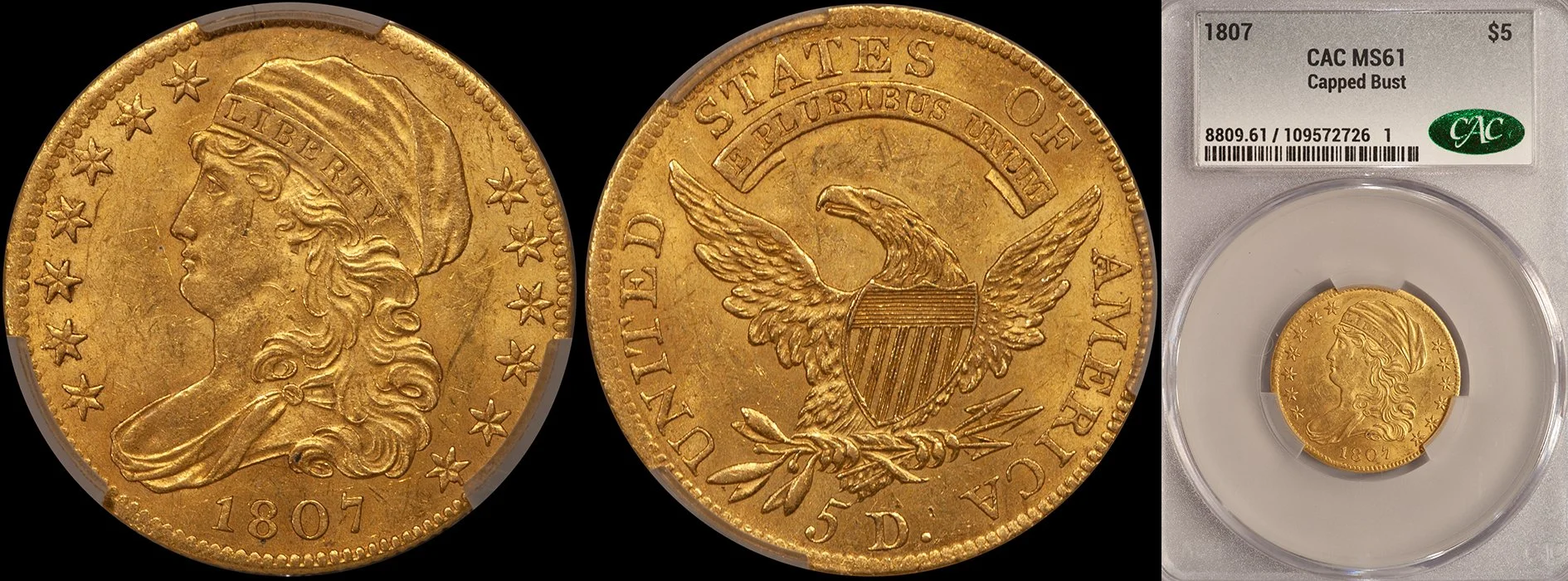
Date…….1807 Capped Bust Left
Grade…….CACG MS61
PCGS Price Guide.…….…..…18500
CDN Greysheet/CPG.…….…17500
Population (PCGS).……….…26/138
Population (NGC)….…..………39/91
Population (CAC).…..……….….8/28
Serial Number……8809.61/109572726 1
PCGS Lookup Number.……….8101
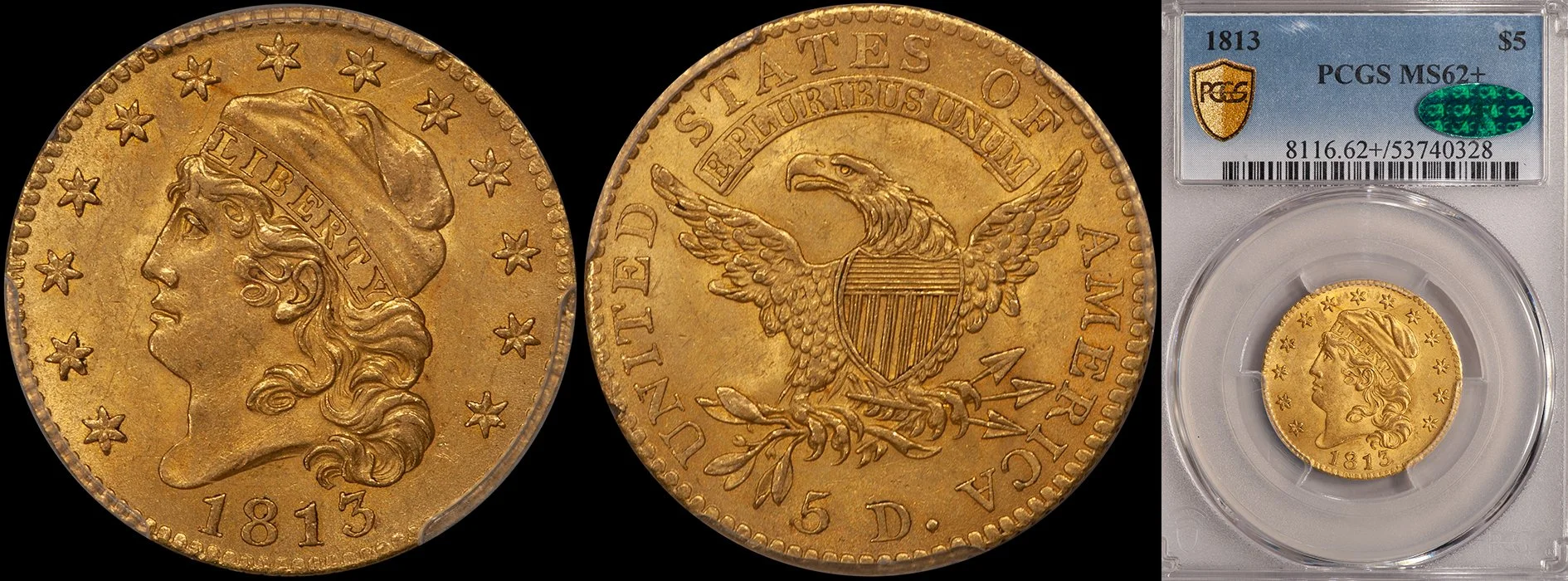
Date…….1813
Grade…….PCGS MS62+ CAC
PCGS Price Guide.……………32500 (in +)
CDN Greysheet/CPG.…….…26000
Population (PCGS)..….…….…59/124 (3 in +)
Population (NGC)..……….……62/62 (3 in +)
Population (CAC)….….....….….16/38
Serial Number……8113.62+/53740328
PCGS Lookup Number………..8113
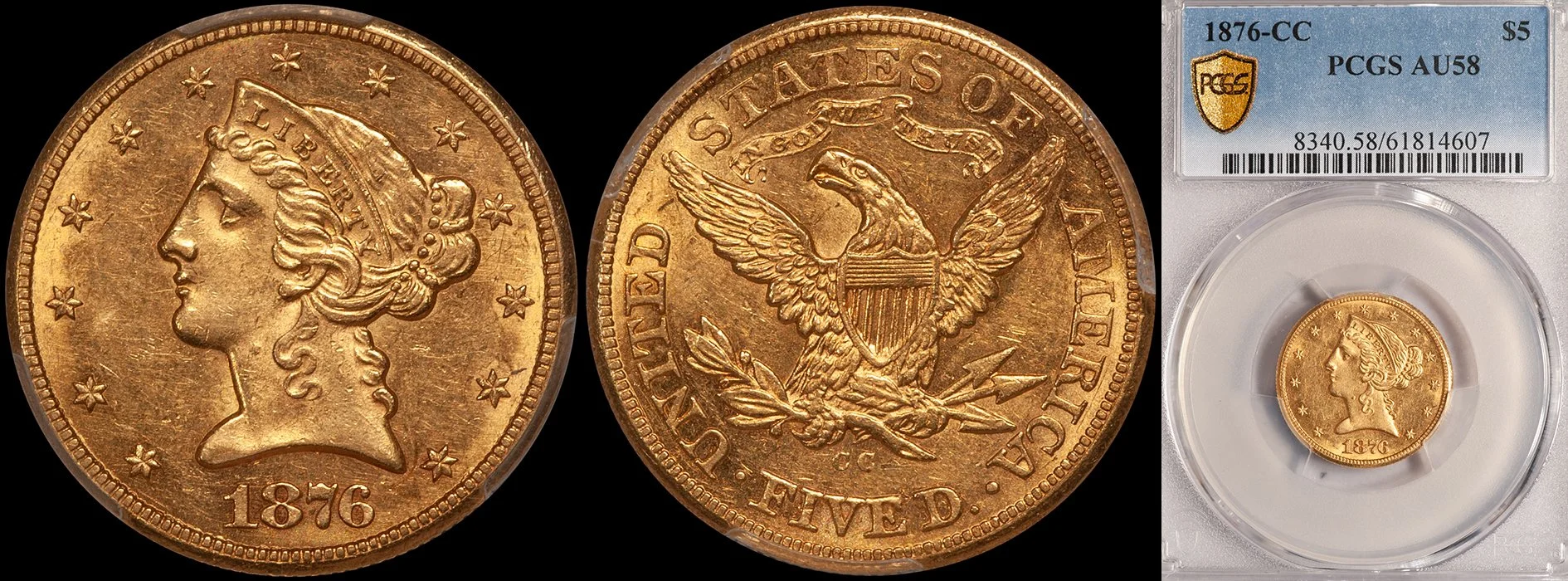
Date…….1876-CC
Grade……PCGS AU58
PCGS Price Guide.….….……85000
Population (PCGS)……………9/2
Population (NGC)….….………10/3
Serial Number……….8340.58/61814607
PCGS Lookup Number…….8340
PO Box 4383 Portland, OR 97208 | 214.675.9897
DWN collects all applicable sales taxes from HI, KY, ME, MN, MS, NV, NJ, NM, NY, TN, VT, WV, WI, DC.
© Douglas Winter Numismatics 2012-2024 | All Rights Reserved.
Photography by Jenna Van Valen.
Site design by Sarah Moon.
Date…….1849-O
Grade…….PCGS MS63 CAC
PCGS Price Guide.…….……35000
CDN Greysheet/CPG.…..…37500
Population (PCGS).……….….3/0
Population (NGC)……...………1/1
Population (CAC).….....….…..2/0
Serial Number……5414.63/61207008
PCGS Lookup Number.……….5414