1879 $5.00 NGC PR64+ CAM

Only 30 Proofs were struck. Given the fact that just eight auction records for Proofs have been noted since 2000, it likely that as few as ten or so are known to exist with only two or three of these being Gems. This superbly toned example has a reddish-orange obverse with some pale ice-blue splashes at the center; the reverse has really neat color with more even rich orange-gold shades framed by a concentric ring of pale blue. There is almost enough contrast to call this coin an Ultra Cameo and a Gem grade is removed solely by the presence of some light lines in the left obverse field; the reverse is superb. The last Gem Proof 1879 half eagle to sell was Goldberg 5/06: 4439 (graded PR65 CAM by PCGS) that sold for $60,375. Rare, important and absolutely beautiful!
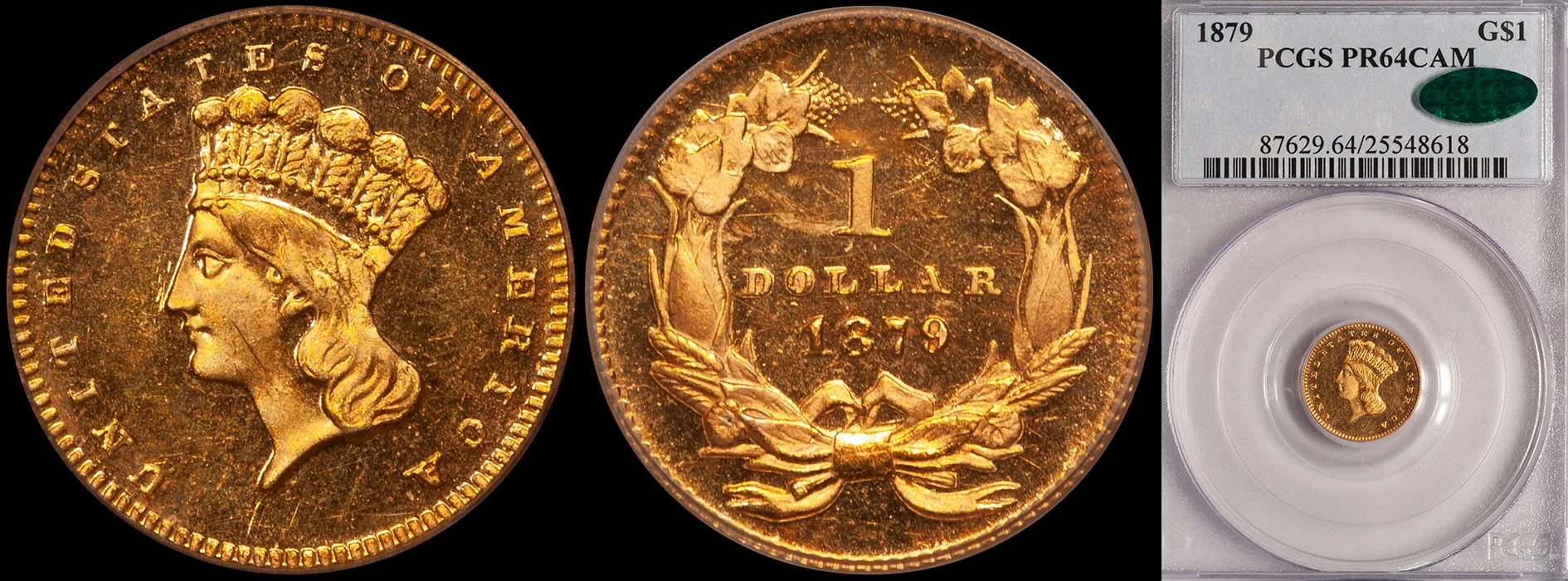
1876 $1.00 NGC PR65 CAM

Only 45 struck. Of these, there are probably no more than twenty or so known with most in the PR64 to PR65 range. This piece is easily recognizable as a Proof on account of its reflective surfaces and a small die line running out to the right from the base of the right foot in the first A in AMERICA. Both the obverse and the reverse show very deep natural toning; the kind that you used to see from time to time on Proof gold before so many coins were dipped in order to gain a Cameo or Deep Cameo designation. The underlying fields appear to be choice with just a few old lines. An attractive example of a rare, historically significant issue.

Ex Heritage 10/11: 4628 where it sold for $16,100

1881 $1.00 NGC PR65+ UCAM

Prior to this year, mintage figures for Proof gold dollars was tiny. Beginning in 1882, production climbed as collecting (and speculating in) Proofs of this denomination became popular. 1881 is sort of a "final year" for low mintages with just 87 pieces struck; it is likely that around half of these are known. What I like about this date is that is sells for just a small premium above the late 1880's dates but it is decidedly scarcer, especially in Gem. This example is as close to being a PR66 as you could imagine and I feel that the only thing that kept NGC from grading it as such is the presence of a few tiny lines in the left obverse field. That said, I have seen inferior coins graded PR66 by both services and I have seen few Proofs of this era with the stunning black and white contrast that this piece displays. Both sides have extremely deep mirrors that display some light natural color that gives them further overall eye appeal. This is the only PR65+ Ultra Cameo of this date currently graded by NGC with only five finer for the date with the UC designation. It is my belief that Gem Proof gold dollars such as this are very good values right now, especially when one considers what larger denomination Proof gold in this grade costs.

1864-S $20.00 PCGS MS62

Before the discovery of a small number of Uncirculated examples in the S.S. Brother Johnathan and S.S. Republic shipwrecks, the 1864-S was nearly impossible to find above AU55 to AU58 grades. It remains rare in MS62 and it is very rare above this with just a small number (four or five) known in MS63. This example is likely from the "Bro Jo" although it is not indicated as such on the holder by PCGS. It has very slightly granular surfaces but they are not dull or "etched" like many of the coins from these wrecks. Both the obverse and the reverse show lovely rich natural orange-gold color with the reverse deeper and more even in hue than the obverse. There are a few light marks in the obverse fields that limit the grade. However, this is one of the cleanest and most dynamic-appearing examples of this date that I can recall having seen. Since February 2006, there have been five auction appearances for the date in PCGS MS62 with the prices realized ranging from a low of $14,950 to a high of $18,975. A PCGS MS63, if available, would certainly be a $30,000+ coin. For most collectors of Type One double eagles or Civil War gold, this 1864-S is "as good as it gets!"

1862 $10.00 NGC MS60

In the "new" coin market of 2012, Liberty Head eagles have become among the most popular series with rarity-loving collectors. And formerly overlooked dates like the 1862 have grown greatly in stature. The 1862 eagle is scarce in any grade with probably less than 100 known from the original mintage of 10,960. When available, it tends to come in the EF40 to AU50 range and it is extremely scarce in AU55 to AU58. In Uncirculated, this date is a major rarity with just three known to me: the present example, a second NGC MS60 (ex Heritage 2003 ANA: 10437) and an NGC MS63 from the S.S. Republic that is off the market in the finest collection of Liberty Head eagles. The example I offer here is nearly fully lustrous and unquestionably free of wear with rich rose and yellow-gold color. As is befitting an MS60 Civil War gold coin, this piece does have some dense marks but these are mostly confined to the fields and they are shallow and well-dispersed. This is an extremely important coin for the collector of Liberty Head eagles or rare, high grade Civil War coinage and it represents what may be the only chance you have in many, many years to obtain an Uncirculated example of an 1862 eagle.

1862 $20.00 NGC AU58

The 1862 is the "king" of the Civil War double eagles and along with the 1859, it is the rarest double eagle from this mint until the Big Five ultra-low mintage issues from the 1880's and early 1890's. Not only does the 1862 have the loweast mintage figure of any business strike from this era (not including the Paquet issues, of course) but it has a decidedly low rate of survival with just north of 100-150 pieces known from the mintage of just south of 100,000. The 1862 is very scarce in the higher AU grades and very rare in Uncirculated. Prices have risen appreciably for this issue over the years but given the level of demand for it, they are not out of whack. The present example is a lovely slider with the body and appearance of a fully "new" coin but just a few too many small ticks on the surfaces to grade MS60. Unlike most 1862 double eagles, this piece has nice color with flashes of rose and light orange-gold seen atop very frosty surfaces. The strike is sharp and the overall appearance is very high end for the date and grade. There have been three auction records for this date since April 2011 in AU58 and the results have been remarkably consistent: $23,000, $23,000 and $25,300. The level of demand for this issue remains consistent as well and there are numerous Type One double easgle collector and Civil War gold specialists who covet the 1862 double eagle

1881-CC $10.00 NGC MS61

Every Carson City eagle struck prior to 1890-CC is difficult to find in Uncirculated but the 1881-CC is the only issue that is sometimes seen in Uncirculated, albeit in grades from MS60 to MS62. This fresh-from-Europe example has superb deep natural color with even medium reddish-orange hues on the obverse; the reverse is similar but deeper with some natural grease stains around MERI in AMERICA. The underlying luster is frosty in texture with only a few scuffs in the upper left obverse field keeping this piece from strong consideration at the MS62 level. Only four examples have appeared at auction in this grade in the last four years and I have only handled a few examples finer than MS61 including the Eliasberg MS64 coin that is the single finest known. Of the few dozen 1881-CC eagles known in Uncirculated, few have the eye appeal that this coin and only a handful show this degree of originality. A great coin for the date collector or the type collector looking for a single better date Liberty Head eagle for his set dated prior to 1890.

1839 Head of '38 $10.00 NGC EF45 CAC

After a 34 year hiatus, the ten dollar gold denomination was resurrected in 1838. In the first two years of the new Liberty Head design, the portrait featured the first incarnation of the portrait with the coronet tip close to the outer edge of the sixth star and a noticeably curved edge to the neck of Liberty. This designed changed in the later part of 1839 but not before 25,801 examples of this variety were coined. The 1839 Head of 1838 is only a marginally scarce coin until you gert to the AU55/58 range but it is in constant demand as a type issue. It remains very affordable in the lower to middle grades and this Choice EF example, with a CAC sticker, has pleasing deep, even green-gold color with some contrasting reddish hues at the reverse periphery. This is exactly what an EF45 should look like with minimal luster but good details and very choice surfaces without a single detracting mark of note. In the recent Stack's Bowers sale, a more lustrous but less original example graded AU53 by PCGS brought double the amount of this coin, making the present example a great value for the collector who likes gold coins from the highly interesting era (1834-1846) that saw so much experimentation with types and designs of U.S. issues.